
ISO 27001 Certification in Barcelona
ISO 27001 certification is a formal third-party attestation that an organization’s Information Security Management System conforms to the requirements of ISO/IEC 27001:2022. It is issued by an independent certification body following a structured audit program that evaluates ISMS documentation, control design, and operating effectiveness. CertPro is a Licensed CPA Firm operating as an independent certification body, providing ISO 27001 Certification in Barcelona for organizations across technology, fintech, cloud, and digital media sectors.
OUR CLIENTS










ISO 27001 Certification for Barcelona-Based Financial and Technology Organizations
Barcelona stands as one of Southern Europe’s leading technology and innovation centers, anchoring a dense ecosystem of SaaS providers, mobile and telecommunications firms, e-commerce platforms, digital media companies, cloud service providers, and technology startups and scale-ups. Organizations within this ecosystem regularly handle sensitive customer data, intellectual property, and regulated information assets — creating structured demand for independent ISO 27001 Certification in Barcelona.
CertPro operates as a Licensed CPA Firm and independent certification body, conducting ISO 27001 certification audits for Barcelona-based organizations against the requirements of ISO/IEC 27001:2022. The certification process involves an objective evaluation of the organization’s Information Security Management System (ISMS) — covering documentation, control design, risk treatment framework, and operating effectiveness — without any involvement in designing, implementing, or remediating those controls.
This structural independence is foundational to the certification’s credibility in enterprise procurement processes, financial sector vendor reviews, and international client due diligence.
Barcelona’s Technology Ecosystem and Information Security Demand
Barcelona consistently ranks among Europe’s most active technology hubs. Its startup and scale-up ecosystem has grown substantially over the past decade, with a concentration of mobile technology firms, SaaS platforms, digital health companies, and e-commerce operators placing it among the continent’s premier centers for digital business.
Many of these organizations operate under contractual obligations requiring independently verified information security controls. ISO 27001 Certification in Barcelona provides the structured third-party attestation that enterprise clients, regulated financial institutions, and international procurement teams require before onboarding technology vendors.
For cloud service providers and managed service providers operating from Barcelona, ISO 27001 certification demonstrates that their Information Security Management System has been evaluated against an internationally recognized standard — satisfying security questionnaire requirements and enterprise security review processes without the need for repeated bilateral assessments.
CertPro as an Independent Certification Body
CertPro operates exclusively as an independent certification body, conducting ISO 27001 audits without any involvement in designing, constructing, or remediating the Information Security Management System under evaluation. This structural independence distinguishes certification from consulting and is required by ISO/IEC 17021-1, the international standard governing management system certification bodies.
The certification body’s role is to evaluate evidence, identify nonconformities, and issue an objective certification decision — not to develop controls or prepare documentation. For Barcelona-based organizations engaging with international clients, financial institutions, or regulated industries, this independence is precisely what makes ISO 27001 Certification in Barcelona credible.
A certificate issued by a Licensed CPA Firm operating as an independent certification body carries evidential weight in vendor due diligence, procurement, and regulatory review contexts that self-assessment or consulting-led frameworks simply cannot replicate.
ISO/IEC 27001:2022 and the Barcelona Regulatory Environment
ISO/IEC 27001:2022 is the current version of the international standard for Information Security Management Systems, replacing the 2013 edition with a restructured Annex A that consolidates controls into four domains: Organizational, People, Physical, and Technological. The 2022 revision reduced the total number of controls from 114 to 93 while introducing 11 new controls addressing threat intelligence, cloud security, and data masking.
Organizations operating under the 2013 version must transition to ISO/IEC 27001:2022 by October 31, 2025, as established by accreditation bodies. For Barcelona-based organizations, the 2022 standard aligns well with obligations arising under the EU General Data Protection Regulation (GDPR), the NIS2 Directive, and sector-specific frameworks applicable to financial technology and cloud service providers.
ISO 27001 compliance, as verified through independent ISO 27001 certification audit, provides a documented control framework that maps directly to these regulatory requirements — making it a practical and recognized tool for demonstrating regulatory alignment.

What Is ISO 27001 Certification?
ISO 27001 certification is a formal third-party attestation confirming that an organization’s Information Security Management System conforms to the requirements specified in ISO/IEC 27001:2022. The certification is issued by an independent certification body following a structured audit program that evaluates the ISMS across documentation, risk management processes, control design, and operating effectiveness.
ISO 27001 certification is not a self-declaration. It requires an independent examination of evidence by qualified auditors who assess whether the ISMS meets each clause of the standard. The certification is recognized internationally across procurement frameworks, financial sector vendor assessments, and regulatory compliance programs.
The resulting ISO 27001 attestation confirms that the certified organization has established, implemented, maintained, and continually improved an ISMS in accordance with the standard’s requirements — providing a portable, independently verified credential that carries weight across client and regulatory contexts.
Structure of ISO/IEC 27001:2022
ISO/IEC 27001:2022 is organized into two primary components: management system clauses (Clauses 4 through 10) and Annex A, which contains 93 information security controls across four domains.
Clauses 4 through 10 define the requirements for establishing and maintaining the ISMS itself — covering organizational context, leadership commitment, planning, support, operations, performance evaluation, and continual improvement. Annex A provides a reference set of controls that organizations select based on their risk assessment outcomes, documenting their selections and exclusions in the Statement of Applicability.
The four Annex A domains are:
- Organizational Controls — 37 controls
- People Controls — 8 controls
- Physical Controls — 14 controls
- Technological Controls — 34 controls
During an ISO 27001 audit, auditors evaluate both the management system clauses and the applicable Annex A controls to determine whether the ISMS meets the standard’s full requirements.
Core ISMS Documentation Requirements
ISO 27001 compliance requires organizations to maintain a defined set of documented information as evidence that the ISMS is operating in accordance with the standard. The four foundational documents evaluated during an ISO 27001 audit are:
- Information Security Policy — establishes the organization’s commitment to information security and sets the direction for the ISMS
- Risk Assessment — identifies and evaluates threats and vulnerabilities to information assets
- Risk Treatment Plan — documents the controls selected to address identified risks
- Statement of Applicability — lists all Annex A controls, indicates which are applicable, and documents justifications for any exclusions
These documents must be maintained, kept current, and made accessible for review during the ISO 27001 examination process. Incomplete or outdated documentation is a common source of nonconformities identified during Stage 1 audits.
| ISMS Document | Purpose | Audit Relevance |
|---|---|---|
| Information Security Policy | Defines organizational commitment and strategic direction for information security | Evaluated for scope alignment and leadership approval |
| Risk Assessment | Identifies and evaluates information security risks and vulnerabilities across the organization | Reviewed for methodology consistency and completeness |
| Risk Treatment Plan | Documents controls selected to address identified risks | Assessed against Annex A control selection and implementation evidence |
| Statement of Applicability | Lists applicable and excluded Annex A controls with documented justifications | Required evidence for all Stage 2 ISO 27001 certification audits |
| Internal Audit Records | Documents results of internal ISMS audits conducted during the certification period | Evaluated for frequency, scope coverage, and follow-up on findings |
ISO 27001 Certification Audit Process for Organizations in Barcelona
The ISO 27001 audit process for Barcelona-based organizations follows a structured, multi-stage program governed by ISO/IEC 17021-1. The process provides an objective, evidence-based evaluation of the Information Security Management System against the requirements of ISO/IEC 27001:2022. Each stage produces defined outputs that form the basis for the independent certification decision.
The audit program is determined during an initial application review, where the scope of the ISMS, the organization’s size and complexity, and the applicable Annex A controls are assessed to define the audit parameters. All ISO 27001 audit engagements in Barcelona follow this same structured methodology, regardless of the organization’s sector or operational scale.
The Stage 1 audit is a documentation review conducted to evaluate whether the organization’s ISMS documentation meets the requirements of ISO/IEC 27001:2022 and whether the organization is prepared for the Stage 2 audit. During Stage 1, auditors review the Information Security Policy, Risk Assessment methodology and results, Risk Treatment Plan, Statement of Applicability, and supporting ISMS documentation including internal audit records and management review outputs.
The Stage 1 audit also evaluates the defined scope of the ISMS — identifying which organizational units, locations, information assets, and processes fall within the certification boundary. Findings are documented in a Stage 1 report, which identifies any areas requiring clarification or remediation before the Stage 2 audit proceeds.
Importantly, the Stage 1 audit does not include substantive testing of control operating effectiveness. That evaluation is reserved for Stage 2.
The Stage 2 audit is the substantive phase of the ISO 27001 certification examination. During this stage, auditors evaluate whether the ISMS controls are implemented as documented and are operating effectively. Auditors assess control design and operating effectiveness across all applicable Annex A domains, testing whether controls address the risks identified in the Risk Assessment and whether the organization’s ISMS processes function as required by Clauses 4 through 10.
Evidence reviewed during Stage 2 includes access control records, incident response logs, vulnerability management reports, asset inventories, training completion records, supplier agreement reviews, and business continuity test results. Nonconformities identified during Stage 2 are classified and documented, and the organization must respond with a corrective action plan before the certification decision is made.
The Stage 2 audit produces the primary evidence base for the ISO 27001 certification decision issued at the conclusion of the program.
Following the Stage 2 audit and resolution of any identified nonconformities, the audit findings are submitted to an independent certification committee for review. The committee evaluates the audit evidence and makes the certification decision independently of the audit team — preserving the objectivity that is central to ISO 27001 certification credibility.
If the decision is affirmative, the ISO 27001 certificate is issued with a three-year validity period. The certificate identifies the certified organization, the scope of the ISMS, the applicable standard (ISO/IEC 27001:2022), and the certificate expiry date. Annual surveillance audits are conducted during the three-year certification cycle to verify that the ISMS continues to operate in conformance with the standard, reviewing a subset of controls and evaluating any changes to the ISMS scope, risk environment, or organizational structure.
A full recertification audit is conducted before the certificate expires to renew the ISO 27001 certification for an additional three-year term.
| Audit Stage | Key Activities | Output |
|---|---|---|
| Application Review | Scope determination, audit program planning, resource allocation | Audit program and schedule |
| Stage 1 Audit | ISMS documentation review, scope validation, readiness assessment | Stage 1 report with findings |
| Stage 2 Audit | Control design and operating effectiveness evaluation, evidence testing across Annex A domains | Stage 2 audit report with nonconformities |
| Certification Decision | Independent committee review of audit evidence and findings | ISO 27001 certificate (3-year validity) |
| Surveillance Audit | Annual review of ISMS control operation, scope changes, and risk environment updates | Surveillance audit report |
| Recertification Audit | Full ISMS re-evaluation at end of three-year certification cycle | Renewed ISO 27001 certificate |
- ✓Stage 1 Audit: Documentation and Readiness Review
- ✓Stage 2 Audit: Control Effectiveness Evaluation
- ✓Certification Decision, Issuance, and Surveillance Cycle
Why Organizations in Barcelona Pursue ISO 27001 Certification
ISO 27001 Certification in Barcelona is driven by a combination of contractual requirements, enterprise procurement expectations, regulatory alignment, and the competitive dynamics of operating within a dense technology ecosystem. Organizations in Barcelona’s SaaS, fintech, cloud, and digital media sectors routinely encounter customer security questionnaires, vendor due diligence reviews, and contractual clauses requiring independently verified information security controls.
ISO 27001 Certification in Barcelona provides a standardized, internationally recognized credential that satisfies these requirements efficiently — eliminating the need for separate bilateral security assessments with each new client relationship and reducing the overhead associated with recurring vendor security reviews.
Enterprise Vendor Security Reviews and Procurement Requirements
Large enterprise clients and financial institutions increasingly require technology vendors to hold ISO 27001 certification as a precondition for procurement approval or contract renewal. A Barcelona-based SaaS company seeking to contract with a major European bank, a U.S. financial services firm, or a multinational enterprise will typically encounter a vendor security review process that specifies ISO 27001 certification or an equivalent independently audited information security credential.
ISO 27001 Certification in Barcelona provides documented evidence of control design and operating effectiveness that satisfies these procurement requirements without requiring the vendor to undergo separate, client-specific security assessments for each relationship. The certification serves as a portable, third-party-verified credential recognized across procurement frameworks in Europe, North America, and the Asia-Pacific region.
Regulatory Alignment for Barcelona’s Fintech and Cloud Sectors
Fintech organizations and cloud service providers in Barcelona pursue ISO 27001 certification in part because the ISMS framework maps directly to regulatory requirements under the EU General Data Protection Regulation and the NIS2 Directive. GDPR Article 32 requires organizations to implement appropriate technical and organizational measures to ensure a level of security appropriate to the risk — an obligation that ISO 27001 compliance, as independently verified through certification audit, directly addresses.
The NIS2 Directive, which expands cybersecurity obligations to a broader range of sectors including digital infrastructure, cloud computing, and managed service providers, similarly references risk-based information security controls that align with ISO 27001’s framework. For Barcelona-based fintech organizations operating under the Digital Operational Resilience Act (DORA), ISO 27001 certification provides a recognized control framework that supports ICT risk management obligations.
International Expansion and Cross-Border Client Due Diligence
Barcelona-based technology companies pursuing international expansion — particularly into U.S., UK, or Asia-Pacific markets — encounter due diligence requirements from international clients and partners that frequently include ISO 27001 certification or equivalent independent security assurance. ISO 27001 Certification in Barcelona for tech companies entering the U.S. market positions them to satisfy vendor security review requirements from financial institutions, healthcare organizations, and government contractors, all of which operate under rigorous third-party risk management frameworks.
The ISO 27001 attestation issued at the conclusion of a successful certification audit provides documented evidence that the organization’s information security controls have been independently evaluated — a requirement that self-certification and vendor-completed questionnaires cannot satisfy. This cross-border certification value is a primary driver of ISO 27001 examination demand among Barcelona’s internationally oriented technology companies.
ISO 27001 Certification Scope and Independent Decision Framework
The scope of an ISO 27001 certification defines the boundaries of the Information Security Management System that has been evaluated and certified. Scope determination is a critical step in the certification process, establishing which organizational units, locations, information assets, processes, and services are included within the certified ISMS.
For Barcelona-based organizations with multiple service lines or locations, scope definition determines whether the certification covers the entire organization or a defined subset of operations. The certification scope is documented on the issued certificate and must accurately reflect the ISMS boundaries evaluated during the Stage 1 and Stage 2 audits. Misalignment between the defined scope and actual operations is one of the most common findings in ISO 27001 examination engagements.
Evidence-Based Assessment and Control Evaluation
The ISO 27001 audit is conducted using an evidence-based assessment methodology, meaning auditor conclusions are drawn from documentary and observational evidence collected during the audit — not from representations or self-assessments provided by the organization.
During the ISO 27001 examination, auditors collect and evaluate evidence across four Annex A control domains:
- Organizational Controls — including information security policies, roles, responsibilities, supplier relationships, and incident management
- People Controls — covering background verification, employment terms, training, and awareness programs
- Physical Controls — addressing physical security perimeters, entry controls, and equipment protection
- Technological Controls — encompassing access control, cryptography, network security, vulnerability management, and logging
Each applicable control is assessed for both design effectiveness — whether the control is designed to address the identified risk — and operating effectiveness — whether the control is functioning as designed over the audit period.
Nonconformity Review and Corrective Action
When auditors identify instances where the ISMS does not conform to the requirements of ISO/IEC 27001:2022, these findings are documented as nonconformities in the audit report. The organization is required to respond with a documented corrective action plan that addresses the root cause of the finding and describes the remediation steps and timeline.
The certification body reviews the corrective action response to determine whether the proposed actions adequately address the nonconformity before proceeding to the certification decision. Nonconformities that are not adequately resolved within the specified timeframe may result in a delay of the certification decision. In cases of major nonconformities that remain unresolved, a negative certification outcome may follow.
This structured nonconformity and corrective action process is a defined component of ISO/IEC 17021-1 and applies consistently to all ISO 27001 audit engagements in Barcelona.
Certificate Validity, Suspension, and Withdrawal
An ISO 27001 certificate issued following a successful certification audit is valid for three years from the date of issue, subject to annual surveillance audits confirming continued ISMS conformance. The certification body maintains the authority to suspend or withdraw certification if surveillance audits reveal significant nonconformities, if the organization fails to maintain the ISMS within the certified scope, or if the organization does not cooperate with scheduled surveillance activities.
Certificate suspension is a temporary measure, during which the organization must take corrective action to restore conformance. Certificate withdrawal results in the revocation of the certification, requiring the organization to undergo a new initial ISO 27001 certification audit to obtain a valid certificate. These conditions apply consistently to all ISO 27001 Certification in Barcelona engagements and are documented in the certification agreement established at the outset of the program.
Benefits of ISO 27001 Certification for Barcelona-Based Organizations
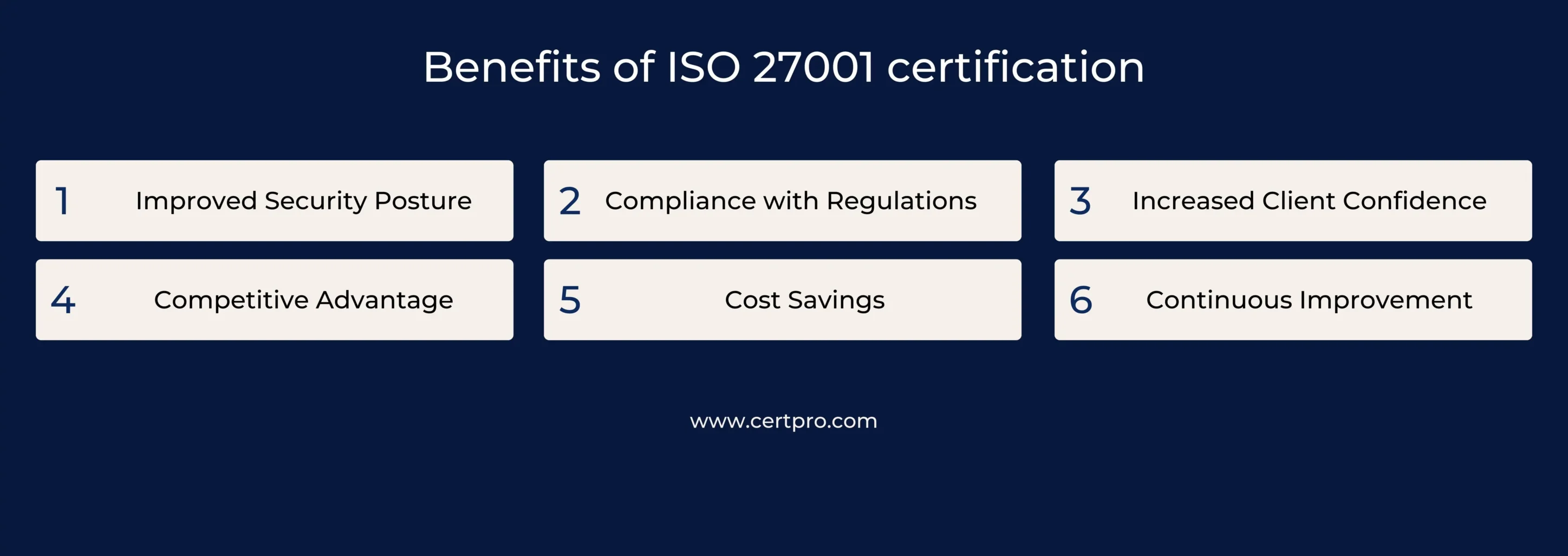
ISO 27001 Certification in Barcelona delivers measurable, documented benefits for organizations operating in technology, financial services, cloud computing, and digital media sectors. The certification provides independent, third-party verification of information security control design and operating effectiveness — a credential that carries evidentiary weight in procurement, regulatory, and client due diligence contexts.
The benefits described below reflect the audit-verified nature of the ISO 27001 attestation credential, rather than advisory or consulting outcomes. Each benefit is grounded in the independent examination process that distinguishes ISO 27001 certification from self-assessment frameworks.
- ✓Independent third-party verification of ISMS control design and operating effectiveness, recognized across enterprise procurement frameworks in Europe and internationally
- ✓Documented ISO 27001 attestation that satisfies vendor security review requirements from financial institutions, regulated enterprises, and government contractors
- ✓Alignment of the ISMS with EU GDPR Article 32 obligations, NIS2 Directive requirements, and DORA ICT risk management frameworks applicable to Barcelona-based organizations
- ✓Structured risk assessment and risk treatment framework that systematically identifies, evaluates, and addresses information security risks across the organization
- ✓Annual surveillance audit cycle providing ongoing, independent oversight of ISMS operation and control effectiveness throughout the three-year ISO 27001 certification period
- ✓Internationally recognized ISO 27001 compliance credential supporting market access in U.S., UK, Asia-Pacific, and other international markets requiring independently verified security assurance
- ✓Reduced vendor security assessment burden through a portable, standardized certification that satisfies client security questionnaire requirements across multiple client relationships
- ✓Documented information security governance structure that demonstrates organizational accountability and continual improvement to regulators, clients, and boards
Organizations in Barcelona’s SaaS, cloud, mobile technology, and e-commerce sectors seek information security certification to demonstrate that their controls meet an independently verified standard. Each sector benefits from ISO 27001 Certification in Barcelona in distinct ways:
- SaaS providers — certification provides enterprise clients with assurance that customer data is protected by a documented and audited control framework
- Cloud and managed service providers — certification demonstrates that the security controls protecting client environments have been independently evaluated
- E-commerce platforms — ISO 27001 compliance complements PCI DSS by providing a broader ISMS framework for organizations handling payment card and personal customer data
- Digital media companies — certification demonstrates adherence to recognized information security standards for organizations handling proprietary content and advertiser data
Across all of these sectors, ISO 27001 Certification in Barcelona serves as a standardized, internationally recognized credential for information security control verification.
ISO 27001 compliance, as independently verified through certification audit, generates internal governance benefits that extend beyond the external credential. The structured requirements of ISO/IEC 27001:2022 — including management review, internal audit, corrective action, and continual improvement — establish a repeatable governance cycle for information security management.
Organizations that maintain a certified ISMS develop systematic processes for identifying and responding to changes in their risk environment, including new threat vectors, changes in technology architecture, and evolving regulatory requirements. The management review process required under Clause 9.3 of the standard ensures that senior leadership receives regular, documented reporting on ISMS performance, security incidents, and improvement objectives.
This governance structure supports board-level accountability for information security and demonstrates to regulators and clients that information security is managed as an organizational priority — not merely a technical function.
- ✓Information Security Certification for Barcelona’s Technology Sectors
- ✓Operational and Governance Benefits of ISO 27001 Compliance
ISO 27001 Certification Requirements and Control Domains
ISO 27001 certification requires organizations to demonstrate conformance with both the management system clauses of ISO/IEC 27001:2022 (Clauses 4 through 10) and the applicable Annex A controls selected through the risk assessment and documented in the Statement of Applicability. The ISO 27001 audit evaluates whether the ISMS meets each applicable requirement through evidence collected during the Stage 1 documentation review and Stage 2 control effectiveness assessment.
The following sections describe the primary requirements evaluated during an ISO 27001 examination for Barcelona-based organizations, covering both the management system clauses and the Annex A control domains.
Clauses 4 through 10 of ISO/IEC 27001:2022 define the management system requirements governing how the ISMS is established, operated, evaluated, and improved. Key clause requirements include:
- Clause 4 — Define internal and external organizational context and identify interested parties whose requirements are relevant to information security
- Clause 5 — Demonstrate leadership commitment, including establishment of an information security policy and assignment of roles and responsibilities
- Clause 6 — Plan the risk assessment methodology, risk treatment process, and information security objectives
- Clause 7 — Address support requirements including resources, competence, awareness, communication, and documented information
- Clause 8 — Manage operational planning and control activities
- Clause 9 — Conduct performance evaluation through internal audit and management review
- Clause 10 — Drive continual improvement and manage nonconformities
During the ISO 27001 examination, auditors evaluate evidence of conformance across each of these clauses to form an objective assessment of ISMS maturity and effectiveness.
Annex A of ISO/IEC 27001:2022 contains 93 controls across four domains, each addressing a distinct aspect of information security management:
- Organizational Controls (37 controls) — policies, roles, asset management, supplier relationships, incident management, and business continuity
- People Controls (8 controls) — background verification, employment terms, disciplinary processes, remote working policies, and security event reporting
- Physical Controls (14 controls) — physical security boundaries, entry controls, desk and screen policies, and equipment security
- Technological Controls (34 controls) — access management, cryptography, network security, vulnerability management, configuration management, backup procedures, logging and monitoring, and web filtering
Organizations document which controls are applicable and which are excluded — with documented justification — in the Statement of Applicability. During the ISO 27001 audit, each applicable control is evaluated for both design and operating effectiveness, with auditors collecting specific evidence to support conclusions on each control area. This evidence-based approach is what gives ISO 27001 compliance its credibility in enterprise and regulatory contexts.
- ✓Management System Clause Requirements (Clauses 4–10)
- ✓Annex A Control Domain Requirements
Business Sectors in Barcelona Seeking ISO 27001 Certification
ISO 27001 Certification in Barcelona is pursued across a diverse range of sectors that share a common characteristic: they handle sensitive information assets requiring independently verified protection. The concentration of technology-intensive organizations in Barcelona’s economy creates broad demand for information security certification across multiple industry verticals.
The sectors described below represent the primary categories of Barcelona-based organizations that undergo ISO 27001 audit for commercial, contractual, or regulatory reasons. Each sector faces distinct drivers, though the certification standard and audit process remain consistent across all of them.
SaaS Providers, Cloud Companies, and Technology Startups
Barcelona’s SaaS ecosystem includes a substantial number of B2B software companies serving enterprise clients across financial services, healthcare, logistics, and retail. These organizations routinely face enterprise security requirements that specify ISO 27001 certification as a prerequisite for vendor approval. Cloud service providers and infrastructure-as-a-service companies operating from Barcelona similarly encounter procurement requirements from regulated clients that mandate independently audited information security controls.
Technology startups and scale-ups pursuing Series A funding and beyond often encounter investor and acquirer due diligence processes that include information security review — contexts where ISO 27001 Certification in Barcelona provides a recognized third-party credential that accelerates the process. ISO 27001 examination is also frequently required when Barcelona-based technology companies seek to list on cloud marketplace platforms operated by major hyperscalers.
Fintech, Digital Payments, and Financial Technology Organizations
Barcelona hosts a growing fintech sector encompassing digital payment platforms, open banking technology providers, investment technology firms, and insurance technology companies. ISO 27001 Certification in Barcelona for fintech organizations is driven by multiple concurrent requirements: contractual obligations from banking partners requiring ISO 27001 compliance, regulatory expectations under DORA for ICT risk management, and procurement requirements from enterprise clients in regulated industries.
For open banking technology providers, ISO 27001 certification demonstrates that the systems processing third-party bank account data operate under a documented and independently audited information security framework. For payment technology organizations, the certification provides assurance that cardholder data environments are governed by a risk-based ISMS that has been independently evaluated — a credential that complements PCI DSS certification in enterprise procurement contexts.
E-Commerce, Digital Media, and Mobile Technology Firms
Barcelona’s e-commerce, digital media, and mobile technology sectors handle substantial volumes of consumer personal data, behavioral data, and proprietary content — creating both regulatory and commercial drivers for ISO 27001 certification. E-commerce platforms processing personal data from EU consumers are subject to GDPR requirements that align with ISO 27001 control objectives, making ISO 27001 compliance a practical tool for demonstrating regulatory conformance to data protection authorities.
Digital media companies handling advertiser data, audience behavioral data, and third-party content distribution rights seek ISO 27001 attestation to satisfy data processing agreement requirements from enterprise advertising partners. Mobile technology firms — including telecommunications software providers and application developers — encounter ISO 27001 certification requirements from mobile network operators and enterprise clients as a condition of platform access or integration agreements.
ISO 27001 Certification Transition Requirements for Barcelona Organizations
Organizations in Barcelona that hold ISO 27001 certification under the 2013 version of the standard (ISO/IEC 27001:2013) are required to transition to ISO/IEC 27001:2022 by October 31, 2025. After this date, certificates issued under the 2013 standard will no longer be recognized by accreditation bodies, and organizations will need to hold a valid ISO/IEC 27001:2022 certificate to maintain certification status.
The transition involves a structured ISO 27001 audit process to evaluate the ISMS against the updated standard’s requirements, including the restructured Annex A controls. Organizations should initiate transition planning well in advance of the deadline to allow sufficient time for ISMS updates, documentation revisions, and audit scheduling.
The transition from ISO/IEC 27001:2013 to ISO/IEC 27001:2022 involves several substantive changes that affect both the ISMS and the ISO 27001 audit process. The total number of Annex A controls was reduced from 114 to 93, with controls reorganized from 14 domains into four: Organizational, People, Physical, and Technological.
Eleven new controls were introduced in the 2022 revision, addressing areas such as:
- Threat intelligence (Annex A 5.7)
- Cloud services security (Annex A 5.23)
- Physical security monitoring (Annex A 7.4)
- Data masking (Annex A 8.11)
- Data leakage prevention (Annex A 8.12)
- Configuration management (Annex A 8.9)
Existing controls from the 2013 standard were merged, renamed, or retained, requiring organizations to update their Statement of Applicability to reflect the new control structure. The ISO 27001 examination during a transition audit evaluates whether the ISMS has been updated to address the 2022 standard’s requirements, including the new controls relevant to the organization’s risk treatment decisions.
The transition audit for Barcelona-based organizations holding ISO/IEC 27001:2013 certification follows a defined process. The transition can be conducted as part of a scheduled surveillance audit or recertification audit, or as a separate transition audit engagement — depending on the organization’s current certification cycle and the time remaining before the October 31, 2025 deadline.
The transition ISO 27001 audit evaluates whether the ISMS documentation and controls have been updated to reflect the ISO/IEC 27001:2022 structure, including the updated Statement of Applicability referencing the 2022 Annex A controls. Upon successful completion of the transition audit and resolution of any identified nonconformities, the certification body issues a new certificate referencing ISO/IEC 27001:2022.
Organizations that do not complete the transition before October 31, 2025 will need to undergo a new initial ISO 27001 certification audit under the 2022 standard to obtain a valid certificate — a more extensive process than a transition audit. Early planning is strongly advisable for all Barcelona organizations currently certified under the 2013 standard.
- ✓Key Changes in ISO/IEC 27001:2022 Affecting Barcelona Organizations
- ✓Transition Audit Process and Timeline
FAQ
▶
What is ISO 27001 certification and who issues it?
▶
Which version of the ISO 27001 standard applies to Barcelona organizations?
▶
What is the difference between Stage 1 and Stage 2 of the ISO 27001 audit?
▶
How long is an ISO 27001 certificate valid?
▶
What documents are required for an ISO 27001 certification audit?
▶
Which Barcelona industries most commonly require ISO 27001 certification?
▶
What is the ISO 27001 attestation issued at the conclusion of a certification audit?
▶
Does ISO 27001 certification satisfy GDPR compliance requirements for Barcelona organizations?
Get In Touch
have a question? let us get back to you.