
ISO 27001 Certification in Birmingham
ISO 27001 Certification in Birmingham is pursued across a broad range of industry sectors reflecting the city’s diverse economic base. The following table summarizes the primary sectors in which Birmingham-based organizations seek ISO 27001 Certification, along with the principal demand drivers in each sector.
OUR CLIENTS










ISO 27001 Certification for Birmingham-Based Financial, Technology, and Manufacturing Organizations
ISO 27001 Certification in Birmingham is pursued by banking institutions, fintech operators, SaaS providers, cloud service companies, advanced manufacturers, healthcare technology organizations, and logistics enterprises. These organizations operate across the city’s financial district, its technology and digital economy cluster, and its broader professional services sector. CertPro operates as a Licensed CPA Firm and independent certification body, conducting ISO 27001 certification audits under ISO/IEC 27001:2022 for Birmingham-based organizations. ISO 27001 Certification constitutes an independent, evidence-based evaluation of an organization’s Information Security Management System (ISMS) against the requirements of the standard. It culminates in a formal certification decision issued by an independent certification committee — not an advisory engagement or a readiness assessment.
Birmingham is one of the United Kingdom’s most significant financial and professional services centres. The city hosts a concentration of regulated financial institutions, insurance firms, accounting practices, and a rapidly expanding fintech ecosystem centred around the Colmore Business District and the wider Birmingham city centre. Alongside financial services, Birmingham’s technology sector — encompassing SaaS platforms, managed service providers, cloud infrastructure companies, and digital health enterprises — generates substantial demand for ISO 27001 Certification in Birmingham. Organizations seek this certification to satisfy enterprise client security expectations, supply chain assurance requirements, and public sector procurement frameworks. Advanced manufacturing and engineering firms in the broader West Midlands region, including those supplying automotive, aerospace, and defence supply chains, similarly pursue ISO 27001 Certification to meet Tier 1 customer vendor assurance standards.
ISO 27001 Certification in Birmingham is also driven by obligations arising from UK GDPR, the UK Cyber Essentials framework, and international client security standards. Enterprise procurement teams in London, continental Europe, and North America routinely impose these standards on Birmingham-based suppliers. Organizations processing personal data, financial records, health information, or commercially sensitive client data across digital infrastructure face structured vendor security reviews from regulated counterparties. ISO 27001 attestation — the formal certificate issued by an independent certification body such as CertPro — provides documented, third-party evidence that the organization’s ISMS has been evaluated against internationally recognized requirements. It confirms that controls addressing confidentiality, integrity, and availability have been independently assessed.
CertPro’s ISO 27001 audit scope covers all clauses of ISO/IEC 27001:2022 — Clauses 4 through 10 governing the management system framework — and all four Annex A control domains: Organizational controls, People controls, Physical controls, and Technological controls. The 2022 update reduced the number of Annex A controls from 114 (in the 2013 version) to 93 controls across these four domains. The transition deadline for organizations previously certified under ISO/IEC 27001:2013 is 31 October 2025, after which only certifications issued under the 2022 version remain valid. Organizations in Birmingham seeking initial certification or transitioning from the 2013 version are evaluated against the full requirements of ISO/IEC 27001:2022 through CertPro’s structured two-stage audit methodology, followed by ongoing surveillance audits and a three-year recertification cycle.

What Is ISO 27001 Certification?
ISO 27001 Certification is a formal third-party attestation that an organization’s Information Security Management System conforms to the requirements of ISO/IEC 27001:2022. The standard specifies requirements for establishing, implementing, maintaining, and continually improving an ISMS — a structured framework for managing information security risks in relation to people, processes, and technology. ISO 27001 attestation is issued by an accredited or licensed independent certification body following a rigorous audit process. That process evaluates documentation, control design, and control operating effectiveness against the requirements of the standard. ISO 27001 Certification cannot be self-declared and must be issued by a recognized external certification body.
ISO/IEC 27001:2022 Standard Structure
ISO/IEC 27001:2022 is structured around two principal components. The first is the management system clauses — Clauses 4 through 10 — which define requirements for organizational context, leadership and commitment, planning (including risk assessment and risk treatment), support, operation, performance evaluation, and continual improvement. These clauses establish the governance framework within which information security controls are selected, implemented, and monitored. The second component is Annex A, which contains 93 reference controls organized across four domains: Organizational controls (37 controls), People controls (8 controls), Physical controls (14 controls), and Technological controls (34 controls). Organizations must produce a Statement of Applicability documenting which controls are applicable to their ISMS scope, which are implemented, and which are excluded with documented justification.
The management system clauses of ISO/IEC 27001:2022 require organizations to define the scope of the ISMS, identify internal and external issues that affect information security, document the needs of interested parties, and conduct a structured information security risk assessment. The risk assessment process must identify information security risks, evaluate their likelihood and potential impact, and produce a risk treatment plan that maps selected controls — drawn from Annex A or other sources — to identified risks. These foundational documents — the ISMS scope document, information security policy, risk assessment, risk treatment plan, and Statement of Applicability — form the core documentation set reviewed during a Stage 1 ISO 27001 audit.
ISO 27001 Certification vs. ISO 27001 Compliance
ISO 27001 compliance refers to an organization’s internal alignment with the requirements of the standard — a state that can be self-assessed without external verification. ISO 27001 Certification, by contrast, is an independently issued formal attestation that follows a structured audit conducted by a licensed or accredited certification body. ISO 27001 compliance that Birmingham organizations achieve through internal control implementation and documented risk management does not carry the same evidentiary weight as an independently issued ISO 27001 certificate. Enterprise procurement teams and regulated financial institutions specifically request ISO 27001 Certification — not internal compliance declarations — as a condition of supplier onboarding in vendor reviews, regulated procurement frameworks, and cross-border client due diligence processes.
The distinction between ISO 27001 compliance and ISO 27001 attestation is material for Birmingham-based organizations supplying services to regulated clients. ISO 27001 attestation — the formal certificate issued following an independent audit — provides third-party verification that the organization’s ISMS has been evaluated against the full requirements of ISO/IEC 27001:2022. This attestation is the document that enterprise clients request in vendor security questionnaires, that regulated financial institutions include in their third-party risk management frameworks, and that public sector procurement frameworks in the UK reference as a recognized information security standard. Organizations seeking ISO 27001 Certification in Birmingham should engage CertPro as an independent certification body to initiate the formal audit process.
ISO 27001 Certification Audit Process for Organizations in Birmingham
The ISO 27001 audit process conducted by CertPro for Birmingham-based organizations follows a structured, multi-stage methodology. It is designed to independently evaluate whether an organization’s Information Security Management System conforms to the requirements of ISO/IEC 27001:2022. The ISO 27001 audit Birmingham process begins with an application review and scope determination, proceeds through two formal audit stages, and results in a certification decision issued by CertPro’s independent certification committee. The process is evidence-based and evaluative — auditors assess documentation, interview personnel, and test the operating effectiveness of controls against defined criteria.
| Audit Stage | Key Activities | Output |
|---|---|---|
| Application & Scope Review | Review of ISMS scope, organizational context, and initial documentation set | Audit program determination |
| Stage 1 Audit | Review of ISMS documentation, policy framework, risk assessment, risk treatment plan, and Statement of Applicability | Stage 1 audit report; readiness determination for Stage 2 |
| Stage 2 Audit | On-site or remote evaluation of control implementation and operating effectiveness across all applicable Annex A domains | Stage 2 audit report; nonconformity identification |
| Nonconformity Review | Assessment of corrective actions submitted in response to identified nonconformities | Nonconformity closure determination |
| Certification Decision | Independent review by certification committee; issuance of ISO 27001 certificate | ISO 27001 certificate (3-year validity) |
| Surveillance Audits | Annual audits reviewing continued ISMS conformance and control effectiveness | Surveillance audit reports |
| Recertification Audit | Full re-evaluation of ISMS at end of three-year certification cycle | Renewed ISO 27001 certificate |
The Stage 1 ISO 27001 audit is a documentation-focused review conducted by CertPro auditors. Its purpose is to assess whether the organization’s ISMS documentation is sufficiently developed and implemented to proceed to the Stage 2 field audit. During Stage 1, auditors review the ISMS scope document, information security policy, risk assessment methodology and results, risk treatment plan, Statement of Applicability, and supporting procedural documentation. Auditors evaluate whether the organization has correctly identified the boundaries of its ISMS, whether the risk assessment process is systematic and documented, and whether the Statement of Applicability accurately reflects the selection and exclusion of Annex A controls with justified rationale. Stage 1 findings are documented in a formal audit report identifying any areas requiring attention before Stage 2 proceeds.
For Birmingham-based organizations, the Stage 1 audit may be conducted remotely or at the organization’s premises, depending on the size and complexity of the ISMS scope. Technology companies, SaaS providers, and cloud service organizations with distributed operations may complete Stage 1 remotely. Manufacturing organizations or those with significant physical infrastructure may require on-site review of physical security documentation and site-specific controls. The Stage 1 audit report produced by CertPro documents observations, areas of concern, and any conditions that must be addressed before the Stage 2 audit begins — providing a clear, structured basis for confirming that documentation is complete and aligned with ISO/IEC 27001:2022 requirements.
The Stage 2 ISO 27001 audit is an evidence-based evaluation of whether the controls documented in the organization’s ISMS are implemented and operating effectively in practice. CertPro auditors assess control implementation across all four Annex A domains — Organizational, People, Physical, and Technological — by reviewing evidence, conducting structured interviews with personnel responsible for information security functions, observing operational processes, and testing selected controls against ISO/IEC 27001:2022 requirements. The ISO 27001 examination of control operating effectiveness is the central activity of the Stage 2 audit and forms the evidentiary basis for the certification decision. Auditors document all findings in a formal Stage 2 audit report, identifying conformities, observations, and any nonconformities against specific clauses or Annex A controls.
Nonconformities identified during the Stage 2 ISO 27001 audit Birmingham process are formally documented and communicated to the organization. The organization must submit corrective action evidence within a defined timeframe. CertPro auditors review that evidence and determine whether nonconformities have been adequately addressed before forwarding the certification recommendation to the independent certification committee. The certification committee — which operates separately from the audit team — reviews the complete audit record and issues the formal certification decision. This structural separation between the audit function and the certification decision function is a fundamental requirement of independent certification body operations. It ensures that the ISO 27001 attestation issued to Birmingham-based organizations reflects an objective, evidence-based evaluation.
ISO 27001 Certification issued by CertPro is valid for a three-year period, subject to satisfactory completion of annual surveillance audits. Surveillance audits are conducted at approximately twelve-month intervals following initial certification. They evaluate whether the organization’s ISMS continues to conform to ISO/IEC 27001:2022 requirements, whether nonconformities from previous audits have been addressed, and whether significant changes to the organization’s scope, operations, or technology environment have been incorporated into the ISMS. Surveillance audits are narrower in scope than the initial certification audit but cover critical ISMS processes — including internal audit results, management review outputs, corrective action records, and selected Annex A control domains on a rotating basis.
At the end of the three-year certification cycle, a recertification audit is conducted. This comprehensive re-evaluation covers all requirements of ISO/IEC 27001:2022 and is similar in scope to the original Stage 2 audit. A renewed certificate is issued if the ISMS is found to be conformant. Birmingham-based organizations undergoing recertification must demonstrate that the ISMS has been maintained and continually improved throughout the certification period. Organizations previously certified under ISO/IEC 27001:2013 that have not yet transitioned must do so before the October 2025 deadline to maintain valid ISO 27001 Certification status.
- ✓Stage 1 Audit: Documentation and Readiness Review
- ✓Stage 2 Audit: Control Implementation and Operating Effectiveness
- ✓Surveillance Audits and Recertification
Why Organizations in Birmingham Pursue ISO 27001 Certification
ISO 27001 Certification in Birmingham is driven by a combination of enterprise vendor assurance requirements, regulated sector procurement expectations, cross-border client security standards, and statutory data protection obligations. Birmingham-based organizations supplying services to FTSE 100 enterprises, regulated financial institutions, NHS-connected health technology platforms, and international technology companies face structured security evaluation requirements that specify ISO 27001 Certification as a recognized standard for demonstrating ISMS conformance. Demand for ISO 27001 Certification among Birmingham companies has intensified as enterprise procurement teams formalize their third-party risk management frameworks and as UK GDPR enforcement has highlighted the importance of documented, independently verified information security controls.
Financial Services and Fintech Sector Demand
ISO 27001 Certification that Birmingham financial services organizations pursue is directly linked to the concentration of regulated banking institutions, insurance firms, asset managers, and payment service providers operating in the Colmore Business District and Birmingham’s wider financial centre. Financial institutions regulated by the Financial Conduct Authority (FCA) and the Prudential Regulation Authority (PRA) are subject to outsourcing and third-party risk management requirements. Under the FCA’s operational resilience framework and EBA guidelines, these institutions must obtain documented evidence of supplier information security controls. Birmingham-based technology suppliers, SaaS platforms, and data processing organizations serving regulated financial institutions are routinely required to provide ISO 27001 Certification as part of supplier onboarding due diligence and annual vendor review processes.
ISO 27001 compliance that Birmingham fintech operators pursue is similarly driven by enterprise financial institution clients that impose ISO 27001 Certification as a vendor qualification requirement. Birmingham’s fintech sector — which includes payments technology firms, regtech platforms, open banking operators, and digital lending companies — frequently supplies services to banks, insurers, and asset managers. These institutions treat ISO 27001 Certification as a baseline security assurance standard. A Birmingham fintech company seeking to supply its platform to a major UK bank will typically encounter ISO 27001 Certification as a condition of the vendor security questionnaire process. The bank’s third-party risk team will require a valid, independently issued ISO 27001 certificate before the commercial relationship can proceed.
Technology, SaaS, and Cloud Service Provider Demand
ISO 27001 Certification that Birmingham technology companies pursue reflects the expectation that software platforms, cloud infrastructure services, and managed service providers demonstrate independently verified information security controls. Birmingham’s technology ecosystem — centred around the Innovation Birmingham campus, the wider Eastside digital quarter, and a distributed base of SaaS founders and scale-up technology companies — generates significant demand for ISO 27001 Certification in Birmingham. This certification provides a mechanism for accessing enterprise sales channels and international markets. Enterprise software procurement decisions at large organizations routinely require ISO 27001 Certification from SaaS vendors as a condition of security review approval, particularly for platforms processing personal data, financial data, or sensitive business information.
Cloud service organizations and managed service providers in Birmingham pursuing ISO 27001 Certification must demonstrate that their ISMS covers the specific scope of services delivered to clients. This includes data centre controls, access management, incident response procedures, and vendor management processes for their own supply chain. The ISO 27001 examination of a cloud service provider’s control environment evaluates not only internal technical controls but also the contractual and governance mechanisms through which the organization manages information security obligations to its clients. Birmingham-based MSPs supplying IT services to healthcare organizations, legal practices, or financial institutions face particular scrutiny of controls relating to data access, segregation, encryption, and business continuity — all areas addressed within the Annex A Technological controls domain.
Advanced Manufacturing and Engineering Sector Demand
The ISO 27001 audit that Birmingham manufacturing organizations undergo is increasingly requested by Tier 1 automotive, aerospace, and defence customers operating within the West Midlands supply chain. Advanced manufacturing and engineering firms in Birmingham and the surrounding region — including those supplying Jaguar Land Rover, aerospace component manufacturers, and defence prime contractors — face information security requirements that reference ISO 27001 Certification as a recognized standard. Customers use it to verify the protection of design data, intellectual property, manufacturing processes, and commercially sensitive technical information. The integration of digital manufacturing technologies, industrial IoT, and connected supply chain platforms has significantly increased the attack surface for information security incidents — and correspondingly elevated customer expectations for formal ISMS certification.
ISO 27001 Certification Requirements and ISMS Documentation
ISO 27001 Certification in Birmingham requires organizations to establish, document, implement, and maintain an Information Security Management System that satisfies all applicable requirements of ISO/IEC 27001:2022. The certification audit evaluates both the documented management system and the operational evidence demonstrating that controls are implemented and functioning as designed. Organizations must maintain a defined set of mandatory documented information as specified by the standard, alongside additional documentation required to demonstrate the effective operation of selected controls across the four Annex A domains.
The core documentation set required for ISO 27001 Certification includes five key documents. First, the ISMS scope document defines the boundaries and applicability of the management system. Second, the information security policy establishes the organization’s commitment to information security and defines top-level objectives. Third, the information security risk assessment systematically identifies, analyzes, and evaluates information security risks within the defined scope. Fourth, the risk treatment plan documents selected controls, responsible parties, and timelines for addressing identified risks. Fifth, the Statement of Applicability maps all 93 Annex A controls to the organization’s ISMS — indicating which are applicable and implemented, and which are excluded with documented justification. These five documents form the foundational set reviewed during the Stage 1 ISO 27001 audit.
- ✓ISMS scope document defining organizational boundaries and applicability
- ✓Information security policy approved by top management
- ✓Information security risk assessment methodology, results, and risk register
- ✓Risk treatment plan mapping controls to identified risks
- ✓Statement of Applicability covering all 93 ISO/IEC 27001:2022 Annex A controls
- ✓Internal audit programme and audit results
- ✓Management review records documenting periodic ISMS performance evaluation
- ✓Corrective action records addressing identified nonconformities
The four Annex A control domains of ISO/IEC 27001:2022 address distinct categories of information security risk and require corresponding documented controls and operational evidence during the ISO 27001 audit. Organizational controls — comprising 37 controls — address governance structures, information security policies, roles and responsibilities, threat intelligence, supplier relationship security, and incident management. People controls — 8 controls — address personnel screening, employment terms, security awareness and training, and disciplinary processes. Physical controls — 14 controls — address physical security perimeters, physical access controls, equipment security, and secure disposal of storage media. Technological controls — 34 controls — address access control, cryptography, network security, secure development practices, vulnerability management, and monitoring.
During the Stage 2 ISO 27001 audit, CertPro auditors evaluate evidence of control implementation and operating effectiveness across all applicable Annex A control domains. For Birmingham-based technology organizations, the Technological controls domain typically receives significant audit attention. This covers identity and access management, multi-factor authentication, encryption of data in transit and at rest, secure software development lifecycle practices, network segmentation, security monitoring and logging, and vulnerability and patch management. For Birmingham-based financial services organizations, Organizational controls addressing supplier relationships, incident management, and information classification are frequently areas of detailed audit evaluation — given the volume of third-party data processing relationships these organizations maintain.
- ✓Mandatory ISMS Documentation
- ✓Annex A Control Domain Requirements
Benefits of ISO 27001 Certification for Birmingham-Based Organizations
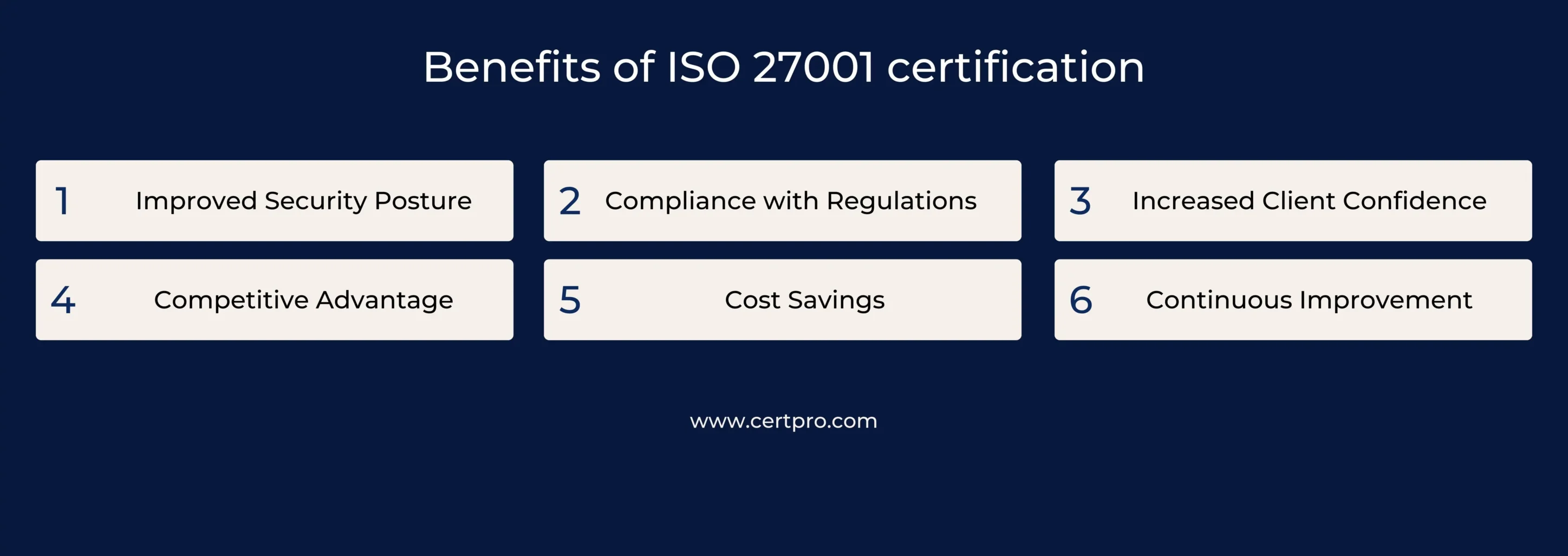
ISO 27001 Certification in Birmingham provides organizations with a formally issued, third-party attestation of ISMS conformance. This attestation carries recognized evidentiary weight in enterprise vendor reviews, regulated sector procurement frameworks, and cross-border client security evaluations. The benefits of ISO 27001 Certification extend across commercial, operational, and regulatory dimensions, reflecting the standard’s comprehensive coverage of information security governance, risk management, and control implementation. The following summarizes the primary recognized outcomes of ISO 27001 Certification for organizations operating in Birmingham’s financial, technology, manufacturing, and professional services sectors.
- ✓Independent, third-party verification of ISMS conformance with ISO/IEC 27001:2022 requirements
- ✓Formal ISO 27001 attestation accepted in enterprise vendor security questionnaires and procurement frameworks
- ✓Demonstrated alignment with information security requirements referenced in UK GDPR, FCA outsourcing guidelines, and NHS data security standards
- ✓Structured risk assessment framework that systematically identifies and documents information security risks
- ✓Evidence of control operating effectiveness across Organizational, People, Physical, and Technological control domains
- ✓Recognition in international procurement processes — including US, EU, and APAC enterprise markets — that reference ISO 27001 as a recognized security standard
- ✓Annual surveillance audit cycle providing ongoing independent oversight of ISMS performance
- ✓Certificate validity supporting continuous supplier qualification in regulated sector vendor panels
ISO 27001 Certification for Birmingham companies provides a formally recognized credential that satisfies information security requirements embedded in enterprise procurement processes. Large organizations in financial services, professional services, and the public sector that procure software, cloud services, managed services, or data processing from Birmingham-based suppliers routinely include ISO 27001 Certification as a mandatory or scored qualification criterion. An independently issued ISO 27001 certificate enables Birmingham-based suppliers to demonstrate ISMS conformance without providing direct auditor access to internal systems or responding to lengthy security questionnaires on a per-client basis. This commercial utility is particularly significant for SaaS companies and technology providers that maintain multiple enterprise client relationships simultaneously.
International market access is a further commercial benefit of ISO 27001 Certification in Birmingham. Organizations supplying services to enterprise clients in the United States, European Union, Middle East, or Asia-Pacific encounter information security requirements that reference ISO 27001 Certification as a recognized standard. US enterprise organizations subject to SOC 2 requirements frequently accept ISO 27001 Certification alongside or as a complement to SOC 2 reports in their vendor security evaluation processes. EU-regulated organizations subject to DORA — the Digital Operational Resilience Act — reference ISO 27001 as a relevant standard for demonstrating ICT risk management framework conformance. Birmingham-based organizations with international client bases derive particular value from the cross-border recognition of ISO 27001 attestation.
ISO 27001 compliance supports Birmingham-based organizations’ alignment with statutory data protection obligations under UK GDPR. The regulation requires controllers and processors to implement appropriate technical and organizational measures to protect personal data. The Information Commissioner’s Office (ICO) references ISO 27001 as an example of an appropriate technical and organizational measure under Article 32 of UK GDPR. An ISO 27001 certified organization can demonstrate to the ICO — and to clients raising UK GDPR due diligence questions — that its information security controls have been independently evaluated against an internationally recognized standard. This documented, audited approach to data security is materially stronger in a regulatory investigation context than undocumented or self-assessed compliance claims.
- ✓Commercial and Procurement Recognition
- ✓Regulatory Alignment and Data Protection
ISO 27001 Certification Scope and Independent Decision Framework
The scope of ISO 27001 Certification in Birmingham defines the boundaries of the ISMS subject to independent audit and certification. Scope determination is the organization’s responsibility and must accurately reflect the information assets, processes, locations, and organizational units within which information security risks are managed. CertPro’s certification audit evaluates the organization’s ISMS within the stated scope and does not extend to organizational units, processes, or information assets explicitly excluded from the ISMS boundary. Scope accuracy is a critical element of the Stage 1 audit review. A scope that materially understates the organization’s information processing activities may result in nonconformities or conditions that must be resolved before ISO 27001 Certification can proceed.
Certification Committee and Independent Decision
The ISO 27001 Certification decision is made by CertPro’s independent certification committee. The committee reviews the complete audit record — including Stage 1 and Stage 2 audit reports, nonconformity records, corrective action evidence, and the auditor’s recommendation — and issues a formal certification determination. The certification committee operates independently from the audit team to preserve the objectivity of the certification decision. This structural separation is a fundamental requirement of independent certification body operations. It ensures that the ISO 27001 attestation issued to Birmingham-based organizations reflects an objective evaluation of documented audit evidence rather than a commercial or advisory relationship between the certification body and the auditee.
Certificate suspension or withdrawal may occur when an organization fails to maintain ISMS conformance between surveillance audits, fails to complete a required surveillance audit within the defined timeframe, or experiences a significant information security incident that calls the continued validity of the certificate into question. CertPro’s certification agreement specifies the conditions under which certification may be suspended, reduced in scope, or withdrawn — and these conditions are communicated to the organization at the time of initial certification. Birmingham-based organizations are responsible for notifying CertPro of significant changes to their ISMS scope, organizational structure, or technology environment. Such changes may trigger an unscheduled surveillance audit or scope review to ensure the basis of the original certificate remains valid.
Sector-Specific Scope Considerations for Birmingham Organizations
Birmingham-based organizations across different sectors face sector-specific scope considerations when defining the ISMS boundary for ISO 27001 Certification. Financial services organizations must typically include within scope all systems processing customer financial data, payment information, and regulated account records, as well as third-party relationships through which that data is processed. Healthcare technology organizations supplying NHS trusts or private healthcare providers must address the intersection of ISO 27001 requirements with NHS Digital Data Security and Protection Toolkit obligations — ensuring that the ISMS scope encompasses all systems processing patient-identifiable data. SaaS providers must define scope to include cloud infrastructure, development environments, and customer data processing pipelines. Manufacturing organizations must address the increasingly significant intersection of operational technology and information technology within their ISMS scope.
ISO 27001 Certification in Birmingham for Key Industry Sectors
ISO 27001 Certification in Birmingham is pursued across a broad range of industry sectors reflecting the city’s diverse economic base. The following table summarizes the primary sectors in which Birmingham-based organizations seek ISO 27001 Certification, along with the principal demand drivers in each sector.
| Sector | Typical ISMS Scope | Primary Certification Demand Driver |
|---|---|---|
| Financial Services & Fintech | Customer data systems, payment processing, banking platforms, regulatory reporting | FCA outsourcing requirements, enterprise bank vendor panels, PSD2 compliance |
| SaaS & Cloud Technology | Cloud infrastructure, application code, customer data processing, DevOps environments | Enterprise procurement security questionnaires, international client expansion |
| Advanced Manufacturing & Engineering | Design data systems, IP repositories, connected manufacturing platforms, supply chain portals | Tier 1 automotive and defence customer vendor requirements |
| Healthcare Technology | Patient data platforms, NHS-connected systems, clinical decision support tools | NHS DSPT requirements, regulated healthcare client procurement |
| Managed Service Providers | IT service delivery infrastructure, client data environments, service desk systems | Client contractual requirements, regulated sector service delivery |
Professional Services and Legal Sector
Birmingham’s professional services sector — including law firms, accountancy practices, management consultancies, and recruitment organizations — increasingly pursues ISO 27001 Certification to satisfy client security expectations and demonstrate that sensitive client information is protected within a formally certified ISMS. Law firms handling mergers and acquisitions, litigation, and regulatory matters process highly sensitive client information and face security evaluation requirements from their corporate and financial institution clients. Accountancy practices managing audit files, tax records, and financial reporting data for corporate clients face similar expectations. The ISO 27001 audit that Birmingham professional services organizations undergo typically focuses on access control, document management, email security, and controls governing remote working arrangements — all areas of heightened scrutiny given the sector’s reliance on distributed working models.
CertPro: Licensed CPA Firm and Independent ISO 27001 Certification Body in Birmingham
CertPro operates as a Licensed CPA Firm and independent certification body conducting ISO 27001 certification audits for organizations in Birmingham and across the United Kingdom. As an independent certification body, CertPro’s role is exclusively evaluative. CertPro auditors assess organizations’ Information Security Management Systems against the requirements of ISO/IEC 27001:2022, identify conformities and nonconformities, and provide documented audit findings to the independent certification committee for the formal certification determination. CertPro does not provide consulting, implementation, policy development, or control design services. Its function is exclusively the independent audit and certification of ISMS conformance — maintaining the objectivity that gives ISO 27001 attestation its recognized value.
Independent Audit Methodology and Evidence Standards
CertPro’s ISO 27001 audit methodology for Birmingham-based organizations is structured around evidence-based evaluation of both documentation and operational control performance. Auditors collect and review documentary evidence — including policies, procedures, risk registers, control logs, access records, incident reports, and management review minutes — and conduct structured interviews with personnel across information security, IT, operations, and management functions. The ISO 27001 examination conducted during Stage 2 evaluates whether documented controls are implemented in practice and operating as designed, not merely whether documentation exists. This distinction between documented control design and demonstrated control operating effectiveness is central to the independent audit methodology. It ensures that ISO 27001 Certification issued to Birmingham-based organizations reflects genuine ISMS performance rather than documentation completeness alone.
The ISO 27001 audit that Birmingham organizations undergo with CertPro is conducted by auditors with sector-specific knowledge relevant to Birmingham’s principal industry verticals — financial services, technology, manufacturing, and healthcare. Auditor assignments are made to align audit team expertise with the sector context of the auditee organization. This ensures that evidence evaluation is informed by an understanding of the specific information security risks, regulatory requirements, and operational environments relevant to the organization’s industry. This sector-aligned approach to auditor assignment supports the quality and depth of the ISO 27001 examination and the relevance of audit findings to the organization’s specific operating context.
FAQ
▶
What is ISO 27001 certification and why is it relevant for Birmingham organizations?
▶
Who conducts ISO 27001 certification audits in Birmingham?
▶
What is the difference between Stage 1 and Stage 2 of the ISO 27001 audit?
▶
How long is an ISO 27001 certificate valid?
▶
What documents are required for ISO 27001 certification?
▶
Is ISO 27001 certification required for ISO 27001 compliance Birmingham fintech operators?
▶
What is the ISO 27001 transition deadline for organizations previously certified under the 2013 version?
▶
Can ISO 27001 certification support UK GDPR compliance for Birmingham-based organizations?
Get In Touch
have a question? let us get back to you.