
ISO 27001 Certification in Brisbane
ISO 27001 certification is the formal outcome of an independent conformity assessment confirming that an organisation’s Information Security Management System meets the requirements of ISO/IEC 27001:2022. The certification is awarded by an independent certification body following a structured ISO 27001 audit process that evaluates ISMS documentation, risk assessment outputs, control implementation, and management system operation against the requirements of the ISO 27001 standard.
OUR CLIENTS










Independent ISO 27001 Certification in Brisbane by a Licensed CPA Firm
CertPro is a Licensed CPA Firm providing independent ISO 27001 Certification in Brisbane to organisations across financial services, technology, healthcare, telecommunications, professional services, logistics, energy, and government technology. ISO 27001 Certification in Brisbane is conducted as a third-party conformity assessment against the requirements of ISO/IEC 27001:2022 — the current edition of the international standard for Information Security Management Systems (ISMS). CertPro’s role is strictly that of an independent certification body, evaluating whether an organisation’s ISMS conforms to the ISO 27001 standard through a structured, evidence-based audit process. CertPro does not design, implement, operate, or advise on ISMS. The organisation seeking certification is solely responsible for establishing, operating, and maintaining its ISMS in accordance with ISO/IEC 27001:2022.
Brisbane has developed into one of Australia’s most significant technology and financial services centres. The city hosts a concentrated ecosystem of fintech firms, SaaS providers, cloud service companies, cybersecurity businesses, AI developers, healthcare technology organisations, and professional services firms operating across Queensland and nationally. Many of these organisations handle sensitive personal, financial, and operational data on behalf of clients, partners, and regulators. Independent ISO 27001 Certification in Brisbane provides objective, third-party confirmation that an organisation’s information security controls have been assessed against a globally recognised standard — producing a certification outcome that enterprise clients, government procurement bodies, and international partners can rely upon with confidence.
The Australian regulatory context reinforces demand for ISO 27001 compliance among Brisbane-based organisations. The Privacy Act 1988 (Cth), including the Australian Privacy Principles (APPs), establishes mandatory data protection obligations for organisations handling personal information. The Australian Signals Directorate (ASD) Information Security Manual (ISM) and the ACSC Essential Eight provide complementary cybersecurity frameworks referenced by government agencies and regulated entities. ISO 27001 certification does not replace compliance with these frameworks. However, organisations that have achieved ISO 27001 Certification in Brisbane demonstrate that their ISMS has been independently assessed against a structured set of information security controls — including 93 controls across four Annex A domains (Organisational, People, Physical, and Technological) as specified in ISO/IEC 27001:2022.
The transition deadline from ISO/IEC 27001:2013 to ISO/IEC 27001:2022 was 31 October 2025, as established by accredited certification bodies internationally. Organisations in Brisbane that previously held certification under the 2013 edition are required to transition to the 2022 standard. All new certification applications are assessed exclusively against ISO/IEC 27001:2022. CertPro conducts every ISO 27001 certification audit in Brisbane under the current standard, evaluating conformity with Clauses 4 through 10 of the management system requirements and the applicable controls selected in the organisation’s Statement of Applicability (SoA). The certification decision is made by an independent certification committee based on objective audit evidence — not on commercial or advisory considerations.

What Is ISO 27001 Certification?
ISO 27001 certification is the formal outcome of an independent conformity assessment confirming that an organisation’s Information Security Management System meets the requirements of ISO/IEC 27001:2022. The ISO 27001 standard was developed by the International Organization for Standardization (ISO) and the International Electrotechnical Commission (IEC). It specifies the requirements for establishing, implementing, maintaining, and continually improving an ISMS within the context of the organisation’s information security risks. Certification is awarded when an independent certification body determines — through a structured audit process — that the organisation’s ISMS conforms to all applicable requirements of the ISO 27001 standard.
The ISO/IEC 27001:2022 Standard Structure
ISO/IEC 27001:2022 is structured around ten clauses. Clauses 1 through 3 address scope, normative references, and terms and definitions. Clauses 4 through 10 specify the management system requirements that form the basis of every ISO 27001 certification audit. Clause 4 requires organisations to understand their context and the needs of interested parties. Clause 5 addresses leadership and commitment. Clause 6 covers planning — including information security risk assessment and risk treatment. Clause 7 addresses support resources, including documented information. Clause 8 covers operational planning and control. Clause 9 addresses performance evaluation, including internal audit and management review. Clause 10 requires continual improvement and corrective action for nonconformities.
Annex A of ISO/IEC 27001:2022 contains 93 information security controls organised across four domains: Organisational controls (37 controls), People controls (8 controls), Physical controls (14 controls), and Technological controls (34 controls). Annex A is normative, meaning organisations must consider all 93 controls during risk treatment. They must also document — in their Statement of Applicability — which controls are applicable, which are implemented, and the justification for any controls excluded. During the ISO 27001 certification audit, auditors review the SoA and assess whether implemented controls are operating effectively based on objective evidence.
Key ISMS Documentation Evaluated During Certification
ISO/IEC 27001:2022 requires organisations to maintain specific documented information as evidence of ISMS operation. The core documentation evaluated during an ISO 27001 certification audit includes the information security policy, information security risk assessment records, the risk treatment plan, and the Statement of Applicability. Supporting documented information includes records of internal audits, management review outputs, corrective action records, and evidence of control operation across the applicable Annex A domains. The depth and completeness of documented information is a primary focus of the Stage 1 audit and forms the evidentiary basis for the Stage 2 assessment. Organisations that maintain incomplete or inconsistent documentation will receive audit findings that must be resolved before a certification decision can be made.
ISO 27001 Certification Audit Process in Brisbane
The ISO 27001 certification audit process for Brisbane-based organisations follows a structured, multi-stage methodology conducted by CertPro as an independent certification body. Each stage produces documented outputs that inform the subsequent stage and ultimately support the certification committee’s decision. The process is designed to evaluate conformity objectively, without advisory input or implementation guidance from the auditor. Brisbane organisations pursuing ISO 27001 Certification in Brisbane should understand each stage so that audit activities can be planned and coordinated efficiently with internal teams.
| Audit Stage | Key Activities | Output |
|---|---|---|
| Application Review | Scope confirmation, ISMS boundary definition, audit program determination | Agreed audit scope and program |
| Stage 1 Audit | Review of ISMS documentation, policy, risk assessment, SoA, and readiness of documented information | Stage 1 findings report; readiness determination for Stage 2 |
| Stage 2 Audit | On-site or remote evidence assessment of control operation across Clauses 4–10 and Annex A | Stage 2 audit findings; nonconformity identification |
| Nonconformity Review | Organisation submits corrective action evidence; auditor reviews adequacy | Corrective action closure report |
| Certification Decision | Independent certification committee reviews audit evidence and determines conformity | ISO 27001 certificate issued or deferred |
The Stage 1 ISO 27001 audit is a documentation and readiness review conducted before on-site or remote evidence testing begins. During Stage 1, the auditor reviews the organisation’s ISMS documentation to assess whether the information security management system has been established in accordance with ISO/IEC 27001:2022. Key items reviewed include the scope statement, information security policy, risk assessment methodology and outputs, risk treatment plan, Statement of Applicability, internal audit records, and management review records. The Stage 1 audit identifies areas where documentation is absent, incomplete, or inconsistent with ISO 27001 standard requirements, and determines whether the organisation is ready to proceed to Stage 2. The output is a written findings report that identifies any concerns requiring resolution before the evidence-based assessment begins.
The Stage 2 ISO 27001 audit is an evidence-based assessment of whether the organisation’s ISMS controls are implemented and operating effectively in practice. Auditors collect objective evidence through document review, interviews with personnel, observation of processes, and examination of system configurations, logs, and records. The Stage 2 assessment evaluates conformity against Clauses 4 through 10 of ISO/IEC 27001:2022 and against the controls identified as applicable in the organisation’s Statement of Applicability. Nonconformities identified during Stage 2 are classified and documented in the audit findings report. The organisation must provide evidence of corrective action for all nonconformities before the certification committee makes its determination. Importantly, the ISO 27001 certification audit process does not permit the auditor to prescribe corrective actions — the organisation determines its own corrective measures.
An ISO 27001 certificate is valid for three years from the date of issue, subject to satisfactory surveillance audits. Surveillance audits are conducted at least annually during the certification cycle and evaluate whether the ISMS continues to conform to ISO/IEC 27001:2022 requirements. Surveillance audits are not full re-assessments; they focus on areas of the ISMS that have changed, corrective actions from prior findings, internal audit and management review outputs, and continued operation of key controls. At the end of the three-year certification cycle, a recertification audit is required to renew the certificate. The recertification audit is a comprehensive re-evaluation of the full ISMS scope and must be completed before the existing certificate expires to maintain continuity of ISO 27001 certification status.
- ✓Stage 1 Audit: Documentation and Readiness Review
- ✓Stage 2 Audit: Evidence-Based Control Assessment
- ✓Surveillance Audits and Recertification
Why Brisbane Organisations Pursue ISO 27001 Certification
Demand for ISO 27001 Certification in Brisbane is driven by a combination of procurement requirements, regulatory expectations, contractual obligations, and international market access considerations. Brisbane’s growth as a technology and financial services hub has increased the volume of vendor assurance reviews and enterprise procurement processes that reference ISO 27001 certification as a qualifying criterion. Organisations across Brisbane’s key sectors — including SaaS, cloud, fintech, healthcare technology, telecommunications, and professional services — increasingly encounter ISO 27001 certification as a prerequisite in client contracts, government tender documents, and international partnership agreements.
Enterprise Procurement and Vendor Assurance in Brisbane
Brisbane-based technology and professional services firms regularly participate in procurement processes conducted by large enterprise clients, financial institutions, and government agencies. Enterprise vendor security reviews typically require suppliers to demonstrate independent third-party validation of their information security controls. ISO 27001 certification provides this validation through an independent audit conducted against the ISO 27001 standard — producing a certificate that procurement teams and vendor risk functions can assess without conducting their own on-site security evaluations. A Brisbane SaaS provider that achieves ISO 27001 Certification in Brisbane, for example, can present its certificate and audit scope to enterprise clients as documented evidence of independent conformity assessment, reducing the need for repetitive client-specific security questionnaires and vendor assessments.
Regulatory and Contractual Drivers in Queensland
Queensland government agencies and regulated entities increasingly reference ISO 27001 compliance as a security requirement in technology procurement and data sharing arrangements. Organisations in healthcare, financial services, education, and infrastructure sectors operating in Brisbane may be subject to sector-specific information security expectations under Queensland and Commonwealth legislation — including the Privacy Act 1988, the My Health Records Act 2012, and sector-specific prudential or licensing requirements administered by APRA and ASIC. ISO 27001 certification provides documented, independently assessed evidence of information security governance that organisations can reference in regulatory disclosures, contractual representations, and third-party risk management processes. ISO 27001 compliance in Brisbane is increasingly referenced in procurement frameworks across both state and federal government contracts.
International Market Access for Brisbane Technology Firms
Brisbane technology firms expanding into international markets — including Singapore, Japan, the United Kingdom, the European Union, and the United States — frequently encounter ISO 27001 certification requirements in procurement and partnership processes. ISO/IEC 27001:2022 is an internationally recognised standard, and certification issued by an independent body is accepted across jurisdictions as evidence of ISMS conformity. For Brisbane-based companies pursuing international SaaS contracts or cloud service agreements, ISO 27001 Certification in Brisbane removes a significant barrier in vendor qualification processes — particularly in regulated sectors such as financial services, healthcare, and government technology. The certification is technology-neutral and applicable regardless of whether the organisation’s information assets are hosted on-premises, in public cloud environments, or in hybrid configurations.
ISO 27001 Requirements and Certification Scope
Achieving ISO 27001 certification requires an organisation to demonstrate conformity with all applicable requirements of ISO/IEC 27001:2022, from the management system clauses through to the Annex A controls selected in the Statement of Applicability. The scope of certification defines the boundary of the ISMS subject to assessment and must be clearly documented by the organisation. The certification scope statement is reviewed by the auditor during the Stage 1 audit and determines which organisational units, processes, locations, and information assets fall within the certification boundary. The certificate issued by CertPro reflects the scope as defined and agreed during the audit program determination phase.
ISO/IEC 27001:2022 Clause 6 requires organisations to conduct a systematic information security risk assessment to identify risks to the confidentiality, integrity, and availability of information assets within the ISMS scope. The risk assessment must follow a documented methodology that produces consistent, valid, and comparable results. Risk owners must be identified, and risks must be evaluated against defined acceptance criteria. The risk treatment plan documents the controls selected to address accepted risks, references the applicable Annex A controls, and forms the basis for the Statement of Applicability. During the ISO 27001 certification audit, auditors review risk assessment records to confirm that the methodology has been applied consistently, that identified risks have been addressed through the treatment plan, and that the SoA accurately reflects the outputs of the risk assessment process.
ISO/IEC 27001:2022 Clause 9 requires organisations to conduct internal audits at planned intervals to assess whether the ISMS conforms to both the organisation’s own requirements and the requirements of the ISO 27001 standard. Internal audit records must document audit scope, criteria, findings, and conclusions. Management reviews must be conducted at planned intervals by top management to evaluate the suitability, adequacy, and effectiveness of the ISMS. Management review records must document inputs reviewed, decisions made, and actions assigned. During the ISO 27001 certification audit, evidence that both internal audits and management reviews have been conducted and documented in accordance with Clause 9 is essential to demonstrating that the ISMS operates as a managed system — not solely as a collection of documented policies.
The Statement of Applicability (SoA) is a mandatory document under ISO/IEC 27001:2022 that lists all 93 Annex A controls, specifies which controls are applicable to the organisation, identifies which controls are implemented, and provides justification for any controls excluded from scope. The SoA must be consistent with the outputs of the risk assessment and risk treatment plan. During the Stage 2 ISO 27001 audit, auditors test selected Annex A controls against the implementation status declared in the SoA, collecting objective evidence of control operation. Controls spanning Organisational, People, Physical, and Technological domains are assessed based on evidence such as policies, configuration records, access logs, training records, physical security records, and incident management documentation. Discrepancies between the SoA and actual control implementation are recorded as audit findings requiring corrective action.
- ✓Information Security Risk Assessment and Treatment
- ✓Internal Audit and Management Review Requirements
- ✓Annex A Controls and Statement of Applicability
Business Sectors in Brisbane Seeking ISO 27001 Certification
ISO 27001 certification for Brisbane businesses spans a broad range of industries, reflecting the city’s diverse and growing economy. Organisations across financial services, technology, healthcare, telecommunications, education, energy, logistics, construction, and government technology sectors pursue ISO 27001 Certification in Brisbane for reasons that vary by industry — but share a common foundation: the need for independent, third-party validation of information security controls. ISO 27001 certified companies in Brisbane operate in both regulated and commercially competitive environments where information security assurance is a measurable differentiator in procurement and partnership processes.
- ✓Financial services and fintech: Banks, credit unions, payment platforms, and lending technology firms handling sensitive financial data and subject to APRA and ASIC oversight
- ✓Software and SaaS providers: Cloud application vendors supplying enterprise clients in regulated industries, requiring independent security validation in vendor due diligence processes
- ✓Cybersecurity and AI companies: Security technology and artificial intelligence firms demonstrating ISMS conformity to enterprise and government clients
- ✓Healthcare and life sciences: Digital health platforms, health data processors, and medical technology organisations subject to My Health Records Act and Privacy Act obligations
- ✓Telecommunications and cloud services: Network operators and cloud infrastructure providers managing large volumes of customer and operational data
- ✓Professional and managed services: Consulting, accounting, legal, and IT managed service firms handling client confidential information on behalf of regulated organisations
- ✓Advanced manufacturing, construction, and engineering: Firms managing operational technology, project data, and supply chain information security risks
- ✓Government technology and education: Technology vendors supplying state and federal government agencies and universities managing research and student data
Financial Services and Fintech in Brisbane
Brisbane’s financial services and fintech sector has expanded significantly, with a concentration of payment technology firms, lending platforms, wealth management technology providers, and RegTech companies operating across Queensland and nationally. Financial services organisations in Brisbane face information security obligations under APRA Prudential Standard CPS 234, which requires regulated entities and their material service providers to maintain information security capabilities commensurate with identified vulnerabilities and threats. ISO 27001 certification provides an independently assessed reference point for ISMS conformity that complements CPS 234 obligations. Fintech firms supplying services to APRA-regulated institutions increasingly encounter ISO 27001 certification requirements in third-party risk management and vendor assurance processes conducted by their banking and insurance clients.
Technology, SaaS, and Cloud Providers in Brisbane
Brisbane’s technology ecosystem includes a growing concentration of SaaS companies, cloud service providers, data analytics platforms, and cybersecurity firms. Many of these organisations supply services to enterprise clients in regulated industries, where procurement processes require evidence of independent information security certification. ISO 27001 certification audit assessments for Brisbane technology firms typically evaluate controls across access management, cryptography, system development and maintenance, supplier relationships, and incident management — domains directly relevant to cloud-hosted and software-as-a-service business models. Technology companies that achieve ISO 27001 Certification in Brisbane can present a certificate covering the specific systems and services within the defined ISMS scope, giving procurement teams targeted, evidence-based assurance rather than broad, unverified security claims.
Benefits of ISO 27001 Certification for Brisbane-Based Organisations
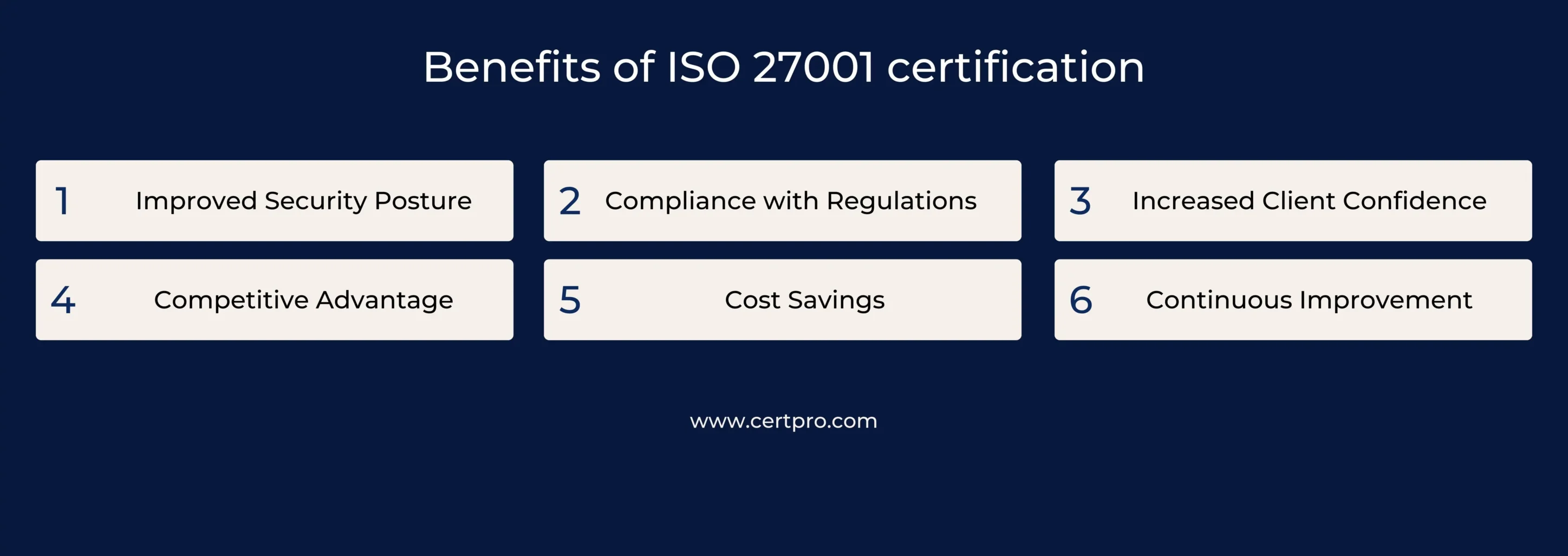
ISO 27001 Certification in Brisbane delivers outcomes that are directly measurable in procurement, regulatory, and operational contexts. The benefits of ISO 27001 certification are grounded in the independent, evidence-based nature of the conformity assessment — certification is not a self-declaration but a third-party determination that the organisation’s ISMS meets the requirements of ISO/IEC 27001:2022. For Brisbane organisations operating in competitive and regulated markets, this distinction is material. ISO 27001 certified companies in Brisbane demonstrate to clients, partners, and regulators that their information security controls have been assessed by an independent body against an internationally recognised standard.
- ✓Independent third-party validation of ISMS conformity against ISO/IEC 27001:2022, providing objective assurance to enterprise clients, government agencies, and international partners
- ✓Documented evidence of information security risk assessment, risk treatment, and control operation — directly relevant to regulatory and contractual disclosure obligations under Australian privacy and sector-specific legislation
- ✓Recognition in enterprise procurement processes across financial services, government technology, healthcare, and cloud sectors, where ISO 27001 certification is a qualifying criterion
- ✓Reduction in repetitive client security questionnaires and vendor due diligence requests, as the certificate and audit scope serve as structured reference documentation
- ✓Structured surveillance audit cycle that provides ongoing oversight of ISMS operation and identifies areas requiring corrective action before they escalate to systemic control failures
- ✓International market access facilitation for Brisbane technology firms pursuing contracts in regulated jurisdictions including the EU, UK, Singapore, Japan, and the United States
- ✓Alignment with complementary Australian cybersecurity frameworks including ASD ISM, ACSC Essential Eight, and APRA CPS 234, supported by independently verified ISMS documentation
ISO 27001 compliance assessed through an independent certification audit provides a level of assurance that internal self-assessment cannot replicate. During the Stage 2 audit, CertPro auditors evaluate whether controls are not merely documented but are operating as intended in practice. This distinction — between control design and control operating effectiveness — is fundamental to the value of the ISO 27001 certification audit. A Brisbane organisation may have documented access control policies, but the Stage 2 audit evaluates whether those controls are actually enforced through technical configurations, reviewed periodically, and updated when personnel changes occur. This evidence-based assessment of actual control operation is what differentiates ISO 27001 certification from a policy documentation exercise.
The three-year certification cycle — structured around annual surveillance audits and a recertification audit at cycle end — provides ongoing oversight of ISMS conformity rather than a single point-in-time assessment. Annual surveillance audits evaluate changes to the ISMS, review corrective actions from prior findings, and assess whether the management system continues to operate in conformity with ISO/IEC 27001:2022. This continuous oversight structure is particularly valuable for Brisbane organisations operating in dynamic technology environments where information assets, processing activities, and third-party relationships change frequently. Enterprise clients and government agencies that rely on ISO 27001 certification as part of their vendor assurance processes benefit from knowing the certificate is subject to ongoing independent review — not merely a historical snapshot of control operation.
- ✓Verification of Control Effectiveness Through Independent Assessment
- ✓Ongoing Oversight Through Surveillance and Recertification
ISO 27001 Certification Scope Definition for Brisbane Organisations
Defining the ISMS scope is one of the most consequential decisions an organisation makes before initiating the ISO 27001 certification audit process. The scope determines which organisational units, services, processes, locations, and information assets are subject to the ISMS requirements — and, consequently, which areas will be assessed during the certification audit. ISO/IEC 27001:2022 Clause 4.3 requires the scope to be defined and documented, taking into account the interfaces and dependencies between activities performed by the organisation and those performed by external parties. For Brisbane-based organisations, scope decisions commonly involve choices about whether to certify a single service line, a division, or the entire organisation, and how to address information assets hosted by cloud service providers or managed service partners.
Scope Boundary Considerations for Technology and Cloud Organisations
Brisbane technology organisations frequently operate ISMS boundaries that extend across cloud infrastructure, third-party data processors, and remote workforce environments. The ISO 27001 standard requires organisations to address information security risks associated with external and internal interfaces at the scope boundary. Where information processing is performed by third parties — such as cloud infrastructure providers, payment processors, or managed security service providers — the organisation must assess and document the applicable information security controls through supplier agreements reviewed under Annex A Organisational controls. During the ISO 27001 certification audit, auditors review supplier management records and third-party agreements to assess whether information security risks at scope boundaries have been adequately addressed. The certificate issued will reflect the defined scope, and any services or systems outside the boundary are not covered by the ISO 27001 certification.
Multi-Site and Multi-Service Scope Considerations
Larger Brisbane organisations operating across multiple sites, business units, or service lines may choose to certify a subset of their operations initially, with scope expansion possible during subsequent certification cycles. The certification scope must be documented with sufficient precision to allow audit planning and to enable certificate users — such as enterprise procurement teams — to understand exactly what is and is not covered. Vague or overly broad scope statements that do not accurately reflect operational boundaries are identified as findings during the Stage 1 audit. Multi-site certifications require audit coverage across all included locations, and the audit program must account for the distribution of ISMS activities and controls across each site within the certification boundary.
ISO 27001 Nonconformities and Certification Decision Framework
The ISO 27001 certification decision is made by CertPro’s independent certification committee based on the complete audit file — including Stage 1 and Stage 2 findings, corrective action evidence, and the auditor’s assessment of conformity. The certification committee is independent of the audit team that conducted the assessment, providing a separation of audit and certification decision functions consistent with internationally recognised certification body practices. The committee evaluates whether all nonconformities identified during the ISO 27001 certification audit have been adequately addressed through documented corrective actions before determining whether to issue the certificate.
Nonconformity Identification and Corrective Action
Nonconformities identified during the ISO 27001 audit represent areas where the organisation’s ISMS does not conform to a specific requirement of ISO/IEC 27001:2022 or to the organisation’s own documented procedures. Each nonconformity is documented in the audit findings report with reference to the specific clause or control requirement that has not been met, supported by the objective evidence reviewed during the audit. The organisation is responsible for determining the root cause of each nonconformity, implementing corrective action, and providing documented evidence that the corrective action has been completed. The auditor reviews this evidence to assess whether it adequately addresses the identified nonconformity before the certification file proceeds to the committee. Organisations that do not resolve nonconformities within the agreed timeframe may experience a delay in the ISO 27001 certification decision.
Certificate Issuance, Suspension, and Withdrawal
When the certification committee determines that the organisation’s ISMS conforms to ISO/IEC 27001:2022, a certificate is issued specifying the organisation’s name, certification scope, the standard and edition against which conformity was assessed, the date of certification, and the certificate expiry date. The certificate is valid for three years subject to satisfactory surveillance audits. If a surveillance audit identifies significant nonconformities that are not resolved within the required timeframe, the certificate may be suspended. Continued failure to address nonconformities — or a material change to the ISMS that is not reported to the certification body — may result in certificate withdrawal. ISO 27001 certified companies in Brisbane are required to notify CertPro of any significant changes to their ISMS scope, organisational structure, or information security risk environment during the certification cycle.
FAQ
▶
What is ISO 27001 certification and what does it confirm?
▶
Which version of the ISO 27001 standard applies to new certifications in Brisbane?
▶
How long does the ISO 27001 certification audit process take in Brisbane?
▶
What is the Statement of Applicability and why is it required?
▶
Does ISO 27001 certification replace compliance with the Privacy Act 1988 or APRA CPS 234?
▶
How long is an ISO 27001 certificate valid?
▶
What is the difference between Stage 1 and Stage 2 ISO 27001 audits?
▶
What sectors in Brisbane most commonly pursue ISO 27001 certification?
Get In Touch
have a question? let us get back to you.