
ISO 27001 Certification in Brussels
ISO 27001 Certification in Brussels is increasingly relevant for organizations supplying services to EU institutions, regulated financial entities, or international enterprise clients. These organizations face vendor assurance and third-party risk management requirements that necessitate formal ISO 27001 attestation. The certification process evaluates whether an organization’s ISMS is designed, documented, and operating effectively in accordance with ISO/IEC 27001:2022 Clauses 4 through 10 and the applicable Annex A controls across four domains: Organizational, People, Physical, and Technological controls.
OUR CLIENTS










ISO 27001 Certification for Brussels-Based Financial, Technology, and EU-Regulated Organizations
Brussels holds a structurally distinct position among European cities. As the administrative and regulatory capital of the European Union, it hosts EU institutions, treaty bodies, financial services firms, government technology vendors, telecommunications operators, professional and legal services organizations, SaaS providers, and cloud service companies. CertPro, operating as a Licensed CPA Firm and independent third-party certification body, provides ISO 27001 Certification in Brussels for organizations seeking formal attestation of their Information Security Management System against ISO/IEC 27001:2022 requirements. This certification is not advisory in nature — it is a structured, evidence-based evaluation concluding in an independent certification decision.
ISO 27001 Certification in Brussels is increasingly relevant for organizations supplying services to EU institutions, regulated financial entities, or international enterprise clients. These organizations face vendor assurance and third-party risk management requirements that necessitate formal ISO 27001 attestation. The certification process evaluates whether an organization’s ISMS is designed, documented, and operating effectively in accordance with ISO/IEC 27001:2022 Clauses 4 through 10 and the applicable Annex A controls across four domains: Organizational, People, Physical, and Technological controls.
The Brussels ecosystem includes a high concentration of organizations with demanding information security obligations. Financial services firms regulated under the European Banking Authority framework, technology companies supplying services to EU institutions, managed service providers handling personal data under GDPR, and SaaS operators serving international enterprise clients all operate in a vendor scrutiny environment that increasingly demands formal ISO 27001 examination and certification. CertPro’s independent certification function is strictly distinct from consulting or implementation activities. The certification body evaluates evidence — it does not design controls, develop policies, or prepare organizations for audit.
ISO/IEC 27001:2022 is the current version of the international standard for Information Security Management Systems. The 2022 revision reduced the number of Annex A controls from 114 in the 2013 edition to 93 controls organized across four domains. This consolidation modernized control language to address contemporary threats including cloud computing risks, data leakage, and threat intelligence. Organizations holding certificates issued under the 2013 standard must transition to ISO/IEC 27001:2022 by October 31, 2025, as established by accredited certification bodies. All ISO 27001 Certification in Brussels conducted through CertPro is evaluated against the full 2022 standard requirements.
CertPro’s ISO 27001 audit process for Brussels-based organizations encompasses the complete audit lifecycle: application review, audit program determination, Stage 1 documentation review, Stage 2 on-site or remote evidence evaluation, nonconformity assessment, independent certification committee decision, certificate issuance, and ongoing surveillance audit oversight. Each stage is conducted by qualified auditors whose role is strictly evaluative. The resulting ISO 27001 attestation documents the scope, audit basis, and certification decision in a format recognized by enterprise procurement teams, regulatory bodies, and institutional clients across the EU and internationally.

ISO 27001 Certification Audit Process for Organizations in Brussels
The ISO 27001 audit process conducted by CertPro for Brussels-based organizations follows a structured, multi-stage methodology aligned with ISO/IEC 17021-1 requirements for certification body operations. Each stage produces documented outputs that form the basis for the independent certification decision. The process is designed to be transparent and extractable, providing organizations and their stakeholders with a clear record of how the certification determination was reached. The ISO 27001 audit in Brussels encompasses both documentation review and operational evidence assessment, ensuring a thorough and defensible evaluation.
The Stage 1 audit is a formal review of the organization’s ISMS documentation against ISO/IEC 27001:2022 Clauses 4 through 10. The auditor evaluates whether the organization has established a documented scope, an information security policy, a completed risk assessment, a risk treatment plan, and a Statement of Applicability identifying applicable and excluded Annex A controls with documented justification. The Stage 1 audit also assesses the organization’s understanding of the standard’s requirements and determines whether the ISMS documentation is sufficiently mature to proceed to Stage 2. Any documentation gaps identified at Stage 1 are recorded and communicated before the Stage 2 audit commences.
For Brussels-based organizations, the Stage 1 review also considers the defined scope boundaries — whether certification covers the entire organization or specific business units, service lines, or geographic operations. Organizations supplying technology services to EU institutions or financial services firms often define their scope to encompass the specific systems and processes handling regulated or sensitive data. The auditor reviews whether scope boundaries are logically defined, clearly documented, and consistent with the organization’s actual information processing activities.
The Stage 2 audit is the substantive ISO 27001 examination of the organization’s ISMS. Auditors evaluate whether controls identified in the Statement of Applicability are not only documented but are implemented and operating effectively. Evidence collection includes review of audit logs, access control records, incident response documentation, supplier agreements, vulnerability management outputs, training records, internal audit reports, and management review minutes. The Stage 2 ISO 27001 audit Brussels assessment is conducted against the full set of applicable Annex A controls and management system clauses, with all findings documented in a formal audit report.
Nonconformities identified during the Stage 2 audit are classified and communicated to the organization. The organization then submits evidence of corrective action, which the auditor reviews before the certification file proceeds to the independent certification committee. The committee — which operates separately from the audit team — makes the final certification decision based on the audit report, nonconformity closure evidence, and overall assessment of ISMS conformity. This separation of audit and certification decision functions is a structural requirement of accredited certification body operations.
ISO 27001 certification is valid for three years from the certification decision date, subject to satisfactory completion of annual surveillance audits. Surveillance audits are conducted in the first and second years of the certification cycle. They assess continued conformity with selected clauses and controls, as well as any changes to the organization’s ISMS, scope, or operating environment. For Brussels-based organizations in dynamic sectors such as fintech or cloud services, surveillance audits may focus on areas of elevated risk — including third-party supplier controls, access management, and incident response procedures.
Recertification audits are conducted in the third year prior to certificate expiry. The recertification audit is a full reassessment of the ISMS against ISO/IEC 27001:2022 requirements and is comparable in scope to the initial Stage 2 audit. Successful completion results in the issuance of a new three-year certificate. Organizations that fail to complete surveillance or recertification audits within the required timeframes may have their certification suspended or withdrawn, in accordance with the certification body’s suspension and withdrawal policy.
| Audit Stage | Key Activities | Output |
|---|---|---|
| Application Review | Scope confirmation, conflict of interest check, audit program planning | Audit plan and engagement confirmation |
| Stage 1 Audit | ISMS documentation review, Clauses 4–10 assessment, Statement of Applicability evaluation | Stage 1 findings report, Stage 2 readiness determination |
| Stage 2 Audit | Evidence-based control testing, Annex A evaluation, nonconformity identification | Stage 2 audit report, nonconformity log |
| Certification Decision | Independent committee review of audit file and corrective actions | ISO 27001 certificate issuance or denial |
| Surveillance Audit | Annual review of selected controls, change assessment, continued conformity verification | Surveillance audit report, certificate maintenance |
- ✓Stage 1 Audit: Documentation and Readiness Review
- ✓Stage 2 Audit: Evidence-Based Control Evaluation
- ✓Surveillance Audits and Recertification
Why Organizations in Brussels Pursue ISO 27001 Certification
The demand for ISO 27001 Certification in Brussels is shaped by the city’s unique institutional and commercial ecosystem. Organizations operating in Brussels face information security scrutiny from multiple directions simultaneously: EU institutional procurement requirements, financial sector vendor assurance programs, international enterprise client security questionnaires, and GDPR compliance expectations. ISO 27001 certification provides a structured, independently verified response to these overlapping demands — replacing self-attestation with evidence-based third-party evaluation that institutional and commercial clients recognize and trust.
EU Institutional and Government Technology Vendors
Brussels is home to the European Commission, the European Parliament, the Council of the European Union, and numerous EU agencies and regulatory bodies. Technology vendors, SaaS providers, managed service providers, and professional services firms supplying services to these institutions face increasingly formalized information security vendor assessment requirements. ISO 27001 compliance in Brussels serves as a recognized baseline for vendor security assurance in EU institutional procurement contexts. Organizations seeking to supply cloud services, software, or data processing services to EU institutions are frequently required to demonstrate ISO 27001 certification as a condition of contract eligibility.
The EU’s NIS2 Directive, which entered into force in January 2023 with member state transposition required by October 2024, establishes cybersecurity risk management and incident reporting obligations for essential and important entities across sectors including digital infrastructure, public administration, and financial services. Brussels-based financial services and technology organizations use the ISO 27001 standard’s control framework as a structured basis for demonstrating NIS2 risk management measures. It is important to note that NIS2 compliance itself requires additional regulatory steps beyond the scope of ISO 27001 certification.
Financial Services and Fintech Vendor Assurance
Brussels hosts a significant concentration of financial services organizations including banks, insurance companies, investment managers, payment processors, and a growing fintech ecosystem. ISO 27001 compliance is a priority for Brussels fintech operators because financial sector clients and counterparties typically require formal information security attestation as part of their third-party risk management programs. Under the EU’s Digital Operational Resilience Act (DORA), which applies to financial entities and their critical ICT third-party service providers from January 2025, documented information security management and ICT risk controls are mandatory. ISO 27001 certification provides a structured evidence base for demonstrating ISMS controls relevant to DORA obligations.
Consider a practical scenario: a Brussels-based SaaS provider supplying treasury management software to Belgian and European banks is required by its banking clients to submit annual ISO 27001 attestation as part of their supplier due diligence processes. The ISO 27001 examination conducted by CertPro evaluates the SaaS provider’s ISMS controls covering asset management, access control, cryptography, supplier relationships, and information security incident management. This produces an independently verified attestation that satisfies the bank’s third-party risk management requirements — without relying on self-certification.
SaaS Providers and Cloud Service Organizations
Brussels hosts a growing number of SaaS companies, cloud infrastructure operators, and technology startups serving enterprise clients across Europe and internationally. ISO 27001 certified companies in Brussels increasingly use certification as a differentiator in competitive procurement processes where enterprise buyers conduct formal vendor security reviews. For organizations seeking to expand from the Brussels market into broader EU or international markets, ISO 27001 certification provides a universally recognized information security credential. It reduces the need for bespoke customer security assessments with each new enterprise client relationship, accelerating the sales and onboarding process.
ISO 27001 Requirements and ISMS Documentation Framework
ISO/IEC 27001:2022 establishes requirements for an organization’s Information Security Management System through Clauses 4 to 10 of the standard. These clauses define the management system requirements — organizational context, leadership, planning, support, operation, performance evaluation, and improvement — while Annex A specifies 93 information security controls organized across four domains. The ISO 27001 audit evaluates conformity with both the management system clauses and the applicable Annex A controls as documented in the organization’s Statement of Applicability.
The ISO 27001 standard mandates specific documented information as evidence of ISMS establishment and operation. The core documentation set evaluated during the ISO 27001 audit Brussels assessment includes: the information security policy, the ISMS scope statement, the information security risk assessment methodology and results, the risk treatment plan documenting selected controls and their justification, the Statement of Applicability listing all 93 Annex A controls with inclusion or exclusion justifications, objectives for information security, evidence of competence and awareness activities, operational planning and control records, internal audit program and results, management review records, and documented nonconformity and corrective action records.
The Statement of Applicability (SoA) is a critical document in the ISO 27001 certification process. It must reference all 93 Annex A controls from ISO/IEC 27001:2022, indicating whether each control is applicable or excluded. For excluded controls, the organization must provide documented justification. The SoA links risk treatment decisions to specific controls and serves as the primary reference document during the Stage 2 audit for determining which controls the auditor will evaluate. Organizations must maintain the SoA as a living document, updated whenever changes to the risk environment or control set occur.
ISO/IEC 27001:2022 organizes its 93 Annex A controls across four domains. Organizational controls (37 controls) address policies, roles, responsibilities, asset management, supplier relationships, information security incident management, and business continuity. People controls (8 controls) cover screening, terms of employment, information security awareness, training, and disciplinary processes. Physical controls (14 controls) address physical security perimeters, entry controls, equipment protection, and clear desk and screen policies. Technological controls (34 controls) encompass access control, cryptography, malware protection, network security, system development security, vulnerability management, and monitoring.
The 2022 revision introduced 11 new controls not present in the 2013 edition. These address areas including threat intelligence, information security for cloud services, ICT readiness for business continuity, physical security monitoring, configuration management, information deletion, data masking, data leakage prevention, monitoring activities, web filtering, and secure coding. For Brussels-based cloud service providers and fintech organizations, the new controls addressing cloud services (Annex A 5.23) and data leakage prevention (Annex A 8.12) are particularly relevant and will be evaluated as part of the ISO 27001 examination.
- ✓Information security policy (Clause 5.2)
- ✓ISMS scope documentation (Clause 4.3)
- ✓Information security risk assessment results (Clause 6.1.2)
- ✓Risk treatment plan with control justifications (Clause 6.1.3)
- ✓Statement of Applicability referencing all 93 Annex A controls (Clause 6.1.3)
- ✓Internal audit program and results (Clause 9.2)
- ✓Management review records (Clause 9.3)
- ✓Nonconformity and corrective action records (Clause 10.1)
- ✓Core ISMS Documentation Requirements
- ✓Annex A Control Domains Under ISO/IEC 27001:2022
ISO 27001 Certification Scope and Independent Decision Framework
The scope of ISO 27001 certification defines the boundaries of the ISMS subject to independent evaluation. For Brussels-based organizations, scope determination is a critical early step in the certification process. Organizations may pursue certification for their entire enterprise or limit scope to specific business units, service lines, data centers, or geographic locations. The defined scope must be documented, justified, and consistent with the organization’s actual information security risk environment. Scope boundaries that are artificially narrow or that exclude high-risk processes without documented justification will be identified and flagged during the ISO 27001 audit.
Evidence-Based Assessment and Control Effectiveness Evaluation
ISO 27001 compliance is assessed through an evidence-based methodology. The auditor does not accept policy documentation alone as evidence of control operation — the audit requires operational evidence demonstrating that controls are implemented and functioning as documented. For access control (Annex A 8.2–8.5), this includes access provisioning records, privileged access reviews, and user account lifecycle documentation. For vulnerability management (Annex A 8.8), the auditor reviews scanning outputs, remediation records, and patch management logs. For incident management (Annex A 5.24–5.28), the auditor examines incident records, response timelines, and post-incident review documentation.
The ISO 27001 audit Brussels assessment evaluates both control design adequacy and operating effectiveness. A control may be well-designed on paper but fail to operate as intended due to gaps in execution, personnel, or technology. The auditor assesses whether each control, as implemented, is capable of achieving its stated security objective. Where controls are found to be absent, poorly designed, or not operating effectively, nonconformities are raised and documented. Minor nonconformities require corrective action evidence before the certification decision. Major nonconformities prevent certification until the root cause is addressed and corrective action is independently verified.
Certificate Validity, Suspension, and Withdrawal
An ISO 27001 certificate issued by CertPro is valid for three years from the certification decision date, contingent on the satisfactory completion of annual surveillance audits. The certificate specifies the organization’s name, registered address, certification scope, standard version (ISO/IEC 27001:2022), certificate number, issue date, and expiry date. Certificate suspension may occur when an organization fails to complete a required surveillance audit on schedule, when a major nonconformity is not closed within the prescribed period, or when the organization requests voluntary suspension. Certificate withdrawal occurs when suspension conditions remain unresolved or when the organization requests termination of the certification.
Benefits of ISO 27001 Certification for Brussels-Based Organizations
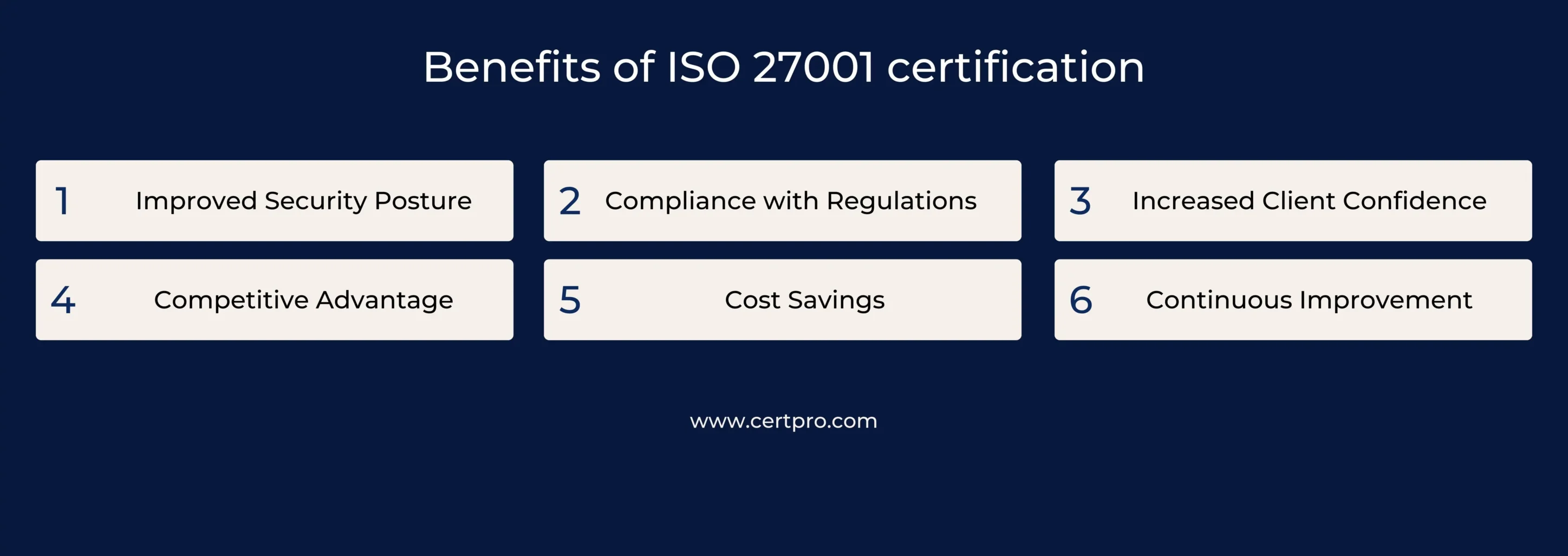
ISO 27001 Certification in Brussels produces verifiable, independently assessed outcomes that address the information security assurance requirements of institutional clients, regulated counterparties, and enterprise procurement processes. The benefits of ISO 27001 certification are structural rather than promotional — they arise from the independent nature of the certification process and the recognized authority of the standard within EU and international information security frameworks. Organizations that achieve certification gain a credible, auditable foundation for communicating their security posture to stakeholders.
ISO 27001 attestation is recognized by enterprise procurement teams, financial services firms, and institutional clients as evidence of a structured, independently evaluated information security program. For ISO 27001 certified companies in Brussels, certification reduces the volume and complexity of security questionnaires required by individual clients, since the certification itself serves as documented third-party verification of ISMS conformity. Financial institutions operating vendor due diligence programs under EBA outsourcing guidelines and DORA requirements recognize ISO 27001 certification as a substantive input to third-party risk assessment — reducing the audit burden on both vendor and client organizations.
For Brussels-based technology vendors supplying services to EU institutions, ISO 27001 certification provides a structured basis for responding to institutional information security requirements. EU institutional procurement frameworks increasingly reference ISO 27001 as a baseline security standard for technology suppliers. Organizations holding a current ISO 27001 certification can reference the independent attestation in responses to EU procurement tenders, reducing the need for bespoke security assessments at each procurement cycle. The certification scope and certificate number provide procurement officers with traceable, independently verified security assurance documentation.
ISO 27001 compliance establishes a structured risk management methodology that directly supports GDPR Article 32 obligations for technical and organizational security measures. The ISMS risk assessment process identifies information security risks to the confidentiality, integrity, and availability of personal data, while the risk treatment plan documents controls implemented to address those risks. This documented framework provides evidence of systematic security decision-making — relevant to GDPR accountability obligations under Article 5(2). For Brussels-based organizations handling EU personal data, the alignment between ISO 27001 compliance and GDPR security requirements reduces duplicative documentation effort and strengthens overall data protection posture.
- ✓Independent third-party verification of ISMS design and operating effectiveness
- ✓Internationally recognized attestation accepted in EU institutional and enterprise procurement
- ✓Structured basis for responding to financial sector vendor due diligence requirements
- ✓Documented risk management framework aligned with GDPR Article 32 security obligations
- ✓Annual surveillance audit oversight maintaining continuous ISMS accountability
- ✓Recognized credential supporting SaaS and cloud service expansion into EU and international markets
- ✓Evidence-based certification decision distinct from self-attestation or internal audit
- ✓Vendor Assurance and Third-Party Risk Management Recognition
- ✓Structured Risk Management and GDPR Alignment
Business Sectors in Brussels Seeking ISO 27001 Certification
ISO 27001 Certification in Brussels is pursued across a wide range of sectors shaped by the city’s institutional, financial, and technology ecosystem. The demand for ISO 27001 certification among Brussels companies reflects the intersection of EU regulatory requirements, financial sector vendor assurance standards, and the information security expectations of enterprise and institutional clients operating across Europe and internationally.
Financial Services, Fintech, and Payment Organizations
Brussels hosts major banking institutions, insurance companies, investment management firms, payment processing organizations, and a growing fintech sector including digital payment operators, open banking providers, and regulatory technology companies. ISO 27001 certification is a priority for Brussels financial services organizations, driven by both internal risk management requirements and external vendor assurance demands from regulated financial counterparties. Under DORA’s ICT third-party risk management requirements, financial entities must assess the information security controls of their critical technology suppliers — and ISO 27001 certification is widely recognized as a structured basis for satisfying these assessment requirements.
Professional Services, Legal Firms, and Telecommunications
Brussels hosts a high concentration of law firms, public affairs organizations, management consultancies, and professional services firms operating in the EU regulatory environment. These organizations handle confidential client information, privileged communications, and sensitive commercial data — making information security management a core professional obligation. ISO 27001 certification provides professional services firms with independent verification of their information security controls, supporting client assurance requirements and professional liability risk management. Telecommunications operators in Brussels, subject to the EU Electronic Communications Code and NIS2 obligations, also pursue ISO 27001 certification as evidence of systematic ICT security management.
SaaS Providers, Cloud Companies, and Managed Service Providers
The Brussels technology sector includes SaaS companies, cloud infrastructure operators, data center organizations, and managed service providers serving enterprise and institutional clients. ISO 27001 consultants that Brussels organizations engage may recommend certification as a prerequisite for certain enterprise contracts, though CertPro operates exclusively as the independent certification body rather than in a consulting capacity. For cloud service providers, ISO 27001 certification addresses the information security management requirements that complement cloud-specific standards such as ISO/IEC 27017 (cloud services security) and ISO/IEC 27018 (cloud privacy). Together, these certifications provide a comprehensive information security attestation framework for Brussels-based cloud organizations.
| Sector | Key ISO 27001 Driver | Relevant Regulatory Context |
|---|---|---|
| Financial Services & Fintech | Third-party risk management, ICT vendor assurance | DORA, EBA outsourcing guidelines |
| EU Institutional Technology Vendors | Procurement security requirements, contract eligibility | EU institutional procurement frameworks, NIS2 |
| SaaS and Cloud Providers | Enterprise client security questionnaires, market access | GDPR Article 32, ISO/IEC 27017 |
| Professional and Legal Services | Client assurance, confidentiality obligations | GDPR, professional regulatory requirements |
| Telecommunications Operators | ICT security management, regulatory compliance | NIS2 Directive, EU Electronic Communications Code |
ISO 27001 Compliance and Its Relationship to EU Regulatory Frameworks
ISO 27001 compliance in Brussels operates within a layered EU regulatory environment. The standard’s control framework intersects with multiple EU regulatory instruments that establish mandatory information security, data protection, and operational resilience requirements for organizations operating in Belgium and across the EU. Understanding the relationship between ISO 27001 and these regulatory frameworks is essential for organizations assessing the full value and appropriate scope of their certification.
GDPR, NIS2, and DORA Intersections
GDPR Article 32 requires organizations processing personal data to implement technical and organizational measures appropriate to the risk — including measures to ensure confidentiality, integrity, availability, and resilience of processing systems. ISO 27001’s risk-based ISMS framework directly addresses these requirements through its structured risk assessment, risk treatment, and control implementation methodology. However, ISO 27001 certification does not constitute GDPR compliance certification. The two frameworks have different scope, legal basis, and enforcement mechanisms. ISO 27001 compliance provides documented evidence of systematic security measures relevant to GDPR accountability, but does not replace Data Protection Impact Assessments or other GDPR-specific obligations.
The NIS2 Directive requires essential and important entities to implement cybersecurity risk management measures across ten specified areas, including policies on risk analysis, incident handling, business continuity, supply chain security, network and information systems security, and cryptography. ISO 27001’s Annex A controls address each of these areas substantively. For Brussels organizations subject to NIS2 — including digital service providers, energy companies, transport operators, financial market infrastructure, and public administration bodies — ISO 27001 certification provides a structured control framework that maps to NIS2 risk management measure requirements. NIS2 registration and incident reporting obligations, however, require separate compliance activities beyond ISO 27001 scope.
ISO 27001 as a Vendor Security Assurance Standard
Beyond regulatory alignment, ISO 27001 certification functions as a vendor security assurance standard in commercial contexts. Enterprise clients in financial services, healthcare, government, and technology sectors routinely require ISO 27001 certification from their technology vendors as a condition of contract award or renewal. For Brussels-based organizations seeking to supply services to international enterprise clients — particularly those in the United States, United Kingdom, and across the EU — ISO 27001 certification replaces the need to respond to bespoke security questionnaires with an independently verified attestation document. The ISO 27001 audit Brussels organizations complete with CertPro produces a certificate and audit report structured for direct submission to enterprise procurement and vendor risk teams.
CertPro’s Independent Certification Function in Brussels
CertPro operates as a Licensed CPA Firm and independent third-party certification body for ISO 27001 Certification in Brussels. The certification function is strictly evaluative — CertPro assesses whether organizations’ Information Security Management Systems conform to ISO/IEC 27001:2022 requirements through a structured audit methodology. The certification body does not provide consulting, implementation, policy development, control design, training, or readiness preparation services. This independence is a structural characteristic of accredited certification body operations and ensures that the ISO 27001 certification decision is objective and based solely on audit evidence.
Qualified Audit Personnel and Methodology
ISO 27001 audits conducted by CertPro are performed by qualified auditors with documented competence in ISO/IEC 27001:2022 requirements and information security management principles. Auditors are selected based on their technical knowledge of the organization’s sector and the information systems environment within scope. For Brussels-based financial services organizations, auditors with competence in financial sector information security requirements and relevant regulatory frameworks are assigned. The audit team’s qualifications are documented and available for review as part of the certification body’s transparency and impartiality obligations.
The ISO 27001 examination methodology employed by CertPro encompasses document review, personnel interviews, technical system observation, and evidence sampling. Auditors interview personnel across relevant functions — information security, IT operations, human resources, legal, and senior management — to assess whether the ISMS is embedded in organizational operations rather than existing solely as documentation. Technical observation may include review of system configurations, access control settings, log management systems, and network architecture where relevant to the defined scope. This multi-method evidence collection approach ensures that the certification assessment reflects actual ISMS operation, not just documented intent.
Impartiality, Confidentiality, and Certification Body Governance
CertPro’s certification operations are governed by impartiality and confidentiality requirements consistent with ISO/IEC 17021-1. Auditors and certification committee members are required to declare and manage conflicts of interest. Information obtained during the ISO 27001 audit is treated as confidential and is not disclosed to third parties without the organization’s consent, except as required by accreditation or legal obligations. The certification committee that makes the final certification decision operates independently of the audit team — reviewing the audit file and corrective action evidence without involvement in fieldwork. This separation of functions is a governance requirement of accredited certification body operations.
FAQ
▶
What is ISO 27001 Certification and why is it relevant for Brussels-based organizations?
▶
What is the difference between a Stage 1 and Stage 2 ISO 27001 audit?
▶
How long is an ISO 27001 certificate valid for organizations in Brussels?
▶
What ISMS documentation is required for ISO 27001 certification?
▶
Does ISO 27001 compliance satisfy GDPR Article 32 requirements?
▶
Which version of the ISO 27001 standard applies to certification audits in Brussels?
▶
What sectors in Brussels most commonly pursue ISO 27001 certification?
▶
What happens if nonconformities are identified during the ISO 27001 audit?
Get In Touch
have a question? let us get back to you.