
ISO 27001 Certification in Budapest
ISO 27001 Certification in Budapest is conducted by CertPro, a Licensed CPA Firm operating exclusively as an independent third-party certification body. CertPro evaluates the design and operating effectiveness of an organization’s Information Security Management System (ISMS) against the requirements of ISO/IEC 27001:2022, issuing certification based on objective, evidence-based audit findings. No consulting, implementation, or advisory services are offered — only rigorous, independent ISO 27001 audit and attestation services.
OUR CLIENTS










ISO 27001 Certification for Budapest-Based Financial and Technology Organizations
ISO 27001 Certification in Budapest is conducted by CertPro, a Licensed CPA Firm operating exclusively as an independent third-party certification body. CertPro evaluates the design and operating effectiveness of an organization’s Information Security Management System (ISMS) against the requirements of ISO/IEC 27001:2022, issuing certification based on objective, evidence-based audit findings. No consulting, implementation, or advisory services are offered — only rigorous, independent ISO 27001 audit and attestation services.
Budapest’s Technology and Shared Services Ecosystem
Budapest has established itself as a leading hub for technology operations, shared services, and business process outsourcing across Central and Eastern Europe. The city hosts a dense concentration of multinational shared services centers, BPO operators, software development firms, IT services providers, SaaS companies, cloud infrastructure organizations, managed service providers, and financial technology enterprises.
Many of these organizations process sensitive customer, financial, operational, and personal data on behalf of international clients — creating a direct demand for independently verified information security credentials. ISO 27001 Certification in Budapest provides organizations with an externally validated attestation that their ISMS is structured, documented, and operating in accordance with internationally recognized requirements. For technology companies serving regulated industries and for shared services operations handling data across borders, ISO 27001 compliance is increasingly a baseline expectation rather than a competitive differentiator.
Beyond the technology sector, Budapest’s financial services landscape includes banking institutions, insurance companies, asset managers, payment processors, and a growing fintech community. These organizations are subject to regulatory expectations from the Hungarian National Bank (Magyar Nemzeti Bank), the European Banking Authority, and GDPR-aligned data protection requirements enforced by the Hungarian National Authority for Data Protection and Freedom of Information (NAIH).
ISO 27001 Certification in Budapest that financial services organizations pursue serves as a structured framework for mapping information security controls to regulatory obligations. It supports evidence-based responses to supervisory inquiries and client due diligence assessments. Automotive engineering service providers, academic research institutions, and e-commerce platforms operating within Budapest’s diverse economy also engage ISO 27001 certification as a mechanism for demonstrating information security discipline to customers, partners, and procurement functions.
Independent Certification Body Positioning
CertPro functions exclusively as an independent third-party audit and certification provider. The organization does not offer consulting, readiness assessments, policy development, control design, implementation support, or training services. This structural independence is foundational to the integrity of the ISO 27001 attestation.
The certification decision is determined by an independent certification committee that reviews audit findings, evaluates the completeness of evidence, and assesses conformance with ISO/IEC 27001:2022 requirements — without influence from the audit team or from commercial incentives. This separation of functions is consistent with the requirements of ISO/IEC 17021-1, the international accreditation standard governing management system certification bodies. It ensures that the resulting ISO 27001 certification carries objective, credible weight in enterprise procurement processes, regulatory assessments, and client due diligence reviews.
Alignment with U.S. Cybersecurity and Vendor Assurance Expectations
Organizations in Budapest that provide services to U.S.-based enterprises, financial institutions, healthcare organizations, or technology companies increasingly encounter third-party risk management requirements aligned with U.S. cybersecurity frameworks. These include the NIST Cybersecurity Framework and sector-specific guidance from regulators such as the OCC, FFIEC, and HHS.
ISO 27001 examination of an organization’s ISMS provides a recognized, internationally accepted credential that satisfies enterprise vendor security assessment requirements, information security questionnaires, and procurement due diligence criteria. For fintech and SaaS organizations in Budapest targeting U.S. market expansion, ISO 27001 compliance serves as a foundational component of vendor qualification — often replacing or substantially reducing the burden of self-reported security assessments. ISO 27001 Certification in Budapest is the credential that technology companies rely on to demonstrate to multinational clients that their information security controls have been independently evaluated by a qualified third-party certification body operating under defined accreditation standards.

What Is ISO 27001 Certification?
Definition and Standard Framework
ISO 27001 certification is a formal attestation issued by an accredited third-party certification body confirming that an organization’s Information Security Management System meets the requirements of ISO/IEC 27001:2022. The standard, published jointly by the International Organization for Standardization (ISO) and the International Electrotechnical Commission (IEC), establishes requirements for establishing, implementing, maintaining, and continually improving an ISMS.
ISO/IEC 27001 is structured around Clauses 4 through 10, which address organizational context, leadership, planning, support, operation, performance evaluation, and improvement. These clauses form the management system requirements that every certified organization must satisfy. Additionally, Annex A of the standard provides a reference set of 93 information security controls organized across four domains: Organizational controls, People controls, Physical controls, and Technological controls. The 2022 revision reduced the control set from the 114 controls contained in the 2013 version. All organizations are required to complete the transition to ISO/IEC 27001:2022 by October 31, 2025.
ISMS Scope and Statement of Applicability
The Information Security Management System subject to ISO 27001 certification is defined by an organization’s documented scope. This scope specifies the boundaries and applicability of the ISMS, including the information assets, processes, organizational units, locations, and technology environments covered. The scope must be documented and maintained as part of the ISMS, along with a Statement of Applicability (SoA).
The SoA identifies which Annex A controls are applicable, justifies exclusions, and references the risk treatment decisions that support control selection. It is a primary audit artifact reviewed during Stage 1 of the ISO 27001 audit. An effective ISMS scope captures all environments and processes relevant to the organization’s information security risk profile. The audit evaluates whether the defined scope reflects the actual operational boundaries of the organization. Artificially narrow or incomplete scopes are examined as part of the ISO 27001 audit to ensure the certification accurately represents the organization’s true security posture.
Risk Assessment and Treatment Requirements
ISO 27001 requires organizations to establish, implement, and maintain a formal information security risk assessment process. The risk assessment must identify information security risks associated with the loss of confidentiality, integrity, and availability of information assets within the defined ISMS scope. Organizations must evaluate the likelihood and potential consequences of identified risks, assign risk owners, and document risk treatment decisions.
Where risks require treatment, the organization must select controls from Annex A or from other sources, document the rationale in the Statement of Applicability, and maintain a risk treatment plan. These four core documents — the information security policy, risk assessment records, risk treatment plan, and Statement of Applicability — form the foundational documentation reviewed during an ISO 27001 audit. The auditor evaluates whether the risk assessment methodology is appropriate, consistently applied, and whether treatment decisions are proportionate to identified risks and aligned with the organization’s information security objectives.
ISO 27001 Certification Audit Process in Budapest
The ISO 27001 audit process for organizations in Budapest follows a defined sequence of stages consistent with ISO/IEC 17021-1 requirements for management system certification bodies. Each stage produces documented outputs that feed into the subsequent phase, culminating in an independent certification committee decision. The table below summarizes the key stages of the ISO 27001 certification audit process.
| Audit Stage | Key Activities | Output |
|---|---|---|
| Application Review | Scope definition, ISMS boundary confirmation, audit program determination | Confirmed audit scope and audit plan |
| Stage 1 Audit | ISMS documentation review, readiness evaluation, SoA and risk treatment plan assessment | Stage 1 findings report, Stage 2 readiness determination |
| Stage 2 Audit | Evidence collection, control operating effectiveness testing, interviews, and observation | Stage 2 findings report, nonconformity identification |
| Certification Committee Review | Independent review of audit findings, evidence completeness, and conformance determination | Certification decision and issuance of ISO 27001 certificate |
| Surveillance Audits | Annual monitoring of ISMS operation, selected control areas, and continual improvement | Surveillance audit report, certificate maintenance confirmation |
The Stage 1 ISO 27001 audit focuses on evaluating the completeness and adequacy of the organization’s ISMS documentation against the requirements of ISO/IEC 27001:2022 Clauses 4 through 10. The auditor reviews the information security policy, risk assessment methodology, risk assessment records, risk treatment plan, Statement of Applicability, ISMS objectives, internal audit records, and management review outputs.
The Stage 1 audit also assesses whether the organization has defined a meaningful ISMS scope, whether roles and responsibilities for information security are clearly assigned, and whether documented procedures exist for key ISMS processes. Findings from this stage may identify areas requiring clarification or additional documentation before Stage 2 proceeds. The Stage 1 output is a formal findings report that communicates the auditor’s assessment of documentation completeness and identifies any concerns to be addressed. The audit may be conducted on-site or remotely depending on the agreed audit program.
The Stage 2 ISO 27001 audit evaluates the operating effectiveness of the controls implemented within the organization’s ISMS. The auditor collects and assesses evidence through document review, system observation, process walkthroughs, and interviews with personnel responsible for information security controls. Control areas examined during Stage 2 are determined based on the organization’s Statement of Applicability, identified risk areas, and the audit program developed prior to the engagement.
The audit evaluates whether controls documented in the SoA are actually implemented and operating as intended, whether the ISMS processes defined in Clauses 4 through 10 are functioning effectively, and whether the organization maintains adequate records of ISMS operation. Any nonconformities identified during Stage 2 are documented in the audit findings report. The organization must then provide a corrective action response addressing root cause and remediation before the certification committee completes its review. ISO 27001 audit engagements in Budapest follow this structured two-stage methodology consistently across all industry sectors.
Following completion of the Stage 2 audit and resolution of any identified nonconformities, the audit file is transferred to CertPro’s independent certification committee for review. The certification committee evaluates audit findings, evidence completeness, and the adequacy of corrective actions before making a certification decision. Crucially, the certification committee operates independently from the audit team to ensure objectivity.
Upon a positive certification decision, CertPro issues the ISO 27001 certificate, which is valid for three years subject to satisfactory completion of annual surveillance audits. Surveillance audits are conducted in year one and year two of the certification cycle. They assess continued ISMS operation, any significant changes to the organization’s information security environment, and progress on previously identified observations. A recertification audit is conducted before the expiration of the three-year certificate to evaluate whether the ISMS continues to meet ISO/IEC 27001:2022 requirements and to renew certification for a further three-year period.
- ✓Stage 1 Audit — Documentation and Readiness Review
- ✓Stage 2 Audit — Control Effectiveness and Evidence Collection
- ✓Certification Decision, Certificate Issuance, and Surveillance Cycle
Why Organizations in Budapest Pursue ISO 27001 Certification
Enterprise Vendor Security Reviews and Procurement Requirements
Enterprise clients across financial services, healthcare, retail, and technology sectors increasingly require their vendors and service providers to demonstrate independently verified information security credentials. Organizations in Budapest supplying software development, IT outsourcing, managed services, data processing, or cloud-hosted platforms to enterprise clients are routinely subject to vendor security assessment processes. These processes evaluate ISMS maturity, control design, and independent certification status.
ISO 27001 Certification in Budapest provides organizations with a structured, third-party-validated credential that addresses information security questionnaire requirements, replaces or supplements lengthy self-assessment processes, and satisfies procurement-stage due diligence criteria. A Budapest-based SaaS provider serving a multinational financial institution, for example, may encounter contractual requirements specifying ISO 27001 certification as a condition of supplier qualification. ISO 27001 certification in this context enables streamlined vendor onboarding by presenting audit-confirmed evidence of ISMS effectiveness rather than relying on self-attestation.
Financial Sector Regulatory Alignment
Budapest-based financial services organizations and fintech firms operate within a regulatory environment that includes the Hungarian National Bank’s IT security requirements, the European Banking Authority’s ICT risk management guidelines, DORA (the Digital Operational Resilience Act) applicable from January 2025, and GDPR data protection obligations. ISO 27001 compliance provides a documented, auditable framework for mapping information security controls to these regulatory requirements.
The ISO 27001:2022 control set includes provisions directly relevant to financial sector regulatory compliance — covering information classification, access management, cryptography, supplier relationships, incident management, and business continuity. ISO 27001 compliance pursued by Budapest fintech organizations positions the ISMS as a structured response to ICT risk management expectations. This enables organizations to reference audit-confirmed control effectiveness in regulatory correspondence and supervisory examinations. The standard’s continual improvement requirement also aligns with regulatory expectations for dynamic, risk-responsive information security programs.
SaaS and Cloud Providers Serving Regulated Clients
SaaS providers, cloud service companies, and technology startups operating from Budapest and targeting international regulated-industry clients encounter heightened information security expectations at the point of contract negotiation and client security review. ISO 27001 Certification in Budapest demonstrates to regulated clients — including banks, insurers, healthcare organizations, and public sector bodies — that the vendor’s information security environment has been independently examined against an internationally recognized standard.
For organizations expanding from Hungary into Western European or North American markets, ISO 27001 certification operates as a market-access credential. It reduces friction in client security reviews and supports responses to regulatory supply chain assessment requirements. The ISO 27001 examination conducted by CertPro evaluates not only the design of controls but their operating effectiveness over a defined period. This gives clients evidence that the certified organization’s ISMS functions as documented — rather than existing only on paper.
ISO 27001 Certification Requirements and Evaluation Criteria
ISO 27001 compliance requires organizations to establish and maintain documented evidence across the mandatory requirements of ISO/IEC 27001:2022 Clauses 4 through 10. The core ISMS documents listed below are assessed during the ISO 27001 audit as primary evidence of management system conformance. Each document must be controlled, version-managed, and accessible for audit review.
- ✓Information security policy (Clause 5.2) — documented, approved, and communicated to relevant personnel
- ✓ISMS scope document (Clause 4.3) — defining boundaries, applicability, and exclusions
- ✓Information security risk assessment records (Clause 6.1.2) — covering methodology, risk identification, analysis, and evaluation
- ✓Risk treatment plan (Clause 6.1.3) — documenting selected controls, risk owners, and implementation status
- ✓Statement of Applicability (Clause 6.1.3(d)) — identifying applicable and excluded Annex A controls with justification
- ✓Information security objectives and plans (Clause 6.2) — measurable targets with assigned responsibility
- ✓Internal audit program and records (Clause 9.2) — evidence of systematic internal audit activity
- ✓Management review records (Clause 9.3) — documented evidence of leadership review of ISMS performance
ISO/IEC 27001:2022 Annex A contains 93 information security controls organized across four domains. The Organizational controls domain (37 controls) addresses policies, roles, threat intelligence, information classification, supplier relationships, and incident management. The People controls domain (8 controls) covers personnel screening, terms and conditions of employment, security awareness, and disciplinary processes. The Physical controls domain (14 controls) addresses physical security perimeters, equipment protection, clear desk and screen policies, and secure disposal of media. The Technological controls domain (34 controls) encompasses access control, authentication, cryptography, network security, vulnerability management, data masking, and monitoring.
The ISO 27001 audit evaluates selected controls from each domain based on the organization’s Statement of Applicability and identified risk areas. The auditor assesses both the design adequacy of controls — whether the control, if operating as intended, would address the identified risk — and operating effectiveness — whether the control is actually functioning as designed over the audit period. This dual assessment is central to the ISO 27001 examination methodology.
ISO 27001 certification is subject to ongoing conditions that must be maintained throughout the three-year certificate lifecycle. Conditions that may result in certificate suspension include: failure to complete surveillance audits within the required timeframe; identification of major nonconformities during surveillance that are not resolved within the stipulated correction period; significant changes to the organization’s ISMS scope or operational environment that have not been communicated to and assessed by the certification body; or misuse of the certification mark or certificate.
Certificate withdrawal may follow from sustained non-resolution of suspension conditions or from evidence of systematic ISMS breakdown. Organizations undergoing significant changes — such as mergers, acquisitions, major system migrations, or outsourcing of previously in-scope functions — are required to notify the certification body. CertPro may then initiate an unscheduled review to assess continued conformance with ISO/IEC 27001:2022 requirements.
- ✓Mandatory ISMS Documentation Requirements
- ✓Annex A Control Domains and Technical Requirements
- ✓Conditions for Certificate Suspension or Withdrawal
Benefits of ISO 27001 Certification for Budapest-Based Organizations
ISO 27001 Certification in Budapest provides organizations with an independent, third-party-verified attestation that their ISMS controls are designed and operating effectively. Unlike self-assessments or internally generated compliance reports, the certification reflects the conclusions of an accredited certification body that has reviewed documented evidence, conducted on-site or remote audit procedures, and evaluated control effectiveness against a defined international standard.
This independent verification is particularly significant for organizations in sectors where client trust, regulatory confidence, and supply chain credibility depend on externally validated security postures. The ISO 27001 attestation issued by CertPro is supported by a documented audit file that clients, regulators, and procurement functions can reference as substantive evidence of information security discipline. For shared services centers and BPO operators in Budapest processing client data, this level of independent verification directly supports service-level assurance obligations and contractual information security representations.
The ISO 27001 framework imposes a structured, systematic approach to information security risk management that extends beyond control implementation to encompass ongoing monitoring, measurement, internal audit, and management review. Organizations certified to ISO/IEC 27001:2022 maintain a documented risk assessment process that is reviewed and updated at planned intervals or when significant changes occur. This ensures that the ISMS remains responsive to an evolving threat landscape and changing business environment.
The continual improvement requirement embedded in Clause 10 of the standard means that ISO 27001 certification is not a static achievement but an ongoing commitment to identifying and addressing weaknesses in the information security management system. Annual surveillance audits conducted as part of ISO 27001 audit engagements in Budapest reinforce this improvement discipline. They evaluate whether the organization has acted on previously identified observations and whether the ISMS continues to reflect current organizational realities and risk exposures.
ISO 27001 certification supports organizations in Budapest in demonstrating structured compliance with information security-related obligations under the General Data Protection Regulation, the NIS2 Directive applicable to operators of essential and important entities, and sector-specific cybersecurity requirements. The ISMS documentation required for ISO 27001 compliance — including risk assessments, access control records, incident management procedures, and business continuity plans — maps directly to the technical and organizational measures required under Article 32 of the GDPR.
While ISO 27001 certification does not constitute GDPR compliance in itself, the documented control environment produced through the ISMS provides substantive evidence of the security measures in place. This is especially valuable when responding to data protection authority inquiries, notifying data breaches, or addressing client data protection impact assessment requests. Organizations subject to NIS2 reporting obligations can reference ISO 27001 examination findings as evidence of structured risk management practices aligned with the directive’s requirements.
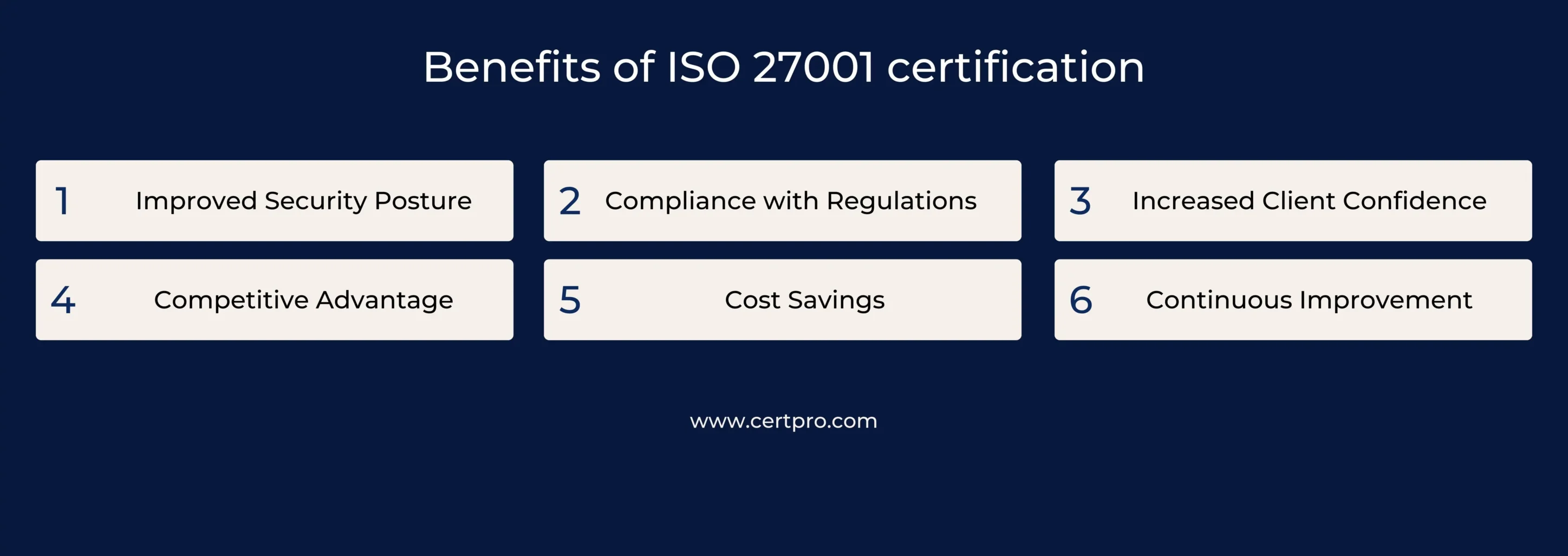
- ✓Independent Verification of Information Security Controls
- ✓Structured Risk Management and Continual Improvement
- ✓Regulatory Alignment and GDPR Mapping
Industry Sectors in Budapest Seeking ISO 27001 Certification
ISO 27001 Certification in Budapest encompasses a broad range of industry sectors reflecting the city’s diverse and internationally integrated economy. The following table outlines the primary organizational profiles engaging ISO 27001 certification and the key drivers specific to each sector.
| Industry Sector | Primary ISO 27001 Driver | Key Information Assets |
|---|---|---|
| Financial Services and Fintech | Regulatory compliance, client due diligence, EBA ICT risk requirements | Payment data, customer financial records, transaction processing systems |
| Shared Services and BPO | Client contractual requirements, multinational data processing obligations | HR data, finance records, customer data processed on behalf of clients |
| Software Development and IT Services | Enterprise vendor qualification, market access, supply chain security | Source code, development environments, customer system access credentials |
| SaaS and Cloud Providers | Regulated-industry client requirements, international market expansion | Multi-tenant customer data, cloud infrastructure, API security |
| Managed Service Providers | Third-party risk management requirements from enterprise clients | Client network access, endpoint management systems, monitoring infrastructure |
Shared Services Centers and BPO Operators
Budapest hosts one of the highest concentrations of shared services centers in Central and Eastern Europe. Major multinational corporations from the financial, pharmaceutical, consumer goods, energy, and technology sectors operate significant BPO and global business services functions from the city. These centers handle sensitive HR data, finance and accounting records, customer relationship data, and operational information on behalf of parent organizations and external clients across multiple jurisdictions.
ISO 27001 Certification in Budapest for companies in the shared services sector provides parent organizations and external clients with independently verified assurance that information security controls governing data processing activities are designed and operating effectively. Annual ISO 27001 audit procedures monitor continued ISMS operation and flag any material changes to the data processing environment. This supports ongoing supply chain risk management requirements across client organizations globally.
Software Development, IT Services, and Automotive Engineering
Budapest’s software development and IT services sector serves both domestic and international clients, with a growing number of firms providing embedded software, automotive engineering software, and industrial automation systems to European and global manufacturing clients. These organizations handle intellectual property, proprietary design data, and client system access credentials — high-value information assets that require structured security protection.
ISO 27001 compliance pursued by Budapest technology organizations provides a documented framework for managing access to source code repositories, controlling privileged access to client environments, and maintaining secure software development lifecycle practices. For automotive engineering service providers, ISO 27001 certification complements sector-specific standards such as TISAX (Trusted Information Security Assessment Exchange), which references ISO/IEC 27001 principles. Certification by an independent body such as CertPro provides evidence of systematic information security discipline that supports client qualification assessments in the automotive supply chain.
ISO 27001 Certification Scope and Independent Decision Framework
Defining and Evaluating the ISMS Scope
The scope of ISO 27001 certification defines the boundaries of the ISMS subject to independent audit and certification. Scope definition is a critical step in the certification process because it determines which information assets, organizational units, physical locations, technology environments, and processes are subject to audit evaluation. An organization seeking ISO 27001 Certification in Budapest may define its scope to cover a single operational division, a specific service line, a defined data center environment, or the entire organization.
The auditor evaluates whether the defined scope accurately reflects the operational environment and whether any exclusions from the scope are appropriately justified. Scopes that exclude significant information security risk areas without documented justification may be flagged as concerns during the ISO 27001 examination. The certificate issued at the conclusion of the audit explicitly references the certified scope, giving clients and stakeholders a clear understanding of which organizational functions and information assets are covered by the certification.
Evidence-Based Assessment Methodology
The ISO 27001 audit is conducted using an evidence-based assessment methodology consistent with ISO 19011 guidelines for auditing management systems. The auditor collects evidence through multiple channels: review of documented policies, procedures, and records; observation of control activities and physical security arrangements; system demonstrations of technical controls such as access management, logging, and monitoring configurations; and interviews with personnel responsible for ISMS processes and Annex A controls.
Evidence is assessed against the specific requirements of ISO/IEC 27001:2022 clauses and the controls identified in the organization’s Statement of Applicability. The auditor documents findings in a structured report that distinguishes between conforming evidence, observations that may indicate emerging risks, and nonconformities representing departures from standard requirements. This findings report forms the basis of the certification committee’s independent review and provides the organization with actionable audit conclusions regardless of the certification outcome — a core strength of the ISO 27001 attestation process.
Nonconformity Management and Corrective Action
Nonconformities identified during the ISO 27001 audit represent specific instances where the organization’s ISMS does not meet the requirements of ISO/IEC 27001:2022. Nonconformities are classified and documented in the audit findings report with reference to the specific clause or Annex A control requirement not met. The organization must then analyze the root cause of each nonconformity, define and implement corrective actions, and provide documented evidence that those actions have been effectively implemented.
The certification committee reviews the organization’s corrective action response as part of its independent evaluation prior to issuing a certification decision. Unresolved nonconformities prevent certification from being issued or may result in suspension of an existing certificate. The corrective action process is a defined element of the ISO 27001 compliance framework and is evaluated during subsequent surveillance audits. This confirms sustained resolution and assesses whether the root cause analysis identified systemic issues requiring broader ISMS process improvements.
ISO 27001 Transition to the 2022 Standard
Key Changes in ISO/IEC 27001:2022
ISO/IEC 27001:2022 introduced substantive updates to both the management system clauses and the Annex A control set compared to the 2013 version. The control count was reduced from 114 to 93, with controls reorganized into four domains: Organizational (37 controls), People (8 controls), Physical (14 controls), and Technological (34 controls). Eleven new controls were introduced in the 2022 version, including controls addressing threat intelligence, information security for cloud services, ICT readiness for business continuity, physical security monitoring, configuration management, data masking, data leakage prevention, web filtering, and secure coding.
Organizations previously certified to ISO 27001:2013 are required to complete transition to ISO/IEC 27001:2022 by October 31, 2025. After this date, certificates referencing the 2013 version will no longer be considered valid. Organizations in Budapest holding 2013-version certificates that have not yet transitioned face the risk of client and procurement processes rejecting expired or superseded ISO 27001 certification credentials — making timely transition a business-critical priority.
Transition Audit Requirements
Organizations transitioning from ISO 27001:2013 to ISO/IEC 27001:2022 certification must update their ISMS documentation to reflect the revised clause structure and demonstrate conformance with the new and restructured Annex A controls. The Statement of Applicability must be updated to reference the 2022 control set, incorporating the eleven new controls with documented applicability decisions and justifications. The risk assessment must also be reviewed to confirm that all 2022 controls have been considered as part of the risk treatment process.
The transition audit evaluates the organization’s revised documentation, updated SoA, and evidence that the ISMS has been adapted to address the requirements of the 2022 standard. CertPro conducts transition audits as part of the ISO 27001 audit process for organizations in Budapest upgrading from 2013-version certification. Depending on the organization’s certification cycle position and the extent of ISMS changes, the transition audit may be combined with a scheduled surveillance or recertification audit.
FAQ
▶
What is ISO 27001 certification and who issues it in Budapest?
▶
What is the difference between Stage 1 and Stage 2 of the ISO 27001 audit?
▶
How long is an ISO 27001 certificate valid?
▶
Which Budapest organizations are required to obtain ISO 27001 certification?
▶
What documents are required for ISO 27001 compliance in Budapest?
▶
What is an ISO 27001 surveillance audit and when does it occur?
▶
Does ISO 27001 certification satisfy GDPR requirements?
▶
What is the deadline for transitioning from ISO 27001:2013 to ISO/IEC 27001:2022?
Get In Touch
have a question? let us get back to you.