
ISO 27001 Certification in Cambridge
ISO 27001 Certification in Cambridge is delivered by CertPro as a Licensed CPA Firm and independent third-party certification body. CertPro evaluates an organisation’s Information Security Management System against the requirements of ISO/IEC 27001:2022, covering management system clauses 4 through 10, Annex A control domains, and the confidentiality, integrity, and availability of information assets. CertPro provides no advisory, implementation, or consulting services — the scope is strictly ISO 27001 audit and certification.
OUR CLIENTS










ISO 27001 Certification for Cambridge-Based Technology and Life Sciences Organizations
ISO 27001 Certification in Cambridge is delivered by CertPro as a Licensed CPA Firm and independent third-party certification body. CertPro evaluates an organisation’s Information Security Management System against the requirements of ISO/IEC 27001:2022, covering management system clauses 4 through 10, Annex A control domains, and the confidentiality, integrity, and availability of information assets. CertPro provides no advisory, implementation, or consulting services — the scope is strictly ISO 27001 audit and certification.
Cambridge’s Information Security Landscape
Cambridge’s technology cluster — anchored by the Cambridge Science Park, Babraham Research Campus, and the broader Cambridge Cluster — generates significant volumes of sensitive research data, intellectual property, and personal information. Biotechnology and life sciences firms in the area must meet strict data protection obligations under the UK General Data Protection Regulation and the Data Protection Act 2018.
Artificial intelligence and deep tech companies managing proprietary model training datasets, inference pipelines, and customer records face increasing enterprise procurement scrutiny from regulated buyers across financial services, healthcare, and the public sector. ISO 27001 Certification in Cambridge provides an independently verified baseline of information security control effectiveness that aligns with these regulatory and commercial demands.
University-driven research spinouts and early-stage technology companies scaling into enterprise markets commonly identify ISO 27001 Certification as a prerequisite for vendor approval. This ISO 27001 attestation is distinct from self-assessment or internal compliance declarations, providing objective, third-party verification that unlocks access to larger customer bases and international markets.
Licensed CPA Firm as Independent Certification Body
CertPro operates as a Licensed CPA Firm and functions solely as an independent certification body for organisations seeking ISO 27001 Certification in Cambridge. The certification relationship requires structural independence — CertPro does not design controls, develop ISMS documentation, or advise on remediation strategies.
The certification decision is issued by an independent certification committee following evidence-based review of audit findings from Stage 1 and Stage 2 audits conducted against ISO/IEC 27001:2022. This structural separation between the ISO 27001 audit function and any advisory or consulting activity preserves the integrity of the certification outcome and satisfies applicable independence requirements.
Organisations that have previously engaged consultants to implement their ISMS are assessed solely on the conformity and operating effectiveness of those controls at the time of audit, without any dependency on the identity or approach of the implementing party.
Applicable Standard: ISO/IEC 27001:2022
The current applicable standard for ISO 27001 Certification is ISO/IEC 27001:2022, which replaced the 2013 edition. The 2022 revision restructured and consolidated Annex A controls into four domains — Organisational, People, Physical, and Technological — reducing the total control count from 114 in the 2013 version to 93 across the four domains.
The revision also introduced new controls addressing threat intelligence, cloud security, information deletion, and data masking. These additions reflect the operational realities facing Cambridge technology companies and biotech firms pursuing ISO 27001 Certification in Cambridge today.
Organisations previously certified against the 2013 edition were required to transition to the 2022 standard by the October 31, 2025 deadline established by accreditation bodies. Organisations seeking ISO 27001 compliance in Cambridge must ensure their current certification scope references the 2022 edition and that their Statement of Applicability reflects the updated Annex A control structure.

What Is ISO 27001 Certification?
ISO 27001 Certification is a formal third-party attestation that an organisation’s Information Security Management System conforms to the requirements of ISO/IEC 27001:2022. The certification is issued following an independent ISO 27001 audit conducted by an accredited or licensed certification body. It confirms that the organisation has established, implemented, maintained, and continually improved an ISMS in accordance with the standard’s management system clauses and Annex A control domains.
ISO 27001 attestation differs from self-assessment or internal compliance declarations in that it requires objective evidence gathered by independent auditors. That evidence is then reviewed by a certification committee structurally separate from the audit team, ensuring an unbiased and credible certification outcome.
Core Requirements of the ISO/IEC 27001:2022 Standard
ISO 27001 compliance requires organisations to satisfy the management system requirements defined in clauses 4 through 10 of the standard. Clause 4 addresses organisational context and the determination of interested parties and their requirements. Clause 5 establishes leadership obligations, including the information security policy and defined roles. Clause 6 covers planning — specifically risk assessment and risk treatment — and requires organisations to produce a Statement of Applicability identifying applicable Annex A controls.
Clauses 7 through 10 address support resources, operational execution, performance evaluation, and continual improvement. The ISO 27001 examination of an organisation’s management system evaluates conformity with each of these clauses through documented evidence and control testing. Conformity with Annex A controls is evaluated alongside the Statement of Applicability, which must accurately reflect the organisation’s risk treatment decisions.
The Information Security Management System Defined
An Information Security Management System is the structured set of policies, procedures, processes, and controls that an organisation establishes to manage information security risks and protect information assets. The ISMS is not a technology platform — it is a management framework that governs how an organisation identifies risks, selects and implements controls, monitors control effectiveness, and responds to security incidents.
The scope of the ISMS — the organisational units, locations, processes, and information assets included — is defined by the organisation and documented as part of the certification scope. ISO 27001 Certification in Cambridge evaluates the ISMS as defined within the certified scope, and the issued certificate specifies that scope explicitly. Organisations may choose to certify a subset of their operations, provided the scope boundary is clearly documented and justified.
Annex A Control Domains Under ISO/IEC 27001:2022
ISO/IEC 27001:2022 organises its 93 controls across four Annex A domains. The Organisational domain contains 37 controls addressing policies, roles, threat intelligence, supplier relationships, and incident management. The People domain contains 8 controls covering personnel security, awareness, and responsibilities. The Physical domain contains 14 controls addressing physical security boundaries, equipment protection, and secure working areas. The Technological domain contains 34 controls addressing access management, cryptography, network security, application security, and data masking.
Each control in Annex A is evaluated for applicability based on the organisation’s risk assessment. The Statement of Applicability must record justifications for any controls identified as not applicable. During the ISO 27001 audit, auditors review the Statement of Applicability against the risk treatment plan to verify that control selection decisions are risk-driven and consistently documented.
| Annex A Domain | Control Count | Key Focus Areas |
|---|---|---|
| Organisational | 37 | Policies, roles, threat intelligence, supplier security, incident management |
| People | 8 | Personnel security, awareness training, responsibilities |
| Physical | 14 | Physical boundaries, equipment protection, secure working areas |
| Technological | 34 | Access control, cryptography, network security, data masking |
ISO 27001 Certification Audit Process in Cambridge
The ISO 27001 audit process in Cambridge follows a structured sequence of stages, each producing documented outputs that feed into the next stage. The process is designed to provide objective evidence of ISMS conformity and control effectiveness, culminating in an independent certification decision. The stages below describe how ISO 27001 audit engagements in Cambridge are structured and executed by CertPro as the certifying body.
The ISO 27001 Certification process begins with an application review. The organisation submits information about its ISMS scope, the number of in-scope locations, its size, and the nature of the information assets and processes covered. CertPro reviews this information to determine the audit program, including the appropriate audit duration, audit team composition, and the scheduling of Stage 1 and Stage 2 audits.
The audit program reflects the complexity of the ISMS scope, the organisation’s risk profile, and any multi-site considerations. For ISO 27001 Certification in Cambridge life sciences firms, for example, the program accounts for the sensitivity of research data, laboratory information management systems, and regulatory obligations that influence ISMS design. The finalised audit program is documented and shared with the organisation before the Stage 1 audit commences.
The Stage 1 audit is a review of the organisation’s ISMS documentation and readiness to proceed to the Stage 2 audit. During Stage 1, auditors review the information security policy, the risk assessment methodology and results, the risk treatment plan, the Statement of Applicability, and evidence that the ISMS has been implemented and has been operating for a sufficient period.
The Stage 1 audit also identifies any significant gaps in documentation or ISMS design that would likely result in nonconformities at Stage 2. A Stage 1 audit report is issued following this review, and the organisation is informed of any areas requiring attention before Stage 2 is scheduled. For ISO 27001 Certification in Cambridge technology companies, the Stage 1 review typically includes an assessment of how the ISMS documentation addresses cloud security controls, data classification, and access management.
The Stage 2 audit is the principal ISO 27001 certification assessment. During this stage, auditors evaluate the operating effectiveness of the ISMS controls defined in the organisation’s Statement of Applicability. Evidence is collected through document review, observation, personnel interviews, and technical testing where applicable.
Evidence gathered during the Stage 2 audit is evaluated against the requirements of ISO/IEC 27001:2022 clauses 4 through 10 and the applicable Annex A controls. Nonconformities are classified and documented in the audit report, and the organisation must submit a corrective action plan before the certification committee reviews the findings. For Cambridge fintech organisations, Stage 2 testing commonly focuses on access control, cryptographic key management, incident response procedures, and third-party supplier security assessments.
| Audit Stage | Key Activities | Output |
|---|---|---|
| Application Review | Scope confirmation, audit program determination, team assignment | Audit program document |
| Stage 1 Audit | Documentation review, ISMS readiness assessment, gap identification | Stage 1 audit report |
| Stage 2 Audit | Control effectiveness testing, evidence collection, nonconformity identification | Stage 2 audit report |
| Nonconformity Review | Corrective action plan review, evidence of closure | Nonconformity closure confirmation |
| Certification Decision | Independent committee review of audit findings | ISO 27001 certificate |
Following the Stage 2 audit and nonconformity closure review, audit findings are submitted to CertPro’s independent certification committee for a certification decision. The committee reviews the audit report and evidence independently of the audit team, then issues the ISO 27001 attestation upon confirming that the ISMS conforms to ISO/IEC 27001:2022.
The certificate is valid for a three-year certification cycle, subject to successful annual surveillance audits in years one and two. Surveillance audits assess ongoing ISMS operation, internal audit program effectiveness, management review outputs, and any changes to the ISMS scope or control environment. A recertification audit is conducted before the three-year cycle expires to renew the certificate. Organisations that fail to maintain ongoing ISO 27001 compliance may have their certification suspended or withdrawn by the certification committee.
- ✓Application Review and Audit Program Determination
- ✓Stage 1 Audit: Documentation and Readiness Review
- ✓Stage 2 Audit: Control Effectiveness and Evidence Collection
- ✓Certification Decision, Surveillance, and Recertification
ISO 27001 Certification Requirements for Cambridge Organizations
Achieving ISO 27001 compliance requires organisations to satisfy a defined set of documentation, process, and control requirements before the Stage 2 audit can confirm ISMS conformity. The following requirements are evaluated during the ISO 27001 examination conducted by CertPro auditors for Cambridge-based organisations.
The ISO 27001 examination requires organisations to maintain a defined set of documented information as mandatory ISMS outputs. The four core documentation requirements are: the information security policy, the risk assessment methodology and results, the risk treatment plan, and the Statement of Applicability.
The information security policy must be approved by top management, communicated to relevant parties, and available as documented information. The risk assessment must follow a defined methodology that produces consistent and comparable results, and the results must be retained as evidence. The risk treatment plan must document selected controls, the rationale for their selection, and the responsible parties for implementation. The Statement of Applicability must list all 93 Annex A controls, indicate whether each is applicable, and provide justification for any excluded controls. These four documents form the evidential backbone of the ISMS that auditors review during the Stage 1 assessment.
Beyond documentation, ISO 27001 compliance requires evidence that the ISMS has been operationally implemented and has been functioning for a sufficient period prior to the certification audit. Auditors assess whether the internal audit program has been executed and whether results have been reported to management. Evidence of management review meetings — including inputs such as audit results and nonconformity status, and outputs such as decisions on ISMS improvements — must be retained and made available.
The organisation must also demonstrate processes for identifying and responding to information security incidents, managing nonconformities, and conducting continual improvement activities. For ISO 27001 Certification in Cambridge biotech firms operating under UK GDPR obligations, ISMS operational records must reflect how personal data processing activities are addressed within the control environment — particularly under controls relating to data classification, access management, and incident response.
Technical control requirements under Annex A of ISO/IEC 27001:2022 vary based on the organisation’s risk assessment and the applicable controls identified in its Statement of Applicability. Common technical controls evaluated during the ISO 27001 audit include access control policies and their technical enforcement, logging and monitoring configurations, cryptographic controls for data in transit and at rest, network security segmentation, vulnerability management processes, and secure development lifecycle practices.
Cambridge technology companies and SaaS providers seeking ISO 27001 Certification are frequently assessed on cloud security controls — including cloud service configuration management, multi-tenant data segregation, and identity and access management in cloud environments. The Technological domain’s 34 controls provide the framework for this assessment, and auditors evaluate the design and operating effectiveness of each applicable control against documented evidence from the organisation’s ISMS.
- ✓Information security policy approved by top management and communicated to relevant parties
- ✓Documented risk assessment methodology with retained results
- ✓Risk treatment plan identifying selected Annex A controls and responsible parties
- ✓Statement of Applicability listing all 93 Annex A controls with applicability justifications
- ✓Internal audit program with documented results reported to management
- ✓Evidence of management review meetings with documented inputs and outputs
- ✓Incident response process with documented incident records
- ✓Nonconformity and corrective action records demonstrating continual improvement
- ✓Core ISMS Documentation Requirements
- ✓Operational and Process Requirements
- ✓Technical Control Requirements Across Annex A Domains
Why Organizations in Cambridge Pursue ISO 27001 Certification
Organisations across Cambridge’s technology, life sciences, and research-driven sectors pursue ISO 27001 Certification in Cambridge for reasons rooted in commercial necessity, regulatory alignment, and operational risk management. The demand drivers below reflect the specific conditions of the Cambridge market and the expectations of enterprise buyers, academic institutions, and regulated entities with which Cambridge organisations transact.
Enterprise Vendor Security Reviews and Procurement Requirements
Enterprise procurement processes in technology, financial services, healthcare, and the public sector increasingly require suppliers to demonstrate ISO 27001 compliance as a condition of vendor approval. Organisations supplying software, cloud services, or data processing capabilities to NHS trusts, financial institutions, government departments, or large technology companies in the Cambridge region frequently encounter ISO 27001 Certification as a mandatory or strongly preferred vendor qualification criterion.
In a representative scenario, a Cambridge-based SaaS provider seeking to onboard a regulated financial services client submits its ISO 27001 certificate as evidence of ISMS conformity — satisfying the client’s third-party risk management requirement without a bespoke security questionnaire process. ISO 27001 attestation allows Cambridge organisations to produce the certificate and associated audit scope statement in response to procurement security reviews, significantly reducing the administrative burden of repeated assessments from multiple enterprise buyers.
Regulatory Alignment for Life Sciences and Biotech Organizations
ISO 27001 Certification for Cambridge life sciences and biotech firms provides a structured mechanism for demonstrating information security control effectiveness in the context of UK GDPR compliance, clinical data protection obligations, and pharmaceutical regulatory requirements. While ISO 27001 Certification does not replace regulatory compliance under the Medicines and Healthcare products Regulatory Agency or other sector-specific bodies, it provides documented evidence that the organisation has implemented controls addressing data confidentiality, integrity, and availability.
Organisations operating from the Babraham Research Campus or affiliated with Cambridge’s research hospitals that process personal health data benefit from ISO 27001 compliance as a demonstration that their ISMS addresses the technical and organisational security measures required under UK GDPR Article 32. The structured risk assessment and control selection process required by the standard maps directly to the risk-based approach to data protection mandated by data protection legislation.
International Market Access for Cambridge Technology Exporters
ISO 27001 Certification is recognised internationally and is accepted by enterprise buyers in North America, the European Union, the Asia-Pacific region, and other markets as evidence of a structured and independently verified information security control environment. Cambridge’s AI and deep tech companies, university spinouts, and SaaS providers frequently seek to expand into international markets where local enterprise buyers require ISO 27001 Certification as part of their vendor qualification process.
Cambridge fintech organisations seeking to serve regulated financial institutions in the EU or the United States, for example, produce their ISO 27001 certificate as part of the vendor due diligence package submitted to prospective clients. The international recognition of ISO 27001 Certification reduces the need for multiple country-specific security assessments and supports consistent demonstration of control effectiveness across different regulatory environments.
Benefits of ISO 27001 Certification for Cambridge-Based Organizations
ISO 27001 Certification in Cambridge delivers a range of independently verified benefits relevant to the information security posture, commercial positioning, and operational governance of Cambridge-based organisations. The benefits below reflect the outcomes of successful ISO 27001 Certification as documented through the audit and certification process.
The primary benefit of ISO 27001 Certification is the independent, third-party verification that the organisation’s ISMS controls are designed and operating effectively. This verification is distinct from internal audit conclusions or management self-assessments — it is conducted by auditors with no consulting relationship with the organisation and reviewed by an independent certification committee.
The ISO 27001 audit process in Cambridge produces documented evidence of control effectiveness that the organisation can reference in regulatory filings, contractual representations, and due diligence responses. For organisations in Cambridge’s technology and research sectors, this independently verified evidence base reduces reliance on subjective security representations and provides a structured, auditable record of ISMS control operation across multiple stakeholder engagements.
ISO 27001 compliance requires organisations to maintain a structured risk management process that is reviewed and updated at defined intervals. The risk assessment methodology, risk treatment plan, and Statement of Applicability together create a documented framework for identifying information security risks, selecting proportionate controls, and monitoring control effectiveness over time.
The continual improvement requirements in clause 10 of ISO/IEC 27001:2022 mandate that organisations identify nonconformities, conduct root cause analysis, implement corrective actions, and verify their effectiveness. This structured improvement cycle — evaluated during annual surveillance audits — ensures the ISMS adapts to changes in the organisation’s threat environment, technology infrastructure, and business context. Cambridge organisations pursuing ISO 27001 Certification demonstrate to customers and regulators that information security is managed through a systematic, evidence-based process rather than ad hoc controls or reactive incident response.
ISO 27001 attestation is recognised in enterprise and financial sector procurement processes as a standard indicator of third-party information security maturity. Cambridge organisations supplying services to regulated financial institutions, insurance companies, asset managers, or fintech platforms benefit from the certificate’s acceptance as a vendor qualification document within existing third-party risk management frameworks.
The certificate eliminates or significantly reduces the need for bespoke security questionnaires and individual control assessments in procurement contexts where buyers accept ISO 27001 Certification as sufficient evidence of ISMS conformity. Cambridge companies seeking entry into competitive public sector procurement frameworks — including G-Cloud and the Digital Marketplace — similarly benefit from the certificate’s recognition as a security assurance marker by government buyers assessing cloud and technology vendor credentials.
- ✓Independent third-party verification of ISMS control design and operating effectiveness
- ✓Documented evidence base for regulatory filings, contractual representations, and due diligence
- ✓Structured risk management framework covering risk identification, treatment, and monitoring
- ✓Recognition in enterprise procurement processes as a vendor security qualification credential
- ✓Alignment with UK GDPR technical and organisational security measure requirements under Article 32
- ✓Annual surveillance audit oversight ensuring ongoing ISMS conformity throughout the three-year cycle
- ✓International recognition supporting market expansion across North America, EU, and Asia-Pacific
- ✓Structured continual improvement process governed by clause 10 of ISO/IEC 27001:2022
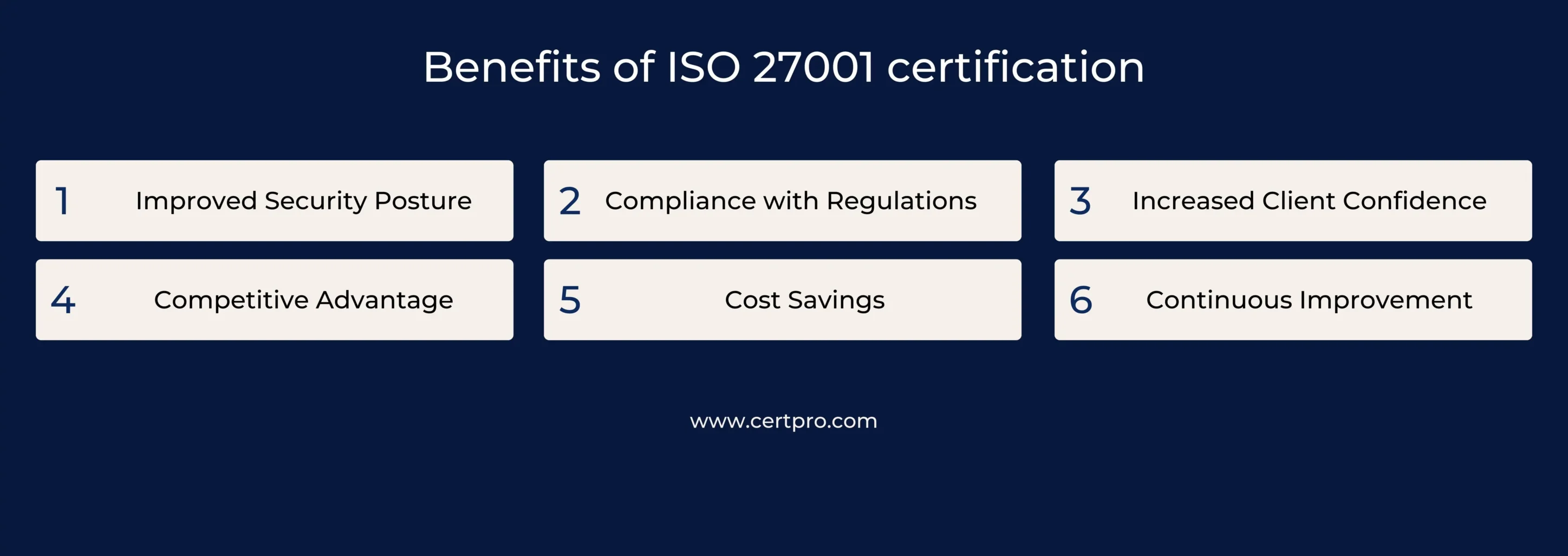
- ✓Independent Verification of Information Security Control Effectiveness
- ✓Structured Risk Management and Continual Improvement
- ✓Recognition in Financial Sector and Enterprise Procurement Processes
Industry Sectors in Cambridge Seeking ISO 27001 Certification
ISO 27001 Certification in Cambridge is pursued across a defined range of industry sectors reflecting the city’s distinct innovation ecosystem. The sectors below represent the primary organisational profiles seeking ISO 27001 audit engagements in Cambridge through CertPro.
Biotechnology, Life Sciences, and Research Organizations
Biotechnology and life sciences organisations in Cambridge — including those operating from the Babraham Research Campus, the Wellcome Genome Campus, and the Cambridge Biomedical Campus — process significant volumes of sensitive research data, clinical trial information, genomic data, and personal health information. ISO 27001 Certification for Cambridge biotech firms demonstrates that their information security controls meet defined international standards, satisfying the expectations of pharmaceutical partners, academic collaborators, clinical trial sponsors, and regulatory authorities.
The ISMS scope for life sciences organisations typically includes laboratory information management systems, electronic data capture platforms, bioinformatics infrastructure, and the associated data governance processes that protect the confidentiality and integrity of research outputs.
Artificial Intelligence, Deep Tech, and SaaS Providers
Cambridge’s artificial intelligence and deep tech sector — including companies operating from the Cambridge Science Park, ARM’s Cambridge headquarters ecosystem, and university-affiliated research commercialisation vehicles — manages proprietary model training data, inference infrastructure, and customer-facing platforms that handle sensitive information. ISO 27001 Certification in Cambridge for AI sector companies demonstrates that their data handling practices, model governance processes, and customer data security controls are independently assessed against ISO/IEC 27001:2022.
SaaS providers serving enterprise customers from Cambridge data centres or cloud infrastructure benefit from ISO 27001 compliance as a baseline security assurance that satisfies enterprise security review requirements without requiring bespoke assessment for each customer engagement. ISO 27001 Certification for Cambridge AI and SaaS companies frequently covers cloud-hosted infrastructure, development environments, and customer data processing pipelines.
Fintech, Financial Services Technology, and University Spinouts
Cambridge’s growing fintech sector and university-driven research spinouts — including companies commercialising intellectual property from the University of Cambridge’s engineering, computer science, and mathematics departments — frequently seek ISO 27001 Certification as an enabling credential for commercial partnerships with regulated financial institutions. ISO 27001 compliance for Cambridge fintech organisations is assessed against controls relevant to financial data security, payment processing environments, fraud detection systems, and customer identity and access management.
University spinouts entering enterprise markets for the first time commonly identify ISO 27001 Certification as the initial third-party security assurance credential required by their first enterprise customers. The ISO 27001 audit evaluates the ISMS as implemented regardless of the organisation’s size or age, provided the ISMS has been operationally active for a sufficient period, establishing a scalable foundation for subsequent security certifications or regulatory approvals.
| Sector | Key ISMS Scope Areas | Primary Demand Driver |
|---|---|---|
| Biotechnology and Life Sciences | Research data, clinical trial information, genomic data, LIMS | Pharmaceutical partner and regulatory expectations |
| AI and Deep Tech | Model training data, inference infrastructure, customer data pipelines | Enterprise procurement and vendor due diligence |
| SaaS Providers | Cloud infrastructure, development environments, customer data processing | Enterprise vendor qualification requirements |
| Fintech and Financial Technology | Payment systems, customer identity management, fraud detection | Regulated financial institution partnership requirements |
| University Spinouts | Intellectual property systems, research data, commercial platforms | First enterprise customer security qualification |
Certification Scope, Independence, and the Certification Decision Framework
The ISO 27001 attestation issued by CertPro reflects a certification decision made through a structured, evidence-based process by an independent certification committee. The following describes the scope definition, independence requirements, and decision framework that govern ISO 27001 Certification in Cambridge engagements.
Defining and Documenting the ISMS Scope
The scope of ISO 27001 Certification defines the organisational units, physical locations, processes, information assets, and technology systems included within the certified ISMS boundary. The scope must be documented by the organisation and must accurately reflect the boundary of the management system that has been established, implemented, and maintained in accordance with the standard. Scope boundaries must be clearly justified, and any exclusions of organisational activities or assets that interact with in-scope systems must be explained.
The ISO 27001 examination conducted during Stage 1 reviews the scope documentation for clarity and completeness. Auditors assess whether the defined scope boundary is coherent and whether excluded elements are appropriately justified. The issued ISO 27001 certificate specifies the certified scope statement, which organisations reference in contractual representations, procurement submissions, and regulatory disclosures.
Independence Requirements and Structural Separation
CertPro’s role as an independent certification body requires structural separation between the certification function and any advisory, consulting, or implementation activities. This independence is a prerequisite for the credibility and validity of the ISO 27001 attestation. Auditors conducting ISO 27001 audit engagements in Cambridge have no prior consulting relationship with the audited organisation and are evaluated for independence and competence before assignment.
The certification committee reviewing audit findings is composed of members who have not participated in the audit and who make the certification decision based solely on documented audit evidence. This structural separation means that the organisation’s previous use of external consultants to implement the ISMS does not affect the independence of the certification process, provided CertPro has no prior consulting relationship with those individuals in the context of the audited organisation.
Nonconformity Classification and Certificate Suspension
Nonconformities identified during the ISO 27001 audit are documented in the audit report and communicated to the organisation. The organisation must submit a corrective action plan and evidence of corrective action implementation before the certification committee can issue the certificate. Where nonconformities identified during surveillance audits indicate a significant failure of ISMS operation or a breakdown in the continual improvement process, the certification committee may suspend the certificate pending corrective action.
Persistent or unresolved nonconformities may result in certificate withdrawal. Cambridge organisations seeking to maintain ISO 27001 compliance must keep their ISMS in active operation throughout the three-year certification cycle — including maintaining the internal audit program, conducting annual management reviews, and addressing identified nonconformities within defined timeframes.
ISO 27001 Surveillance Audits and Certificate Maintenance
ISO 27001 Certification in Cambridge is maintained through a three-year certification cycle that includes annual surveillance audits and a recertification audit before the certificate expires. This surveillance and recertification structure ensures ongoing ISMS conformity and provides continuous independent oversight of the certified control environment.
Annual Surveillance Audit Scope and Focus Areas
Surveillance audits are conducted annually in years one and two of the three-year certification cycle. Each surveillance audit assesses a subset of the ISMS, focusing on areas of identified risk, changes to the ISMS scope or control environment, and the ongoing effectiveness of the internal audit program and management review process. Surveillance audits verify that the organisation has maintained ISO 27001 compliance since the previous audit, that identified nonconformities have been addressed, and that the ISMS continues to operate as documented.
For Cambridge technology companies that have expanded their operations, added new cloud services, or changed data processing activities since the initial certification audit, the surveillance audit scope is adjusted to address the changed ISMS environment. The surveillance audit report is reviewed by the certification committee, which determines whether certification status is to be maintained, suspended, or withdrawn.
Recertification Audit and Certificate Renewal
The recertification audit is conducted before the expiry of the three-year certification cycle and functions similarly to the initial Stage 2 audit in scope and depth. It reviews the full ISMS scope, evaluates the effectiveness of the management system over the preceding certification cycle, and assesses whether the organisation has maintained continual improvement as required by clause 10 of ISO/IEC 27001:2022. A successful recertification audit results in the issuance of a new three-year certificate, resetting the surveillance cycle.
Organisations that have undergone significant changes to their ISMS scope, technology infrastructure, or business context during the preceding certification cycle must demonstrate that these changes have been assessed for information security risk and addressed within the ISMS. ISO 27001 audit recertification engagements in Cambridge are scheduled and conducted using the same independent audit team assignment and certification committee review process as the initial certification.
FAQ
▶
What is ISO 27001 Certification and why is it relevant for Cambridge organizations?
▶
Which certification body provides ISO 27001 Certification in Cambridge?
▶
What is the difference between Stage 1 and Stage 2 audits in the ISO 27001 audit process?
▶
How long is an ISO 27001 certificate valid?
▶
What documents does an organization need for ISO 27001 certification?
▶
Does ISO 27001 certification in Cambridge cover UK GDPR compliance?
▶
What Annex A control domains are evaluated during the ISO 27001 audit?
▶
What happens if nonconformities are identified during the ISO 27001 audit?
Get In Touch
have a question? let us get back to you.