
ISO 27001 Certification in Canberra
ISO 27001 Certification in Canberra ACT is relevant across a broad range of sectors given the city’s distinctive industry composition. While government and defence dominate the Canberra economy, the ACT also hosts a significant and growing technology sector, as well as universities, research institutions, healthcare providers, financial services firms, and professional services organisations. Each of these sectors faces specific information security obligations and certification drivers that align with the requirements of the ISO 27001 standard and ISO/IEC 27001:2022.
OUR CLIENTS










ISO 27001 Certification for Canberra-Based Government, Defence, and Technology Organisations
CertPro is a Licensed CPA Firm providing independent ISO 27001 Certification in Canberra to Australian Government agencies, defence contractors, cybersecurity firms, SaaS providers, cloud platforms, universities, research institutions, and critical infrastructure operators across the Australian Capital Territory. ISO 27001 Certification in Canberra is the formal outcome of an independent conformity assessment confirming that an organisation’s Information Security Management System (ISMS) has been evaluated against the requirements of ISO/IEC 27001:2022. The ISO 27001 standard establishes a globally recognised framework for managing information security risks systematically and continuously. CertPro operates exclusively as an independent third-party certification body — evaluating conformity through structured ISO 27001 certification audits — and does not provide consulting, implementation, or advisory services to the organisations it certifies.
Canberra’s position as Australia’s national capital creates a distinctive information security environment unlike any other Australian city. The ACT is home to the highest concentration of Australian Government agencies, defence organisations, intelligence-adjacent technology firms, and government contractors in the country. Organisations operating within this ecosystem face procurement requirements, vendor assurance frameworks, and information handling obligations that frequently mandate or strongly incentivise independent ISO 27001 Certification in Canberra. Government panels, procurement gateways, and enterprise vendor due diligence processes routinely include ISO 27001 compliance as a prerequisite or evaluation criterion — making certification directly relevant to commercial access and contract eligibility for Canberra-based organisations.
ISO/IEC 27001:2022 is the current version of the ISO 27001 standard, specifying requirements for establishing, implementing, maintaining, and continually improving an ISMS. The standard is structured around management system clauses 4 to 10, which address organisational context, leadership, planning, support, operation, performance evaluation, and improvement. Annex A of ISO/IEC 27001:2022 contains 93 controls across four domains — Organisational, People, Physical, and Technological — against which an organisation’s control selection and implementation is assessed. The transition deadline from the 2013 version to the 2022 standard is 31 October 2025, as established by accredited certification bodies. Organisations in Canberra seeking ISO 27001 Certification must demonstrate conformity with the 2022 standard within this timeframe.
The scope of ISO 27001 Certification in Canberra varies by organisation type and information security obligations. For a government agency, scope may encompass the management of classified or sensitive government information, ICT systems, and third-party access controls. For a defence contractor, scope typically includes systems handling defence information, supply chain interfaces, and personnel security controls. For a technology company or SaaS provider, scope commonly covers the development, delivery, and support of software platforms and the cloud infrastructure on which they operate. CertPro evaluates the defined ISMS scope as documented by the organisation and assesses whether the controls implemented are appropriate, effective, and consistent with the organisation’s risk treatment decisions. The ISO 27001 certification decision is made independently by CertPro’s certification committee based on audit evidence.

What Is ISO 27001 Certification?
ISO 27001 Certification is the formal recognition that an organisation’s ISMS conforms to the requirements of ISO/IEC 27001:2022, as determined through an independent third-party audit conducted by an accredited or licensed certification body. Certification is not self-declared. It requires an external evaluation of documented information, implemented controls, internal audit records, management review outputs, risk assessment documentation, and objective evidence that the ISMS operates as described. The ISO 27001 standard specifies what an organisation must establish and maintain. ISO 27001 certification confirms, through independent assessment, that those requirements have been fully met.
The ISO/IEC 27001:2022 Standard and ISMS Requirements
ISO/IEC 27001:2022 requires organisations to establish an ISMS by defining its scope, identifying internal and external context, determining interested parties and their requirements, and conducting a structured information security risk assessment. The risk assessment process must identify information security risks, assign risk owners, and evaluate risks against defined criteria. Risk treatment decisions must be documented in a Risk Treatment Plan, and the organisation must produce a Statement of Applicability (SoA) that records which Annex A controls have been selected, which have been excluded, and the justification for each decision. The SoA is a central document reviewed during every ISO 27001 certification audit.
The management system clauses (4 to 10) of ISO/IEC 27001:2022 require documented information security policies, defined roles and responsibilities, competence and awareness records, internal audit programmes, management review meetings, and a process for handling nonconformities and corrective actions. These clauses form the governance backbone of the ISMS and are evaluated during both Stage 1 and Stage 2 of the ISO 27001 certification audit. An organisation is responsible for establishing, operating, and continually improving its ISMS. CertPro’s role is to independently assess whether that system meets the requirements of the ISO 27001 standard through structured, evidence-based audit activities.
Annex A Controls and the Statement of Applicability
Annex A of ISO/IEC 27001:2022 contains 93 information security controls grouped into four domains: Organisational controls (37), People controls (8), Physical controls (14), and Technological controls (34). These controls address areas including access control, cryptography, asset management, supplier relationships, incident management, business continuity, and secure development. During the ISO 27001 certification audit, CertPro evaluates whether the controls documented in the SoA have been implemented and are operating effectively, and whether the rationale for any exclusions is justified within the context of the organisation’s risk treatment decisions. All control evidence is assessed against objective audit criteria derived directly from the ISO 27001 standard.
| Annex A Domain | Number of Controls | Example Control Areas |
|---|---|---|
| Organisational | 37 | Policies, roles, asset management, supplier security, incident management |
| People | 8 | Screening, terms of employment, awareness, disciplinary process |
| Physical | 14 | Physical security perimeters, clear desk, equipment security |
| Technological | 34 | Access control, cryptography, secure development, vulnerability management |
ISO 27001 Certification Audit Process in Canberra
The ISO 27001 certification audit process for Canberra organisations follows a structured, multi-stage methodology conducted by CertPro as an independent certification body. Each stage produces documented outputs that feed into the subsequent stage, and the overall process culminates in an independent certification decision made by CertPro’s certification committee. The ISO 27001 audit process is consistent with international certification requirements and is applied uniformly across all sectors — whether a government agency, a defence contractor, a technology company, or a university operating in the ACT.
The Stage 1 audit is a structured review of the organisation’s ISMS documentation and readiness for the Stage 2 ISO 27001 certification audit. During Stage 1, CertPro’s auditors examine the ISMS scope statement, information security policy, risk assessment methodology and results, Risk Treatment Plan, Statement of Applicability, internal audit programme and results, and management review records. The Stage 1 audit determines whether the ISMS has been established in conformity with ISO/IEC 27001:2022 and whether the organisation is prepared for the Stage 2 on-site assessment. All Stage 1 findings are documented and communicated to the organisation before Stage 2 commences.
The Stage 2 ISO 27001 certification audit is an on-site evaluation of whether the ISMS is implemented and operating effectively in accordance with ISO/IEC 27001:2022. CertPro auditors collect objective evidence through interviews with personnel, observation of processes, and examination of records — including system configurations, access logs, change management records, incident logs, and operational documentation. The ISO 27001 audit evaluates both the design and operating effectiveness of controls documented in the SoA. Any nonconformities identified during Stage 2 are classified, documented, and communicated to the organisation. Corrective actions must be addressed before the certification committee can issue a certification decision.
Following the completion of Stage 2 and the resolution of any identified nonconformities, CertPro’s certification committee conducts an independent review of all audit evidence and findings. The certification decision is based solely on audit evidence — no other factors influence the outcome. If conformity is confirmed, CertPro issues an ISO 27001 certificate valid for three years, subject to satisfactory annual surveillance audits. Surveillance audits are conducted in Year 1 and Year 2 of the certification cycle to verify ongoing ISO 27001 compliance and continuous improvement. A recertification audit is conducted in Year 3 to renew the certificate for a further three-year cycle.
| Audit Stage | Key Activities | Output |
|---|---|---|
| Application Review | Scope definition, audit programme determination | Audit plan confirmed |
| Stage 1 Audit | ISMS documentation review, readiness assessment | Stage 1 findings report |
| Stage 2 Audit | On-site conformity assessment, evidence collection, control evaluation | Audit findings, nonconformity report |
| Certification Decision | Independent committee review of all audit evidence | ISO 27001 certificate issued |
| Surveillance Audit | Annual ongoing conformity verification (Year 1 and Year 2) | Surveillance audit report |
| Recertification Audit | Full ISMS reassessment (Year 3) | Certificate renewed for three years |
- ✓Stage 1 Audit: Documentation and Readiness Review
- ✓Stage 2 Audit: On-Site Conformity Assessment
- ✓Certification Decision, Issuance, and Ongoing Surveillance
ISO 27001 Requirements Evaluated During Certification
ISO 27001 compliance requires organisations to satisfy requirements across the full structure of ISO/IEC 27001:2022, from the management system clauses through to Annex A control implementation. During the ISO 27001 certification audit, CertPro evaluates conformity against each applicable clause and control. The evaluation is evidence-based — auditors assess documented information, operational records, and system outputs against defined audit criteria drawn from the ISO 27001 standard. Understanding what the standard requires at each clause helps organisations structure their ISMS documentation and operational practices appropriately before the certification audit commences.
ISO/IEC 27001:2022 specifies mandatory documented information across multiple clauses. Core documentation requirements include the ISMS scope statement, information security policy, risk assessment process documentation, risk assessment results, Risk Treatment Plan, Statement of Applicability, information security objectives, competence evidence, internal audit programme and results, management review records, and records of nonconformities and corrective actions. The information security policy must be authorised by top management, communicated to relevant personnel, and made available to interested parties. During the ISO 27001 certification audit, CertPro reviews whether each required document exists, is current, and reflects actual operational practice rather than aspirational intent.
The risk assessment process is central to ISO 27001 compliance. Organisations must establish and apply a documented methodology for identifying information security risks associated with the loss of confidentiality, integrity, and availability of information assets within the ISMS scope. Risk assessment results must be retained as documented information, and identified risks must be treated through a documented Risk Treatment Plan that maps treatment decisions to Annex A controls or other applicable controls. Internal audits must be conducted at planned intervals to determine whether the ISMS conforms to both the organisation’s own requirements and the ISO 27001 standard. Internal audit records are reviewed during the ISO 27001 certification audit as evidence that the organisation is actively monitoring and evaluating its own ISMS.
- ✓ISMS scope statement aligned with organisational context
- ✓Information security policy authorised by top management
- ✓Documented risk assessment methodology and risk assessment results
- ✓Risk Treatment Plan with mapped Annex A controls
- ✓Statement of Applicability with inclusion and exclusion justifications
- ✓Internal audit programme with results and follow-up records
- ✓Management review records including inputs, outputs, and decisions
- ✓Corrective action records for identified nonconformities
- ✓Documentation and Information Security Policy Requirements
- ✓Risk Assessment, Risk Treatment, and Internal Audit
Why Canberra Organisations Pursue ISO 27001 Certification
The demand for ISO 27001 Certification in Canberra is driven by a combination of government procurement requirements, defence industry obligations, enterprise vendor assurance frameworks, and the concentration of organisations handling sensitive or classified information across the ACT. Canberra’s unique ecosystem — where public sector technology, defence, intelligence-adjacent services, and government contracting intersect — creates specific and recurring certification drivers not present to the same degree in other Australian cities. For many Canberra-based organisations, ISO 27001 Certification functions as a direct commercial prerequisite rather than a voluntary quality signal.
Government Procurement and Vendor Assurance Requirements
Australian Government agencies operating under the Australian Government Information Security Manual (ISM) and the Protective Security Policy Framework (PSPF) apply vendor assurance requirements when engaging technology suppliers, managed service providers, and data processing partners. ISO 27001 Certification in Canberra is frequently cited within tender evaluation criteria, contract schedules, and supplier security assessment frameworks as evidence of an independently verified ISMS. Agencies sourcing cloud services, cybersecurity platforms, managed IT services, or data analytics solutions from Canberra-based vendors commonly require ISO 27001 certification as a condition of panel membership or contract award. The certification provides procurement officers with an independent, structured basis for vendor information security assurance that goes beyond self-reported questionnaires.
Defence Industry and National Security Sector Obligations
ISO 27001 Certification in Canberra is a common requirement for defence industry organisations operating within procurement frameworks such as the Defence Industry Security Program (DISP) and supply chain security requirements imposed by prime contractors. Defence contractors operating in Canberra — whether providing software, ICT infrastructure, engineering services, or logistics support — frequently encounter ISO 27001 certification as a requirement within contractual obligations or as an assessment criterion in tender processes. The certification provides an independently verified basis for demonstrating that defence-related information, systems, and supply chain interfaces are protected by a documented and audited ISMS. The ISO 27001 standard’s Annex A controls relevant to supplier relationships, access control, and operational security are of particular relevance in the defence context.
Technology, SaaS, and Cloud Providers Serving Regulated Sectors
Canberra-based IT companies — including SaaS developers, cloud service providers, AI platform operators, and managed security service providers — pursue ISO 27001 Certification in Canberra to meet the due diligence requirements of their government and enterprise customers. When a Canberra technology company supplies platforms or services to Australian Government agencies, financial institutions, healthcare organisations, or defence entities, those customers typically require independent verification of the supplier’s information security controls before onboarding. ISO 27001 Certification in Canberra serves as that independent verification — providing a structured, third-party-assessed basis for customer confidence that does not rely on self-declaration or questionnaire-based assessments alone.
Sectors Seeking ISO 27001 Certification in Canberra ACT
ISO 27001 Certification in Canberra ACT is relevant across a broad range of sectors given the city’s distinctive industry composition. While government and defence dominate the Canberra economy, the ACT also hosts a significant and growing technology sector, as well as universities, research institutions, healthcare providers, financial services firms, and professional services organisations. Each of these sectors faces specific information security obligations and certification drivers that align with the requirements of the ISO 27001 standard and ISO/IEC 27001:2022.
Government, Defence, and Public Sector Technology
Australian Government agencies and ACT Government entities managing information systems, digital services, and citizen data are primary pursuers of ISO 27001 Certification in Canberra ACT. These organisations manage information assets subject to the Privacy Act 1988, the Australian Privacy Principles, the ISM, and the PSPF. ISO 27001 compliance provides a structured framework for documenting and operating controls that align with these regulatory instruments. An independent ISO 27001 certification audit provides objective evidence that those controls are implemented and effective. Defence contractors and national security-adjacent technology organisations similarly pursue ISO 27001 Certification in Canberra to satisfy contractual and regulatory information security obligations specific to their operating environment.
Universities, Research Institutions, and Healthcare Providers
Canberra’s universities — including the Australian National University (ANU) and the University of Canberra — and research institutions such as CSIRO’s Data61, the Australian Institute of Health and Welfare (AIHW), and various government-funded research bodies manage substantial volumes of sensitive research data, personal information, and intellectual property. These organisations face increasing pressure from funding bodies, research partners, and government agencies to demonstrate formal information security governance. ISO 27001 Certification in Canberra provides universities and research organisations with an independently assessed ISMS framework that satisfies these expectations. Healthcare providers and health technology organisations in the ACT similarly seek ISO 27001 certification to address obligations under the My Health Records Act and the Australian Privacy Principles governing health information.
- ✓Australian Government agencies and ACT Government entities
- ✓Defence contractors and national security technology firms
- ✓Cybersecurity companies and managed security service providers
- ✓SaaS developers and cloud service providers
- ✓AI and data analytics platform operators
- ✓Universities and government-funded research institutions
- ✓Healthcare providers and health technology organisations
- ✓Financial services firms and fintech companies operating in the ACT
Benefits of ISO 27001 Certification for Canberra-Based Organisations
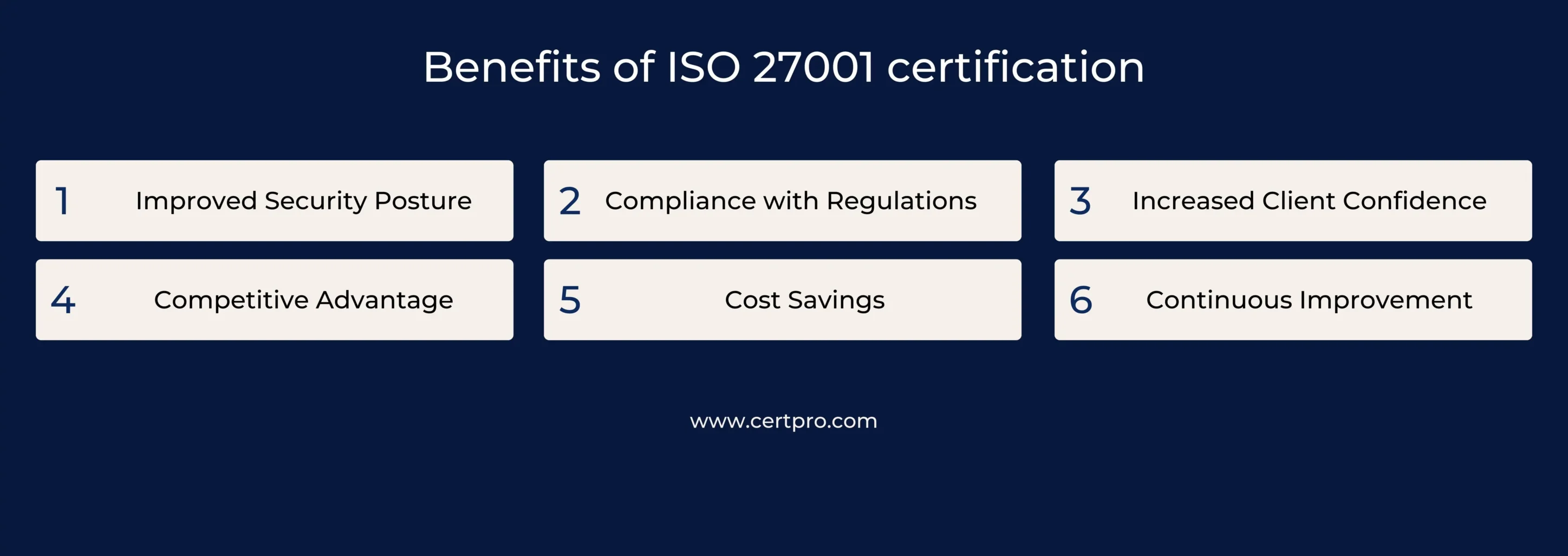
ISO 27001 Certification in Canberra delivers a range of substantive outcomes for organisations operating within the ACT’s government-centric and technology-driven ecosystem. These outcomes extend from procurement eligibility and contract access through to operational risk management, regulatory alignment, and stakeholder confidence. The benefits of ISO 27001 certification are grounded in the independent, third-party nature of the conformity assessment — certification carries credibility precisely because it is issued by an independent body that has assessed objective evidence, not by the organisation itself.
For Canberra organisations pursuing government contracts and panel arrangements, ISO 27001 Certification functions as a verifiable credential that satisfies vendor security assessment requirements in procurement processes. Australian Government agencies, ACT Government entities, and large prime contractors frequently include ISO 27001 certification as an eligibility criterion for technology and services panels. Holding a valid, independently issued ISO 27001 certificate removes the need for resource-intensive supplier security questionnaires in many tender processes. It also provides procurement officers with an objective, evidence-based basis for vendor information security assurance. This procurement dimension makes ISO 27001 Certification in Canberra particularly valuable for organisations competing for government technology contracts.
ISO 27001 compliance requires organisations to implement a structured, documented approach to information security risk management — including risk identification, assessment, treatment, and ongoing monitoring. The ISO 27001 certification audit evaluates whether this risk management process is operating effectively and producing documented outputs aligned with the organisation’s risk appetite. For Canberra organisations managing sensitive government information, defence data, health records, or research data, the ISMS provides a systematic mechanism for identifying and treating information security risks before they result in incidents. The annual surveillance audit cycle reinforces ongoing risk management discipline by requiring continuous evidence of ISMS operation and improvement.
ISO 27001 compliance supports alignment with multiple Australian and international regulatory instruments relevant to Canberra organisations. The Annex A controls address areas that map to requirements under the Privacy Act 1988, the Australian Privacy Principles, the Notifiable Data Breaches scheme, the ISM, and the PSPF. For organisations with international operations or customer bases, ISO/IEC 27001:2022 controls also provide a structured basis for addressing GDPR information security obligations. From a third-party risk management perspective, ISO 27001 Certification in Canberra provides customers, partners, and regulators with an independently verified basis for assessing the organisation’s information security posture — without relying solely on self-reported claims.
- ✓Procurement Eligibility and Government Panel Access
- ✓Structured Information Security Risk Management
- ✓Regulatory Alignment and Third-Party Risk Management
ISO 27001 Certification Scope for Canberra Organisations
Defining the scope of the ISMS is one of the most consequential decisions an organisation makes before pursuing ISO 27001 Certification in Canberra. The scope statement determines which information assets, business processes, organisational units, physical locations, and external relationships are included within the certified ISMS boundary. During the ISO 27001 certification audit, CertPro evaluates whether the defined scope is consistent with the organisation’s context, whether it is justified by the risk assessment, and whether the boundaries are clearly documented and maintained. Scope decisions directly affect the range of Annex A controls that must be addressed in the SoA.
Defining ISMS Scope and Boundaries
ISO/IEC 27001:2022 Clause 4.3 requires organisations to determine the boundaries and applicability of the ISMS. For a Canberra government contractor, scope might encompass the ICT systems, personnel, and physical facilities used to deliver a specific government contract, while excluding unrelated business lines. For a SaaS provider, scope might encompass the development, operations, and customer support functions associated with a specific platform. For a university, scope might encompass the research data management systems, researcher access controls, and data sharing interfaces. The scope must be documented, reviewed periodically, and assessed for continued appropriateness as the organisation’s activities, contracts, and risk profile evolve. CertPro’s Stage 1 ISO 27001 audit examines whether the scope is clearly defined and appropriately justified.
Certification Validity, Suspension, and Withdrawal
An ISO 27001 certificate issued by CertPro is valid for three years, subject to satisfactory completion of annual surveillance audits. If an organisation fails to undergo a scheduled surveillance audit, fails to resolve identified nonconformities within agreed timeframes, or experiences a significant change to its ISMS that is not reported to CertPro, the certificate may be suspended. Persistent or unresolved nonconformities can result in certificate withdrawal. ISO 27001 certification status is maintained only when the organisation demonstrates ongoing conformity with the ISO 27001 standard through the structured audit cycle. Recertification audits in Year 3 involve a comprehensive reassessment of the ISMS comparable in scope to the initial certification audit.
ISO 27001 Audit Methodology Applied by CertPro in Canberra
The ISO 27001 audit methodology applied by CertPro in Canberra follows structured, evidence-based procedures consistent with international requirements for certification body operations. CertPro’s auditors operate as independent evaluators — they do not advise organisations on how to address audit findings, design controls, or operate their ISMS. The ISO 27001 certification audit is conducted against objective criteria derived directly from ISO/IEC 27001:2022, and all audit findings are documented with specific references to the clauses or controls against which nonconformities are identified.
Evidence Collection and Objective Assessment
CertPro auditors collect objective evidence during the ISO 27001 audit through multiple methods: review of documented information (policies, procedures, risk registers, SoA, audit reports, and management review minutes), interviews with personnel at all relevant levels of the organisation, and observation of processes and technical controls in operation. For technology organisations in Canberra, this may include examination of system access control configurations, logging and monitoring outputs, change management records, vulnerability scan results, and incident response documentation. Evidence collected during the ISO 27001 audit is assessed against the specific requirements of ISO/IEC 27001:2022 and the audit criteria defined in the audit plan. All findings are recorded with reference to the specific clause or control requirement and the evidence examined.
Nonconformity Classification and Corrective Action
During the ISO 27001 certification audit, nonconformities identified by CertPro auditors are documented with a clear description of the observed evidence, the applicable requirement, and the nature of the gap. Organisations must respond to identified nonconformities with documented corrective actions that address the root cause — not just the immediate symptom. CertPro reviews corrective action documentation and, where applicable, evidence of corrective action implementation before the certification committee proceeds with the certification decision. Corrective actions that are incomplete or insufficiently supported by evidence will delay or prevent the issuance of the ISO 27001 certificate. This review process ensures that the certification decision reflects genuine, evidenced ISO 27001 compliance rather than a procedural formality.
FAQ
▶
What is ISO 27001 Certification and why does it matter for Canberra organisations?
▶
Which organisations in Canberra are required to obtain ISO 27001 Certification?
▶
What is the difference between ISO/IEC 27001:2013 and ISO/IEC 27001:2022?
▶
How long does the ISO 27001 certification audit process take?
▶
What documents does an organisation need for an ISO 27001 audit?
▶
What is the Statement of Applicability (SoA) and why is it important?
▶
How often are surveillance audits conducted after ISO 27001 certification?
▶
Does ISO 27001 compliance in Canberra align with the Australian Government ISM and PSPF?

Get In Touch
have a question? let us get back to you.