
ISO 27001 Certification in Columbus
CertPro is a Licensed CPA Firm providing independent ISO 27001 Certification in Columbus to organizations across financial services, healthcare, technology, SaaS, insurance, and other information-sensitive sectors. Certification is issued solely upon objective determination of conformity with ISO/IEC 27001:2022 — not upon completion of any advisory program, implementation engagement, or readiness activity. CertPro operates exclusively as a third-party certification body, entirely separate from any consulting, implementation, or information security advisory function.
OUR CLIENTS









Independent ISO 27001 Certification for Columbus-Based Organizations
CertPro is a Licensed CPA Firm providing independent ISO 27001 Certification in Columbus to organizations across financial services, healthcare, technology, SaaS, insurance, and other information-sensitive sectors. Certification is issued solely upon objective determination of conformity with ISO/IEC 27001:2022 — not upon completion of any advisory program, implementation engagement, or readiness activity. CertPro operates exclusively as a third-party certification body, entirely separate from any consulting, implementation, or information security advisory function.
Columbus, Ohio has emerged as one of the Midwest’s most dynamic technology and business hubs. The city’s economy encompasses a significant concentration of financial services firms, insurance carriers, fintech startups, healthcare institutions, health-tech companies, SaaS providers, cybersecurity firms, cloud service providers, AI-driven enterprises, data analytics organizations, retail and e-commerce operations, logistics companies, advanced manufacturers, professional services firms, and educational research institutions.
Central Ohio’s rapid growth has brought with it an expanding volume of sensitive data — financial records, health information, customer data, and enterprise intellectual property. This growth creates strong demand for internationally recognized information security assurance, making ISO 27001 Certification in Columbus increasingly relevant across virtually every major industry sector.
ISO 27001 Certification in Columbus is pursued by organizations that need to demonstrate, through independent third-party assessment, that their Information Security Management System (ISMS) conforms to the requirements of ISO/IEC 27001:2022. The ISO 27001 standard is the internationally recognized framework for establishing, implementing, operating, monitoring, reviewing, maintaining, and continually improving an ISMS.
Conformity with the standard is evaluated by accredited certification bodies through a structured, evidence-based audit process. CertPro conducts these evaluations as an independent Licensed CPA Firm, applying objective audit methodology and issuing certification decisions based exclusively on audit evidence.
Columbus organizations across every major sector face heightened scrutiny from enterprise customers, regulated industry counterparties, federal and state procurement programs, and international business partners. Financial institutions headquartered or operating in Columbus — including banks, credit unions, insurance carriers, and fintech platforms — encounter vendor security reviews that frequently require ISO 27001 Certification as a condition of contract award or renewal.
Healthcare organizations and health-tech companies operating under HIPAA face additional pressure to demonstrate structured information security governance beyond regulatory minimums. Technology companies and SaaS providers serving enterprise clients increasingly encounter ISO 27001 Certification in Columbus as a contractual prerequisite for vendor qualification.
The ISO/IEC 27001:2022 version — the current and only certifiable edition of the standard — introduced significant structural changes from the 2013 version. The total Annex A control set was reduced from 114 controls across 14 domains to 93 controls organized across four control categories: Organizational, People, Physical, and Technological.
All organizations holding ISO 27001 certification under the 2013 edition were required to transition to the 2022 standard by October 31, 2025. New certification audits conducted after that date are evaluated exclusively against ISO/IEC 27001:2022. CertPro conducts all ISO 27001 certification audits in Columbus against the current 2022 standard, ensuring that issued certificates reflect conformity with the most up-to-date requirements.
The demand for ISO 27001 Certification in Columbus reflects broader national and international trends in enterprise risk management, third-party vendor assurance, and regulatory alignment. Columbus-based organizations expanding into international markets — particularly in Europe, where GDPR creates strong alignment with ISO 27001 requirements — face procurement processes that treat ISO 27001 certification as a baseline security assurance credential.
Government technology contractors operating in the Central Ohio region also find that ISO 27001 compliance supports alignment with federal cybersecurity frameworks and procurement expectations. CertPro’s role in this ecosystem is strictly that of an independent certification body: evaluating objective evidence, determining conformity, and issuing certification where the evidence supports a positive determination.

What Is ISO 27001 Certification?
The ISO/IEC 27001:2022 Standard and ISMS Framework
ISO 27001 certification is the formal, third-party confirmation that an organization’s Information Security Management System (ISMS) conforms to all mandatory requirements specified in ISO/IEC 27001:2022. The ISO 27001 standard is published jointly by the International Organization for Standardization (ISO) and the International Electrotechnical Commission (IEC). It defines a systematic framework for managing information security risks through documented policies, structured risk assessment and treatment processes, defined control objectives, and ongoing monitoring and improvement activities.
The standard applies to organizations of all sizes and sectors. Any entity that processes, stores, or transmits information assets subject to confidentiality, integrity, or availability requirements can seek ISO 27001 certification — making it one of the most universally applicable information security frameworks available.
The ISO 27001 standard is structured around two primary components. Clauses 4 through 10 define the mandatory management system requirements — covering context of the organization, leadership and commitment, planning, support, operation, performance evaluation, and continual improvement. Annex A provides a reference set of 93 information security controls organized into four categories: Organizational controls (37), People controls (8), Physical controls (14), and Technological controls (34).
Organizations are required to evaluate which Annex A controls are applicable to their specific scope and risk profile, document their selection rationale in a Statement of Applicability (SoA), and demonstrate that applicable controls are effectively designed and operating. The ISO 27001 certification audit evaluates conformity with both the Clauses and the Annex A control implementation as documented in the SoA.
ISO 27001 Certification vs. ISO 27001 Compliance
ISO 27001 compliance and ISO 27001 certification are related but distinct concepts. ISO 27001 compliance refers to an organization’s internal determination that its ISMS meets the requirements of the standard — typically through self-assessment, internal audits, and management review. ISO 27001 certification, by contrast, is issued by an independent, accredited third-party certification body following a formal audit process.
The certification body evaluates objective evidence of compliance and makes an independent determination about whether the organization’s ISMS conforms to the standard. For Columbus organizations, ISO 27001 certification provides a level of independent assurance that internal compliance claims alone cannot deliver. This distinction is critical in enterprise procurement, regulated-industry vendor reviews, and international market access scenarios.
ISO 27001 certification also differs from other information security frameworks and attestations. Unlike SOC 2, which evaluates controls against AICPA Trust Services Criteria, ISO 27001 certification evaluates an ISMS against a globally recognized international standard. Unlike NIST CSF alignment — a self-assessed maturity model — ISO 27001 certification requires independent third-party assessment and formal issuance of a certificate.
Unlike HIPAA compliance, which is a regulatory obligation for U.S. healthcare organizations, ISO 27001 certification is a voluntary standard that organizations pursue to demonstrate a structured, internationally recognized approach to information security. Many Columbus organizations pursue ISO 27001 certification alongside regulatory compliance obligations, using the standard’s risk-based structure to map documented controls to multiple frameworks simultaneously.
Key ISMS Documentation Required Under ISO/IEC 27001:2022
ISO/IEC 27001:2022 specifies mandatory documented information that organizations must maintain as part of their ISMS. Core required documents include the information security policy, the information security risk assessment methodology and results, the risk treatment plan, and the Statement of Applicability (SoA).
The SoA is a particularly critical document in any ISO 27001 certification audit. It lists all 93 Annex A controls, indicates which are applicable to the organization’s scope, documents justification for any exclusions, and references the implementation status of each applicable control. During the audit, auditors evaluate these documents as primary evidence of the organization’s ISMS design. Incomplete, inconsistent, or undated documentation is a common source of audit findings and nonconformities identified during Stage 1 and Stage 2 evaluations.
ISO 27001 Certification Audit Process in Columbus
The ISO 27001 certification audit process for Columbus organizations follows a structured, multi-stage methodology. CertPro conducts each stage as an independent evaluation activity, and no stage outcome predetermines the next. The process progresses from application review through certification decision, with surveillance and recertification audits maintaining certificate validity across the standard three-year certification cycle.
Each stage is governed by objective evidence evaluation principles. ISO 27001 certification is issued only where audit evidence demonstrates conformity with all mandatory requirements of ISO/IEC 27001:2022.
| Audit Stage | Key Activities | Output |
|---|---|---|
| Application Review | Scope definition, ISMS boundary confirmation, audit program determination | Audit plan and program |
| Stage 1 Audit | Review of ISMS documentation, policy review, Statement of Applicability evaluation, readiness assessment | Stage 1 findings report |
| Stage 2 Audit | On-site or remote evidence collection, control effectiveness testing, personnel interviews, records review | Audit findings and nonconformity report |
| Certification Decision | Independent committee review of audit evidence and findings; determination of ISO 27001 conformity | ISO 27001 certificate (if conformity confirmed) |
| Surveillance Audit | Annual review of ISMS operation, selected control areas, continual improvement evidence | Surveillance report; certificate maintained or suspended |
The Stage 1 audit is a structured review of the organization’s ISMS documentation against the requirements of ISO/IEC 27001:2022. During Stage 1, the auditor evaluates the information security policy, scope statement, risk assessment methodology and documented results, risk treatment plan, Statement of Applicability, and other mandatory documented information specified by the standard.
The auditor assesses whether the organization’s ISMS is sufficiently documented and developed to proceed to the Stage 2 field audit. Stage 1 may be conducted on-site or remotely and typically results in identification of areas requiring clarification or correction before Stage 2 commences. The Stage 1 output is a formal findings report communicating the audit team’s observations regarding ISMS documentation completeness and alignment with ISO/IEC 27001:2022 Clauses 4–10.
Organizations in Columbus frequently encounter Stage 1 findings related to the completeness of their Statement of Applicability, the traceability between risk assessment results and selected Annex A controls, and the documentation of internal audit and management review outcomes. These findings do not constitute certification decisions — they inform the scope and focus of the subsequent Stage 2 audit.
Organizations are expected to address Stage 1 findings prior to the Stage 2 audit, and the auditor confirms resolution as part of the Stage 2 opening activities. The ISO 27001 audit process in Columbus is designed to ensure that the Stage 2 field evaluation focuses on control implementation and operational effectiveness rather than basic documentation gaps.
The Stage 2 audit is the principal field evaluation of the organization’s ISMS. During Stage 2, the audit team collects and evaluates objective evidence of control design and operating effectiveness across the ISMS scope defined in the Stage 1 audit. Evidence collection activities include review of records and logs, personnel interviews, observation of operational processes, technical configuration review, and testing of control activities.
The Stage 2 audit evaluates conformity with all applicable Clauses of ISO/IEC 27001:2022 and the Annex A controls identified as applicable in the organization’s Statement of Applicability. Nonconformities identified during Stage 2 are formally documented and categorized. Organizations must submit documented corrective actions addressing identified nonconformities before the certification decision is made.
For Columbus technology companies, SaaS providers, and financial services organizations, Stage 2 audit activities frequently include evaluation of access control configurations, encryption implementation, incident response records, asset inventory management, supplier and third-party security controls, and business continuity provisions. Audit evidence is assessed against the specific control requirements documented in the organization’s Statement of Applicability.
The audit team documents all findings in a formal audit report, which is subsequently reviewed by CertPro’s independent certification committee. The ISO 27001 certification audit process does not permit the auditor who conducts the field work to make the final certification decision — these roles are maintained as separate functions to preserve audit independence.
ISO 27001 certificates are valid for a three-year certification cycle, subject to successful annual surveillance audits. Surveillance audits are conducted in years one and two following initial certification. These audits evaluate whether the organization’s ISMS continues to conform to ISO/IEC 27001:2022 requirements, with particular focus on areas of change within the organization’s information security environment, internal audit results, management review outcomes, and continual improvement activities.
If a surveillance audit identifies nonconformities that are not resolved within the specified timeframe, the certificate may be suspended or withdrawn. At the end of the three-year cycle, a full recertification audit is conducted, which follows substantially the same methodology as the initial Stage 1 and Stage 2 certification audit sequence.
- ✓Stage 1 Audit: Documentation and Readiness Review
- ✓Stage 2 Audit: Control Implementation and Operating Effectiveness
- ✓Surveillance Audits and Recertification
ISO 27001 Requirements Evaluated During the Certification Audit
The ISO 27001 certification audit evaluates conformity with all mandatory requirements of ISO/IEC 27001:2022. These requirements span two primary areas: the management system clauses (Clauses 4–10) and the applicable Annex A controls documented in the organization’s Statement of Applicability. Each requirement is evaluated through objective evidence — documented policies, records, configurations, personnel testimony, and observable operational activities.
Columbus organizations preparing for an ISO 27001 audit are expected to demonstrate that their ISMS is not only documented but operationally effective, with evidence of ongoing monitoring, internal auditing, management review, and continual improvement.
Clauses 4 through 10 of ISO/IEC 27001:2022 define the core management system requirements that every certified organization must satisfy. Clause 4 requires organizations to define the organizational context, identify interested parties, and establish the scope of the ISMS. Clause 5 requires leadership commitment, an information security policy approved at the executive level, and defined organizational roles and responsibilities. Clause 6 requires documented risk assessment results and a risk treatment plan with defined control objectives.
Clause 7 addresses the resources, competence, awareness, communication, and documented information needed to support the ISMS. Clause 8 requires documented evidence that the ISMS is being operated as planned. Clause 9 requires internal audits and management reviews. Clause 10 requires documented evidence of nonconformity, corrective action, and continual improvement activities.
During the ISO 27001 certification audit, auditors evaluate objective evidence for each applicable clause. Common findings in Columbus organizations relate to insufficient evidence of management review outputs (Clause 9.3), incomplete internal audit programs that do not cover the full ISMS scope (Clause 9.2), and risk treatment plans that do not clearly trace to identified risks (Clause 6.1.3).
The ISO 27001 certification audit is not limited to documentation review. Auditors interview personnel responsible for ISMS operation, review records of ISMS activities, and assess whether the management system is functioning as a living system rather than a static documentation set. ISO 27001 compliance requires demonstrated operational reality, not merely documented intention.
Annex A of ISO/IEC 27001:2022 contains 93 information security controls organized into four categories. Organizational controls (5.1–5.37) address policies, roles, threat intelligence, information security in project management, supplier relationships, incident management, and business continuity. People controls (6.1–6.8) address screening, employment terms, information security awareness, disciplinary processes, and remote working. Physical controls (7.1–7.14) address physical security perimeters, entry controls, desk and screen policies, equipment maintenance, and secure disposal.
Technological controls (8.1–8.34) address user endpoint devices, privileged access, information access restriction, authentication, cryptography, secure development, configuration management, vulnerability management, and monitoring. During the ISO 27001 certification audit, auditors evaluate objective evidence for each Annex A control identified as applicable in the organization’s SoA.
The Statement of Applicability is a central reference document during the ISO 27001 certification audit. Auditors verify that all 93 Annex A controls have been considered, that inclusion and exclusion decisions are documented with reasoned justification, and that applicable controls have been implemented with verifiable evidence.
For Columbus technology companies and SaaS providers operating cloud-based services, Annex A’s technological controls — particularly those addressing cloud security (control 8.23), secure configuration (8.9), data masking (8.11), and monitoring activities (8.16) — receive significant audit attention. Organizations that exclude controls without adequate justification, or that document controls as implemented without supporting evidence, are likely to receive nonconformity findings during the Stage 2 audit.
ISO/IEC 27001:2022 requires organizations to establish and apply a documented information security risk assessment process that produces consistent, comparable, and reproducible results. The risk assessment must identify information security risks associated with the loss of confidentiality, integrity, and availability of information assets within the ISMS scope. Risk owners must be assigned, and each identified risk must be evaluated against defined criteria for risk acceptance.
The risk treatment process requires organizations to select appropriate treatment options — risk modification, risk avoidance, risk sharing, or risk retention — and to select Annex A controls as part of the risk treatment plan. The risk assessment and treatment results must be documented, and the outputs must align with the Statement of Applicability. Traceability between identified risks and selected controls is a key area of focus during the ISO 27001 certification audit.
- ✓Management System Clause Requirements (Clauses 4–10)
- ✓Annex A Control Requirements and the Statement of Applicability
- ✓Information Security Risk Assessment and Treatment Requirements
Why Columbus Organizations Pursue ISO 27001 Certification
ISO 27001 Certification in Columbus is driven by a combination of enterprise procurement requirements, regulated-industry expectations, contractual obligations, and international market access needs. Columbus’s concentration of financial services, insurance, healthcare, and technology organizations creates an environment in which information security assurance is a routine component of vendor qualification, partnership agreements, and customer due diligence.
Understanding the specific demand drivers for ISO 27001 certification that Columbus technology and financial organizations face helps contextualize why independent third-party certification provides value beyond internal compliance declarations.
Enterprise Vendor Security Reviews and Procurement Requirements
Large enterprises headquartered in or operating from Columbus — including financial institutions, insurance carriers, healthcare systems, and major retailers — routinely require technology vendors, SaaS providers, cloud service providers, and managed service organizations to demonstrate ISO 27001 certification as a condition of vendor qualification. Vendor security review processes at Columbus financial services organizations typically request copies of ISO 27001 certificates and associated audit reports as part of third-party risk management due diligence.
An organization holding ISO 27001 Certification in Columbus can present an independently issued certificate and audit scope as structured evidence in response to customer security questionnaires. This reduces the administrative burden of responding to multiple individual security assessments from different enterprise customers.
Columbus fintech organizations and technology companies serving financial institutions face particularly rigorous vendor security requirements. Banking regulators — including the OCC, FDIC, and Federal Reserve — have issued guidance on third-party risk management that expects financial institutions to assess the information security posture of their technology vendors. ISO 27001 certification provides a structured, internationally recognized basis for satisfying those assessments.
ISO 27001 compliance that Columbus fintech organizations demonstrate through certification enables them to accelerate vendor onboarding with bank and credit union customers, reduce time spent on individual security assessments, and present a structured ISMS without disclosing proprietary security configurations to multiple external reviewers.
Healthcare, Health-Tech, and HIPAA-Adjacent Information Security Requirements
Columbus is home to a significant concentration of healthcare organizations, academic medical centers, health-tech companies, and digital health platforms. Organizations that process, store, or transmit protected health information (PHI) under HIPAA face specific administrative, physical, and technical safeguard requirements. ISO 27001 Certification in Columbus healthcare and health-tech contexts provides a structured framework for documenting and demonstrating compliance with information security controls that overlap substantially with HIPAA’s Security Rule requirements.
While ISO 27001 certification does not substitute for HIPAA compliance, the structured risk assessment, documented controls, and ongoing monitoring requirements of ISO/IEC 27001:2022 align with and reinforce HIPAA’s administrative safeguard expectations for covered entities and business associates operating in the Columbus healthcare ecosystem.
International Market Access and Cross-Border Data Requirements
Columbus technology companies and SaaS providers expanding into European markets, serving multinational clients, or operating in sectors subject to international data protection regulations increasingly encounter ISO 27001 certification as a procurement baseline. The European Union’s General Data Protection Regulation (GDPR) does not mandate ISO 27001 certification, but the standard’s risk-based approach to information security controls aligns closely with GDPR’s Article 32 technical and organizational measures requirements.
European enterprise procurement processes frequently treat ISO 27001 certification as the preferred method of demonstrating GDPR-aligned information security governance. Columbus organizations pursuing EU market expansion or serving European customers can use ISO 27001 Certification in Columbus to demonstrate a structured, internationally audited approach to information security — satisfying European counterpart due diligence requirements without the need for country-specific security assessments.
ISO 27001 Certification for Columbus Financial Services and Technology Sectors
Columbus is recognized as one of the largest financial services centers in the United States, hosting the headquarters of major banks, insurance companies, payment processors, and a growing fintech ecosystem. The city’s technology sector spans enterprise software, cybersecurity, artificial intelligence, cloud infrastructure, and data analytics. ISO 27001 Certification in Columbus that financial services and technology organizations pursue reflects the specific information security governance requirements of these sectors and the independent assurance demands of their customer and regulatory environments.
Financial Services, Insurance, and Fintech Organizations
Columbus is home to the headquarters of several of the nation’s largest financial institutions, insurance carriers, and payment processing organizations. These organizations maintain extensive vendor ecosystems — including technology providers, data processors, software vendors, and managed service organizations — all of which are subject to third-party risk management programs that assess information security posture.
ISO 27001 certification that Columbus financial services vendors pursue enables them to present independently validated ISMS evidence in response to bank vendor due diligence requests, reducing the frequency and depth of individual security assessments required by each financial institution customer. ISO 27001 certification held by Columbus financial services organizations is also relevant to examiner expectations from state and federal banking regulators, who assess whether institutions have adequate processes for evaluating third-party information security.
The Columbus fintech sector has expanded substantially, with a growing number of payment technology companies, digital banking platforms, lending technology providers, and financial data aggregators operating from Central Ohio. These organizations frequently handle sensitive financial data — account information, payment credentials, transaction records, and consumer financial profiles — that attracts heightened scrutiny from enterprise customers and regulatory bodies.
ISO 27001 compliance that Columbus fintech organizations demonstrate through independent certification signals to banking partners, investors, and customers that their information security governance meets an internationally recognized standard. The ISO 27001 certification audit’s objective evidence requirements also drive fintech organizations to maintain structured documentation, systematic risk management, and ongoing monitoring activities that support operational resilience beyond the audit itself.
Technology Companies, SaaS Providers, and Cloud Service Organizations
ISO 27001 certification that Columbus technology companies pursue is increasingly driven by enterprise sales requirements rather than regulatory mandates. SaaS providers, cloud service organizations, enterprise software companies, and managed IT service providers operating from Columbus encounter ISO 27001 certification as a standard component of enterprise customer security due diligence. Prospective enterprise customers — particularly those in financial services, healthcare, government technology, and retail — require technology vendors to provide evidence of independently audited information security management before granting access to sensitive systems, customer data, or integrated environments.
ISO 27001 certification provides a structured, independently verified credential that satisfies these requirements more efficiently than individual customer-specific security assessments.
For Columbus-based AI companies and data analytics organizations, ISO 27001 Certification in Columbus addresses information security governance requirements specific to large-scale data processing environments. These organizations typically manage extensive data pipelines, machine learning infrastructure, and analytics platforms that process sensitive customer or operational data. The Annex A technological controls within ISO/IEC 27001:2022 — covering data classification, access control, encryption, secure development, vulnerability management, and monitoring — provide a structured framework for documenting the controls these organizations already operate.
The ISO 27001 certification audit evaluates whether those controls are implemented consistently and operate as documented, providing customers and partners with objective evidence of information security governance across the full data processing environment.
Benefits of ISO 27001 Certification for Columbus-Based Organizations
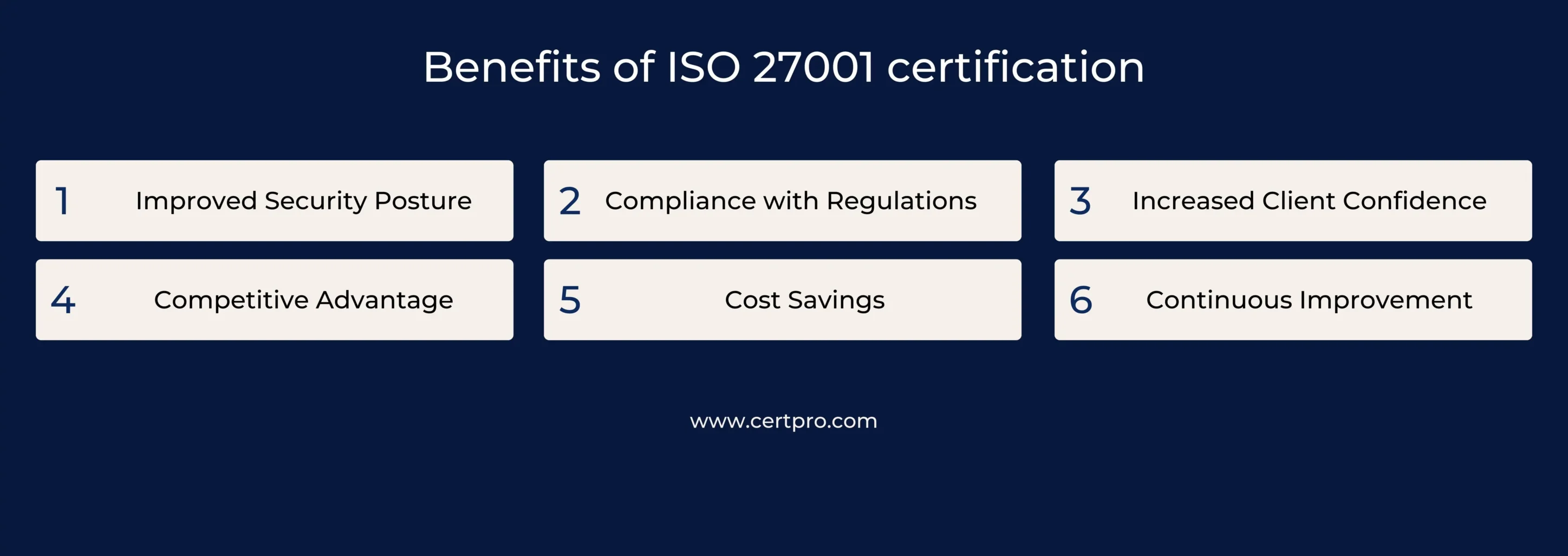
ISO 27001 Certification in Columbus delivers measurable benefits across multiple dimensions of organizational operation. These benefits are the natural consequence of independent, evidence-based verification of conformity with ISO/IEC 27001:2022 — they arise from the certification itself, not merely from the audit process. The following benefits reflect the structured outcomes that organizations holding ISO 27001 certification experience in enterprise procurement, regulatory engagement, operational governance, and information security risk management.
- ✓Independent third-party verification that the ISMS conforms to ISO/IEC 27001:2022 requirements, providing objective assurance to customers, partners, and regulators
- ✓Structured evidence base demonstrating information security risk management, risk treatment, and control effectiveness across the certified scope
- ✓Accelerated enterprise vendor qualification by satisfying information security due diligence requirements through an independently issued certificate rather than repeated individual assessments
- ✓Demonstrated alignment with international information security standards relevant to GDPR technical measures, U.S. regulatory third-party risk expectations, and sector-specific security requirements
- ✓Ongoing surveillance audit oversight ensuring that certified controls continue to operate effectively across the three-year certification cycle
- ✓Recognition in Columbus financial sector procurement processes as an organizationally verified security posture credential
- ✓Documented ISMS governance structure that supports organizational accountability for information security across leadership, operational, and technical functions
- ✓Competitive differentiation in Columbus technology, SaaS, fintech, and healthcare market sectors where enterprise customers require ISO 27001 certification as a baseline vendor qualification criterion
Organizations that achieve ISO 27001 Certification in Columbus typically demonstrate measurable improvements in information security governance structure. The audit process requires organizations to maintain documented risk assessment results, a current Statement of Applicability, internal audit records, and management review outputs — all of which contribute to a more structured and accountable ISMS operating environment.
The requirement for continual improvement under Clause 10 of ISO/IEC 27001:2022 drives organizations to track nonconformities, implement corrective actions, and document ISMS performance trends across audit cycles. This creates an ongoing governance discipline that supports information security management beyond the ISO 27001 certification audit itself, reducing the likelihood of undetected security control gaps and improving organizational responsiveness to emerging information security risks.
For Columbus organizations operating in multiple regulatory environments — such as health-tech companies subject to HIPAA, financial services vendors subject to banking regulator expectations, and SaaS providers serving GDPR-regulated European customers — the structured control documentation required by ISO 27001 compliance supports mapping of a single control framework to multiple regulatory requirements.
Rather than maintaining separate documentation sets for each regulatory obligation, organizations can use their ISO/IEC 27001:2022 SoA and control documentation as a central reference that demonstrates alignment with overlapping security requirements across multiple frameworks. This reduces documentation overhead while providing each regulatory audience with evidence drawn from a single, independently audited source.
- ✓Operational and Governance Improvements Resulting from Certification
ISO 27001 Certification Scope and Independent Decision Framework
The scope of ISO 27001 certification defines the boundaries of the ISMS subject to evaluation. Scope definition is a critical activity that determines which organizational units, locations, processes, systems, and information assets are covered by the certification. CertPro evaluates whether the defined scope is appropriate and whether the ISMS boundaries are clearly documented before proceeding with the ISO 27001 certification audit. The certification decision is made independently by CertPro’s certification committee based exclusively on the audit evidence collected during Stage 1 and Stage 2 activities.
Defining the ISMS Scope for Columbus Organizations
ISO/IEC 27001:2022 requires organizations to define the scope of their ISMS in terms of internal and external context, the needs and expectations of interested parties, and the interfaces and dependencies between activities performed within and outside the scope boundary. For Columbus technology companies and SaaS providers, the ISMS scope typically encompasses the development, hosting, and delivery of specific software products or services — including the cloud infrastructure, development environments, and operational processes associated with those services.
For financial services organizations and fintech companies, the scope often includes payment processing systems, customer data management environments, and the operational and administrative functions supporting those environments. The scope must be documented and made available to auditors, and interfaces at the scope boundary — particularly supplier relationships and cloud service dependencies — must be clearly identified.
Scope limitations that exclude significant information security risks without documented justification are a common source of nonconformity findings during the ISO 27001 certification audit. Organizations that define a narrow scope to reduce audit complexity but then reference out-of-scope systems in their risk treatment plans or Statement of Applicability create internal inconsistencies that auditors identify during evidence review.
Columbus organizations are expected to define a scope that accurately reflects the ISMS boundary — including all organizational units, processes, and technology environments that are materially relevant to the information security risks identified in the risk assessment. An accurately defined scope ensures that the issued ISO 27001 certificate accurately represents the organizational coverage of the certified ISMS.
Independent Certification Decision and Nonconformity Resolution
The certification decision under CertPro’s ISO 27001 audit process is made by an independent certification committee that reviews the full audit file — including Stage 1 and Stage 2 audit reports, documented nonconformities, and evidence of corrective action — without involvement from the field audit team. This structural separation ensures that the certification decision is independent of any relationships formed during field audit activities.
The certification committee determines whether the documented evidence demonstrates conformity with all applicable requirements of ISO/IEC 27001:2022. Where nonconformities have been identified, the committee evaluates whether the organization’s corrective actions are adequate before making a positive certification determination. Certificates are not issued conditionally — conformity must be demonstrated before the ISO 27001 certificate is issued.
Nonconformities identified during the ISO 27001 certification audit are formally documented and communicated to the organization with a required response timeframe. Major nonconformities — those indicating a fundamental failure of an ISMS requirement — must be resolved and verified before certification can proceed. Minor nonconformities indicate partial conformity and must be resolved within a specified period, typically before or during the first surveillance audit.
Observations and opportunities for improvement are documented in the audit report but do not require corrective action as a condition of certification. The organization is responsible for all corrective action activities. CertPro evaluates the effectiveness of corrective actions as part of the follow-up process but does not design, recommend, or implement corrective measures.
ISO 27001 Standard: Domains, Controls, and Compliance Requirements
Understanding the structure of the ISO 27001 standard is essential for organizations evaluating the scope of a certification audit. ISO/IEC 27001:2022 is organized around mandatory management system clauses and a reference set of information security controls in Annex A. The standard’s control structure was substantially reorganized in the 2022 update, and organizations transitioning from the 2013 version or pursuing initial ISO 27001 Certification in Columbus for the first time must align their ISMS design and documentation with the current 2022 control architecture.
| Control Category | Control Count | Key Areas Covered |
|---|---|---|
| Organizational | 37 controls (5.1–5.37) | Policies, roles, threat intelligence, supplier security, incident management, business continuity, compliance |
| People | 8 controls (6.1–6.8) | Screening, employment terms, security awareness, disciplinary processes, remote working, confidentiality |
| Physical | 14 controls (7.1–7.14) | Physical perimeters, entry controls, office security, equipment maintenance, secure disposal, clear desk policy |
| Technological | 34 controls (8.1–8.34) | Endpoint security, access control, encryption, secure development, vulnerability management, monitoring, cloud security |
The four Annex A control categories in ISO/IEC 27001:2022 provide a comprehensive framework for addressing information security risks across organizational, human, physical, and technology dimensions. Each control in Annex A is referenced in the organization’s Statement of Applicability, which documents whether the control is applicable to the ISMS scope, the justification for inclusion or exclusion, and the implementation status.
During the ISO 27001 certification audit, auditors evaluate objective evidence for each applicable control — not merely the documentation of control intent, but the operational evidence that the control is functioning as described. For Columbus technology organizations, the technological control category receives particularly detailed audit scrutiny, as it covers the cloud, software development, access management, and monitoring controls most relevant to their operating environments.
ISO/IEC 27001:2022 introduced 11 new controls not present in the 2013 version, reflecting the evolution of information security threats and operating environments since the previous standard was published. These new controls include threat intelligence (5.7), information security for use of cloud services (5.23), ICT readiness for business continuity (5.30), physical security monitoring (7.4), configuration management (8.9), information deletion (8.10), data masking (8.11), data leakage prevention (8.12), monitoring activities (8.16), web filtering (8.23), and secure coding (8.28).
Organizations pursuing ISO 27001 Certification in Columbus must evaluate all 11 new controls for applicability in their Statement of Applicability. Many Columbus technology companies and SaaS providers will find that cloud security (5.23) and secure coding (8.28) controls are applicable given their operating environments, requiring documented evidence of cloud security governance and software development security practices during the ISO 27001 certification audit.
- ✓Annex A Control Categories in ISO/IEC 27001:2022
- ✓New Controls Introduced in the 2022 Update
FAQ
▶
What is ISO 27001 certification and who issues it in Columbus?
▶
Which Columbus organizations need ISO 27001 certification?
▶
What is the difference between the ISO 27001 Stage 1 and Stage 2 audit?
▶
How long is an ISO 27001 certificate valid?
▶
What is the Statement of Applicability in an ISO 27001 audit?
▶
Does ISO 27001 certification satisfy HIPAA security requirements for Columbus healthcare organizations?
▶
What version of the ISO 27001 standard is currently certifiable?
▶
How does ISO 27001 certification support Columbus fintech and financial services vendor qualification?
Get In Touch
have a question? let us get back to you.