
ISO 27001 Certification in Copenhagen
CertPro, a Licensed CPA Firm, conducts independent ISO 27001 certification audits for organizations operating in Copenhagen. Each ISO 27001 assessment evaluates Information Security Management Systems against ISO/IEC 27001:2022 requirements, including ISMS scope, risk treatment, Annex A controls, and continual improvement obligations. ISO 27001 certification engagements are structured for technology-driven, fintech, logistics, and cloud-native enterprises across the Copenhagen metropolitan region.
OUR CLIENTS





Introduction to ISO 27001 Certification in Copenhagen
ISO 27001 Certification in Copenhagen represents a formal, internationally recognized credential demonstrating that an organization’s Information Security Management System (ISMS) meets the requirements of ISO/IEC 27001:2022. Copenhagen, as Denmark’s leading economic and technology hub, hosts a concentrated ecosystem of fintech firms, SaaS providers, cloud-native enterprises, logistics operators, and digital health organizations — all of which handle sensitive data at scale. For these organizations, achieving ISO 27001 certification is not merely a regulatory formality. It is a strategic imperative that signals institutional maturity in information security governance and positions the organization competitively across Nordic and European markets.
The ISO/IEC 27001 standard was first published by the International Organization for Standardization (ISO) and the International Electrotechnical Commission (IEC). The most recent version, ISO/IEC 27001:2022, was published in October 2022. It introduced restructured Annex A controls, reducing the control set from 114 to 93 controls organized across four themes: Organizational, People, Physical, and Technological. Organizations certified under the 2013 version were required to transition to the 2022 standard by October 31, 2025, as mandated by international certification bodies. Copenhagen-based organizations pursuing ISMS certification must now demonstrate conformance to the 2022 standard exclusively.
Copenhagen’s digital economy is deeply integrated with European regulatory frameworks, including the General Data Protection Regulation (GDPR), the NIS2 Directive, and the EU AI Act. ISO 27001 compliance provides a structured mechanism for organizations to map their information security controls directly to these regulatory requirements. For Copenhagen-based companies operating across borders — particularly those serving EU financial institutions, healthcare systems, or critical infrastructure operators — ISO 27001 certification delivers a universally recognized attestation of information security governance that satisfies both domestic and international stakeholder expectations.
What Is ISO 27001 and the ISMS Framework
ISO 27001 is an international standard that specifies requirements for establishing, implementing, maintaining, and continually improving an Information Security Management System (ISMS). An ISMS is a systematic framework of policies, procedures, processes, and controls designed to manage an organization’s information security risks. The standard operates on a risk-based approach, requiring organizations to identify information assets, assess associated threats and vulnerabilities, determine risk treatment options, and implement controls proportionate to identified risks.
The ISO 27001 standard is structured around ten clauses. Clauses 1 through 3 define scope, normative references, and terms. Clauses 4 through 10 specify mandatory ISMS requirements covering organizational context, leadership commitment, planning, support, operation, performance evaluation, and improvement. Annex A provides a reference set of 93 information security controls that organizations must evaluate for applicability during the Statement of Applicability (SoA) process. ISMS certification requires that an organization demonstrate conformance with all mandatory clauses and justify all control inclusion or exclusion decisions within the SoA.
Copenhagen’s Digital Economy and the Need for ISO 27001
Copenhagen ranks among Europe’s most advanced digital economies, consistently recognized in the European Digital Economy and Society Index (DESI). The city’s technology sector encompasses established enterprises and high-growth startups operating in financial services, maritime logistics, biotechnology, cleantech, and enterprise software. Organizations within these sectors process significant volumes of personal data, financial records, intellectual property, and operational technology data — all of which require structured information security governance to manage risk effectively.
The Copenhagen fintech sector, anchored by firms such as Nets, Saxo Bank, and a growing cluster of payment technology and blockchain companies, operates under stringent information security expectations from clients, regulators, and partners. ISO 27001 certification for Copenhagen fintech organizations provides a credible, audited attestation of ISMS conformance that satisfies due diligence requirements from institutional clients and supports compliance with the EU’s Digital Operational Resilience Act (DORA) and Payment Services Directive (PSD2). Similarly, Copenhagen technology companies serving enterprise clients increasingly encounter contractual requirements mandating ISO 27001 certification as a precondition for vendor qualification.
ISO/IEC 27001:2022 — Key Changes and Copenhagen Implications
The 2022 revision of ISO 27001 introduced significant structural changes that directly affect how Copenhagen organizations design and document their ISMS. The revised Annex A consolidates controls into four thematic categories — Organizational (37 controls), People (8 controls), Physical (14 controls), and Technological (34 controls) — replacing the 14-domain structure of the 2013 version. Eleven new controls were introduced in the 2022 revision, addressing emerging topics including threat intelligence, information security for cloud services, ICT readiness for business continuity, data masking, web filtering, and secure coding.
For Copenhagen-based organizations previously certified under ISO/IEC 27001:2013, the transition to the 2022 standard required a structured review of the Statement of Applicability, updates to risk treatment plans, and integration of the eleven new controls where applicable. CertPro’s ISO 27001 audit engagements in Copenhagen evaluate ISMS documentation, control evidence, and management review records against the 2022 standard exclusively. Organizations that have not completed the transition are assessed as non-conformant, and the ISO 27001 audit identifies specific clause-level gaps requiring remediation before certification can be issued.

Benefits of ISO 27001 Certification in Copenhagen
ISO 27001 Certification in Copenhagen delivers measurable operational, commercial, and regulatory benefits for organizations across all sectors. The certification process — through its structured risk assessment, control evaluation, and management review requirements — drives systematic improvements in information security posture that extend well beyond the formal audit. Organizations that achieve ISMS certification demonstrate to clients, regulators, and partners that their information security governance meets internationally recognized standards, creating a competitive advantage in procurement processes and stakeholder trust assessments.
ISO 27001 compliance provides Copenhagen organizations with a structured mechanism for meeting GDPR obligations related to data security. Article 32 of the GDPR requires controllers and processors to implement appropriate technical and organizational measures to ensure a level of security appropriate to the risk. ISO 27001’s risk-based approach to information security control selection directly satisfies this requirement by providing documented evidence of risk assessment, treatment decisions, and implemented controls. Danish Data Protection Authority (Datatilsynet) enforcement actions increasingly reference ISO 27001 as a benchmark for evaluating whether an organization has implemented appropriate security measures.
Beyond GDPR, ISO 27001 certification assists Copenhagen organizations in demonstrating compliance with the NIS2 Directive, which expanded cybersecurity obligations across critical sectors including energy, transport, banking, financial market infrastructure, health, drinking water, digital infrastructure, and digital services. NIS2, transposed into Danish law through the Act on Network and Information Security, requires essential and important entities to implement risk management measures and incident reporting obligations. ISO 27001’s Annex A controls addressing incident management, business continuity, and supply chain security map directly to NIS2 requirements — enabling certified organizations to demonstrate regulatory conformance through a single, audited framework.
ISO 27001 certification for Copenhagen technology companies operating in enterprise B2B markets delivers direct commercial benefits through vendor qualification processes. Large enterprise clients — particularly financial institutions, healthcare organizations, and public sector entities — routinely require ISO 27001 certification as a mandatory criterion in vendor due diligence and procurement qualification. Copenhagen-based SaaS providers and managed service providers (MSPs) that achieve ISMS certification eliminate a significant barrier to enterprise market access, reducing procurement cycle times and strengthening competitive positioning against uncertified competitors.
For Copenhagen financial services firms, ISO 27001 certification supports compliance with contractual security obligations imposed by institutional counterparties and correspondent banking relationships. The certification provides an audited, third-party attestation that satisfies security questionnaire requirements from clients operating in regulated industries. In the Nordic insurance market, ISO 27001 certification also supports cyber insurance underwriting processes. Certified organizations typically receive more favorable premium assessments due to documented evidence of structured information security management.
The ISO 27001 assessment process requires organizations to conduct systematic information security risk assessments that identify threats, vulnerabilities, and impacts across the full scope of the ISMS. This structured risk identification process frequently surfaces previously unrecognized information security risks — particularly in areas such as cloud service provider dependencies, third-party data processing arrangements, privileged access management, and software development security practices. Organizations that undergo ISO 27001 audit processes consistently report improved risk visibility and more targeted resource allocation for information security investments.
- ✓Demonstrated GDPR compliance through documented risk assessment and control implementation
- ✓Enhanced vendor qualification eligibility for enterprise and public sector procurement
- ✓Reduced cyber insurance premiums through audited security posture documentation
- ✓NIS2 Directive conformance supported by ISO 27001 Annex A control mapping
- ✓Improved incident detection and response through structured monitoring controls
- ✓Supply chain security assurance through documented third-party management requirements
- ✓Competitive differentiation in ISO 27001 certification Copenhagen fintech and technology markets
- ✓Systematic risk identification and treatment across all information asset categories
- ✓Management accountability through defined information security roles and responsibilities
- ✓Continual improvement mechanisms through internal audit, management review, and corrective action processes
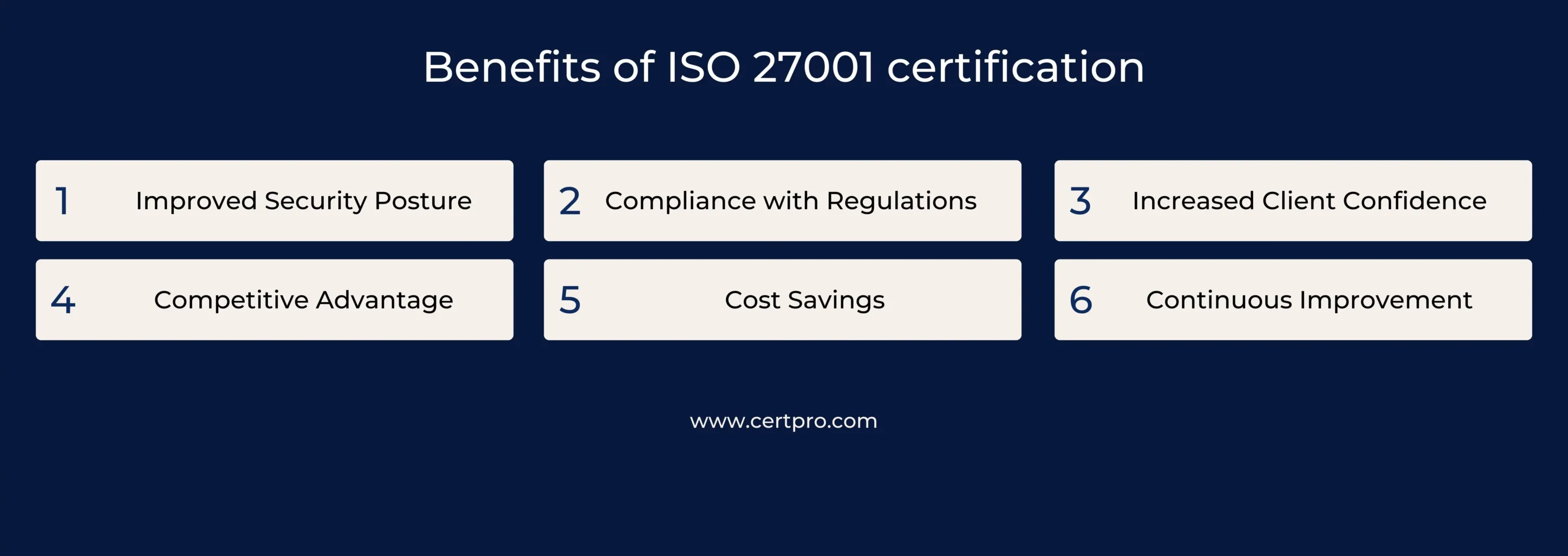
- ✓Regulatory Alignment and GDPR Compliance
- ✓Commercial and Market Access Benefits
- ✓Operational Risk Reduction and Security Posture Improvement
ISO 27001 Certification Process for Copenhagen Organizations
The ISO 27001 certification process follows a structured sequence of activities that culminates in an independent audit assessment and certification decision. CertPro conducts ISO 27001 audit engagements in Copenhagen as a Licensed CPA Firm, delivering independent, third-party evaluations of ISMS conformance against ISO/IEC 27001:2022 requirements. The certification process is designed to provide organizations with clear, actionable audit findings while maintaining the independence and objectivity required for credible third-party ISMS certification.
The ISO 27001 audit process begins with a Stage 1 assessment focused on ISMS documentation review and scope verification. During this phase, CertPro auditors evaluate the organization’s ISMS scope statement to confirm that it accurately defines the boundaries and applicability of the information security management system — including relevant internal and external factors, interested party requirements, and interfaces or dependencies with activities outside the defined scope. The scope statement is assessed for precision, ensuring it neither overstates nor understates the organizational boundaries subject to certification.
Stage 1 documentation review encompasses evaluation of the Information Security Policy, risk assessment methodology documentation, Statement of Applicability (SoA), risk treatment plan, and evidence of management commitment. Auditors verify that the SoA accounts for all 93 Annex A controls from ISO/IEC 27001:2022, with documented justifications for each inclusion or exclusion decision. The Stage 1 assessment produces a findings report identifying documentation deficiencies that must be addressed before Stage 2 audit commencement. Copenhagen organizations typically complete Stage 1 within two to five business days, depending on ISMS complexity and documentation maturity.
Stage 2 of the ISO 27001 audit constitutes the main certification assessment. CertPro auditors evaluate the implementation and operational effectiveness of ISMS controls across the defined scope. The audit program for Stage 2 is determined based on the organizational scope, identified risk treatment controls, and findings from the Stage 1 documentation review. On-site assessment activities include personnel interviews, process observations, configuration reviews, log analysis, and examination of control operation evidence across all applicable Annex A control areas.
During the Stage 2 ISO 27001 audit, CertPro evaluators assess the operational effectiveness of implemented controls by examining objective evidence of control execution. This includes reviewing access control logs to verify authorization processes, evaluating vulnerability management records to confirm scanning frequencies and remediation timelines, examining incident management records to verify detection and response procedures, and reviewing supplier agreement registers to confirm third-party security requirements are contractually established. Control testing follows a risk-proportionate sampling methodology, with higher-risk control areas receiving more extensive examination.
ISO 27001 audit findings are classified according to nonconformity severity. Major nonconformities represent failures to satisfy a mandatory ISO 27001 clause requirement or systematic control failures indicating that the ISMS is not effectively managing identified risks. Minor nonconformities represent isolated control failures or documentation deficiencies that do not indicate systemic ISMS breakdown. Observations represent areas where the ISMS could be strengthened but do not constitute formal nonconformities. Certification cannot be issued until all major nonconformities are resolved through documented corrective action and verification by the audit team.
Copenhagen organizations that receive major nonconformity findings during the ISO 27001 audit are required to submit a corrective action plan within a defined timeframe — typically 30 to 90 days — and provide objective evidence of corrective action implementation. CertPro auditors review submitted corrective action evidence to verify that identified root causes have been addressed and that the risk of recurrence has been mitigated. Once all major nonconformities are resolved and supporting evidence is verified, the certification decision is made by a qualified reviewer independent of the audit team, ensuring objectivity in the final determination.
Following successful resolution of all major nonconformities and completion of the certification decision review, ISO 27001 certification is issued for a three-year period. The certificate specifies the organization’s name, registered address, ISMS scope, applicable standard (ISO/IEC 27001:2022), certificate validity period, and the accredited certification body details. During the three-year certification cycle, organizations are subject to annual surveillance audits that verify ongoing ISMS conformance and continual improvement. Surveillance audits evaluate a subset of ISMS control areas, with specific focus determined by risk exposure, prior nonconformity areas, and organizational changes affecting the ISMS scope.
At the end of the three-year certification cycle, organizations must undergo a recertification audit that re-evaluates the full ISMS scope against ISO/IEC 27001:2022 requirements. The recertification process is comparable in scope to the initial certification audit and must be initiated before the current certificate expires to ensure uninterrupted certification status. CertPro structures recertification engagements for Copenhagen-based organizations to align with operational schedules, ensuring that audit activities minimize disruption to business operations while maintaining the rigor required for credible third-party ISMS certification.

- ✓Stage 1: ISMS Scope Definition and Documentation Review
- ✓Stage 2: On-Site ISMS Audit and Control Evaluation
- ✓Nonconformity Classification and Corrective Action Review
- ✓Certification Decision, Issuance, and Surveillance
Steps for Obtaining ISO 27001 Certification in Copenhagen
Organizations pursuing ISO 27001 Certification in Copenhagen follow a defined sequence of activities to establish, document, and demonstrate ISMS conformance. The steps below represent the structured pathway from initial ISMS establishment through formal certification. Each step involves specific deliverables and decision points that feed directly into the ISO 27001 audit evaluation process conducted by CertPro as the certifying body.
- Define ISMS scope: Establish the organizational boundaries, information assets, processes, and locations included within the ISMS, documenting internal and external context factors per ISO 27001 Clause 4.
- Conduct information security risk assessment: Identify information assets, assess threats and vulnerabilities, determine likelihood and impact ratings, and calculate risk levels using a documented risk assessment methodology.
- Select and document risk treatment options: Apply risk treatment decisions (accept, mitigate, transfer, avoid) for each identified risk, selecting applicable Annex A controls and documenting the rationale in the risk treatment plan.
- Complete the Statement of Applicability (SoA): Document all 93 ISO/IEC 27001:2022 Annex A controls, indicating inclusion or exclusion status with formal justification for each decision.
- Implement ISMS policies and procedures: Develop and approve mandatory ISMS documentation including the Information Security Policy, asset management procedures, access control policy, incident management procedures, and supplier security requirements.
- Implement and operate selected controls: Execute the risk treatment plan by deploying, configuring, and operating the information security controls identified in the SoA across all in-scope organizational areas.
- Conduct internal ISMS audit: Perform structured internal audit activities to evaluate ISMS conformance with ISO 27001 requirements and identify any nonconformities requiring corrective action prior to the external certification audit.
- Conduct management review: Convene formal management review meetings to evaluate ISMS performance, review internal audit findings, assess risk treatment effectiveness, and document continual improvement decisions.
- Submit to Stage 1 certification audit: Engage CertPro for the Stage 1 documentation review and scope verification audit, addressing any identified documentation deficiencies before proceeding to Stage 2.
- Complete Stage 2 on-site audit and resolve nonconformities: Facilitate the CertPro Stage 2 ISO 27001 audit, respond to all audit findings with documented corrective actions, and provide objective evidence of implementation to achieve certification.
Requirements for ISO 27001 Certification in Copenhagen
ISO 27001 certification requirements are defined by the ISO/IEC 27001:2022 standard and encompass mandatory documentation, organizational commitments, operational practices, and audit evidence obligations. Organizations seeking ISO 27001 Certification in Copenhagen must satisfy all mandatory clause requirements (Clauses 4–10) and demonstrate that applicable Annex A controls are implemented and operating effectively. The sections below detail specific requirements across key ISMS domains evaluated during the certification audit.
ISO 27001 mandates specific documented information as explicit requirements across Clauses 4 through 10. Mandatory documents include the ISMS scope statement (Clause 4.3), Information Security Policy (Clause 5.2), risk assessment process documentation (Clause 6.1.2), risk treatment plan (Clause 6.1.3), Statement of Applicability (Clause 6.1.3d), information security objectives (Clause 6.2), and documented evidence of competence for ISMS personnel (Clause 7.2). Each mandatory document must be controlled, version-managed, and accessible to relevant personnel, with retention periods defined in the organization’s documented information management procedure.
Mandatory records required by ISO 27001 include results of risk assessments, results of risk treatment plans, evidence of internal audit programs and results, evidence of management review outputs, evidence of monitoring and measurement results, evidence of corrective action effectiveness, and operational results from implemented controls. Copenhagen organizations frequently underestimate the volume of records required to demonstrate ongoing ISMS operation during the certification audit. CertPro auditors assess records across a defined sampling period — typically twelve months prior to the audit — to verify that ISMS controls have been operating consistently throughout the evaluation period, not solely at the time of the ISO 27001 assessment.
ISO 27001 Clause 5 requires demonstrated leadership commitment to the ISMS from top management. This requirement is evaluated during the certification audit through review of management review meeting records, evidence of Information Security Policy approval by senior leadership, documentation of ISMS resource allocation decisions, and through direct interviews with executive sponsors and ISMS owners. Top management must demonstrate understanding of ISMS scope, risk exposure, and the organization’s information security objectives — not merely delegate these responsibilities to the information security function.
Organizations must formally assign information security roles and responsibilities. This includes designating an individual or function responsible for ISMS oversight (commonly the Chief Information Security Officer or ISMS Manager), information asset owners for each identified asset category, and control owners for applicable Annex A controls. In Copenhagen technology companies, these roles are frequently distributed across engineering, operations, legal, and compliance functions. The certification audit evaluates whether role assignments are formally documented, communicated, and understood by relevant individuals — and whether assigned individuals demonstrate competence appropriate to their ISMS responsibilities.
Technical control requirements evaluated during the ISO 27001 audit encompass access control management, cryptography implementation, physical and environmental security, operations security, communications security, system acquisition and development security, and supplier relationship management. For Copenhagen cloud-native and SaaS organizations, the technical control evaluation focuses significantly on cloud service configuration security, identity and access management (IAM) policy enforcement, encryption at rest and in transit, vulnerability management cadences, and security event logging and monitoring. Auditors assess both the existence of technical controls and the documented evidence of their ongoing operation.
Operational security requirements include documented change management procedures with evidence of change approvals and testing, capacity management records demonstrating monitoring of resource utilization, malware protection configurations with update verification records, backup management procedures with restoration test evidence, and event logging configurations covering privileged access, system events, and security-relevant activities. Copenhagen organizations operating multi-cloud or hybrid infrastructure environments are assessed against cloud-specific controls introduced in ISO/IEC 27001:2022 Annex A — particularly Control 5.23 (Information security for use of cloud services), which requires documented cloud service provider security requirements and monitoring obligations.
The risk assessment requirement under ISO 27001 Clause 6.1.2 mandates that organizations define and apply a consistent, repeatable information security risk assessment process. The methodology must define risk identification criteria (information assets, threats, vulnerabilities), risk analysis criteria (likelihood and impact rating scales), risk evaluation criteria (risk acceptance thresholds), and risk treatment decision criteria. The methodology must be documented and applied consistently across all assessments, with results recorded in a risk register that is reviewed and updated at planned intervals and when significant changes occur.
Risk treatment plans must specify, for each risk above the acceptance threshold, the selected treatment option, the applicable Annex A controls addressing the risk, the control implementation status, the residual risk level following treatment, and the risk owner responsible for treatment implementation. CertPro auditors verify that risk treatment plans are current, that control implementation status reflects actual operational reality rather than planned future states, and that residual risk acceptance decisions are formally documented and approved by appropriate management authority. Organizations presenting risk registers with unaddressed high-rated risks or incomplete treatment documentation receive major nonconformity findings during the ISO 27001 audit.
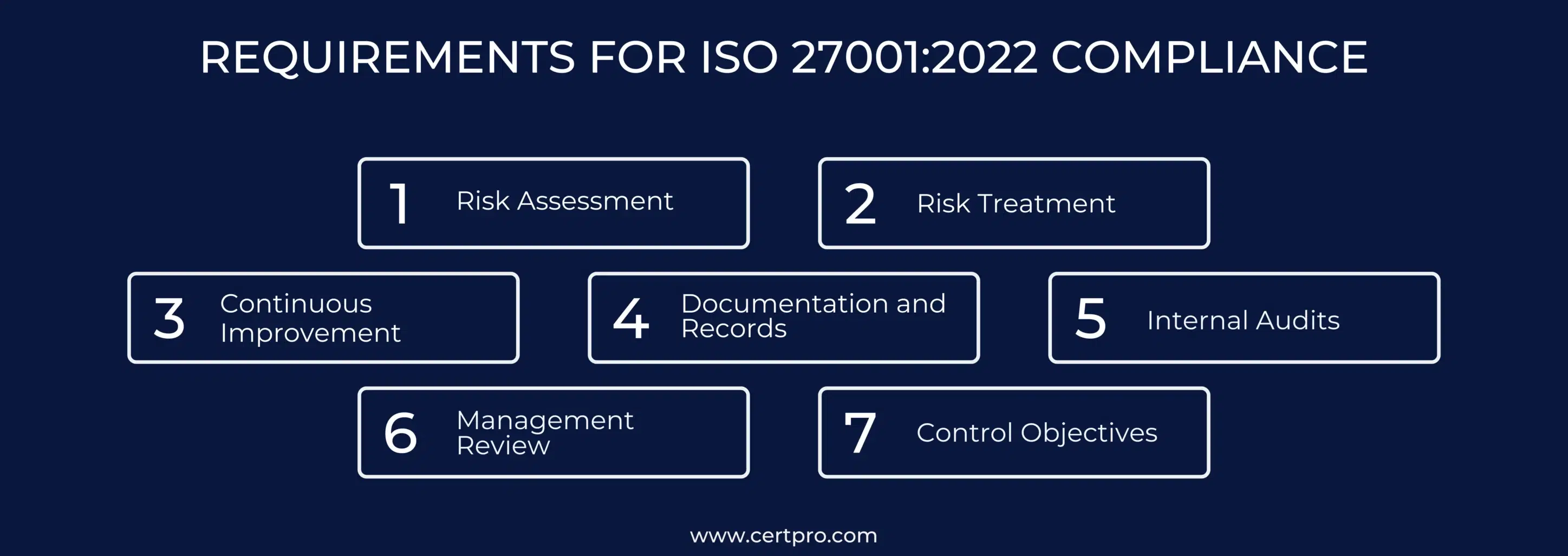
- ✓Documentation and Mandatory Records Requirements
- ✓Leadership, Governance, and Organizational Commitment Requirements
- ✓Technical and Operational Control Requirements
- ✓Risk Assessment and Treatment Requirements
ISO 27001 Audit Structure and Evaluation Methodology
The ISO 27001 audit conducted by CertPro follows a structured evaluation methodology designed to provide objective, evidence-based assessment of ISMS conformance. The audit methodology encompasses planning, evidence collection, analysis, and reporting phases — each governed by defined procedures that ensure consistency, independence, and professional rigor across all certification engagements. For ISO 27001 Certification in Copenhagen, audit programs are tailored to reflect the specific ISMS scope, organizational complexity, and identified risk profile of each client organization.
Audit Program Determination and Planning
The ISO 27001 audit program for each Copenhagen engagement is determined based on the ISMS scope statement, the organization’s size and operational complexity, the number and nature of information assets within scope, the results of prior audits where applicable, and the risk profile reflected in the organization’s risk register. Audit program planning identifies specific ISMS clauses and Annex A control domains to be assessed, allocates audit time proportionate to risk significance, defines the composition and qualifications of the audit team, and establishes the evidence collection methods to be applied during the ISO 27001 assessment.
Audit team composition for ISO 27001 assessments in Copenhagen reflects the technical complexity of the organizations being evaluated. CertPro assigns audit team members with expertise relevant to the client’s technology environment — including auditors with backgrounds in cloud security architecture, financial services information security, software development security, and operational technology security where applicable. This domain expertise ensures that technical control evaluations are conducted by auditors capable of assessing the adequacy and effectiveness of implemented controls, not merely verifying the existence of policy documentation.
Evidence Collection and Control Testing Methods
Evidence collection during the ISO 27001 audit employs multiple methods to obtain sufficient, appropriate audit evidence for each assessed control area. Interview-based evidence collection involves structured discussions with ISMS personnel, process owners, control operators, and management representatives to verify understanding of roles, procedures, and control objectives. Document review encompasses examination of ISMS policies, procedures, risk assessments, treatment plans, incident logs, audit reports, and management review records. Observation-based evidence involves direct examination of control configurations, system settings, physical security measures, and operational processes.
Technical testing and configuration review constitute a significant component of ISO 27001 audit evidence collection for Copenhagen technology organizations. Auditors examine access control configurations in identity management systems, review firewall and network segmentation rule sets, assess encryption configuration in data storage and transmission systems, verify patch management records against vulnerability scan outputs, and evaluate security event log configurations against policy requirements. Technical evidence provides objective verification that documented controls are operational and configured as designed — supplementing interview and document evidence with direct configuration observation.
Audit Reporting and Finding Documentation
The ISO 27001 audit report documents all findings with specific reference to the ISO 27001 clause or Annex A control applicable to each finding, the objective evidence examined, the auditor’s assessment of conformance or nonconformance, and the nonconformity classification (major, minor, or observation). Each nonconformity finding includes a precise description of the observed deficiency, the specific standard requirement not met, and the objective evidence supporting the finding. The audit report serves as the primary documentation basis for the certification decision and is retained as part of the certification file for the duration of the certification cycle.
ISO 27001 Certification Cost in Copenhagen
The cost of ISO 27001 Certification in Copenhagen varies based on multiple organizational and engagement-specific factors. Primary cost determinants include the size of the organization (measured by number of employees and information assets within ISMS scope), the operational complexity of the ISMS (number of locations, technology systems, and cloud service dependencies), the maturity of existing documentation and control implementation, and the specific audit program duration required to achieve sufficient evidence coverage. Secondary factors include the need for specialized technical expertise within the audit team and the organization’s prior certification history.
| Organization Type | Audit Duration (Approx.) | Typical Scope Complexity |
|---|---|---|
| Small SaaS or Technology Startup (20–50 employees) | 5–8 audit days | Single location, cloud-native, limited asset scope |
| Mid-Size Technology or Fintech Firm (50–250 employees) | 8–15 audit days | Multi-system, hybrid cloud, supplier dependencies |
| Large Enterprise (250+ employees) | 15–25+ audit days | Multi-location, complex ISMS, extensive Annex A coverage |
| Managed Service Provider or Cloud Platform | 10–20 audit days | Multi-tenant architecture, extensive technical control scope |
Organizations pursuing ISO 27001 certification for the first time in Copenhagen should account for both external certification audit fees and internal resource costs associated with ISMS documentation development, risk assessment execution, internal audit programs, and management review activities. The total cost of achieving ISMS certification encompasses the full lifecycle of ISMS establishment and operation — not solely the external audit engagement fee. Surveillance audit fees in years two and three of the certification cycle are typically lower than the initial certification audit, as they assess a defined subset of ISMS controls rather than the full scope evaluated during initial certification.
Copenhagen organizations operating in multiple EU jurisdictions may benefit from coordinated ISO 27001 audit engagements that evaluate the ISMS across multiple legal entities or geographic locations within a single audit program. Multi-site certification engagements require careful scope definition to ensure that the ISMS scope statement accurately reflects all locations and entities subject to certification. CertPro structures multi-site audit programs to optimize evidence coverage across locations while maintaining audit rigor at each assessed site — providing Copenhagen-headquartered organizations with a cost-effective pathway to group-level ISO 27001 certification.
ISMS Framework Components Evaluated in ISO 27001 Assessment
The ISO 27001 assessment conducted by CertPro evaluates the Information Security Management System across all components defined by the ISO/IEC 27001:2022 standard. The ISMS framework encompasses governance structures, risk management processes, security control domains, monitoring mechanisms, and continual improvement practices. For ISO 27001 Certification in Copenhagen, each ISMS component is assessed for both design adequacy — whether the control or process is appropriately designed to address identified risks — and operational effectiveness, meaning whether the control or process is operating as designed over the assessment period.
Information Security Governance and Policy Framework
The governance component of the ISMS encompasses the Information Security Policy, supporting topic-specific policies, organizational roles and responsibilities, and management review mechanisms. The Information Security Policy must be appropriate to the organization’s purpose, include information security objectives or provide a framework for setting them, include a commitment to satisfying applicable requirements, and include a commitment to continual improvement. Auditors evaluate whether the policy is formally approved by top management, communicated to all personnel, and available to relevant interested parties — including clients, regulators, and suppliers where appropriate.
Topic-specific policies required by ISO 27001 Annex A include policies covering access control, cryptography use, physical security, operations security, communications security, and supplier relationships. Each topic-specific policy must be formally approved, regularly reviewed, and communicated to relevant personnel. Copenhagen organizations with rapidly evolving technology environments — particularly those undergoing cloud migration, DevSecOps transformation, or merger and acquisition activity — frequently require more frequent policy review cycles to ensure policies remain current and applicable to actual operational practices being audited.
Information Security Risk Management Process
The risk management process is the central mechanism of the ISMS framework, driving all control selection and resource allocation decisions. ISO 27001’s risk-based approach requires that organizations maintain a current, comprehensive risk register covering all information assets within the defined ISMS scope. Risk assessment results must be documented, reviewed at planned intervals — typically annually or when significant changes occur — and used as the basis for risk treatment decisions. The risk register must demonstrate that each identified risk above the acceptance threshold has an associated treatment decision, an identified control owner, and a current implementation status.
For Copenhagen technology companies operating complex cloud-native environments, risk assessment must address cloud-specific risks including shared responsibility model gaps, cloud configuration management failures, API security exposures, and cross-border data transfer risks under GDPR. The ISO 27001 assessment evaluates whether the organization’s risk assessment methodology and risk register adequately capture these cloud-specific risk categories and whether corresponding controls — such as cloud security posture management (CSPM) tooling, API gateway security configurations, and data residency controls — are included in the risk treatment plan and operating effectively.
Monitoring, Measurement, and Internal Audit Mechanisms
ISO 27001 Clause 9 requires organizations to evaluate ISMS performance through monitoring, measurement, internal audit, and management review. Monitoring and measurement requirements mandate that organizations define what needs to be monitored, the methods for monitoring and measurement, when results will be analyzed and evaluated, and who is responsible for these activities. Information security metrics — covering areas such as incident frequency, vulnerability remediation rates, access review completion rates, and security awareness training completion rates — provide quantitative evidence of ISMS performance that auditors examine during the certification assessment.
Internal audit requirements under ISO 27001 Clause 9.2 mandate that organizations conduct internal audits at planned intervals to provide information on whether the ISMS conforms to both the organization’s own requirements and ISO 27001 requirements, and whether the ISMS is effectively implemented and maintained. Internal audit programs must cover the full ISMS scope over the certification cycle, with audit criteria, scope, frequency, and methods defined and documented. CertPro auditors examine internal audit reports, auditor qualifications, corrective action records for internal audit findings, and evidence of management review of internal audit results — all of which demonstrate the organization’s own ISMS self-evaluation rigor.
ISO 27001 Compliance and European Regulatory Context for Copenhagen
ISO 27001 compliance operates within a broader European and Danish regulatory context that significantly shapes the information security obligations of Copenhagen-based organizations. Understanding how ISO 27001 intersects with applicable regulations enables organizations to leverage their ISMS investment for multiple compliance purposes simultaneously — reducing overall compliance burden through a unified information security management approach. CertPro’s ISO 27001 audit Copenhagen engagements recognize this regulatory context and evaluate control effectiveness with reference to applicable legal and regulatory requirements that constitute part of the organization’s ISMS context under Clause 4.
GDPR and ISO 27001 Alignment for Danish Organizations
The General Data Protection Regulation (GDPR) imposes information security obligations on all organizations processing personal data of EU data subjects, including organizations based in Copenhagen and across Denmark. ISO 27001 compliance provides a structured approach to meeting GDPR Article 32 requirements for appropriate technical and organizational security measures. The ISO 27001 risk-based approach to security control selection directly supports the GDPR’s requirement that security measures be appropriate to the risk posed by data processing activities, including consideration of the nature, scope, context, and purposes of processing.
Specific ISO 27001 Annex A controls map directly to GDPR obligations. Control 8.12 (Data leakage prevention) supports GDPR data breach prevention requirements. Control 8.11 (Data masking) addresses pseudonymization requirements under GDPR Article 25 (data protection by design and by default). Control 5.30 (ICT readiness for business continuity) supports GDPR Article 32 requirements for ensuring ongoing confidentiality, integrity, availability, and resilience of processing systems. Control 5.34 (Privacy and protection of PII) directly addresses GDPR personal information protection obligations. CertPro’s ISO 27001 assessment engagements in Copenhagen evaluate these controls with awareness of their dual function as both ISO 27001 conformance evidence and GDPR compliance evidence.
NIS2 Directive and Information Security Governance Requirements
The NIS2 Directive (Directive (EU) 2022/2555) expanded mandatory cybersecurity requirements across a significantly broader set of sectors and entities compared to the original NIS Directive. In Denmark, NIS2 was transposed into national law through the Act on Network and Information Security for Critical Sectors, effective from October 2024. Copenhagen organizations classified as essential or important entities under NIS2 must implement security risk management measures covering policies on risk analysis and information system security, incident handling, business continuity and crisis management, supply chain security, and network and information system security standards.
ISO 27001 certification provides Copenhagen NIS2-obligated organizations with a comprehensive, audited framework that addresses all mandatory NIS2 security risk management areas. The alignment between ISO 27001’s ISMS requirements and NIS2’s security risk management obligations enables certified organizations to present their ISO 27001 certification as evidence of NIS2 compliance to competent national authorities. The Danish Centre for Cyber Security (Center for Cybersikkerhed — CFCS) has recognized ISO 27001 as a relevant reference framework for NIS2 compliance, reinforcing the value of ISMS certification for Copenhagen organizations subject to NIS2 obligations.
DORA Compliance and ISO 27001 for Copenhagen Financial Services
The Digital Operational Resilience Act (DORA, Regulation (EU) 2022/2554) entered into application in January 2025, establishing comprehensive ICT risk management, incident reporting, digital operational resilience testing, and third-party risk management requirements for EU financial services entities. Copenhagen-based financial institutions, payment service providers, fintech firms, and ICT service providers to financial entities are all subject to DORA’s requirements. ISO 27001 certification for Copenhagen financial services organizations provides a foundational ISMS framework that addresses DORA’s ICT risk management requirements, complementing DORA-specific obligations with a broader information security governance structure.
CertPro’s ISO 27001 Certification Services for Copenhagen Organizations
CertPro is a Licensed CPA Firm that conducts independent, third-party ISO 27001 certification audits for organizations across Copenhagen and the broader Nordic region. As a certification body, CertPro delivers structured audit engagements that evaluate ISMS conformance against ISO/IEC 27001:2022 requirements through objective, evidence-based assessment methodologies. CertPro’s ISO 27001 certification services are distinct from advisory or consulting engagements — the firm’s mandate is to conduct independent evaluation and issue certification decisions based on audit evidence, maintaining the objectivity essential to credible third-party ISMS certification.
Independence and Objectivity in ISO 27001 Audit Engagements
CertPro maintains strict independence in all ISO 27001 audit engagements conducted in Copenhagen. The firm does not provide ISMS design, policy development, risk assessment execution, or control implementation services to organizations subject to certification audit — ensuring that auditors evaluate controls and documentation without prior involvement in their creation. This independence is fundamental to the credibility of the certification issued and ensures that the ISO 27001 certificate accurately reflects an objective third-party assessment rather than a self-evaluation or a certification of the certifier’s own advisory work.
The certification decision for all ISO 27001 Certification in Copenhagen engagements is made by a qualified reviewer who did not participate in conducting the audit. This separation of audit execution and certification decision ensures objectivity in the final determination and prevents individual auditor judgment from unduly influencing the certification outcome. CertPro’s certification decisions are documented in a formal certification file that includes all audit reports, nonconformity records, corrective action evidence, and reviewer determinations — providing a complete audit trail for accreditation oversight and client verification purposes.
Sector-Specific Expertise for Copenhagen Industries
CertPro’s ISO 27001 audit teams for Copenhagen engagements include auditors with domain expertise spanning the sectors most prominent in Copenhagen’s digital economy. Technology company audits benefit from team members with backgrounds in software development security, DevSecOps practices, and cloud-native architecture security assessment. ISO 27001 certification Copenhagen fintech engagements include auditors with financial services information security expertise — including familiarity with payment system security standards (PCI DSS), open banking API security requirements, and financial regulatory information security expectations under the Danish Financial Supervisory Authority (Finanstilsynet).
For Copenhagen logistics and maritime sector organizations, CertPro assigns audit team members experienced in operational technology (OT) security assessment, supply chain information security requirements, and port community system security configurations. ISO 27001 certification for Copenhagen technology companies operating in cloud computing, artificial intelligence, and data analytics sectors draws on team members familiar with AI governance frameworks, cloud security architecture patterns, and data governance requirements. This sector-specific expertise ensures that technical control evaluations are meaningful and that audit findings accurately reflect the security posture of the organization’s actual operational environment.
Certification Lifecycle Management and Surveillance Structure
CertPro manages ISO 27001 certification lifecycle activities for Copenhagen-based organizations through a structured engagement model covering initial certification, annual surveillance, and three-year recertification cycles. Surveillance audit programs are designed prior to each annual assessment based on ISMS changes, prior audit findings, and risk profile evolution since the previous assessment. Surveillance audits evaluate ongoing conformance with mandatory ISMS clauses, assess the effectiveness of corrective actions implemented since the prior audit, and evaluate the organization’s continual improvement activities — ensuring the ISMS remains effective and current between recertification cycles.
ISO 27001 Certification in Copenhagen — Key Facts and Summary
ISO 27001 Certification in Copenhagen is conducted by CertPro, a Licensed CPA Firm delivering independent, third-party ISMS certification audits against ISO/IEC 27001:2022 requirements. The certification process encompasses Stage 1 documentation review and Stage 2 on-site control evaluation, resulting in a three-year certification valid subject to annual surveillance audits. Copenhagen organizations across technology, fintech, logistics, cloud services, and enterprise software sectors pursue ISO 27001 certification to satisfy regulatory obligations, meet enterprise client requirements, and demonstrate institutional information security governance maturity in Denmark’s leading digital economy.
| ISO 27001 Certification Element | Specification |
|---|---|
| Applicable Standard | ISO/IEC 27001:2022 |
| Certification Validity Period | 3 years with annual surveillance audits |
| Mandatory Annex A Controls | 93 controls across 4 themes (Organizational, People, Physical, Technological) |
| Audit Stages | Stage 1 (Documentation Review) and Stage 2 (On-Site ISMS Audit) |
| Certification Body | CertPro — Licensed CPA Firm, independent third-party auditor |
The ISO 27001 audit Copenhagen engagements conducted by CertPro are designed to provide organizations with a rigorous, credible certification process that withstands regulatory scrutiny, satisfies enterprise client expectations, and delivers meaningful assurance of information security governance effectiveness. ISO 27001 compliance in Copenhagen represents a foundational investment in information security governance — generating returns across regulatory compliance, commercial positioning, risk management effectiveness, and organizational resilience. Together, these outcomes establish a documented, audited foundation for managing information security risks in Copenhagen’s dynamic digital economy.
Organizations pursuing ISO 27001 Certification in Copenhagen are encouraged to engage CertPro early in the ISMS development process to clarify audit scope requirements, understand documentation expectations, and ensure that ISMS design decisions align with certification audit criteria. Early engagement with the certifying body enables organizations to make informed decisions about ISMS scope, control selection, and documentation structure. This reduces the risk of significant nonconformity findings during the formal ISO 27001 certification audit and ensures an efficient, effective pathway to ISMS certification for organizations operating across Copenhagen’s competitive digital economy.
FAQ
▶
What is ISO 27001 Certification and why is it important for Copenhagen organizations?
▶
How long does the ISO 27001 certification process take in Copenhagen?
▶
What is the difference between a Stage 1 and Stage 2 ISO 27001 audit?
▶
What is an ISMS and what does ISMS certification demonstrate?
▶
How does ISO 27001 compliance support GDPR obligations for Copenhagen companies?
▶
What are major and minor nonconformities in an ISO 27001 audit?
▶
How frequently are surveillance audits required after ISO 27001 certification?
▶
What is the Statement of Applicability (SoA) in ISO 27001 certification?

NEW BLOG DESIGN
Ethical Hacking for SOC 2, ISO 27001, HIPAA Audit Readiness | CertPro CPA LLC HERO Dark bg, full width, padded Image as rounded card LEFT | Info panel…
ETHICAL HACKING FOR AUDIT ASSURANCE: STRENGTHENING SOC 2, ISO 27001, AND HIPAA COMPLIANCE
Ethical Hacking For Control Effectiveness. Uncover Gaps And Strengthen Audit Evidence For SOC 2, ISO 27001, And HIPAA Compliance Reviews.
HOW COMPLIANCE AUDIT SOFTWARE IMPROVES AUDIT READINESS
Today, most companies deal with a growing number of compliance regulations. From data privacy standards to security frameworks like SOC 2 and ISO 2700…
Get In Touch
have a question? let us get back to you.