
ISO 27001 Certification in George Town
CertPro is a Licensed CPA Firm delivering ISO 27001 certification audit services to organizations operating in George Town. ISO 27001 Certification in George Town is evaluated against ISO/IEC 27001:2022 requirements, encompassing the Information Security Management System (ISMS) scope, Annex A controls, and mandatory documentation. Certification is issued following successful Stage 1 and Stage 2 audits conducted under accredited certification body standards, providing independently verified evidence of information security governance maturity.
OUR CLIENTS





What Is ISO 27001 Certification in George Town
ISO 27001 Certification in George Town designates formal third-party verification that an organization’s Information Security Management System (ISMS) conforms to the requirements of ISO/IEC 27001:2022. This international standard is published jointly by the International Organization for Standardization (ISO) and the International Electrotechnical Commission (IEC). It establishes a systematic framework for identifying, assessing, and treating information security risks across people, processes, and technology. Certification is awarded by an accredited certification body upon successful completion of a two-stage audit program, demonstrating that the ISMS is fully operational, documented, and subject to continual improvement.
ISO/IEC 27001:2022 as the International ISMS Standard
ISO/IEC 27001:2022 is the current version of the standard, superseding ISO/IEC 27001:2013. Organizations certified under the 2013 version must transition to the 2022 standard by 31 October 2025, as mandated by accredited certification bodies. The 2022 revision restructured Annex A controls from 114 controls across 14 domains to 93 controls organized into four thematic categories: Organizational Controls, People Controls, Physical Controls, and Technological Controls. Eleven new controls were introduced, reflecting advances in cloud security, threat intelligence, and data masking. Any ISO 27001 certification issued after the transition deadline must reference ISO/IEC 27001:2022 exclusively.
The standard applies to any organization regardless of size, sector, or geography. ISO 27001 Certification in George Town is pursued by financial institutions, fintech companies, data center operators, technology firms, law practices, healthcare providers, and public sector bodies operating within George Town’s established commercial and digital infrastructure ecosystem. The certification scope can be defined to cover the entire organization or specific business units, products, services, or geographic sites — providing flexibility while maintaining the rigorous requirements of the standard.
George Town’s Business Environment and Information Security Obligations
George Town functions as a significant financial and technology hub, hosting FTSE-listed enterprises, multinational financial institutions, data center operators, and a growing concentration of technology and fintech companies. Organizations operating in this environment process substantial volumes of personal data, financial records, and commercially sensitive information. This places them under elevated scrutiny from the Information Commissioner’s Office (ICO), which enforces UK GDPR obligations across all sectors. Enforcement activity in financial services and technology has accelerated in recent years, with maximum fines reaching £17.5 million or 4% of global annual turnover under UK GDPR Article 83.
UK GDPR Article 32 mandates that controllers and processors implement appropriate technical and organizational measures to ensure a level of security appropriate to the risk of processing personal data. ISO 27001 certification satisfies ICO technical security requirements under UK GDPR Article 32 by providing independently verified evidence of a structured, risk-based ISMS. The ICO recognizes certification to approved standards as a meaningful indicator of compliance. Certified organizations are better positioned to demonstrate due diligence in the event of an ICO investigation or enforcement action. ISO 27001 compliance that George Town businesses achieve through certification directly supports regulatory defensibility before the ICO.
ISO 27001 and George Town’s Digital Infrastructure Context
George Town’s data centers and digital infrastructure underpin critical operations for financial services firms, cloud service providers, and enterprise technology organizations. These facilities are frequent targets of procurement security assessments by enterprise clients and public sector contracting authorities, both of which routinely require ISO 27001 certification as a minimum security qualification. ISO 27001 certification that George Town data center and technology operators achieve establishes a third-party verified security posture. This satisfies procurement requirements without the need for repetitive client-driven security questionnaires.
For George Town companies engaged in financial services, ISO 27001 certification also aligns with Financial Conduct Authority (FCA) expectations for operational resilience and cybersecurity governance. The FCA’s operational resilience framework — published in 2021 and fully effective from March 2022 — requires firms to identify important business services, set impact tolerances, and demonstrate the ability to remain within those tolerances during disruptions. An operational ISMS certified under ISO 27001 provides the documented risk treatment and incident management infrastructure required to satisfy these obligations. George Town-based financial institutions that hold ISO 27001 certification signal to regulators, counterparties, and clients that information security governance is independently verified.

ISO 27001 Requirements for George Town Organizations
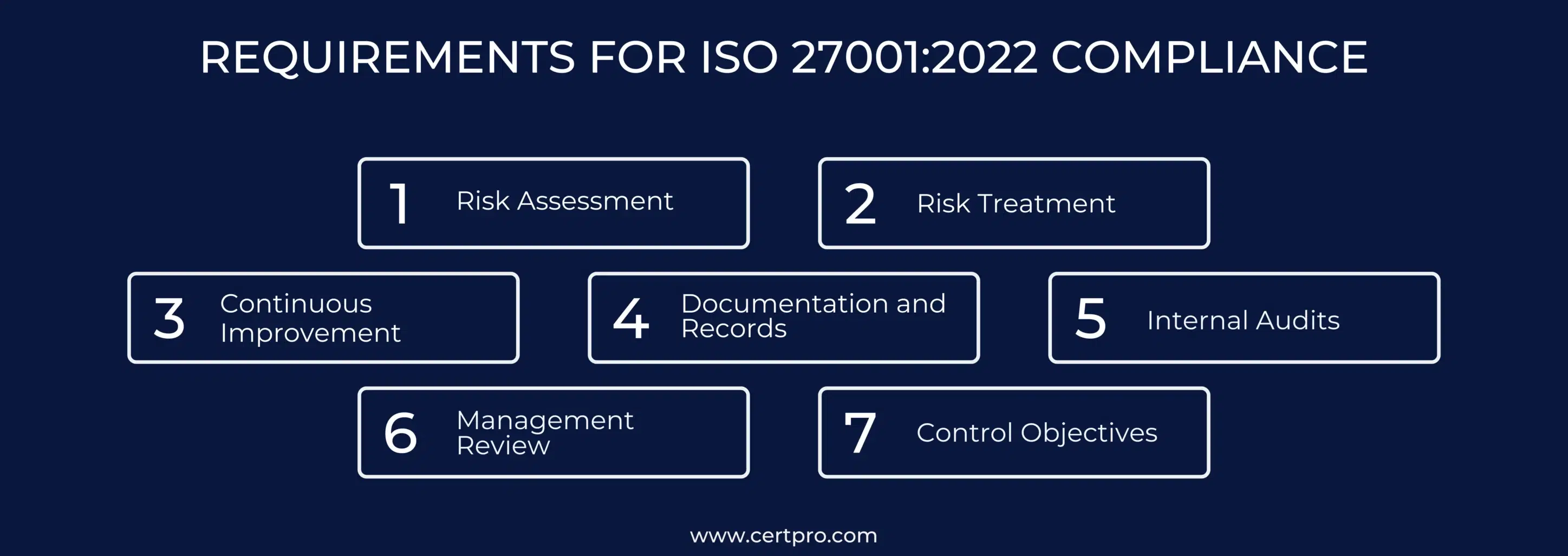
ISO 27001 compliance requires organizations to fulfill a structured set of mandatory clauses and implement selected Annex A controls based on a formal risk assessment. The standard is organized into ten clauses (Clauses 1 through 10), with Clauses 4 through 10 containing normative requirements that must be addressed to achieve certification. ISO 27001 compliance that George Town organizations must demonstrate is evaluated during the Stage 2 audit against all mandatory clauses and the Statement of Applicability (SoA). The SoA documents the selected and excluded Annex A controls, along with justification for each decision.
Clause 4 (Context of the Organization) requires the organization to identify internal and external issues relevant to its purpose, define the ISMS scope, and understand the needs of interested parties including regulators, clients, and contractual partners. Clause 5 (Leadership) mandates top management commitment, an information security policy, and clear assignment of roles and responsibilities. Clause 6 (Planning) requires a systematic risk assessment methodology, a risk treatment plan, and measurable information security objectives. These planning requirements form the analytical foundation of the ISMS and are scrutinized closely during every ISO 27001 audit.
Clause 7 (Support) covers resource allocation, personnel competence, awareness programs, communication protocols, and documentation requirements. Clause 8 (Operation) requires the organization to plan, implement, and control all processes needed to meet information security requirements. Clause 9 (Performance Evaluation) mandates monitoring, measurement, internal audits, and management reviews to assess ISMS effectiveness. Clause 10 (Improvement) requires the organization to address nonconformities, implement corrective actions, and drive continual improvement. Each of these clauses is directly evaluated during the ISO 27001 audit conducted by the certification body.
Annex A of ISO/IEC 27001:2022 contains 93 controls organized into four domains. Organizational Controls (37 controls) address policies, roles, threat intelligence, supplier relationships, and incident management. People Controls (8 controls) govern screening, terms of employment, awareness and training, and disciplinary processes. Physical Controls (14 controls) cover physical security perimeters, equipment maintenance, clear desk and screen policies, and secure disposal of media. Technological Controls (34 controls) address user endpoint devices, privileged access rights, network security, secure coding, data masking, and monitoring. Organizations select applicable controls based on risk assessment results and document selections and exclusions in the Statement of Applicability.
| Annex A Domain | Number of Controls | Key Areas Covered |
|---|---|---|
| Organizational Controls | 37 | Policies, threat intelligence, supplier security, incident management |
| People Controls | 8 | Screening, awareness, training, disciplinary process |
| Physical Controls | 14 | Physical perimeters, equipment security, secure disposal |
| Technological Controls | 34 | Access control, network security, secure coding, monitoring |
ISO 27001 certification requires organizations to produce and maintain a defined set of documented information. Mandatory documentation includes the ISMS scope document, information security policy, risk assessment process documentation, risk treatment plan, Statement of Applicability (SoA), information security objectives, evidence of personnel competence, monitoring and measurement results, internal audit records, management review outputs, and nonconformity and corrective action records. All documents must be version-controlled, approved by authorized personnel, and made available to auditors during the ISO 27001 audit. Incomplete or outdated documentation is among the most common sources of nonconformities identified during Stage 1 and Stage 2 audits.
- ✓ISMS scope document defining organizational and system boundaries
- ✓Information security policy approved by top management
- ✓Risk assessment methodology and documented risk assessment results
- ✓Risk treatment plan with control selection rationale
- ✓Statement of Applicability (SoA) referencing all 93 Annex A controls
- ✓Information security objectives with measurable targets and plans
- ✓Evidence of personnel competence and awareness program delivery
- ✓Internal audit program, audit schedules, and audit results
- ✓Management review minutes and outputs
- ✓Nonconformity records and corrective action documentation
- ✓Operational security procedures supporting implemented controls
- ✓Asset inventory and information classification documentation
- ✓Mandatory Clauses: Overview of ISO 27001:2022 Structure
- ✓Annex A Controls: Four Domains of ISO 27001:2022
- ✓Mandatory Documentation Requirements
ISO 27001 Certification Process in George Town
The ISO 27001 certification process follows a structured sequence of stages governed by the requirements of the accrediting certification body and the standard itself. ISO 27001 Certification in George Town requires organizations to complete ISMS implementation, undergo a formal two-stage audit program, address any identified nonconformities, and receive a certification decision from the certification body. The full certification cycle — from initial ISMS scoping to certificate issuance — typically spans six to twelve months. Actual timelines depend on organizational size, complexity, and the maturity of existing security controls at the time of engagement.
The Stage 1 audit is a documentation review conducted by the certification body auditor to assess whether the organization’s ISMS documentation meets the requirements of ISO/IEC 27001:2022 and whether the organization is ready to proceed to the Stage 2 audit. During Stage 1, the auditor reviews the ISMS scope, information security policy, risk assessment and treatment documentation, the Statement of Applicability, and evidence of management review and internal audit completion. The auditor identifies areas of concern, documents any major or minor nonconformities, and provides a written report confirming readiness or specifying corrective actions required before Stage 2 can proceed.
Stage 1 audits are typically conducted on-site at the organization’s primary operating location or, increasingly, through remote audit methods using document management systems and video conferencing platforms. For a small to medium-sized organization in George Town, Stage 1 audit duration is typically one to two days. Larger organizations with complex multi-site ISMS scopes may require additional audit days. The Stage 1 audit report forms the basis for Stage 2 audit planning, including the audit program, sampling approach, and focus areas identified as requiring deeper examination.
The Stage 2 audit evaluates the operational effectiveness of the ISMS by testing whether implemented controls function as designed and whether the system meets all mandatory clause requirements. The auditor collects evidence through personnel interviews, observation of security processes, testing of technical controls, and review of operational records including logs, incident reports, training records, and supplier security assessments. The Stage 2 audit must be conducted at the organization’s premises or operational sites to verify physical and technical controls in their actual operating environment. Remote audit methods may supplement evidence collection but do not replace on-site evaluation for the initial certification audit.
Following the Stage 2 audit, the auditor compiles a report documenting conformities, observations, and any nonconformities classified as major or minor. Major nonconformities indicate a systematic failure of a mandatory requirement and must be resolved before certification can be issued. Minor nonconformities require corrective action within a defined timeframe — typically 90 days — and are verified at the first surveillance audit. The certification body review panel examines the audit report and makes the formal certification decision. Upon approval, the ISO 27001 certificate is issued with a three-year validity period, subject to successful surveillance audits.
- Scope Definition: Define the ISMS scope, organizational boundaries, and information assets subject to certification.
- Risk Assessment: Conduct a formal information security risk assessment identifying threats, vulnerabilities, and potential impacts.
- Risk Treatment: Develop and approve a risk treatment plan selecting applicable Annex A controls and documenting the Statement of Applicability.
- ISMS Implementation: Implement selected controls, establish operational procedures, and deploy monitoring and measurement mechanisms.
- Internal Audit: Conduct a complete internal audit of the ISMS against all mandatory ISO/IEC 27001:2022 clauses.
- Management Review: Hold a formal management review confirming ISMS performance, resource adequacy, and continual improvement commitments.
- Stage 1 Audit: Submit to documentation review by the accredited certification body auditor; address identified documentation gaps.
- Stage 2 Audit: Undergo on-site operational effectiveness evaluation covering all mandatory clauses and selected Annex A controls.
- Nonconformity Resolution: Address and close all major nonconformities identified during the Stage 2 audit.
- Certification Decision: Certification body review panel issues formal certification decision and issues the ISO 27001 certificate.
- Surveillance Audits: Complete annual surveillance audits in Years 1 and 2 of the three-year certification cycle.
- Recertification Audit: Undergo recertification audit in Year 3 to renew the ISO 27001 certificate for a further three-year cycle.

- ✓Stage 1 Audit: Documentation Review and Readiness Assessment
- ✓Stage 2 Audit: Operational Effectiveness Evaluation
- ✓Certification Stages: Numbered Process Overview
ISO 27001 Audit: Internal and External Audit Requirements
The ISO 27001 audit framework encompasses both internal audits conducted by the organization and external audits conducted by the accredited certification body. Both audit types are mandatory requirements under ISO/IEC 27001:2022. Internal audits must be completed before the certification body’s Stage 1 audit and must cover all mandatory clauses of the standard. The internal audit program must be planned, resourced, and conducted by competent auditors who are independent of the areas being audited. All findings must be documented with audit reports and records. The certification body auditor will review internal audit records during the Stage 2 audit evaluation to assess the maturity and effectiveness of the internal audit program.
ISO/IEC 27001:2022 Clause 9.2 requires organizations to conduct internal audits at planned intervals to confirm whether the ISMS conforms to the organization’s own requirements and to the requirements of the standard — and whether it is effectively implemented and maintained. The internal audit program must define audit criteria, scope, frequency, and methods. Organizations must select internal auditors who possess the knowledge and skills to conduct audits objectively and who do not audit their own work. Annual audits are typical, though higher-risk organizations or those in early ISMS operation phases may conduct more frequent reviews to accelerate security maturity.
Internal audit findings must be reported to management and must feed into the corrective action process and management review cycle. The complete audit trail — from planning through finding documentation to corrective action closure — constitutes critical evidence during the ISO 27001 audit that George Town certification bodies conduct. Incomplete or superficial internal audit records are among the most commonly identified nonconformities during initial certification audits, particularly for organizations implementing an ISMS for the first time. CertPro’s Stage 1 audit program includes a detailed review of internal audit completeness and objectivity.
Following initial certification, the ISO 27001 certificate is valid for three years subject to satisfactory annual surveillance audits. Surveillance Audit 1 is conducted approximately 12 months after certificate issuance. Surveillance Audit 2 is conducted approximately 24 months after certificate issuance. Each surveillance audit evaluates a subset of the ISMS, focusing on organizational changes, progress on corrective actions, internal audit and management review outputs, and the continued effectiveness of critical controls. Surveillance audits are shorter than the initial Stage 2 audit — typically one to two days for small and medium-sized organizations.
The recertification audit, conducted in the third year of the certification cycle, is a full re-evaluation of the ISMS comparable in scope to the original Stage 2 audit. Organizations must demonstrate that the ISMS has been consistently maintained, that all nonconformities from previous audit cycles have been resolved, and that continual improvement activities have been implemented. An ISO 27001 audit conducted during recertification confirms the ongoing relevance and effectiveness of the ISMS in the context of the organization’s current operating environment — including any changes in technology, personnel, regulatory obligations, or threat landscape since the previous certification cycle.
ISO 27001 certificates are issued only by certification bodies accredited by a recognized national accreditation body operating under the International Accreditation Forum (IAF) multilateral recognition arrangement. In the United Kingdom, the relevant accreditation body is the United Kingdom Accreditation Service (UKAS). UKAS-accredited certification bodies are qualified to conduct ISO 27001 audits and issue internationally recognized certificates. Organizations in George Town seeking ISO 27001 Certification should confirm that their chosen certification body holds current UKAS accreditation for ISO/IEC 27001. This ensures certificates are accepted by enterprise clients, public sector contracting authorities, and international regulatory bodies.
- ✓Internal Audit Requirements and Frequency
- ✓Surveillance Audits and Recertification Cycle
- ✓Certification Body Accreditation and Audit Objectivity
ISO 27001 Compliance for George Town Businesses
ISO 27001 compliance designates the state of an organization’s ISMS conforming to the requirements of ISO/IEC 27001:2022 across all mandatory clauses and applicable Annex A controls. ISO 27001 compliance that George Town organizations must achieve is verified independently by the certification body auditor during the certification and surveillance audit cycle. Compliance is not a static condition — it requires ongoing ISMS maintenance, periodic internal audits, management reviews, corrective action processes, and adaptation of controls in response to changes in the risk environment, organizational structure, or applicable legal and regulatory requirements.
ISO 27001 Compliance and UK GDPR Obligations
UK GDPR Article 32 requires organizations to implement appropriate technical and organizational measures to ensure information security, taking into account the state of the art, implementation costs, and the nature, scope, context, and purposes of processing. ISO 27001 certification provides documented evidence that an organization has implemented a risk-based, systematically managed set of technical and organizational security measures. This directly satisfies the Article 32 obligation and positions the organization to demonstrate compliance to the ICO in the event of a data breach investigation or enforcement inquiry. ISO 27001 compliance that George Town fintech and financial services firms maintain through certification is particularly relevant given the ICO’s sector-specific enforcement priorities.
The ICO’s enforcement framework under UK GDPR allows fines up to £17.5 million or 4% of global annual turnover for serious infringements, including failures to implement appropriate security measures under Article 32. Organizations that cannot demonstrate appropriate technical and organizational measures at the time of a breach investigation face significantly increased enforcement risk. ISO 27001 certification provides a recognized, independently verified baseline that the ICO takes into account when assessing the adequacy of security measures. George Town organizations that achieve and maintain ISO 27001 certification are materially better positioned in ICO enforcement contexts than those relying solely on self-assessed security programs.
Industries in George Town Most Impacted by ISO 27001 Compliance Requirements
ISO 27001 compliance is practically mandatory across several key industries operating in George Town. Financial services organizations — including banks, investment managers, insurance firms, and payment processors — face explicit security expectations from the FCA and Prudential Regulation Authority (PRA), both of which reference ISO 27001 in guidance on cyber and operational resilience. ISO 27001 certification that George Town financial services organizations hold provides a certified evidence base for FCA supervisory engagement and demonstrates alignment with the Senior Managers and Certification Regime (SMCR) responsibilities for operational resilience.
Technology companies and cloud service providers operating in George Town face ISO 27001 certification requirements from enterprise and public sector procurement processes. The UK Government’s Cyber Essentials scheme applies to public sector suppliers, while higher-tier suppliers and those handling sensitive government data are increasingly required to hold ISO 27001 certification. ISO 27001 compliance that George Town technology companies achieve through certification satisfies these supply chain security requirements and eliminates barriers in major contract bids. Data center operators similarly require ISO 27001 certification to retain and acquire enterprise hosting and colocation clients, for whom third-party verified physical and technical security controls are a contractual baseline requirement.
Mapping ISO 27001 Controls to Regulatory Frameworks
ISO 27001 compliance provides a foundational control framework that maps directly to multiple regulatory and contractual requirements applicable to George Town businesses. UK GDPR Article 32 security obligations, FCA operational resilience requirements, PCI DSS technical security controls, HIPAA security rule requirements for healthcare data, and NIS Regulations security duties for operators of essential services can all be addressed through ISO 27001-compliant controls. Organizations that establish ISO 27001 certification as their primary security framework can streamline compliance with multiple regulatory regimes simultaneously — reducing the cost and complexity of maintaining separate compliance programs for each applicable standard or regulation.
| Regulatory Framework | Relevant ISO 27001 Alignment | Primary George Town Sectors |
|---|---|---|
| UK GDPR Article 32 | ISMS risk treatment and Annex A technical controls | All sectors processing personal data |
| FCA Operational Resilience | Business continuity and incident management controls | Financial services, fintech |
| NIS Regulations | Network and information system security controls | Digital service providers, utilities |
| PCI DSS | Access control, encryption, and monitoring controls | Payment processors, e-commerce |
| ISO 27701 (Privacy Extension) | Privacy-specific controls extending ISO 27001 ISMS | Data processors, technology firms |
ISO 27001 Cost in George Town
ISO 27001 cost is determined by a combination of organizational factors including scope size, operational complexity, number of sites, existing security maturity, and the volume of Annex A controls selected for implementation. ISO 27001 certification cost that George Town organizations face encompasses certification body audit fees, internal resource costs associated with ISMS implementation and documentation, and any technology investments required to implement selected controls. CertPro operates on a fixed pricing model for ISO 27001 certification services, providing organizations with a defined cost structure from the outset — eliminating the variable fee uncertainty common in other certification service models.
Factors That Influence ISO 27001 Certification Cost
The primary cost driver for ISO 27001 certification is the number of audit days required by the certification body. This is calculated based on the number of employees within the ISMS scope, the complexity of information processing activities, and the number of sites to be audited. ISO/IEC 27006 provides guidance on audit time calculations. A small organization with fewer than 10 employees within scope may require as few as three to four audit days for the combined Stage 1 and Stage 2 program. A mid-sized organization with 50 to 250 employees typically requires six to ten audit days. Large organizations with complex multi-site ISMS scopes may require fifteen or more audit days across the initial certification program.
Internal resource costs represent a significant component of the total ISO 27001 cost for organizations building an ISMS from a low baseline of security maturity. These costs include the time of the Information Security Manager or ISMS lead, contributions from IT, HR, legal, and operations functions for policy and procedure development, and management time for risk assessment workshops, training programs, and management reviews. Technology investment costs vary widely depending on gaps identified in the risk assessment. Organizations requiring new security tooling — such as SIEM platforms, multi-factor authentication systems, or data loss prevention tools — will incur additional capital or subscription expenditure as part of the ISO 27001 implementation program.
ISO 27001 Cost Compared to ICO Enforcement Penalties
The ISO 27001 cost for a George Town organization must be evaluated in the context of the financial and reputational consequences of a data breach or ICO enforcement action. ICO fines under UK GDPR can reach £17.5 million or 4% of global annual turnover. A single ransomware incident can result in operational downtime, incident response fees, legal costs, customer notification expenses, and reputational damage that far exceed the total investment in ISO 27001 certification. Viewed this way, ISO 27001 certification cost represents a quantifiable, bounded investment with predictable returns — in the form of regulatory risk reduction, insurance premium optimization, and improved contract win rates.
Cyber insurance premiums for George Town organizations are increasingly linked to demonstrated security maturity. Insurers routinely apply premium reductions and more favorable coverage terms to organizations holding ISO 27001 certification compared to uncertified peers. The ISO 27001 cost is therefore partially offset by reductions in annual cyber insurance premiums that materialize upon certification. Additionally, certified organizations can significantly reduce the cost of responding to client security questionnaires — which can consume substantial internal resource time in organizations servicing multiple enterprise clients with active vendor security management programs. CertPro’s fixed pricing model provides the budget certainty George Town clients need to plan ISO 27001 certification cost with confidence.
CertPro Fixed Pricing Structure for ISO 27001 Certification
CertPro, as a Licensed CPA Firm, provides ISO 27001 certification services under a fixed pricing model defined at the outset of each engagement. Pricing is based on the agreed ISMS scope, audit day requirements, and site configuration. Fixed pricing covers Stage 1 and Stage 2 audit delivery, audit reporting, nonconformity tracking, and certification decision facilitation. Annual surveillance audit fees and recertification audit fees are also specified in the initial engagement agreement — enabling organizations to plan the full three-year certification cycle cost with precision. There are no variable escalation clauses tied to audit complexity or finding volume. Contact CertPro directly for a scope-based pricing assessment for ISO 27001 Certification in George Town.
Benefits of ISO 27001 Certification for George Town Businesses
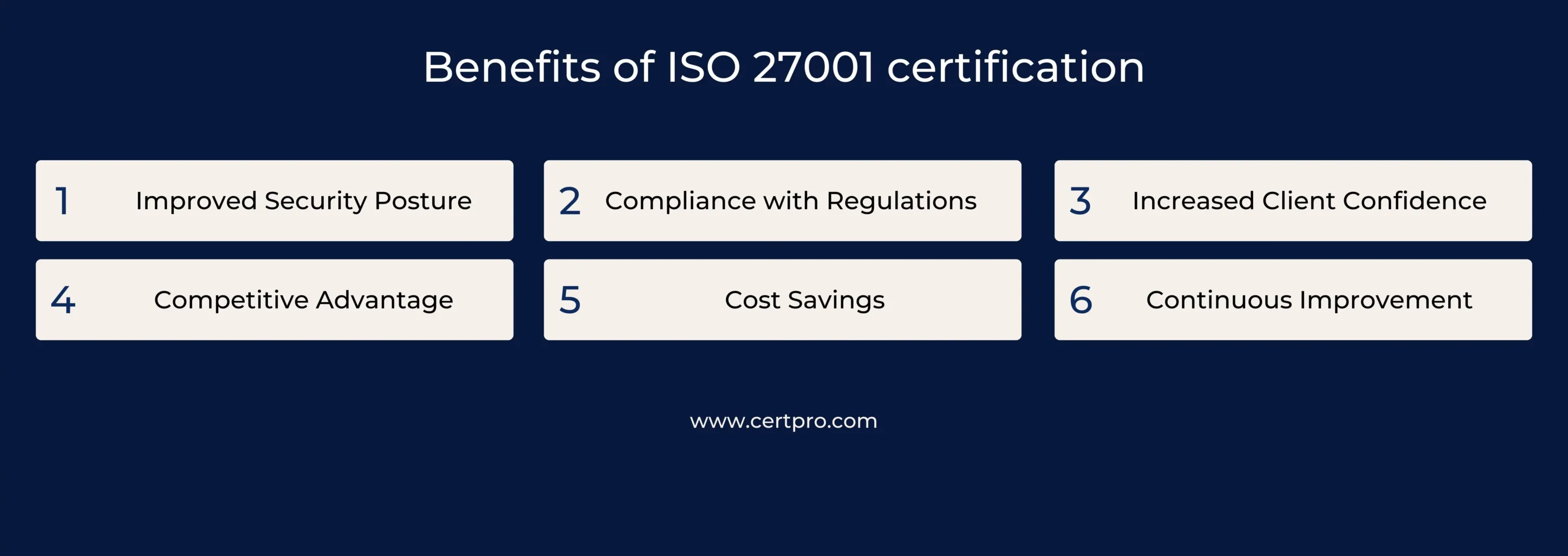
ISO 27001 certification delivers measurable, verifiable benefits to George Town organizations across regulatory, commercial, operational, and reputational dimensions. These benefits are directly traceable to the certification’s function as a third-party verified attestation of ISMS conformance — providing a level of assurance that self-assessed security programs cannot replicate. ISO 27001 Certification in George Town is particularly impactful in a commercial environment characterized by sophisticated enterprise buyers, active regulatory oversight, and competitive procurement processes that routinely require security certification as a qualification criterion.
ISO 27001 certification provides George Town organizations with independently verified evidence of appropriate technical and organizational security measures as required under UK GDPR Article 32. In the event of a personal data breach, the ICO’s investigation will assess whether the organization had implemented appropriate security measures. Certified organizations can present their ISO 27001 certificate, Statement of Applicability, and audit reports as direct evidence of compliance — significantly reducing enforcement risk. The ICO has explicitly recognized certification to approved standards as a factor in assessing the appropriateness of security measures, making ISO 27001 certification a material asset in any ICO enforcement defense.
George Town’s concentration of FTSE-listed enterprises, financial institutions, and public sector procurement authorities creates a commercial environment where ISO 27001 certification is increasingly a prerequisite for contract qualification rather than a competitive differentiator. ISO 27001 certification that George Town organizations hold eliminates procurement barriers in vendor qualification processes assessing supplier security posture. Technology companies, managed service providers, and professional services firms that achieve certification gain direct access to contract opportunities structurally inaccessible to uncertified competitors. The certification also accelerates due diligence timelines in M&A transactions, partnership negotiations, and enterprise client onboarding — reducing the time and cost of security questionnaire completion and buyer security assessments.
ISO 27001 certification drives tangible operational improvements through the systematic identification and treatment of information security risks. The risk assessment and treatment processes required for certification ensure that all significant threats to information assets are formally evaluated, and that treatment decisions are documented, approved, and subject to regular review. Organizations that implement ISO 27001-compliant controls typically experience reductions in security incident frequency and severity, improved incident detection and response capabilities, and more effective management of third-party supplier risks. The internal audit and management review cycle embedded in the standard creates a continuous improvement mechanism that advances security maturity over successive certification cycles.
- ✓ICO enforcement risk reduction through independently verified UK GDPR Article 32 compliance
- ✓Qualification for FTSE enterprise, financial services, and public sector procurement contracts
- ✓Cyber insurance premium reduction through demonstrated security maturity
- ✓Elimination of repetitive client security questionnaire burden
- ✓Improved incident detection, response, and recovery capabilities
- ✓Systematic supplier and third-party risk management framework
- ✓Board-level information security governance and accountability structure
- ✓Demonstrable alignment with FCA operational resilience requirements
- ✓Competitive differentiation in the ISO 27001 certification George Town financial services market
- ✓International recognition enabling cross-border contract qualification
- ✓Reduced data breach probability and associated financial exposure
- ✓Continual improvement framework ensuring ISMS relevance over time
- ✓Regulatory Risk Reduction and ICO Defensibility
- ✓Commercial and Procurement Advantages in George Town’s Market
- ✓Operational and Risk Management Benefits
ISO 27001 Certification Cost in George Town: Detailed Cost Framework
Understanding the complete ISO 27001 cost framework enables George Town organizations to plan certification investments accurately and align budget allocation with organizational scale and scope complexity. ISO 27001 certification cost components span the full three-year certification cycle and include initial implementation investment, Stage 1 and Stage 2 audit fees, annual surveillance audit fees, internal resource costs for ongoing ISMS maintenance, and recertification audit fees at the end of the three-year cycle. Organizations that approach ISO 27001 certification with a clear cost framework can build a compelling business case — quantifying return on investment against regulatory risk reduction, insurance savings, and contract win rate improvements.
| Cost Component | Small Organization (1–50 employees) | Medium Organization (51–250 employees) |
|---|---|---|
| Stage 1 + Stage 2 Audit Fees | £3,000 – £6,000 | £7,000 – £15,000 |
| Annual Surveillance Audit Fees | £1,500 – £3,000 | £3,500 – £7,000 |
| Recertification Audit Fees | £3,000 – £6,000 | £7,000 – £15,000 |
| Internal Resource Costs (Year 1) | £10,000 – £30,000 | £30,000 – £80,000 |
| Technology Investment (estimated) | £5,000 – £20,000 | £15,000 – £60,000 |
Why Choose CertPro for ISO 27001 Certification in George Town
CertPro is a Licensed CPA Firm specializing exclusively in information security certification audit services, including ISO 27001 certification. The firm’s engagement model is defined by the delivery of accredited certification audits and structured audit programs — not advisory or consulting services. CertPro’s ISO 27001 audit teams possess deep technical knowledge of ISO/IEC 27001:2022 requirements across all industry sectors operating in George Town, including financial services, fintech, technology, data centers, healthcare, and professional services. Organizations seeking audit-framed, evidence-based ISO 27001 Certification in George Town will find CertPro’s fixed pricing and structured methodology aligned with their compliance governance requirements.
Licensed CPA Firm Positioning and Institutional Credibility
CertPro’s status as a Licensed CPA Firm establishes an institutional foundation of professional accountability, ethical obligations, and technical rigor that distinguishes the firm from non-licensed certification service providers. The Licensed CPA Firm designation requires adherence to professional standards governing audit objectivity, evidence gathering, documentation, and reporting — all directly aligned with the requirements of accredited ISO 27001 certification programs. This positioning is particularly relevant for George Town organizations in regulated industries such as financial services, healthcare, and professional services, where certification body credibility and auditor professional standing are material factors in the acceptance of certification outputs by regulators and enterprise clients.
ISO 27001 certification for George Town companies requires certification body auditors who combine technical knowledge of information security controls with the professional discipline to conduct objective, evidence-based audits. CertPro’s audit teams are trained and evaluated under professional standards that ensure audit quality, consistency, and defensibility. The firm’s audit reports are structured for use by legal, compliance, and regulatory functions — enabling George Town organizations to present certification evidence to the ICO, FCA, enterprise procurement teams, and insurance underwriters with full confidence in the professional standing of the issuing firm.
Fixed Pricing and Audit-Framed Methodology
CertPro’s engagement structure for ISO 27001 certification is defined by fixed pricing, structured audit delivery, and clearly delineated scope agreements. The certification engagement does not include advisory services, framework implementation, or pre-audit preparation activities. This clear boundary between audit services and consulting activities eliminates the conflict of interest inherent in combined consulting-certification models and ensures that CertPro’s certification decisions are made exclusively on the basis of audit evidence and conformance with ISO/IEC 27001:2022 requirements. The fixed pricing model covers the complete audit program from Stage 1 through surveillance and recertification — enabling organizations to plan the full ISO 27001 certification cost that George Town businesses incur with precision and confidence.
Sector Expertise Across George Town’s Key Industries
CertPro’s ISO 27001 audit teams hold sector-specific experience across the industries that form George Town’s commercial core. ISO 27001 certification engagements in George Town financial services are conducted by auditors with specific knowledge of FCA operational resilience requirements, PRA supervisory expectations, and the intersection of ISO 27001 compliance with financial regulatory obligations. ISO 27001 compliance engagements for George Town fintech firms address the specific control requirements arising from open banking infrastructure, payment processing obligations under PSD2, and cloud-first technology architectures. For technology companies and data center operators, CertPro’s audit teams evaluate infrastructure security controls, cloud service provider management, and network security architecture against the Technological Controls domain of ISO/IEC 27001:2022 Annex A.
Attain ISO 27001 Certification in George Town with CertPro
ISO 27001 Certification in George Town represents a strategic information security credential with direct regulatory, commercial, and operational value for organizations in George Town’s demanding business environment. CertPro, as a Licensed CPA Firm, delivers the structured, accreditation-aligned ISO 27001 audit program that George Town organizations require to achieve and maintain certification under ISO/IEC 27001:2022. The firm’s fixed pricing model, institutional audit methodology, and sector-specific expertise across financial services, fintech, technology, and data infrastructure make CertPro the certification partner of choice for organizations seeking ISO 27001 Certification in George Town with professional rigor and regulatory defensibility.
Organizations seeking ISO 27001 certification services from a Licensed CPA Firm with documented expertise in ISO/IEC 27001:2022 requirements, UK GDPR Article 32 alignment, and George Town’s specific regulatory landscape should initiate a scope-based engagement assessment with CertPro. The assessment defines the ISMS scope, calculates audit day requirements, specifies the fixed certification cost, and establishes the certification timeline from Stage 1 audit through certificate issuance. ISO 27001 audit programs delivered by CertPro for George Town organizations are structured to satisfy the evidentiary requirements of the ICO, FCA, enterprise procurement teams, and cyber insurance underwriters — providing certified organizations with maximum utility from the certification across all relevant regulatory and commercial contexts.
- ✓Licensed CPA Firm delivering accredited ISO 27001 certification audits
- ✓Fixed pricing model covering the complete three-year certification cycle
- ✓Stage 1 and Stage 2 audit delivery under ISO/IEC 27001:2022
- ✓Sector-specific expertise in financial services, fintech, and technology
- ✓Audit reporting structured for ICO, FCA, and enterprise procurement use
- ✓Annual surveillance audit and recertification audit delivery
- ✓ISO/IEC 27001:2022 transition audit services for currently certified organizations
- ✓Multi-site audit program capability for George Town organizations with distributed operations
- ✓Audit objectivity maintained through strict separation of certification and consulting activities
- ✓Internationally recognized certification output accepted by global enterprise and regulatory audiences
FAQ
▶
What is ISO 27001 Certification?
▶
How long does ISO 27001 Certification take in George Town?
▶
What is the ISO 27001 audit process?
▶
What does ISO 27001 compliance require?
▶
What is the ISO 27001 cost for a George Town organization?
▶
Does ISO 27001 certification satisfy UK GDPR requirements?
▶
What are the Annex A controls in ISO 27001:2022?
▶
Which industries in George Town most require ISO 27001 certification?
Multi-Framework Compliance Guide: Best Practices and Strategies
Most compliance teams aren’t managing one framework. They’re managing three, four, sometimes five — simultaneously. A SaaS company selling to enterpri…
HOW COMPLIANCE AUDIT SOFTWARE IMPROVES AUDIT READINESS
Today, most companies deal with a growing number of compliance regulations. From data privacy standards to security frameworks like SOC 2 and ISO 2700…

THE ROLE OF GRC IN ISO 27001, SOC 2, AND OTHER FRAMEWORKS
The term GRC stands for Governance Risk and Compliance. It’s a system of integrated and centralized approaches used by organizations. This system comb…
Get In Touch
have a question? let us get back to you.