
ISO 27001 Certification in Hobart
The ISO 27001 certification audit process conducted by CertPro follows a structured, multi-stage methodology aligned with ISO/IEC 17021-1 requirements for bodies providing audit and certification of management systems. Each stage is designed to independently evaluate objective evidence of ISMS conformity — without providing guidance, implementation support, or readiness assistance. The table below summarises the principal stages of the ISO 27001 audit process as conducted for organisations seeking ISO 27001 Certification in Hobart.
OUR CLIENTS










ISO 27001 Certification for Hobart-Based Financial, Technology, and Public-Sector Organisations
ISO 27001 Certification in Hobart is the formal outcome of an independent conformity assessment confirming that an organisation’s Information Security Management System (ISMS) meets the requirements of the ISO/IEC 27001:2022 standard. CertPro, a Licensed CPA Firm, conducts independent ISO 27001 certification audits for organisations operating across Hobart and Tasmania. These audits evaluate objective evidence of ISMS conformity without performing consulting, implementation, or advisory services. Certification decisions are issued solely on the basis of evidence gathered during the structured ISO 27001 audit process.
Hobart’s economy spans a broad and distinctive range of industries, each generating significant volumes of sensitive information that must be governed, protected, and independently verified. Aquaculture and marine industries manage proprietary species data, biosecurity records, and export compliance documentation. Antarctic and environmental research institutions — operated by the Australian Antarctic Division and the University of Tasmania — handle classified scientific datasets and international collaboration agreements. Agriculture, food and beverage producers, and agribusiness entities operate digital supply chains that intersect with national food safety frameworks.
Tourism technology platforms, hospitality management systems, and booking infrastructure serve both domestic and international markets, creating data exposure across customer records and payment systems. Healthcare and life sciences organisations in Hobart manage sensitive patient information subject to the My Health Records Act 2012 and the Australian Privacy Act 1988. Government technology providers, SaaS developers, cloud service operators, and cybersecurity firms serving Tasmania’s public sector are increasingly required to demonstrate ISO 27001 compliance as a condition of procurement and vendor assurance reviews.
The ISO/IEC 27001:2022 standard establishes requirements for establishing, implementing, maintaining, and continually improving an ISMS. It applies to any organisation — regardless of size or sector — that seeks to manage information security risks in a structured, auditable manner. The 2022 revision updated Annex A to reorganise controls into four domains: Organisational, People, Physical, and Technological. It also introduced eleven new controls addressing areas such as threat intelligence, cloud service security, data masking, and ICT readiness for business continuity.
Organisations certified to the earlier ISO/IEC 27001:2013 version were required to transition to the 2022 standard, with certification bodies setting a transition deadline of 31 October 2025. ISO 27001 Certification in Hobart now reflects conformity with the current 2022 version of the standard.
CertPro’s position as a Licensed CPA Firm and independent ISO 27001 certification body means its audit conclusions are free from conflicts of interest. CertPro does not assist organisations in designing, implementing, or operating their ISMS — that responsibility remains entirely with the organisation. The ISO 27001 certification audit evaluates whether the organisation’s documented ISMS, its implemented controls, and its operational evidence collectively demonstrate conformity with ISO/IEC 27001:2022 Clauses 4 through 10 and Annex A.
Across Hobart’s technology, research, maritime, healthcare, and public-sector ecosystem, this independent evaluation is increasingly recognised as a meaningful indicator of information security governance maturity. ISO 27001 Certification in Hobart is sought by organisations responding to enterprise procurement requirements, regulatory expectations, and international market access criteria that demand independently verified information security controls.

What Is the ISO 27001 Standard and Why Does It Matter for Hobart Organisations?
The ISO/IEC 27001:2022 Standard Defined
The ISO 27001 standard is an internationally recognised framework published by the International Organization for Standardization (ISO) and the International Electrotechnical Commission (IEC). It specifies requirements for an Information Security Management System — a set of policies, processes, procedures, and controls that an organisation uses to manage risks to the confidentiality, integrity, and availability of information.
The standard is structured around ISO/IEC 27001 Clauses 4 to 10, covering context of the organisation, leadership, planning, support, operation, performance evaluation, and improvement. Annex A provides a reference control set of 93 controls across four domains: Organisational (37 controls), People (8 controls), Physical (14 controls), and Technological (34 controls).
The ISO 27001 standard is not prescriptive about which controls must be implemented. Instead, it requires organisations to determine applicable controls through a risk assessment process and document those decisions in a Statement of Applicability. This risk-based, scalable design makes the ISO/IEC 27001:2022 standard applicable to organisations across every sector represented in Hobart’s economy.
ISMS Scope and Information Security Governance
An ISMS is not a single system or technology — it is a management framework that integrates people, processes, and technology to protect information assets. ISO/IEC 27001:2022 requires organisations to define the scope of their ISMS, identifying which parts of the business, which information assets, and which locations fall within its boundaries.
For a Hobart-based SaaS provider, the ISMS scope might encompass cloud infrastructure, development pipelines, customer data environments, and third-party service relationships. For a healthcare organisation, scope may include patient record systems, clinical applications, and network infrastructure. The ISMS must be supported by demonstrable leadership commitment, documented information security policies, defined roles and responsibilities, and a systematic approach to identifying and treating information security risks.
ISO 27001 compliance requires that organisations not only design these elements but maintain them through ongoing monitoring, internal audits, and management review — all of which generate the objective evidence evaluated during a certification audit.
Relationship Between Risk Assessment, Risk Treatment, and Annex A Controls
ISO/IEC 27001:2022 requires organisations to conduct an information security risk assessment, identify risks to the confidentiality, integrity, and availability of information assets in scope, and select risk treatment options — including the application of controls from Annex A or other sources. The risk treatment plan documents the selected controls and the rationale for inclusions or exclusions.
The Statement of Applicability (SoA) is a mandatory document that lists all 93 Annex A controls, indicates whether each is applicable, and provides justification for any excluded controls. The SoA is a critical piece of objective evidence reviewed during a Stage 1 audit. For organisations in Hobart’s maritime, Antarctic research, and government technology sectors, the risk landscape may include nation-state threats, supply chain vulnerabilities, and sensitive data shared with international partners — all of which must be reflected in the risk assessment and addressed through appropriate Annex A controls.
The relationship between risk, treatment decisions, and control implementation is a core area of evaluation in any ISO 27001 certification audit conducted for Hobart organisations.
ISO 27001 Certification Audit Process for Organisations in Hobart
The ISO 27001 certification audit process conducted by CertPro follows a structured, multi-stage methodology aligned with ISO/IEC 17021-1 requirements for bodies providing audit and certification of management systems. Each stage is designed to independently evaluate objective evidence of ISMS conformity — without providing guidance, implementation support, or readiness assistance. The table below summarises the principal stages of the ISO 27001 audit process as conducted for organisations seeking ISO 27001 Certification in Hobart.
| Audit Stage | Key Activities | Output |
|---|---|---|
| Application Review | Review of organisational scope, ISMS boundaries, and initial documentation | Audit programme determination |
| Stage 1 Audit | Review of ISMS documentation, risk assessment, SoA, and management system readiness | Stage 1 findings report; readiness determination for Stage 2 |
| Stage 2 Audit | On-site or remote evaluation of ISMS implementation, control effectiveness, and objective evidence | Audit findings report; nonconformity identification |
| Nonconformity Review | Assessment of corrective actions raised against identified nonconformities | Closure verification; recommendation for certification |
| Certification Decision | Independent certification committee review of audit evidence and findings | Certificate issuance or deferral |
| Surveillance Audit | Annual evaluation of continued ISMS conformity within certification cycle | Surveillance findings report; continued certification confirmation |
The Stage 1 audit focuses on reviewing the organisation’s ISMS documentation to assess whether the management system has been adequately designed and documented in accordance with ISO/IEC 27001:2022. The audit team reviews core documented information including the information security policy, scope statement, risk assessment methodology, risk treatment plan, Statement of Applicability, and evidence of management review and internal audit activities.
For Hobart-based organisations, the Stage 1 audit also considers the specific operational context — including whether the ISMS scope accurately reflects the organisation’s information assets, third-party relationships, and applicable legal and regulatory obligations under Australian privacy and data protection legislation. The Stage 1 audit concludes with a findings report identifying any areas requiring clarification or additional documented evidence prior to the Stage 2 audit.
Importantly, the Stage 1 audit does not evaluate the operational effectiveness of controls. It evaluates the adequacy of the ISMS design and its documented foundation — a critical distinction in the ISO 27001 certification audit process.
The Stage 2 audit is the principal conformity assessment activity in the ISO 27001 certification audit process. Audit teams evaluate whether the ISMS has been implemented and is operating effectively across the defined scope, examining objective evidence that controls are functioning as designed and that the organisation’s risk treatment decisions are being executed.
Evidence collected during the Stage 2 audit includes system configurations, access control logs, incident response records, training completion data, third-party agreements, physical security assessments, and management review minutes. For organisations in Hobart’s healthcare, aquaculture, SaaS, and government technology sectors, the audit may also include review of environment-specific controls such as data classification schemes, cloud security configurations, and supply chain security practices.
Nonconformities identified during the Stage 2 audit are classified and communicated to the organisation for corrective action. The ISO 27001 audit findings are documented in a formal report reviewed by CertPro’s independent certification committee prior to the final certification decision.
ISO 27001 certification is issued with a three-year validity period, subject to annual surveillance audits that verify continued conformity with the ISO/IEC 27001:2022 standard. Surveillance audits are typically conducted annually and evaluate whether the ISMS continues to operate effectively, whether corrective actions from prior audits have been sustained, and whether significant changes to the organisation’s information security environment have been addressed within the ISMS.
For Hobart-based organisations experiencing growth, technology transformation, or changes in regulatory obligations, surveillance audits assess whether the ISMS scope and controls remain appropriate to the current risk environment. Recertification audits are conducted prior to the expiry of the three-year certification cycle and involve a comprehensive re-evaluation of the ISMS against the ISO/IEC 27001:2022 standard.
Continued certification requires sustained objective evidence of conformity across the full ISMS scope. CertPro’s ISO 27001 audit programme for Hobart organisations includes structured surveillance scheduling to maintain certification integrity throughout the certification cycle.
- ✓Stage 1 Audit: Documentation and ISMS Review
- ✓Stage 2 Audit: Implementation and Evidence Evaluation
- ✓Surveillance Audits and Recertification
Why Organisations in Hobart Pursue ISO 27001 Certification
ISO 27001 certification for Hobart businesses is driven by a convergence of procurement requirements, regulatory expectations, international market access demands, and information security governance maturity objectives. Across Hobart’s distinctive industry sectors, independently verified information security controls are increasingly a baseline expectation — not merely a competitive differentiator. Organisations pursuing ISO 27001 Certification in Hobart do so to meet concrete business, legal, and market requirements.
Government and Public Sector Procurement Requirements
Tasmanian government agencies and Commonwealth entities operating in Hobart — including the Australian Antarctic Division, the Department of Natural Resources and Environment Tasmania, and Service Tasmania — increasingly require technology vendors, cloud service providers, and managed service operators to demonstrate ISO 27001 compliance as a condition of procurement. The Australian Government’s Information Security Manual (ISM) and the Protective Security Policy Framework (PSPF) establish information security expectations for vendors supplying to government. ISO 27001 certification provides a structured, independently verified mechanism for demonstrating conformity with those expectations.
A SaaS provider supplying case management software to a Tasmanian government agency, or a cloud hosting operator servicing Department of Health systems, may face vendor security review requirements that reference the ISO/IEC 27001:2022 standard. ISO 27001 Certification in Hobart provides a formal, third-party verified response to those procurement requirements — reducing friction in government tender processes and supplier panel applications.
Research, Antarctic, and Maritime Sector Information Security Requirements
Hobart’s position as Australia’s Antarctic gateway and a centre for marine and environmental research creates information security obligations that extend beyond standard commercial contexts. The Australian Antarctic Division, the Commonwealth Scientific and Industrial Research Organisation (CSIRO), and the University of Tasmania manage research datasets, international collaboration data, and environmental monitoring information subject to bilateral data sharing agreements and national security considerations.
Maritime logistics operators servicing the Port of Hobart and Antarctic resupply missions manage vessel tracking data, cargo manifests, and operational communications that require controlled access and documented security practices. ISO 27001 compliance in Hobart is particularly relevant for these organisations because the standard provides a systematic framework for identifying, assessing, and treating information security risks in complex, multi-stakeholder environments.
Certification demonstrates to international research partners and government funders that information security governance meets internationally recognised standards — supporting continued access to collaborative research programmes and grant funding.
Financial Services, Fintech, and Healthcare Vendor Assurance
Financial services organisations, credit unions, and fintech operators in Hobart routinely evaluate suppliers’ information security posture as part of third-party vendor risk assessments. An ISO 27001 certification audit provides an independently verified record of a supplier’s ISMS conformity, reducing the burden of individual vendor questionnaires and security assessments. Similarly, healthcare providers and life sciences organisations managing patient information under the My Health Records Act 2012, the Privacy Act 1988, and the Healthcare Identifiers Act require technology suppliers to demonstrate equivalent information security standards.
ISO 27001 certified companies in Hobart supplying clinical software, health data analytics, or medical device management systems can reference their certification as evidence of independently verified security controls. The certification also maps to regulatory obligations under the Notifiable Data Breaches (NDB) scheme, which requires Australian organisations to notify the OAIC and affected individuals when an eligible data breach occurs — a scenario that ISMS controls are designed to prevent and detect. ISO 27001 compliance in Hobart thus serves both a regulatory and commercial assurance function for financial and healthcare sector organisations.
ISO 27001 Requirements: ISMS Documentation and Control Domains
ISO 27001 compliance requires organisations to establish and maintain specific documented information and implement controls across four Annex A domains. The following section identifies the core documentation and control requirements evaluated during an ISO 27001 certification audit, assessed against the ISO/IEC 27001:2022 standard. Understanding these requirements is essential for any Hobart-based organisation preparing for independent certification.
ISO/IEC 27001:2022 specifies mandatory documented information that organisations must maintain as part of their ISMS. These documents form the foundation of the Stage 1 audit review and must be available as objective evidence of ISMS design and intent. The following items are among those evaluated during an ISO 27001 certification audit conducted by CertPro for organisations in Hobart and across Tasmania.
- ✓Information security policy — top-level statement of intent signed by senior leadership
- ✓ISMS scope document — defining the boundaries and applicability of the management system
- ✓Information security risk assessment — identifying risks to information assets in scope
- ✓Risk treatment plan — documenting selected controls and treatment decisions
- ✓Statement of Applicability (SoA) — listing all 93 Annex A controls with inclusion/exclusion justification
- ✓Internal audit programme and findings records — evidence of systematic internal evaluation
- ✓Management review records — evidence of leadership oversight and ISMS performance review
- ✓Nonconformity and corrective action records — documentation of identified issues and responses
The ISO/IEC 27001:2022 Annex A reorganised the previous 114 controls into 93 controls across four domains. The Organisational domain (37 controls) covers policies, roles, responsibilities, threat intelligence, information security in project management, and supplier relationships — areas particularly relevant for Hobart organisations managing complex supply chains in food and beverage, aquaculture, and logistics sectors.
The People domain (8 controls) addresses screening, terms of employment, information security awareness, and responsibilities after termination — critical for research organisations managing access to sensitive scientific data. The Physical domain (14 controls) covers physical security perimeters, secure areas, equipment protection, and clear desk and clear screen policies — directly relevant for maritime, Antarctic, and government facilities in Hobart.
The Technological domain (34 controls) encompasses access control, cryptography, endpoint protection, network security, application security, and the eleven controls introduced in the 2022 revision — including threat intelligence, data masking, web filtering, and ICT readiness for business continuity. ISO 27001 compliance requires organisations to assess each control’s applicability and document that decision in the SoA.
Beyond Annex A, the ISO 27001 standard imposes requirements through Clauses 4 to 10 of the management system framework. Clause 4 requires the organisation to understand its internal and external context and the needs of interested parties. Clause 5 requires demonstrable leadership commitment and the establishment of information security objectives. Clause 6 covers planning, including risk assessment, risk treatment, and the SoA. Clause 7 covers support requirements including resources, competence, awareness, communication, and documented information.
Clause 8 covers operational planning and control. Clause 9 covers performance evaluation, including monitoring, measurement, internal audit, and management review. Clause 10 covers improvement, including nonconformity management and continual improvement. During the ISO 27001 certification audit, auditors evaluate objective evidence of conformity with each applicable clause requirement — not merely the presence of documentation. For organisations in Hobart, evidence gathered across all clauses informs the certification committee’s independent decision.
- ✓Core ISMS Documentation Requirements
- ✓Annex A Control Domains: Organisational, People, Physical, and Technological
- ✓ISO/IEC 27001 Clauses 4 to 10: Management System Requirements
Benefits of ISO 27001 Certification for Hobart-Based Organisations
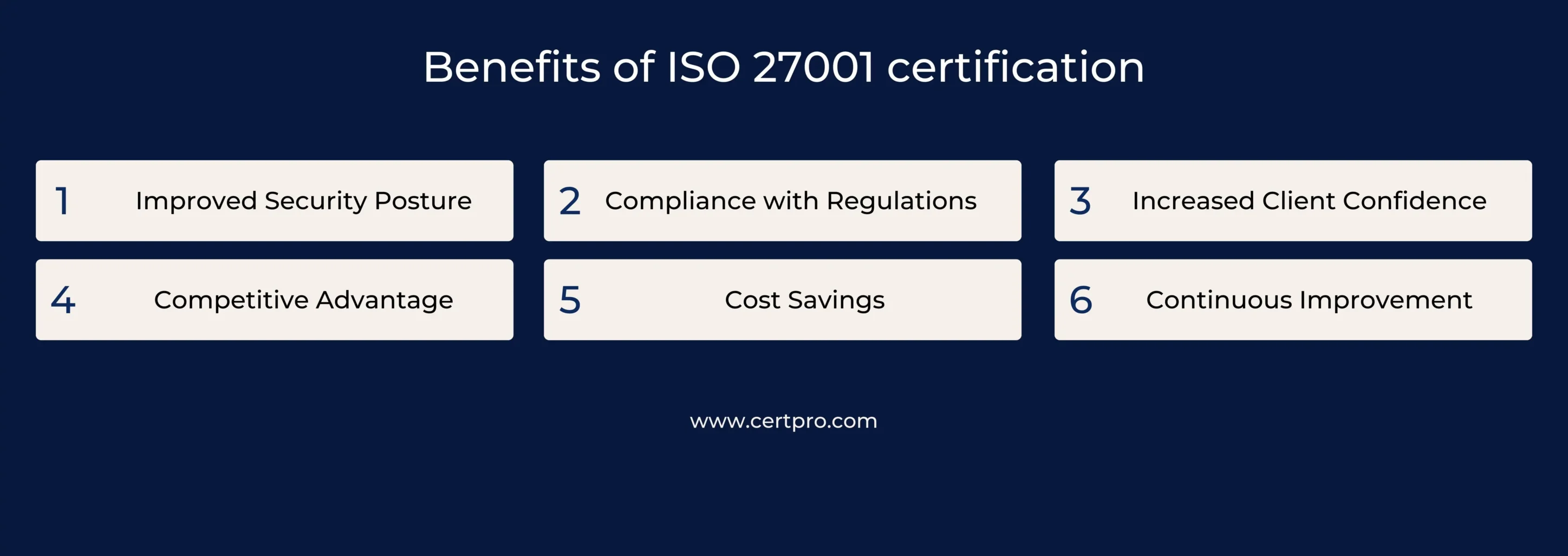
ISO 27001 Certification in Hobart delivers measurable outcomes for organisations across Tasmania’s diverse economic sectors. The following benefits are directly associated with achieving and maintaining independent third-party certification against the ISO/IEC 27001:2022 standard. Each benefit reflects a concrete, evidence-based outcome of a successfully completed ISO 27001 certification audit.
- ✓Independent verification of ISMS conformity through a structured, evidence-based ISO 27001 certification audit
- ✓Demonstrated compliance with the Australian Privacy Act 1988, Notifiable Data Breaches scheme, and sector-specific regulatory obligations
- ✓Eligibility for government and enterprise procurement opportunities requiring independently verified information security standards
- ✓Structured risk management framework reducing information security incidents through documented, implemented controls
- ✓Recognition by international research partners, export markets, and global enterprise customers requiring ISO 27001 compliance
- ✓Annual surveillance audit cycle providing ongoing assurance of continued ISMS effectiveness and control operation
- ✓Alignment with Australian Government Information Security Manual (ISM) and Protective Security Policy Framework (PSPF) expectations
- ✓Reduced third-party audit burden — a single ISO 27001 certification audit replaces multiple individual vendor security assessments
For Hobart’s technology and SaaS sector, ISO 27001 certification provides a market-recognised signal of information security maturity that supports enterprise sales, international expansion, and participation in government procurement panels. Cloud service providers and data hosting organisations operating from Hobart can demonstrate independently verified security controls to enterprise customers conducting vendor due diligence reviews.
For aquaculture and food and beverage producers integrating digital supply chain management systems, ISO 27001 compliance in Hobart demonstrates that the information systems managing biosecurity data, export documentation, and supplier records are governed by a certified ISMS. For renewable energy operators and utilities managing operational technology (OT) environments alongside corporate IT infrastructure, the ISO/IEC 27001:2022 standard’s requirements for asset management, access control, and network security provide a systematic framework for reducing information security risk in critical infrastructure contexts.
ISO 27001 helps organisations map legal and regulatory requirements — including the Australian Privacy Act 1988, the My Health Records Act 2012, the Security of Critical Infrastructure Act 2018, and the Notifiable Data Breaches (NDB) scheme — to documented ISMS controls. This mapping, documented in the SoA and risk treatment plan, provides evidence that the organisation has considered applicable legal obligations in its information security risk management process.
For healthcare organisations in Hobart, the SoA may reference Annex A controls addressing access control, cryptography, and incident management as mechanisms for meeting obligations under the My Health Records Act. For critical infrastructure operators in energy, water, and maritime sectors, the Security of Critical Infrastructure Act 2018 imposes cyber security incident reporting and risk management programme obligations that align with ISO/IEC 27001:2022 requirements.
ISO 27001 certification does not itself constitute regulatory compliance, but it provides documented, independently verified evidence that information security controls are in place and operating — evidence that regulators and auditors may review during their own assessments.
- ✓Sector-Specific Value Across Hobart’s Economy
- ✓Regulatory Mapping and Legal Compliance Support
Sectors in Hobart and Tasmania Seeking ISO 27001 Certification
ISO 27001 certification is relevant across Hobart’s entire economic and institutional landscape. The table below identifies key sectors in Hobart and Tasmania seeking ISO 27001 Certification and the primary information security considerations driving certification demand in each sector. Organisations across all of these sectors may engage CertPro for an independent ISO 27001 audit tailored to their operational context.
| Sector | Key Information Security Considerations | Relevant Driver |
|---|---|---|
| Healthcare and Life Sciences | Patient records, clinical systems, health data under Privacy Act and My Health Records Act | Regulatory compliance and vendor assurance |
| Aquaculture and Marine Industries | Biosecurity data, species management records, export compliance documentation | Supply chain security and export market requirements |
| Government Technology and SaaS | Public sector data, procurement security requirements, ISM and PSPF alignment | Government procurement mandates |
| Antarctic and Environmental Research | Scientific datasets, international collaboration data, national security considerations | Research partner requirements and grant conditions |
| Financial Services and Fintech | Customer financial data, payment systems, third-party risk management | Vendor assurance and regulatory expectations |
| Renewable Energy and Utilities | Operational technology, SCADA systems, critical infrastructure obligations | Security of Critical Infrastructure Act 2018 |
Technology, Cloud, and Cybersecurity Organisations
Hobart’s growing technology ecosystem includes SaaS developers, managed service providers, cybersecurity firms, AI solution providers, and cloud and data service operators. Many of these organisations serve clients in regulated industries — including government, healthcare, and financial services — where independently verified information security controls are a procurement requirement. An ISO 27001 certification body in Hobart such as CertPro provides the independent, accreditation-aligned ISO 27001 certification audit that technology organisations need to demonstrate ISMS conformity to prospective enterprise customers.
The ISO 27001 audit evaluates whether the organisation’s cloud security configurations, software development security practices, access management controls, and incident response capabilities conform to the ISO/IEC 27001:2022 standard. ISO 27001 certified companies in Hobart operating in the technology sector can reference their certification in responses to enterprise vendor questionnaires, government panel applications, and international contract tender processes — reducing friction in sales cycles that involve security due diligence reviews.
Education, Research, and Professional Services
The University of Tasmania, TAFE Tasmania, and independent research institutions operating in Hobart manage student records, research data, intellectual property, and grant-funded information assets that require structured information security governance. International collaborations — including Antarctic Treaty System research activities and CSIRO partnerships — may impose information security requirements on Hobart-based research institutions as conditions of data sharing agreements.
Professional services firms in Hobart — including legal, accounting, engineering, and consulting practices — manage client confidential information subject to professional conduct obligations and, increasingly, client-imposed vendor security requirements. ISO 27001 compliance in Hobart’s professional services context demonstrates that client data is managed within a certified ISMS, reducing reputational risk and supporting client retention in markets where information security governance is a baseline expectation.
ISO 27001 Certification in Hobart for education and research organisations also supports access to international grant funding that requires applicants to demonstrate credible information security management capability.
CertPro as an Independent ISO 27001 Certification Body for Hobart
Licensed CPA Firm and Independent Certification Body Positioning
CertPro is a Licensed CPA Firm that conducts independent ISO 27001 certification audits for organisations in Hobart and across Tasmania. As an independent certification body, CertPro does not provide consulting, advisory, implementation, or readiness services — its role is exclusively the independent evaluation of ISMS conformity against the ISO/IEC 27001:2022 standard. This structural independence is foundational to the integrity of the certification outcome.
An ISO 27001 certification audit conducted by a body that also performs consulting or advisory services for the same organisation would represent a conflict of interest inconsistent with ISO/IEC 17021-1 requirements for impartiality. CertPro’s exclusive focus on independent audit and certification activities means that its certification decisions are based solely on objective evidence evaluated during the audit process — not on prior familiarity with the organisation’s ISMS design or implementation.
This independence is precisely what gives ISO 27001 Certification in Hobart its value as a third-party verified assurance signal for procurement, regulatory, and commercial purposes.
Independent Certification Committee and Certification Decision Process
Following the completion of Stage 2 audit activities and the resolution of identified nonconformities, the audit findings and evidence documentation are submitted to CertPro’s independent certification committee for review. The certification committee evaluates the audit record — including the audit programme, Stage 1 and Stage 2 findings reports, nonconformity records, and corrective action evidence — and makes an independent determination on whether the organisation’s ISMS demonstrates sufficient conformity with the ISO/IEC 27001:2022 standard to warrant certification.
The certification committee’s decision is not made by the audit team that conducted the field evaluation, ensuring a further layer of independence in the certification decision process. Where the committee determines that sufficient objective evidence of conformity exists, the ISO 27001 certificate is issued specifying the scope, the applicable standard version, the certification period, and the surveillance audit schedule. ISO 27001 consultants in Hobart who have assisted organisations in establishing their ISMS have no involvement in CertPro’s certification decision process — preserving the independence that makes ISO 27001 certification credible.
ISO 27001 Certification Cost Hobart: Scope and Audit Programme Factors
The scope and structure of an ISO 27001 certification audit programme are determined by the characteristics of the organisation seeking certification. Factors that influence the audit programme include the number of employees within the ISMS scope, the complexity of information processing activities, the number and type of information systems in scope, the number of physical locations, the degree of outsourcing and third-party reliance, and the risk profile of the organisation’s information assets.
These factors are assessed during the application review phase and inform the audit programme determination prior to the commencement of Stage 1 activities. Organisations seeking information on ISO 27001 certification cost in Hobart should engage directly with CertPro to discuss their specific scope, organisational structure, and ISMS boundaries. The audit programme is tailored to each organisation’s circumstances and cannot be reliably estimated without a scope review.
Scope Definition and Audit Programme Determination
The audit programme determination is a structured activity conducted after the organisation submits its application and ISMS scope documentation. CertPro reviews the submitted documentation to understand the boundaries of the ISMS — which business units, information assets, locations, and processes are included — and determines the appropriate audit duration, team composition, and sampling approach for the Stage 1 and Stage 2 audits.
For a small SaaS provider in Hobart with a narrowly defined ISMS scope covering cloud development and customer service operations, the audit programme will differ significantly from that of a large healthcare organisation with a multi-site ISMS encompassing clinical systems, administrative infrastructure, and third-party clinical application providers. The audit programme is documented and agreed with the organisation prior to audit commencement.
No advisory input on ISMS design or control implementation is provided during this process — it is an administrative and planning activity focused on ensuring the ISO 27001 audit is appropriately scoped and resourced for Hobart organisations.
Certificate Validity, Suspension, and Withdrawal
An ISO 27001 certificate is valid for three years from the date of issue, subject to satisfactory completion of annual surveillance audits. Certificate suspension may occur where an organisation fails to complete a scheduled surveillance audit within the agreed timeframe, where significant nonconformities are identified during a surveillance audit and not resolved within the specified corrective action period, or where the organisation’s ISMS scope undergoes material changes that have not been reviewed and approved through the certification process.
Certificate withdrawal occurs where suspended certification is not reinstated within the applicable period, or where the organisation voluntarily withdraws from the certification programme. These conditions are defined in the certification agreement and are consistent with ISO/IEC 17021-1 requirements. Organisations seeking ISO 27001 Certification in Hobart should understand that maintaining certification requires continued ISMS operation and ongoing engagement with the surveillance audit programme. Certification is not a one-time event — it is an ongoing commitment to operating and demonstrating a conforming ISMS.
FAQ
▶
What is ISO 27001 Certification?
▶
Which organisations in Hobart need ISO 27001 certification?
▶
What is the difference between Stage 1 and Stage 2 of the ISO 27001 audit?
▶
What is a Statement of Applicability (SoA) in ISO 27001?
▶
How long does ISO 27001 certification remain valid?
▶
What is the role of an internal audit in ISO 27001 compliance?
▶
Does ISO 27001 certification demonstrate compliance with Australian privacy law?
▶
What is the transition deadline from ISO/IEC 27001:2013 to ISO/IEC 27001:2022?
Get In Touch
have a question? let us get back to you.