
ISO 27001 Certification in Kyiv
ISO 27001 Certification in Kyiv is conducted by CertPro, a Licensed CPA Firm operating exclusively as an independent third-party certification body. CertPro evaluates Information Security Management Systems (ISMS) against the requirements of ISO/IEC 27001:2022 and its Annex A control framework, issuing certification decisions based solely on audit evidence and documented conformity findings. No advisory, consulting, or implementation services are provided.
OUR CLIENTS










ISO 27001 Certification for Kyiv-Based Financial and Technology Organizations
ISO 27001 Certification in Kyiv is conducted by CertPro, a Licensed CPA Firm operating exclusively as an independent third-party certification body. CertPro evaluates Information Security Management Systems (ISMS) against the requirements of ISO/IEC 27001:2022 and its Annex A control framework, issuing certification decisions based solely on audit evidence and documented conformity findings. No advisory, consulting, or implementation services are provided.
Kyiv as a Regional Hub for Technology and Information Security
Kyiv functions as one of Eastern Europe’s most significant centers for software development, IT outsourcing, cybersecurity, fintech, and SaaS delivery. The city hosts a dense concentration of technology companies, engineering talent pools, cloud service providers, and managed service providers that deliver services to enterprise clients across the United States, the European Union, and global markets.
Organizations operating within this ecosystem routinely face vendor assurance requirements, third-party risk management obligations, and enterprise procurement security reviews that demand independent, internationally recognized certification. ISO 27001 Certification in Kyiv directly addresses these requirements by providing objective, evidence-based verification of an organization’s information security management practices.
Kyiv-based IT outsourcing firms processing client data under U.S. and EU agreements, SaaS companies serving regulated industries, and fintech platforms handling sensitive financial and personal data represent the primary organizational categories for which ISO 27001 Certification carries direct commercial and regulatory significance.
What ISO 27001 Certification Establishes
ISO 27001 Certification establishes that an organization’s Information Security Management System meets the documented requirements of ISO/IEC 27001:2022, including the management system clauses (Clauses 4 through 10) and the Annex A control domains covering Organizational, People, Physical, and Technological controls.
Certification is not self-declared. It is issued following a structured ISO 27001 audit program conducted by an accredited or recognized independent certification body. The audit evaluates both the design adequacy of ISMS controls and their operating effectiveness over a defined scope and period.
ISO 27001 Certification in Kyiv signals to clients, enterprise procurement teams, and regulatory stakeholders that the certified organization has undergone rigorous independent examination of its information security practices, risk treatment decisions, and control evidence. The certification applies to a defined organizational scope, which may encompass specific business units, service lines, geographic locations, or the entirety of the organization’s information-processing activities.
Independent Certification Body Positioning
CertPro operates exclusively as a certification body and does not provide consulting, readiness preparation, policy development, or control design services. This strict separation of roles maintains the independence and objectivity required for credible ISO 27001 attestation. Certification decisions are issued by an independent certification committee that reviews audit findings, nonconformity evidence, and auditor conclusions before issuing or denying a certificate.
Organizations seeking ISO 27001 Certification in Kyiv engage CertPro solely for the audit and certification process. The ISO/IEC 27001:2022 standard, updated from the previous 2013 version, introduced a revised Annex A structure with 93 controls organized across four domains, replacing the previous 114 controls across 14 domains. Organizations that have not yet transitioned from the 2013 version face a mandatory transition deadline of October 31, 2025, as set by applicable certification and accreditation bodies.

ISO 27001 Certification Audit Process for Organizations in Kyiv
The ISO 27001 audit process for organizations in Kyiv follows a structured, multi-stage methodology designed to independently evaluate ISMS conformity and control effectiveness. Each stage produces documented findings that contribute to the certification committee’s final decision.
The process is consistent with internationally recognized certification body practices and applies uniformly regardless of the organization’s industry sector or size. Understanding each stage helps Kyiv-based organizations prepare effectively for ISO 27001 Certification.
The ISO 27001 audit that Kyiv organizations undergo begins with a Stage 1 audit. This stage reviews the organization’s ISMS documentation, scope definition, risk assessment methodology, Statement of Applicability, and readiness of the management system against ISO/IEC 27001:2022 Clauses 4 through 10. The Stage 1 audit identifies areas where ISMS documentation does not conform to standard requirements and establishes the audit program for Stage 2.
The Stage 2 audit involves on-site or remote evaluation of control implementation and operating effectiveness. Auditors collect and assess evidence across all applicable Annex A control domains, interview process owners, review documented records, and test whether controls are operating as designed within the defined scope.
Nonconformities identified during Stage 2 are classified and documented in the audit report. The organization must address major nonconformities before a certification decision can be issued. Minor nonconformities are subject to documented corrective action plans with defined timelines for closure.
Following the Stage 2 audit, the audit team’s findings and the auditor’s recommendation are reviewed by an independent certification committee that was not involved in conducting the audit. This separation ensures objective evaluation of conformity findings.
The committee reviews whether the evidence collected supports a conclusion of conformity with ISO/IEC 27001:2022 requirements and whether the auditor’s conclusions are substantiated. Where conformity has been demonstrated, an ISO 27001 certificate is issued specifying the certified scope, the applicable standard version, the certificate validity period, and the surveillance audit schedule.
The certificate remains valid for three years, subject to satisfactory annual surveillance audits and, at the end of the three-year cycle, a recertification audit. Suspension or withdrawal of certification may result from failure to maintain conformity or refusal to undergo scheduled surveillance audit procedures.
| Audit Stage | Key Activities | Output |
|---|---|---|
| Application Review | Scope confirmation, conflict-of-interest check, audit program determination | Audit plan and program |
| Stage 1 Audit | ISMS documentation review, risk assessment evaluation, scope and SoA assessment | Stage 1 findings report |
| Stage 2 Audit | Control implementation testing, evidence collection, Annex A evaluation | Nonconformity report and audit conclusions |
| Nonconformity Review | Review of corrective actions for major nonconformities | Closure verification or suspension |
| Certification Committee Decision | Independent review of audit evidence and auditor recommendation | ISO 27001 certificate issuance or denial |
| Surveillance Audit | Annual review of ISMS maintenance and control operation | Continued certification or suspension |
| Recertification Audit | Full ISMS re-evaluation at end of three-year cycle | Certificate renewal or lapse |
ISO 27001 compliance for Kyiv organizations requires active ISMS management throughout the three-year certificate lifecycle. Annual surveillance audits verify that the certified ISMS continues to conform to ISO/IEC 27001:2022 requirements and that controls remain operational within the defined scope.
Surveillance audits are narrower in scope than the initial Stage 2 audit but include review of internal audit results, management review records, changes to the ISMS scope, and the status of any previously identified nonconformities. Organizations that modify their service delivery model, expand geographic scope, or undergo significant structural changes must notify the certification body, as these changes may require scope amendment and additional audit procedures.
At the end of the three-year certification cycle, a recertification audit is conducted to evaluate the continued effectiveness of the ISMS and to renew the certificate for a further three-year period. Failure to maintain satisfactory surveillance audit outcomes results in suspension or withdrawal of the ISO 27001 certificate.
- ✓Stage 1 and Stage 2 Audit Methodology
- ✓Certification Committee Decision and Certificate Issuance
- ✓Surveillance Audits and Certificate Maintenance
Why Organizations in Kyiv Pursue ISO 27001 Certification
Demand for ISO 27001 Certification in Kyiv is driven by specific commercial, contractual, and regulatory pressures that Kyiv-based technology and financial services organizations face when delivering services to international enterprise clients. Understanding these demand drivers clarifies why ISO 27001 examination and attestation carry direct operational significance for organizations in this market.
Enterprise Vendor Security Reviews and Procurement Requirements
Kyiv-based IT outsourcing firms and software development companies frequently deliver services under contracts with U.S. and EU enterprise clients who impose third-party information security requirements through vendor risk management programs. These programs routinely require that vendors demonstrate independent certification of their information security controls.
ISO 27001 Certification in Kyiv satisfies vendor assurance questionnaires, security due diligence requests, and contract clauses that require certified ISMS status. For example, a Kyiv-based software development firm delivering managed engineering services to a U.S. financial services company may be required to present a valid ISO 27001 certificate as a condition of contract renewal or expansion.
The certificate provides the client’s procurement and information security teams with documented evidence that an independent audit body has evaluated and attested to the vendor’s ISMS conformity, reducing the client’s third-party risk exposure without requiring direct client audit access.
Fintech and Financial Services Sector Obligations
ISO 27001 compliance that Kyiv fintech organizations pursue reflects the intersection of international financial services data protection requirements and client-side due diligence obligations. Kyiv hosts a growing concentration of fintech companies processing payment data, conducting currency exchange operations, and providing financial software to regulated institutions across Europe and North America.
These organizations are subject to contractual information security requirements from banking partners, payment network operators, and regulated institutional clients that specify ISO 27001 certification or equivalent independent attestation. ISO 27001 Certification that Kyiv financial services organizations obtain provides documented evidence of structured risk management, defined access controls, incident response procedures, and cryptographic control policies — elements that financial services regulators and institutional counterparties evaluate during vendor onboarding.
The ISO 27001 attestation issued following a successful audit provides a single, internationally recognized artifact that addresses multiple client security assessment requirements simultaneously.
SaaS Providers and Cloud Service Organizations
Kyiv’s SaaS and cloud service provider community faces information security certification requirements from enterprise subscription clients who conduct annual vendor security reviews as part of their own internal risk management and regulatory compliance programs. ISO 27001 Certification that Kyiv IT companies obtain signals to enterprise procurement teams that the SaaS provider’s ISMS has been independently evaluated and conforms to an internationally recognized standard.
For cloud service providers, ISO 27001 compliance provides a foundation that aligns with additional frameworks, including SOC 2 and cloud-specific extensions such as ISO/IEC 27017. The certification scope for a SaaS organization typically encompasses the infrastructure, application development, data processing, and support operations that constitute the service delivery environment.
Clients reviewing a potential SaaS vendor’s security posture can rely on an ISO 27001 certificate as evidence of structured, independently verified information security management — without conducting their own on-site audit.
ISO 27001 Certification Requirements and ISMS Documentation
ISO 27001 compliance requires organizations to establish, implement, maintain, and continually improve a documented ISMS that addresses the mandatory requirements of ISO/IEC 27001:2022 Clauses 4 through 10 and the applicable controls selected from Annex A. The ISO 27001 audit evaluates whether these requirements are met through documentary evidence and operational demonstration.
The ISO 27001 examination of an organization’s ISMS documentation focuses on four foundational documents that must be present, complete, and aligned with the organization’s defined scope and risk environment.
The Information Security Policy establishes management’s commitment to information security and defines the principles governing the ISMS. The Risk Assessment document records the methodology used to identify and evaluate information security risks, the criteria for risk acceptance, and the results of risk identification and analysis activities. The Risk Treatment Plan documents how identified risks are addressed, which controls are applied, and the rationale for control selection. The Statement of Applicability (SoA) lists all Annex A controls, indicates whether each control is implemented or excluded, and provides documented justification for exclusions.
These four documents form the audit-facing core of the ISMS and are reviewed during the Stage 1 audit. Auditors assess whether the documentation is complete, internally consistent, and proportionate to the organization’s risk environment and certified scope.
ISO/IEC 27001:2022 reorganized the Annex A control set into four domains: Organizational controls (37 controls), People controls (8 controls), Physical controls (14 controls), and Technological controls (34 controls), totaling 93 controls. The updated structure introduced 11 new controls addressing areas such as threat intelligence, information security for cloud services, ICT readiness for business continuity, data masking, and monitoring activities.
The ISO 27001 audit evaluates the implementation and effectiveness of all Annex A controls that the organization has identified as applicable in its Statement of Applicability. Auditors examine documented policies, procedural records, system configurations, access logs, incident records, and training documentation as evidence of control operation.
The four Annex A domains replace the 14 control domains of ISO/IEC 27001:2013. Organizations still certified to the 2013 version must complete their transition to the 2022 standard before the October 31, 2025 deadline to maintain valid certification.
Beyond Annex A controls, ISO/IEC 27001:2022 requires conformity with management system clauses covering context of the organization (Clause 4), leadership and commitment (Clause 5), planning (Clause 6), support including competence and communication (Clause 7), operation (Clause 8), performance evaluation through internal audits and management review (Clause 9), and improvement through nonconformity and corrective action (Clause 10).
The ISO 27001 audit examines documented evidence of conformity with each clause. For Kyiv-based organizations, Clause 4 requires definition of internal and external issues relevant to the organization’s purpose. For a Kyiv IT outsourcing firm, this would include client contractual requirements, applicable data protection regulations, and technology risk factors specific to its service delivery model.
Clause 9 requires that organizations conduct internal audits and management reviews at planned intervals, producing documented outputs that demonstrate active ISMS governance and continual improvement activity.
- ✓Mandatory ISMS Documentation
- ✓Annex A Control Domains and ISO/IEC 27001:2022 Structure
- ✓Management System Clause Requirements
Certification Scope and Independent Decision Framework
The certification scope defines the organizational boundaries, service lines, locations, and information assets covered by the ISO 27001 certificate. Scope definition is a critical early activity in the ISO 27001 Certification process and directly determines the extent of the audit program conducted by the certification body.
For organizations in Kyiv, scope definition requires careful alignment between the services delivered to clients, the information assets processed within those services, and the organizational units and systems that support them.
Defining Certification Scope for Kyiv-Based Organizations
Organizations pursuing ISO 27001 Certification in Kyiv define their certification scope to encompass the specific business activities, physical locations, technology infrastructure, and information assets for which certification is sought. A Kyiv-based managed service provider might define a scope covering its network operations center, cloud infrastructure management services, and customer data processing activities. A software development firm might define scope around its development lifecycle, code repository management, and client environment access procedures.
The certification scope statement must accurately reflect the organizational boundaries without material exclusions that would misrepresent the coverage of the certified ISMS. Auditors evaluate whether the defined scope is consistent with the organization’s actual operations, whether interface points with out-of-scope areas are appropriately managed, and whether the scope statement does not create misleading impressions about certification coverage.
Clients and enterprise procurement teams rely on the scope statement to determine whether the certified activities align with the services they are procuring.
Independent Certification Committee and Nonconformity Review
The certification committee that reviews audit findings and issues the ISO 27001 attestation operates independently of the audit team. This structural separation is a fundamental requirement of credible certification body practice. The committee reviews the audit report, the auditor’s recommendation, evidence of nonconformity closure, and any additional documentation required to support a certification decision.
Nonconformities identified during the ISO 27001 audit are classified as major or minor. Major nonconformities represent failures to meet a specific ISO/IEC 27001:2022 requirement, or situations where controls are absent or systematically ineffective. These must be resolved through verified corrective action before certification can be issued. Minor nonconformities are documented with agreed corrective action timelines and monitored through subsequent surveillance activities.
The committee’s decision — to issue, defer, or deny certification — is based solely on the documented audit evidence and the auditor’s objective findings, without reference to commercial considerations or the organization’s stated intentions.
Benefits of ISO 27001 Certification for Kyiv-Based Organizations
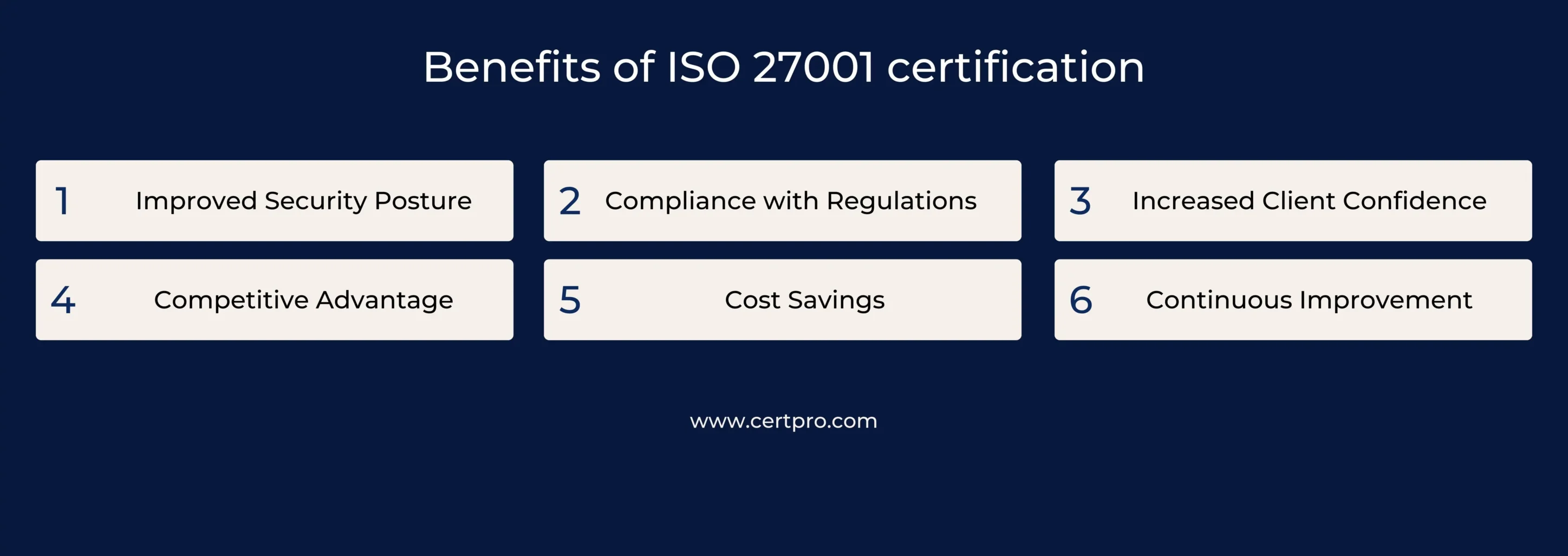
ISO 27001 Certification in Kyiv delivers specific, verifiable outcomes for organizations operating in the technology, financial services, and outsourcing sectors. The following benefits reflect the practical effects of independent certification on organizational operations and market positioning, framed in terms of what the ISO 27001 audit verifies and what the certificate communicates to external stakeholders.
- ✓Independent verification of ISMS design and operating effectiveness against ISO/IEC 27001:2022 requirements, providing enterprise clients with documented evidence of third-party control evaluation
- ✓Structured ISO 27001 audit methodology that evaluates risk assessment quality, control selection rationale, and evidence of continual improvement across the ISMS lifecycle
- ✓Recognition in enterprise procurement processes where U.S. and EU clients require vendor security certification as a condition of contract award or renewal
- ✓Documented alignment with information security regulatory frameworks, including GDPR data protection obligations relevant to Kyiv organizations processing EU personal data
- ✓Ongoing surveillance oversight through annual audits that verify continued ISMS conformity and control effectiveness, providing clients with assurance of sustained ISO 27001 compliance
- ✓A defined scope statement and publicly verifiable certificate that enables clients, prospects, and regulatory stakeholders to confirm certification coverage without conducting their own audit
- ✓Demonstrated conformity with confidentiality, integrity, and availability control requirements across Organizational, People, Physical, and Technological Annex A domains
- ✓Basis for alignment with complementary frameworks including ISO/IEC 27017 for cloud services and SOC 2, where overlapping control requirements reduce duplication of audit evidence
ISO 27001 compliance supports Kyiv-based organizations in addressing regulatory requirements from multiple jurisdictions simultaneously. GDPR applies to organizations processing personal data of EU residents regardless of where the organization is located, and imposes documented information security obligations that the ISO 27001 control framework directly addresses.
Organizations that have implemented and certified their ISMS against ISO/IEC 27001:2022 can reference the ISO 27001 attestation as evidence of structured data protection controls during regulatory inquiries or client data protection impact assessments. For Kyiv organizations serving U.S. clients subject to sector-specific requirements such as HIPAA, GLBA, or state-level privacy laws, ISO 27001 Certification provides independently verified documentation of security controls that addresses elements of these frameworks.
The ISO 27001 attestation does not substitute for sector-specific regulatory compliance but provides documented, auditor-verified evidence of information security practices that regulators, clients, and legal advisors can evaluate in the context of applicable requirements.
The ISO 27001 examination process requires organizations to document and demonstrate systematic treatment of information security risks, including threats to the confidentiality, integrity, and availability of information assets. For Kyiv-based cybersecurity companies and technology firms operating in a heightened threat environment, the structured risk assessment and treatment methodology required by ISO/IEC 27001:2022 provides a documented framework for identifying, evaluating, and addressing information security risks proportionate to the organization’s threat landscape.
Annex A Technological controls evaluated during the ISO 27001 audit include secure configuration management, information deletion procedures, data leakage prevention, monitoring activities, web filtering, and secure coding practices — areas directly relevant to Kyiv IT companies. The audit process produces documented evidence of whether these controls are implemented and operating effectively, providing both the certified organization and its clients with a structured, independently verified view of the information security control environment.
- ✓Regulatory Alignment and Cross-Border Compliance Recognition
- ✓Cybersecurity Posture and Information Asset Protection
Industry Sectors in Kyiv Seeking ISO 27001 Certification
ISO 27001 Certification in Kyiv is pursued across a range of industry sectors reflecting the city’s technology-intensive economic base. The following sectors represent the primary organizational categories for which ISO 27001 audit engagements in Kyiv are conducted, based on the nature of their information security obligations and client requirements.
| Industry Sector | Primary ISO 27001 Certification Driver | Key Certification Scope Areas |
|---|---|---|
| Software Development and IT Outsourcing | Enterprise client vendor security requirements, U.S. and EU contract obligations | Development lifecycle, code management, client environment access, data handling |
| Fintech and Financial Software | Banking partner due diligence, payment network security requirements, ISO 27001 compliance obligations for Kyiv fintech firms | Payment processing, customer data handling, access controls, cryptographic controls |
| SaaS Providers | Enterprise subscription client security reviews, procurement vendor assurance programs | Application infrastructure, data processing, tenant data segregation, incident response |
| Cloud Service Providers and MSPs | Client third-party risk management requirements, ISO/IEC 27017 alignment | Infrastructure management, network operations, data hosting, customer environment access |
| Cybersecurity Companies | Client contractual requirements, credibility demonstration, regulatory alignment | Security operations, vulnerability management, penetration testing governance, data handling |
IT Outsourcing and Software Development Firms
Kyiv’s IT outsourcing sector represents one of the largest concentrations of software engineering and technology delivery capacity in Eastern Europe. Firms in this sector typically operate under master service agreements with U.S. and EU enterprise clients that impose information security requirements, including mandatory ISO 27001 Certification or equivalent independent attestation.
The ISO 27001 audit for a software development organization evaluates access controls over development environments and client systems, secure development lifecycle practices, change management procedures, supplier and subcontractor management controls, and incident management capabilities. ISO 27001 Certification that Kyiv IT companies obtain communicates to existing and prospective clients that these controls have been independently examined and found to conform to internationally recognized requirements.
This certification status is frequently cited in client due diligence questionnaires, security assessment responses, and request-for-proposal submissions where vendor information security posture is a scored evaluation criterion.
Managed Service Providers and Cloud Infrastructure Organizations
Managed service providers (MSPs) and cloud infrastructure organizations in Kyiv face heightened information security scrutiny because of the privileged access they hold to client technology environments. Enterprise clients engaging Kyiv-based MSPs for network management, endpoint management, cloud infrastructure, or security operations center services require documented evidence that the MSP’s own ISMS is independently certified.
ISO 27001 Certification for Kyiv companies in the managed services space provides clients with a certified basis for evaluating the MSP’s internal security controls before granting access to client systems and data. The certification scope for an MSP typically encompasses the network operations center, monitoring tools, privileged access management systems, and the MSP’s internal information security governance structures.
The annual surveillance audit cycle provides clients with ongoing assurance that the MSP maintains certified ISO 27001 compliance status and has not experienced significant degradation in control effectiveness since the previous audit period.
ISO 27001 Consultants Kyiv — Understanding the Boundary Between Consulting and Certification
Organizations in Kyiv evaluating ISO 27001 consultants and ISO 27001 certification bodies should understand the fundamental distinction between these two categories of service providers. ISO 27001 consultants assist organizations in designing, implementing, and maintaining their ISMS. Certification bodies independently audit the ISMS against ISO/IEC 27001:2022 requirements and issue certification decisions. These roles are structurally incompatible and must be performed by separate, independent organizations.
CertPro’s Exclusive Role as Certification Body
CertPro operates exclusively as a certification body and does not engage in consulting, ISMS implementation, control design, policy development, internal audit facilitation, or any other advisory activity. This exclusive focus on certification audit services preserves the independence that is foundational to credible ISO 27001 attestation.
Organizations that engage CertPro for ISO 27001 Certification in Kyiv receive an independent ISO 27001 audit of their ISMS and, where conformity is demonstrated, a certification decision issued by a committee with no involvement in the organization’s ISMS development. This structural independence means that the ISO 27001 certificate issued by CertPro carries the weight of genuine third-party verification rather than self-attestation or consultant-facilitated certification.
Enterprise clients and procurement teams rely on this independence when evaluating the credibility of an organization’s ISO 27001 Certification status.
Evidence-Based Audit Approach
The ISO 27001 audit conducted by CertPro is evidence-based throughout. Auditors evaluate documentary evidence, system records, procedural logs, configuration outputs, and personnel interviews to assess whether the ISMS conforms to ISO/IEC 27001:2022 requirements and whether controls are operating effectively within the defined scope.
Auditor conclusions are documented in structured audit reports that record the evidence examined, the findings reached, and the basis for any nonconformity classifications. Organizations are not asked to demonstrate ISO 27001 compliance through self-assessment or management representation alone — evidence of actual control operation is required.
This evidence-based ISO 27001 examination approach distinguishes certification from less rigorous self-declaration processes and provides the substantive foundation on which the certification committee bases its decision. The ISO 27001 examination conducted during both Stage 1 and Stage 2 audits applies consistent evaluation criteria regardless of the organization’s sector, size, or market position.
FAQ
▶
What is ISO 27001 Certification and what does it demonstrate?
▶
How does the ISO 27001 audit process work for organizations in Kyiv?
▶
How long is an ISO 27001 certificate valid?
▶
What is the difference between ISO 27001 certification and ISO 27001 attestation?
▶
Which organizations in Kyiv require ISO 27001 certification?
▶
What documentation is required for ISO 27001 certification?
▶
What is the ISO 27001:2022 transition deadline?
▶
How does ISO 27001 certification relate to GDPR compliance for Kyiv organizations?
Get In Touch
have a question? let us get back to you.