
ISO 27001 Certification in Leeds
ISO 27001 compliance requires organizations to establish and maintain documented evidence across the mandatory requirements of ISO/IEC 27001:2022 Clauses 4 through 10. The ISO 27001 examination conducted by CertPro auditors assesses both the design of the ISMS and the operating effectiveness of implemented controls within the defined scope. Organizations must demonstrate that their ISMS is actively managed through an ongoing cycle of planning, implementation, internal audit, management review, and corrective action — not merely documented and filed.
OUR CLIENTS










ISO 27001 Certification in Leeds for Financial, Technology, and Data-Sensitive Organizations
ISO 27001 Certification in Leeds is delivered by CertPro as a Licensed Certification Body and independent third-party auditor. CertPro evaluates organizations against the requirements of ISO/IEC 27001:2022 — the internationally recognised standard for Information Security Management Systems (ISMS) — and issues certification based on evidence collected during structured Stage 1 and Stage 2 audits. CertPro provides no consulting, implementation, or advisory services. The certification decision is made by an independent certification committee following a complete ISO 27001 audit and nonconformity review.
Leeds has developed into one of the United Kingdom’s most significant regional economies. Its diverse industrial base spans financial services, legal services, healthcare technology, digital media, SaaS providers, cloud infrastructure companies, managed service providers, and retail and e-commerce technology firms. Organizations across each of these sectors handle sensitive customer data, operate within regulated supply chains, or fulfil procurement requirements from enterprise clients and public sector bodies that mandate formal ISO 27001 Certification in Leeds. ISO 27001 Certification therefore addresses a concrete and growing demand for independent, structured information security verification by organizations that must demonstrate the effectiveness of their ISMS to external stakeholders.
ISO/IEC 27001:2022 is structured around Clauses 4 through 10, which establish the mandatory management system requirements. These cover organizational context, leadership accountability, planning, support, operation, performance evaluation, and continual improvement. Alongside these clauses, Annex A provides 93 controls organized across four domains — Organizational, People, Physical, and Technological — that address the full spectrum of information security risks. The 2022 revision reduced the control set from 114 controls in the 2013 edition and introduced new controls addressing cloud security, threat intelligence, data masking, and secure coding practices. Organizations must document a Statement of Applicability that records which Annex A controls are applicable, which are excluded, and the justification for each determination. The transition deadline for organizations certified to ISO 27001:2013 to migrate to the 2022 standard was set by certification bodies at 31 October 2025.
ISO 27001 compliance requires organizations to implement a risk-based approach to protecting information assets across the three dimensions of the CIA triad: Confidentiality, Integrity, and Availability. A documented risk assessment identifies threats, vulnerabilities, and the likelihood and impact of potential security incidents. A risk treatment plan records the selected treatment options — whether to mitigate, accept, transfer, or avoid — and maps treatment decisions to applicable Annex A controls. The ISMS scope defines which information assets, processes, systems, and locations fall within the boundary of certification. This scope determination is reviewed and confirmed during the Stage 1 audit. ISO 27001 Certification in Leeds is available to organizations of any size and across all industries. The scope of certification is defined by each organization based on its information security risk profile and business context.
Leeds-based organizations pursuing ISO 27001 Certification encounter increasing demand from clients in the financial services sector, from NHS-affiliated healthcare technology contracts, from public procurement frameworks, and from international SaaS and cloud customers who conduct vendor security reviews as part of their third-party risk management programmes. ISO 27001 attestation provides formal, third-party verification that an organization’s information security controls have been independently assessed against the requirements of the standard. CertPro’s ISO 27001 audit methodology applies structured evidence collection, control examination, and documented audit findings to produce a certification outcome recognized in enterprise procurement processes and regulated supply chains across the United Kingdom and internationally.

What Is ISO 27001 Certification?
ISO 27001 Certification is the formal process by which an independent, accredited certification body audits an organization’s Information Security Management System against the requirements of ISO/IEC 27001:2022. Upon satisfactory completion, it issues a certificate confirming conformity. The certificate is valid for three years and is subject to annual surveillance audits that verify the ISMS continues to operate effectively. ISO 27001 Certification is not self-declared — it requires independent third-party evaluation by a recognized certification body conducting structured audits under a defined audit methodology.
The ISMS and the CIA Triad
An Information Security Management System (ISMS) is the structured set of policies, procedures, processes, and controls that an organization establishes to manage information security risks. The ISMS is built around the CIA triad — Confidentiality, ensuring information is accessible only to authorized parties; Integrity, ensuring information is accurate and has not been altered without authorization; and Availability, ensuring information and systems are accessible when required by authorized users. ISO 27001 requires organizations to document, implement, maintain, and continually improve the ISMS. Each cycle of improvement is recorded through internal audit, management review, and corrective action processes. The ISMS scope defines the organizational boundaries and information assets covered by the certification.
ISO 27001 compliance is achieved through the systematic application of risk management to information assets within the defined ISMS scope. Organizations must conduct a structured risk assessment that identifies threats to and vulnerabilities within their information assets, evaluates the likelihood and potential impact of each risk, and determines appropriate treatment options. The risk treatment plan, Statement of Applicability, information security policy, and ISMS scope document are among the key documentation requirements that auditors review during the Stage 1 examination. ISO 27001 attestation through third-party certification provides external stakeholders — clients, regulators, and procurement bodies — with independently verified evidence that the organization’s ISMS meets the requirements of the standard.
ISO/IEC 27001:2022 and the Annex A Control Framework
ISO/IEC 27001:2022 restructured the Annex A control set from 114 controls across 14 categories in the 2013 edition to 93 controls across four domains. The four Annex A domains are: Organizational controls (37 controls), People controls (8 controls), Physical controls (14 controls), and Technological controls (34 controls). New controls introduced in the 2022 revision include threat intelligence, information security for use of cloud services, ICT readiness for business continuity, physical security monitoring, configuration management, data masking, data leakage prevention, monitoring activities, web filtering, and secure coding. Each organization must assess which controls are applicable to its risk profile and record applicable and excluded controls — with justification — in the Statement of Applicability (SoA). The SoA is a mandatory ISMS document reviewed during every ISO 27001 audit as part of the evidence collection process.
| Annex A Domain | Number of Controls | Example Controls |
|---|---|---|
| Organizational | 37 | Information security policies, risk management, supplier relationships, incident management |
| People | 8 | Screening, terms of employment, security awareness, confidentiality agreements |
| Physical | 14 | Physical security perimeters, equipment maintenance, clear desk and screen policy |
| Technological | 34 | Access control, cryptography, secure development, vulnerability management, logging |
ISO 27001 Certification Audit Process for Organizations in Leeds
The ISO 27001 Certification audit process for Leeds-based organizations follows a structured sequence of defined stages conducted by CertPro as an independent certification body. The process covers application review, audit program determination, Stage 1 audit, Stage 2 audit, nonconformity review, certification committee decision, certificate issuance, surveillance audits, and recertification. Each stage produces documented outputs that form the audit record reviewed by the independent certification committee before a certification decision is made. The ISO 27001 audit Leeds process is consistent with international audit standards and is conducted with impartiality and independence from any consulting or implementation activities.
The Stage 1 audit is a documentation review and ISMS scope examination conducted by CertPro auditors prior to the Stage 2 on-site or remote evidence collection audit. During the Stage 1 audit, auditors review the organization’s ISMS documentation to determine whether the management system has been established in conformity with the requirements of ISO/IEC 27001:2022. Key documentation reviewed includes the information security policy, ISMS scope document, risk assessment records, risk treatment plan, Statement of Applicability, and records of internal audit and management review. The Stage 1 ISO 27001 examination confirms whether the organization’s ISMS is sufficiently developed and documented to proceed to Stage 2. Any significant gaps identified at Stage 1 are documented in the audit report and must be addressed before Stage 2 commences.
For Leeds-based organizations, the Stage 1 audit can be conducted remotely through secure document exchange or on-site at the organization’s premises, depending on the complexity of the ISMS scope and the nature of the information assets covered. Where the ISMS scope spans multiple sites — for example, a Leeds-headquartered managed service provider with data centre operations or cloud service delivery across multiple locations — the Stage 1 audit program is adapted to reflect that scope. The audit program determination, which defines the sampling approach, sites to be included, and audit days required, is completed before Stage 1 commences and is communicated to the organization in writing as part of the audit arrangement.
The Stage 2 audit is the main evidence collection phase of the ISO 27001 Certification audit process. CertPro auditors conduct on-site or remote interviews, observations, and document reviews to assess whether the ISMS controls are implemented and operating effectively. This assessment is made in accordance with the organization’s documented policies and procedures, and in conformity with ISO/IEC 27001:2022 requirements. The ISO 27001 audit at Stage 2 examines control design and operating effectiveness across the applicable Annex A domains — Organizational, People, Physical, and Technological — based on the organization’s Statement of Applicability and risk treatment plan. Objective evidence is collected for each area within scope, including access control records, incident response logs, supplier security reviews, vulnerability scan reports, awareness training records, and physical security inspection findings.
At the conclusion of the Stage 2 audit, the lead auditor prepares a written audit report documenting the audit findings, the evidence reviewed, and any nonconformities identified. Nonconformities are classified and must be addressed by the organization through a documented root cause analysis and corrective action plan within a defined timeframe. This must be completed before the certification committee can make a positive certification decision. The certification committee — which operates independently of the audit team — reviews the complete audit record, including the Stage 1 report, Stage 2 report, nonconformity records, and corrective action evidence, before issuing a certification determination. ISO 27001 attestation in the form of a formal certificate is issued only upon satisfactory completion of this review.
| Audit Stage | Key Activities | Output |
|---|---|---|
| Application Review | Scope definition, audit program determination, conflict of interest assessment | Audit plan and program document |
| Stage 1 Audit | ISMS documentation review, scope confirmation, readiness determination | Stage 1 audit report |
| Stage 2 Audit | Evidence collection, control examination, interview and observation | Stage 2 audit report with findings |
| Nonconformity Review | Root cause analysis review, corrective action verification | Closed nonconformity records |
| Certification Decision | Independent committee review of full audit record | ISO 27001 certificate (3-year validity) |
Following initial certification, the ISO 27001 certificate is valid for three years from the date of issue. Annual surveillance audits are conducted in Year 1 and Year 2 of the certificate cycle to verify that the ISMS continues to operate effectively and that the organization maintains ISO 27001 compliance in Leeds between certification cycles. Surveillance audits are not full re-audits. They focus on a defined selection of ISMS requirements and Annex A controls, the status of internal audit and management review processes, any significant changes to the organization’s information security environment, and the status of corrective actions from previous audits. A recertification audit is conducted before the end of the three-year certificate cycle and covers the full scope of the ISMS in a manner comparable to the initial certification audit.
- ✓Stage 1 Audit: Documentation Review and ISMS Scope Determination
- ✓Stage 2 Audit: Evidence Collection and Control Examination
- ✓Surveillance Audits and Recertification
ISMS Requirements and Control Environment Evaluation
ISO 27001 compliance requires organizations to establish and maintain documented evidence across the mandatory requirements of ISO/IEC 27001:2022 Clauses 4 through 10. The ISO 27001 examination conducted by CertPro auditors assesses both the design of the ISMS and the operating effectiveness of implemented controls within the defined scope. Organizations must demonstrate that their ISMS is actively managed through an ongoing cycle of planning, implementation, internal audit, management review, and corrective action — not merely documented and filed.
ISO/IEC 27001:2022 specifies a defined set of mandatory documented information that organizations must maintain as evidence of ISMS operation. The key mandatory documents reviewed during the ISO 27001 audit include: the information security policy; the ISMS scope document; the information security risk assessment methodology and results; the risk treatment plan; the Statement of Applicability; information security objectives; records of competence (training and qualifications); internal audit programme and reports; management review records; and records of nonconformities and corrective actions. Each of these documents must be current, controlled, and accessible for auditor review. The Statement of Applicability is particularly significant — it records every Annex A control, states whether each control is applicable or excluded, and provides justification for all exclusions. It is the primary reference document for control examination during Stage 2 of the ISO 27001 audit Leeds process.
- ✓Information security policy signed by senior leadership
- ✓ISMS scope document defining organizational boundaries and information assets
- ✓Risk assessment methodology, criteria, and documented results
- ✓Risk treatment plan mapping risks to selected treatment options and Annex A controls
- ✓Statement of Applicability listing all 93 Annex A controls with applicability and exclusion justifications
- ✓Internal audit programme, schedules, and completed audit reports
- ✓Management review meeting records and outputs
- ✓Records of corrective actions and their resolution status
The ISO 27001 examination at Stage 2 assesses both the design adequacy and the operating effectiveness of controls within the ISMS scope. Control design adequacy refers to whether a control, as documented and structured, is capable of addressing the information security risk it was selected to treat. Operating effectiveness refers to whether the control has been consistently applied in practice over the review period, as evidenced by records, system configurations, access logs, incident reports, or other objective evidence. Auditors collect evidence from multiple sources — interviews with process owners, document reviews, system inspections, and observation of procedures — to form conclusions about whether each applicable Annex A control is functioning as intended.
For Leeds-based technology organizations — including SaaS providers, cloud service companies, and managed service providers — the Technological controls domain of Annex A is typically the most extensively examined. This domain covers access control, cryptographic key management, secure system development, vulnerability management, logging and monitoring, network security, and endpoint protection. Evidence reviewed in this domain includes access control lists, encryption configuration records, patch management logs, penetration testing reports, security incident records, and audit log samples. The ISO 27001 audit Leeds process for technology organizations therefore requires structured evidence preparation across technical, operational, and administrative control categories to support the auditor’s examination.
- ✓Mandatory ISMS Documentation Requirements
- ✓Control Design and Operating Effectiveness Assessment
Why Organizations in Leeds Pursue ISO 27001 Certification
ISO 27001 Certification in Leeds is pursued by organizations across multiple sectors in response to specific procurement requirements, regulatory expectations, client security questionnaires, and competitive positioning needs. Leeds operates as one of the UK’s leading financial services centres outside London, hosting major banking institutions, insurance groups, legal firms, and a growing fintech sector. All of these generate significant demand for formal information security verification across their supply chains. ISO 27001 Certification for Leeds companies provides independently verified evidence that the organization’s ISMS meets internationally recognised requirements — a level of verification that self-assessment or internal security policies cannot replicate.
Financial Services and Fintech Sector Demand
ISO 27001 Certification demand in the Leeds financial services sector is driven by both regulatory alignment requirements and vendor due diligence processes. Banks, asset managers, and insurance firms operating from Leeds conduct structured third-party risk assessments of technology vendors and service providers that access, process, or store customer or transactional data. ISO 27001 Certification for Leeds companies supplying services to these institutions — including core banking software providers, payment processing vendors, RegTech firms, and cloud data platform operators — is increasingly a mandatory requirement rather than a differentiating credential. The UK Financial Conduct Authority (FCA) expects regulated firms to manage operational resilience and third-party risk, and supplier ISO 27001 Certification is a recognized control within those risk management frameworks.
Leeds fintech organizations pursue ISO 27001 compliance to satisfy investor due diligence requirements, qualify for enterprise financial institution procurement lists, and demonstrate security control maturity to prospective customers evaluating multiple vendors. Leeds hosts an active fintech ecosystem, with companies offering payment infrastructure, open banking platforms, digital identity solutions, and regulatory technology services. These organizations typically process large volumes of sensitive personal and financial data and must demonstrate ISMS conformity to prospective clients operating under GDPR, PCI DSS, and FCA operational resilience obligations. ISO 27001 attestation provides the formal, third-party verification that satisfies these requirements in a format recognized across the financial services sector.
Technology, SaaS, Healthcare Technology, and Public Sector Demand
Leeds technology companies pursue ISO 27001 Certification to satisfy enterprise client security review requirements, qualify for public sector framework agreements including NHS Digital Data Security and Protection Toolkit requirements, and access international customer markets in sectors with mandatory information security verification expectations. ISO 27001 audit assessments for Leeds healthcare technology organizations examine controls relevant to the confidentiality and integrity of patient-related data, system availability for critical clinical processes, and supplier accountability within NHS supply chain governance frameworks. ISO 27001 Certification provides healthcare technology organizations with a structured, externally verified evidence base that supports compliance with the UK Data Security and Protection (DSP) Toolkit requirements and NHS contractual obligations.
Leeds-based SaaS providers and cloud service companies pursue ISO 27001 Certification to satisfy vendor security assessments conducted by enterprise procurement teams across the UK and internationally. Enterprise organizations conducting vendor security reviews increasingly require ISO 27001 Certification as a minimum threshold before onboarding new suppliers that will access corporate data environments. ISO 27001 Certification for Leeds companies in the SaaS and cloud sectors provides a standardized, auditor-verified evidence package that replaces or substantially reduces the volume of security questionnaire responses required during procurement processes. This accelerates vendor onboarding and reduces administrative overhead for both parties. The certification also supports expansion into regulated markets in North America, the European Union, and the Gulf region, where ISO 27001 attestation is a recognized baseline for information security vendor qualification.
Benefits of ISO 27001 Certification for Leeds-Based Organizations
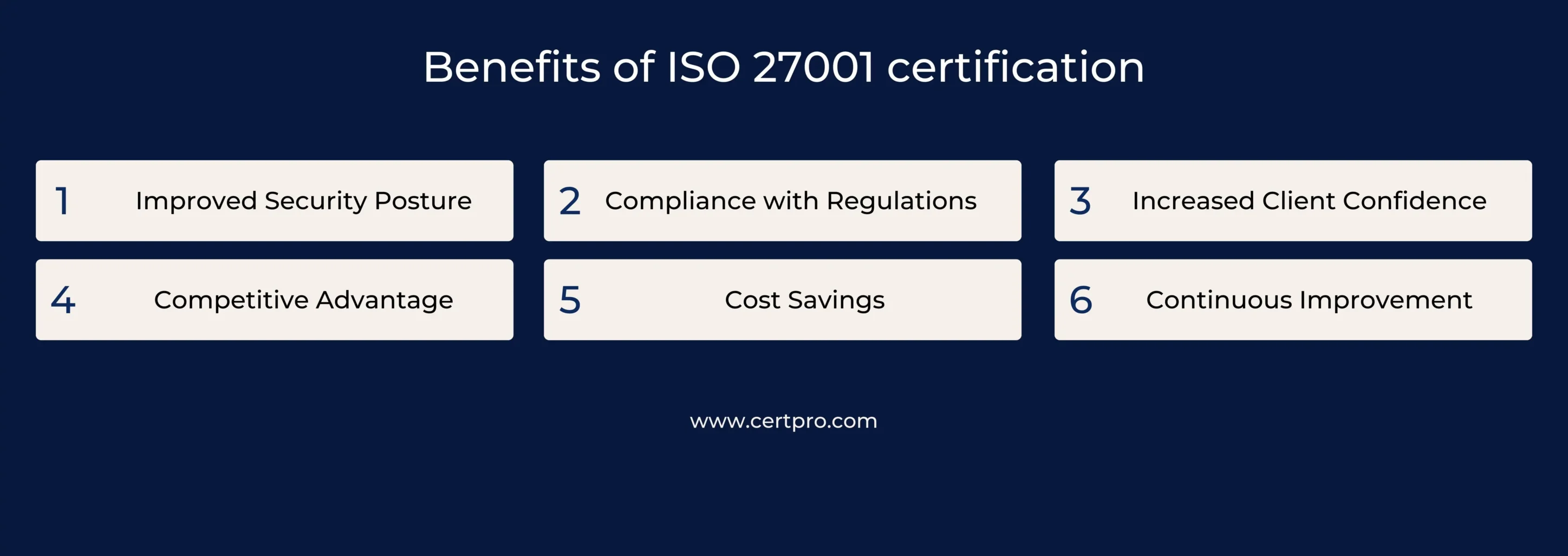
ISO 27001 Certification in Leeds delivers structured, independently verified benefits that address the information security verification requirements of enterprise clients, public sector bodies, regulators, and international customers. The following benefits reflect the outcomes of achieving third-party ISO 27001 Certification through a structured audit process conducted by an independent Licensed Certification Body. These are objective outcomes of the certification process — not promotional claims about advisory outcomes.
- ✓Independent third-party verification that the organization’s ISMS meets the requirements of ISO/IEC 27001:2022
- ✓Recognition in enterprise and public sector procurement processes as a formally certified information security supplier
- ✓Structured risk management framework documented across the organization’s defined ISMS scope
- ✓Demonstrated alignment with UK GDPR, FCA operational resilience, and NHS DSP Toolkit information security expectations
- ✓Reduced volume of vendor security questionnaires required during client procurement and onboarding processes
- ✓Annual surveillance oversight providing ongoing independent verification of ISMS effectiveness
- ✓Competitive differentiation in markets where ISO 27001 Certification is a mandatory or preferred supplier qualification criterion
- ✓Formal ISO 27001 attestation supporting international market entry and cross-border client due diligence requirements
Enterprise procurement teams in the financial services, legal, healthcare, and public sectors conduct structured vendor security assessments before awarding contracts to technology service providers. A Leeds-based managed service provider bidding for a contract with a major financial institution will typically face a formal vendor security review. This includes requests for evidence of information security certification, penetration testing reports, business continuity documentation, and data processing agreements. ISO 27001 Certification in Leeds provides a recognized, auditor-verified response to the information security certification element of these reviews. It reduces the time and effort required to satisfy procurement security requirements and improves the organization’s competitive position in formal tender processes.
For Leeds-based organizations supplying services to NHS trusts, local government bodies, or central government departments through Crown Commercial Service frameworks, ISO 27001 Certification is frequently listed as a mandatory or highly weighted criterion in framework qualification and contract award assessments. The Government Cyber Essentials scheme establishes a baseline, but ISO 27001 Certification demonstrates a substantially more comprehensive and independently verified information security management capability. ISO 27001 compliance for Leeds public sector suppliers is therefore a qualification differentiator that supports contract retention and new business development within the public sector supply chain.
ISO 27001 Certification provides a structured mechanism for mapping information security controls to regulatory obligations including UK GDPR, the Network and Information Systems (NIS) Regulations, and sector-specific requirements such as FCA SYSC operational resilience rules and the NHS Data Security and Protection Standard. The Annex A control framework addresses many of the technical and organisational security measures required by data protection legislation. The documented risk assessment and risk treatment processes align with the accountability and demonstrability requirements of UK GDPR Article 5(2). Leeds-based organizations maintaining ISO 27001 compliance can reference their certification and associated ISMS documentation as evidence of appropriate technical and organisational measures in regulatory inquiries, data protection impact assessments, and Information Commissioner’s Office (ICO) investigations.
- ✓Vendor Assurance and Procurement Qualification
- ✓Regulatory Alignment and Data Protection Compliance Evidence
ISO 27001 Certification Scope and Independent Certification Decision Framework
The scope of ISO 27001 Certification in Leeds is defined by each organization based on the information assets, processes, systems, departments, and physical locations that fall within the ISMS boundary. Scope definition is reviewed and confirmed during the Stage 1 audit and must be accurately reflected in the ISMS scope document and on the issued certificate. An organization may choose to certify its entire information security management system or limit the scope to defined services, business units, or data processing environments. The scope statement on the certificate is publicly verifiable and must accurately represent what has been audited and certified.
The Independent Certification Committee Decision Process
The certification decision for ISO 27001 Certification in Leeds is made by CertPro’s independent certification committee. This committee reviews the complete audit record — including Stage 1 and Stage 2 audit reports, nonconformity records, corrective action evidence, and the lead auditor’s recommendation — before issuing a determination. The certification committee operates independently of the audit team that conducted the examination. This structural separation ensures impartiality between the audit function and the certification decision function. It is a requirement of international certification body accreditation standards and ensures that the certification decision is based on objective audit evidence rather than commercial or relational considerations.
Where nonconformities are identified during the Stage 2 audit, the organization must submit documented root cause analysis and corrective action evidence within a defined timeframe — typically 90 days for major nonconformities. The certification committee reviews this evidence before issuing a positive certification decision. If the evidence submitted is insufficient to close outstanding nonconformities, the certification committee may require a follow-up audit visit or may decline to issue a certificate. ISO 27001 attestation is issued only when the certification committee determines that the full audit record, including resolved nonconformities, demonstrates conformity with the requirements of ISO/IEC 27001:2022 across the defined ISMS scope.
Certificate Suspension, Withdrawal, and Scope Reduction
An issued ISO 27001 certificate may be suspended if an organization fails a surveillance audit, fails to address identified nonconformities within the required timeframe, undergoes significant changes to its ISMS scope or control environment without notifying the certification body, or experiences a major information security incident that demonstrates ISMS breakdown. Certificate withdrawal may follow suspension if the root cause of the nonconformity cannot be resolved. Organizations may also voluntarily reduce their certification scope, which requires a scope change review by the certification body and reissuance of the certificate with the revised scope statement. These conditions ensure that ISO 27001 Certification for Leeds companies remains a current, accurate representation of the organization’s verified ISMS status rather than a historical credential.
Industry Sectors in Leeds Seeking ISO 27001 Certification
ISO 27001 Certification for Leeds companies spans a broad range of industry sectors, reflecting the city’s diverse and growing digital economy. The following sectors represent the primary organizational profiles that pursue ISO 27001 Certification in Leeds, based on the information security risk profiles, procurement requirements, and regulatory obligations characteristic of each sector.
| Sector | Primary ISO 27001 Driver | Key Information Assets at Risk |
|---|---|---|
| Financial Services & Fintech | FCA operational resilience, client vendor due diligence, PCI DSS alignment | Customer financial data, transaction records, payment systems |
| Healthcare Technology | NHS DSP Toolkit, CQC registration, GDPR Article 9 special category data | Patient records, clinical system integrations, diagnostic data |
| SaaS & Cloud Providers | Enterprise client security requirements, international expansion | Customer data environments, platform source code, API integrations |
| Legal Services | SRA cybersecurity guidance, client confidentiality obligations, GDPR | Client matter files, privileged communications, financial settlement data |
| Managed Service Providers | Client contracts, cyber insurance requirements, supply chain assurance | Client infrastructure access, remote management systems, backup data |
Digital Media, Retail Technology, and E-Commerce Organizations
Leeds hosts a growing cluster of digital media production companies, retail technology platforms, and e-commerce operations that handle large volumes of consumer personal data, payment card information, and proprietary commercial content. ISO 27001 Certification for these organizations addresses the security of customer data repositories, payment processing integrations, content management systems, and digital supply chain partner access. Retail and e-commerce technology firms pursuing ISO 27001 Certification in Leeds frequently do so in response to enterprise retail client requirements. Major retailers conducting vendor security audits of their technology suppliers require ISO 27001 Certification as evidence of minimum information security management standards. ISO 27001 audit assessments for Leeds digital media organizations examine controls around intellectual property protection, user data governance, and access management for production and distribution systems.
E-commerce platform operators and digital marketing technology providers in Leeds that process consumer payment data must maintain PCI DSS compliance alongside information security management requirements. ISO 27001 Certification provides a complementary framework that addresses broader ISMS requirements beyond the payment security scope of PCI DSS — including information security governance, human resource security, supplier relationships, and incident management. Organizations with both PCI DSS and ISO 27001 requirements can structure their ISMS to address both frameworks within a unified control environment. This reduces duplication of compliance effort while satisfying distinct verification requirements from different customer and regulatory stakeholders.
ISO 27001 Certification Requirements for Leeds Organizations
Organizations in Leeds seeking ISO 27001 Certification must satisfy the full requirements of ISO/IEC 27001:2022 Clauses 4 through 10 and demonstrate the application of applicable Annex A controls within the defined ISMS scope. The ISO 27001 examination conducted by CertPro evaluates conformity with each clause requirement through review of documentation, records, interviews, and observation of implemented controls. The following requirements represent the core conformity criteria assessed during the certification audit process.
ISO/IEC 27001:2022 Clauses 4 through 10 establish the mandatory management system requirements that every organization must satisfy to achieve certification. Clause 4 (Context of the Organisation) requires identification of internal and external issues relevant to information security, along with an understanding of interested parties and their requirements. Clause 5 (Leadership) requires top management to demonstrate leadership and commitment to the ISMS, including establishing the information security policy and assigning roles and responsibilities. Clause 6 (Planning) requires structured risk assessment, risk treatment planning, and definition of information security objectives. Clause 7 (Support) covers resource allocation, competence, awareness, communication, and documented information. Clause 8 (Operation) requires implementation of the risk treatment plan and operational controls. Clause 9 (Performance Evaluation) mandates monitoring, internal audit, and management review. Clause 10 (Improvement) requires documented management of nonconformities and continual improvement processes.
Each clause is assessed during the ISO 27001 audit through examination of documented evidence and structured interviews with process owners and senior management. For organizations pursuing ISO 27001 compliance in Leeds, the Clause 5 leadership requirements are frequently a focus area. The standard requires demonstrable top management commitment to the ISMS rather than delegation of information security governance entirely to technical teams. Evidence of management review meetings, a signed information security policy, and board-level information security reporting are among the items auditors examine to assess leadership conformity. Organizations that have integrated information security governance into their wider corporate governance structures typically present stronger evidence of Clause 5 conformity than those that treat the ISMS as a purely operational or technical function.
The risk assessment and risk treatment requirements of ISO/IEC 27001:2022 are among the most substantive elements of the ISO 27001 examination. Organizations must define a repeatable risk assessment methodology that produces consistent, comparable results when applied across the information asset inventory within the ISMS scope. The risk assessment must identify threats and vulnerabilities applicable to each information asset, evaluate the likelihood and potential impact of each identified risk, and produce a prioritized risk register that informs the risk treatment plan. The risk treatment plan must document the selected treatment option for each identified risk — treat, tolerate, terminate, or transfer — and specify the Annex A controls selected to address risks where treatment is the chosen option. Both the risk assessment results and the risk treatment plan must be retained as documented information and are reviewed in full during the Stage 2 ISO 27001 audit Leeds process.
- ✓Clause 4 to 10: Mandatory Management System Requirements
- ✓Risk Assessment and Treatment Requirements
FAQ
▶
What is ISO 27001 Certification and why is it required in Leeds?
▶
What is the difference between a Stage 1 and Stage 2 ISO 27001 audit?
▶
How long is an ISO 27001 certificate valid in Leeds?
▶
What documents are required for ISO 27001 certification?
▶
What is a Statement of Applicability in ISO 27001?
▶
Does ISO 27001 certification Leeds cover GDPR compliance?
▶
What is the transition deadline for ISO 27001:2013 certified organizations in Leeds?
▶
How does ISO 27001 attestation differ from ISO 27001 certification?
Get In Touch
have a question? let us get back to you.