
ISO 27001 Certification in Lisbon
ISO 27001 Certification in Lisbon is pursued by fintech operators, SaaS providers, cloud service companies, technology startups, telecommunications firms, and managed service providers operating within one of Europe’s most rapidly expanding digital economies. CertPro functions as a Licensed CPA Firm and independent certification body, conducting ISO 27001 audits exclusively through an objective, evidence-based methodology aligned with the requirements of ISO/IEC 27001:2022.
OUR CLIENTS










ISO 27001 Certification for Lisbon-Based Financial and Technology Organizations
ISO 27001 Certification in Lisbon is pursued by fintech operators, SaaS providers, cloud service companies, technology startups, telecommunications firms, and managed service providers operating within one of Europe’s most rapidly expanding digital economies. CertPro functions as a Licensed CPA Firm and independent certification body, conducting ISO 27001 audits exclusively through an objective, evidence-based methodology aligned with the requirements of ISO/IEC 27001:2022.
Lisbon as a Technology and Financial Services Hub
Lisbon has evolved into a recognized European center for technology entrepreneurship, financial services innovation, and digital infrastructure. The city hosts a dense concentration of fintech firms operating under Banco de Portugal supervision, cloud service providers serving pan-European enterprise clients, SaaS companies expanding into regulated markets across the EU and North America, and telecommunications operators managing sensitive customer and network data.
Web Summit, one of the world’s largest technology conferences, has anchored annually in Lisbon — reinforcing the city’s position as a technology capital that attracts international investment, enterprise procurement activity, and cross-border vendor relationships. This ecosystem creates measurable demand for ISO 27001 Certification in Lisbon, as enterprise buyers, regulated financial institutions, and international procurement teams increasingly require third-party attestation of information security controls as a precondition to vendor approval.
Organizations operating in Lisbon’s technology sector routinely encounter contractual security requirements embedded in enterprise agreements, financial services vendor frameworks, and public sector procurement processes that reference ISO/IEC 27001:2022 conformity explicitly.
Independent Certification Body — No Advisory Functions
CertPro operates exclusively as an independent certification body conducting ISO 27001 audits and issuing certifications. No consulting, implementation, policy development, control design, or advisory functions are performed at any stage of the certification process. This structural separation preserves audit objectivity and ensures that the certification decision is reached solely through evidence-based evaluation of an organization’s Information Security Management System against ISO/IEC 27001:2022 requirements.
The ISO 27001 examination conducted by CertPro evaluates whether the ISMS satisfies Clauses 4 through 10 of the standard and whether applicable Annex A controls are appropriately implemented, documented, and operating effectively. Organizations seeking ISO 27001 Certification in Lisbon engage CertPro for structured audit engagement, independent evaluation, and formal certification issuance — not for readiness preparation or system design.
This positioning distinguishes CertPro as a certification authority rather than a consulting provider. That distinction is material to organizations in financial services and regulated technology sectors where the independence of the certification body is subject to client and regulatory scrutiny.
Regulatory and Contractual Drivers in Lisbon’s Ecosystem
Organizations in Lisbon operate within a layered regulatory environment that includes the EU General Data Protection Regulation, the Digital Operational Resilience Act (DORA) applicable to financial entities and their ICT service providers, NIS2 Directive obligations for operators of essential and important services, and sector-specific requirements from Banco de Portugal and the Portuguese National Cybersecurity Centre.
ISO 27001 compliance provides a structured mechanism for aligning information security controls with these overlapping legal and regulatory frameworks. The standard’s four control domains — Organizational, People, Physical, and Technological — map directly to the control categories referenced in DORA’s ICT risk management requirements and NIS2’s security measures obligations.
For Lisbon-based SaaS companies and cloud providers serving regulated financial institutions across the EU, ISO 27001 attestation functions as a recognized form of third-party assurance accepted in vendor risk management programs. This acceptance reduces the frequency and scope of individual client security assessments, delivering measurable operational efficiency alongside regulatory alignment.

What Is ISO 27001 Certification?
ISO 27001 Certification is a formal, third-party attestation confirming that an organization’s Information Security Management System conforms to the requirements of ISO/IEC 27001:2022 — the internationally recognized standard for information security management published by the International Organization for Standardization and the International Electrotechnical Commission.
The certification confirms that an organization has established, implemented, maintained, and is continually improving an ISMS that systematically manages information security risks affecting the confidentiality, integrity, and availability of information assets. ISO 27001 Certification is not a self-declaration. It requires independent audit and formal certification issuance by an accredited or licensed certification body.
Structure of ISO/IEC 27001:2022
ISO/IEC 27001:2022 is organized into ten clauses and an Annex A containing 93 controls across four domains. Clauses 1 through 3 establish scope, normative references, and defined terms. Clauses 4 through 10 define the management system requirements an organization must satisfy to achieve and maintain ISO 27001 compliance.
Key clause requirements include: Clause 4 (understanding internal and external context and defining ISMS scope), Clause 5 (leadership, policy, and organizational roles), Clause 6 (information security risk assessment and risk treatment planning), Clause 7 (support requirements including resources, competence, and documented information), Clause 8 (operational planning and control), Clause 9 (performance evaluation including internal audit and management review), and Clause 10 (nonconformity management and continual improvement).
Annex A controls span Organizational, People, Physical, and Technological domains. The 2022 revision reduced the control count from 114 in the 2013 version to 93, with a transition deadline of October 31, 2025 set by certification bodies globally.
ISMS Documentation Requirements
An Information Security Management System subject to ISO 27001 examination must be supported by documented information demonstrating conformity to standard requirements. Core documentation evaluated during the ISO 27001 audit includes the Information Security Policy, the risk assessment methodology and results, the risk treatment plan specifying selected controls and residual risk acceptance decisions, and the Statement of Applicability listing all 93 Annex A controls with justifications for inclusion or exclusion.
Supporting documentation includes records of competence and awareness activities, internal audit reports, management review minutes, and evidence of nonconformity management. The Statement of Applicability is a mandatory document under ISO/IEC 27001:2022 and serves as the primary reference connecting risk treatment decisions to the Annex A control set.
Auditors reviewing ISMS documentation assess whether documented information is maintained, controlled, and accessible in a manner consistent with the standard’s requirements for documented information management under Clause 7.5.
ISO 27001 Certification Audit Process for Organizations in Lisbon
The ISO 27001 audit process for organizations seeking ISO 27001 Certification in Lisbon follows a structured, stage-based methodology that evaluates ISMS documentation, control design, and operational effectiveness against the requirements of ISO/IEC 27001:2022. The process is conducted exclusively by CertPro’s audit team without advisory involvement, preserving the independence required for a valid certification determination. Each stage produces documented outputs that form the evidentiary basis for the certification committee’s decision.
| Audit Stage | Key Activities | Output |
|---|---|---|
| Application Review | Scope determination, audit program establishment, ISMS boundary confirmation | Audit program and engagement letter |
| Stage 1 Audit | Review of ISMS documentation, readiness assessment, identification of areas requiring clarification | Stage 1 findings report |
| Stage 2 Audit | Evidence-based evaluation of control implementation and operational effectiveness | Stage 2 audit report with nonconformity findings |
| Nonconformity Review | Review of corrective action evidence submitted for identified nonconformities | Closure determination for each nonconformity |
| Certification Decision | Independent certification committee evaluation and formal certification issuance | ISO 27001 certificate (3-year validity) |
| Surveillance Audits | Annual review of continued ISMS conformity and improvement activities | Surveillance audit reports |
| Recertification Audit | Full re-evaluation of ISMS prior to certificate expiry at end of three-year cycle | Recertification determination |
The Stage 1 audit focuses on reviewing the organization’s ISMS documentation to determine whether the documented management system is sufficiently developed to proceed to Stage 2 evidence testing. Auditors evaluate the Information Security Policy, risk assessment methodology, risk treatment plan, and Statement of Applicability for completeness and consistency with ISO/IEC 27001:2022 requirements. The Stage 1 review also confirms that the defined ISMS scope accurately reflects the organization’s operational boundaries and information asset environment.
Auditors identify areas where documentation is incomplete, ambiguous, or inconsistent with standard requirements and communicate those findings to the organization prior to Stage 2 scheduling. The Stage 1 audit does not constitute advisory input on how to address deficiencies — it identifies areas requiring attention so that the organization can determine appropriate actions independently before the Stage 2 audit is conducted.
For Lisbon-based technology organizations, Stage 1 frequently surfaces scope boundary questions related to cloud infrastructure dependencies, third-party processor relationships, and remote work environments.
The Stage 2 audit constitutes the primary ISO 27001 examination of control implementation and operating effectiveness. Auditors assess whether controls specified in the risk treatment plan and Statement of Applicability are implemented as documented and operating effectively across the certification period. Evidence review encompasses configuration records, access control logs, incident response records, vulnerability management outputs, supplier assessment documentation, physical security records, and personnel security evidence.
Interviews with process owners and technical staff are conducted to verify that controls are understood and consistently applied. Observations of technical environments may be included where relevant to the ISMS scope. Nonconformities identified during Stage 2 are classified and documented in the audit report. Organizations must submit corrective action evidence for identified nonconformities before the certification committee proceeds to a certification determination.
ISO 27001 audit engagements in Lisbon typically cover cloud-hosted environments, distributed development teams, and customer data handling processes characteristic of the city’s SaaS and fintech sectors.
ISO 27001 certificates are issued for a three-year validity period and are maintained through annual surveillance audits conducted in Year 1 and Year 2 of the certificate cycle. Surveillance audits assess continued conformity with ISO/IEC 27001:2022 requirements, evaluate the effectiveness of actions taken in response to previously identified nonconformities, and review significant changes to the ISMS scope or organizational context.
At the end of the three-year cycle, a recertification audit is conducted as a full re-evaluation of the ISMS against current standard requirements. The recertification audit confirms whether the organization has maintained and improved its ISMS and determines whether the certificate should be renewed.
Organizations that fail to address nonconformities within defined timeframes or that experience significant ISMS failures may be subject to certificate suspension or withdrawal, determined by the certification committee on the basis of documented evidence. Lisbon-based organizations with rapidly scaling technology environments are advised to maintain documented records of ISMS changes between surveillance cycles to support uninterrupted ISO 27001 compliance.
- ✓Stage 1 Audit — Documentation Review and Readiness Evaluation
- ✓Stage 2 Audit — Evidence-Based Control Evaluation
- ✓Surveillance Audits and Recertification
Why Organizations in Lisbon Pursue ISO 27001 Certification
ISO 27001 Certification in Lisbon is pursued for a combination of regulatory, contractual, and commercial reasons specific to the city’s technology and financial services ecosystem. The demand for ISO 27001 compliance in Lisbon is driven by the intersection of EU regulatory obligations, enterprise vendor security requirements, and international client expectations — particularly from organizations in the United States, United Kingdom, and Northern Europe that apply structured third-party risk management programs to their technology vendor relationships.
Enterprise Vendor Security Reviews and Procurement Requirements
Enterprise procurement teams at financial institutions, insurance companies, healthcare organizations, and large technology firms routinely require ISO 27001 attestation from technology vendors as a condition of vendor approval. A Lisbon-based SaaS provider seeking to contract with a major European bank, a U.S. financial services firm, or a UK regulated insurer will typically encounter ISO 27001 Certification as a mandatory requirement in vendor security questionnaires, RFP processes, and master services agreements.
ISO 27001 attestation enables Lisbon-based organizations to respond to these requirements with documented, independently verified evidence rather than relying on self-assessment responses that enterprise security teams subject to additional scrutiny. For technology companies pursuing ISO 27001 Certification in Lisbon, achieving certification frequently unlocks enterprise customer segments that were previously inaccessible due to security assessment barriers — representing a material commercial outcome rather than simply a compliance formality.
Financial Sector and Fintech Procurement Expectations
Lisbon-based fintech organizations pursue ISO 27001 Certification primarily because regulated financial institutions require third-party ICT providers to demonstrate information security management capabilities consistent with EBA outsourcing guidelines, DORA ICT risk management requirements, and internal vendor due diligence standards. Banco de Portugal’s supervised entities apply structured vendor assessment frameworks that reference internationally recognized security certifications, and ISO/IEC 27001:2022 is the most broadly accepted standard in this context.
For financial services providers in Lisbon, ISO 27001 Certification provides a recognized mechanism for satisfying security attestation requirements embedded in client contracts, regulatory examination requests, and third-party risk assessments conducted by institutional clients. The structured annual surveillance audit cycle further supports ongoing ISO 27001 compliance in Lisbon by providing evidence that the ISMS is actively maintained rather than representing a point-in-time certification claim.
International Expansion and Cross-Border Client Requirements
Lisbon-based technology companies expanding into North American, Middle Eastern, and Asia-Pacific markets encounter ISO 27001 certification requirements imposed by clients operating under their own vendor risk management frameworks. U.S.-based enterprise buyers subject to SOC 2 or NIST CSF expectations frequently accept ISO 27001 Certification as a complementary or equivalent demonstration of information security controls, particularly for cloud service providers and SaaS vendors.
International organizations establishing European operations or regional hubs in Lisbon — attracted by Portugal’s technology talent base, EU single market access, and favorable business environment — pursue ISO 27001 Certification in Lisbon to satisfy home-country security requirements that apply globally across their vendor relationships. A single, internationally recognized ISO 27001 attestation can be presented to clients across multiple jurisdictions, eliminating the need for jurisdiction-specific security assessments in each market.
ISO 27001 Requirements and Certification Scope
ISO 27001 compliance requires organizations to establish an ISMS that satisfies the management system requirements of Clauses 4 through 10 and implements controls from Annex A appropriate to identified information security risks. The scope of ISO 27001 Certification in Lisbon is defined by the organization under Clause 4.3 and must clearly identify the information assets, processes, organizational units, physical locations, and technologies included within the certified boundary. Scope definition is a critical audit evaluation point — overly narrow scopes that exclude material information processing activities undermine the validity and credibility of the certification.
Clause 6.1 of ISO/IEC 27001:2022 requires organizations to conduct an information security risk assessment using a defined and repeatable methodology that identifies risks to the confidentiality, integrity, and availability of information assets within the ISMS scope. The risk assessment must produce documented results connecting identified risks to their likelihood and impact. The risk treatment plan must specify selected controls — whether from Annex A or otherwise justified — along with risk owners and residual risk acceptance decisions.
The Statement of Applicability, required under Clause 6.1.3(d), must document all 93 Annex A controls with a determination of applicability and justification for any excluded controls. Controls must follow risk assessment findings and address applicable legal, regulatory, and contractual requirements.
During ISO 27001 audit engagements in Lisbon, auditors evaluate whether the risk assessment methodology produces consistent results, whether risk treatment decisions are justified by documented evidence, and whether the Statement of Applicability accurately reflects implemented controls.
ISO/IEC 27001:2022 Annex A organizes 93 controls across four domains: Organizational controls (37 controls addressing policies, roles, supplier relationships, incident management, and business continuity), People controls (8 controls addressing personnel security, screening, training, and disciplinary processes), Physical controls (14 controls addressing physical security perimeters, equipment protection, and clear desk policies), and Technological controls (34 controls addressing access management, cryptography, network security, vulnerability management, and monitoring).
The 2022 revision introduced 11 new controls not present in the 2013 version, including controls addressing threat intelligence, cloud service security, ICT readiness for business continuity, data masking, and web filtering. Organizations operating cloud-native environments — which characterize a significant portion of Lisbon’s ISO 27001-certified technology companies — must carefully evaluate the applicability of Technological controls, particularly those addressing cloud security configurations, secure coding practices, and data leakage prevention. Auditors evaluate control implementation through evidence review rather than self-declaration.
Clause 9.2 requires organizations to conduct internal ISMS audits at planned intervals to confirm whether the ISMS conforms to requirements and is effectively implemented and maintained. Internal audit programs must be documented with defined scope, frequency, methods, and responsibilities, and audit results must be reported to relevant management.
Clause 9.3 requires top management to conduct management reviews of the ISMS at planned intervals, covering risk assessment results, security performance indicators, audit findings, nonconformity status, and opportunities for improvement. Evidence of both internal audit and management review activities is examined during the ISO 27001 examination conducted by CertPro — these activities demonstrate that the ISMS operates as a functioning management system rather than a static documentation set.
For Lisbon-based organizations, auditors assess whether internal audit programs are operationally independent of the processes being audited and whether management review outputs produce documented decisions and actions rather than nominal review records.
- ✓Risk Assessment and Treatment Requirements
- ✓Annex A Control Domains
- ✓Internal Audit and Management Review Requirements
Benefits of ISO 27001 Certification for Lisbon-Based Organizations
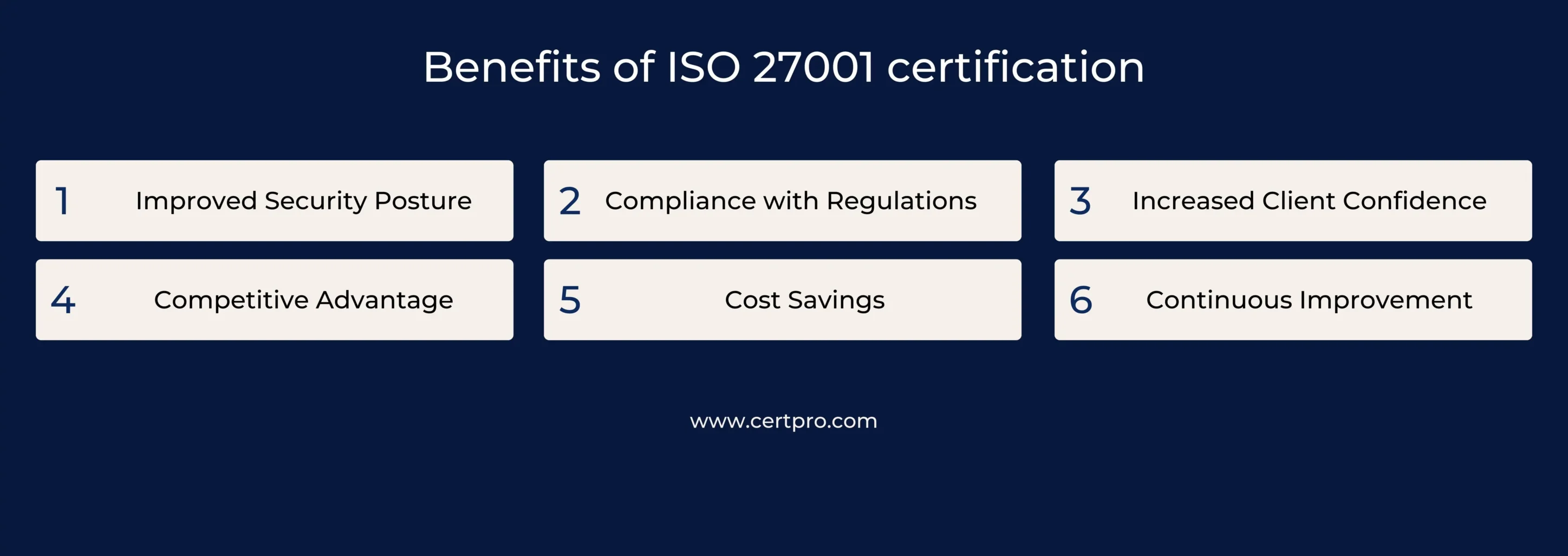
ISO 27001 Certification in Lisbon produces documented outcomes across regulatory compliance, commercial positioning, operational security, and organizational governance. The benefits are derived from the independent, evidence-based audit process rather than from the certification document itself — the structured evaluation identifies control gaps, operational weaknesses, and governance deficiencies that may not be apparent through internal assessment alone. The following outcomes are commonly demonstrated by organizations that achieve ISO 27001 attestation in Lisbon.
- ✓Independent third-party validation of ISMS control design and operational effectiveness against ISO/IEC 27001:2022 requirements
- ✓Recognition in enterprise procurement processes as a qualified vendor meeting documented information security standards
- ✓Structured alignment of information security controls with EU regulatory requirements including GDPR, DORA, and NIS2
- ✓Annual surveillance audit oversight providing ongoing verification of ISMS maintenance and continual improvement
- ✓Reduction in the volume and scope of client security questionnaires and individual vendor assessments
- ✓Demonstrated commitment to confidentiality, integrity, and availability of customer and partner information
- ✓Internationally recognized ISO 27001 certification accepted by enterprise clients across multiple jurisdictions simultaneously
- ✓Formal nonconformity identification and corrective action cycle supporting continuous improvement of the information security posture
ISO 27001 attestation produced through an independent audit provides a materially different level of assurance compared to self-certification or internal security assessments. The ISO 27001 audit evaluates control implementation through examination of documented evidence, staff interviews, and technical observation — delivering an objective determination of whether controls are operating as designed across the certification scope.
For Lisbon-based organizations seeking to demonstrate information security management maturity to international enterprise clients, independent ISO 27001 attestation carries substantially greater credibility than internal declarations of compliance. Enterprise security teams and regulated financial institutions specifically require third-party attestation because self-assessment responses cannot provide the independence required for vendor approval decisions.
ISO 27001 compliance demonstrated through independent audit also provides boards and executive leadership with objective evidence of ISMS effectiveness that supports governance oversight and regulatory reporting obligations.
ISO 27001 helps organizations map legal and regulatory requirements — including GDPR data protection obligations, DORA ICT risk management requirements, NIS2 security measures, and contractual information security obligations — to documented controls within the ISMS. This mapping is evaluated during the ISO 27001 examination as part of the Clause 4.2 assessment of interested parties’ requirements and the Clause 6.1 risk assessment process.
For ISO 27001-certified financial services organizations in Lisbon, the structured control environment provides documented evidence of ICT risk management practices that can be referenced in regulatory examinations by Banco de Portugal, CMVM, or European supervisory authorities. The alignment between ISO 27001 controls and DORA’s ICT risk management framework — particularly in incident detection, ICT continuity, and third-party risk management — enables organizations subject to both frameworks to leverage a single control environment across multiple compliance obligations. This reduces duplication of evidence and control documentation across regulatory programs.
- ✓Verification of Control Effectiveness Through Independent Audit
- ✓Structured Risk Management and Regulatory Alignment
Industry Sectors in Lisbon Pursuing ISO 27001 Certification
ISO 27001 Certification in Lisbon is relevant across a broad range of industry sectors that share common characteristics: responsibility for sensitive customer information, operational dependence on digital infrastructure, contractual obligations to enterprise clients or regulated institutions, and exposure to information security risks material to business continuity and regulatory standing. The sectors below account for the majority of ISO 27001 audit engagements conducted by CertPro in Lisbon.
| Industry Sector | Primary ISO 27001 Driver | Key Information Assets |
|---|---|---|
| Fintech and Payments | DORA compliance, banking client vendor requirements, PCI DSS alignment | Payment transaction data, customer financial records, API credentials |
| SaaS Providers | Enterprise procurement requirements, contractual security obligations | Customer data, application source code, cloud infrastructure configurations |
| Cloud Service Providers | Regulated client requirements, international expansion, NIS2 obligations | Hosted customer data, network infrastructure, access management systems |
| Telecommunications | NIS2 essential service obligations, enterprise customer requirements | Network operations data, subscriber records, communication infrastructure |
| Managed Service Providers | Client contractual security requirements, financial sector vendor approvals | Client system access credentials, managed infrastructure, monitoring data |
Technology Startups and Scale-Ups
Lisbon’s technology startup ecosystem — supported by incubators including Startup Lisboa, accelerators affiliated with major universities, and a government-backed startup visa program — produces a significant number of early-stage and scaling technology companies that pursue ISO 27001 Certification in Lisbon as they approach Series A and Series B funding rounds or begin engaging enterprise clients.
Investors in technology companies increasingly review information security governance as part of due diligence, and ISO 27001 Certification provides documented evidence of structured security management that supports investor confidence. Scale-ups expanding internationally from Lisbon into EU, UK, and North American markets encounter ISO 27001 requirements in enterprise procurement processes, using certification to establish security credibility in new markets without the brand recognition that established providers carry.
ISO 27001 compliance for technology startups in Lisbon also demonstrates operational maturity to prospective enterprise customers who apply vendor risk management frameworks assessing organizational security governance alongside technical product capabilities.
Cloud Service Providers and Data Center Operators
Cloud service providers and data center operators in Lisbon serving regulated financial institutions, healthcare organizations, and public sector entities face heightened information security scrutiny from both clients and regulators. NIS2 Directive obligations applicable to digital infrastructure providers and cloud computing services impose security requirements that align closely with ISO 27001 control domains — making ISO/IEC 27001:2022 certification a practical mechanism for demonstrating NIS2 compliance readiness to competent authorities.
Enterprise clients in financial services and healthcare sectors require their cloud service providers to present ISO 27001 attestation as evidence that information security controls protecting hosted data are independently verified. Cloud infrastructure organizations pursuing ISO 27001 Certification in Lisbon must give particular attention to Technological controls in Annex A addressing cloud service security, configuration management, network segregation, and cryptographic key management — areas representing elevated risk in multi-tenant environments serving regulated clients across multiple jurisdictions.
Certification Scope Definition and Independent Decision Framework
The scope of ISO 27001 Certification in Lisbon is a critical determinant of the certification’s credibility and commercial value. An accurately defined certification scope communicates to clients, auditors, and regulators exactly which processes, systems, locations, and organizational units are covered by the independently verified ISMS. CertPro’s certification committee evaluates scope adequacy as part of the certification determination, assessing whether the defined scope reflects the organization’s actual information processing activities and whether material information assets are appropriately included within the certified boundary.
Evidence-Based Assessment and Certification Decision
CertPro’s ISO 27001 examination is conducted on an entirely evidence-based basis. Certification decisions are not made on the basis of organizational representations, management assertions, or prior certifications — they are made exclusively on documented evidence reviewed and evaluated by auditors during Stage 1 and Stage 2 audit activities. The certification committee reviews the complete audit file, including Stage 1 and Stage 2 reports, nonconformity records, and corrective action evidence, before issuing a certification determination.
ISO 27001 Certification is issued only when audit evidence supports a conclusion that the ISMS conforms to ISO/IEC 27001:2022 requirements and that identified nonconformities have been addressed with documented corrective actions. The independence of this process from any consulting or advisory relationship is fundamental to the validity of ISO 27001 attestation and is a requirement evaluated during accreditation assessments of certification bodies.
For ISO 27001 audit engagements in Lisbon, this independence is maintained through documented conflict-of-interest screening, audit team assignment protocols, and certification committee review separation from audit execution functions.
Certificate Validity, Suspension, and Withdrawal
ISO 27001 certificates are valid for three years from the date of issuance, subject to satisfactory completion of annual surveillance audits in Years 1 and 2. Certificate validity may be suspended by the certification committee where an organization fails to complete a surveillance audit within the scheduled period, fails to address nonconformities within defined timeframes, or experiences a significant ISMS failure or information security incident that raises material questions about continued ISMS conformity.
Certificate withdrawal occurs where suspension conditions are not resolved within the suspension period or where the organization voluntarily withdraws from certification. All suspension and withdrawal decisions are documented and communicated formally. For organizations relying on ISO 27001 attestation in Lisbon to satisfy enterprise client contract requirements or regulatory obligations, maintaining uninterrupted certificate validity through timely surveillance audits and responsive nonconformity management is operationally significant. CertPro’s certification committee maintains documented records of all certification status decisions throughout the three-year certificate cycle.
ISO 27001 Compliance and Information Security Management Across Lisbon’s Regulatory Environment
ISO 27001 compliance in Lisbon operates within a multi-layered regulatory environment shaped by EU cybersecurity legislation, Portuguese national cybersecurity requirements, sector-specific financial regulation, and international contractual obligations. Organizations achieving ISO 27001 Certification in Lisbon gain a structured control framework that can be referenced across multiple regulatory reporting and compliance contexts — reducing the administrative burden of managing separate compliance programs for each applicable regulatory requirement.
GDPR and Data Protection Alignment
ISO 27001 compliance provides a recognized framework for implementing the technical and organizational measures required by GDPR Article 32, which mandates appropriate security of personal data — including measures to ensure confidentiality, integrity, availability, and resilience of processing systems. The ISMS controls evaluated during the ISO 27001 examination — including access control, encryption, incident response, data classification, and supplier security management — map directly to the security obligations that data processors and controllers operating in Lisbon must demonstrate to the Portuguese Data Protection Authority (CNPD).
While ISO 27001 Certification does not constitute GDPR certification under Article 42, the independently verified control environment provides substantive evidence of compliance with Article 32 security requirements. This evidence can be referenced in CNPD regulatory interactions and in responses to data subject inquiries about processing security. For organizations processing personal data on behalf of European clients, ISO 27001 attestation in Lisbon demonstrates the technical and organizational security measures required in data processing agreements under GDPR Article 28.
NIS2 Directive and DORA Intersection
The NIS2 Directive, transposed into Portuguese law, requires operators of essential and important services — including digital infrastructure providers, cloud computing services, and managed service providers — to implement security measures addressing risk analysis, incident handling, business continuity, supply chain security, and network security. ISO 27001 compliance in Lisbon addresses each of these requirement categories through corresponding ISMS controls and management system processes, enabling NIS2-obligated organizations to reference their certified control environment in compliance demonstrations to CNCS (Centro Nacional de Cibersegurança).
DORA, applicable to financial entities and their critical ICT third-party providers, imposes ICT risk management requirements that align substantially with ISO 27001 control domains — particularly in ICT incident management, ICT business continuity, and third-party risk management. Financial services and fintech organizations with ISO 27001 Certification in Lisbon use the certified ISMS as a reference framework for DORA ICT risk management policy documentation, reducing duplication between ISO 27001 control documentation and DORA compliance evidence packages.
FAQ
▶
What is ISO 27001 Certification and why do Lisbon-based organizations need it?
▶
What is the difference between Stage 1 and Stage 2 of the ISO 27001 audit?
▶
How long is an ISO 27001 certificate valid?
▶
What documentation is required for ISO 27001 certification?
▶
Does ISO 27001 certification satisfy GDPR requirements for Lisbon-based data processors?
▶
What is the Statement of Applicability in an ISO 27001 examination?
▶
Which sectors in Lisbon most frequently pursue ISO 27001 certification?
▶
How does CertPro maintain independence during the ISO 27001 audit process?
Get In Touch
have a question? let us get back to you.