
ISO 27001 Certification in Madrid
Madrid functions as one of Europe’s most significant financial, technology, and innovation hubs. The city is home to major banking institutions, international fintech operators, SaaS and cloud service providers, telecommunications firms, healthcare and life sciences organisations, advanced manufacturers, logistics networks, and a growing ecosystem of AI, cybersecurity, and professional services companies. Organisations across these sectors face increasing pressure to demonstrate structured, independently verified information security governance — driven by enterprise procurement processes and evolving Spanish and European regulatory expectations.
OUR CLIENTS










Independent ISO 27001 Certification in Madrid by a Licensed CPA Firm
CertPro operates as a Licensed CPA Firm providing independent, third-party ISO 27001 Certification in Madrid to organisations across the Community of Madrid and the broader Spanish market. Certification is conducted exclusively as a conformity assessment against the requirements of ISO/IEC 27001:2022 — evaluating whether an organisation’s Information Security Management System (ISMS) satisfies the standard’s mandatory clauses (Clauses 4 through 10) and applicable Annex A controls. CertPro does not participate in ISMS design, implementation, or remediation at any stage of the certification engagement, ensuring the independence that makes third-party ISO 27001 Certification meaningful.
Madrid functions as one of Europe’s most significant financial, technology, and innovation hubs. The city is home to major banking institutions, international fintech operators, SaaS and cloud service providers, telecommunications firms, healthcare and life sciences organisations, advanced manufacturers, logistics networks, and a growing ecosystem of AI, cybersecurity, and professional services companies. Organisations across these sectors face increasing pressure to demonstrate structured, independently verified information security governance — driven by enterprise procurement processes and evolving Spanish and European regulatory expectations.
Spain’s alignment with the General Data Protection Regulation (GDPR) and the European Union Agency for Cybersecurity (ENISA) frameworks, combined with the transposition of the NIS2 Directive into Spanish law, has elevated ISO 27001 compliance to a strategic requirement for organisations serving regulated industries or cross-border European markets. ISO 27001 Certification in Madrid is increasingly cited as a baseline expectation in vendor assurance programmes operated by financial institutions, public sector procurement authorities, and multinational technology buyers across the European Single Market.
As a Licensed CPA Firm, CertPro conducts ISO 27001 certification audits under a structured methodology that evaluates documented information, objective evidence, and operational practices against the requirements of ISO/IEC 27001:2022. The certification decision is made independently by CertPro’s certification committee, which reviews the totality of audit findings before issuing a certificate of conformity. This institutional independence is central to the value of third-party ISO 27001 Certification — it clearly distinguishes an externally validated ISMS from an organisation’s own internal declarations of security posture.
ISO 27001 Certification in Madrid is relevant across the full spectrum of Madrid’s commercial and public sector economy. Financial services firms and fintech operators seeking to satisfy DORA-aligned vendor requirements, SaaS providers pursuing enterprise contracts with European clients, healthcare organisations subject to ENS (Esquema Nacional de Seguridad) obligations, and technology companies expanding into regulated international markets all pursue independent ISO 27001 Certification as a mechanism for demonstrating structured information security risk management. CertPro’s certification scope covers single-site and multi-site organisations, cloud-hosted environments, hybrid infrastructure, and outsourced service delivery arrangements — all evaluated against the applicable requirements of ISO/IEC 27001:2022.

What Is ISO 27001 Certification?
ISO 27001 Certification is the formal process by which an independent certification body assesses whether an organisation’s Information Security Management System conforms to the requirements of the ISO 27001 standard. The standard is published jointly by the International Organization for Standardization (ISO) and the International Electrotechnical Commission (IEC). The current version — ISO/IEC 27001:2022 — was published in October 2022, replacing the previous 2013 edition. Certification bodies were required to transition all active certificates to the 2022 standard by October 31, 2025, making the updated version the only valid basis for new ISO 27001 Certification today.
The ISO/IEC 27001:2022 Standard and Its Structure
The ISO 27001 standard establishes requirements for establishing, implementing, maintaining, and continually improving an Information Security Management System. The standard is structured around ten mandatory clauses. Clauses 1 through 3 define the scope, normative references, and terms. Clauses 4 through 10 specify the requirements against which an organisation’s ISMS is evaluated during an ISO 27001 certification audit. These clauses address context of the organisation, leadership and commitment, planning (including risk assessment and risk treatment), support, operation, performance evaluation, and continual improvement. Conformity with all mandatory clauses is required for ISO 27001 Certification to be granted.
Annex A of ISO/IEC 27001:2022 provides a reference set of information security controls that organisations evaluate during risk treatment planning. The 2022 update restructured Annex A from 114 controls across 14 domains in the 2013 version to 93 controls organised across four domains: Organisational controls, People controls, Physical controls, and Technological controls. The 2022 revision also introduced 11 new controls addressing areas such as threat intelligence, cloud service information security, and data masking — all highly relevant to Madrid’s technology-driven economy. Annex A controls do not all apply automatically; applicability is determined through the organisation’s risk assessment and documented in the Statement of Applicability (SoA).
What an ISMS Is and What Certification Evaluates
An Information Security Management System is the structured framework of policies, procedures, processes, controls, and documented information through which an organisation manages information security risks. The ISMS scope defines which information assets, processes, locations, and services are subject to the system. During an ISO 27001 certification audit, the auditor evaluates objective evidence that the ISMS has been established in conformity with ISO/IEC 27001:2022 requirements, that controls are implemented and operating effectively, and that the management system supports continual improvement. The ISO 27001 standard requires organisations to document specific information — including the ISMS scope, information security policy, risk assessment methodology, risk treatment plan, Statement of Applicability, and records of internal audits and management reviews.
ISO 27001 Standard vs. Other Information Security Frameworks
The ISO 27001 standard differs from other information security frameworks by providing a certifiable management system standard rather than a voluntary control catalogue or best-practice guide. Frameworks such as NIST CSF or CIS Controls offer guidance that organisations may adopt voluntarily, but they do not result in third-party certification. ISO 27001 Certification requires an independent conformity assessment conducted by a recognised certification body against the mandatory requirements of the standard. This distinction is significant for Madrid organisations operating in regulated environments where contractual counterparties, public sector procurement authorities, or financial regulators require independently verified information security governance — not self-declared ISO 27001 compliance.
ISO 27001 Certification Audit Process for Organisations in Madrid
The ISO 27001 certification audit process conducted by CertPro follows a structured sequence of evaluation stages. Each stage produces documented audit findings that inform the certification committee’s independent decision. The process applies consistently to organisations across Madrid’s financial services, technology, healthcare, logistics, energy, and public sector ecosystems. The structured stages of the ISO 27001 audit process for Madrid-based organisations are described below.
| Audit Stage | Key Activities | Output |
|---|---|---|
| Application Review | Assessment of ISMS scope, organisational context, and audit programme determination | Audit programme and engagement acceptance |
| Stage 1 Audit | Review of ISMS documentation, policy framework, risk assessment, SoA, and readiness for Stage 2 | Stage 1 findings report; identification of areas requiring resolution before Stage 2 |
| Stage 2 Audit | On-site or remote evaluation of ISMS implementation, control effectiveness, and objective evidence | Stage 2 audit report with conformity findings and any nonconformities |
| Nonconformity Review | Assessment of corrective action evidence submitted by the organisation in response to identified nonconformities | Closure determination for each nonconformity |
| Certification Decision | Independent review by CertPro’s certification committee of the complete audit record | Certificate of conformity to ISO/IEC 27001:2022 (if conformity is established) |
| Surveillance Audit | Annual evaluation of continued ISMS conformity against ISO/IEC 27001:2022 requirements | Surveillance audit report; confirmation of certificate continuation |
| Recertification Audit | Full-scope reassessment conducted at the three-year certificate renewal cycle | Updated certificate of conformity |
The Stage 1 ISO 27001 audit evaluates the organisation’s ISMS documentation and the degree to which the management system has been established in accordance with ISO/IEC 27001:2022 requirements. The auditor reviews the ISMS scope definition, the information security policy, the risk assessment methodology and outputs, the risk treatment plan, and the Statement of Applicability. The Stage 1 audit also confirms that mandatory documented information required by the ISO 27001 standard is present, and that the organisation has completed at least one internal audit and management review cycle before the Stage 2 audit proceeds. Findings from Stage 1 are communicated to the organisation, and any significant gaps in documented information must be addressed before Stage 2 commences.
The Stage 2 ISO 27001 certification audit evaluates the implementation and operational effectiveness of the ISMS and its controls. The auditor collects and assesses objective evidence through document review, interviews with personnel, observation of processes, and technical testing where applicable. Evidence is evaluated against each applicable requirement of Clauses 4 through 10 and against the controls identified as applicable in the Statement of Applicability. Where control design or operating effectiveness does not conform to ISO/IEC 27001:2022 requirements, the auditor raises a nonconformity. Nonconformities are classified and documented in the audit report. The organisation must then submit corrective action evidence addressing each nonconformity before the certification committee conducts its final decision review.
An ISO/IEC 27001:2022 certificate is valid for three years, subject to satisfactory annual surveillance audits. Surveillance audits are conducted within twelve months of the initial certification date and again in the second year of the certification cycle. Each surveillance audit evaluates continued conformity with ISO/IEC 27001:2022 requirements, the status of actions taken to address previously identified nonconformities, and the effectiveness of continual improvement activities. At the end of the three-year cycle, a full recertification audit is conducted to reassess the complete ISMS scope. If a surveillance audit identifies evidence of significant nonconformity, certificate suspension or withdrawal may be initiated by the certification committee. The ISO 27001 audit surveillance schedule for Madrid organisations is established at the time of initial certification.
- ✓Stage 1 Audit: Documentation and Readiness Review
- ✓Stage 2 Audit: Implementation and Evidence Evaluation
- ✓Surveillance Audits and Recertification
ISO 27001 Requirements: What Organisations Must Demonstrate
ISO/IEC 27001:2022 specifies mandatory requirements across Clauses 4 through 10. During the ISO 27001 certification audit process in Madrid, each clause is evaluated against objective evidence provided by the organisation. The following sections summarise the primary areas assessed under each clause grouping, reflecting what organisations must demonstrate to achieve and maintain ISO 27001 Certification.
ISO/IEC 27001:2022 requires organisations to maintain specific documented information as evidence of ISMS conformity. Core documentation includes the defined ISMS scope, the information security policy approved by top management, the information security risk assessment methodology and results, the risk treatment plan documenting selected controls and their justification, and the Statement of Applicability listing all Annex A controls with a determination of applicability and justification for any exclusions. The ISO 27001 standard also requires documented evidence of internal audit results, management review outputs, and records of any nonconformities and corrective actions. These documents form the primary evidence base reviewed during both the Stage 1 and Stage 2 ISO 27001 certification audit.
- ✓ISMS scope definition (Clause 4.3)
- ✓Information security policy approved by top management (Clause 5.2)
- ✓Information security risk assessment methodology and documented results (Clause 6.1.2)
- ✓Risk treatment plan and controls selected from or justified against Annex A (Clause 6.1.3)
- ✓Statement of Applicability with applicability determinations and exclusion justifications (Clause 6.1.3d)
- ✓Objectives for information security and plans to achieve them (Clause 6.2)
- ✓Evidence of internal audit programme and results (Clause 9.2)
- ✓Management review records demonstrating top management oversight (Clause 9.3)
ISO/IEC 27001:2022 requires organisations to conduct a structured information security risk assessment that identifies information security risks, assesses their likelihood and impact, and determines appropriate risk treatment options. Risk treatment involves selecting controls from Annex A or from other sources, and documenting the treatment decisions and their rationale. The Statement of Applicability (SoA) is the central document linking risk assessment outputs to the controls implemented by the organisation. The SoA must account for all 93 Annex A controls in ISO/IEC 27001:2022 — stating whether each is applicable or not applicable, and providing justification for any exclusions. During the ISO 27001 compliance audit, auditors evaluate the logical consistency between risk assessment outputs, risk treatment decisions, and the controls documented in the SoA.
Clause 9.2 of ISO/IEC 27001:2022 requires organisations to conduct internal audits of the ISMS at planned intervals. The internal audit programme must cover all clauses of the ISO 27001 standard applicable to the organisation’s scope. Internal auditors must be selected to ensure objectivity and impartiality — individuals may not audit their own work. Internal audit results must be documented and reported to management. Clause 9.3 requires top management to conduct a management review of the ISMS at planned intervals, evaluating its continuing suitability, adequacy, and effectiveness. Evidence of both the internal audit programme and the management review is examined during the ISO 27001 certification audit as indicators of the organisation’s commitment to continual improvement under Clause 10.
- ✓Mandatory ISMS Documentation Requirements
- ✓Risk Assessment, Risk Treatment, and the Statement of Applicability
- ✓Internal Audit and Management Review Requirements
Annex A Controls and the Four ISO 27001 Control Domains
ISO/IEC 27001:2022 Annex A organises 93 information security controls across four domains. During the ISO 27001 audit, the auditor evaluates the implementation and operating effectiveness of controls documented as applicable in the organisation’s Statement of Applicability. The four domains address distinct areas of information security risk and collectively provide a structured framework for control coverage across the ISMS scope — a key element of what makes ISO 27001 Certification internationally recognised.
Organisational and People Controls
The Organisational controls domain (Controls 5.1 through 5.37) contains 37 controls addressing governance-level information security requirements. These include information security policies, roles and responsibilities, threat intelligence, information security in project management, supplier relationships, incident management, and business continuity planning. The domain also covers controls for intellectual property, classification of information, and management of information security events. The People controls domain (Controls 6.1 through 6.8) addresses screening of personnel, terms of employment, information security awareness and training, disciplinary processes, and responsibilities following termination or change of employment. During an ISO 27001 audit for Madrid organisations, auditors assess evidence that these controls are not merely documented but actively implemented across the organisation’s workforce.
Physical and Technological Controls
The Physical controls domain (Controls 7.1 through 7.14) addresses physical security perimeters, physical entry controls, securing of offices and facilities, physical security monitoring, protection against physical and environmental threats, clear desk and clear screen policies, and equipment maintenance. The Technological controls domain (Controls 8.1 through 8.34) is the most extensive, containing 34 controls that address user endpoint devices, privileged access, access control, authentication, information access restriction, secure coding, configuration management, data leakage prevention, backup, logging and monitoring, network security, vulnerability management, and cloud service information security. The 2022 revision introduced new technological controls specifically addressing threat intelligence, data masking, web filtering, and secure deletion — areas of particular relevance to Madrid’s technology and cloud services sector seeking ISO 27001 Certification in Madrid.
Why Organisations in Madrid Pursue ISO 27001 Certification
ISO 27001 Certification in Madrid is pursued across multiple sectors for a combination of regulatory, commercial, and contractual reasons. Madrid’s position as Spain’s primary financial and technology centre — combined with the city’s growing role as a European hub for AI, cloud services, fintech, and digital infrastructure — creates a high-demand environment for independently verified information security management. The drivers below reflect the primary reasons Madrid-based organisations seek ISO 27001 Certification and ongoing ISO 27001 compliance.
Enterprise Vendor Security Reviews and Procurement Requirements
Large enterprises in Madrid’s financial services, telecommunications, energy, and healthcare sectors operate structured vendor security review programmes as part of third-party risk management. These programmes frequently cite ISO 27001 Certification as a baseline requirement or preferred evidence of information security governance for technology suppliers, SaaS providers, data processors, and professional services firms. A Madrid SaaS company seeking to contract with a major Spanish bank or an international insurance group, for example, will commonly be required to produce a current ISO 27001 certificate as a condition of procurement. The independent nature of the certification — assessed by a Licensed CPA Firm rather than self-declared — is precisely what satisfies the vendor assurance requirement in these scenarios.
GDPR, NIS2, and Spanish Regulatory Alignment
ISO 27001 compliance provides a structured mechanism for mapping information security controls to GDPR obligations under the EU General Data Protection Regulation. Article 32 of the GDPR requires data controllers and processors to implement appropriate technical and organisational measures to ensure a level of security appropriate to the risk — a requirement that ISO/IEC 27001:2022’s risk-based control framework directly addresses. The NIS2 Directive, transposed into Spanish law, imposes specific information security requirements on operators of essential services and important entities in sectors including energy, transport, finance, health, and digital infrastructure. ISO 27001 Certification supports NIS2 compliance by evidencing a structured ISMS with defined risk assessment, incident management, and business continuity controls. Organisations subject to Spain’s Esquema Nacional de Seguridad (ENS) also use ISO 27001 as a complementary framework for information security governance.
Cross-Border Commercial Relationships and European Market Access
Madrid-based organisations serving clients across the European Single Market encounter ISO 27001 Certification requirements from counterparties in Germany, the Netherlands, France, the United Kingdom, and the Nordic markets — where enterprise procurement standards for technology and data service providers routinely include independent ISO 27001 Certification as a mandatory or strongly preferred criterion. For a Madrid technology company expanding into Northern European markets, ISO 27001 Certification in Madrid issued by a recognised certification body provides a portable, internationally recognised evidence base for information security governance. This is particularly relevant for cloud service providers, managed security service providers, and AI platform vendors operating under cross-border data processing agreements subject to GDPR’s data transfer and processor accountability requirements.
Benefits of ISO 27001 Certification for Madrid-Based Organisations
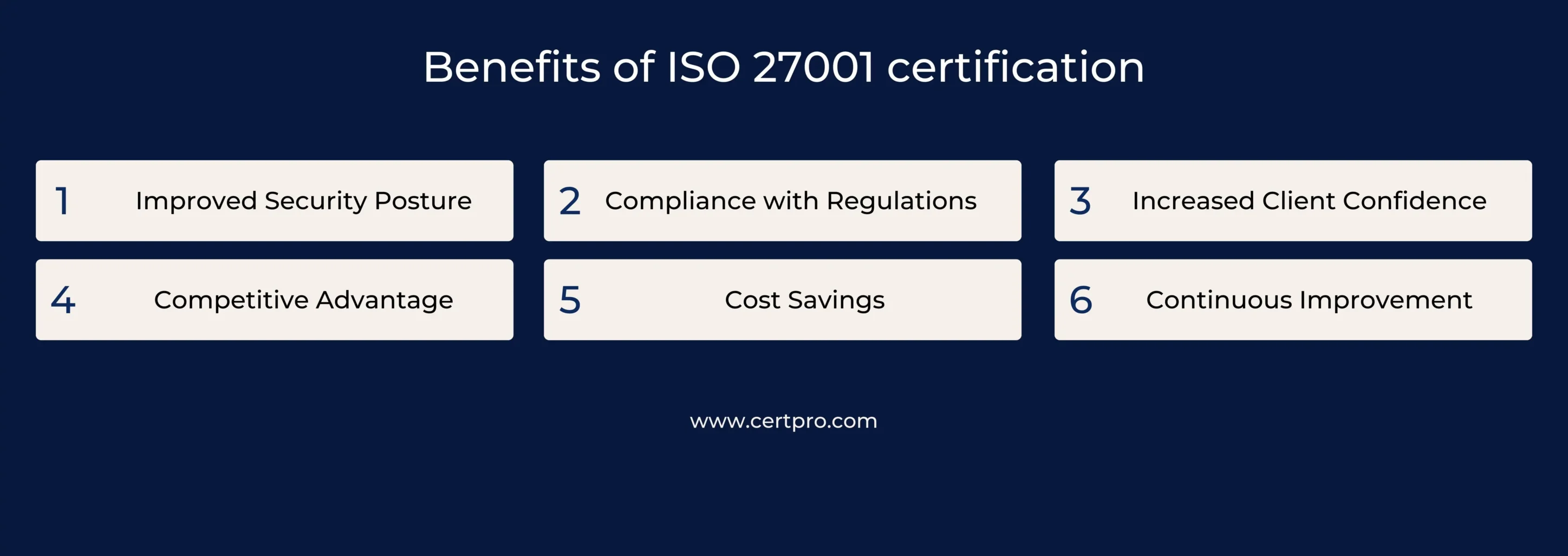
Independent ISO 27001 Certification in Madrid provides organisations with externally validated evidence of ISMS conformity. The following benefits reflect the substantive outcomes of certification for Madrid organisations across financial services, technology, healthcare, logistics, manufacturing, energy, education, and public sector contexts. These outcomes are a direct result of the ISO 27001 certification audit process — not of advisory or implementation activities.
- ✓Independent verification of ISMS conformity with ISO/IEC 27001:2022 requirements, conducted by a Licensed CPA Firm with no involvement in the organisation’s ISMS design or operation
- ✓Structured evidence of information security risk management capability, demonstrating that risks have been identified, assessed, and treated in accordance with a documented methodology
- ✓Recognition in enterprise vendor assurance programmes operated by financial institutions, technology buyers, public sector authorities, and regulated entities across Spain and Europe
- ✓Alignment documentation supporting GDPR Article 32 technical and organisational measure obligations and NIS2 Directive information security requirements applicable to Madrid-based operators
- ✓A certification framework that supports recurring surveillance oversight, ensuring that ISMS conformity is maintained and independently re-evaluated on an annual basis
- ✓Demonstration of top management commitment to information security governance, as evidenced by management review records and leadership accountability requirements under Clause 5 of ISO/IEC 27001:2022
- ✓A portable, internationally recognised certificate of conformity accepted in cross-border procurement and vendor evaluation processes across EU member states and international markets
Madrid is home to Spain’s largest banking institutions — including those headquartered on Paseo de la Castellana — as well as a rapidly expanding fintech sector operating from the city’s technology and innovation districts. ISO 27001 certification audit engagements for financial services firms in Madrid address the management of information security risks across payment processing, customer data handling, digital banking infrastructure, and third-party technology provider relationships. Under the EU Digital Operational Resilience Act (DORA), which applies to financial entities and their ICT third-party service providers from January 2025, ISO 27001 Certification provides a recognised evidence base for ICT risk management governance. ISO 27001 compliance for Madrid-based fintech companies also supports regulatory submissions to the Banco de España and the Comisión Nacional del Mercado de Valores (CNMV).
Madrid’s technology sector includes a concentration of SaaS companies, cloud infrastructure providers, AI platform developers, cybersecurity firms, and managed service providers. ISO 27001 Certification for Madrid technology companies addresses the specific information security risks associated with multi-tenant cloud environments, software development lifecycles, API security, data residency, and continuous deployment pipelines. The ISO/IEC 27001:2022 Annex A Technological controls — including cloud service information security (Control 8.23), secure development lifecycle controls (Controls 8.25 through 8.31), and vulnerability management (Control 8.8) — are directly applicable to companies operating in Madrid’s software and cloud services market. Achieving ISO 27001 Certification in Madrid under the 2022 standard signals to enterprise clients that the organisation’s ISMS addresses current threat categories relevant to cloud-delivered services.
- ✓ISO 27001 Certification for Madrid’s Financial Services and Fintech Sector
- ✓ISO 27001 Certification for Madrid’s Technology and Cloud Services Sector
Sectors in Madrid Seeking ISO 27001 Certification
ISO 27001 Certification in Madrid is sought across a wide range of sectors reflecting the city’s diverse commercial and institutional economy. The Community of Madrid concentrates an unusually high proportion of Spain’s nationally significant organisations — including headquarters of major financial groups, telecommunications operators, energy companies, and public administration bodies. The table below identifies key sectors and the primary information security contexts driving ISO 27001 Certification demand in each.
| Sector | Primary ISO 27001 Certification Drivers in Madrid |
|---|---|
| Financial Services and Banking | Vendor assurance requirements, DORA ICT risk governance, Banco de España regulatory expectations, cross-border client data handling |
| Fintech and Payments | ISO 27001 compliance for payment platform operators, PCI DSS alignment, CNMV regulatory submissions, enterprise banking client procurement |
| SaaS and Cloud Services | Enterprise contract requirements, GDPR data processor obligations, multi-tenant environment security, international market access |
| Healthcare and Life Sciences | Patient data protection, ENS compliance, GDPR Article 9 special category data, third-party clinical research partner requirements |
| Telecommunications | NIS2 essential services obligations, network infrastructure security, B2B service agreements requiring independent ISO 27001 Certification |
| Logistics and Transport | Supply chain information security, cross-border data flows, enterprise client vendor reviews, operational resilience requirements |
Healthcare, Pharmaceuticals, and Life Sciences
Madrid’s healthcare and life sciences sector includes major hospital networks, pharmaceutical research organisations, clinical data management companies, and digital health platform providers. These organisations process significant volumes of sensitive personal and health data, placing them under GDPR Article 9 obligations for special category data processing as well as ENS requirements for healthcare information systems. ISO 27001 certification audit evaluations for healthcare organisations in Madrid assess controls relating to data classification, access management, incident response, and the security of health information systems. Pharmaceutical companies operating R&D data environments in Madrid increasingly cite ISO 27001 Certification as a requirement from international research partners and contract research organisations based in regulated EU and North American markets.
Advanced Manufacturing, Automotive, and Energy
Madrid’s advanced manufacturing and automotive sectors include firms engaged in precision engineering, defence supply chains, and mobility technology, while the energy sector encompasses major utilities, renewable energy operators, and grid management organisations. These industries face information security requirements driven by operational technology (OT) and IT convergence, industrial control system security, and supply chain integrity. ISO 27001 Certification for manufacturing and energy organisations in Madrid addresses the protection of intellectual property, engineering data, and operational system integrity. Energy companies subject to NIS2 essential services obligations use the ISO 27001 standard as a foundation for demonstrating systematic information security risk management to Spanish and European regulatory authorities. The standard’s risk-based approach allows manufacturing organisations to define ISMS scope boundaries that encompass connected industrial systems without requiring full OT system inclusion.
ISO 27001 Certification Scope and Independent Decision Framework
The scope of ISO 27001 Certification in Madrid is defined by the organisation before the audit process begins and is validated by the auditor during the Stage 1 review. Scope definition is a critical element of the certification engagement because it determines which assets, processes, locations, and services are subject to ISMS requirements — and which Annex A controls are potentially applicable. CertPro’s certification committee independently evaluates the completeness and appropriateness of the defined scope as part of the ISO 27001 certification audit decision process.
Scope Definition and Boundary Determination
ISO/IEC 27001:2022 Clause 4.3 requires organisations to define the boundaries and applicability of the ISMS in terms of external and internal issues, interested party requirements, and interfaces and dependencies between activities performed by the organisation and those performed by other organisations. For Madrid-based organisations with complex operating structures — including multi-site environments, outsourced service delivery arrangements, shared services centres, and cloud-hosted infrastructure — accurate scope definition is essential. It ensures that the ISO 27001 certification assessment covers the areas of information security risk that are material to the organisation’s operations and to interested parties such as clients, regulators, and contractual counterparties. An inadequately defined scope may result in a certificate that does not satisfy the vendor assurance or regulatory requirements that originally motivated the ISO 27001 compliance effort.
The Independent Certification Decision
The ISO 27001 standard requires that the certification decision be made by an individual or group that has not been involved in the audit of the organisation. At CertPro, the certification committee reviews the complete audit record — including Stage 1 and Stage 2 reports, nonconformity records, and corrective action evidence — before determining whether a certificate of conformity to ISO/IEC 27001:2022 will be issued. This structural independence between the audit function and the certification decision function is fundamental to the integrity of the ISO 27001 certification audit process. The certification decision is not a commercial agreement or a negotiated outcome; it reflects an objective determination of whether the organisation’s ISMS conforms to the requirements of the ISO 27001 standard.
Certificate Validity, Suspension, and Withdrawal
An ISO/IEC 27001:2022 certificate is valid for three years from the date of the certification decision, provided that annual surveillance audits confirm continued conformity. Conditions that may result in certificate suspension include failure to conduct or schedule a surveillance audit within the required timeframe, identification of significant nonconformities during a surveillance audit that are not resolved within the agreed corrective action period, or evidence that the organisation’s ISMS has materially diverged from the certified scope. Certificate withdrawal may occur where suspension conditions are not resolved. Suspended and withdrawn certificates are recorded by the certification body and are visible to relying parties who verify certificate status. Organisations holding ISO 27001 Certification in Madrid are expected to maintain the conditions of certification throughout the three-year cycle and to notify the certification body of material changes to the ISMS scope or organisational structure.
FAQ
▶
What is ISO 27001 Certification and why does it matter for Madrid organisations?
▶
What is the difference between ISO/IEC 27001:2013 and ISO/IEC 27001:2022?
▶
How long does the ISO 27001 certification audit process take in Madrid?
▶
Does ISO 27001 certification guarantee that an organisation will not experience a data breach?
▶
What is the Statement of Applicability and why is it important in the ISO 27001 audit?
▶
Which Madrid sectors are most commonly required to hold ISO 27001 certification?
▶
Does ISO 27001 compliance support GDPR requirements for Madrid organisations?
▶
What happens if an organisation receives a nonconformity during the ISO 27001 certification audit?
Get In Touch
have a question? let us get back to you.