
ISO 27001 Certification in Maryland
ISO 27001 Certification in Maryland is issued by CertPro, a Licensed CPA Firm operating as an independent third-party certification body. CertPro evaluates organizations against ISO/IEC 27001:2022—the international standard for Information Security Management Systems (ISMS)—through structured Stage 1 and Stage 2 audits, nonconformity review, and an independent certification committee decision. This process ensures that every ISO 27001 certification issued reflects verified, evidence-based conformance rather than self-attestation.
OUR CLIENTS










Independent ISO 27001 Certification by a Licensed CPA Firm in Maryland
ISO 27001 Certification in Maryland is issued by CertPro, a Licensed CPA Firm operating as an independent third-party certification body. CertPro evaluates organizations against ISO/IEC 27001:2022—the international standard for Information Security Management Systems (ISMS)—through structured Stage 1 and Stage 2 audits, nonconformity review, and an independent certification committee decision. This process ensures that every ISO 27001 certification issued reflects verified, evidence-based conformance rather than self-attestation.
Maryland occupies a distinctive position in the national information security landscape. The state is home to a dense concentration of federal contractors, defense and aerospace technology firms, cybersecurity companies, healthcare IT and life sciences organizations, financial services institutions, and SaaS providers. Organizations headquartered or operating across Baltimore, Bethesda, Rockville, Silver Spring, Columbia, and the broader Maryland technology corridor regularly face enterprise vendor security reviews, federal procurement requirements, and contractual demands that reference ISO 27001 compliance as a baseline expectation.
ISO 27001 Certification in Maryland addresses these demand drivers directly, providing independently verified evidence of ISMS effectiveness to clients, regulators, and procurement authorities across all major industry sectors.
CertPro’s certification activity is strictly limited to independent audit and evaluation functions. CertPro does not provide consulting, implementation, policy development, control design, or remediation services. This separation maintains auditor independence under ISO/IEC 17021-1, the accreditation standard governing management system certification bodies.
Organizations seeking ISO 27001 Certification in Maryland engage CertPro solely for the purpose of receiving an independent, evidence-based assessment of their ISMS against the requirements of ISO/IEC 27001:2022. This clear boundary between certification and advisory services protects the integrity of every ISO 27001 audit outcome.
Maryland’s regulatory environment adds meaningful context to ISMS certification demand. The Maryland Online Data Privacy Act (MODPA), enacted in 2024 and effective October 1, 2025, establishes obligations for controllers and processors of personal data—including requirements related to data security practices. ISO 27001 certification does not automatically establish compliance with MODPA or any other state or federal law. However, certified organizations can reference their independently verified ISMS controls as documented evidence of structured information security governance.
Federal contractors operating in Maryland may also reference ISO 27001 compliance alignment when responding to supply chain security requirements under frameworks including CMMC, NIST SP 800-171, and applicable agency acquisition regulations.
The ISO/IEC 27001:2022 standard, published in October 2022, revised the control structure from 114 controls across 14 domains to 93 controls organized across four Annex A domains: Organizational, People, Physical, and Technological. Organizations certified under the 2013 version of the standard are required to transition to ISO/IEC 27001:2022 by October 31, 2025, as established by international accreditation bodies.
CertPro conducts all ISO 27001 audits in Maryland exclusively against the 2022 version of the standard. The certification decision is made by an independent certification committee that reviews audit findings, evaluates nonconformity responses, and determines whether the organization’s ISMS meets all applicable requirements before a certificate is issued.
Cross-border vendor due diligence is a significant driver of ISO 27001 Certification in Maryland. Maryland-based SaaS providers, cloud service providers, and data hosting organizations frequently serve clients in regulated industries across multiple jurisdictions—including financial institutions subject to federal oversight, healthcare organizations governed by HIPAA, and multinational technology companies with EU GDPR obligations.
In each scenario, ISO 27001 ISMS certification provides an independently verified, internationally recognized signal of information security governance maturity. This supports procurement decisions, contract negotiations, and regulatory submissions across US and international jurisdictions alike.

What Is ISO 27001 Certification?
ISO 27001 certification is the formal recognition—issued by an accredited or independent third-party certification body—that an organization’s Information Security Management System conforms to the requirements of ISO/IEC 27001:2022. The certification is based on a documented ISO 27001 audit conducted by qualified auditors who evaluate the design, implementation, and operating effectiveness of the ISMS across the organization’s defined scope.
ISMS certification is distinct from self-attestation or internal compliance declarations. It requires an independent, evidence-based assessment by a certification body that maintains no advisory relationship with the organization under evaluation—ensuring objectivity at every stage of the process.
The ISO/IEC 27001:2022 Standard and ISMS Requirements
ISO/IEC 27001:2022 is structured around Clauses 4 through 10, which define the requirements for establishing, implementing, maintaining, and continually improving an Information Security Management System. Each clause addresses a specific dimension of ISMS governance:
Clause 4 addresses organizational context and interested parties. Clause 5 defines leadership and information security policy requirements. Clause 6 covers planning, including risk assessment and risk treatment. Clause 7 addresses support requirements such as resources, competence, and communication. Clause 8 covers operational planning and control. Clause 9 defines performance evaluation requirements including internal audit and management review. Clause 10 addresses improvement, covering nonconformity management and corrective action.
An organization must demonstrate conformance with all mandatory clauses to achieve ISO 27001 certification under the 2022 standard.
Annex A of ISO/IEC 27001:2022 contains 93 information security controls organized across four domains: Organizational controls (37 controls), People controls (8 controls), Physical controls (14 controls), and Technological controls (34 controls). The organization’s Statement of Applicability (SoA) documents which Annex A controls are applicable to its ISMS scope, which have been implemented, and the justification for any controls excluded.
The SoA is a mandatory ISMS document reviewed during every ISO 27001 audit as evidence of systematic control selection aligned with the organization’s documented risk treatment decisions.
Key ISMS Documentation Required for ISO 27001 Assessment
An ISO 27001 assessment evaluates whether the organization maintains and operates a documented ISMS supported by verifiable evidence. Core documentation reviewed during the ISO 27001 audit includes the Information Security Policy, the risk assessment methodology and results, the risk treatment plan, and the Statement of Applicability.
Additional documented information required by the standard includes ISMS scope documentation, information security objectives, records of competence and awareness activities, operational procedures, internal audit results, and management review outputs. The presence, completeness, and operational linkage of these documents are assessed against the requirements of ISO/IEC 27001:2022 Clauses 4 through 10 during both the Stage 1 and Stage 2 audit phases.
| ISMS Document | ISO 27001:2022 Clause Reference | Audit Purpose |
|---|---|---|
| Information Security Policy | Clause 5.2 | Confirms leadership commitment and policy scope |
| Risk Assessment Results | Clause 6.1.2 | Verifies systematic identification and evaluation of information security risks |
| Risk Treatment Plan | Clause 6.1.3 | Confirms control selection is aligned with documented risk decisions |
| Statement of Applicability | Clause 6.1.3(d) | Documents Annex A control applicability, implementation status, and justification |
| Internal Audit Records | Clause 9.2 | Evidences ongoing ISMS evaluation, management review, and continual improvement |
ISO 27001 Certification Audit Process in Maryland
The ISO 27001 certification audit process conducted by CertPro for Maryland organizations follows a structured, multi-stage methodology consistent with ISO/IEC 17021-1 requirements for management system certification bodies. Each stage produces documented outputs that inform the certification committee’s independent decision.
This process applies uniformly to organizations across Baltimore’s technology sector, Bethesda’s federal contractor community, Rockville’s life sciences ecosystem, and any Maryland-based organization seeking independently verified ISMS certification under ISO/IEC 27001:2022.
The Stage 1 audit is a documentation-focused review that evaluates the organization’s ISMS documentation against the requirements of ISO/IEC 27001:2022. During this phase, CertPro auditors review the Information Security Policy, ISMS scope documentation, risk assessment methodology and results, risk treatment plan, and Statement of Applicability.
Auditors assess whether mandatory documented information required by Clauses 4 through 10 is present, complete, and logically structured. The Stage 1 audit also evaluates whether the organization has defined a meaningful ISMS scope, identified its information assets and interested parties, and established a documented risk assessment process that produces results linked to control selection decisions in the SoA.
Findings from the Stage 1 audit are documented and communicated to the organization before the Stage 2 audit proceeds. Where findings indicate areas requiring clarification or additional documentation, the organization addresses these gaps in advance of the next audit phase.
The Stage 1 audit output directly determines the audit program for Stage 2—including the sampling approach, audit focus areas, and the specific ISMS processes and Annex A control domains to be examined in depth. For Maryland organizations with complex or multi-site ISMS scopes—such as defense contractors managing controlled information environments or healthcare IT firms operating across multiple facility locations—the Stage 1 review is especially critical in shaping the scope and depth of Stage 2 activities.
The Stage 2 audit evaluates the implementation and operating effectiveness of the ISMS, including the Annex A controls identified as applicable in the organization’s Statement of Applicability. CertPro auditors examine whether documented controls have been implemented as described, whether they operate effectively to address identified information security risks, and whether the management system processes defined in Clauses 4 through 10 are functioning as required.
Evidence is gathered through document examination, personnel interviews, and observation of operational processes. The Stage 2 audit produces a detailed audit report documenting all findings, including any nonconformities identified against ISO/IEC 27001:2022 requirements.
Nonconformities identified during the ISO 27001 audit are classified and formally reported to the organization. The organization must submit a corrective action response addressing root cause analysis and proposed remediation before the certification committee reviews the complete audit package.
The certification committee independently evaluates the full audit record—including Stage 1 findings, the Stage 2 audit report, nonconformity responses, and auditor recommendations—before making a certification decision. The committee’s decision to grant, deny, or defer ISO 27001 ISMS certification is based solely on documented audit evidence and the organization’s demonstrated conformance with ISO/IEC 27001:2022 requirements.
ISO 27001 certification is valid for a three-year period, subject to ongoing surveillance audit requirements. Surveillance audits are conducted at defined intervals—typically annually—to verify that the certified ISMS continues to conform to ISO/IEC 27001:2022 requirements and remains effectively implemented.
Surveillance audits are narrower in scope than the initial certification audit but must cover mandatory elements including internal audit results, management review outputs, corrective action records, and a representative sample of Annex A controls. Maryland organizations with dynamic information security environments—such as SaaS providers expanding into new markets or cybersecurity firms onboarding new clients—should maintain continuous ISMS documentation currency to support surveillance audit evidence requirements. Recertification audits are conducted at the end of the three-year cycle to renew ISO 27001 ISMS certification for a further three-year term.
| Audit Stage | Key Activities | Output |
|---|---|---|
| Stage 1 Audit | Documentation review, ISMS scope and policy evaluation, Statement of Applicability review | Stage 1 findings report and Stage 2 audit program |
| Stage 2 Audit | ISMS implementation review, Annex A control effectiveness testing, personnel interviews | Audit report with detailed findings and nonconformities |
| Nonconformity Review | Corrective action submission, root cause analysis evaluation by auditors | Closed nonconformities or certification deferral decision |
| Certification Committee | Independent review of the full ISO 27001 audit package | Certification granted, deferred, or denied |
| Surveillance Audit | Annual ISMS conformance verification and sample Annex A control review | Continued certification or suspension action |
| Recertification Audit | Full ISMS re-evaluation at the three-year certification cycle end | Renewed ISO 27001 certificate for a further three-year term |
- ✓Stage 1 Audit: Documentation Review and ISMS Readiness Evaluation
- ✓Stage 2 Audit: ISMS Implementation and Control Effectiveness
- ✓Surveillance Audits and Recertification Cycle
ISO 27001 Certification Requirements for Maryland Organizations
ISO 27001 compliance requires organizations to meet mandatory requirements across all clauses of ISO/IEC 27001:2022 and to implement applicable Annex A controls supported by documented evidence. The ISO 27001 assessment conducted by CertPro evaluates whether each requirement has been addressed through the organization’s ISMS design and whether the ISMS operates effectively within the defined scope.
Organizations pursuing ISO 27001 Certification in Maryland must demonstrate systematic information security governance across their defined ISMS boundary, regardless of organizational size or industry sector. No clause is optional, and no control category can be excluded without documented justification.
ISO/IEC 27001:2022 Clause 6.1.2 requires organizations to define and apply an information security risk assessment process that identifies risks associated with the confidentiality, integrity, and availability of information within the ISMS scope. The risk assessment must produce documented results that identify information security risks, assign risk owners, and evaluate the likelihood and consequence of each identified risk using a defined and repeatable methodology.
Maryland organizations operating in high-risk data environments—such as biotechnology firms managing proprietary research data, healthcare IT organizations processing protected health information, or financial institutions handling sensitive customer financial records—must ensure their risk assessment process captures the specific threat landscape relevant to their information assets and operational context.
Clause 6.1.3 requires organizations to develop a risk treatment plan that selects appropriate options for addressing identified risks and maps treatment decisions to applicable Annex A controls documented in the Statement of Applicability. The risk treatment plan must demonstrate a clear, auditable linkage between identified risks, treatment decisions, and selected controls.
During the ISO 27001 audit, CertPro auditors trace this linkage from the risk assessment results through the risk treatment plan to the SoA, and then to evidence of implemented controls. This verifies that the organization’s control selection is driven by documented risk decisions rather than arbitrary selection. Organizations that cannot demonstrate this traceability are likely to receive nonconformity findings against Clause 6.1.3.
The Statement of Applicability is the central ISMS document that records the organization’s determination of which ISO/IEC 27001:2022 Annex A controls are applicable to its scope, which have been implemented, and the justification for any controls deemed not applicable. All 93 Annex A controls must be considered in the SoA. Controls excluded must be justified through documented risk treatment decisions or documented business context rationale.
The four Annex A domains—Organizational (37 controls), People (8 controls), Physical (14 controls), and Technological (34 controls)—cover information security governance, human resource security, physical access management, and technical controls including cryptography, secure development, network security, and supplier relationship management.
During the Stage 2 ISO 27001 audit, CertPro auditors review the SoA alongside evidence of implemented controls across each applicable Annex A domain. For Maryland organizations with significant technology control environments—such as cloud service providers managing multi-tenant infrastructure, AI companies processing large volumes of sensitive data, or SaaS providers operating under customer data processing agreements—the Technological controls domain (A.8) receives particular audit scrutiny.
Controls in A.8 address areas including user access rights, privileged access management, information backup, logging and monitoring, network security management, and secure software development lifecycle practices. Evidence of control implementation and effectiveness is evaluated through document examination, system configuration review, and personnel interviews.
ISO/IEC 27001:2022 Clause 9.2 requires organizations to conduct internal audits of the ISMS at planned intervals to determine whether the management system conforms to the organization’s own requirements and to the requirements of the standard. Internal audit results must be documented and reported to relevant management.
Clause 9.3 requires management review of the ISMS at planned intervals, with documented outputs including decisions on improvement opportunities, changes to the ISMS, and resource needs. CertPro auditors review internal audit records and management review minutes as mandatory evidence during the ISO 27001 assessment, evaluating whether these activities are conducted systematically and whether findings are addressed through documented corrective actions under Clause 10.1.
- ✓Risk Assessment and Risk Treatment Requirements
- ✓Annex A Control Implementation and Statement of Applicability
- ✓Management System Clause Requirements: Internal Audit and Management Review
Maryland Business Sectors Pursuing ISO 27001 Certification
ISO 27001 Certification in Maryland is pursued by organizations across multiple industries that manage sensitive information, serve regulated clients, or operate under contractual information security requirements. Maryland’s economic geography—anchored by federal agency proximity in the National Capital Region, a mature life sciences corridor in Montgomery County, a growing cybersecurity sector, and an established financial services ecosystem in Baltimore—creates a broad and diverse demand base for ISMS certification.
The following sectors represent the primary organizational categories seeking ISO 27001 certification for Maryland companies.
Federal Contractors, Defense, and Aerospace Technology Organizations
Maryland hosts one of the largest concentrations of federal contractors and defense technology organizations in the United States, with significant activity in Bethesda, Rockville, and the I-270 technology corridor. Organizations providing IT services, cybersecurity solutions, cloud infrastructure, software development, and data analytics to federal agencies face increasing supply chain security scrutiny.
ISO 27001 certification for Maryland government contractors is frequently referenced in federal procurement solicitations, agency vendor assessment processes, and prime contractor supply chain security requirements. It provides documented, independently verified evidence that an organization manages information security risks through a structured, audited management system—a requirement that is distinct from point-in-time security assessments.
Defense and aerospace technology organizations in Maryland often manage controlled unclassified information (CUI) and export-controlled technical data subject to ITAR and EAR restrictions. While ISO 27001 certification is not a direct substitute for CMMC Level 2 or Level 3 certification, many Maryland defense contractors pursue ISO 27001 ISMS certification as part of a broader information security governance program.
This supports NIST SP 800-171 implementation documentation and demonstrates systematic risk management to prime contractors and agency program offices. The independently verified nature of ISO 27001 certification—as opposed to self-assessment—is a key differentiator in high-stakes federal procurement contexts.
Healthcare IT, Life Sciences, and Biotechnology Organizations
Maryland’s life sciences and healthcare IT ecosystem—anchored by research institutions in Bethesda, the FDA headquarters in Silver Spring, and a broad network of biotechnology and pharmaceutical companies across Montgomery and Howard Counties—generates substantial demand for ISO 27001 certification among healthcare IT organizations. Healthcare technology firms, electronic health record vendors, health information exchanges, and clinical research organizations manage protected health information subject to HIPAA, proprietary clinical trial data, and genomic research datasets.
ISO 27001 compliance for Maryland life sciences organizations demonstrates that information security risks associated with these sensitive data categories are managed through a documented, independently audited ISMS—rather than informal or ad hoc practices.
Cybersecurity, SaaS, and Cloud Service Providers
Maryland’s cybersecurity sector—concentrated around Columbia, Annapolis Junction, and Hanover—includes managed security service providers, threat intelligence firms, identity and access management vendors, and security operations centers serving both government and commercial clients. ISO 27001 certification for Maryland cybersecurity firms signals to enterprise clients that the provider’s own information security practices are subject to independent third-party scrutiny under an internationally recognized standard.
SaaS providers and cloud service providers operating from Maryland face similar market expectations. Enterprise procurement teams and regulated industry clients routinely require ISO 27001 ISMS certification as a vendor qualification criterion before executing data processing agreements or cloud service contracts. The certification provides a structured, annually maintained evidence base that supports ongoing client trust and vendor qualification processes throughout the three-year certification period.
Benefits of ISO 27001 Certification for Maryland-Based Organizations
ISO 27001 Certification in Maryland delivers independently verified outcomes for organizations that complete the certification process. These outcomes are observable through documented audit evidence, certification records, and the operational disciplines established through ISMS implementation and ongoing surveillance audits.
The following benefits reflect the direct results of ISMS certification under ISO/IEC 27001:2022, presented in a structured format to support decision-making by procurement teams, executive leadership, and compliance officers.
ISO 27001 ISMS certification is recognized in enterprise vendor qualification processes across financial services, healthcare, defense, and technology sectors. Maryland organizations holding a current ISO 27001 certificate can provide procurement teams, security review committees, and contract compliance officers with independently verified documentation of their ISMS conformance—without requiring repeated, resource-intensive vendor security questionnaire responses.
In Maryland’s federal contractor ecosystem, where vendor due diligence cycles can extend across multiple agency reviews and prime contractor audits simultaneously, ISO 27001 certification reduces the audit burden by providing a single, authoritative third-party assessment. This assessment can be referenced across multiple procurement processes throughout the three-year certification period.
Financial services organizations in Baltimore and across Maryland’s banking and fintech sector apply similar vendor qualification logic when evaluating technology and cloud service providers. Fintech firms, payment processors, and banking technology vendors seeking contracts with Maryland-chartered financial institutions or federally supervised banks benefit from ISO 27001 certification as a recognized third-party validation of information security controls.
This satisfies vendor due diligence requirements under federal banking agency third-party risk management guidance. The certification’s annual surveillance structure provides ongoing evidence of ISMS maintenance, supporting continuous vendor qualification rather than requiring periodic full re-assessment from scratch.
ISO 27001 certification establishes a documented, systematic approach to information security risk management that links identified risks to treatment decisions and implemented controls. Organizations that achieve ISMS certification have demonstrated to an independent auditor that their risk assessment process is repeatable, their risk treatment decisions are documented and justified, and their Annex A controls are implemented in alignment with those decisions.
This structured approach reduces the likelihood of unaddressed information security vulnerabilities and establishes clear accountability for information security governance at the leadership level—reinforced through the mandatory management review process required by Clause 9.3 of ISO/IEC 27001:2022.
ISO 27001 compliance supports documented alignment with multiple regulatory frameworks relevant to Maryland organizations. Healthcare organizations can map ISO 27001 Annex A controls to HIPAA Security Rule administrative, physical, and technical safeguard requirements. Financial institutions can reference ISMS controls in responses to federal banking agency examination requests regarding information security program adequacy. Organizations serving EU-based clients can reference ISO 27001 certification in GDPR data protection impact assessments as evidence of systematic technical and organizational measures.
While ISO 27001 certification does not establish automatic compliance with MODPA, HIPAA, or any other specific regulation, the documented ISMS controls provide an audited evidence base that organizations can reference in regulatory submissions and due diligence responses across US and international jurisdictions.
- ✓Independently verified ISMS conformance recognized in enterprise and government procurement processes
- ✓Documented risk assessment and risk treatment evidence supporting regulatory submissions across jurisdictions
- ✓Annex A control implementation verification across Organizational, People, Physical, and Technological domains
- ✓Annual surveillance audit structure maintaining ongoing ISO 27001 certification evidence currency
- ✓Statement of Applicability documenting systematic control selection linked to risk decisions
- ✓Management review and internal audit records demonstrating continual improvement governance
- ✓Cross-jurisdictional recognition supporting vendor qualification in US, EU, and international markets
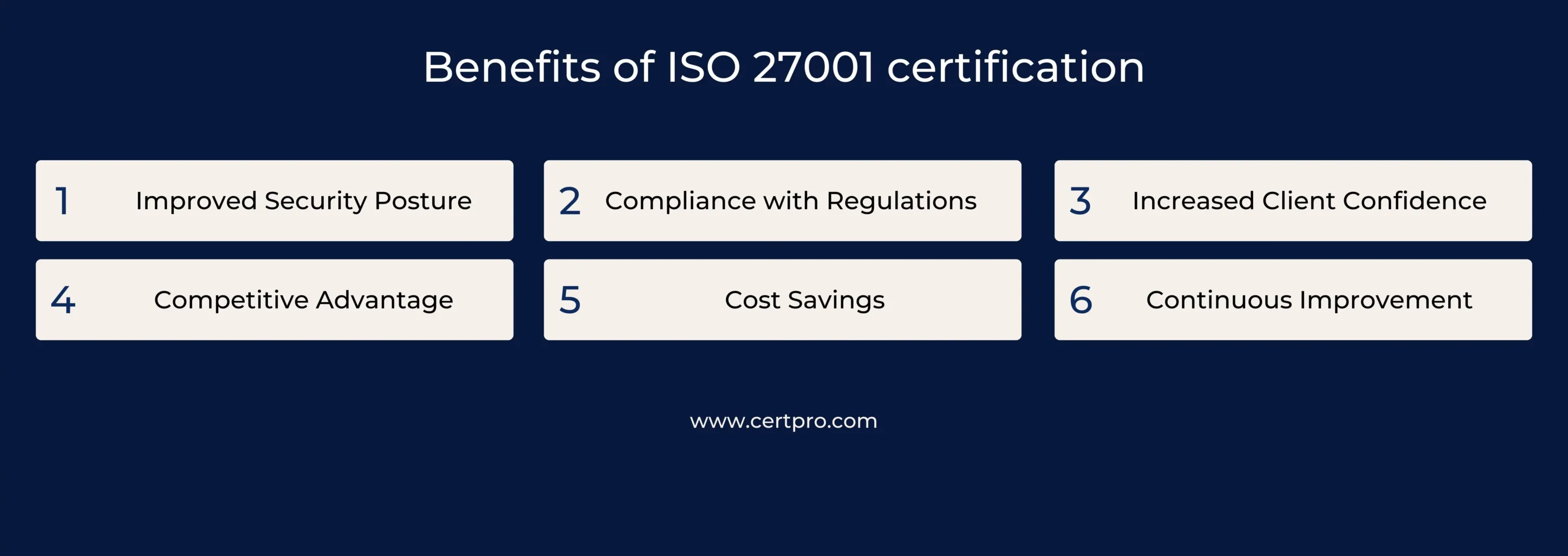
- ✓Vendor Qualification and Enterprise Procurement Recognition
- ✓Structured Risk Management and Improved Security Posture
- ✓Regulatory Alignment and Cross-Jurisdictional Recognition
ISO 27001 Certification Scope and Independent Decision Framework
The scope of ISO 27001 Certification in Maryland defines the boundaries of the ISMS subject to independent audit. Scope definition is the organization’s responsibility and must accurately reflect the information assets, processes, systems, locations, and organizational units included in the ISMS.
CertPro evaluates whether the defined scope is meaningful and complete during every ISO 27001 assessment. Excluding core information processing activities from the ISMS scope to simplify certification is identified as a finding during the audit. The certification committee independently reviews scope adequacy as part of the certification decision process, ensuring the issued certificate reflects genuine ISMS coverage.
Evidence-Based Assessment and Nonconformity Classification
The ISO 27001 audit is conducted on a strictly evidence-based basis. CertPro auditors do not accept verbal assertions of control implementation as sufficient audit evidence. Documentary evidence, system records, configuration outputs, personnel interview corroboration, and observation of operational processes are all used to substantiate whether each evaluated ISMS requirement is met.
Where evidence is insufficient, absent, or inconsistent with documented ISMS requirements, nonconformities are identified and recorded in the audit report. Organizations are required to address nonconformities through documented corrective actions before the certification committee completes its review. The independence of the certification committee from the audit team provides a structured internal check on the integrity of every certification decision.
Conditions for suspension or withdrawal of ISO 27001 ISMS certification include failure to maintain ISMS conformance during the certification period, failure to facilitate surveillance audits within required intervals, or identification of significant nonconformities during surveillance that are not addressed within the corrective action timeframe established by the certification body.
Maryland organizations should maintain continuous ISMS operational readiness rather than treating ISO 27001 certification as a one-time event. Surveillance audit findings can result in suspension of the certificate pending corrective action completion. Recertification at the three-year cycle end requires a full re-evaluation of the ISMS—not a simple administrative renewal.
Multi-Site and Cloud-Hosted ISMS Scope Considerations
Maryland organizations with complex operational architectures—including multi-site operations across Baltimore, Bethesda, Rockville, Columbia, and remote work environments, or ISMS scopes that include cloud-hosted infrastructure managed by third-party cloud service providers—must define their ISMS scope to accurately reflect where information assets reside and how they are protected.
Where cloud service providers process information within the ISMS scope, the organization’s Annex A controls must address supplier relationship management (A.5.19 through A.5.22) and include documented evidence of security requirements incorporated into cloud service agreements. The ISO 27001 audit evaluates whether supplier security controls are verified through the organization’s own processes—not solely through reliance on cloud provider certifications or third-party attestations.
ISO 27001 Compliance Maryland: Regulatory and Contractual Context
ISO 27001 compliance for Maryland organizations exists within a specific regulatory and contractual environment that distinguishes the state from other US jurisdictions. Maryland’s status as a center for federal agency operations, its proximity to NSA and Cyber Command at Fort Meade, its concentration of cleared defense contractors, and the presence of the FDA and NIH in Bethesda collectively create a regulatory demand environment where information security governance documentation is scrutinized by sophisticated counterparties.
ISO 27001 Certification in Maryland provides an independently verified ISMS framework that satisfies multiple simultaneous documentation requirements across this complex stakeholder landscape—making it a strategic investment for organizations operating in regulated or high-scrutiny sectors.
Maryland Online Data Privacy Act and Information Security Governance
The Maryland Online Data Privacy Act, which takes effect October 1, 2025, imposes data security obligations on controllers and processors of personal data of Maryland consumers. The Act requires controllers to implement and maintain reasonable administrative, technical, and physical data security practices to protect personal data.
An ISO 27001 certified ISMS—with documented risk assessment, risk treatment, and Annex A controls addressing access management, cryptography, physical security, and incident management—provides an audited framework for demonstrating structured data security governance. Organizations should engage qualified legal counsel to assess specific MODPA compliance obligations. ISO 27001 certification does not substitute for legal compliance analysis, but it provides documented ISMS evidence directly relevant to data security program inquiries under the Act.
Contractual Information Security Requirements and ISO 27001 Audit Maryland
Contractual requirements for ISO 27001 certification—or equivalent information security controls—appear across multiple Maryland business contexts. Technology procurement contracts with large enterprises, financial institutions, and healthcare organizations commonly include information security addenda requiring vendors to maintain certified ISMS programs or undergo equivalent third-party assessments.
ISO 27001 audit results for Maryland organizations—documented in a certification body’s audit report and supported by an issued certificate—satisfy these contractual requirements with independently verified evidence. Maryland SaaS providers, managed service providers, and data processing organizations that complete the ISO 27001 certification process can reference their audit results in contract negotiations, client security questionnaire responses, and data processing agreement annexes as documented proof of ISMS conformance.
FAQ
▶
What is ISO 27001 certification and who issues it in Maryland?
▶
Which organizations in Maryland are required to obtain ISO 27001 certification?
▶
What does the ISO 27001 audit process involve for Maryland organizations?
▶
What documentation is required for ISO 27001 assessment in Maryland?
▶
How long is ISO 27001 certification valid in Maryland?
▶
Does ISO 27001 certification establish compliance with Maryland’s Online Data Privacy Act?
▶
What is the difference between ISO 27001 and SOC 2 for Maryland organizations?
▶
What is the transition deadline for ISO/IEC 27001:2022 for Maryland organizations certified under the 2013 version?
Get In Touch
have a question? let us get back to you.