
ISO 27001 Certification in Nashville
The ISO 27001 certification audit evaluates conformity with all mandatory requirements of ISO/IEC 27001:2022, spanning the management system clauses and the Annex A controls identified in the organization’s Statement of Applicability. Conformity is assessed through examination of documented information, observation of implemented controls, and interviews with personnel responsible for operating the ISMS.The following areas represent the primary evaluation domains that Nashville organizations must address comprehensively to achieve a successful outcome in the ISO 27001 audit.
OUR CLIENTS










ISO 27001 Certification for Nashville-Based Organizations
ISO 27001 Certification in Nashville is pursued by organizations across Tennessee’s capital to obtain independent, third-party verification that their Information Security Management System conforms to the requirements of ISO/IEC 27001:2022. CertPro, a Licensed CPA Firm, conducts these certification audits as an independent certification body. Our auditors evaluate objective evidence of ISMS conformity against the ISO 27001 standard through a structured, multi-stage audit methodology. The certification decision is made independently based on audit findings and is entirely separate from any organization’s internal compliance programs or self-assessments.
Nashville as a Healthcare and Technology Hub Requiring ISO 27001 Certification
Nashville occupies a unique position in the U.S. economy as both the nation’s largest healthcare services market and a rapidly growing technology and innovation hub. The city is home to more than 500 healthcare companies, including major hospital systems, health-tech startups, digital health platforms, health information exchanges, and managed care organizations. These organizations routinely handle protected health information, electronic health records, clinical data, and patient financial records at scale.
For vendors, partners, and technology providers operating within Nashville’s healthcare supply chain, ISO 27001 Certification in Nashville has become a formal prerequisite in enterprise procurement processes, vendor risk assessments, and third-party due diligence programs. Achieving this certification signals to enterprise clients that your organization’s information security governance has been independently validated against an internationally recognized standard.
Beyond healthcare, Nashville’s economy encompasses a broad range of information-intensive industries. Financial services and fintech firms headquartered along the Cumberland River corridor manage sensitive customer financial data and must satisfy investor-grade security assurance expectations. SaaS companies, cloud service providers, cybersecurity firms, artificial intelligence developers, telecommunications providers, music and entertainment technology companies, professional services firms, and data analytics organizations all represent a growing demand base for independently verified information security governance.
The ISO 27001 standard provides the internationally recognized framework against which these organizations can demonstrate structured, evidence-based ISMS conformity to enterprise clients, regulators, and business partners — both in domestic markets and across international borders.
Independent Third-Party Certification vs. Internal Compliance Programs
ISO 27001 compliance encompasses the full range of activities an organization undertakes to establish, operate, monitor, and improve its ISMS in accordance with the ISO 27001 standard. This includes developing information security policies, conducting risk assessments, implementing risk treatment measures, maintaining the Statement of Applicability, and performing internal audits and management reviews. These activities are entirely the responsibility of the organization seeking certification.
CertPro’s role as a Licensed CPA Firm is strictly that of an independent certification body — evaluating whether the ISMS as implemented actually conforms to ISO/IEC 27001:2022 requirements through objective evidence assessment, not assisting in its design or operation.
Independent third-party certification carries a fundamentally different evidentiary weight than self-assessed compliance or internal audit outcomes. When a Nashville organization obtains ISO 27001 Certification in Nashville following a CertPro certification audit, the resulting certificate represents an external, professionally rendered conformity assessment conclusion. Enterprise clients, regulated-sector partners, and international business counterparts recognize this as objective verification — not a self-declaration.
Self-declarations of ISO 27001 compliance, however well-intentioned, do not carry the same credibility in vendor procurement panels, contract negotiations, or regulatory inquiries. The independence of the certification body is therefore central to the market utility of the certificate itself.
ISO/IEC 27001:2022 and the Information Security Management System Framework
ISO/IEC 27001:2022 is the current version of the international standard for information security management systems, published by the International Organization for Standardization and the International Electrotechnical Commission. It supersedes ISO/IEC 27001:2013 and introduces a restructured Annex A containing 93 controls organized across four domains: Organizational Controls, People Controls, Physical Controls, and Technological Controls.
The transition deadline from the 2013 version to the 2022 version is October 31, 2025, as established by accreditation and certification bodies globally. Organizations in Nashville seeking new certifications or renewing existing ones are evaluated against the 2022 version of the ISO 27001 standard under current audit programs.
The ISO/IEC 27001:2022 standard is structured around Clauses 4 through 10, which define the core management system requirements. These clauses address: understanding organizational context and interested parties (Clause 4); leadership and information security policy (Clause 5); planning including risk assessment and risk treatment (Clause 6); support and resource management (Clause 7); operational planning and control (Clause 8); performance evaluation including internal audit and management review (Clause 9); and improvement including nonconformity management (Clause 10).
Conformity with all clauses and applicable Annex A controls — as documented through the Statement of Applicability — is required for ISO 27001 Certification. The ISO 27001 certification audit evaluates evidence of conformity across all of these requirements in a structured, systematic manner.

What Is ISO 27001 Certification?
ISO 27001 Certification is a formal, independently issued credential confirming that an organization’s Information Security Management System conforms to the requirements of ISO/IEC 27001:2022. It is awarded by an accredited or recognized certification body following a structured ISO 27001 certification audit that evaluates documented policies, implemented controls, risk treatment outcomes, internal audit evidence, and management review records against the ISO 27001 standard.
The certificate is not self-issued and cannot be obtained through internal assessments alone. It requires an independent evaluation conducted by a qualified external certification body such as CertPro — making it a meaningful, credible signal of ISMS conformity in any procurement or regulatory context.
The Information Security Management System Defined
An Information Security Management System (ISMS) is a structured framework of policies, procedures, processes, and controls that an organization implements to manage information security risks in a systematic and continually improving manner. Under ISO/IEC 27001:2022, the ISMS must address the confidentiality, integrity, and availability of information assets within the defined certification scope.
Key ISMS documentation includes the information security policy, information security risk assessment records, the risk treatment plan, and the Statement of Applicability (SoA). The SoA maps identified risks to selected Annex A controls and documents justifications for inclusions and exclusions. These documents form the core evidentiary foundation reviewed during the ISO 27001 audit.
ISO 27001 Standard Requirements: Clauses 4–10 and Annex A Controls
The ISO 27001 standard requires conformity across its management system clauses and the Annex A controls selected through the organization’s risk treatment process. Clauses 4 through 10 establish requirements for organizational context, leadership commitment, planning, support, operations, performance evaluation, and continual improvement.
Annex A in the 2022 version contains 93 controls across four domains. Organizational Controls (37 controls) address policies, roles, supplier relationships, and incident management. People Controls (8 controls) cover screening, training, and awareness. Physical Controls (14 controls) address physical security and equipment protection. Technological Controls (34 controls) encompass access management, cryptography, network security, and vulnerability management. The ISO 27001 certification audit evaluates whether implemented controls are appropriately designed and operating effectively within the defined ISMS scope.
Who Requires ISO 27001 Certification in Nashville?
ISO 27001 Certification in Nashville is sought by a broad range of organizations across information-intensive industries. Healthcare technology companies and health information vendors supplying systems to Nashville’s major hospital networks face contractual requirements for independently verified ISMS conformity. SaaS and cloud service providers whose platforms host regulated data for enterprise clients in healthcare, financial services, or government sectors are frequently required to demonstrate ISO 27001 compliance as a condition of procurement.
Cybersecurity firms, managed service providers, data analytics organizations, and AI technology developers operating in the Middle Tennessee region also pursue ISO 27001 Certification as part of international market access strategies and enterprise vendor qualification processes. In each case, the ISO 27001 standard serves as the recognized benchmark for evaluating information security governance maturity.
ISO 27001 Certification Audit Process in Nashville
The ISO 27001 certification audit process for Nashville organizations follows a structured, multi-stage methodology conducted by CertPro as an independent certification body. Each stage produces documented audit outputs that form the basis for the certification decision. The process is governed by ISO/IEC 17021-1 requirements for certification bodies and ISO/IEC 27006 requirements specific to ISMS certification bodies.
The audit program is determined based on the organization’s defined ISMS scope, the nature and complexity of its information processing activities, and the number of personnel and locations involved within the Nashville operational environment. Understanding each stage helps organizations prepare efficiently and avoid common delays in the path to certification.
| Audit Stage | Key Activities | Output |
|---|---|---|
| Application Review | Scope definition, ISMS boundary confirmation, audit program determination | Confirmed audit scope and program |
| Stage 1 Audit | Documentation review, ISMS readiness assessment, identification of areas requiring clarification | Stage 1 audit report with identified issues |
| Stage 2 Audit | On-site or remote evidence evaluation, control testing, personnel interviews and observation | Stage 2 audit report with nonconformity findings |
| Nonconformity Review | Review of corrective actions for identified major and minor nonconformities | Verified closure or accepted corrective action plan |
| Certification Decision | Independent committee review of audit file, issuance of ISO 27001 certificate | ISO 27001 certificate (3-year validity) |
The Stage 1 audit is conducted as a review of the organization’s ISMS documentation against ISO/IEC 27001:2022 requirements. The ISO 27001 audit at Stage 1 examines whether the information security policy, risk assessment methodology, risk treatment plan, Statement of Applicability, and supporting documented information are present, sufficiently developed, and aligned with the defined certification scope.
The auditor confirms that the organization has defined the ISMS boundary in accordance with Clause 4, that leadership has established the required information security objectives, and that the internal audit and management review processes have been initiated. The Stage 1 audit report identifies any areas where documentation is insufficient or where the ISMS requires further development before the Stage 2 audit can proceed effectively.
The Stage 2 audit constitutes the substantive ISO 27001 certification audit, during which auditors evaluate objective evidence that the ISMS is implemented, operational, and conforming to the requirements of ISO/IEC 27001:2022. Audit activities include personnel interviews, process walkthroughs, observation of information security controls in operation, and examination of records demonstrating that controls are functioning as documented.
Auditors evaluate Annex A control implementation against the Statement of Applicability, verifying that selected controls are designed appropriately for the identified risks and that their operating effectiveness is evidenced through logs, records, monitoring outputs, access review data, vulnerability assessment results, and corrective action histories. Nonconformities identified during the Stage 2 audit are classified and formally reported in the audit report.
Following the Stage 2 audit and satisfactory resolution of any identified nonconformities, the ISO 27001 certification audit file is submitted to CertPro’s independent certification committee for review. The committee evaluates the complete audit record and determines whether the evidence supports a certification decision. If the decision is affirmative, an ISO 27001 certificate is issued with a three-year validity period.
Surveillance audits are conducted at least annually during the certification cycle to verify continued conformity and ISMS operation. A recertification audit is conducted prior to certificate expiry to reassess full conformity and renew the certificate for an additional three-year term. Certificates may be suspended or withdrawn if surveillance audits identify significant nonconformities or evidence of ISMS breakdown.
- ✓Stage 1 Audit: Documentation and Readiness Review
- ✓Stage 2 Audit: Evidence Evaluation and Control Testing
- ✓Certification Decision, Surveillance Audits, and Recertification
ISO 27001 Requirements Evaluated During the Certification Audit
The ISO 27001 certification audit evaluates conformity with all mandatory requirements of ISO/IEC 27001:2022, spanning the management system clauses and the Annex A controls identified in the organization’s Statement of Applicability. Conformity is assessed through examination of documented information, observation of implemented controls, and interviews with personnel responsible for operating the ISMS.
The following areas represent the primary evaluation domains that Nashville organizations must address comprehensively to achieve a successful outcome in the ISO 27001 audit.
ISO/IEC 27001:2022 specifies mandatory documented information that organizations must maintain and retain as evidence of ISMS conformity. Core documentation evaluated during the ISO 27001 certification audit includes the following items:
The information security policy (Clause 5.2); the ISMS scope statement (Clause 4.3); the information security risk assessment process and results (Clause 6.1.2); the risk treatment plan (Clause 6.1.3); the Statement of Applicability documenting selected Annex A controls with justifications (Clause 6.1.3d); information security objectives (Clause 6.2); evidence of competence for personnel with ISMS responsibilities (Clause 7.2); internal audit program and results (Clause 9.2); management review outputs (Clause 9.3); and nonconformity and corrective action records (Clause 10.1). The adequacy and currency of this documented information is a foundational element of the Stage 1 audit review.
Information security risk assessment is a core requirement under ISO/IEC 27001:2022 Clause 6.1.2. The ISO 27001 certification audit evaluates whether the organization has established and applied a consistent, repeatable risk assessment process. This process must identify information security risks associated with the loss of confidentiality, integrity, and availability of information within the ISMS scope. Risk owners must be assigned, risk criteria defined, and risks analyzed and evaluated against documented acceptance criteria.
The risk treatment process (Clause 6.1.3) is then assessed to determine whether selected treatment options — typically risk modification through Annex A controls — are appropriate for identified risk levels. The Statement of Applicability must accurately reflect which controls have been selected, their implementation status, and justifications for any controls excluded from the treatment scope.
ISO/IEC 27001:2022 Clause 9.2 requires organizations to conduct internal audits of the ISMS at planned intervals. These audits determine whether the ISMS conforms to both the organization’s own requirements and those of the ISO 27001 standard. Internal audit evidence — including audit programs, individual audit plans, checklists, findings, and reports — is evaluated during the ISO 27001 certification audit to confirm that the function is independent, systematic, and produces actionable outputs.
Clause 9.3 requires management review of the ISMS at planned intervals, with documented outputs that address resource needs, corrective actions, and opportunities for improvement. Evidence that senior leadership actively reviews ISMS performance metrics, audit results, risk treatment outcomes, and security incidents is a required conformity indicator assessed during the certification audit.
- ✓Documentation Requirements Under ISO/IEC 27001:2022
- ✓Risk Assessment and Risk Treatment Evaluation
- ✓Internal Audit and Management Review as Conformity Evidence
Why Nashville Organizations Pursue ISO 27001 Certification
ISO 27001 Certification for Nashville companies is driven by a convergence of market demands, contractual requirements, regulatory expectations, and international business objectives specific to the city’s industrial composition. Nashville’s status as the healthcare capital of the United States creates procurement environments where independently verified information security governance is a baseline expectation.
The following demand drivers characterize the primary motivations behind ISO 27001 compliance that Nashville organizations prioritize when initiating the certification process. Understanding these drivers helps clarify why ISO 27001 Certification in Nashville has become a competitive necessity rather than a discretionary investment.
Healthcare and Health-Tech Vendor Assurance Requirements
Nashville’s healthcare ecosystem — anchored by hospital management companies, health information technology providers, revenue cycle management firms, digital health platforms, and clinical data analytics organizations — operates within procurement frameworks that treat ISO 27001 certification as a vendor qualification standard. Health systems and managed care organizations conducting third-party risk management assessments of their technology and service vendors increasingly specify ISO 27001 Certification in Nashville as a contractual requirement or formal evaluation criterion.
For health-tech companies seeking to supply into this market, ISO 27001 certification provides independently verified evidence that their ISMS satisfies the information security governance expectations of enterprise healthcare clients — without reliance on self-attestation or internal audit results alone.
Financial Services, Fintech, and Enterprise Procurement Drivers
Nashville’s financial services sector — including banking institutions, insurance carriers, wealth management firms, payment processors, and fintech companies — applies rigorous vendor security assessment frameworks when evaluating technology providers and business partners. Enterprise procurement panels in financial services organizations routinely require evidence of third-party ISO 27001 certification as part of vendor onboarding and periodic re-evaluation.
A Nashville-based SaaS company providing software to a regulated financial institution, for example, would present its ISO 27001 certification audit report and current certificate as primary evidence of ISMS conformity during the institution’s vendor risk review process. ISO 27001 Certification in Nashville that vendors obtain through CertPro provides a recognized, independently verified credential that replaces or supplements more burdensome customer-conducted security assessments.
International Market Access and Regulatory Alignment
Nashville-based technology and professional services companies expanding into European, Asia-Pacific, and Middle Eastern markets encounter procurement and regulatory environments where ISO 27001 certification is a prerequisite for market entry. The ISO 27001 standard is recognized in over 160 countries, and organizations in regulated jurisdictions frequently require their technology vendors to hold valid ISO 27001 certificates as a condition of contract.
Additionally, ISO 27001 compliance supports alignment with specific regulatory frameworks. The standard’s risk-based control structure maps directly to information security requirements under HIPAA, the European Union’s General Data Protection Regulation (GDPR), and other data protection regimes relevant to Nashville organizations with international operations or client bases. This makes the ISO 27001 audit a dual-purpose exercise — satisfying both certification and regulatory alignment objectives simultaneously.
Benefits of ISO 27001 Certification for Nashville-Based Organizations
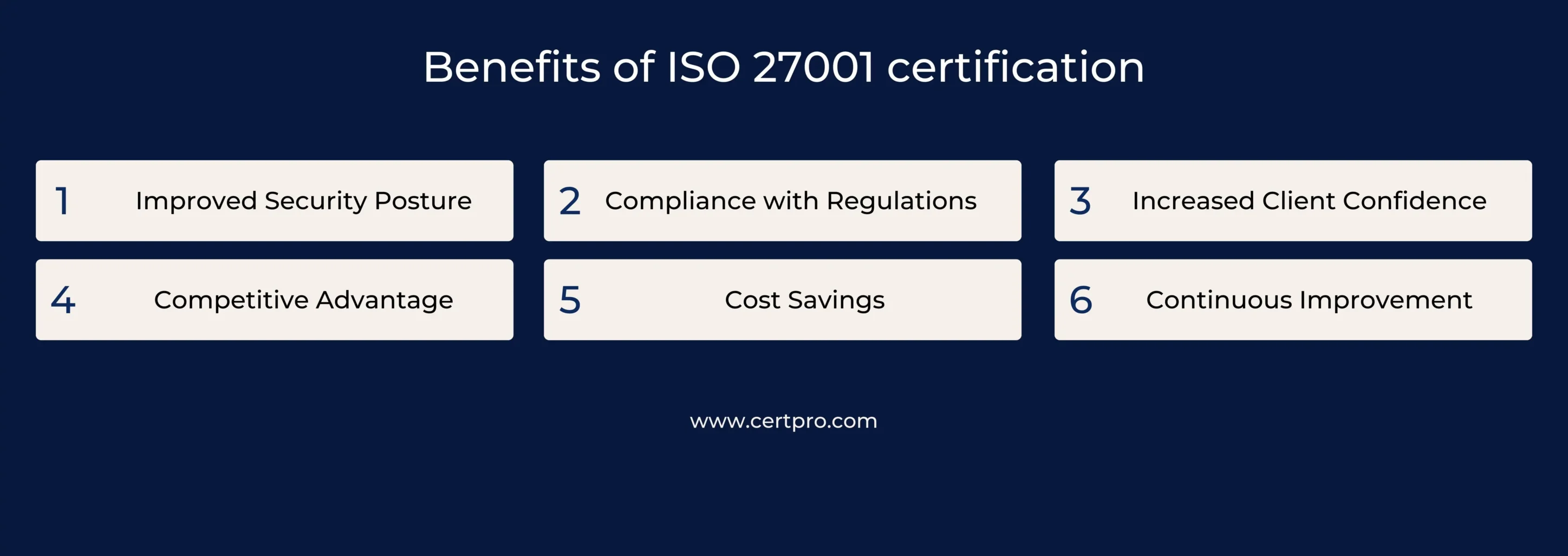
ISO 27001 Certification in Nashville produces a range of demonstrable outcomes for organizations that obtain independent certification through the full audit process. These outcomes are grounded in the structured requirements of the ISO 27001 standard and the evidentiary value of independent certification — not aspirational claims or marketing language.
The benefits below reflect what independent ISO 27001 certification objectively provides to Nashville organizations operating across healthcare, technology, financial services, and related sectors. Each benefit is a direct result of completing the ISO 27001 certification audit with a qualified, independent certification body.
- ✓Independent, third-party verification of ISMS conformity against ISO/IEC 27001:2022 requirements, distinct from self-assessment or internal audit conclusions
- ✓Recognized credential for use in enterprise vendor procurement panels, request-for-proposal responses, and contract negotiations across Nashville’s healthcare and financial services sectors
- ✓Structured ISO 27001 audit methodology that evaluates risk assessment quality, control design, and operating effectiveness across all Annex A control domains
- ✓Documented certification audit report providing objective evidence of ISMS conformity that can be shared with clients, regulators, and business partners
- ✓Ongoing surveillance oversight through annual surveillance audits that verify continued ISMS conformity throughout the three-year certificate validity period
- ✓Alignment evidence for regulatory frameworks including HIPAA, GDPR, and U.S. state-level data protection requirements applicable to Nashville organizations
- ✓International market recognition in over 160 countries, supporting cross-border expansion objectives for Nashville-based technology and professional services firms
- ✓Formal certification committee decision process that ensures independence between the audit team and the certification issuance decision
The ISO 27001 certification audit provides structured evaluation of both control design adequacy and control operating effectiveness within the defined ISMS scope. Control design evaluation assesses whether implemented Annex A controls are logically constructed to address the specific information security risks identified through the organization’s risk assessment process.
Operating effectiveness evaluation examines whether controls are functioning as designed over the audit period. Evidence is drawn from logs, records, incident data, access review outputs, vulnerability assessment results, and personnel interviews. This two-dimensional assessment — design plus operation — distinguishes the ISO 27001 certification audit from documentation-only reviews and provides a more substantive basis for the certification decision. For Nashville organizations, this depth of evaluation carries particular weight in vendor assurance contexts where clients require evidence of actual control operation, not merely documented intent.
Nashville’s concentration of healthcare organizations, health-tech companies, and enterprise technology buyers creates a procurement environment where ISO 27001 Certification in Nashville represents a recognized baseline for information security governance assurance. A technology vendor presenting a current ISO 27001 certificate — issued following an independent certification audit — can demonstrate to a hospital system’s security team or a fintech company’s vendor risk panel that its ISMS has been evaluated by a qualified external party.
This distinction is material in procurement decisions where multiple vendors compete on security posture. The certificate also reduces the frequency and scope of customer-led security assessments. Enterprise buyers increasingly accept the ISO 27001 certification audit report as primary evidence of ISMS conformity, reducing administrative burden for both parties in the vendor qualification process.
- ✓Verification of Control Design and Operating Effectiveness
- ✓Credibility in Nashville’s Healthcare and Technology Procurement Environment
ISO 27001 Annex A Controls and the Statement of Applicability
Annex A of ISO/IEC 27001:2022 contains a reference set of 93 information security controls organized across four control domains. The Statement of Applicability (SoA) is the document that links the organization’s risk treatment decisions to specific Annex A controls. It documents which controls have been selected for implementation, which have been excluded, and the justification for each inclusion and exclusion decision.
The SoA is one of the most critically evaluated documents during any ISO 27001 audit Nashville organizations undergo. It represents the organization’s formal assertion of control coverage relative to identified risks — and auditors scrutinize it carefully to confirm alignment between risk assessment outputs and actual control implementation status.
| Annex A Domain | Number of Controls | Example Control Areas |
|---|---|---|
| Organizational Controls | 37 | Information security policies, roles and responsibilities, supplier security, incident management, business continuity |
| People Controls | 8 | Screening, terms of employment, information security awareness, training, confidentiality agreements |
| Physical Controls | 14 | Physical security perimeters, equipment maintenance, secure disposal, clear desk and screen policy |
| Technological Controls | 34 | Access control, cryptography, network security, vulnerability management, data masking, monitoring and logging |
How the Statement of Applicability Is Evaluated in the Audit
During the ISO 27001 certification audit, auditors evaluate the Statement of Applicability against the organization’s risk assessment outputs to confirm that control selection decisions are logically justified. Where an Annex A control has been excluded from the SoA, the audit examines whether the exclusion rationale is supported by documented risk assessment evidence. This evidence must demonstrate that the associated risk is either not applicable to the organization’s ISMS scope or has been addressed through alternative treatment measures.
Auditors also verify that controls listed as implemented in the SoA are in fact operational, with objective evidence available to support implementation claims. Discrepancies between the SoA and actual control implementation status represent nonconformities under ISO/IEC 27001:2022 Clause 6.1.3. These are documented in the audit report and must be resolved prior to the certification decision.
Technological Controls Relevant to Nashville’s Digital Infrastructure
Nashville organizations operating cloud-native architectures, SaaS platforms, health information systems, or financial technology infrastructure face particular scrutiny in the Technological Controls domain during the ISO 27001 audit. Key technological controls evaluated include identity and access management (A.5.15–A.5.18), covering the management of privileged access rights and user access provisioning; secure authentication (A.8.5); information deletion and data masking controls (A.8.11–A.8.12); data leakage prevention (A.8.12); and vulnerability management (A.8.8).
Additional controls assessed include network security and filtering (A.8.20–A.8.22), configuration management (A.8.9), and security monitoring, event logging, and log protection (A.8.15–A.8.17). For Nashville’s technology-intensive organizations, providing systematic evidence of the implementation and ongoing monitoring of these controls is a substantive component of the Stage 2 ISO 27001 certification audit evaluation.
ISO 27001 Certification Scope for Nashville Organizations
The certification scope defines the boundaries of the ISMS subject to evaluation in the ISO 27001 certification audit. Scope definition is governed by ISO/IEC 27001:2022 Clause 4.3 and requires the organization to specify the internal and external issues, interested parties, and interfaces and dependencies that affect information security within the defined boundary. The scope must be documented and available to the certification body before the audit program is confirmed.
For Nashville organizations with multiple operational sites, cloud environments, or third-party dependencies, scope definition requires careful analysis. The certification boundary must accurately represent the organization’s information processing activities and associated security risks — and any gaps in scope can result in findings during the ISO 27001 audit.
Defining the ISMS Boundary and Exclusions
Organizations pursuing ISO 27001 Certification in Nashville must document the ISMS scope with sufficient precision to allow the certification body to determine an appropriate audit program. The scope statement must identify the types of information processed, the organizational units included, the physical and virtual locations covered, and any interfaces with external organizations or systems that fall within scope.
Exclusions from the ISMS scope are permitted where activities genuinely fall outside the organization’s control or operational mandate. However, exclusions cannot be used to omit activities that would undermine the organization’s ability to achieve its information security objectives or that are materially relevant to interested parties’ requirements. Auditors evaluate the appropriateness of scope boundaries during the Stage 1 audit and may raise concerns if scope limitations appear to exclude significant information security risks.
Multi-Site and Cloud Scope Considerations for Nashville Technology Companies
Nashville technology companies operating hybrid or multi-cloud architectures, distributed development teams, or service delivery models spanning multiple geographic locations face specific scope definition considerations under the ISO 27001 standard. Where cloud infrastructure providers are used — such as AWS, Microsoft Azure, or Google Cloud — the organization’s ISMS scope must address the shared responsibility model. The cloud provider’s physical and infrastructure controls may be referenced, but the organization remains responsible for configuring and operating its own information security controls within the cloud environment.
For Nashville SaaS companies with customer data processing operations distributed across cloud regions, the scope must accurately capture all customer data flows, access control boundaries, and third-party data processor relationships within the defined ISMS boundary. Failure to do so can result in scope-related nonconformities during the ISO 27001 certification audit, delaying the path to certification.
ISO 27001 Certification and Regulatory Alignment for Nashville Industries
ISO 27001 compliance that Nashville organizations achieve through certification supports alignment with multiple regulatory and contractual information security frameworks relevant to the city’s industrial sectors. While ISO 27001 certification does not constitute regulatory compliance in itself, the risk-based control structure of ISO/IEC 27001:2022 is designed to be mappable to specific legal and regulatory requirements.
This enables organizations to use their certified ISMS as a foundation for demonstrating a broader compliance posture to regulators, clients, and auditors. The ISO 27001 standard thereby functions as a unifying framework that streamlines compliance efforts across multiple regulatory obligations simultaneously.
HIPAA Alignment for Nashville Healthcare Organizations
The Health Insurance Portability and Accountability Act (HIPAA) Security Rule establishes administrative, physical, and technical safeguard requirements for electronic protected health information (ePHI). Nashville’s healthcare organizations and health-tech vendors subject to HIPAA can map ISO/IEC 27001:2022 Annex A controls to HIPAA Security Rule standards and implementation specifications.
Organizational controls addressing workforce security (A.6.1–A.6.6), access management (A.5.15–A.5.18, A.8.2–A.8.5), audit controls (A.8.15–A.8.17), integrity (A.8.24–A.8.25), and transmission security (A.8.20–A.8.23) align with the corresponding HIPAA technical safeguards. A certified ISMS demonstrates to HIPAA-regulated covered entities and business associates that information security governance is systematically managed and independently verified. This supports the organization’s overall HIPAA compliance posture through structured, evidence-based control operation — rather than ad hoc security measures that may not withstand regulatory scrutiny.
GDPR and International Data Protection Considerations
Nashville organizations processing personal data of European Union residents are subject to the General Data Protection Regulation (GDPR), which requires that personal data be processed with appropriate technical and organizational security measures. ISO/IEC 27001:2022 provides a recognized framework for implementing and demonstrating such measures in a structured, auditable way.
GDPR Article 32 specifically references confidentiality, integrity, availability, and resilience of processing systems as security objectives — objectives that align directly with the core ISMS requirements of the ISO 27001 standard. For Nashville technology and professional services companies with European client bases or EU data processing operations, ISO 27001 Certification in Nashville provides documented, independently verified evidence of GDPR-relevant technical and organizational security measures. This evidence can be referenced in Data Processing Agreements, Data Protection Impact Assessments, and regulatory inquiries, strengthening the organization’s overall data protection compliance posture.
FAQ
▶
What is ISO 27001 Certification and how is it obtained in Nashville?
▶
How long does the ISO 27001 certification audit process take for Nashville organizations?
▶
What is the difference between ISO 27001 compliance and ISO 27001 certification?
▶
Which version of the ISO 27001 standard applies to current certification audits in Nashville?
▶
What does the Statement of Applicability include and why is it important in the audit?
▶
How long is an ISO 27001 certificate valid, and what are surveillance audit requirements?
▶
Is ISO 27001 certification required for Nashville healthcare technology vendors?
▶
Can ISO 27001 certification cover cloud and SaaS environments used by Nashville companies?
Get In Touch
have a question? let us get back to you.