
ISO 27001 Certification in New Jersey
ISO 27001 Certification in New Jersey is issued by CertPro, a Licensed CPA Firm operating as an independent third-party certification body. CertPro evaluates organizations against the requirements of ISO/IEC 27001:2022, the internationally recognized standard for Information Security Management Systems (ISMS). The certification process follows structured Stage 1 and Stage 2 audits, with each ISO 27001 audit decision made by an independent certification committee based solely on documented audit evidence — ensuring impartiality at every stage.
OUR CLIENTS









Independent ISO 27001 Certification by a Licensed CPA Firm in New Jersey
ISO 27001 Certification in New Jersey is issued by CertPro, a Licensed CPA Firm operating as an independent third-party certification body. CertPro evaluates organizations against the requirements of ISO/IEC 27001:2022, the internationally recognized standard for Information Security Management Systems (ISMS). The certification process follows structured Stage 1 and Stage 2 audits, with each ISO 27001 audit decision made by an independent certification committee based solely on documented audit evidence — ensuring impartiality at every stage.
New Jersey occupies a critical position in the U.S. economic landscape. The state is home to a concentrated ecosystem of financial services institutions, fintech companies, pharmaceutical and life sciences organizations, healthcare technology providers, telecommunications carriers, SaaS developers, cloud service providers, cybersecurity firms, logistics operators, and professional services enterprises.
Major commercial centers — including Newark, Jersey City, Princeton, Hoboken, and Trenton — generate substantial volumes of sensitive data. This includes financial records, protected health information, intellectual property, research data, and customer data, all of which require independently verified security controls to satisfy both regulatory and client expectations.
ISO 27001 Certification in New Jersey directly addresses the regulatory and procurement environment in which New Jersey organizations operate. The state’s financial services sector is subject to federal frameworks including the Gramm-Leach-Bliley Act and SEC cybersecurity disclosure rules. Healthcare organizations managing protected health information face HIPAA Security Rule obligations. Pharmaceutical and biotechnology firms must protect proprietary research data and comply with FDA cybersecurity guidance.
New Jersey’s own data privacy and breach notification law — N.J.S.A. 56:8-161 et seq. — imposes obligations on organizations handling New Jersey residents’ personal information. The ISO 27001 compliance New Jersey organizations achieve through certification provides a structured, independently verified framework that maps clearly to these overlapping legal and regulatory requirements, reducing duplication of compliance effort.
Enterprise procurement teams — particularly those in regulated financial institutions, hospital systems, government contractors, and multinational corporations operating within or contracting with New Jersey-based organizations — increasingly require ISO 27001 certification as a condition of vendor onboarding.
New Jersey technology and SaaS companies seeking contracts with financial institutions headquartered in Jersey City and Newark, or with pharmaceutical enterprises along the Route 1 corridor, routinely encounter vendor security review questionnaires that reference ISO/IEC 27001:2022 compliance as a baseline expectation. The ISMS certification New Jersey organizations obtain through CertPro’s ISO 27001 audit process provides the independently issued certificate and audit report required by enterprise procurement and third-party risk management teams.
CertPro conducts each ISO 27001 audit under a structured audit program that includes documentation review, evidence collection, control effectiveness testing, and nonconformity identification. The certification decision is made by an independent committee separate from the audit team, ensuring full impartiality throughout the process.
Organizations that successfully complete the certification process receive an ISO 27001 certificate valid for three years, subject to annual surveillance audits and a recertification audit at the end of the certification cycle. CertPro’s positioning as a Licensed CPA Firm provides an additional layer of professional accountability, reflecting the audit rigor and independence standards applicable to licensed public accounting professionals under applicable state CPA licensing requirements.

What Is ISO 27001 Certification?
ISO 27001 certification is the formal recognition — issued by an accredited or independent certification body — that an organization’s Information Security Management System conforms to the requirements of ISO/IEC 27001:2022. The standard was developed jointly by the International Organization for Standardization (ISO) and the International Electrotechnical Commission (IEC).
ISO/IEC 27001:2022 replaced the previous 2013 edition and reduced the number of Annex A controls from 114 to 93, now organized across four control domains: Organizational controls, People controls, Physical controls, and Technological controls. Organizations pursuing ISO 27001 certification must demonstrate conformance to all mandatory clauses (Clauses 4 through 10) and must produce a Statement of Applicability (SoA) that identifies which Annex A controls are applicable and justifies any exclusions.
The ISO/IEC 27001:2022 Standard and ISMS Requirements
ISO/IEC 27001:2022 requires organizations to establish, implement, maintain, and continually improve an Information Security Management System. The ISMS must be scoped to cover the assets, processes, systems, and locations where information security risks are present.
Clause 4 requires organizations to understand their internal and external context and the needs of interested parties. Clause 6 mandates a formal risk assessment and risk treatment process — through which organizations identify information security risks, evaluate their likelihood and potential impact, and select applicable controls from Annex A or from other sources. The risk treatment plan documents how identified risks will be addressed. The Statement of Applicability records which Annex A controls have been selected, which have been excluded, and the justification for each determination. These documents serve as core audit evidence reviewed during every ISO 27001 assessment.
Clauses 7 through 10 address the operational requirements of the ISMS. Clause 7 covers competence, awareness, and documented information. Clause 8 requires organizations to plan, implement, and control the processes needed to meet information security requirements. Clause 9 mandates monitoring, measurement, internal audit, and management review. Clause 10 addresses nonconformity, corrective action, and continual improvement.
Together, these clauses define the management system infrastructure that an ISO 27001 audit evaluates. ISMS certification New Jersey organizations pursue requires documented evidence across all of these clauses — not merely technical security controls, but a functioning management system with defined ownership, regular review cycles, and documented corrective action processes.
ISO 27001 vs. Other Information Security Frameworks
ISO 27001 differs from other information security frameworks in a fundamental way: it is a certifiable management system standard, not a controls catalogue or regulatory requirement. NIST CSF, for example, provides a risk management framework but does not define a certifiable management system. SOC 2 Type II is an attestation report based on the AICPA Trust Services Criteria, focused on service organization controls over a defined reporting period. HIPAA is a regulatory requirement applicable to covered entities and business associates handling protected health information.
ISO 27001 certification, by contrast, issues a third-party certificate confirming that the organization’s entire ISMS conforms to ISO/IEC 27001:2022 requirements — covering risk assessment methodology, control selection, management system governance, and ongoing continual improvement. For New Jersey organizations operating across financial services, pharma, healthcare, and technology sectors, the ISO 27001 compliance New Jersey certification delivers a universally recognized credential that simultaneously supports multiple regulatory mapping exercises.
| Framework | Type | Certifiable? | Primary Audience |
|---|---|---|---|
| ISO/IEC 27001:2022 | Management System Standard | Yes — third-party certificate issued | All sectors handling sensitive information |
| NIST CSF | Risk Management Framework | No — not certifiable | U.S. federal agencies and critical infrastructure |
| SOC 2 Type II | Attestation Report | No — attestation only | Service organizations, SaaS, and cloud providers |
| HIPAA Security Rule | Regulatory Requirement | No — regulatory obligation only | Healthcare covered entities and business associates |
| PCI DSS | Payment Card Standard | Yes — QSA assessment required | Organizations processing payment card data |
ISO 27001 Certification Audit Process in New Jersey
The ISO 27001 audit process in New Jersey follows a structured sequence of evaluation stages, each designed to assess a specific dimension of the organization’s ISMS. CertPro conducts this process as an independent certification body, ensuring that audit findings and certification decisions are based exclusively on documented evidence.
The process begins with an application review and audit program determination. It concludes with a certification committee decision, certificate issuance, and an ongoing surveillance audit cycle — providing continuous oversight of the certified ISMS throughout its three-year validity period.
The Stage 1 audit is a documentation-focused review conducted prior to the Stage 2 on-site assessment. During this phase of the ISO 27001 audit, the auditor reviews the organization’s ISMS documentation to assess whether the management system has been established in accordance with ISO/IEC 27001:2022 requirements.
Key documents reviewed include the ISMS scope statement, information security policy, risk assessment methodology and results, risk treatment plan, Statement of Applicability, and records of internal audits and management reviews. The Stage 1 ISO 27001 audit also confirms that the organization understands its legal, regulatory, and contractual obligations — a particularly critical dimension for New Jersey organizations in regulated industries such as financial services, healthcare, and pharmaceuticals, where multiple overlapping compliance requirements apply simultaneously.
The output of the Stage 1 audit is a documented report identifying areas of conformance and any concerns that must be addressed before the Stage 2 audit proceeds. If the Stage 1 review identifies significant gaps in documentation or management system maturity, the Stage 2 audit may be deferred until the organization demonstrates that identified issues have been resolved.
The Stage 1 audit does not result in certification — it is an evaluative step designed to confirm that the ISMS is sufficiently documented and that the organization is ready for the more rigorous Stage 2 ISO 27001 assessment. This structured sequencing is a defining characteristic of the ISO 27001 certification process.
The Stage 2 audit is the principal conformity assessment conducted against the full requirements of ISO/IEC 27001:2022. The auditor evaluates whether the ISMS is not only documented but effectively implemented and operating as designed. This includes testing the operating effectiveness of selected Annex A controls, reviewing evidence of risk treatment activities, verifying corrective actions taken in response to nonconformities, and confirming that management review meetings have been conducted with appropriate participation and documentation.
For New Jersey organizations with complex ISMS scopes — such as a fintech company operating across Jersey City and Hoboken offices, or a pharmaceutical firm managing research data across Princeton-based laboratories — the Stage 2 ISO 27001 audit may involve multiple site visits and interviews with personnel across different functional areas.
Nonconformities identified during the Stage 2 audit are classified and reported to the organization, which must then submit a corrective action plan addressing each finding. The auditor reviews the corrective action evidence before the certification committee proceeds with its decision.
The certification committee — which operates independently of the audit team — evaluates the complete audit record and determines whether the organization’s ISMS conforms to ISO/IEC 27001:2022 requirements. Where conformance is confirmed, the committee authorizes issuance of the ISO 27001 certificate. The certificate is valid for three years and specifies the certified ISMS scope, the standard applied, and the certification body details.
ISO 27001 certification is maintained through annual surveillance audits conducted in the first and second years following initial certification. These audits verify that the ISMS continues to conform to ISO/IEC 27001:2022 requirements and that the organization is implementing continual improvement activities as required by Clause 10.
Surveillance audits focus on areas of the ISMS identified as higher risk during the initial ISO 27001 audit, as well as any changes to the organization’s operations, technology environment, or risk profile that may affect the ISMS. For New Jersey organizations that undergo significant operational changes — such as cloud migrations, acquisitions, or expansions of data processing activities — surveillance audits assess how those changes have been managed within the certified ISMS framework.
| Audit Stage | Key Activities | Output |
|---|---|---|
| Application Review | Scope confirmation, audit program determination, scheduling | Audit plan and program |
| Stage 1 Audit | ISMS documentation review, regulatory context assessment, SoA review | Stage 1 report with findings |
| Stage 2 Audit | Control effectiveness testing, evidence review, nonconformity identification | Stage 2 ISO 27001 audit report |
| Nonconformity Review | Corrective action submission and evidence verification | Closed nonconformity records |
| Certification Decision | Independent committee review of complete audit record | ISO 27001 certificate (3-year validity) |
| Surveillance Audits | Annual ISMS conformance review and continual improvement verification | Surveillance audit reports |
| Recertification Audit | Full ISMS re-evaluation at end of 3-year certification cycle | Renewed ISO 27001 certificate |
- ✓Stage 1 Audit: Documentation and Readiness Review
- ✓Stage 2 Audit: On-Site Control Effectiveness Evaluation
- ✓Surveillance Audits and Recertification
ISO 27001 Certification Requirements for New Jersey Organizations
ISO 27001 certification requirements are defined by ISO/IEC 27001:2022 and apply uniformly to any organization seeking certification, regardless of sector, size, or geography. For New Jersey organizations, these requirements are applied within a specific regulatory and operational context that shapes how the standard’s clauses are interpreted, scoped, and evidenced during an ISO 27001 assessment.
The following subsections outline the primary documentation, management system, and control requirements that the ISO 27001 audit evaluates — covering everything from foundational ISMS documentation through Annex A control domains and top management governance obligations.
ISO/IEC 27001:2022 mandates a defined set of documented information that must be maintained as part of the ISMS. The foundational documents include the ISMS scope statement, the information security policy, the risk assessment methodology, the risk assessment results, the risk treatment plan, and the Statement of Applicability.
The information security policy must be approved by top management and communicated to all relevant personnel. The risk assessment must follow a defined and repeatable methodology, identifying information security risks associated with the loss of confidentiality, integrity, and availability of information assets within the defined ISMS scope. For New Jersey pharmaceutical companies handling proprietary drug formulation data, or fintech organizations processing financial transaction records, the risk assessment must explicitly address the specific threat landscape and regulatory context applicable to those information categories.
The Statement of Applicability is one of the most critically reviewed documents in an ISO 27001 audit. It must list all 93 Annex A controls from ISO/IEC 27001:2022, indicate whether each control is applicable or excluded, document the justification for any exclusions, and reference whether each applicable control has been implemented.
Controls may be excluded only where the organization can demonstrate that no relevant risks, legal requirements, or contractual obligations require their implementation. The SoA is cross-referenced against the risk treatment plan during the Stage 2 ISO 27001 assessment to verify that control selections are traceable to identified risks and treatment decisions. Incorrectly excluding necessary controls remains one of the most common nonconformity findings across ISO 27001 audits.
ISO/IEC 27001:2022 Annex A organizes 93 controls across four distinct domains. Organizational controls (37 controls) address policies, roles and responsibilities, threat intelligence, information security in supplier relationships, and incident management governance. People controls (8 controls) cover personnel screening, employment terms, information security awareness, and responsibilities upon termination. Physical controls (14 controls) address physical security perimeters, equipment security, clear desk and clear screen policies, and secure disposal of physical media.
Technological controls (34 controls) cover access control, authentication, encryption, network security, vulnerability management, configuration management, data leakage prevention, logging, and monitoring. During a Stage 2 ISO 27001 audit, the auditor evaluates evidence of control implementation and operating effectiveness across all applicable domains listed in the organization’s Statement of Applicability — making thorough Annex A preparation essential for ISO 27001 compliance.
- ✓ISMS scope statement defining organizational boundaries and any excluded locations or systems
- ✓Information security policy approved by top management and communicated to all relevant personnel
- ✓Risk assessment methodology, results, and documented risk register covering all in-scope information assets
- ✓Risk treatment plan mapping identified risks to selected Annex A controls
- ✓Statement of Applicability with clear justifications for control inclusions and exclusions
- ✓Internal audit program and records of completed internal audits
- ✓Management review meeting records demonstrating active top management engagement
- ✓Corrective action records demonstrating timely resolution of identified nonconformities
ISO/IEC 27001:2022 requires demonstrable top management commitment to the ISMS — not merely the existence of a documented policy. Clause 5 requires top management to establish the information security policy, ensure that ISMS objectives align with the organization’s strategic direction, and integrate ISMS requirements into core business processes. Clause 9.3 mandates periodic management reviews evaluating ISMS performance, including audit results, security incidents, risk treatment status, and opportunities for continual improvement.
During an ISO 27001 audit, the auditor interviews senior management and reviews management review records to assess whether the ISMS is genuinely embedded in the organization’s governance structure — or exists only as a documentation exercise. For New Jersey financial services and healthcare organizations subject to regulatory examination of information security governance, this management system dimension carries particular weight and deserves careful attention during ISMS implementation.
- ✓Core ISMS Documentation Requirements
- ✓Annex A Control Domains Under ISO/IEC 27001:2022
- ✓Management System and Governance Requirements
Business Sectors in New Jersey Seeking ISO 27001 Certification
ISO 27001 Certification in New Jersey is pursued by organizations across a wide range of industries, driven by the state’s diverse and heavily regulated business ecosystem. The concentration of financial services, pharmaceutical, healthcare, technology, and telecommunications organizations in New Jersey creates consistent demand for independently verified information security management systems.
The following subsections describe the primary sectors seeking ISO 27001 certification for New Jersey companies and outline the specific regulatory, contractual, and competitive drivers relevant to each industry.
Financial Services and Fintech Organizations
New Jersey is a major U.S. financial services hub, with significant concentrations of banking institutions, insurance companies, investment management firms, and fintech operators headquartered in Jersey City, Newark, and Hoboken. The ISO 27001 certification New Jersey financial services organizations pursue reflects both internal governance requirements and external demands from enterprise clients, correspondent banks, institutional investors, and regulatory bodies.
The SEC’s cybersecurity disclosure rules for public companies and the NYDFS Cybersecurity Regulation — applicable to financial entities licensed in New York that also operate in New Jersey — create overlapping compliance obligations. The ISO 27001 compliance New Jersey financial institutions achieve through a certified ISMS can address these obligations within a single framework. ISO 27001 certification New Jersey fintech companies obtain is increasingly referenced in vendor due diligence questionnaires issued by Tier 1 banks and payment processors as a baseline third-party security assurance credential.
Pharmaceutical, Life Sciences, and Biotechnology Organizations
New Jersey’s pharmaceutical and life sciences sector is among the largest in the world, anchored by global enterprises and specialized biotechnology firms concentrated along the Route 1 corridor in Princeton, Bridgewater, and Somerset. The ISO 27001 certification New Jersey pharma organizations pursue addresses the protection of proprietary drug formulation data, clinical trial data, manufacturing process information, and intellectual property — assets that represent core competitive and regulatory value.
FDA cybersecurity guidance for pharmaceutical manufacturers, combined with increasing supply chain information security scrutiny from enterprise clients and contract research organizations, creates strong demand for ISMS certification. The ISO 27001 audit evaluates controls relevant to research data integrity, access management for laboratory information systems, and third-party supplier security — all critical considerations in the pharmaceutical manufacturing and development context.
Technology, SaaS, Cloud, and Telecommunications Providers
New Jersey’s technology sector encompasses SaaS developers, cloud service providers, cybersecurity firms, managed security service providers, data center operators, and major telecommunications carriers. Organizations in these sectors frequently serve enterprise clients in financial services, healthcare, and government — sectors that conduct rigorous vendor security assessments as part of third-party risk management programs.
The ISO 27001 compliance New Jersey technology organizations demonstrate through certification enables access to procurement processes that require independently verified security management credentials. Telecommunications providers operating in New Jersey — including national carriers with significant infrastructure in the state — handle critical communications data and face increasing regulatory scrutiny of their security practices. The ISMS certification New Jersey telecommunications organizations obtain confirms that information security risks to communications infrastructure are being systematically identified, treated, and monitored through an independently certified management system.
Why Organizations in New Jersey Pursue ISO 27001 Certification
The decision to pursue ISO 27001 Certification in New Jersey is driven by a combination of regulatory compliance obligations, enterprise procurement requirements, cross-border vendor assurance expectations, and internal information security governance objectives. Unlike self-attested security frameworks, ISO 27001 certification provides a third-party verified credential that carries weight across multiple stakeholder groups simultaneously — from enterprise clients and regulatory bodies to cyber insurance underwriters and institutional investors.
Enterprise Vendor Security Reviews and Procurement Requirements
Enterprise vendor security reviews represent one of the most significant drivers of ISO 27001 assessment demand for New Jersey organizations. A technology company based in Newark providing cloud-based data analytics to a national bank headquartered in Jersey City will typically encounter a vendor risk management questionnaire that requests evidence of ISO 27001 certification or an equivalent third-party security assurance credential.
Without a current ISO 27001 certificate, the vendor may be required to complete lengthy custom security questionnaires, undergo direct customer audits, or risk disqualification from the procurement process entirely. ISO 27001 Certification in New Jersey eliminates this friction by providing a standardized, independently issued certificate that enterprise procurement teams accept as evidence of ISMS conformance — accelerating vendor onboarding timelines and reducing the cost of responding to customer security assessments.
For New Jersey SaaS companies and cloud service providers targeting regulated industries such as insurance, asset management, or pharmaceutical manufacturing, ISO 27001 certification is frequently referenced in master service agreements and data processing addenda as a required security credential. A SaaS provider in Hoboken serving insurance companies in the New York metropolitan area, for example, may find that renewal of its enterprise contracts is contingent on maintaining a current ISO 27001 certificate.
The ISO 27001 audit provides the structured, documented evidence base — including risk assessment records, control testing results, and corrective action history — that enterprise clients and their internal audit teams rely on when evaluating third-party security postures during vendor qualification processes.
Regulatory Alignment and Cyber Insurance Considerations
The ISO 27001 compliance New Jersey organizations achieve through certification supports alignment with multiple regulatory frameworks without requiring separate compliance programs for each. The ISMS risk assessment and control framework maps directly to HIPAA Security Rule administrative, physical, and technical safeguard requirements for New Jersey healthcare organizations and business associates. For financial services firms, the ISMS governance and incident management controls align with GLBA Safeguards Rule requirements and NYDFS Part 500 cybersecurity program obligations.
New Jersey’s Identity Theft Prevention Act and data breach notification requirements under N.J.S.A. 56:8-161 are addressed through ISMS incident detection, response, and notification controls embedded in the certified management system. Cyber insurance underwriters also increasingly factor ISO 27001 certification status into coverage terms and premium evaluations, recognizing that a certified ISMS demonstrates information security risks are being systematically managed through a documented, independently audited framework.
Benefits of ISO 27001 Certification for New Jersey-Based Organizations
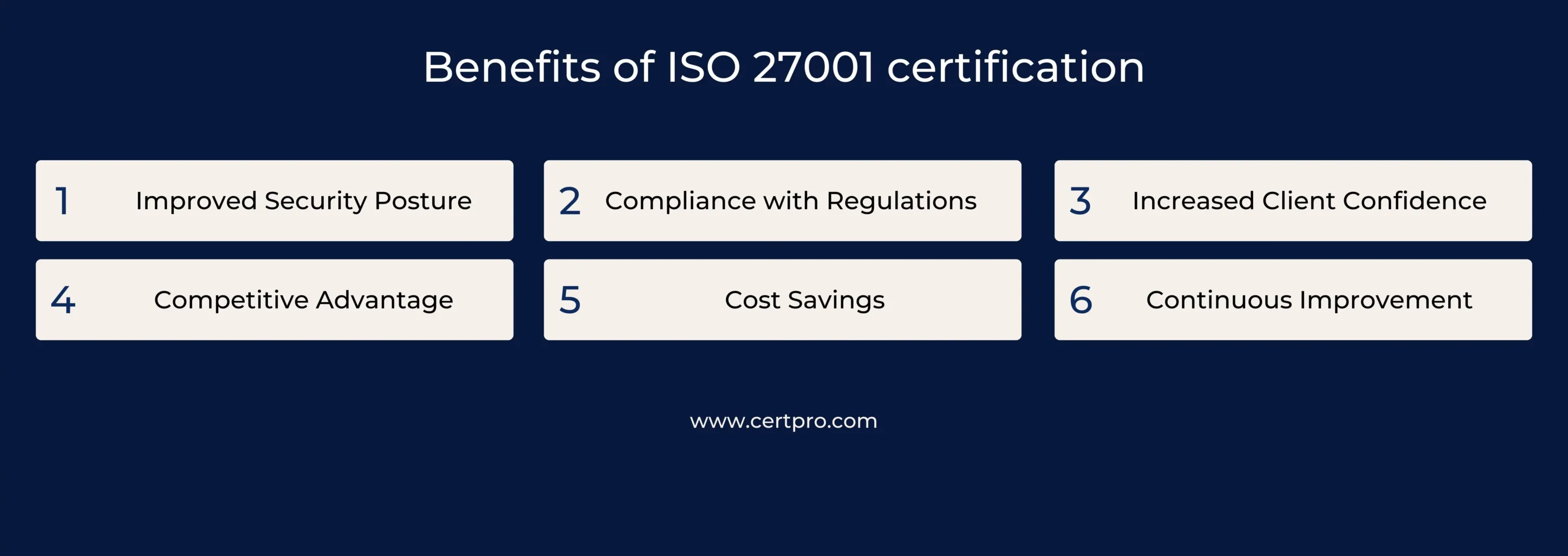
ISO 27001 Certification in New Jersey delivers independently verified outcomes across several dimensions of organizational information security management. The benefits listed below are observable consequences of the certification process — not claims or guarantees. Each reflects the structured evaluation conducted during the ISO 27001 audit and the specific requirements of ISO/IEC 27001:2022 that the certified ISMS must satisfy.
- ✓Independent verification of ISMS conformance to ISO/IEC 27001:2022, providing stakeholders with a credible, third-party assessed security credential
- ✓Structured documentation of information security risks, risk treatment decisions, and control selections traceable through the Statement of Applicability
- ✓Recognition in enterprise procurement processes and vendor security assessments across financial services, pharmaceutical, healthcare, and technology sectors
- ✓Alignment with multiple regulatory frameworks including HIPAA, GLBA Safeguards Rule, NYDFS Part 500, and New Jersey state data protection requirements
- ✓Demonstration of top management commitment to information security governance through documented management review and internal audit programs
- ✓Ongoing surveillance audit oversight that verifies continued ISMS conformance and continual improvement across the three-year certification cycle
- ✓Improved competitive positioning in enterprise sales processes where ISO 27001 certification is a procurement requirement or evaluation criterion
- ✓A structured incident management framework that supports regulatory breach notification obligations under New Jersey and applicable federal law
The ISO 27001 risk assessment and risk treatment process — as evaluated during the ISO 27001 audit — produces a documented, structured view of the organization’s information security risks that is directly actionable. Organizations that complete the certification process have conducted a systematic review of threats, vulnerabilities, and risk levels across their information assets, and have documented treatment decisions for each identified risk.
This structured risk visibility — independently reviewed during the Stage 2 ISO 27001 assessment — enables more informed resource allocation for information security investments and provides a defensible record of risk management decision-making. For New Jersey organizations subject to regulatory examination or litigation risk, the documented risk treatment history maintained within the ISMS provides clear evidence that information security obligations were taken seriously and systematically addressed over time.
ISO 27001 Certification in New Jersey provides a measurable competitive advantage for organizations competing for contracts in regulated industries. A fintech company in Jersey City with a current ISO 27001 certificate can differentiate itself from competitors relying on self-assessed security questionnaires or point-in-time penetration test reports. A healthcare technology provider in Trenton can use ISO 27001 certification — which New Jersey pharma and hospital procurement teams widely recognize — to shorten vendor onboarding timelines and reduce the probability of disqualification during competitive bids.
The certification also signals to prospective customers, partners, and investors that the organization has submitted its ISMS to independent third-party scrutiny — a level of transparency that self-attested frameworks cannot replicate. For New Jersey organizations pursuing international expansion, ISO 27001 certification is recognized globally and facilitates cross-border vendor assurance without requiring separate country-specific security assessments.
- ✓Improved Security Posture and Risk Visibility
- ✓Competitive Advantage in New Jersey’s Regulated Markets
ISO 27001 Certification Scope and Independent Decision Framework
The scope of ISO 27001 certification defines the organizational boundaries, locations, systems, and information types covered by the certified ISMS. Scope definition is a critical early step in the certification process and directly determines the breadth of the Stage 2 ISO 27001 audit. An inadequately defined scope — one that excludes significant information assets or business processes — may result in a nonconformity finding or may undermine the commercial value of the certificate to enterprise clients evaluating vendor security posture.
Defining the ISMS Scope for New Jersey Organizations
ISO/IEC 27001:2022 Clause 4.3 requires organizations to define the ISMS scope by considering the external and internal issues identified under Clause 4.1, the requirements of interested parties identified under Clause 4.2, and the interfaces and dependencies between the organization’s activities and those performed by external parties.
For a New Jersey-based cloud service provider with data centers in Newark and disaster recovery facilities in Piscataway, the ISMS scope must address both locations and all cloud services delivered from those facilities. For a pharmaceutical company with research operations in Princeton and manufacturing in Parsippany, the scope must address how information flows between research, manufacturing, and regulatory submission functions — including interfaces with contract research organizations and third-party logistics providers that handle controlled data. Exclusions from scope must be justified and must not result in a materially incomplete picture of information security risk.
Certification Committee Independence and Suspension Conditions
CertPro’s certification decision is made by a certification committee that operates independently of the audit team that conducted the Stage 1 and Stage 2 audits. This structural separation is a fundamental requirement of certification body independence. It ensures that the certification decision is based on an objective review of the audit record — not on any advisory relationship with the auditee.
The committee evaluates whether all mandatory clauses of ISO/IEC 27001:2022 are met, whether identified nonconformities have been closed with adequate corrective action evidence, and whether the ISMS scope is appropriately defined. ISO 27001 certification may be suspended if an organization fails to complete a surveillance audit within the required timeframe, fails to address major nonconformities identified during surveillance, or undergoes significant organizational changes that materially affect the certified ISMS scope without notifying the certification body. All suspension and withdrawal conditions are communicated to the organization at the time of certification.
FAQ
▶
What is ISO 27001 Certification in New Jersey?
▶
Which industries in New Jersey most commonly seek ISO 27001 certification?
▶
What does the ISO 27001 audit process involve?
▶
How long is an ISO 27001 certificate valid?
▶
What documents are required for ISO 27001 assessment?
▶
How does ISO 27001 certification relate to New Jersey’s data privacy law?
▶
Does ISO 27001 certification apply to cloud service providers in New Jersey?
▶
What is the difference between ISO 27001 certification and SOC 2?
Get In Touch
have a question? let us get back to you.