
ISO 27001 Certification in New South Wales
CertPro is a Licensed CPA Firm providing independent ISO 27001 Certification in New South Wales to organisations across financial services, technology, healthcare, government technology, and advanced industries. CertPro conducts third-party conformity assessments against ISO/IEC 27001:2022 requirements, evaluating both the design and operating effectiveness of an organisation’s Information Security Management System (ISMS). Critically, CertPro has no involvement in the design, implementation, or operation of the ISMS it certifies — ensuring full independence throughout every ISO 27001 certification audit engagement.
OUR CLIENTS










Independent ISO 27001 Certification by a Licensed CPA Firm in New South Wales
CertPro is a Licensed CPA Firm providing independent ISO 27001 Certification in New South Wales to organisations across financial services, technology, healthcare, government technology, and advanced industries. CertPro conducts third-party conformity assessments against ISO/IEC 27001:2022 requirements, evaluating both the design and operating effectiveness of an organisation’s Information Security Management System (ISMS). Critically, CertPro has no involvement in the design, implementation, or operation of the ISMS it certifies — ensuring full independence throughout every ISO 27001 certification audit engagement.
ISO/IEC 27001:2022 and the Australian Regulatory Context
The ISO 27001 standard — formally designated ISO/IEC 27001:2022 — specifies requirements for establishing, implementing, maintaining, and continually improving an ISMS within the context of an organisation’s risk environment. The standard is structured around Clauses 4 through 10, covering organisational context, leadership, planning, support, operation, performance evaluation, and improvement. Annex A provides a reference set of 93 information security controls across four domains: Organisational, People, Physical, and Technological.
The 2022 revision reduced the control set from 114 controls in the 2013 edition. Accredited certification bodies globally set a mandatory transition deadline of 31 October 2025 for organisations to migrate their ISO 27001 certification to the 2022 version of the standard.
ISO 27001 compliance in New South Wales operates within a layered Australian regulatory environment. Organisations handling personal information are subject to the Privacy Act 1988 (Cth) and the thirteen Australian Privacy Principles (APPs). Those operating critical infrastructure assets must satisfy obligations under the Security of Critical Infrastructure Act 2018 (Cth). NSW government agencies and their technology vendors are governed by the NSW Cyber Security Policy and the Protective Data Security Framework (PDSF), administered by the NSW Government.
ISO 27001 certification audit findings provide structured, documented evidence of conformity that organisations can present to regulators, procurement panels, and enterprise customers. This objective verification demonstrates that an organisation’s information security controls align with these layered regulatory requirements — making ISO 27001 Certification in New South Wales a commercially and legally significant credential.
CertPro’s Role as an Independent Certification Body
CertPro operates exclusively as an independent third-party certification body. The ISO 27001 certification audit evaluates an organisation’s ISMS against the ISO 27001 standard through documented evidence review, personnel interviews, system observation, and control testing. CertPro does not design, implement, or advise on ISMS controls at any stage of the engagement.
The certification decision — whether to issue, maintain, suspend, or withdraw a certificate — is made by an independent certification committee based solely on audit evidence and identified nonconformities. This clear separation between the audited organisation’s operational responsibilities and CertPro’s evaluation role ensures objectivity. It also satisfies the independence requirements that govern third-party ISO 27001 certification audit engagements under international standards for conformity assessment bodies.
Cross-Border Certification Scenario: NSW Organisations in APAC Procurement
ISO 27001 Certification in New South Wales carries direct commercial value for organisations engaged in cross-border procurement across the Asia-Pacific region. Consider a NSW-headquartered SaaS provider contracting with a Singapore-based financial institution subject to the Monetary Authority of Singapore’s Technology Risk Management Guidelines. The Singapore buyer’s vendor assurance process requires independent verification of the supplier’s ISMS before contract execution.
ISO 27001 certification issued by an accredited body satisfies this requirement without necessitating a separate jurisdiction-specific audit. The ISO 27001 standard is recognised across APAC procurement frameworks — including those applied by financial regulators in Singapore, Japan, Hong Kong, and South Korea. A single ISO 27001 certification audit can therefore simultaneously satisfy vendor assurance requirements across multiple APAC jurisdictions, reducing duplicated assessment costs for NSW-based exporters of technology and data services.

What Is ISO 27001 Certification?
Definition and Purpose of ISO 27001
ISO 27001 certification is a formal, third-party attestation that an organisation’s ISMS conforms to the requirements of the ISO/IEC 27001:2022 standard. Certification is achieved through an independent ISO 27001 audit conducted by an accredited certification body. That body evaluates whether the organisation has established and is operating its ISMS in accordance with the standard’s requirements across Clauses 4 to 10.
Certification is not self-declared. It requires objective evidence reviewed by qualified auditors and a formal certification decision by an independent committee. The certificate issued following a successful ISO 27001 certification audit is valid for three years, subject to annual surveillance audits confirming continued conformity.
The ISO 27001 standard is internationally recognised and adopted by organisations across every major industry sector. It provides a systematic framework for identifying and treating information security risks, selecting and implementing controls from Annex A, and maintaining documented evidence of the ISMS’s ongoing effectiveness.
ISO 27001 compliance demonstrates to customers, regulators, and contractual counterparties that an organisation manages information security risk in a structured, auditable manner. For NSW organisations operating in regulated sectors — including financial services, healthcare, and government technology — the standard provides a recognised baseline that maps directly to Australian privacy, cybersecurity, and data protection obligations.
ISMS Scope and Core Documentation Requirements
An ISMS certified under the ISO 27001 standard must be defined by a clearly documented scope. That scope identifies the boundaries of the management system, the assets it protects, and the organisational units it covers. Core documentation evaluated during an ISO 27001 certification audit includes the information security policy, the risk assessment methodology and results, the risk treatment plan, and the Statement of Applicability (SoA).
The SoA is a critical document that lists all 93 Annex A controls, states which controls are applicable to the organisation’s scope, and provides justification for any controls excluded from the ISMS. The SoA is not a template document — it must reflect the specific risk treatment decisions made by the organisation based on its own documented risk assessment. Auditors examine the SoA closely during every ISO 27001 certification audit to verify that exclusions are genuinely justified.
Annex A Controls and the Four Control Domains
ISO/IEC 27001:2022 Annex A organises 93 controls across four domains. Organisational controls (37 controls) address policies, roles, responsibilities, threat intelligence, and supplier relationships. People controls (8 controls) cover screening, employment terms, security awareness, and disciplinary processes. Physical controls (14 controls) address physical security perimeters, equipment protection, and secure disposal. Technological controls (34 controls) encompass access management, cryptography, network security, data masking, monitoring, and vulnerability management.
During an ISO 27001 audit, the certification body evaluates whether selected controls are appropriately designed to address identified risks and whether those controls are operating effectively within the defined ISMS scope. Any controls not selected must be formally justified in the SoA — a requirement auditors verify as part of every ISO 27001 certification audit in New South Wales and globally.
| Annex A Domain | Number of Controls | Example Control Areas |
|---|---|---|
| Organisational | 37 | Information security policies, supplier security, incident management |
| People | 8 | Screening, security awareness, disciplinary process |
| Physical | 14 | Physical security perimeters, equipment maintenance, secure disposal |
| Technological | 34 | Access control, cryptography, network security, vulnerability management |
ISO 27001 Certification Audit Process in New South Wales
The ISO 27001 certification audit process for New South Wales organisations follows a structured, multi-stage methodology conducted by CertPro as an independent third-party certification body. Each stage produces documented outputs that form the basis of the certification committee’s decision. The process is designed to provide objective, evidence-based evaluation of ISMS conformity with ISO/IEC 27001:2022 requirements — ensuring that every ISO 27001 certification audit in New South Wales meets the rigour expected by enterprise customers, regulators, and international procurement bodies.
The Stage 1 audit is a documentation and readiness review conducted before the Stage 2 on-site assessment. During Stage 1, the auditor reviews the organisation’s ISMS documentation against ISO/IEC 27001:2022 requirements. Key documents reviewed include the ISMS scope statement, information security policy, risk assessment results, risk treatment plan, Statement of Applicability, internal audit reports, and management review records.
The Stage 1 audit determines whether the ISMS is sufficiently documented and whether the organisation is ready to proceed to Stage 2. Findings are documented in a formal report, and any areas requiring attention before Stage 2 are clearly communicated to the organisation. Stage 1 does not involve operational control testing or effectiveness evaluation — that assessment occurs in the subsequent stage of the ISO 27001 certification audit process.
The Stage 2 audit is the principal conformity assessment, conducted on-site or through remote audit techniques where appropriate. Auditors evaluate the operating effectiveness of ISMS controls through personnel interviews, document examination, system observation, and technical testing. Evidence is gathered against each applicable Annex A control and each Clause 4–10 requirement within the defined ISMS scope.
Nonconformities identified during the Stage 2 ISO 27001 audit are classified and documented in the audit report. The organisation is required to submit a corrective action plan addressing each nonconformity. The certification committee then reviews the audit findings — including the corrective action responses — before issuing a certification decision for the ISO 27001 certification audit in New South Wales.
Following completion of the Stage 2 audit and nonconformity resolution review, an independent certification committee — separate from the audit team — reviews the complete audit file and issues a certification decision. A certificate issued under ISO 27001 Certification in New South Wales is valid for a three-year certification cycle.
Annual surveillance audits are conducted in years one and two of the cycle to verify that the ISMS continues to conform to the ISO 27001 standard and that corrective actions remain effective. A recertification audit is conducted before the certificate’s expiry to renew certification for a further three-year period. Failure to maintain ISMS conformity between surveillance audits may result in certificate suspension or withdrawal — outcomes that can directly affect a NSW organisation’s standing in government and enterprise procurement panels.
| Audit Stage | Key Activities | Output |
|---|---|---|
| Application Review | Scope confirmation, conflict-of-interest check, audit program determination | Audit plan and program |
| Stage 1 Audit | ISMS documentation review against ISO/IEC 27001:2022 Clauses 4–10 | Stage 1 audit report with findings |
| Stage 2 Audit | Control testing, evidence evaluation, personnel interviews, system observation | Stage 2 audit report with nonconformities |
| Nonconformity Review | Corrective action plan assessment by audit team | Verified closure or conditional status |
| Certification Decision | Independent committee review of complete audit file | Certificate issued, suspended, or withheld |
| Surveillance Audit | Annual ISMS conformity verification (Years 1 and 2) | Surveillance audit report |
| Recertification Audit | Full ISMS reassessment before certificate expiry | Renewed three-year certificate |
- ✓Stage 1 Audit: Documentation and Readiness Review
- ✓Stage 2 Audit: Control Testing and Evidence Evaluation
- ✓Certification Decision, Surveillance, and Recertification
ISO 27001 Certification Requirements and Evaluation Criteria
ISO 27001 certification requires organisations to demonstrate conformity with the management system requirements of ISO/IEC 27001:2022 through objective, auditable evidence. The certification body evaluates both the design adequacy of controls and their operating effectiveness within the defined ISMS scope. Requirements span documentation, risk management, control implementation, internal audit, and management review — each of which is assessed during the ISO 27001 certification audit against the ISO 27001 standard’s Clauses 4 through 10 and Annex A.
The ISO 27001 standard structures its requirements across seven operational clauses. Clause 4 (Organisational Context) requires the organisation to identify internal and external issues relevant to its ISMS, define interested parties and their requirements, and establish the scope of the management system. Clause 5 (Leadership) requires demonstrated top management commitment, an approved information security policy, and defined roles and responsibilities. Clause 6 (Planning) mandates documented risk assessment and risk treatment processes, a risk treatment plan, and a Statement of Applicability.
Clause 7 (Support) addresses competence, awareness, communication, and documented information management. Clause 8 (Operation) requires execution of the risk treatment plan and control of outsourced processes. Clause 9 (Performance Evaluation) requires internal audit and management review. Clause 10 (Improvement) requires documented corrective action processes for nonconformities. Together, these seven clauses form the evidence framework evaluated during every ISO 27001 audit.
An ISO 27001 certification audit is an evidence-based assessment. Auditors do not accept verbal representations or policy statements as sole evidence of control effectiveness. Evidence reviewed during the ISO 27001 audit in New South Wales includes configuration records, access logs, vulnerability scan results, training completion records, incident response logs, supplier contract clauses, risk register entries, internal audit reports, and management review minutes.
The nature, sufficiency, and reliability of evidence determine whether a control is assessed as conforming or recorded as a nonconformity. Where evidence is incomplete, unavailable, or inconsistent with documented procedures, the auditor records a finding that the organisation must address through corrective action. Nonconformities must be resolved before ISO 27001 certification is granted, making thorough documentation a practical prerequisite for any organisation pursuing ISO 27001 compliance in New South Wales.
ISO/IEC 27001:2022 requires organisations to conduct internal audits at planned intervals to confirm that the ISMS conforms to both the organisation’s own requirements and the standard’s requirements, and is effectively implemented and maintained. Internal audit records — including audit plans, audit reports, and evidence of nonconformity closure — are reviewed during the Stage 2 ISO 27001 certification audit.
Management review records are similarly evaluated to confirm that top management has reviewed ISMS performance, addressed resource needs, and made decisions for continual improvement. Organisations that cannot produce internal audit reports and management review records from within the current certification cycle will typically receive a nonconformity during the ISO 27001 audit. Completing these activities before initiating the ISO 27001 certification audit process is essential for organisations pursuing ISO 27001 Certification in New South Wales.
- ✓Management System Requirements: Clauses 4 to 10
- ✓Evidence-Based Assessment and Documented Information
- ✓Internal Audit and Management Review as Certification Prerequisites
Business Sectors in New South Wales Seeking ISO 27001 Certification
ISO 27001 certification for New South Wales companies spans a broad range of industries. Demand is driven by procurement requirements from enterprise customers, regulatory expectations from sector-specific bodies, contractual obligations from international buyers, and board-level information security governance priorities. Both private and public sector organisations across New South Wales increasingly treat ISO 27001 Certification as a baseline requirement rather than a differentiator — reflecting the standard’s central role in Australia’s information security regulatory landscape.
Financial Services, Fintech, and Professional Services
NSW-headquartered banks, insurers, superannuation funds, and financial market infrastructure operators seek ISO 27001 certification to demonstrate information security governance to APRA, ASIC, and enterprise customers. ISO 27001 Certification in New South Wales maps closely to APRA Prudential Standard CPS 234 (Information Security) obligations, which require APRA-regulated entities to implement information security controls commensurate with identified vulnerabilities and threats.
Fintech organisations and payment service providers operating in Sydney’s financial technology cluster — encompassing firms in the Barangaroo and Darling Harbour precincts — pursue ISO 27001 compliance in New South Wales to satisfy vendor due diligence requirements from major financial institution customers. ISO 27001 certification also supports licensing applications with ASIC and the Australian Transaction Reports and Analysis Centre (AUSTRAC), making the ISO 27001 certification audit process a strategic priority for regulated fintech businesses.
Technology, SaaS, Cloud, and Government Technology
Sydney’s technology ecosystem includes large concentrations of SaaS providers, cloud-native platforms, managed service providers, cybersecurity firms, and AI-driven data analytics businesses. These organisations pursue ISO 27001 certification in New South Wales primarily to access enterprise and government procurement panels, where security certification is a standard vendor requirement.
NSW Government technology vendors listed on the Digital.NSW ICT Services Catalogue and the Digital Transformation Agency’s Whole of Australian Government panels are routinely required to hold — or be actively pursuing — ISO 27001 certification. ISO 27001 compliance for NSW government vendors must cover data handling, access control, cryptography, and incident response, with documented evidence available for review by agency procurement teams and security assessors conducting vendor risk assessments.
Healthcare, Telecommunications, Mining, and Other Sectors
Healthcare organisations and life sciences companies operating in NSW — including private hospital groups, pathology providers, health data platforms, and pharmaceutical manufacturers — pursue ISO 27001 certification to manage electronic health record security, satisfy My Health Record system operator requirements, and demonstrate conformity to the Australian Digital Health Agency’s security frameworks.
Telecommunications carriers and media technology companies serving NSW markets seek ISO 27001 certification to satisfy obligations under the Telecommunications (Security of Infrastructure) Act 2017 and to demonstrate supply chain security to enterprise customers. Mining and resources companies, energy and utilities operators, and advanced manufacturers across NSW are increasingly seeking ISO 27001 compliance in New South Wales to address operational technology security requirements and manage third-party supplier risk within critical infrastructure environments — reflecting the growing breadth of the ISO 27001 standard’s adoption across the NSW economy.
Benefits of ISO 27001 Certification for New South Wales-Based Organizations
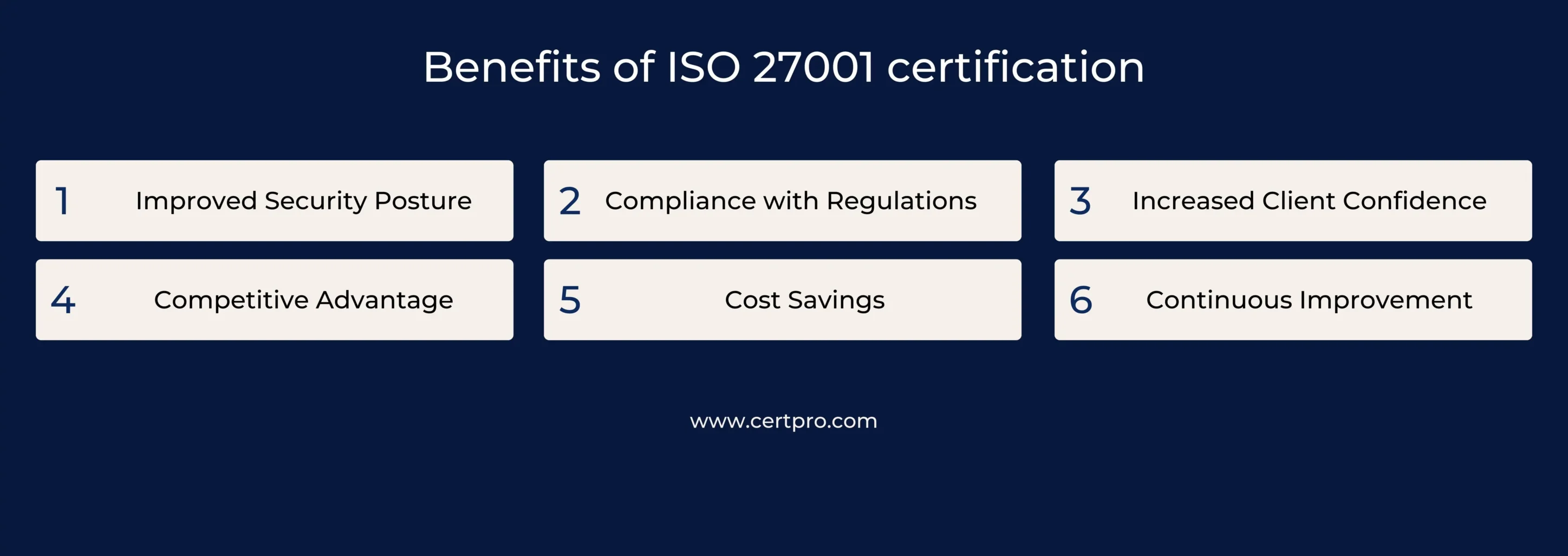
ISO 27001 Certification in New South Wales provides organisations with independently verified evidence of ISMS conformity. The benefits listed below reflect the outcomes of a completed ISO 27001 certification audit — they are not representations about services provided by CertPro. Each benefit is a direct consequence of engaging with the ISO 27001 standard through a rigorous, accredited certification process.
- ✓Independent third-party verification of ISMS design and operating effectiveness against ISO/IEC 27001:2022 requirements
- ✓Documented evidence of information security risk management for use in enterprise and government procurement processes
- ✓Structured ISO 27001 audit methodology evaluating Annex A controls across Organisational, People, Physical, and Technological domains
- ✓Recognition across APAC vendor assurance frameworks, reducing the need for multiple jurisdiction-specific security assessments
- ✓Alignment with Australian Privacy Principles, NSW Cyber Security Policy, and the Security of Critical Infrastructure Act 2018
- ✓Annual surveillance audit oversight maintaining continuous accountability for ISMS conformity between certification cycles
- ✓Certification committee decision based solely on audit evidence, providing an objective and defensible basis for third-party reliance
- ✓Three-year certificate validity with structured recertification audit confirming sustained ISO 27001 compliance
ISO 27001 certification is explicitly recognised in NSW Government procurement policy, federal government vendor panels, and enterprise security frameworks across banking, telecommunications, and healthcare in New South Wales. Organisations holding a valid ISO 27001 certificate issued by an accredited certification body can present that certificate as primary evidence in vendor security questionnaires — reducing the time and administrative burden associated with responding to individual customer security assessments.
For organisations competing in APAC markets — including Singapore, Japan, Hong Kong, and New Zealand — ISO 27001 Certification in New South Wales satisfies vendor assurance requirements that would otherwise require separate country-level security reviews. This directly reduces the cost and complexity of international market entry for NSW-based technology and data services exporters pursuing ISO 27001 compliance across multiple jurisdictions.
The ISO 27001 standard requires a risk-based approach to ISMS design and operation. ISO 27001 certification audit evidence confirms that the organisation has identified, assessed, and treated information security risks systematically, and that selected controls are operating as intended. This risk management discipline — verified through an independent ISO 27001 certification audit — provides board and executive leadership with an auditable record of information security governance decisions.
For listed companies and large private organisations in NSW subject to ASX Corporate Governance Principles or APRA governance expectations, a certified ISMS provides a structured, auditable basis for disclosing cybersecurity risk management to investors, directors, and regulators. ISO 27001 compliance therefore serves both an operational risk function and a corporate governance function for organisations managing significant information assets in New South Wales.
- ✓Procurement and Regulatory Recognition
- ✓Risk Management and Information Security Governance
Why NSW Organisations Pursue ISO 27001 Certification
Demand for ISO 27001 Certification in New South Wales is driven by a convergence of regulatory pressure, enterprise procurement requirements, and information security governance expectations unique to the state’s economic environment. NSW accounts for approximately one-third of Australia’s GDP and hosts the country’s largest concentration of financial services, technology, healthcare, and government operations — creating a high-demand market for independently verified information security management backed by a formal ISO 27001 certification audit.
Enterprise Vendor Security Reviews and Financial Sector Procurement
Major financial institutions headquartered in Sydney — including the four major Australian banks, insurance conglomerates, and superannuation fund administrators — operate formal third-party risk management programs requiring technology and data service vendors to hold or be actively pursuing ISO 27001 certification. ISO 27001 compliance for NSW fintech organisations is effectively a threshold requirement for inclusion in vendor panels operated by CBA, ANZ, Westpac, NAB, Macquarie, and comparable institutions.
Without a valid ISO 27001 certificate issued following a completed ISO 27001 certification audit, technology vendors are routinely excluded from procurement processes at the request-for-proposal stage — regardless of their technical capabilities or commercial terms. This procurement reality makes ISO 27001 Certification in New South Wales a commercial necessity for a growing number of technology businesses operating in the Sydney financial services ecosystem.
International SaaS Expansion and Cross-Border Vendor Assurance
NSW-based SaaS providers expanding into international markets — including the United States, United Kingdom, European Union, and APAC financial centres — encounter ISO 27001 certification requirements as a standard contractual prerequisite. Enterprise customers in regulated sectors across these markets require independent assurance of vendor ISMS conformity before onboarding cloud-hosted platforms that process customer, financial, or health data.
ISO 27001 Certification in New South Wales positions SaaS organisations to satisfy these requirements across multiple markets simultaneously, as ISO/IEC 27001:2022 is recognised as an international benchmark by regulators and procurement bodies in over 150 countries. The NSW digital economy — anchored by the Sydney Olympic Park technology precinct, Macquarie Park innovation district, and the Australian Technology Park — produces a significant volume of SaaS organisations for whom completing the ISO 27001 certification audit process is a commercial prerequisite for global expansion.
NSW Cyber Security Policy and Critical Infrastructure Obligations
The NSW Cyber Security Policy, administered by the NSW Department of Customer Service’s Office of the CISO, mandates minimum cyber security requirements for NSW Government agencies and directs agencies to apply the Australian Cyber Security Centre’s Essential Eight as a baseline. Technology vendors and managed service providers contracting with NSW agencies are increasingly required to demonstrate alignment with the Policy’s requirements through independent certification evidence.
ISO 27001 certification provides a structured evidentiary basis for demonstrating that an ISMS is operating effectively — covering the access control, patch management, application security, and incident response domains addressed by both the Essential Eight and the NSW Cyber Security Policy. Similarly, organisations operating assets designated as critical infrastructure under the Security of Critical Infrastructure Act 2018 — including energy, water, transport, and data storage providers in NSW — find that ISO 27001 compliance supports risk management program obligations under that legislation, making ISO 27001 Certification in New South Wales strategically relevant for critical infrastructure sectors.
ISO 27001 Certification Scope, Validity, and Ongoing Conformity
ISO 27001 Certification in New South Wales is scoped to the specific organisational boundaries, information assets, processes, and locations included in the certified ISMS. Understanding scope definition, certificate validity, and ongoing conformity obligations is essential for organisations managing their ISO 27001 certification lifecycle effectively — particularly those operating across multiple business units or geographic locations within NSW.
Defining and Maintaining the ISMS Scope
The ISMS scope defines the boundaries of the certified management system and is documented as part of the ISO 27001 certification audit record. Scope may be defined by organisational unit, geographic location, service line, or technology platform. A NSW-headquartered organisation may, for example, scope its ISMS to its Sydney-based software development and cloud operations, excluding unrelated manufacturing or logistics functions.
The scope statement must be realistic, auditable, and consistent with the organisation’s actual operations. Changes to the scope — such as the addition of new services, platforms, or business units — must be reported to the certification body and may trigger a scope extension audit. Scope limitations that exclude high-risk processes or assets without justification grounded in the risk assessment will be examined critically during the ISO 27001 certification audit, and may result in nonconformity findings.
Certificate Validity, Suspension, and Withdrawal
An ISO 27001 certificate issued following a successful certification decision is valid for three years from the date of issue. Certificate validity is conditional on the organisation completing annual surveillance audits in the first and second years of the certification cycle. Failure to complete surveillance audits, failure to remediate major nonconformities within agreed timeframes, or material changes to the ISMS that compromise conformity may result in certificate suspension.
Suspension is a formal status communicated to the organisation and, where applicable, to relying parties — which can have material consequences for NSW organisations whose ISO 27001 certification underpins government or enterprise contracts. Certificate withdrawal occurs when the organisation fails to address the conditions giving rise to suspension within the specified period. Reinstating a withdrawn certificate requires a new ISO 27001 certification audit conducted from Stage 1, restarting the full certification process.
FAQ
▶
What is ISO 27001 certification?
▶
Who needs ISO 27001 certification?
▶
How long does ISO 27001 certification take?
▶
What are the benefits of ISO 27001 certification?
▶
What is the cost of ISO 27001 certification?
▶
How do I prepare for ISO 27001 certification?
▶
What happens after ISO 27001 certification?
▶
How long does the ISO 27001 certification process take?
Get In Touch
have a question? let us get back to you.