
ISO 27001 Certification in Newcastle
The ISO 27001 certification audit process conducted by CertPro follows a structured, multi-stage methodology aligned with ISO/IEC 17021-1 requirements. Each stage produces documented outputs that inform the certification decision. Newcastle organizations should understand that the ISO 27001 certification audit evaluates the design and operating effectiveness of the ISMS — it does not prescribe how that ISMS should be structured or operated.
OUR CLIENTS










ISO 27001 Certification for Newcastle and Hunter Region Organizations
CertPro CPA LLC is a Licensed CPA Firm conducting independent ISO 27001 certification audits for organizations across Newcastle, the Hunter Region, and New South Wales. ISO 27001 Certification in Newcastle is the formal outcome of a structured conformity assessment confirming that an organization’s Information Security Management System (ISMS) conforms to the requirements of ISO/IEC 27001:2022. Achieving ISO 27001 Certification demonstrates that an organization has implemented a robust, independently verified framework for managing information security risks. CertPro operates exclusively as an independent third-party certification body — no consulting, advisory, or implementation services are provided.
ISO/IEC 27001:2022 and the Information Security Management System (ISMS)
ISO/IEC 27001:2022 is the international standard published by the International Organization for Standardization (ISO) and the International Electrotechnical Commission (IEC). It specifies requirements for establishing, implementing, maintaining, and continually improving an Information Security Management System (ISMS). The ISO 27001 standard is structured around Clauses 4 to 10 — the mandatory management system requirements — and Annex A, which provides a reference set of 93 information security controls across four domains: Organizational, People, Physical, and Technological.
The 2022 revision introduced updated control domains and new controls addressing threat intelligence, cloud services, ICT readiness, and data masking. Organizations certified to the 2013 version were required to transition to ISO/IEC 27001:2022 by 31 October 2025, as mandated by accredited certification bodies globally.
The ISMS is the organizational framework through which an entity identifies, assesses, treats, and monitors information security risks. ISO/IEC 27001:2022 requires the organization to define the ISMS scope, establish an information security policy, conduct a systematic risk assessment, produce a risk treatment plan, and document a Statement of Applicability (SoA). The SoA records which Annex A controls are applicable and whether each has been implemented.
The organization is solely responsible for establishing and operating its ISMS. CertPro’s role is limited to independently evaluating conformity of that ISMS against the requirements of the ISO 27001 standard — assessing objective evidence, reviewing documented information, and making an independent certification decision through a dedicated certification committee.
Newcastle and Hunter Region Sectors Seeking ISO 27001 Certification
ISO 27001 Certification in Newcastle is relevant across a broad and economically significant range of sectors. The Hunter Region’s industrial base encompasses mining and resources, energy and utilities, advanced manufacturing, engineering, maritime and port operations at the Port of Newcastle, logistics and transport, and construction — all of which handle sensitive operational, contractual, and supply chain data subject to information security risk.
Healthcare and health technology organizations operating across the region manage substantial volumes of personal health information governed by the Australian Privacy Act 1988 and the My Health Records Act 2012. Financial services and fintech organizations, software and SaaS providers, cybersecurity firms, AI developers, and cloud and data service providers in Newcastle’s growing technology ecosystem frequently encounter enterprise procurement requirements that mandate ISO 27001 compliance as a condition of vendor approval.
Agriculture and agribusiness organizations, education and research institutions — including the University of Newcastle and CSIRO’s Hunter Region presence — professional services firms, and government technology contractors similarly pursue ISO 27001 Certification in Newcastle to demonstrate information security governance to clients, regulators, and counterparties.
The concentration of defence supply chain organizations and critical infrastructure operators across the Hunter Region further reinforces demand for independently certified ISMS frameworks. Each of these sectors faces distinct information assets, threat landscapes, and regulatory contexts. ISO/IEC 27001:2022 provides the internationally recognized framework against which ISMS conformity is independently assessed and certified.
Independent Certification Body Positioning
CertPro CPA LLC functions exclusively as an independent third-party certification body. ISO 27001 certification audit activities conducted by CertPro are structured in accordance with ISO/IEC 17021-1, which governs the competence and consistent operation of bodies providing audit and certification of management systems.
All certification decisions are made by an independent certification committee that reviews audit findings without involvement from the audit team. This structural separation between the audit function and the certification decision function ensures the objectivity and impartiality of every ISO 27001 certification audit outcome. CertPro does not provide readiness assessments, control design, policy development, internal audit services, or any form of implementation support — maintaining a clear boundary between the organization’s responsibility for its ISMS and CertPro’s responsibility for independently evaluating that ISMS.

ISO 27001 Certification Audit Process for Newcastle Organizations
The ISO 27001 certification audit process conducted by CertPro follows a structured, multi-stage methodology aligned with ISO/IEC 17021-1 requirements. Each stage produces documented outputs that inform the certification decision. Newcastle organizations should understand that the ISO 27001 certification audit evaluates the design and operating effectiveness of the ISMS — it does not prescribe how that ISMS should be structured or operated.
The Stage 1 audit involves a structured review of the organization’s ISMS documentation against the requirements of ISO/IEC 27001:2022. During Stage 1, the auditor evaluates whether the ISMS scope is clearly defined, whether the information security policy is documented and appropriate, whether a risk assessment methodology has been established, and whether a risk treatment plan and Statement of Applicability (SoA) have been produced. Auditors also verify that mandatory documented information required by Clauses 4 to 10 is in place.
The Stage 1 audit identifies any significant gaps in the documented management system that would prevent a productive Stage 2 audit. The outputs of Stage 1 directly inform the audit program for Stage 2.
The Stage 2 audit is an on-site assessment of the operational effectiveness of the ISMS. Auditors collect and evaluate objective evidence — including records, system configurations, process outputs, interviews, and observations — to determine whether the ISMS is operating in conformity with ISO/IEC 27001:2022 requirements and the controls documented in the SoA.
Annex A control effectiveness is assessed across Organizational, People, Physical, and Technological control domains. Nonconformities identified during the Stage 2 ISO 27001 audit are documented, classified, and reported to the organization. The organization must submit a corrective action plan addressing identified nonconformities before the certification decision is finalized by the independent certification committee.
Following completion of Stage 2 and review of any corrective action submissions, audit findings are referred to CertPro’s independent certification committee. The committee evaluates the totality of audit evidence and makes a certification decision independent of the audit team. Where the organization’s ISMS is determined to conform to ISO/IEC 27001:2022, a certificate of conformity is issued specifying the scope of certification, the applicable standard, the certification date, and the validity period.
ISO 27001 certificates issued under this process are valid for three years, subject to satisfactory surveillance audit outcomes. The certification decision reflects only the committee’s evaluation of audit evidence — it does not constitute an advisory judgment about the broader quality or appropriateness of the organization’s security posture beyond conformity with the ISO 27001 standard.
| Audit Stage | Key Activities | Output |
|---|---|---|
| Stage 1 Audit | Review of ISMS documentation, scope, policy, risk assessment, SoA, and Clause 4–10 documented information | Stage 1 findings report; Stage 2 audit program |
| Stage 2 Audit | On-site evaluation of ISMS operational effectiveness; objective evidence collection; Annex A control assessment across all four domains | Nonconformity report; audit findings report |
| Nonconformity Review | Organization submits corrective action plan; auditor reviews adequacy and sufficiency of proposed actions | Corrective action acceptance or further review |
| Certification Committee Decision | Independent committee reviews all audit findings and corrective actions; makes final certification determination | Certification decision; certificate issuance or deferral |
| Surveillance Audit | Annual review of ISMS continued conformity within the three-year certification cycle | Surveillance audit report; continued certification or suspension |
ISO 27001 certification is maintained through a three-year certification cycle comprising annual surveillance audits and a full recertification audit at the end of the cycle. Surveillance audits are conducted at least once per calendar year and evaluate whether the organization’s ISMS continues to conform to ISO/IEC 27001:2022 requirements, whether the scope of certification remains accurate, and whether management review and internal audit processes are being maintained.
Where significant nonconformities are identified during a surveillance audit, certification may be suspended pending corrective action. The recertification audit — conducted before the three-year certificate expires — is a comprehensive reassessment of the full ISMS, equivalent in scope to the original Stage 2 ISO 27001 certification audit.
- ✓Stage 1 and Stage 2 Certification Audit Methodology
- ✓Certification Decision and Certificate Issuance
- ✓Surveillance Audits and Recertification
ISO 27001 Requirements and ISMS Documentation
ISO/IEC 27001:2022 specifies a defined set of mandatory documented information requirements and management system obligations evaluated during the ISO 27001 certification audit. Understanding these requirements is essential for Newcastle organizations establishing or maintaining an ISMS in preparation for independent certification assessment. Thorough documentation is not only a prerequisite for ISO 27001 compliance — it provides the evidentiary foundation for every stage of the audit process.
ISO/IEC 27001:2022 mandates specific documented information as evidence of ISMS conformity. Core documents reviewed during the ISO 27001 audit include the ISMS scope statement, the information security policy, the risk assessment methodology and risk register, the risk treatment plan, the Statement of Applicability (SoA), documented objectives, competence records, evidence of internal audits, management review outputs, and records of nonconformities and corrective actions.
The SoA is a particularly critical document — it maps each of the 93 Annex A controls to the organization’s risk treatment decisions, recording whether each control is applicable, whether it has been implemented, and the justification for any exclusions. Auditors review the SoA in detail during both Stage 1 and Stage 2 of the ISO 27001 certification audit in Newcastle.
Clauses 4 to 10 of ISO/IEC 27001:2022 form the mandatory management system framework evaluated during an ISO 27001 certification audit. Each clause addresses a distinct area of ISMS governance:
Clause 4 requires the organization to determine internal and external context, identify interested parties, and define the ISMS scope. Clause 5 addresses leadership obligations including top management commitment, information security policy, and assignment of roles and responsibilities. Clause 6 covers planning — including risk assessment, risk treatment, and information security objectives. Clause 7 addresses support requirements encompassing resources, competence, awareness, communication, and documented information. Clause 8 covers operational planning and control. Clause 9 requires performance evaluation through monitoring, measurement, internal audit, and management review. Clause 10 mandates continual improvement and corrective action. Conformity with each clause is assessed through objective evidence during the ISO 27001 audit.
ISO/IEC 27001:2022 Annex A provides a normative reference set of 93 controls organized across four domains. Understanding each domain is central to achieving and maintaining ISO 27001 compliance:
The Organizational domain (37 controls) covers policies, roles, threat intelligence, information security in supplier relationships, incident management, and business continuity. The People domain (8 controls) addresses security screening, terms of employment, awareness, training, and disciplinary processes. The Physical domain (14 controls) covers physical security perimeters, entry controls, equipment security, and clear desk and clear screen policies. The Technological domain (34 controls) encompasses access control, identity management, cryptography, logging, monitoring, vulnerability management, configuration management, data masking, data leakage prevention, and web filtering.
The organization’s SoA documents how each applicable Annex A control has been implemented. The Stage 2 ISO 27001 audit evaluates objective evidence of that implementation across all relevant domains.
- ✓Mandatory ISMS Documentation Requirements
- ✓ISO 27001 Clauses 4 to 10 — Management System Requirements
- ✓Annex A Controls — Organizational, People, Physical, and Technological Domains
Why Newcastle Organizations Pursue ISO 27001 Certification
ISO 27001 Certification in Newcastle is pursued across multiple sectors for distinct but overlapping reasons related to procurement requirements, regulatory alignment, risk governance, and market positioning. The demand drivers outlined below reflect the specific context of organizations operating in Newcastle, the Hunter Region, and across New South Wales — and illustrate why ISO 27001 compliance has become a baseline expectation in many commercial and regulatory environments.
Enterprise Vendor Assurance and Procurement Requirements
A primary driver of ISO 27001 compliance in Newcastle is the enterprise vendor assurance process. Large organizations in the mining, energy, resources, defence, and financial services sectors operating across the Hunter Region increasingly require their technology vendors, managed service providers, cloud suppliers, and professional services firms to hold valid ISO 27001 certification as a condition of vendor approval or contract renewal.
For example, a SaaS provider based in Newcastle’s technology precinct seeking to supply services to a resources or energy company at scale is likely to encounter an ISO 27001 certification requirement at the procurement or security assessment stage. Independent ISO 27001 certification provides objective, third-party evidence of ISMS conformity that satisfies vendor security review requirements — without reliance on self-attestation.
Regulatory Alignment and Australian Privacy and Cybersecurity Obligations
ISO 27001 compliance aligns closely with obligations under the Australian Privacy Act 1988, the Notifiable Data Breaches (NDB) scheme, the Security of Critical Infrastructure Act 2018 (SOCI Act), and the Australian Government Information Security Manual (ISM). Organizations subject to these frameworks — including critical infrastructure operators, government technology contractors, healthcare providers, and financial services entities across Newcastle and the Hunter Region — can use ISO 27001 certification to demonstrate structured, documented information security risk management to regulators and oversight bodies.
The ISO 27001 standard maps to key principles of the Privacy Act’s Australian Privacy Principles (APPs) and the SOCI Act’s risk management program requirements, making ISO 27001 certification audit outcomes directly relevant to regulatory compliance evidence.
International Market Access and Cross-Border Data Requirements
Newcastle-based technology companies, SaaS providers, and professional services firms seeking to enter international markets — particularly in the United Kingdom, European Union, United States, Singapore, and Japan — encounter ISO 27001 certification requirements as a market access condition. ISO 27001 Certification in Newcastle is especially relevant for technology companies supplying services to organizations subject to GDPR in the EU, where ISO 27001 certification is recognized as demonstrating appropriate technical and organizational measures under Article 32.
ISO 27001 certification is similarly recognized in financial services regulatory contexts in Singapore (MAS TRM Guidelines) and the United Kingdom (FCA operational resilience expectations). The international recognition of the ISO 27001 standard makes it the most globally applicable information security certification for organizations pursuing cross-border commercial relationships.
Benefits of ISO 27001 Certification for Newcastle-Based Organizations
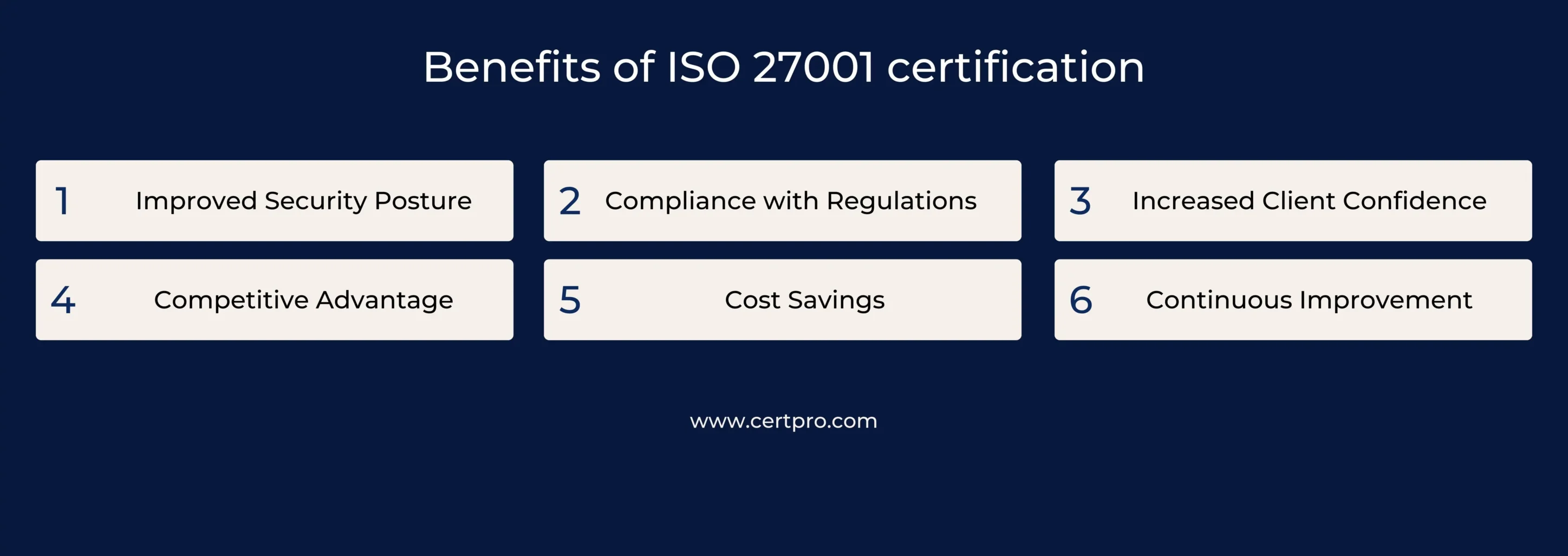
ISO 27001 Certification in Newcastle delivers a range of independently verifiable outcomes for organizations across the Hunter Region’s industrial, technology, and services sectors. These benefits result directly from demonstrated ISMS conformity assessed through the ISO 27001 certification audit process — they are not claimed outcomes or promotional representations. Each benefit is tied to objective evidence gathered and evaluated by an independent third-party certification body.
- ✓Independent, third-party verification of ISMS conformity with ISO/IEC 27001:2022 requirements
- ✓Objective evidence of information security risk management suitable for enterprise vendor assurance reviews
- ✓Demonstrated ISO 27001 compliance with Australian Privacy Act, NDB scheme, and SOCI Act risk management expectations
- ✓Recognition in procurement processes across mining, energy, resources, defence, financial services, and government technology sectors
- ✓Internationally recognized ISO 27001 certification supporting market access in EU, UK, US, Singapore, and other regulated markets
- ✓Structured internal audit and management review disciplines embedded in the ISMS through ISO 27001 standard requirements
- ✓Three-year certification cycle with annual surveillance audits maintaining ongoing conformity verification
- ✓Independently documented SoA and Annex A control implementation providing audit-ready evidence for clients and regulators
ISO 27001 certification is particularly relevant for Newcastle financial services organizations and fintech providers, given the sensitivity of financial data, the expectations of APRA-regulated entities under CPS 234 Information Security, and the growing fintech sector operating across the Hunter Region. APRA’s Prudential Standard CPS 234 requires APRA-regulated entities to maintain information security capability commensurate with information security vulnerabilities and threats. ISO 27001 certification provides a recognized framework for demonstrating that capability to third-party assessors, clients, and regulators.
ISO 27001 compliance for Newcastle fintech organizations is also driven by requirements from banking and financial institution clients who mandate certified ISMS frameworks in their vendor contracts. The independent ISO 27001 certification audit process provides fintech organizations with externally verified evidence of information security control effectiveness — satisfying both APRA-aligned and client-driven assurance requirements.
Newcastle technology companies — including SaaS providers, cloud service providers, managed security service providers, and AI developers — use ISO 27001 certification to differentiate in competitive procurement environments and to meet the security requirements of enterprise and government clients. The Australian Government’s Hosting Certification Framework and the Digital Transformation Agency’s cloud security guidelines reference ISO 27001 as a relevant security standard for cloud service providers seeking to serve government clients.
Newcastle-based technology organizations supplying services to government agencies, critical infrastructure operators, or regulated financial institutions frequently encounter ISO 27001 certification requirements at the contracting or vendor assessment stage. Independent ISO 27001 certification audit findings provide technology organizations with audit-grade evidence of their security controls that withstands scrutiny in formal procurement assessments.
- ✓ISO 27001 Certification for Newcastle Financial Services and Fintech Organizations
- ✓ISO 27001 Certification for Newcastle Technology and Cloud Service Providers
ISO 27001 Certification Scope and Independent Decision Framework
The scope of an ISO 27001 certification audit is a critical determinant of what the resulting certificate represents. Scope definition affects which organizational units, locations, processes, information assets, and systems are covered by the ISMS and evaluated during the ISO 27001 certification audit. Organizations operating in Newcastle and the Hunter Region must ensure that their defined ISMS scope accurately reflects the boundaries of the information security management framework being certified — an accurately scoped ISMS is fundamental to the integrity of the ISO 27001 compliance outcome.
Defining and Evaluating ISMS Scope
ISO/IEC 27001:2022 Clause 4.3 requires the organization to determine the boundaries and applicability of the ISMS and document it as the ISMS scope. The scope must account for internal and external issues identified under Clause 4.1, interested party requirements identified under Clause 4.2, and interfaces and dependencies between activities performed within and outside the ISMS boundary.
During the Stage 1 ISO 27001 audit, auditors evaluate whether the documented scope is consistent with the organization’s actual operational context. Scope limitations or exclusions must be documented and justified — a scope that is artificially narrow to exclude high-risk activities or systems is subject to challenge during the certification audit. For Newcastle organizations operating across multiple sites — such as port operations, mining sites, and corporate offices — multi-site ISMS scopes require careful definition and may require auditor visits to multiple locations.
Nonconformity Classification and Corrective Action
During the ISO 27001 certification audit, auditors document nonconformities where objective evidence demonstrates that a requirement of ISO/IEC 27001:2022 has not been met. Nonconformities are reported to the organization with clear reference to the specific clause or Annex A control that has not been satisfied, along with the objective evidence supporting the finding.
The organization is required to analyse the root cause of each nonconformity, implement corrective action to address it, and submit evidence of corrective action to the auditor for review. The adequacy and effectiveness of corrective actions are evaluated before audit findings are referred to the certification committee. This evidence-based nonconformity and corrective action process is a fundamental discipline of ongoing ISO 27001 compliance and is maintained throughout the three-year certification cycle via surveillance audit activities.
Conditions for Suspension and Withdrawal of Certification
ISO 27001 certification may be suspended or withdrawn where the organization fails to meet the conditions of continued certification. Suspension is typically applied where a surveillance audit identifies significant nonconformities that have not been addressed within the required timeframe, where the organization fails to undergo a scheduled surveillance audit, or where there are substantiated concerns about the continued integrity of the ISMS.
Withdrawal of certification occurs where the grounds for suspension are not resolved, where the organization voluntarily withdraws, or where the scope of the certified ISMS changes materially without notification to the certification body. These conditions are documented in the certification agreement and evaluated by CertPro’s independent certification committee. The possibility of suspension or withdrawal reinforces that ISO 27001 certification is a continuous conformity obligation — not a one-time achievement.
ISO 27001 Audit Newcastle — Evaluating Information Security Risk Management
Information security risk management is the operational core of any ISO/IEC 27001:2022-conformant ISMS, and its design and effectiveness are central areas of evaluation during an ISO 27001 audit. Newcastle organizations should understand the specific risk management requirements of the ISO 27001 standard and how those requirements are assessed through the certification audit process — from the initial risk assessment methodology through to risk treatment decisions documented in the SoA.
Risk Assessment Requirements and Audit Evaluation
ISO/IEC 27001:2022 Clause 6.1.2 requires the organization to establish and apply an information security risk assessment process that identifies risks associated with the loss of confidentiality, integrity, and availability of information within the ISMS scope. The process must analyse those risks using a consistent and repeatable methodology and evaluate them against defined risk acceptance criteria. The risk assessment must produce documented results that can be reviewed and verified.
During the ISO 27001 certification audit, auditors evaluate the risk assessment methodology for consistency and reproducibility, review the risk register for completeness relative to the defined ISMS scope, and assess whether risk evaluation decisions are supported by objective evidence. The connection between risk assessment outputs and the risk treatment decisions documented in the SoA is a critical audit trail examined during both Stage 1 and Stage 2 assessments.
Risk Treatment, Statement of Applicability, and Control Effectiveness
ISO/IEC 27001:2022 Clause 6.1.3 requires the organization to select appropriate risk treatment options, determine the Annex A controls necessary to implement those options, produce a Statement of Applicability, and develop a risk treatment plan. The SoA is the definitive document linking risk treatment decisions to specific Annex A controls and must include justification for the inclusion or exclusion of each control.
During the Stage 2 ISO 27001 audit, auditors evaluate objective evidence of the implementation and operational effectiveness of controls recorded as implemented in the SoA. For Newcastle organizations with complex information environments — such as port logistics systems, mine site operational technology, hospital patient data systems, or cloud-hosted SaaS platforms — the depth and accuracy of the SoA is a significant factor in the audit’s assessment of risk treatment adequacy.
ISO 27001 Standard — Internal Audit and Management Review Requirements
The ISO 27001 standard requires organizations to establish and maintain internal audit and management review processes as ongoing ISMS disciplines. These processes are evaluated during the ISO 27001 certification audit as evidence of the organization’s commitment to continual improvement and effective operational oversight of the ISMS. For Newcastle organizations across all sectors, a credible internal audit program and documented management review cycle are essential to achieving and maintaining ISO 27001 certification.
ISO/IEC 27001:2022 Clause 9.2 requires the organization to conduct internal audits at planned intervals to provide information on whether the ISMS conforms to the organization’s own requirements and to the requirements of the ISO 27001 standard, and whether the ISMS is effectively implemented and maintained. The internal audit program must be planned, established, implemented, and maintained — taking into account the importance of the processes concerned and the results of previous audits.
Internal audit results must be documented and reported to relevant management. During the ISO 27001 certification audit, auditors review the internal audit program, internal audit reports, and evidence of follow-up actions to verify that a functioning internal audit discipline is in place. For organizations across Newcastle’s mining, energy, healthcare, and technology sectors, demonstrating a credible internal audit program is a significant factor in achieving and maintaining ISO 27001 certification.
ISO/IEC 27001:2022 Clause 9.3 requires top management to review the organization’s ISMS at planned intervals to ensure its continued suitability, adequacy, and effectiveness. Management review inputs must include the status of actions from previous reviews, changes in external and internal issues relevant to the ISMS, feedback on information security performance including nonconformities, monitoring and measurement results, audit results, and fulfilment of information security objectives.
Management review outputs must include decisions related to continual improvement opportunities and any need for changes to the ISMS. During the ISO 27001 audit, auditors review management review records to verify that reviews are conducted at appropriate intervals, that required inputs are addressed, and that outputs include documented decisions and action items. This requirement establishes top management accountability for the ISMS as a central tenet of the ISO 27001 standard.
- ✓Internal Audit Program Requirements
- ✓Management Review and Continual Improvement Obligations
FAQ
▶
What is ISO 27001 certification and why does it matter for Newcastle organizations?
▶
Which Newcastle sectors most commonly seek ISO 27001 certification?
▶
What does the ISO 27001 audit process involve?
▶
How long is an ISO 27001 certificate valid?
▶
What is the Statement of Applicability (SoA) and why is it important?
▶
Does ISO 27001 certification align with Australian regulatory requirements?
▶
What is the difference between ISO 27001 and other information security frameworks?
▶
How does CertPro conduct the ISO 27001 certification audit Newcastle organizations undergo?
Get In Touch
have a question? let us get back to you.