
ISO 27001 Certification in Ohio
ISO 27001 Certification in Ohio is issued by CertPro, a Licensed CPA Firm operating as an independent third-party certification body. CertPro evaluates Information Security Management Systems (ISMS) against the requirements of ISO/IEC 27001:2022, conducting structured audit programs that produce evidence-based certification decisions. These decisions are made entirely separate from consulting, implementation, or advisory activities — preserving the independence and integrity of every ISO 27001 audit we conduct.
OUR CLIENTS









Independent ISO 27001 Certification by a Licensed CPA Firm in Ohio
ISO 27001 Certification in Ohio is issued by CertPro, a Licensed CPA Firm operating as an independent third-party certification body. CertPro evaluates Information Security Management Systems (ISMS) against the requirements of ISO/IEC 27001:2022, conducting structured audit programs that produce evidence-based certification decisions. These decisions are made entirely separate from consulting, implementation, or advisory activities — preserving the independence and integrity of every ISO 27001 audit we conduct.
Ohio’s Information Security Landscape and Certification Demand
Ohio operates one of the most diverse technology and commercial ecosystems in the Midwest. Major concentrations of financial services firms, healthcare technology organizations, SaaS providers, cloud service providers, insurance companies, manufacturing and industrial technology companies, automotive businesses, logistics providers, cybersecurity firms, and AI-focused enterprises all call Ohio home.
Business activity across Columbus, Cleveland, Cincinnati, Dayton, and Akron generates substantial volumes of sensitive customer, financial, operational, and proprietary data — creating clear demand for independently verified information security frameworks. ISO 27001 Certification in Ohio provides organizations with a structured, independently audited credential demonstrating that their ISMS meets the requirements of an internationally recognized standard.
Organizations operating in Ohio’s financial sector face information security expectations from regulators and enterprise clients, while healthcare technology companies handle data subject to HIPAA requirements. ISO 27001 compliance programs allow these organizations to document, assess, and treat information security risks systematically. This positions ISO 27001 certification as a meaningful signal in vendor due diligence reviews, contract negotiations, and regulatory conversations.
Ohio’s growing SaaS and cloud infrastructure sector has further accelerated demand, as enterprise clients increasingly require independently audited security postures before awarding contracts or integrating third-party systems.
Regulatory Context and Cross-Border Demand Drivers
Ohio organizations operating across state and national boundaries face layered information security expectations. The Ohio Data Protection Act establishes a cybersecurity safe harbor framework that references recognized security standards. While ISO 27001 certification does not automatically satisfy this or any other legal obligation, organizations that have completed an ISO 27001 audit in Ohio operate within a well-documented control environment that is directly relevant to that framework.
Ohio-based SaaS providers contracting with enterprise clients in the European Union encounter GDPR supply chain requirements, where third-party vendors must demonstrate independently verified security controls. ISO 27001 Certification in Ohio directly addresses this demand by providing an internationally recognized credential that EU-based clients and global enterprise procurement teams recognize in vendor assessment processes.
Ohio cloud service providers serving federally regulated industries — including financial institutions subject to GLBA and healthcare entities subject to HIPAA — similarly benefit from the structured risk assessment and control documentation that ISO 27001 certification requires. CertPro, as a Licensed CPA Firm, conducts these evaluations under an independent audit mandate, maintaining clear separation from any implementation or advisory role. The certification decision is made by an independent certification committee following a defined nonconformity review, ensuring that the ISMS certification issued reflects a genuine, evidence-based determination of conformance with ISO/IEC 27001:2022.
Licensed CPA Firm as Independent Certification Body
CertPro’s status as a Licensed CPA Firm establishes the institutional foundation for independent ISO 27001 certification in Ohio. Unlike certification bodies that operate without professional licensing obligations, a Licensed CPA Firm is held to professional standards that reinforce independence, objectivity, and evidence-based evaluation.
CertPro does not provide consulting, implementation support, or control design services to organizations it certifies — preserving the integrity of the audit relationship at every stage. The audit program evaluates ISMS conformance across all applicable clauses of ISO/IEC 27001:2022, from scope definition and organizational context through leadership commitment, planning, risk assessment, risk treatment, operational controls, performance evaluation, and continual improvement.
The resulting ISO 27001 certification is valid for three years, subject to annual surveillance audits that verify the ISMS remains operational and effective. Ohio organizations seeking ISO 27001 Certification engage CertPro through a defined application and scoping process, leading to a structured two-stage audit program. The process culminates in a certification decision made by a committee independent of the audit team — ensuring that every ISMS certification issued reflects a credible, independently verified determination.

What Is ISO 27001 Certification?
ISO 27001 certification is the formal recognition that an organization’s Information Security Management System (ISMS) conforms to the requirements of ISO/IEC 27001:2022 — the international standard for information security management published by the International Organization for Standardization (ISO) and the International Electrotechnical Commission (IEC).
Certification is granted by an independent third-party body following a structured ISO 27001 audit program. That program evaluates documented policies, risk assessment processes, risk treatment decisions, selected controls, and evidence of operational effectiveness — producing a certification decision grounded entirely in audit evidence.
ISO/IEC 27001:2022 Standard Structure and Requirements
ISO/IEC 27001:2022 is organized into ten clauses covering the full lifecycle of an ISMS. Clauses 1 through 3 establish scope, normative references, and definitions. Clauses 4 through 10 define the mandatory management system requirements:
These requirements include understanding the organization and its context (Clause 4), leadership and commitment (Clause 5), planning — including risk assessment and risk treatment — (Clause 6), support including resources and documentation (Clause 7), operational controls (Clause 8), performance evaluation including internal audit and management review (Clause 9), and continual improvement (Clause 10).
The 2022 revision reduced the Annex A control set from 114 controls across 14 domains to 93 controls organized across four domains: Organizational, People, Physical, and Technological. Organizations must produce a Statement of Applicability (SoA) documenting which Annex A controls are applicable and the justification for any exclusions.
ISO 27001 compliance programs in Ohio require organizations to demonstrate that this documentation is current, complete, and aligned with documented risk assessment outcomes. Organizations pursuing ISO 27001 Certification in Ohio must demonstrate conformance with all mandatory clauses and produce evidence that selected controls are both designed appropriately and operating effectively within the defined ISMS scope.
ISMS Certification: Scope, Documentation, and Core Outputs
ISMS certification requires organizations to define a clear scope statement identifying the information assets, processes, organizational units, and physical or cloud locations covered by the management system. The scope boundary determines which risks are assessed, which controls are implemented, and which evidence is collected during the audit review.
Core documentation required for ISMS certification includes the information security policy, documented risk assessment methodology, risk register, risk treatment plan, Statement of Applicability, and records of internal audit and management review activities. The Statement of Applicability is a particularly critical document: it maps each of the 93 Annex A controls to the organization’s risk treatment decisions, records whether each control is implemented, and provides justification for any controls considered not applicable.
During an ISO 27001 assessment, the certification auditor reviews this documentation to verify internal consistency. The auditor confirms that risk treatment decisions are traceable to documented risk assessment outcomes and evaluates whether selected controls are demonstrably operational. ISO 27001 assessment engagements conducted by CertPro in Ohio examine these outputs at both the Stage 1 documentation review and Stage 2 on-site or remote audit phases.
Annex A Control Domains in ISO/IEC 27001:2022
The four Annex A control domains in ISO/IEC 27001:2022 address distinct categories of information security risk. The Organizational controls domain (37 controls) covers policies, roles, responsibilities, asset management, supplier relationships, incident management, and business continuity. The People controls domain (8 controls) addresses personnel security, screening, terms and conditions, awareness, training, and disciplinary processes. The Physical controls domain (14 controls) governs physical security perimeters, secure areas, equipment protection, and physical media handling. The Technological controls domain (34 controls) encompasses access control, authentication, encryption, secure development, vulnerability management, logging, monitoring, and network security.
Ohio organizations operating in sectors with significant digital infrastructure — including cloud service providers, SaaS companies, fintech firms, and healthcare technology organizations — typically engage a broad range of Technological and Organizational controls. The ISO 27001 audit conducted by CertPro evaluates whether controls selected in the Statement of Applicability are implemented in a manner consistent with the stated risk treatment approach, and whether operating evidence confirms those controls function as designed within the ISMS scope.
| Annex A Domain | Number of Controls | Key Focus Areas |
|---|---|---|
| Organizational | 37 | Policies, asset management, supplier security, incident management |
| People | 8 | Personnel screening, security awareness, disciplinary processes |
| Physical | 14 | Physical perimeters, secure areas, equipment and media protection |
| Technological | 34 | Access control, encryption, vulnerability management, monitoring |
ISO 27001 Certification Audit Process in Ohio
The ISO 27001 audit process in Ohio follows a defined sequence of stages established under ISO/IEC 27001:2022 and CertPro’s certification program requirements. Each stage produces specific outputs that feed into subsequent phases, culminating in a certification decision made by an independent committee. The process is structured to evaluate ISMS conformance through both documentation review and evidence-based operational testing.
The ISO 27001 certification process begins with an application review in which CertPro assesses the organization’s defined ISMS scope, sector context, and the complexity of its information security environment. This review determines the audit program structure, including the audit team composition, the scope of Stage 1 and Stage 2 audits, and the applicable Annex A control domains subject to evaluation.
For Ohio organizations operating across multiple locations — such as enterprises with offices in Columbus, Cleveland, and Cincinnati — the audit program determination addresses multi-site sampling requirements and confirms which sites fall within the certification boundary. Organizations in sectors with elevated data sensitivity, such as healthcare technology or financial services, may require expanded audit coverage across Technological and Organizational control domains.
The application review produces a formal audit program specifying audit objectives, methods, criteria, and the sequence of audit activities. This document forms the governance framework for all subsequent audit stages and is reviewed by the organization before any audit activities commence — ensuring full alignment on scope expectations prior to Stage 1.
The Stage 1 audit is a documentation review conducted to assess whether the organization’s ISMS documentation meets the mandatory requirements of ISO/IEC 27001:2022 Clauses 4 through 10, and whether the organization is ready to proceed to Stage 2 evidence testing.
During the Stage 1 ISO 27001 audit in Ohio, CertPro auditors review the information security policy, ISMS scope statement, risk assessment methodology, risk register, risk treatment plan, Statement of Applicability, internal audit records, and management review minutes. Auditors assess internal consistency — specifically whether risk treatment decisions in the risk treatment plan are traceable to risk assessment outputs, and whether the Statement of Applicability accurately reflects those treatment decisions with sound control justifications.
The Stage 1 audit also evaluates whether the organization has completed at least one full internal audit cycle and one management review covering all mandatory agenda items. The output is a Stage 1 report identifying any areas requiring attention before Stage 2, including documentation gaps or inconsistencies that would be classified as nonconformities if left unresolved. The Stage 1 report does not constitute a certification decision; it informs the planning and scope of the Stage 2 audit.
The Stage 2 audit constitutes the primary evidence-gathering phase of the ISO 27001 assessment, during which CertPro auditors evaluate whether the ISMS controls documented in the Statement of Applicability are implemented and operating effectively within the defined scope. Auditors collect evidence through interviews with personnel, observation of operational processes, and review of records — including access logs, vulnerability scan reports, incident records, change management documentation, and training completion records.
For Ohio technology companies, SaaS providers, and cloud service organizations, Stage 2 audit activities typically include review of technical controls such as encryption configurations, access control provisioning records, patch management logs, and network monitoring outputs. Nonconformities identified during Stage 2 are classified and communicated to the organization, which must submit a corrective action plan within a defined timeframe.
Major nonconformities must be resolved before certification can be granted. Minor nonconformities are subject to closure verification at the first surveillance audit. Following nonconformity review, the audit team prepares a certification recommendation submitted to CertPro’s independent certification committee. The committee reviews the audit findings and recommendation, then makes the final certification decision. Upon a positive decision, ISMS certification is issued with a three-year validity period, subject to annual surveillance audits.
| Audit Stage | Key Activities | Output |
|---|---|---|
| Application Review | Scope assessment, audit program determination, team assignment | Formal audit program document |
| Stage 1 Audit | Documentation review, ISMS policy and records assessment, readiness evaluation | Stage 1 audit report with identified gaps |
| Stage 2 Audit | Evidence collection, control effectiveness testing, personnel interviews | Stage 2 audit report with nonconformity findings |
| Nonconformity Review | Corrective action submission and verification by audit team | Closed or open nonconformity register |
| Certification Decision | Independent committee review of audit recommendation | ISO 27001 certificate (3-year validity) |
ISO 27001 certification is not a one-time event. The certification cycle requires annual surveillance audits during years one and two of the three-year certification period, and a full recertification audit in year three. Surveillance audits conducted by CertPro verify that the ISMS remains operational, that continual improvement activities are documented and implemented, and that any minor nonconformities identified in the initial Stage 2 audit have been closed.
Surveillance audits also evaluate whether significant changes to the organization’s information security environment — such as new product launches, acquisitions, cloud migrations, or changes to the scope boundary — have been assessed and reflected in updated risk assessments and control documentation. Ohio organizations that undergo substantial operational changes between certification cycles are expected to notify CertPro and initiate a scope review.
Failure to maintain the ISMS in conformance with ISO/IEC 27001:2022 requirements may result in suspension or withdrawal of the certificate. Recertification audits in year three follow a similar structure to the initial certification, including documentation review and evidence-based control testing, and result in an updated certification decision valid for a further three years. The recertification audit ensures that the ISMS certification Ohio organizations hold remains current and accurately reflects the organization’s actual operating environment.
- ✓Application Review and Audit Program Determination
- ✓Stage 1 Audit: Documentation and Readiness Review
- ✓Stage 2 Audit, Nonconformity Review, and Certification Decision
- ✓Surveillance Audits and Recertification
ISO 27001 Certification Requirements for Ohio Organizations
Achieving ISO 27001 Certification in Ohio requires organizations to demonstrate conformance with all mandatory clauses of ISO/IEC 27001:2022 and to produce documented evidence that selected controls from Annex A are both designed appropriately and operating effectively. The following requirements apply to all organizations pursuing ISMS certification, regardless of sector or size.
ISO/IEC 27001:2022 mandates a defined set of documented information that must exist and be maintained within the ISMS. At minimum, this includes the ISMS scope statement, information security policy, risk assessment methodology documentation, risk register, risk treatment plan, Statement of Applicability, objectives and plans to achieve them, evidence of competence for personnel with ISMS responsibilities, internal audit program and results, management review records, and records of identified nonconformities and corrective actions.
The Statement of Applicability is the central reference document linking risk treatment decisions to selected or excluded Annex A controls. It must be version-controlled and kept current. For Ohio organizations operating in cloud environments, documentation must also address how controls apply to cloud-hosted assets, third-party service dependencies, and shared responsibility models.
ISO 27001 compliance programs in Ohio frequently involve multi-vendor environments where supplier security controls are incorporated into the risk treatment plan. The ISO 27001 assessment conducted by CertPro during Stage 1 verifies the existence, completeness, and internal consistency of these mandatory documents before Stage 2 evidence testing begins. Incomplete or inconsistent documentation will be identified as nonconformities requiring resolution prior to or during the certification cycle.
ISO/IEC 27001:2022 Clause 6 requires organizations to establish and apply a documented information security risk assessment process that produces consistent, comparable, and reproducible results. The risk assessment must identify information security risks associated with the loss of confidentiality, integrity, and availability of information within the ISMS scope, assign risk owners, and evaluate the potential consequences and likelihood of each identified risk.
Risk treatment decisions must be documented in a risk treatment plan that identifies selected controls, maps those controls to the Annex A reference where applicable, and records the residual risk accepted by management following treatment. Ohio organizations in sectors handling particularly sensitive data — including healthcare technology companies managing protected health information, fintech firms processing financial account data, and SaaS providers holding enterprise client data — typically identify a wide range of risks requiring treatment across multiple Annex A control domains.
The ISO 27001 audit evaluates whether the risk assessment methodology is applied consistently, whether risk treatment decisions are proportionate to assessed risk levels, and whether the Statement of Applicability accurately reflects those treatment decisions. Risk assessment outputs must be reviewed and updated at planned intervals and following significant changes to the information security environment.
ISO/IEC 27001:2022 Clauses 9 and 10 establish mandatory requirements for internal audit, management review, and continual improvement that must be demonstrated as operational before ISO 27001 certification can be issued. The internal audit program must cover all elements of the ISMS within a defined audit cycle, be conducted by auditors who are objective and impartial with respect to the areas being audited, and produce documented audit findings and reports.
Management review meetings must address a defined agenda including the status of actions from previous reviews, changes in internal and external issues relevant to the ISMS, security performance metrics, risk assessment results, audit findings, opportunities for continual improvement, and resource adequacy. Continual improvement requires that the organization take action to address nonconformities, implement corrective actions, and evaluate their effectiveness.
For Ohio technology companies and enterprises, these requirements necessitate formal governance structures including defined ISMS roles, scheduled internal audit calendars, and documented management review meeting minutes. CertPro’s Stage 2 ISO 27001 audit in Ohio reviews records from these activities to verify that the ISMS is actively governed and that improvement activities are tracked through to closure. Organizations that have not completed at least one full internal audit cycle and management review will receive a major nonconformity finding during the audit process.
- ✓Documented ISMS scope statement aligned with organizational context
- ✓Information security policy approved by top management
- ✓Completed risk assessment using a documented methodology with traceable outputs
- ✓Risk treatment plan mapping controls to identified risks and Annex A references
- ✓Statement of Applicability covering all 93 Annex A controls with inclusion or exclusion justifications
- ✓Internal audit program with at least one completed cycle and documented findings
- ✓Management review records addressing all mandatory agenda items under Clause 9.3
- ✓Corrective action records demonstrating closure of identified nonconformities
- ✓Mandatory ISMS Documentation Requirements
- ✓Risk Assessment and Risk Treatment Requirements
- ✓Internal Audit, Management Review, and Continual Improvement
Ohio Business Sectors Pursuing ISO 27001 Certification
ISO 27001 Certification in Ohio serves organizations across a broad range of sectors, each with distinct information security profiles, regulatory contexts, and enterprise client expectations. The following sectors represent the primary demand base for ISO 27001 certification among Ohio companies.
Financial Services, Fintech, and Insurance Organizations
Ohio is home to a concentrated financial services sector, with major banking institutions, insurance carriers, and a growing fintech ecosystem spanning Columbus, Cleveland, and Cincinnati. ISO 27001 Certification in Ohio allows financial services organizations to demonstrate independently verified information security controls to regulators, enterprise clients, and counterparties.
Financial institutions subject to GLBA face expectations around information security program documentation that align closely with the ISMS requirements of ISO/IEC 27001:2022 — although ISO 27001 certification does not establish or substitute for GLBA compliance. Insurance organizations handling policyholder data and fintech companies processing payment and account information face third-party vendor review requirements from enterprise partners that frequently reference ISO 27001 or equivalent independently audited security frameworks.
The ISO 27001 audit evaluates controls across access management, encryption, incident response, supplier security, and monitoring — all areas of particular relevance to Ohio’s financial sector. ISMS certification signals to procurement and risk management teams at enterprise clients that information security controls have been independently reviewed and found conformant with a recognized international standard, reducing the burden of individual vendor security questionnaires.
Healthcare Technology, SaaS, and Cloud Service Providers
ISO 27001 compliance is increasingly central to the information security posture of Ohio healthcare technology organizations that process sensitive health data in SaaS platforms, clinical technology systems, and cloud-hosted applications. While HIPAA establishes specific legal obligations for covered entities and business associates, ISO 27001 certification provides a complementary, independently audited framework that healthcare technology clients and hospital systems recognize in vendor evaluation processes.
Ohio SaaS providers serving enterprise clients in regulated industries — including financial services, healthcare, insurance, and government — increasingly encounter ISO 27001 certification requirements in RFP responses, master service agreements, and security questionnaire processes. Cloud service providers operating data centers or multi-tenant infrastructure in Ohio similarly face ISO 27001 certification expectations from enterprise and government clients evaluating third-party cloud risk.
The ISO 27001 assessment conducted by CertPro for these organizations covers cloud-specific control areas including shared responsibility documentation, logical access controls, data residency, encryption at rest and in transit, and incident notification procedures. ISMS certification achieved by Ohio cloud and SaaS organizations through this process provides a durable, annually surveilled credential demonstrating ongoing conformance with ISO/IEC 27001:2022.
Manufacturing, Automotive, Logistics, and Industrial Technology
Ohio’s manufacturing, automotive, and logistics sectors operate increasingly interconnected digital environments where intellectual property, operational technology (OT), supply chain data, and customer information require structured information security management. Automotive suppliers and manufacturers based in Ohio — particularly those supplying to global automotive OEMs with supply chain cybersecurity requirements — encounter ISO 27001 certification expectations in supplier qualification programs.
Industrial technology companies deploying IoT and OT systems face information security risks that span physical and technological control domains covered by Annex A. Logistics providers handling shipment data, track-and-trace systems, and third-party integration points manage information security risks across complex multi-party supply chains.
ISO 27001 Certification in Ohio provides these organizations with a structured framework for identifying, assessing, and treating information security risks across their operational environments. The ISO 27001 audit that Ohio manufacturing and logistics organizations undergo evaluates controls relevant to asset management, physical security, access control, network security, supplier relationships, and incident management — addressing the specific risk profile of organizations operating at the intersection of physical and digital operations. CertPro conducts these evaluations as an independent certification body, issuing ISMS certification based on audit evidence rather than organizational self-assessment.
Benefits of ISO 27001 Certification for Ohio-Based Organizations
ISO 27001 Certification in Ohio delivers independently verifiable outcomes across information security posture, enterprise procurement positioning, regulatory alignment, and operational risk management. The benefits below reflect the direct outcomes of achieving and maintaining ISO 27001 certification through a structured, independently audited ISMS program.
The primary outcome of ISO 27001 certification is an independently verified determination that the organization’s ISMS conforms to the requirements of ISO/IEC 27001:2022, and that selected Annex A controls are both designed appropriately and operating effectively within the defined scope. This independent verification, conducted by CertPro as a Licensed CPA Firm, carries institutional credibility that self-attestation or internal security assessments cannot replicate.
For Ohio organizations engaged in enterprise procurement processes, ISO 27001 certification reduces the volume and depth of security questionnaires required by clients, as the certificate serves as documented evidence of a reviewed and conformant ISMS. Enterprise clients in financial services, healthcare, insurance, and technology sectors increasingly accept ISO 27001 certification as a baseline security assurance in vendor evaluation programs — reducing the friction associated with third-party risk management reviews.
The annual surveillance audit structure ensures that the certification remains current and that the ISMS continues to operate as documented, providing ongoing assurance rather than a point-in-time snapshot. Ohio organizations that maintain ISO 27001 certification through the full three-year cycle demonstrate a commitment to sustained information security governance that resonates with risk-conscious enterprise clients and procurement teams.
ISO 27001 certification requires organizations to implement a documented, repeatable risk assessment and risk treatment process that systematically identifies, evaluates, and addresses information security risks. This structured approach produces documented outputs — risk registers, risk treatment plans, and the Statement of Applicability — that serve as both internal governance tools and external evidence of a mature security program.
Ohio organizations operating in regulated sectors benefit from the alignment between ISO 27001’s risk management requirements and the security program expectations established by frameworks such as the HIPAA Security Rule, GLBA Safeguards Rule, and NIST Cybersecurity Framework. This alignment does not imply that ISO 27001 certification independently satisfies these regulatory obligations, but it meaningfully supports overall compliance readiness.
The ISO 27001 compliance framework also supports alignment with the Ohio Data Protection Act’s cybersecurity safe harbor provisions, which reference recognized security programs as a basis for reduced liability exposure following a data breach. Organizations that have implemented and independently audited an ISMS under ISO/IEC 27001:2022 are positioned to demonstrate to regulators, clients, and insurers that their information security program is structured, documented, and subject to ongoing review. This documentation trail is directly relevant in insurance underwriting assessments, regulatory inquiries, and litigation scenarios involving data security claims.
ISO 27001 certification is recognized internationally, making it a particularly valuable credential for Ohio organizations engaged in cross-border business. Ohio SaaS providers, cloud service companies, and technology organizations contracting with European enterprise clients must address GDPR Article 28 requirements for data processors — including demonstrating that appropriate technical and organizational measures are in place. ISO 27001 certification provides documented evidence of an independently audited ISMS that EU clients recognize in their data processor due diligence assessments.
Similarly, Ohio-based organizations competing for contracts with multinational corporations, federal agencies, or defense sector clients encounter security certification requirements where ISO 27001 is recognized as an internationally accepted credential. The certification also supports positioning in procurement processes across Southeast Asia, the Middle East, and other markets where ISO 27001 is specified as a vendor qualification requirement.
For Ohio automotive suppliers competing in global OEM supply chains, ISO 27001 Certification in Ohio signals compliance with supply chain security expectations — without requiring each OEM to conduct individual security audits. ISMS certification achieved through CertPro’s audit program carries the institutional weight of an independent Licensed CPA Firm evaluation, strengthening its recognition in international vendor assessment processes.
- ✓Independent third-party verification of ISMS conformance with ISO/IEC 27001:2022
- ✓Reduced vendor security questionnaire burden in enterprise procurement processes
- ✓Documented risk assessment and risk treatment outputs supporting regulatory alignment
- ✓Annual surveillance audit cycle providing ongoing assurance of ISMS effectiveness
- ✓Internationally recognized credential supporting cross-border client and supply chain due diligence
- ✓Structured internal audit and management review governance demonstrating active ISMS oversight
- ✓Alignment with Ohio Data Protection Act cybersecurity safe harbor framework as a contextual reference point
- ✓Three-year certification validity with defined renewal and recertification pathway
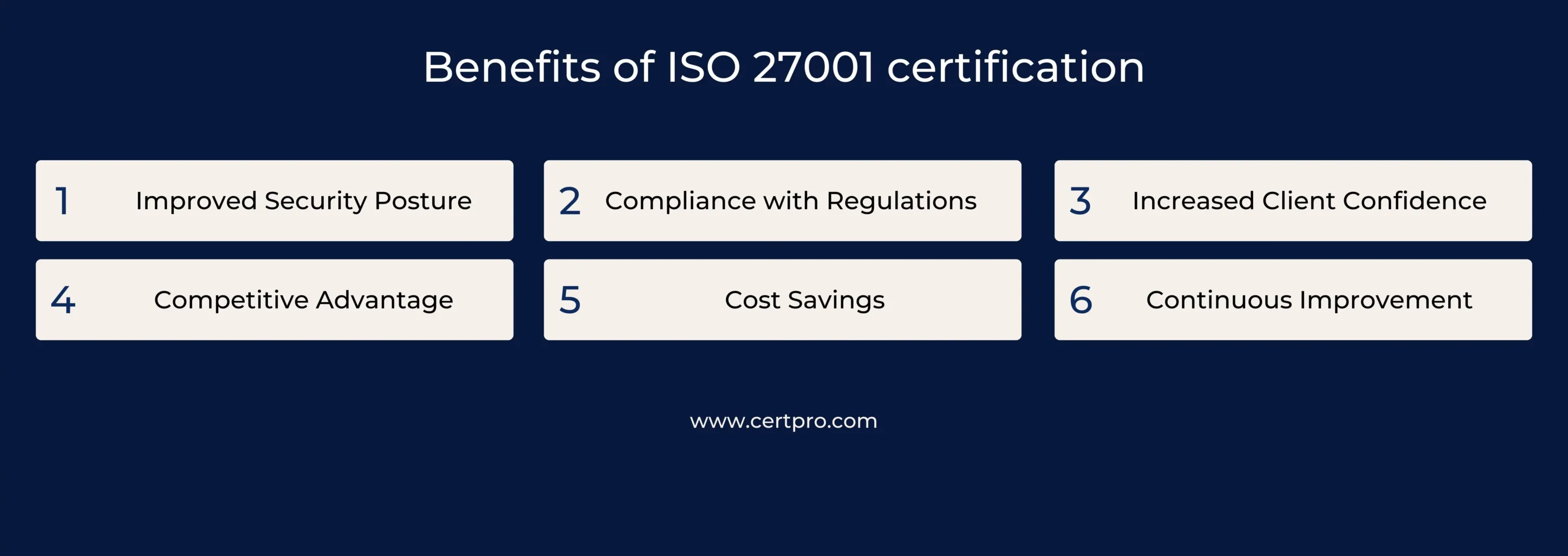
- ✓Independent Verification of ISMS Effectiveness
- ✓Structured Risk Management and Regulatory Alignment
- ✓Market Access and International Supply Chain Positioning
ISO 27001 Certification Scope and Independent Decision Framework
The scope of ISO 27001 certification defines the boundary within which the ISMS is evaluated, the controls that apply, and the certificate that is issued. The independent decision framework applied by CertPro ensures that all certification decisions are based solely on audit evidence and are made by a committee independent of the audit team.
Scope Definition and Boundary Determination
The ISMS scope defines which parts of the organization, which information assets, which processes, and which physical or virtual locations are covered by the management system — and therefore subject to the certification audit. Scope boundaries must be clearly documented and must reflect the organization’s actual operational environment.
For Ohio organizations with multiple office locations across Columbus, Cleveland, Cincinnati, Dayton, and Akron, the scope statement must address whether all locations are included, whether specific business units or product lines are excluded, and how interactions with out-of-scope systems or third parties are managed at the boundary. For cloud-native organizations, the scope must address how cloud-hosted infrastructure, third-party platform dependencies, and managed service providers are reflected in the ISMS.
The ISO 27001 assessment evaluates whether the defined scope is appropriately bounded — neither artificially narrow in a way that excludes material risks, nor so broad that it lacks meaningful audit coverage. CertPro auditors review the scope statement during Stage 1 and verify during Stage 2 that operational evidence is available for all in-scope processes, assets, and locations. Scope changes during the certification cycle require notification to CertPro and may trigger an interim scope review audit.
Independent Certification Committee and Certificate Validity
CertPro’s certification decision is made by an independent certification committee that reviews the complete audit record — including Stage 1 and Stage 2 audit reports, identified nonconformities, corrective action submissions, and the audit team’s certification recommendation. The committee is composed of individuals who did not participate in the audit, ensuring that the certification decision is independent of the audit team’s judgment.
The committee may approve certification, request additional evidence, require resolution of major nonconformities before certification, or decline certification based on audit findings. This governance structure is essential to the integrity of ISMS certification and clearly distinguishes an independently issued certificate from self-attestation or internally generated compliance declarations.
Upon a positive certification decision, CertPro issues an ISO 27001 certificate specifying the certified organization’s name, the defined ISMS scope, the standard version (ISO/IEC 27001:2022), the certification date, and the expiry date three years from initial certification. The certificate may be suspended or withdrawn if the organization fails to maintain the ISMS in conformance with the standard, fails to cooperate with surveillance audit activities, or experiences a material change in scope that has not been addressed through the defined change notification process. ISO 27001 Certification in Ohio remains valid throughout the three-year cycle for organizations that maintain their ISMS and complete annual surveillance audits on schedule.
Why Ohio Organizations Choose ISO 27001 Certification
Demand for ISO 27001 Certification in Ohio is driven by specific, identifiable factors: enterprise vendor security review requirements, sector-specific regulatory expectations, international market access needs, and the increasing baseline of information security assurance expected by enterprise procurement teams across Ohio’s technology, financial services, and healthcare ecosystems.
Enterprise Vendor Security Reviews and Procurement Requirements
A primary driver of ISO 27001 certification for Ohio companies is the enterprise vendor security review process. In this process, large organizations evaluate the information security posture of their technology vendors, SaaS providers, and cloud service partners before awarding contracts or renewing service agreements.
Ohio technology companies supplying software, infrastructure, or data processing services to enterprise clients in banking, insurance, healthcare, retail, and government sectors regularly encounter security questionnaires, vendor risk assessment forms, and contractual security requirements that reference ISO 27001 or request equivalent independently audited documentation. ISO 27001 certification obtained by Ohio technology organizations through CertPro’s audit program provides a standardized, independently verified response to these vendor review requirements — reducing the time and resources associated with individual client security assessments.
Enterprise procurement teams at large Ohio-based corporations — including those operating in Columbus’s banking and insurance sector or Cleveland’s healthcare and manufacturing ecosystem — similarly require their own technology vendors to demonstrate ISO 27001 certification or equivalent assurance as a condition of vendor qualification. This bidirectional procurement expectation reflects the standard’s central role in enterprise information security vendor management across Ohio.
Cybersecurity, AI, and Emerging Technology Organizations
Ohio’s growing cybersecurity and artificial intelligence sector — with concentrations in Columbus and Dayton including defense-adjacent technology companies, AI platform providers, and cybersecurity services firms — represents a significant and expanding demand base for ISO 27001 Certification in Ohio. Cybersecurity companies that hold ISO 27001 certification demonstrate that their own information security management is subject to the same level of independent scrutiny they recommend to their clients, providing an additional layer of credibility in client relationships.
AI platform and data analytics companies processing large volumes of proprietary or sensitive client data face increasing pressure from enterprise clients to demonstrate that data handling environments are independently audited. The ISO 27001 assessment that Ohio AI and data companies undergo through CertPro covers the full ISMS, including data classification, access control to training data and model outputs, incident response procedures, and third-party data processor management.
The ISO/IEC 27001:2022 standard’s updated Annex A controls include provisions specifically relevant to cloud services, secure development, and threat intelligence — directly addressing the risk profile of AI and cybersecurity technology organizations. As regulatory and client expectations around AI governance and data security continue to evolve, ISO 27001 certification provides an established, recognized framework for independently demonstrating that information security risks associated with AI and data systems are systematically managed.
FAQ
▶
What is ISO 27001 certification and why does it matter for Ohio organizations?
▶
Who issues ISO 27001 certification in Ohio?
▶
How long does the ISO 27001 audit process take in Ohio?
▶
What documents are required for an ISO 27001 audit in Ohio?
▶
How long is ISO 27001 certification valid in Ohio?
▶
Does ISO 27001 certification satisfy HIPAA or GLBA compliance requirements for Ohio organizations?
▶
What is the difference between an ISO 27001 Stage 1 and Stage 2 audit?
▶
Which Ohio sectors most commonly pursue ISO 27001 certification?
Get In Touch
have a question? let us get back to you.