
ISO 27001 Certification in Philadelphia
ISO 27001 Certification in Philadelphia is issued by CertPro CPA LLC, a Licensed CPA Firm operating as an independent third-party certification body. CertPro evaluates Information Security Management Systems against the requirements of ISO/IEC 27001:2022, issuing certification to organizations that demonstrate conformance through a structured, evidence-based audit process. Organizations across Philadelphia’s financial, technology, and healthcare sectors rely on this independent ISO 27001 Certification to satisfy vendor security requirements and demonstrate ISMS conformance.
OUR CLIENTS









ISO 27001 Certification for Philadelphia-Based Financial, Technology, and Healthcare Organizations
ISO 27001 Certification in Philadelphia is issued by CertPro CPA LLC, a Licensed CPA Firm operating as an independent third-party certification body. CertPro evaluates Information Security Management Systems against the requirements of ISO/IEC 27001:2022, issuing certification to organizations that demonstrate conformance through a structured, evidence-based audit process. Organizations across Philadelphia’s financial, technology, and healthcare sectors rely on this independent ISO 27001 Certification to satisfy vendor security requirements and demonstrate ISMS conformance.
Philadelphia’s Information Security Certification Landscape
Philadelphia’s regional economy encompasses a concentrated cluster of financial institutions, fintech companies, health technology organizations, academic medical centers, pharmaceutical manufacturers, biotechnology firms, life sciences enterprises, SaaS providers, cloud service providers, cybersecurity companies, education technology firms, e-commerce businesses, and AI-focused organizations. This breadth of data-intensive sectors creates a clearly defined demand for independent ISO 27001 Certification in Philadelphia.
Organizations operating across Center City, University City, the Navy Yard, King of Prussia, and the broader Greater Philadelphia region manage sensitive customer records, financial data, protected health information, proprietary research, and regulated clinical data. All of these data categories fall within the scope of an Information Security Management System audited under ISO/IEC 27001:2022, making information security audit a core operational requirement rather than an optional measure.
Philadelphia’s financial services sector includes federally regulated banks, insurance carriers, investment advisers, and a growing concentration of fintech firms developing payment infrastructure, lending platforms, and wealth management applications. These organizations regularly face enterprise vendor security reviews that require independently verified ISMS Certification as a condition of contract award.
Similarly, Philadelphia’s health technology ecosystem — anchored by academic medical centers, hospital networks, and digital health software developers operating across University City and surrounding neighborhoods — generates procurement requirements that reference ISO 27001 compliance as a baseline information security standard. Independent ISO 27001 Certification in Philadelphia from a Licensed CPA Firm satisfies these requirements through documented audit findings rather than self-attestation.
Pennsylvania’s regulatory environment reinforces information security accountability across sectors. The Pennsylvania Breach of Personal Information Notification Act imposes notification obligations on entities that experience unauthorized access to personal information, establishing a legal context in which documented ISMS controls carry both operational and legal significance.
While ISO 27001 Certification does not automatically establish compliance with Pennsylvania law, U.S. federal regulations, or industry-specific requirements such as HIPAA or GLBA, an independently audited ISMS provides documented evidence of security control design and operating effectiveness that supports broader compliance frameworks. CertPro’s information security audit evaluates organizations against the ISO/IEC 27001:2022 standard exclusively, without providing advisory, implementation, or consulting services. The certification decision reflects an objective assessment of whether the organization’s ISMS conforms to the standard’s requirements as evidenced during the audit.
CertPro’s Independent Certification Body Positioning in Philadelphia
CertPro CPA LLC functions exclusively as an independent certification body. The firm conducts third-party ISO 27001 audits, evaluating ISMS design and operating effectiveness against ISO/IEC 27001:2022 requirements. CertPro does not provide implementation services, policy drafting, risk treatment recommendations, or control design activities — functions that would compromise the independence required of a certification body.
This structural independence ensures that the certification decision reflects an objective, evidence-based assessment of the organization’s ISMS rather than a judgment influenced by prior advisory engagement. Philadelphia-based organizations seeking ISO 27001 Certification in Philadelphia engage CertPro specifically for the third-party audit and certification function, maintaining a clear separation between internal ISMS operations and the external information security audit process.
The ISO/IEC 27001:2022 standard, updated from the 2013 version, reduced the Annex A control set from 114 controls across 14 domains to 93 controls organized across four domains: Organizational, People, Physical, and Technological. The transition deadline for organizations previously certified under ISO/IEC 27001:2013 is October 31, 2025, as established by international certification bodies.
Organizations seeking new ISO 27001 Certification in Philadelphia must demonstrate conformance to the 2022 standard. CertPro’s audit program reflects the current standard’s requirements, including the management system clauses (Clauses 4 through 10) and the applicable Annex A controls selected and documented in the organization’s Statement of Applicability.

What Is ISO 27001 Certification?
ISO 27001 Certification is a formal, independently verified recognition that an organization’s Information Security Management System conforms to the requirements of ISO/IEC 27001:2022 — the internationally recognized standard for ISMS design, implementation, operation, monitoring, and continual improvement. Certification is issued by an independent third-party certification body following a structured information security audit process that evaluates both the design and operating effectiveness of the organization’s ISMS controls.
ISMS Certification demonstrates that an organization has established a systematic approach to managing information security risks, documented applicable controls, and maintained evidence of operational conformance across the certification scope. For Philadelphia organizations, this independently verified status directly supports vendor qualification, procurement eligibility, and regulatory documentation requirements.
ISO/IEC 27001:2022 Standard Structure and Requirements
ISO/IEC 27001:2022 is structured across ten clauses and an Annex A control reference set. Clauses 1 through 3 define the standard’s scope, normative references, and terminology. Clauses 4 through 10 constitute the management system requirements that organizations must satisfy to achieve and maintain ISMS Certification.
Clause 4 requires organizations to understand their organizational context and the expectations of interested parties. Clause 5 addresses leadership commitment and the establishment of an information security policy. Clause 6 covers planning, including risk assessment and risk treatment. Clause 7 addresses support requirements — resources, competence, awareness, communication, and documented information. Clause 8 governs operational planning and control. Clause 9 addresses performance evaluation through monitoring, measurement, internal audit, and management review. Clause 10 requires continual improvement through corrective action and ongoing ISMS refinement.
Annex A of ISO/IEC 27001:2022 provides 93 reference controls organized across four domains. The Organizational controls domain (37 controls) covers policies, roles, threat intelligence, information security in projects, supplier relationships, and incident management. The People controls domain (8 controls) addresses screening, terms and conditions, information security awareness, and disciplinary processes. The Physical controls domain (14 controls) covers physical security perimeters, equipment security, and clear desk and screen policies. The Technological controls domain (34 controls) addresses user endpoint devices, access control, cryptography, network security, data masking, data leakage prevention, monitoring, web filtering, and secure coding practices.
Organizations select applicable controls based on their risk assessment results and document their selections and justifications in a Statement of Applicability. The Statement of Applicability is a required artifact for ISO 27001 compliance and a central document reviewed during every ISO 27001 audit conducted by CertPro.
Key ISMS Documentation Requirements
ISO/IEC 27001:2022 mandates specific documented information as evidence of ISMS operation. The four foundational documents are: the Information Security Policy, which establishes management direction and commitment; the Risk Assessment Report, which documents identified risks, likelihood and impact assessments, and risk owners; the Risk Treatment Plan, which records selected treatment options and the controls chosen to address identified risks; and the Statement of Applicability, which lists all Annex A controls, indicates whether each is applicable or excluded, and provides justification for each decision.
Additional required documented information includes the ISMS scope definition, information security objectives, evidence of competence, operational planning records, internal audit results, management review records, and nonconformity and corrective action documentation. The completeness and accuracy of this documented information is directly assessed during the ISO 27001 audit conducted by CertPro, making thorough documentation preparation essential for Philadelphia organizations pursuing ISMS Certification.
| ISMS Document | ISO/IEC 27001:2022 Clause | Purpose |
|---|---|---|
| Information Security Policy | Clause 5.2 | Establishes management direction and commitment to information security |
| Risk Assessment Report | Clause 6.1.2 | Documents identified risks, likelihood and impact assessments, and risk ownership |
| Risk Treatment Plan | Clause 6.1.3 | Records selected controls and risk treatment decisions for identified information security risks |
| Statement of Applicability | Clause 6.1.3(d) | Lists all Annex A controls with applicability decisions and documented justifications for ISO 27001 compliance |
| Internal Audit Records | Clause 9.2 | Evidences systematic internal evaluation of ISMS conformance and operational effectiveness |
ISO 27001 Certification Audit Process for Organizations in Philadelphia
The ISO 27001 certification audit process follows a defined sequence of stages, from initial application through certification issuance and ongoing surveillance. CertPro conducts each stage as an independent certification body, maintaining objectivity throughout the full audit program. The process applies uniformly to Philadelphia-based organizations regardless of sector, size, or the specific systems and information assets within the ISMS scope.
Each stage produces documented outputs that form the basis for the final certification decision. Understanding this structured approach helps Philadelphia organizations plan their ISO 27001 Certification timeline and prepare the necessary documentation and control evidence at each phase.
The ISO 27001 audit process begins with an application review in which CertPro examines the organization’s defined ISMS scope, the nature of information assets included, the number of locations covered, and the complexity of the information processing environment. This review establishes the audit program structure — including the audit days required for Stage 1 and Stage 2 audits, the audit team composition, and the scheduling of surveillance and recertification activities.
For Philadelphia organizations operating across multiple sites — such as a fintech firm with offices in Center City and a data center at the Navy Yard — the audit program reflects the multi-site nature of the ISMS scope. The application review does not constitute an advisory engagement; it defines the parameters of the ISO 27001 Certification audit activity only.
The Stage 1 audit is a documentation-focused information security audit in which CertPro evaluates the completeness and conformance of the organization’s ISMS documentation. Auditors review the ISMS scope statement, Information Security Policy, Risk Assessment Report, Risk Treatment Plan, Statement of Applicability, and supporting documented information required by Clauses 4 through 10 of ISO/IEC 27001:2022.
The Stage 1 audit determines whether the organization’s documented ISMS is sufficiently developed to proceed to the Stage 2 field audit. Auditors identify any areas where documentation is absent, incomplete, or does not reflect the requirements of the standard. Stage 1 findings are communicated to the organization, and the Stage 2 audit is scheduled only when the Stage 1 review confirms that the ISMS documentation meets the threshold for operational assessment.
The Stage 1 ISO 27001 audit in Philadelphia may be conducted remotely, on-site at the organization’s primary operating location, or in a hybrid format depending on the scope and structure of the ISMS. For organizations with complex technical environments — such as healthcare IT providers operating clinical systems across multiple Philadelphia hospital networks, or SaaS vendors hosting customer data in multi-tenant cloud environments — the Stage 1 review includes examination of network architecture documentation, data flow diagrams, asset inventories, and supplier management records as they relate to the documented ISMS scope.
The Stage 1 output is a formal audit report identifying any areas requiring resolution before the Stage 2 information security audit proceeds.
The Stage 2 ISO 27001 audit evaluates the operational effectiveness of the ISMS controls within the defined scope. CertPro auditors examine evidence that documented controls are operating as designed, that risk treatment activities have been implemented, and that the management system processes — including internal audit, management review, and corrective action — are functioning in accordance with ISO/IEC 27001:2022 requirements.
Auditors sample control evidence across all applicable Annex A domains, interview personnel with information security responsibilities, and observe operational processes to assess conformance. Nonconformities identified during the Stage 2 audit are formally documented. The organization is then required to present a corrective action plan addressing each nonconformity. CertPro reviews the corrective actions for adequacy before the certification recommendation is finalized.
Following the nonconformity review, a CertPro certification committee — operating independently of the audit team — reviews the complete audit file and issues the certification decision. This structural separation between the audit team and the certification committee preserves the objectivity of the ISMS Certification outcome.
When ISO 27001 Certification is granted, CertPro issues the certificate specifying the organization’s name, the defined ISMS scope, the applicable standard version (ISO/IEC 27001:2022), the certification date, and the three-year certificate validity period. The certificate is subject to suspension or withdrawal if the organization fails to maintain ISMS conformance during the certification cycle, as determined through surveillance audit findings.
| Audit Stage | Key Activities | Output |
|---|---|---|
| Application Review | ISMS scope evaluation, audit program determination, audit team assignment | Audit program document |
| Stage 1 Audit | ISMS documentation review, Clauses 4–10 conformance check, Statement of Applicability review | Stage 1 audit report with findings |
| Stage 2 Audit | Control effectiveness testing, evidence sampling, personnel interviews for ISO 27001 compliance verification | Stage 2 audit report with nonconformities |
| Nonconformity Review | Corrective action plan evaluation, adequacy confirmation, closure of open findings | Closed nonconformity records |
| Certification Decision | Independent committee review of complete audit file, issuance decision | ISO/IEC 27001:2022 Certificate (3-year validity) |
- ✓Application Review and Audit Program Determination
- ✓Stage 1 Audit: Documentation Review and Readiness Assessment
- ✓Stage 2 Audit, Nonconformity Review, and Certification Decision
Surveillance Audits and Recertification for Philadelphia Organizations
ISO 27001 Certification in Philadelphia carries a three-year validity period, during which CertPro conducts annual surveillance audits to verify that the organization’s ISMS continues to conform to ISO/IEC 27001:2022 requirements. Surveillance audits are narrower in scope than the initial certification audit but include assessment of key management system processes, selected Annex A control domains, any changes to the ISMS scope or environment, and the status of corrective actions from prior audits.
Organizations that undergo significant operational changes — such as a Philadelphia health technology company expanding into new clinical data processing activities, or a fintech firm acquiring additional systems that fall within the ISMS scope — must notify CertPro so that the audit program can be updated to reflect the revised scope and maintain uninterrupted ISO 27001 Certification status.
Surveillance Audit Structure and Scope
Surveillance audits are conducted annually — typically in the first and second years following initial certification — and focus on a rotating selection of ISMS processes and Annex A control domains. CertPro auditors assess management review records, internal audit results, information security incident records, corrective action status, and changes in the risk treatment landscape.
For Philadelphia organizations in regulated sectors, surveillance audits provide ongoing documented evidence of ISMS operational continuity, which directly supports vendor security questionnaire responses and enterprise procurement reviews. The surveillance audit produces a formal audit report. Organizations that fail to maintain ISO 27001 compliance may receive nonconformities requiring corrective action within defined timeframes. Failure to resolve major nonconformities within the specified period may result in certification suspension.
Recertification Audit at Three-Year Cycle Completion
At the end of the three-year certification cycle, CertPro conducts a recertification audit to evaluate the continued conformance and effectiveness of the organization’s ISMS. The recertification audit is more comprehensive than annual surveillance audits and examines all major management system processes and a broader sample of Annex A controls.
Recertification audits review the organization’s performance across the full three-year period, including the results of internal audits, management reviews, corrective actions, and any changes to the ISMS scope, risk environment, or organizational structure. Successful completion of the recertification audit results in the issuance of a renewed ISO 27001 Certification with a new three-year validity period. Philadelphia organizations should initiate the recertification scheduling process with CertPro sufficiently in advance of their certificate expiry date to maintain uninterrupted certification status.
Why Philadelphia Organizations Pursue ISO 27001 Certification
Organizations across Philadelphia’s financial, technology, healthcare, and life sciences sectors pursue ISO 27001 Certification in Philadelphia in response to defined procurement requirements, contractual obligations, regulatory expectations, and competitive positioning considerations. The certification provides independently verified evidence of ISMS conformance — a standard form of assurance recognized across enterprise vendor management programs, financial sector supplier reviews, and international technology procurement processes.
Several sector-specific drivers make ISO 27001 Certification particularly valuable in the Philadelphia market, spanning fintech vendor qualification, healthcare IT procurement, and SaaS enterprise sales requirements.
Financial Services and Fintech Sector Demand
Philadelphia’s financial services sector — encompassing federally regulated depository institutions, insurance companies, investment firms, and fintech organizations developing payment, lending, and wealth management platforms — generates substantial demand for ISO 27001 compliance among technology vendors serving these institutions. Banks and insurance carriers operating under federal and Pennsylvania state oversight conduct structured vendor security assessments that evaluate whether third-party software and service providers maintain independently certified information security controls.
ISO 27001 Certification in Philadelphia for companies providing financial technology products or data processing services satisfies these vendor due diligence requirements with documented, third-party-verified evidence. Fintech firms seeking to expand their institutional client base in Philadelphia’s financial corridor benefit from ISMS Certification as a differentiating qualification in competitive procurement evaluations.
Healthcare Technology and Life Sciences Organizations
University City’s concentration of academic medical centers, research hospitals, and digital health technology companies creates a sector-specific demand for information security certification that extends beyond HIPAA technical safeguard compliance. Healthcare technology vendors providing electronic health record integrations, clinical decision support platforms, telehealth infrastructure, or medical device software to Philadelphia health systems are evaluated through vendor security review processes that reference ISO 27001 audit findings as an acceptable evidence standard for ISMS assurance.
Pharmaceutical companies and biotechnology firms based in Philadelphia — managing clinical trial data, proprietary research assets, and regulatory submission documentation — similarly operate in an environment where supply chain information security reviews reference ISO/IEC 27001:2022 conformance. ISO 27001 Certification in Philadelphia’s healthcare IT sector represents a distinct demand category driven by the density of life sciences activity across Greater Philadelphia.
SaaS Providers, Cloud Vendors, and Enterprise Technology Organizations
SaaS providers and cloud service vendors headquartered in Philadelphia or operating within the Greater Philadelphia technology ecosystem — including organizations at the Navy Yard technology campus and King of Prussia business parks — regularly encounter enterprise procurement requirements that specify ISO 27001 Certification as a prerequisite for vendor registration or contract execution.
Enterprise procurement programs evaluate SaaS vendors through structured security questionnaire processes in which ISO/IEC 27001:2022 certification, issued by an independent certification body, serves as documented evidence of ISMS conformance. This eliminates the need for lengthy individual security reviews and accelerates vendor approval. Philadelphia-based SaaS companies pursuing international expansion into European markets — where ISO 27001 compliance is often contractually required — similarly rely on ISMS Certification to satisfy cross-border procurement requirements without undergoing separate country-by-country security assessments.
Benefits of ISO 27001 Certification for Philadelphia-Based Organizations
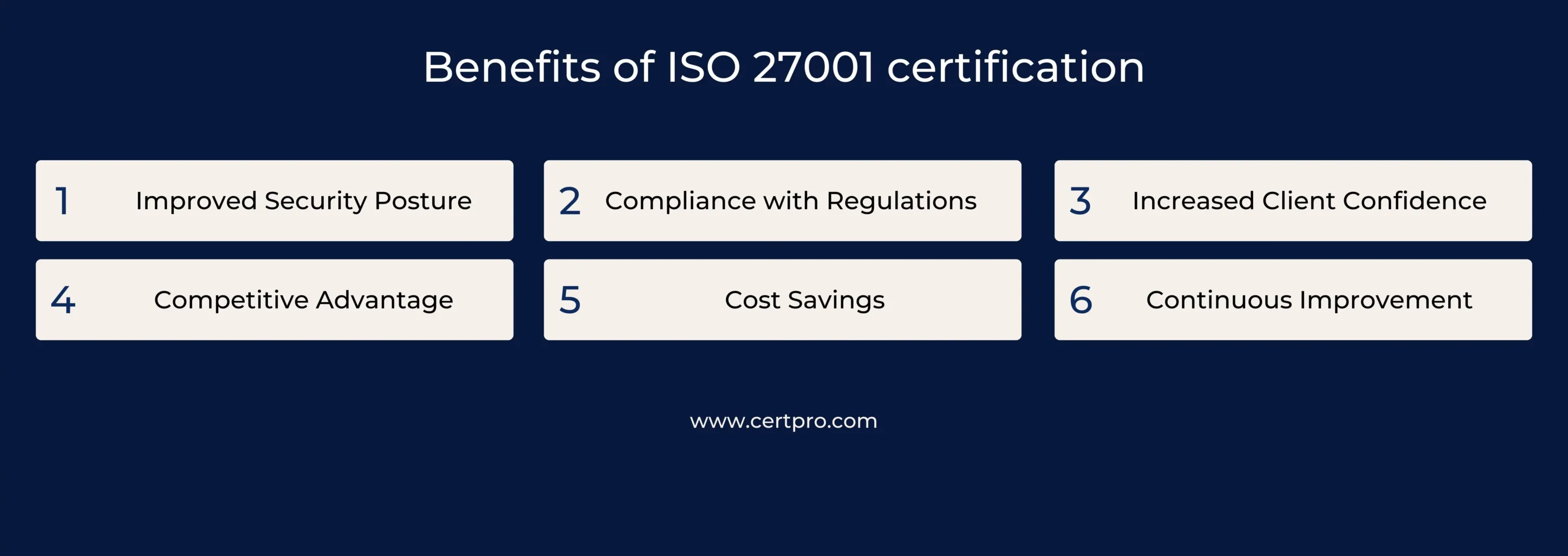
ISO 27001 Certification delivers measurable, documented benefits for Philadelphia organizations across financial services, healthcare technology, pharmaceutical, SaaS, cloud, and enterprise sectors. The following benefits reflect the operational and commercial outcomes associated with independently verified ISMS Certification under ISO/IEC 27001:2022. Each benefit is stated in objective terms consistent with the certification body’s evidence-based assessment framework.
- ✓Independent verification of ISMS control design and operating effectiveness, documented through a structured third-party information security audit process
- ✓Demonstrated ISO 27001 compliance through a certificate recognized in enterprise vendor management, financial sector procurement, and international technology contracts
- ✓Systematic identification and treatment of information security risks through a documented risk assessment and risk treatment framework aligned to ISO/IEC 27001:2022 Clause 6
- ✓Structured Annex A control coverage across Organizational, People, Physical, and Technological domains, providing auditable evidence of security control implementation
- ✓Ongoing ISMS oversight through annual surveillance audits, providing continuous third-party monitoring of control effectiveness across the three-year ISO 27001 Certification cycle
- ✓Support for broader compliance frameworks — including HIPAA technical safeguard documentation, GLBA information security program requirements, and Pennsylvania data security obligations — through documented ISMS controls
- ✓Competitive differentiation in Philadelphia’s financial technology, healthcare IT, and SaaS procurement markets, where ISMS Certification is a recognized qualification criterion
- ✓Documented evidence of continual improvement through internal audit results, management review records, and corrective action processes assessed during each CertPro ISO 27001 audit
The ISO/IEC 27001:2022 risk assessment and risk treatment framework requires organizations to systematically identify information assets, assess threats and vulnerabilities, evaluate risk likelihood and impact, select risk treatment options, and implement controls to address accepted risks. This documented risk management process — verified through the ISO 27001 audit conducted by CertPro — produces an auditable record of the organization’s information security decision-making.
For Philadelphia organizations managing sensitive financial data, protected health information, proprietary pharmaceutical research, or personally identifiable customer records, the documented risk treatment process provides traceable evidence of management accountability for information security risks. This documentation supports responses to regulatory inquiries, insurance underwriting assessments, and board-level information security reporting requirements.
ISO 27001 Certification in Philadelphia provides a standardized assurance instrument that organizations can present to enterprise customers, institutional partners, and regulatory reviewers in response to third-party security assessment requests. Rather than responding to individualized security questionnaires with self-attested answers, ISO/IEC 27001:2022-certified organizations can reference their current certificate and the supporting audit findings as documented evidence of ISMS conformance.
This approach reduces the administrative burden associated with vendor security reviews and provides enterprise customers with independently verified information rather than self-reported assessments. Philadelphia fintech firms serving bank clients, healthcare IT vendors serving hospital systems, and SaaS providers serving enterprise organizations across regulated sectors all benefit from the standardized assurance value of ISMS Certification in vendor qualification processes.
- ✓Risk Management and Security Posture Documentation
- ✓Vendor Assurance and Third-Party Risk Management Support
ISO 27001 Certification Scope and Independent Decision Framework
The scope of ISO 27001 Certification is defined by the organization and documented in the ISMS scope statement, which is reviewed during the Stage 1 information security audit. The scope specifies the boundaries and applicability of the ISMS, including the organizational units, locations, information assets, processes, and systems covered by the certified ISMS.
CertPro evaluates the defined scope for adequacy and assesses whether the ISMS boundaries are clearly defined and consistently maintained across the organization’s operations. A well-defined scope is essential for achieving ISO 27001 Certification and ensuring the audit findings accurately reflect the organization’s information security posture.
Defining ISMS Scope for Philadelphia Organizations
Philadelphia organizations define their ISMS scope based on the information assets, processes, and environments for which they seek certification. A Philadelphia SaaS provider may scope its ISMS to the software development, hosting, and customer support functions associated with a specific product platform. A financial services organization may scope its ISMS to the technology systems and processes supporting a defined line of business. A healthcare technology company may scope its ISMS to the clinical data processing systems serving hospital network clients.
The scope must be documented clearly, including the exclusion of any Annex A controls that the organization determines are not applicable, with justifications provided in the Statement of Applicability. CertPro auditors assess whether the scope accurately reflects the organization’s information processing activities and whether any exclusions are appropriately justified in support of ISO 27001 compliance.
Independent Certification Committee and Certificate Maintenance
CertPro’s certification decision is made by a certification committee that operates independently of the audit team. This separation ensures that the decision to grant, maintain, suspend, or withdraw ISO 27001 Certification is based on an objective review of the complete audit file rather than the judgment of the auditors who conducted the fieldwork. The certification committee reviews audit reports, nonconformity records, corrective action evidence, and audit team recommendations before issuing a final decision.
The ISO 27001 certificate, once issued, specifies the certification scope, the applicable standard version, the certification date, and the three-year validity period. Certificate maintenance is contingent on satisfactory surveillance audit results throughout the certification cycle. Significant nonconformities identified during surveillance audits that are not resolved within specified timeframes may result in suspension or withdrawal of certification.
ISO 27001 Compliance and Annex A Control Domains
ISO 27001 compliance requires organizations to implement and maintain controls addressing the specific information security risks identified through their risk assessment process. The 93 controls in Annex A of ISO/IEC 27001:2022 serve as a reference set from which organizations select applicable controls based on their risk treatment decisions.
The selection of controls is documented in the Statement of Applicability, which is a mandatory element of ISO 27001 compliance and a primary document reviewed during the ISO 27001 audit conducted by CertPro auditors. Proper Annex A control selection and documentation is one of the most critical steps Philadelphia organizations must complete before pursuing ISO 27001 Certification.
Organizational and People Controls
The Organizational controls domain (37 controls) covers the policy, governance, and management-level information security requirements that establish the foundation of an ISO/IEC 27001:2022-conformant ISMS. Key organizational controls include information security policies, roles and responsibilities, segregation of duties, management responsibilities, contact with authorities and special interest groups, threat intelligence, information security in project management, asset management, acceptable use, return of assets, classification and labeling, supplier relationships, incident management, and business continuity planning.
The People controls domain (8 controls) addresses the human element of information security — including screening procedures for personnel with access to sensitive information, terms and conditions of employment, information security awareness, education and training programs, and the information security disciplinary process. CertPro’s ISO 27001 audit evaluates evidence of these controls’ design and operation within the defined ISMS scope.
Physical and Technological Controls
The Physical controls domain (14 controls) addresses the security of physical locations, equipment, and environmental factors that affect information assets. Physical controls include physical security perimeters, entry controls, securing offices and facilities, physical security monitoring, protection against environmental threats, working in secure areas, clear desk and clear screen policies, equipment siting and protection, and secure disposal or reuse of equipment. For Philadelphia organizations operating data centers, secure office environments, or laboratory facilities containing sensitive information, physical control evidence is evaluated during Stage 2 of the ISO 27001 audit process.
The Technological controls domain (34 controls) encompasses technical measures including user endpoint device management, privileged access rights, access control systems, authentication mechanisms, cryptographic controls, network segmentation, data masking, data leakage prevention, backup procedures, logging and monitoring, web filtering, secure coding practices, and vulnerability management. CertPro auditors sample technical evidence across applicable technological controls during the Stage 2 information security audit to assess ISO 27001 compliance.
Philadelphia Sectors Requiring ISO 27001 Certification
ISO 27001 Certification in Philadelphia addresses the information security assurance requirements of a broad range of sectors present in the Greater Philadelphia region. The following sectors represent the primary market for ISMS Certification in Philadelphia, each with distinct procurement, regulatory, or contractual drivers that reference ISO/IEC 27001:2022 conformance as an acceptable evidence standard for third-party security assurance.
| Philadelphia Sector | Primary ISO 27001 Demand Driver | Relevant Data Categories |
|---|---|---|
| Fintech and Financial Services | Bank and insurance vendor security reviews; ISO 27001 compliance requirements for financial technology vendors | Financial records, payment data, customer account information |
| Healthcare Technology and Health IT | Hospital network vendor qualification; ISO 27001 Certification in Philadelphia for healthcare IT suppliers | Protected health information, clinical records, EHR integration data |
| Pharmaceutical and Life Sciences | Clinical trial data security; supply chain information security audit requirements | Clinical data, proprietary research, regulatory submission records |
| SaaS and Cloud Service Providers | Enterprise procurement qualification; international expansion ISO 27001 audit requirements | Customer data, SaaS platform data, multi-tenant information assets |
| Education Technology and Universities | Institutional data governance; student record security reviews requiring ISMS Certification | Student records, research data, institutional information assets |
Cybersecurity, AI, and Emerging Technology Organizations
Philadelphia’s emerging technology sector includes cybersecurity firms, artificial intelligence companies, e-commerce platforms, and insurtech organizations that handle sensitive customer, financial, and behavioral data at scale. Cybersecurity companies seeking to demonstrate their own information security posture through independent audit — separate from the security products or services they provide to clients — pursue ISO 27001 Certification as evidence of ISMS conformance in their own operating environment.
AI companies managing training datasets, model outputs, and customer interaction records benefit from ISMS Certification in enterprise sales processes where customers require documented security assurance from AI vendors. E-commerce and insurtech firms handling payment card data, insurance records, and consumer behavioral profiles similarly encounter contractual and procurement requirements referencing ISO 27001 audit findings as a recognized assurance mechanism for vendor qualification.
Insurance and Professional Services Organizations
Insurance organizations operating in Pennsylvania — subject to state insurance department oversight and federal regulatory expectations — manage policyholder records, actuarial data, claims information, and underwriting data that require structured information security controls. ISO 27001 Certification provides these organizations with an independently verified ISMS framework that documents control design and effectiveness for data categories subject to both Pennsylvania insurance regulations and broader privacy expectations.
Professional services firms handling client financial records, legal documents, or sensitive business information similarly benefit from ISMS Certification as a documented assurance instrument in client onboarding and vendor qualification processes. CertPro conducts the ISO 27001 audit for these organizations using the same structured, evidence-based approach applied across all other Philadelphia sectors, maintaining consistent information security audit standards regardless of organizational size or industry classification.
FAQ
▶
What is ISO 27001 Certification and who issues it in Philadelphia?
▶
How long does the ISO 27001 audit process take for a Philadelphia organization?
▶
What documents must a Philadelphia organization prepare for the ISO 27001 audit?
▶
Does ISO 27001 Certification establish HIPAA or Pennsylvania regulatory compliance?
▶
What is the difference between the Stage 1 and Stage 2 ISO 27001 audits?
▶
How many Annex A controls does ISO/IEC 27001:2022 include, and are all required?
▶
What happens during surveillance audits after ISO 27001 Certification is issued?
▶
Which Philadelphia sectors most commonly pursue ISO 27001 Certification?
Get In Touch
have a question? let us get back to you.