
ISO 27001 Certification in Phoenix
The ISO 27001 certification audit process for Phoenix-based organizations follows a structured, multi-stage methodology conducted by CertPro as an independent certification body. Each stage is designed to evaluate a distinct aspect of the organization’s ISMS — from documentation and planning through operational controls and continual improvement. The process produces objective, evidence-based audit findings that inform the certification committee’s decision. The stages below describe the standard ISO 27001 audit Phoenix organizations undergo when seeking ISO 27001 Certification in Phoenix through CertPro.
OUR CLIENTS










Independent ISO 27001 Certification by a Licensed CPA Firm in Phoenix
ISO 27001 Certification in Phoenix is pursued by organizations across Arizona’s technology, healthcare, financial services, semiconductor, aerospace, and cloud computing sectors to obtain independent, third-party verification that their Information Security Management System conforms to the requirements of ISO/IEC 27001:2022. CertPro operates as a Licensed CPA Firm and independent certification body, conducting objective, evidence-based ISO 27001 certification audits for Phoenix-based organizations. CertPro does not provide consulting, implementation, or advisory services — its role is strictly that of an independent evaluator assessing conformity against the ISO 27001 standard.
Phoenix has emerged as one of the most dynamic business and technology ecosystems in the American Southwest. The Valley of the Sun hosts a substantial concentration of technology companies, SaaS providers, cybersecurity firms, semiconductor manufacturers, aerospace and defense contractors, cloud service providers, data center operators, healthcare technology organizations, financial services institutions, and fintech companies. Organizations operating across these sectors routinely face vendor security questionnaires, procurement qualification requirements, and regulatory expectations that necessitate independent ISO 27001 compliance verification from a recognized third-party certification body.
The ISO/IEC 27001:2022 standard — the most recent revision, which reduced the number of Annex A controls from 114 to 93 across four control domains — defines requirements for establishing, implementing, maintaining, and continually improving an Information Security Management System. Certification against this standard is obtained through a structured ISO 27001 certification audit conducted by an accredited or independent third-party certification body. CertPro’s ISO 27001 audit evaluates conformity with all mandatory clauses of ISO/IEC 27001:2022 (Clauses 4 through 10) and reviews the organization’s Statement of Applicability and risk treatment decisions against the applicable Annex A controls.
For Phoenix companies competing in enterprise markets — whether selling SaaS to regulated healthcare organizations, providing cloud infrastructure to financial institutions, supplying technology services to government agencies, or operating as a third-party processor of sensitive personal data — ISO 27001 certification functions as a recognized, independently verified credential. Enterprise procurement teams, vendor risk management programs, and information security governance frameworks across regulated industries regularly request or require ISO 27001 certification in Phoenix as a condition of vendor qualification. Independent certification by a Licensed CPA Firm such as CertPro provides the objective assurance that procurement teams and information security officers require.
CertPro’s ISO 27001 audit methodology is structured around objective evidence collection, documented information review, personnel interviews, and technical control observation. The certification process follows a two-stage audit structure, culminating in a certification committee decision and the issuance of an ISO 27001 certificate covering the defined scope of the organization’s ISMS. Certified organizations are subject to ongoing surveillance audits to confirm continued conformity, with a full recertification audit required at the end of the three-year certification cycle. This structured approach ensures that ISO 27001 Certification in Phoenix reflects an independently verified, point-in-time assessment of a real, functioning information security management system — not a self-declared posture.

What Is ISO 27001 Certification?
ISO 27001 certification is the formal process through which an independent third-party certification body evaluates and confirms that an organization’s Information Security Management System conforms to the requirements set out in ISO/IEC 27001:2022. Certification is not self-declared — it requires a structured ISO 27001 audit conducted by a qualified external body, resulting in an independently issued certificate that specifies the organization’s name, the defined ISMS scope, the audit standard version, and the certificate validity period. The ISO 27001 standard is published jointly by the International Organization for Standardization (ISO) and the International Electrotechnical Commission (IEC) and is internationally recognized as the definitive framework for information security management.
The ISO/IEC 27001:2022 Standard and ISMS Requirements
The ISO 27001 standard specifies requirements for establishing, implementing, maintaining, and continually improving an Information Security Management System within the context of the organization’s overall business objectives and risk environment. The management system requirements are defined in Clauses 4 through 10, covering organizational context, leadership and commitment, planning (including information security risk assessment and risk treatment), support, operation, performance evaluation, and continual improvement. These clauses form the mandatory framework against which the ISO 27001 certification audit evaluates conformity. No clause may be excluded — partial conformity does not result in certification.
Annex A of ISO/IEC 27001:2022 lists 93 information security controls organized across four domains: Organizational controls (37 controls), People controls (8 controls), Physical controls (14 controls), and Technological controls (34 controls). These controls are referenced — not automatically applied — based on the organization’s risk assessment results and risk treatment decisions. The organization must produce a Statement of Applicability (SoA) that documents which Annex A controls are applicable, which are implemented, and the justification for any exclusions. During the ISO ISMS Audit, the auditor reviews the SoA and evaluates whether control implementation is consistent with the organization’s documented risk treatment plan.
Key ISMS Documentation Evaluated During Certification
ISO 27001 compliance requires organizations to maintain a defined set of documented information as mandatory evidence of ISMS operation. The four foundational documents reviewed during any ISO 27001 audit are the information security policy, the information security risk assessment, the risk treatment plan, and the Statement of Applicability. Beyond these, organizations must maintain evidence of internal audit activity, management review outcomes, corrective actions, and control implementation records. The auditor evaluates whether these documents are current, properly authorized, accessible, and reflect the actual state of the ISMS — not aspirational or template-based content disconnected from the organization’s real operations and risk environment.
- ✓Information Security Policy — defining management commitment, objectives, and scope
- ✓Information Security Risk Assessment — identifying, analyzing, and evaluating risks
- ✓Risk Treatment Plan — documenting selected controls and treatment options
- ✓Statement of Applicability (SoA) — referencing Annex A controls with inclusion/exclusion rationale
- ✓Internal Audit Records — evidence of periodic ISMS self-assessment
- ✓Management Review Minutes — documented leadership review of ISMS performance
- ✓Corrective Action Records — evidence of nonconformity identification and resolution
- ✓Control Implementation Evidence — operational records supporting deployed Annex A controls
ISO 27001 Certification Audit Process in Phoenix
The ISO 27001 certification audit process for Phoenix-based organizations follows a structured, multi-stage methodology conducted by CertPro as an independent certification body. Each stage is designed to evaluate a distinct aspect of the organization’s ISMS — from documentation and planning through operational controls and continual improvement. The process produces objective, evidence-based audit findings that inform the certification committee’s decision. The stages below describe the standard ISO 27001 audit Phoenix organizations undergo when seeking ISO 27001 Certification in Phoenix through CertPro.
| Audit Stage | Key Activities | Output |
|---|---|---|
| Application Review | Scope definition, ISMS boundary confirmation, audit program determination | Confirmed audit scope and program |
| Stage 1 Audit | Documentation review, ISMS readiness assessment, identification of Stage 2 focus areas | Stage 1 findings report |
| Stage 2 Audit | Evidence collection, control testing, personnel interviews, technical observation | Audit findings and nonconformity report |
| Nonconformity Review | Evaluation of corrective actions submitted by the organization | Closure confirmation or escalation |
| Certification Decision | Independent certification committee review of audit evidence and findings | ISO 27001 certificate issuance |
The Stage 1 audit is a documentation-focused evaluation conducted before the field-based Stage 2 audit. During Stage 1, the auditor reviews the organization’s mandatory ISMS documentation — including the information security policy, risk assessment methodology and results, risk treatment plan, Statement of Applicability, and internal audit and management review records — to confirm that the ISMS has been formally established. This review also verifies that documented information is sufficient to support a meaningful Stage 2 evaluation. The Stage 1 audit confirms the defined audit scope, identifies any significant documentation gaps, and determines the specific focus areas, high-risk processes, and control domains that will be examined during Stage 2.
For Phoenix technology and SaaS organizations, Stage 1 frequently surfaces areas where cloud service dependencies, third-party processor relationships, or multi-site ISMS scopes require additional clarification before Stage 2 proceeds. The Stage 1 findings report documents the auditor’s observations and confirms whether the organization is prepared to advance. If significant gaps are identified, Stage 2 may be deferred until the organization addresses the documented concerns. This staged approach is a defining feature of the ISO 27001 certification audit process and ensures that Stage 2 audit resources are deployed effectively against a verifiable ISMS foundation.
The Stage 2 audit is the primary field-based certification audit, during which CertPro’s auditors collect and evaluate objective evidence of ISMS operation. Evidence collection methods include document and record review, interviews with personnel responsible for information security processes, direct observation of technical controls and physical security measures, and inspection of system configurations, access control records, incident logs, and monitoring outputs. The auditor evaluates whether the ISMS is operating as documented and whether implemented controls are consistent with the organization’s risk treatment plan and Statement of Applicability. The ISO 27001 certification audit at this stage assesses both the design and operational effectiveness of controls across all Annex A domains applicable to the defined ISMS scope.
For Phoenix-area organizations operating cloud infrastructure, hybrid environments, or complex multi-tenant architectures, the Stage 2 ISO ISMS Audit examines technological controls including access management, encryption, vulnerability management, network security, security monitoring, and supplier relationship management. The auditor evaluates evidence that these controls are functioning as intended and that the organization has mechanisms to detect, respond to, and recover from information security incidents. Nonconformities identified during Stage 2 are documented with specific reference to the ISO 27001 standard clause or Annex A control against which the finding applies. Organizations must address all major nonconformities before the certification committee can issue a certificate.
ISO 27001 certification is valid for a three-year period, during which certified organizations are subject to annual surveillance audits conducted by CertPro. Surveillance audits verify that the ISMS continues to conform to ISO/IEC 27001:2022 requirements and that the organization maintains the controls and processes evaluated during the initial certification audit. Surveillance audits are narrower in scope than the full certification audit but include review of internal audit records, management review outcomes, corrective action closure, and any significant changes to the ISMS scope or operating environment. At the end of the three-year cycle, a full recertification audit is conducted to renew the ISO 27001 certificate for a further three years.
- ✓Stage 1 Audit: Documentation and Readiness Review
- ✓Stage 2 Audit: Evidence Collection and Control Evaluation
- ✓Surveillance Audits and Recertification
ISO 27001 Requirements: What Phoenix Organizations Must Establish
ISO 27001 compliance requires Phoenix-based organizations to establish a formal Information Security Management System that addresses all mandatory requirements of ISO/IEC 27001:2022 prior to submitting to a certification audit. The organization — not the certification body — is responsible for designing, implementing, and operating its ISMS. CertPro’s role is exclusively to evaluate whether the ISMS conforms to the standard’s requirements through an independent ISO 27001 audit. The following sections describe the principal requirements organizations must address and that auditors evaluate during the ISO 27001 certification audit process.
ISO/IEC 27001:2022 Clause 6 requires organizations to establish and apply an information security risk assessment process that identifies risks associated with the loss of confidentiality, integrity, and availability of information within the ISMS scope. The risk assessment must be conducted at planned intervals and whenever significant changes occur. Risk owners must be identified, and risks must be analyzed and evaluated against defined risk acceptance criteria. The outputs of the risk assessment directly inform the risk treatment plan, which documents the organization’s selected treatment options — including which Annex A controls are implemented — and the residual risk accepted by management.
During the ISO 27001 audit, auditors examine the risk assessment methodology for logical consistency and completeness. The auditor verifies that the risk assessment covers all assets, processes, and locations within the defined ISMS scope and that risk treatment decisions are traceable to the Statement of Applicability. Phoenix organizations operating in sectors such as healthcare technology, financial services, and cloud computing frequently have complex risk landscapes that include cloud service dependencies, third-party data processors, remote workforce risks, and regulatory data handling requirements. The ISO 27001 certification audit evaluates whether the organization’s risk assessment methodology adequately addresses these sector-specific risk dimensions within the defined ISMS boundary.
ISO/IEC 27001:2022 Clause 9 requires organizations to conduct internal ISMS audits at planned intervals to confirm that the management system conforms to both the organization’s own requirements and the requirements of the ISO 27001 standard, and that the ISMS is effectively implemented and maintained. Internal audits must be conducted by personnel who are objective and impartial with respect to the processes being audited — meaning individuals responsible for operating controls cannot audit their own work. Internal audit records, including audit programs, findings, and evidence of follow-up actions, are reviewed as mandatory evidence during the ISO 27001 certification audit.
Management review, required under Clause 9.3, mandates that top management periodically evaluate the ISMS to confirm its continuing suitability, adequacy, and effectiveness. The management review must consider internal and external issues affecting the ISMS, information security performance data, feedback from interested parties, risk assessment results, and opportunities for continual improvement. Documented management review outputs must address decisions and actions related to ISMS changes and resource requirements. The ISO ISMS Audit examines management review records to confirm that leadership engagement is genuine, documented, and generates actionable outcomes — not merely a compliance checkbox exercise.
| Annex A Domain | Number of Controls | Example Controls Evaluated |
|---|---|---|
| Organizational Controls | 37 | Information security policies, roles and responsibilities, supplier security, incident management |
| People Controls | 8 | Screening, terms of employment, security awareness, disciplinary process |
| Physical Controls | 14 | Physical security perimeters, clear desk/screen, equipment siting, secure disposal |
| Technological Controls | 34 | Access control, cryptography, network security, vulnerability management, monitoring |
- ✓Information Security Risk Assessment and Risk Treatment
- ✓Internal Audit and Management Review Requirements
- ✓Annex A Control Domains Evaluated During ISO 27001 Audit
Industries in Phoenix Seeking ISO 27001 Certification
ISO 27001 Certification in Phoenix is sought by organizations across a wide range of industries that handle sensitive information, operate critical technology infrastructure, or supply services to regulated enterprise customers. Phoenix’s economic diversity — spanning semiconductor fabrication, aerospace manufacturing, healthcare systems, financial services, cloud computing, SaaS development, and government technology — creates extensive demand for independent ISO 27001 compliance verification. The following industries represent the primary drivers of ISO 27001 certification audit demand in the Phoenix metropolitan area.
Technology, SaaS, and Cloud Service Providers
Phoenix has developed a substantial technology sector, with SaaS companies, cloud platform providers, managed service providers, and cybersecurity firms forming a significant portion of the regional economy. Technology organizations serving enterprise customers — particularly those in regulated industries such as healthcare, financial services, or government — routinely face procurement requirements that specify ISO 27001 certification as a vendor qualification criterion. ISO 27001 certification audit Phoenix engagements for technology and SaaS companies frequently cover ISMS scopes that include cloud-hosted production environments, software development pipelines, customer data processing systems, and third-party API integrations. The certification provides independently verified assurance that the technology provider’s information security controls have been assessed against the ISO 27001 standard by a qualified external auditor.
Cloud service providers and data center operators in the Phoenix Valley — which hosts multiple large-scale data center facilities due to favorable climate, power access, and land availability — also pursue ISO 27001 Certification in Phoenix to satisfy contractual and enterprise customer requirements. These organizations frequently maintain ISO 27001 certification alongside other frameworks such as SOC 2, demonstrating a layered approach to independent information security assurance. The ISO 27001 standard’s structured ISMS framework is particularly well suited to cloud infrastructure organizations, where systematic risk assessment, supplier management, access control, and cryptographic controls are central to information security governance.
Healthcare, Financial Services, and Regulated Industries
Phoenix is home to a large healthcare ecosystem, including major health systems, hospital networks, health technology companies, health information exchanges, and medical device manufacturers. Healthcare organizations and their technology suppliers handle protected health information subject to HIPAA requirements, and many use ISO 27001 certification as a complementary framework for demonstrating structured information security governance to business partners, payers, and regulatory bodies. ISO 27001 compliance Phoenix engagements in the healthcare sector often cover ISMS scopes addressing electronic health record systems, patient portal platforms, medical device connectivity, and clinical data analytics environments. The ISO 27001 standard’s risk-based approach aligns naturally with HIPAA’s risk analysis and risk management requirements.
Phoenix’s financial services sector — which includes regional banks, credit unions, insurance companies, mortgage servicers, payment processors, and a growing fintech ecosystem — represents another significant source of ISO 27001 certification demand. Financial institutions subject to GLBA, PCI DSS, state banking regulations, and federal examination requirements increasingly request ISO 27001 certification from their technology vendors and third-party service providers as evidence of structured information security management. Semiconductor and electronics manufacturers, aerospace and defense contractors, and telecommunications companies operating in the Phoenix area also pursue ISO 27001 Certification in Phoenix to satisfy supply chain security requirements and government contractor information security expectations.
Benefits of ISO 27001 Certification for Phoenix-Based Organizations
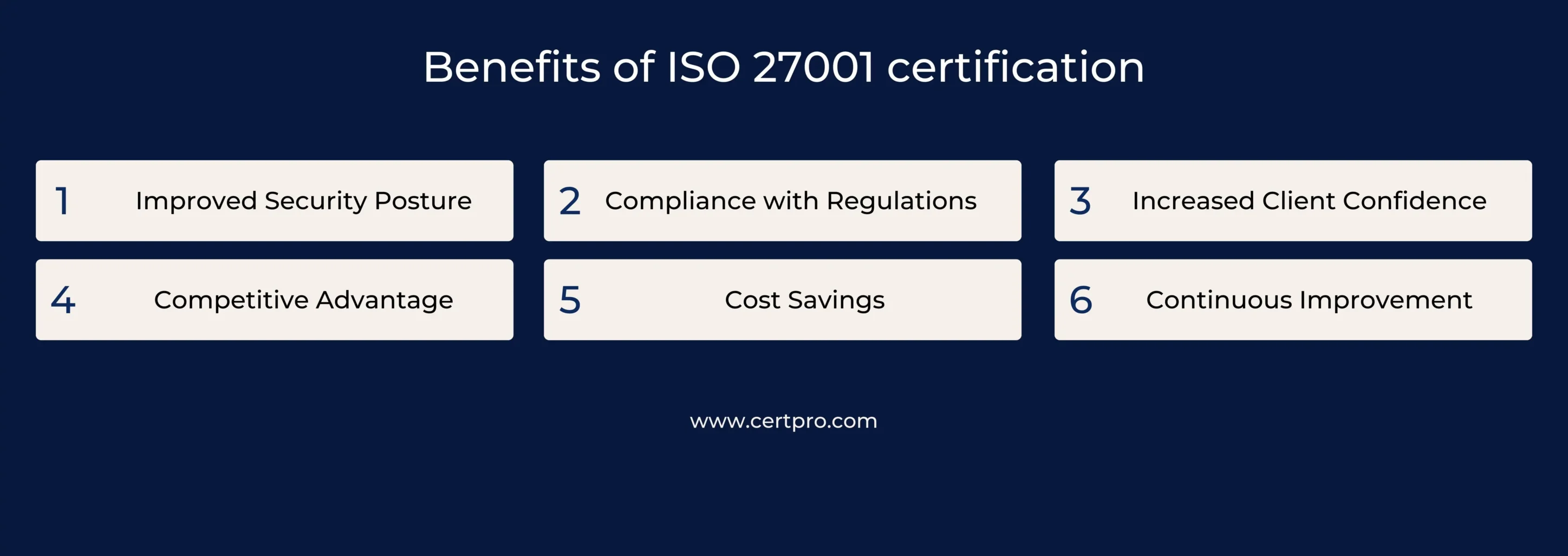
ISO 27001 certification for Phoenix companies delivers independently verified, structured assurance of information security management system conformity. The benefits associated with ISO 27001 certification are grounded in the audit process itself — the structured evaluation of controls, risk management practices, and management system governance — rather than in the possession of a certificate alone. The following sections outline the principal verified outcomes associated with ISO 27001 Certification in Phoenix.
ISO 27001 certification is recognized by enterprise procurement teams, third-party risk management programs, and vendor security review panels as evidence of independently assessed information security governance. For Phoenix-based technology companies, SaaS providers, and managed service organizations seeking to qualify as approved vendors to large enterprise customers — particularly those in regulated sectors — ISO 27001 certification audit Phoenix engagements provide the third-party validation that procurement teams require. Rather than completing multiple vendor security questionnaires or submitting to customer-directed security assessments, certified organizations can reference their ISO 27001 certificate and underlying audit findings as a standardized, independently verified information security credential.
Phoenix’s position as a major Southwest business hub means that many local technology organizations serve enterprise customers headquartered in Los Angeles, San Francisco, Dallas, Chicago, and New York — all markets where large enterprise procurement programs routinely evaluate vendor information security posture as part of supplier due diligence. ISO 27001 certification for Phoenix companies functioning as technology vendors or data processors provides a recognized, internationally understood credential that satisfies vendor security review requirements across domestic and international enterprise markets. This is particularly relevant for Phoenix-based SaaS companies pursuing expansion into European markets, where ISO 27001 certification is frequently expected by enterprise buyers operating under GDPR obligations.
ISO 27001 certification verifies that an organization has established a structured, risk-based approach to information security governance — not merely deployed a collection of individual technical controls. The ISO 27001 certification audit evaluates the management system as an integrated whole: whether leadership commitment is genuine and documented, whether risk assessment drives control selection, whether internal audit and management review create genuine feedback loops, and whether the organization demonstrates a pattern of continual improvement. This holistic, management system-level evaluation distinguishes ISO 27001 certification from point-in-time technical assessments and penetration testing, which address individual controls or vulnerabilities rather than the governance framework that sustains them.
- ✓Independent third-party verification of ISMS conformity against ISO/IEC 27001:2022
- ✓Recognized credential for enterprise vendor qualification and procurement processes
- ✓Structured risk-based framework that maps to HIPAA, GDPR, GLBA, and NIST requirements
- ✓Documented evidence of management commitment to information security governance
- ✓Ongoing surveillance audit oversight providing continued conformity assurance
- ✓Internationally recognized ISO 27001 standard supporting cross-border market access
- ✓Structured Annex A control evaluation covering organizational, people, physical, and technical domains
ISO 27001 compliance provides organizations with a structured, documented risk management framework that can be mapped to multiple regulatory and contractual requirements simultaneously. For Phoenix healthcare technology organizations subject to HIPAA, the ISO 27001 risk assessment and risk treatment methodology addresses the Security Rule’s requirements for risk analysis and risk management. For Phoenix financial services organizations and their vendors subject to GLBA, the ISO 27001 ISMS framework’s documented control environment supports Safeguards Rule compliance documentation. For Phoenix technology companies processing personal data of EU residents, the ISO 27001 standard’s documented approach to access control, encryption, incident management, and supplier security aligns with GDPR Article 32 technical and organizational measures requirements. Independent ISO 27001 certification audit findings provide auditable evidence of regulatory alignment.
- ✓Vendor Qualification and Enterprise Procurement Recognition
- ✓Structured Information Security Governance Verification
- ✓Regulatory Alignment and Risk Management Documentation
ISO 27001 Certification Scope Definition for Phoenix Organizations
Defining the scope of an organization’s ISMS is a foundational step in the ISO 27001 certification process. The ISMS scope determines which organizational units, locations, systems, services, and processes are subject to the ISO 27001 standard’s requirements and, consequently, which are evaluated during the ISO 27001 certification audit. Scope definition must reflect the organization’s actual operational boundaries and cannot arbitrarily exclude business units or systems that handle information relevant to the certification’s objectives. For Phoenix organizations, scope decisions often involve determining how to address cloud service dependencies, remote workforce environments, co-located data center facilities, and relationships with third-party processors.
Scope Inclusions and Interface Considerations
ISO/IEC 27001:2022 Clause 4.3 requires organizations to document the ISMS scope, including the interfaces and dependencies between activities performed by the organization and those performed by external parties. This requirement is particularly significant for Phoenix technology companies that rely on hyperscale cloud providers — such as AWS, Microsoft Azure, or Google Cloud — for infrastructure services, or that use third-party SaaS platforms for critical business functions. The scope document must clearly identify which services and controls are within the organization’s direct responsibility and which are addressed through supplier agreements, inherited controls, or complementary user entity controls. The ISO ISMS Audit evaluates the scope document for clarity, accuracy, and completeness.
Phoenix organizations with multiple office locations, remote employees, or operations spanning multiple Arizona sites must address multi-location scope considerations in their ISMS documentation. The scope must specify which physical locations are included and confirm that information security controls — including physical security measures, access management, and device management — extend to all in-scope locations. Organizations that scope their ISMS around a specific product, service line, or business unit — a common approach for SaaS companies seeking to certify their cloud platform operations without including corporate support functions — must ensure that the defined scope boundary is logically defensible and consistent with how information flows within the organization. Auditors evaluate scope adequacy as part of the Stage 1 review during the ISO 27001 audit.
Independent Certification Committee and Decision Framework
Following completion of the Stage 2 audit and resolution of any identified nonconformities, the audit findings and supporting evidence are submitted to CertPro’s independent certification committee for review. The certification committee evaluates the audit record to confirm that the ISMS scope is appropriately defined, that the audit methodology was applied consistently, that all mandatory ISO 27001 standard clauses were assessed, and that identified nonconformities were appropriately resolved before certification is granted. The certification decision is made independently of the auditors who conducted the field work, providing an additional layer of objectivity to the ISO 27001 certification audit process. This committee-based decision structure is a key feature of CertPro’s certification governance framework.
Why Phoenix Organizations Choose CertPro for ISO 27001 Audit Services
CertPro is engaged by Phoenix organizations seeking ISO 27001 Certification in Phoenix because of its positioning as a Licensed CPA Firm operating exclusively as an independent third-party certification body. This distinction matters: CertPro does not provide consulting, policy development, control design, implementation services, or any form of advisory engagement that would compromise its independence as an auditor. Phoenix organizations that engage consulting firms for information security program development and then seek certification from the same firm face objectivity concerns that may be questioned by enterprise customers, regulators, and procurement teams reviewing the certification’s credibility.
Licensed CPA Firm Positioning and Audit Independence
CertPro’s status as a Licensed CPA Firm subjects its audit and certification activities to professional standards governing independence, objectivity, and professional competence. This positioning provides Phoenix organizations and their enterprise customers with additional assurance regarding the rigor and independence of the ISO 27001 certification audit process. Licensed CPA Firm status establishes that CertPro operates within a regulated professional framework with defined obligations regarding audit quality, documentation standards, and conflict of interest management — attributes that distinguish it from unregulated certification bodies operating outside professional licensure frameworks.
For Phoenix enterprise customers performing vendor due diligence — and for Phoenix organizations seeking to demonstrate the credibility of their ISO 27001 certification — the Licensed CPA Firm designation provides a verifiable professional credential that supports the certification’s evidentiary weight. This is particularly relevant in procurement contexts where enterprise security teams and legal departments review vendor certifications and may inquire about the certification body’s qualifications, independence, and professional standing. ISO 27001 certification audit Phoenix engagements conducted by CertPro carry the institutional authority of a professionally licensed audit firm operating with defined independence obligations.
ISO 27001 Standard Expertise and Sector-Specific Audit Experience
CertPro’s auditors bring documented ISO 27001 standard expertise and sector-specific audit experience relevant to Phoenix’s diverse industry landscape. ISO 27001 certification audits for healthcare technology organizations require familiarity with HIPAA’s Security Rule and its relationship to ISO 27001 controls. Audits for financial services technology vendors require an understanding of GLBA Safeguards Rule requirements and financial institution vendor management expectations. Audits for SaaS and cloud service providers require technical familiarity with cloud architecture, multi-tenant environments, shared responsibility models, and cloud-specific Annex A controls — such as those addressing cloud services, virtualization security, and information deletion. CertPro’s ISO 27001 audit methodology is calibrated to Phoenix’s industry mix and the specific ISO 27001 compliance requirements applicable to each sector.
FAQ
▶
What is ISO 27001 certification and why does it matter for Phoenix organizations?
▶
What is the difference between ISO 27001 compliance and ISO 27001 certification?
▶
What does the ISO 27001 audit process in Phoenix involve?
▶
How long is an ISO 27001 certificate valid?
▶
Which Phoenix industries most commonly pursue ISO 27001 certification?
▶
What is the Statement of Applicability in ISO 27001?
▶
Does ISO 27001 certification cover cloud environments?
▶
What is the ISO 27001 transition deadline for organizations certified under the 2013 version?
Get In Touch
have a question? let us get back to you.