
ISO 27001 Certification in Pittsburgh
Demand for ISO 27001 Certification in Pittsburgh is driven by a convergence of enterprise procurement requirements, sector-specific security expectations, and competitive positioning across the city’s technology, financial services, and healthcare ecosystems. Organizations across Oakland, East Liberty, South Side, Cranberry Township, and the broader Western Pennsylvania region pursue ISO 27001 certification primarily in response to customer-driven requirements rather than voluntary interest alone. The independently issued credential distinguishes certified organizations from those relying on self-declared ISO 27001 compliance.
OUR CLIENTS









ISO 27001 Certification for Pittsburgh-Based Financial, Technology, and Healthcare Organizations
ISO 27001 Certification in Pittsburgh is issued by CertPro CPA LLC, a Licensed CPA Firm operating as an independent third-party certification body. CertPro evaluates organizations against the requirements of ISO/IEC 27001:2022 through a structured, evidence-based audit methodology. Certification decisions are made by an independent certification committee based solely on audit evidence — not by the auditor who conducted the assessment. CertPro does not provide consulting, implementation, or readiness services. Its role is exclusively that of an independent certification authority, ensuring objectivity at every stage of the ISO 27001 certification audit process.
Pittsburgh occupies a distinct position in the mid-Atlantic and Midwest technology economy. The Oakland tech corridor anchors a dense concentration of university-affiliated technology companies, AI research organizations, and life sciences ventures originating from Carnegie Mellon University and the University of Pittsburgh. East Liberty has emerged as a hub for technology and SaaS companies, while South Side hosts fintech and software-as-a-service firms serving financial institutions across Western Pennsylvania. Cranberry Township supports a significant cluster of enterprise technology organizations and regional headquarters.
Across this ecosystem, ISO 27001 Certification in Pittsburgh is increasingly sought by organizations that must demonstrate formal information security governance to enterprise customers, healthcare systems, financial institutions, and government agencies. The demand for an independently issued ISO 27001 certification reflects the region’s growing emphasis on verifiable security credentials over self-attestation.
Pittsburgh’s robotics and autonomous systems sector — anchored by firms spun out of CMU’s Robotics Institute — operates at the intersection of proprietary intellectual property protection and connected systems security. Both areas are directly addressed by ISO/IEC 27001:2022 controls. AI-focused businesses and healthcare data organizations in the Pittsburgh region also face procurement requirements from regional health systems, including UPMC and Allegheny Health Network, which increasingly require vendor security assessments as part of third-party risk management programs.
ISO 27001 Certification in Pittsburgh provides these companies with an independently verified credential that satisfies vendor security review requirements without relying on self-attestation. An ISO 27001 audit conducted by a third-party certification body delivers the objective evidence enterprise procurement teams require.
Pennsylvania’s regulatory environment adds further context for organizations pursuing ISO 27001 Certification in Pittsburgh. The Pennsylvania Breach of Personal Information Notification Act establishes obligations for organizations that maintain personal information of Pennsylvania residents. While ISO 27001 certification does not automatically establish compliance with Pennsylvania law or any other U.S. regulation, the structured risk assessment and documented control framework required under ISO/IEC 27001:2022 supports an organization’s broader information security governance.
This governance foundation, in turn, informs the organization’s approach to applicable legal and regulatory obligations. Organizations in financial services, healthcare technology, biotechnology, energy technology, and industrial manufacturing across the Pittsburgh metropolitan area pursue ISO 27001 compliance as a demonstrable, third-party-verified signal of information security maturity.
A representative scenario illustrating localized demand: a Pittsburgh-based healthcare technology company developing a clinical data integration platform undergoes an ISO 27001 certification audit as part of a vendor security review required by a regional health system. The health system’s procurement process requires independent certification rather than a self-completed security questionnaire. ISO 27001 Certification in Pittsburgh — issued by a Licensed CPA Firm operating as an independent certification body — satisfies that requirement directly.
The certification scope, audit methodology, and independent committee decision structure provide the health system with objective audit evidence rather than vendor-prepared documentation. This scenario is representative of procurement-driven demand across Pittsburgh’s healthcare technology, SaaS, and enterprise software sectors, where ISO 27001 compliance is increasingly a baseline expectation rather than a differentiator.

What Is ISO 27001 Certification?
ISO 27001 certification is the formal recognition that an organization’s Information Security Management System (ISMS) conforms to the requirements of ISO/IEC 27001:2022. This international standard for information security management is published jointly by the International Organization for Standardization and the International Electrotechnical Commission. Certification is issued by an accredited or independent certification body following a structured two-stage ISO 27001 audit process.
The resulting certificate confirms that the organization has established, implemented, maintained, and is continually improving an ISMS that addresses information security risks in a systematic, documented, and auditable manner. For organizations seeking ISO 27001 Certification in Pittsburgh, this independently issued credential carries weight across enterprise procurement, healthcare, and financial services contexts.
ISO/IEC 27001:2022 and the ISMS Framework
ISO/IEC 27001:2022 is structured around Clauses 4 through 10, which define the management system requirements: organizational context, leadership, planning, support, operation, performance evaluation, and improvement. These clauses form the governance backbone of the ISMS and are evaluated during every ISO 27001 audit. Annex A of the 2022 standard contains 93 controls organized across four domains — Organizational, People, Physical, and Technological — reduced from 114 controls in the 2013 version.
Organizations select applicable controls through a risk treatment process and document their selections, justifications, and exclusions in a Statement of Applicability. The transition deadline for organizations certified under the 2013 version is October 31, 2025. After that date, all certifications must reference ISO/IEC 27001:2022, making timely transition planning essential for Pittsburgh organizations currently holding 2013-era certificates.
The four Annex A control domains address distinct aspects of information security. Organizational controls govern policies, roles, responsibilities, and supplier relationships. People controls address security awareness, screening, and disciplinary processes. Physical controls cover facility access, equipment protection, and clear desk requirements. Technological controls include access management, cryptography, network security, and software development security.
During an ISMS audit, auditors evaluate whether selected controls are appropriately designed and operating effectively relative to the risks identified in the organization’s risk assessment. Evidence reviewed includes documented policies, configuration records, access logs, training records, and management review outputs. This multi-source evidence approach distinguishes an ISO 27001 certification audit from a point-in-time technical assessment.
Key ISMS Documentation Requirements
ISO/IEC 27001:2022 requires organizations to maintain a defined set of documented information as evidence of ISMS operation. Core documentation includes the Information Security Policy, the risk assessment methodology and results, the risk treatment plan, and the Statement of Applicability. The Statement of Applicability is a mandatory document that lists all Annex A controls, identifies which are applicable to the organization, justifies any exclusions, and records the implementation status of each applicable control.
Additional required records include internal audit results, management review outputs, and evidence of nonconformity management and corrective actions. During an ISO 27001 certification audit, these documents are examined as primary evidence of conformity with the standard’s requirements. Organizations pursuing ISO 27001 Certification in Pittsburgh should ensure these records are current, complete, and accurately reflect operational practice before the audit commences.
- ✓Information Security Policy aligned with organizational objectives
- ✓Risk assessment methodology, criteria, and documented results
- ✓Risk treatment plan identifying selected controls and owners
- ✓Statement of Applicability covering all 93 Annex A controls
- ✓Internal audit program results and corrective action records
- ✓Management review minutes and decisions
- ✓Evidence of competence, awareness, and training activities
ISO 27001 Certification Audit Process in Pittsburgh
The ISO 27001 certification audit process in Pittsburgh follows a structured sequence of stages consistent with international certification practice. CertPro CPA LLC conducts the audit program as an independent Licensed CPA Firm, evaluating each organization’s ISMS against the full requirements of ISO/IEC 27001:2022. The process begins with scope and application review and concludes with an independent certification committee decision.
Each stage of the ISO 27001 audit produces documented outputs that form the audit record supporting the final certification decision. This transparent, stage-based approach ensures that organizations understand exactly where they stand at each point in the ISO 27001 certification audit process.
| Audit Stage | Key Activities | Output |
|---|---|---|
| Application Review | Scope confirmation, ISMS boundary definition, audit program determination | Audit plan and engagement confirmation |
| Stage 1 Audit | Review of ISMS documentation, risk assessment, Statement of Applicability, and readiness indicators | Stage 1 findings report; identification of areas requiring Stage 2 focus |
| Stage 2 Audit | On-site or remote evaluation of ISMS implementation and control operating effectiveness | Detailed audit findings; nonconformity report if applicable |
| Nonconformity Review | Organization submits corrective action evidence; auditor evaluates closure | Nonconformity disposition and closure confirmation |
| Certification Committee Decision | Independent committee reviews full audit record; issues or withholds ISO 27001 certification | ISO 27001 certificate (3-year validity) or deferral with documented rationale |
The Stage 1 audit is a structured review of the organization’s ISMS documentation and its readiness for Stage 2 assessment. The auditor examines the Information Security Policy, the risk assessment process and results, the risk treatment plan, and the Statement of Applicability to determine whether the ISMS is sufficiently developed to proceed. The Stage 1 audit also confirms that the defined scope accurately reflects the organization’s information assets, processes, and boundaries.
Any significant gaps identified at Stage 1 — such as an incomplete Statement of Applicability or undocumented risk treatment decisions — are recorded and must be addressed before Stage 2 proceeds. Stage 1 does not itself result in ISO 27001 certification; it is a prerequisite evaluation that shapes the Stage 2 ISO 27001 audit program and focuses auditor attention on the areas of greatest risk.
The Stage 2 audit is the substantive phase of the ISO 27001 audit in which the auditor evaluates whether the ISMS has been implemented as documented and whether controls are operating effectively. Auditors review evidence across all applicable Annex A control domains and test the organization’s management system processes — including internal audits, management review, corrective action, and continual improvement activities.
For Pittsburgh organizations with complex IT environments — such as SaaS platforms, cloud infrastructure, or healthcare data pipelines — the Stage 2 ISO 27001 certification audit examines technical controls including access management, encryption, logging, incident response, and network segmentation. Nonconformities identified during Stage 2 are classified and documented. The organization must provide objective evidence of corrective action before the certification committee issues a decision on ISO 27001 compliance.
ISO 27001 certification is valid for three years from the date of issue. During the certification cycle, the organization undergoes annual surveillance audits — typically at 12 and 24 months after initial certification — to confirm that the ISMS remains operational and continues to conform to ISO/IEC 27001:2022 requirements. Surveillance audits are narrower in scope than the initial ISO 27001 certification audit but must cover mandatory elements including management review, internal audit outcomes, corrective action effectiveness, and any significant changes to the ISMS scope.
A recertification audit is conducted prior to the three-year expiry to determine whether the certificate should be renewed for a further three-year period. Failure to maintain conformity during surveillance can result in suspension or withdrawal of the ISO 27001 certificate. For organizations holding ISO 27001 Certification in Pittsburgh, maintaining a continuous cycle of internal audit and management review is the most effective way to sustain ongoing certification.
- ✓Stage 1 Audit: Documentation and Readiness Review
- ✓Stage 2 Audit: ISMS Implementation and Control Effectiveness
- ✓Surveillance Audits and Recertification
Why Organizations in Pittsburgh Pursue ISO 27001 Certification
Demand for ISO 27001 Certification in Pittsburgh is driven by a convergence of enterprise procurement requirements, sector-specific security expectations, and competitive positioning across the city’s technology, financial services, and healthcare ecosystems. Organizations across Oakland, East Liberty, South Side, Cranberry Township, and the broader Western Pennsylvania region pursue ISO 27001 certification primarily in response to customer-driven requirements rather than voluntary interest alone. The independently issued credential distinguishes certified organizations from those relying on self-declared ISO 27001 compliance.
Enterprise Vendor Security Reviews and Procurement Requirements
Enterprise customers — particularly in financial services, healthcare, and government contracting — increasingly require third-party security certifications as a condition of vendor approval. ISO 27001 compliance must be demonstrated through an independently issued certificate rather than a self-completed questionnaire. Pittsburgh’s SaaS providers, cloud service vendors, and managed service organizations frequently encounter this requirement in sales cycles involving large financial institutions, regional health systems, or federal contractors based in Western Pennsylvania.
ISO 27001 Certification in Pittsburgh positions technology companies to satisfy security review requirements without repeated ad-hoc assessments for each enterprise customer engagement. An ISO 27001 certification audit conducted by an independent Licensed CPA Firm provides the objective third-party evidence that enterprise procurement teams require and that self-assessment cannot replicate.
Financial Services and Fintech Security Expectations
ISO 27001 certification pursued by Pittsburgh financial services organizations reflects the sector’s long-standing emphasis on documented information security governance. South Side and downtown Pittsburgh fintech firms serving regional banks, credit unions, and investment managers operate in an environment where counterparties and regulators expect formal information security frameworks. ISO/IEC 27001:2022 provides a recognized international standard against which an organization’s ISMS can be independently assessed through a structured ISO 27001 audit.
For fintech companies handling payment data, account information, or proprietary financial algorithms, an independently issued ISO 27001 certificate provides verifiable evidence of control design and operating effectiveness. This distinction — between a third-party ISMS audit and internal self-certification — is precisely what financial services procurement teams seek when evaluating vendor ISO 27001 compliance.
Healthcare Technology and Life Sciences Organizations
ISO 27001 compliance pursued by Pittsburgh healthcare technology and life sciences companies is shaped by the procurement requirements of the region’s dominant health systems. UPMC, Allegheny Health Network, and affiliated research institutions conduct structured vendor security reviews extending to software vendors, data integration platforms, and clinical analytics providers. ISO 27001 Certification in Pittsburgh satisfies the independent verification requirement that these procurement processes impose, providing health systems with audit-backed evidence rather than vendor-prepared documentation.
Biotechnology and life sciences organizations managing clinical trial data, genomic information, or proprietary research data similarly benefit from ISO/IEC 27001:2022 certification. The framework provides an internationally recognized structure for protecting sensitive intellectual property and regulated research information — verified through an independent ISO 27001 certification audit rather than internal controls documentation alone.
ISO 27001 Certification Requirements and Evaluation Criteria
ISO 27001 certification requires organizations to demonstrate conformity with all mandatory clauses of ISO/IEC 27001:2022 (Clauses 4–10) and to implement an appropriate selection of Annex A controls based on a documented risk assessment and risk treatment process. During the ISMS audit, the certification body evaluates both the design adequacy of controls and their operating effectiveness through examination of objective evidence. Understanding these requirements in full helps Pittsburgh organizations prepare effectively for their ISO 27001 certification audit.
ISO/IEC 27001:2022 requires organizations to establish and apply a defined information security risk assessment process. The process must identify risks associated with the loss of confidentiality, integrity, and availability of information within the defined ISMS scope. Risk owners must be assigned, risk criteria must be defined, and risk levels must be evaluated against the organization’s risk acceptance threshold.
The risk treatment plan documents the controls selected to address identified risks, references the corresponding Annex A controls, and records the residual risk accepted by management. During the ISO 27001 certification audit, auditors verify that the risk assessment methodology is consistently applied, that risk treatment decisions are documented and approved, and that the Statement of Applicability accurately reflects the risk treatment outcomes. For organizations pursuing ISO 27001 Certification in Pittsburgh, a well-documented and consistently applied risk assessment process is among the most critical success factors.
Beyond Annex A controls, ISO 27001 compliance requires demonstrated conformity with the management system clauses that govern how the ISMS is structured and operated. Clause 4 requires the organization to understand its internal and external context and to identify interested parties and their requirements. Clause 5 requires visible leadership commitment and the assignment of information security roles and responsibilities. Clause 6 addresses planning, including objectives and risk treatment.
Clause 7 covers resource allocation, competence, awareness, and communication. Clause 8 governs operational planning and control. Clause 9 requires internal audits and management review at defined intervals. Clause 10 establishes the continual improvement obligation, including the corrective action process for nonconformities. The ISMS audit evaluates each of these clauses against documented evidence and structured interviews with process owners, ensuring that ISO 27001 compliance is operational rather than merely documented.
The 93 controls in Annex A of ISO/IEC 27001:2022 are organized across four domains: Organizational (37 controls), People (8 controls), Physical (14 controls), and Technological (34 controls). Not all controls are mandatory for every organization; applicability is determined by the risk assessment and risk treatment process. However, any control classified as not applicable must be justified in the Statement of Applicability with a documented rationale demonstrating that the associated risk is not relevant to the organization’s scope.
During the ISO 27001 audit, auditors examine whether applicability determinations are defensible and whether implemented controls are operating as intended. Controls related to supplier relationships, cloud service use, and information transfer receive particular scrutiny for Pittsburgh organizations operating cloud-dependent or SaaS-delivered services. Ensuring these controls are thoroughly addressed strengthens both the ISMS audit outcome and the organization’s overall ISO 27001 compliance posture.
- ✓Risk Assessment and Risk Treatment Requirements
- ✓Management System Conformity: Clauses 4–10
- ✓Annex A Control Domains and Applicability
Benefits of ISO 27001 Certification for Pittsburgh-Based Organizations
ISO 27001 Certification in Pittsburgh delivers measurable, independently verified outcomes for organizations across the city’s technology, financial services, healthcare, and industrial sectors. The following benefits reflect what certification actually demonstrates — not what a consulting engagement promises — and are directly supported by the audit evidence generated during the ISO 27001 certification audit process. Each benefit is a direct product of the ISMS audit, not a self-assessed claim.
- ✓Independent verification of ISMS design and operating effectiveness by a Licensed CPA Firm
- ✓Satisfaction of enterprise vendor security review requirements without repeated self-assessments
- ✓Structured documentation of information security risk assessment and risk treatment decisions
- ✓Demonstrated ISO 27001 compliance across all four Annex A control domains of ISO/IEC 27001:2022
- ✓Ongoing oversight through annual surveillance audits confirming continuous ISMS operation
- ✓Recognition in financial services, healthcare, and government procurement processes
- ✓Support for broader regulatory alignment with Pennsylvania data security and notification obligations
- ✓Internationally recognized ISO 27001 certification credential supporting cross-border commercial relationships
The ISO 27001 certification process requires organizations to conduct a systematic information security risk assessment covering all assets, processes, and third-party relationships within the defined ISMS scope. For Pittsburgh technology companies managing cloud infrastructure, intellectual property, or customer data, this process identifies specific control gaps that may not be visible through informal security reviews. The risk treatment plan documents the organization’s decisions about control implementation and residual risk acceptance.
Findings from the ISO 27001 certification audit — including nonconformities and observations — provide auditor-identified evidence of control weaknesses requiring corrective action. This structured, audit-driven approach to risk identification is more rigorous than internal self-assessment and produces documented evidence that the organization’s leadership and board can review with confidence. The ISMS audit process transforms information security from an internally managed function into an externally verified discipline.
ISO 27001 certification for Pittsburgh companies competing for enterprise contracts provides a demonstrable differentiator in procurement evaluations where multiple vendors may be technically comparable. An independently issued certificate from a Licensed CPA Firm confirms that the organization’s ISMS has been assessed against an internationally recognized standard — not merely self-described. Pittsburgh’s robotics, AI, and autonomous systems companies protecting proprietary algorithms and sensor data, its cybersecurity firms managing sensitive client environments, and its energy technology companies operating industrial control systems all operate in markets where information security maturity is a procurement consideration.
ISO 27001 Certification in Pittsburgh positions organizations to respond to security questionnaires with objective third-party evidence, reducing the time and cost associated with repeated customer-driven security reviews. In competitive sales cycles, an independently audited ISO 27001 compliance credential can accelerate vendor approval and reduce procurement friction in ways that self-attestation cannot.
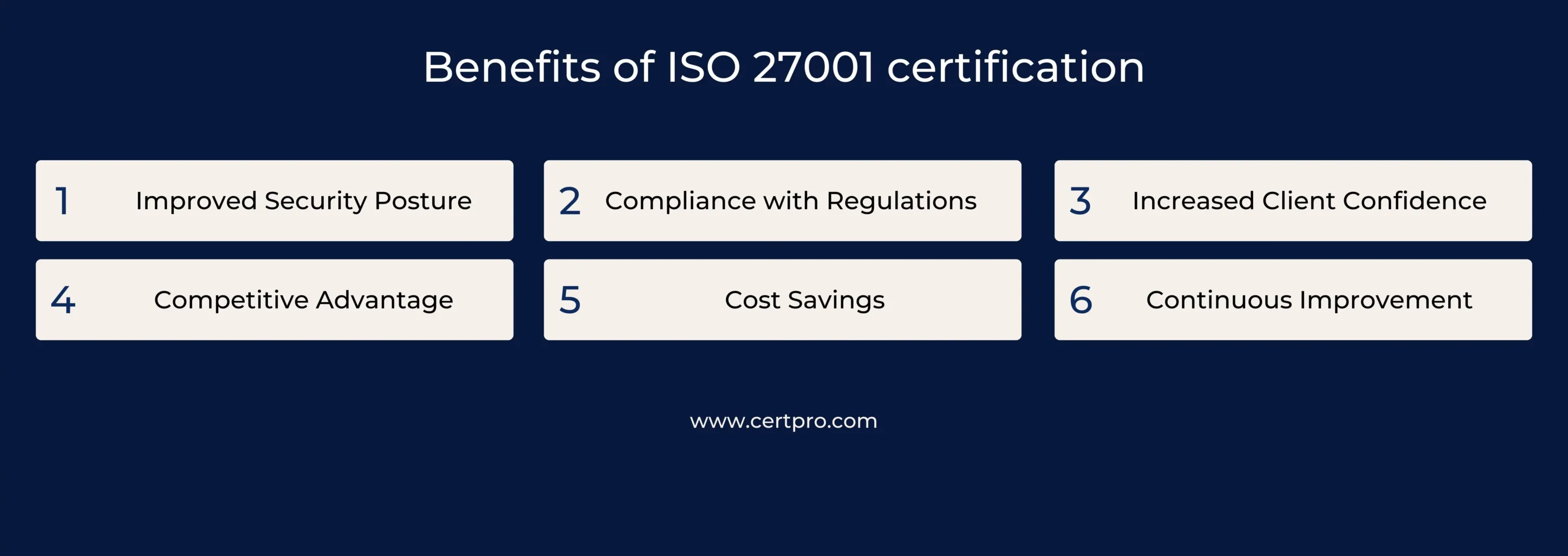
- ✓Improved Security Posture Through Structured Risk Management
- ✓Competitive Positioning in Pittsburgh’s Technology Market
ISO 27001 Certification Scope for Pittsburgh Organizations
Defining an appropriate ISMS scope is a foundational requirement under ISO/IEC 27001:2022 and a primary focus of the Stage 1 audit. The scope determines which organizational units, processes, locations, assets, and third-party dependencies are covered by the ISMS and included within the certification boundary. For Pittsburgh-based organizations pursuing ISO 27001 Certification in Pittsburgh, scope definition involves identifying all information assets relevant to the organization’s products and services, the locations at which those assets are processed or stored, and the contractual and regulatory obligations that apply within that boundary.
Scope Definition and Boundary Setting
The ISMS scope must be documented and must accurately reflect the organization’s context, including interfaces and dependencies with activities outside the defined boundary. For a Pittsburgh SaaS company, the scope might include the software development environment, production cloud infrastructure, customer data handling processes, and the organizational units responsible for information security governance. For a healthcare technology company, the scope would typically include clinical data processing systems, third-party integrations with health systems, and the access control framework governing protected health information.
The auditor evaluates whether the stated scope is realistic — not artificially narrow to exclude high-risk processes — and whether the ISMS documentation reflects all processes and assets within the defined boundary. Scope misrepresentation or artificial exclusion of material processes constitutes a nonconformity under Clause 4.3 of ISO/IEC 27001:2022. Accurate scope definition is therefore as important to ISO 27001 compliance as the controls themselves.
Independent Certification Committee and Decision Framework
CertPro’s certification decisions are made by an independent certification committee that reviews the complete audit record — including Stage 1 and Stage 2 findings, nonconformity disposition records, and corrective action evidence — without involvement from the conducting auditor in the decision itself. This separation of auditing and certification decision functions is a structural requirement of independent certification body practice and provides an additional layer of objectivity in the ISO 27001 certification process.
The committee may issue a certificate, defer certification pending resolution of outstanding nonconformities, or decline certification where material conformity deficiencies remain unresolved. All decisions are documented with reference to specific audit evidence and standard clauses. This framework applies uniformly to all organizations evaluated for ISO 27001 Certification in Pittsburgh by CertPro, regardless of organizational size or industry sector, ensuring consistent and impartial ISO 27001 compliance determinations.
Industry Sectors Seeking ISO 27001 Certification in Pittsburgh
ISO 27001 certification pursued by Pittsburgh organizations spans a broad range of industries reflecting the city’s diversified technology economy. The following sectors represent the primary sources of ISO 27001 certification demand across the Pittsburgh metropolitan area and Western Pennsylvania business ecosystem. Each sector faces distinct drivers that make an independently issued ISO 27001 certification — backed by a formal ISMS audit — essential to sustained commercial growth.
| Industry Sector | Primary ISO 27001 Drivers | Typical ISMS Scope Focus |
|---|---|---|
| Healthcare Technology & Life Sciences | Health system vendor reviews, HIPAA-adjacent security requirements, clinical data protection | Clinical data platforms, third-party integrations, access management |
| Financial Services & Fintech | Bank and credit union procurement requirements, payment data security, regulatory expectations | Payment processing, customer account data, fraud detection systems |
| Robotics, AI & Autonomous Systems | Intellectual property protection, connected systems security, enterprise customer ISO 27001 requirements | Proprietary algorithm repositories, sensor data pipelines, development environments |
| SaaS & Cloud Service Providers | Enterprise customer vendor approvals, cross-border data processing, multi-tenant security | Cloud infrastructure, tenant data isolation, change management |
| Energy Technology & Industrial Manufacturing | Industrial control system security, OT/IT convergence, supply chain security reviews | SCADA/OT interfaces, remote access controls, third-party supplier management |
Technology and SaaS Organizations
Pittsburgh’s East Liberty and Oakland technology corridors host a significant concentration of SaaS companies, cloud service providers, and software development organizations. These organizations frequently encounter ISO 27001 audit requirements in enterprise sales processes, where procurement teams at large financial institutions, healthcare organizations, and government agencies require independent certification as a vendor qualification criterion.
ISO 27001 compliance demonstrated by Pittsburgh technology companies through certification encompasses their cloud infrastructure configuration, software development security practices, access management frameworks, and incident response capabilities. For multi-tenant SaaS platforms, the ISMS scope must address tenant data isolation, shared responsibility models with cloud infrastructure providers, and the controls governing customer data handling across the full service delivery chain. Obtaining ISO 27001 Certification in Pittsburgh positions these companies to compete effectively in enterprise markets where security credentials are a baseline expectation.
Cybersecurity, E-Commerce, and Enterprise Organizations
Cybersecurity firms operating in the Pittsburgh region face a distinctive requirement: demonstrating that their own internal information security governance meets the same standards they evaluate in client environments. ISO 27001 Certification in Pittsburgh for cybersecurity organizations provides an independently verified credential that supports client confidence in the firm’s internal security practices — a credential backed by a formal ISO 27001 certification audit rather than internal attestation.
E-commerce organizations handling customer payment data, order history, and personal information similarly seek ISO 27001 certification to satisfy payment processor and enterprise retail partner requirements. Larger enterprise organizations headquartered in or operating significant facilities in Cranberry Township and across Western Pennsylvania pursue ISO 27001 certification as part of enterprise-wide information security governance programs. These programs must satisfy board-level oversight requirements and the ISO 27001 compliance expectations of international business partners.
ISO 27001 Audit Methodology and Evidence Standards
The ISO 27001 audit methodology applied by CertPro CPA LLC as an independent Licensed CPA Firm is evidence-based and structured to evaluate conformity with ISO/IEC 27001:2022 requirements across both the management system clauses and the applicable Annex A controls. The ISMS audit conducted for Pittsburgh organizations combines document review, control testing, process interviews, and technical evidence examination into a comprehensive assessment of ISMS design and operating effectiveness. This rigorous approach ensures that ISO 27001 certification issued by CertPro reflects genuine conformity, not procedural compliance alone.
Evidence Collection and Audit Procedures
During the ISO 27001 certification audit, auditors collect evidence through multiple procedures. Document review covers policies, procedures, risk assessment records, the Statement of Applicability, and management review minutes. Interviews with process owners and technical staff evaluate awareness, competence, and operational adherence to documented procedures. Technical testing and configuration review assess the implementation of Technological controls — including access provisioning, logging and monitoring, encryption configurations, and patch management processes.
Records examination covers access logs, incident reports, internal audit findings, corrective action records, and training completion data. Each finding in the ISO 27001 audit is documented with specific reference to the ISO/IEC 27001:2022 clause or Annex A control being evaluated, the evidence examined, and the conformity determination. This structured documentation supports the independent certification committee’s review and ensures that the ISO 27001 compliance determination rests on verifiable audit evidence.
Nonconformity Classification and Corrective Action
Nonconformities identified during the ISO 27001 audit are documented with reference to the specific ISO/IEC 27001:2022 requirement not met and the objective evidence supporting the finding. The organization is required to conduct root cause analysis, implement corrective action, and provide evidence of closure before the certification committee issues a certification decision. Nonconformities that represent systemic failures in ISMS operation — such as absence of internal audit records or undocumented risk treatment decisions — carry greater weight in the certification decision than isolated control implementation gaps.
Observations and opportunities for improvement noted during the ISMS audit do not block certification but are recorded in the audit report for management consideration. The corrective action process is itself a subject of surveillance audit review, ensuring that issues identified during the initial ISO 27001 certification audit result in durable ISMS improvements rather than being closed on paper alone.
FAQ
▶
Who issues ISO 27001 certification for organizations in Pittsburgh?
▶
What does an ISO 27001 audit in Pittsburgh involve?
▶
How long is an ISO 27001 certificate valid?
▶
What is the difference between ISO 27001 certification and ISO 27001 compliance?
▶
Does ISO 27001 certification establish compliance with Pennsylvania privacy law?
▶
Which Pittsburgh industries most commonly pursue ISO 27001 certification?
▶
What is a Statement of Applicability in ISO 27001?
▶
What is the transition deadline for ISO 27001:2013 certified organizations?
Get In Touch
have a question? let us get back to you.