
ISO 27001 Certification in Queensland
The ISO 27001 certification audit process for Queensland organisations follows a structured, multi-stage methodology conducted by CertPro as an independent certification body. The process is designed to produce an objective, evidence-based determination of whether the organisation’s ISMS conforms to the requirements of ISO/IEC 27001:2022. Each stage of the ISO 27001 audit is governed by documented procedures and produces outputs that form the basis for the final certification decision.
OUR CLIENTS










Independent ISO 27001 Certification by a Licensed CPA Firm in Queensland
CertPro is a Licensed CPA Firm providing independent ISO 27001 Certification in Queensland to organisations across mining and resources, energy, financial services, technology, healthcare, education, and government sectors. As an independent third-party conformity assessment body, CertPro evaluates organisations exclusively against the requirements of ISO/IEC 27001:2022 — the international standard for Information Security Management Systems. CertPro does not establish, design, implement, or operate Information Security Management Systems; that responsibility rests entirely with the organisation seeking certification. CertPro’s role is to independently assess whether an organisation’s ISMS conforms to the ISO 27001 standard through a structured, evidence-based ISO 27001 certification audit process.
Queensland’s regulatory environment shapes the information security obligations of organisations across the state. The Privacy Act 1988 (Cth) and the Australian Privacy Principles establish baseline requirements for handling personal information. The Australian Signals Directorate publishes the Essential Eight cybersecurity maturity framework, applicable to government and critical infrastructure entities in Queensland. Sector-specific obligations apply under the My Health Records Act 2012 (healthcare), APRA Prudential Standard CPS 234 Information Security (financial services), and the Security of Critical Infrastructure Act 2018 (energy and critical infrastructure). ISO 27001 Certification in Queensland provides an independently verified assurance mechanism that organisations can use to demonstrate conformity with these regulatory frameworks.
Brisbane has developed into one of Australia’s most active business and technology hubs, hosting financial services institutions, SaaS companies, AI developers, cloud service providers, cybersecurity firms, research institutions, and advanced manufacturers. Queensland’s broader economy encompasses significant mining and resources operations in the Bowen Basin and Surat Basin, major energy infrastructure, agribusiness and logistics networks, and an expanding technology and digital services ecosystem. Organisations across these sectors routinely handle sensitive operational data, customer personal information, financial records, intellectual property, and critical infrastructure data — all of which fall within the scope of an Information Security Management System assessed under ISO/IEC 27001:2022 through the ISO 27001 certification audit process.
A representative cross-border compliance scenario illustrates the demand for ISO 27001 Certification in Queensland: a Brisbane-based SaaS provider supplying enterprise software to regulated financial institutions in the United Kingdom and Singapore is required by those clients to demonstrate independently verified information security assurance as a condition of vendor due diligence and contract renewal. The ISO 27001 certification audit, conducted by CertPro as an independent certification body, produces a certificate of conformity. The Queensland organisation can then present this certificate in response to enterprise procurement questionnaires, regulatory third-party risk assessments, and international tender requirements — without requiring each buyer to conduct its own security assessment. This scenario is common across Queensland’s technology, professional services, and data-handling sectors where international enterprise clients apply vendor assurance requirements.
ISO 27001 compliance that Queensland organisations demonstrate through independent certification reflects a commitment to structured information security governance that extends well beyond self-declaration. The ISO 27001 standard requires organisations to establish a documented ISMS, conduct formal information security risk assessments, implement risk treatment measures, maintain a Statement of Applicability, operate internal audit and management review processes, and continuously improve information security performance. CertPro evaluates the conformity of each element through documented evidence review and audit procedures, issuing an objective certification decision based on findings — not on advisory engagement. Queensland organisations seeking ISO 27001 Certification in Queensland engage CertPro as an independent assessor operating within a structured certification framework applicable across all sectors of the Queensland economy.

What Is ISO 27001 Certification?
ISO 27001 certification is the formal recognition, issued by an accredited or independent certification body, that an organisation’s Information Security Management System conforms to the requirements of ISO/IEC 27001:2022 — the current version of the internationally recognised information security standard published by the International Organization for Standardization. Certification is achieved when an independent certification body, following a structured ISO 27001 audit process, determines that the organisation has established, implemented, maintained, and is continually improving an ISMS that meets all applicable clauses of the standard and addresses identified information security risks through appropriately selected and operating controls.
ISO/IEC 27001:2022 and the Information Security Management System
ISO/IEC 27001:2022 is structured around a Plan-Do-Check-Act management system model and contains ten clauses governing the establishment, operation, monitoring, and improvement of an ISMS. Clauses 4 through 10 contain the normative requirements against which organisations are assessed during an ISO 27001 certification audit. Clause 4 addresses organisational context and interested party requirements. Clause 5 covers leadership and information security policy. Clause 6 addresses information security risk assessment and risk treatment planning. Clause 7 covers resource, competence, awareness, communication, and documented information requirements. Clause 8 addresses operational planning and control. Clause 9 covers performance evaluation, internal audit, and management review. Clause 10 addresses nonconformity, corrective action, and continual improvement. Together, these clauses define the management system framework that an organisation must operate and that an ISO 27001 auditor evaluates during the certification process.
Annex A of ISO/IEC 27001:2022 provides a reference set of 93 information security controls organised across four domains: Organisational controls (37 controls), People controls (8 controls), Physical controls (14 controls), and Technological controls (34 controls). The 2022 update reduced the control count from 114 in the 2013 version and introduced several new controls addressing areas including threat intelligence, information security for cloud services, ICT readiness for business continuity, data masking, and monitoring activities. Organisations are not required to implement every Annex A control. Rather, they must document their control selection decisions and any exclusions in a Statement of Applicability — a core document evaluated during the ISO 27001 certification audit. The transition deadline from ISO/IEC 27001:2013 to ISO/IEC 27001:2022 was October 31, 2025, as established by certification bodies globally.
Key ISMS Documentation Evaluated in an ISO 27001 Audit
The ISO 27001 standard specifies documented information requirements that an organisation must maintain as objective evidence of its ISMS operation. Core documentation evaluated during an ISO 27001 certification audit includes the information security policy, information security risk assessment records, the risk treatment plan, the Statement of Applicability, internal audit records, management review records, and records of nonconformities and corrective actions. The Statement of Applicability is a particularly significant document: it identifies which Annex A controls the organisation has selected, which it has excluded, and the justification for each decision. Auditors assess whether the Statement of Applicability accurately reflects risk treatment decisions and whether applicable controls are demonstrably implemented and operating effectively. Incomplete or inconsistent documented information constitutes a finding during the ISO 27001 audit.
| ISMS Document | ISO 27001 Clause Reference | Purpose in Certification Audit |
|---|---|---|
| Information Security Policy | Clause 5.2 | Demonstrates leadership commitment and ISMS scope boundaries |
| Risk Assessment Records | Clause 6.1.2 | Evidence of systematic risk identification and evaluation |
| Risk Treatment Plan | Clause 6.1.3 | Documents control selection and residual risk acceptance decisions |
| Statement of Applicability | Clause 6.1.3(d) | Justifies Annex A control inclusion and exclusion decisions for the ISO 27001 audit |
| Internal Audit Records | Clause 9.2 | Demonstrates ongoing internal conformity evaluation across the ISMS |
Certification Scope and Applicability
The scope of an ISO 27001 certification defines the boundaries and applicability of the ISMS subject to the audit. Organisations may certify their entire information security management system or a defined subset of operations, business units, information assets, or geographic locations. The scope statement is a normative requirement under Clause 4.3 of ISO/IEC 27001:2022 and must clearly identify what is included within the ISMS boundary. During the ISO 27001 certification audit, auditors evaluate whether the defined scope is appropriate given the organisation’s context, whether interested party requirements have been identified, and whether information assets and risks relevant to the scope are addressed within the ISMS. Queensland organisations commonly scope their ISO 27001 Certification in Queensland to cover specific service lines, data processing environments, or information systems relevant to particular client or regulatory requirements — rather than scoping the entire enterprise on initial certification.
ISO 27001 Certification Audit Process in Queensland
The ISO 27001 certification audit process for Queensland organisations follows a structured, multi-stage methodology conducted by CertPro as an independent certification body. The process is designed to produce an objective, evidence-based determination of whether the organisation’s ISMS conforms to the requirements of ISO/IEC 27001:2022. Each stage of the ISO 27001 audit is governed by documented procedures and produces outputs that form the basis for the final certification decision.
The ISO 27001 certification audit process begins with an application review in which CertPro evaluates the organisation’s proposed ISMS scope, the nature of its information assets, the complexity of its operations, and any sector-specific regulatory or contractual requirements applicable to its Queensland operations. Based on this review, CertPro determines the audit program — including the audit duration, audit team composition, and scheduling of Stage 1 and Stage 2 activities. The audit program is developed to ensure that evidence collection activities are proportionate to the scope and complexity of the ISMS under assessment. For Queensland organisations operating across multiple sites — such as mining companies with operational technology environments across regional Queensland, or financial services firms with branches across Brisbane and regional centres — the audit program accounts for multi-site sampling requirements relevant to the ISO 27001 certification audit.
The Stage 1 audit is a documentation and readiness review conducted prior to the Stage 2 on-site assessment. During Stage 1, CertPro auditors review the organisation’s ISMS documentation to assess whether it addresses the normative requirements of ISO/IEC 27001:2022, whether the scope statement is appropriately defined, whether the risk assessment methodology is documented and applied, whether the Statement of Applicability is complete and internally consistent, and whether documented information required by the ISO 27001 standard is present and accessible. The Stage 1 audit also evaluates whether the ISMS has been implemented sufficiently to proceed to Stage 2. Where Stage 1 findings identify documentation deficiencies or areas requiring clarification, these are communicated to the organisation prior to Stage 2 scheduling. The Stage 1 audit output is a documented report that directly informs the Stage 2 audit plan.
The Stage 2 audit is the principal conformity assessment activity in the ISO 27001 certification audit process. CertPro auditors conduct on-site or remote assessment activities to evaluate whether the ISMS is implemented and operating in conformity with ISO/IEC 27001:2022 across all clauses and applicable Annex A controls identified in the Statement of Applicability. Evidence collection during Stage 2 includes document review, records examination, observation of information security processes, and interviews with relevant personnel. Auditors assess both control design — whether controls are capable of addressing identified risks — and operating effectiveness — whether controls are functioning as designed across the audit period. Nonconformities identified during the Stage 2 ISO 27001 audit are documented, classified, and communicated to the organisation. Major nonconformities require resolution before certification can be issued. Minor nonconformities are addressed through corrective action plans reviewed as part of the certification process.
| Audit Stage | Key Activities | Output |
|---|---|---|
| Application Review | Scope evaluation, audit program determination, team assignment | Audit program and scheduling confirmation |
| Stage 1 Audit | Documentation review, ISMS readiness assessment, Statement of Applicability evaluation | Stage 1 findings report and Stage 2 audit plan |
| Stage 2 Audit | On-site evidence collection, control effectiveness assessment, personnel interviews | Stage 2 ISO 27001 audit report with nonconformity findings |
| Nonconformity Review | Corrective action evaluation, evidence of resolution assessment | Nonconformity closure or escalation determination |
| Certification Decision | Independent committee review of audit findings and evidence | Certificate of conformity issuance or deferral |
ISO 27001 certification is valid for a three-year certification cycle, subject to satisfactory completion of annual surveillance audits. Surveillance audits are conducted at intervals not exceeding twelve months following initial certification. They assess whether the certified ISMS continues to conform to ISO/IEC 27001:2022, whether corrective actions from previous audits have been implemented, whether changes to the organisation’s operations or information security environment are reflected in the ISMS, and whether internal audit and management review processes are functioning as required. At the conclusion of the three-year cycle, a recertification audit is conducted to evaluate continued ISO 27001 compliance and renew the certificate for a further three-year period. Queensland organisations should maintain active ISMS documentation, internal audit records, and management review records throughout the certification cycle to support surveillance and recertification audit activities.
- ✓Application Review and Audit Program Determination
- ✓Stage 1 Audit: Documentation and Readiness Review
- ✓Stage 2 Audit: On-Site Evidence Assessment and Certification Decision
- ✓Surveillance Audits and Recertification
ISO 27001 Requirements and Evaluation Criteria
ISO 27001 compliance is evaluated against the normative requirements of ISO/IEC 27001:2022 across two distinct areas: the management system requirements in Clauses 4 to 10, and the information security controls referenced in Annex A. An ISO 27001 certification audit assesses conformity with both areas through structured evidence collection and documented findings. Understanding the specific requirements evaluated during the ISO 27001 audit enables Queensland organisations to understand what an independent conformity assessment examines — and how to prepare effectively.
Clause 6 of ISO/IEC 27001:2022 requires organisations to establish and apply an information security risk assessment process that produces consistent, valid, and comparable results. The risk assessment process must identify information security risks associated with the loss of confidentiality, integrity, and availability of information within the ISMS scope; analyse those risks; evaluate them against defined risk acceptance criteria; and produce documented risk assessment records. The risk treatment process then requires organisations to select appropriate controls — including those from Annex A — and produce a risk treatment plan and Statement of Applicability documenting control selection rationale. During the ISO 27001 certification audit, auditors review risk assessment records and the Statement of Applicability to assess whether identified risks have been systematically addressed and whether control selection decisions are appropriately justified — particularly for Queensland organisations handling sensitive operational, personal, or financial information.
The four Annex A control domains in ISO/IEC 27001:2022 — Organisational, People, Physical, and Technological — provide the reference control set against which organisations structure their risk treatment measures. Organisational controls address information security policies, roles and responsibilities, information classification, supplier relationships, and incident management. People controls address screening, terms of employment, information security awareness, and disciplinary processes. Physical controls address secure perimeters, equipment security, clear desk policies, and physical media handling. Technological controls address access control, authentication, cryptography, secure development, malware protection, logging, monitoring, and vulnerability management. During the ISO 27001 certification audit, auditors evaluate whether controls identified as applicable in the Statement of Applicability are demonstrably implemented through objective evidence — not through assertions — and whether they address the risks for which they were selected. This evidence-based approach is the foundation of the ISO 27001 standard’s certification process.
Clause 9 of ISO/IEC 27001:2022 requires organisations to conduct planned internal audits at defined intervals to assess whether the ISMS conforms to the organisation’s own requirements and to the requirements of the standard, and whether it is effectively implemented and maintained. Internal audit records — including audit programmes, audit reports, and records of findings and corrective actions — are reviewed during the ISO 27001 certification audit as evidence of ongoing self-evaluation. Clause 9 also requires top management to conduct management reviews of the ISMS at planned intervals, evaluating its continuing suitability, adequacy, and effectiveness. Management review records — covering inputs such as audit results, risk assessment outputs, nonconformity status, and stakeholder feedback, and outputs covering ISMS improvement decisions — are evaluated by auditors as evidence of active leadership engagement with ISO 27001 compliance requirements.
- ✓Information Security Risk Assessment and Treatment Requirements
- ✓Annex A Control Domains and Audit Evaluation
- ✓Internal Audit and Management Review Evaluation
Queensland Industries Pursuing ISO 27001 Certification
ISO 27001 Certification in Queensland is pursued by organisations across a broad and diverse range of industries. Queensland’s economic structure — spanning extractive industries, infrastructure, financial services, technology, healthcare, education, and agriculture — generates significant demand for independently verified information security assurance across multiple sectors. The following industries represent the primary sectors where ISO 27001 certification audit activity occurs in Queensland.
Mining, Resources, Energy, and Critical Infrastructure
Queensland’s mining and resources sector — encompassing coal operations in the Bowen and Surat Basins, base metals operations in Mount Isa, and liquefied natural gas infrastructure along the state’s coast — operates extensive operational technology environments alongside corporate information systems. The convergence of IT and OT in mining and resources creates information security risks that ISO/IEC 27001:2022 addresses through its risk-based ISMS framework. Energy and utilities organisations operating Queensland’s electricity generation, transmission, and distribution infrastructure face obligations under the Security of Critical Infrastructure Act 2018, which establishes risk management program requirements for critical infrastructure assets. ISO 27001 Certification in Queensland provides an independently evaluated framework for demonstrating structured information security governance to regulators, infrastructure owners, and enterprise supply chain partners across the state’s critical infrastructure sectors.
Financial Services, Fintech, Technology, and SaaS
Brisbane’s financial services sector includes major banking institutions, insurance companies, superannuation funds, and an expanding fintech ecosystem. APRA-regulated entities operating in Queensland are subject to Prudential Standard CPS 234 Information Security, which mandates defined information security capability, policy frameworks, and incident notification requirements. ISO 27001 compliance that Queensland financial services organisations demonstrate through independent certification supports alignment with CPS 234 obligations by providing a structured, audited ISMS framework addressing information security roles, risk management, and control requirements. Queensland’s technology sector — encompassing SaaS companies, cloud service providers, AI developers, and cybersecurity firms concentrated in Brisbane’s technology precincts — pursues ISO 27001 Certification in Queensland to satisfy vendor security requirements imposed by enterprise clients in regulated industries including banking, healthcare, and government, both within Australia and internationally.
Healthcare, Education, Research, and Professional Services
Queensland’s healthcare and life sciences sector — including public hospitals, private healthcare providers, pathology services, medical device companies, and pharmaceutical research organisations — handles sensitive health information subject to the Privacy Act 1988 and the My Health Records Act 2012. ISO 27001 certification provides a structured framework for evaluating information security controls applicable to health record systems, clinical data environments, and research data repositories. Queensland’s universities, TAFE institutions, and research organisations manage extensive student personal data, research datasets, and intellectual property, making structured information security governance directly relevant to their operations. Professional services firms — including legal, accounting, engineering, and consulting organisations handling client confidential information — pursue ISO 27001 Certification in Queensland as a means of demonstrating independently verified information security assurance to clients conducting vendor due diligence processes.
- ✓Mining and resources companies with IT/OT convergence environments across regional Queensland
- ✓Energy and utilities operators subject to the Security of Critical Infrastructure Act 2018
- ✓APRA-regulated financial services and fintech organisations managing customer financial data
- ✓SaaS providers and cloud service companies serving regulated enterprise clients requiring ISO 27001 compliance
- ✓Healthcare and life sciences organisations handling sensitive patient and research data
- ✓Universities and research institutions managing student records and intellectual property
- ✓Government technology and digital services providers handling public sector data
- ✓Logistics, transportation, and agribusiness organisations with supply chain data systems
Benefits of ISO 27001 Certification for Queensland-Based Organizations
ISO 27001 Certification in Queensland delivers independently verified assurance benefits that extend across information security governance, enterprise procurement, regulatory alignment, and organisational risk management. The benefits described below reflect the outcomes of achieving ISO 27001 certification through an independent audit process — not advisory or implementation outcomes. Organisations that complete the ISO 27001 certification audit gain a credential that supports business development, regulatory reporting, and information security governance simultaneously.
ISO 27001 certification provides Queensland organisations with independently verified evidence of information security control effectiveness that is recognised in enterprise procurement processes, vendor due diligence questionnaires, and regulated-sector supply chain assessments. A certified organisation can present its ISO 27001 certificate as independently assessed assurance to prospective clients in financial services, government, healthcare, and technology sectors — reducing the burden of responding to multiple individual security assessments. For Queensland SaaS providers and technology companies seeking contracts with enterprise buyers in Australia, Asia-Pacific, Europe, and North America, ISO 27001 Certification in Queensland functions as a recognised vendor assurance credential that satisfies information security verification requirements across multiple jurisdictions simultaneously. This cross-border recognition is particularly valuable for Queensland technology exporters operating in international markets where ISO 27001 is an established procurement requirement.
Achieving ISO 27001 certification demonstrates that an organisation has established a structured Information Security Management System that systematically identifies, assesses, and treats information security risks. The ISO 27001 certification audit evaluates not only the existence of an ISMS but its ongoing operation — confirming through objective evidence that risk assessment processes are applied consistently, that Annex A controls are implemented and functioning, that internal audits are conducted, and that management review is performed. For Queensland organisations in sectors including mining, energy, and financial services — where information security incidents can have significant operational, financial, and regulatory consequences — the verified ISMS governance structure confirmed through ISO 27001 certification provides a documented basis for demonstrating information security due diligence to boards, regulators, insurers, and contractual counterparties. ISO 27001 compliance verified through independent certification is increasingly requested in Queensland government procurement and regulated sector contracts.
The ISO 27001 standard’s management system structure supports alignment with multiple Australian regulatory and cybersecurity frameworks. The Plan-Do-Check-Act cycle embedded in ISO/IEC 27001:2022 provides a foundation for mapping ISMS controls to requirements under the Privacy Act 1988, APRA CPS 234, the Essential Eight, and the Security of Critical Infrastructure Act 2018. The ISO 27001 certification audit process evaluates whether the ISMS produces documented evidence of continual improvement — not merely a point-in-time snapshot — through mechanisms including corrective action processes, internal audit findings, management review decisions, and updates to the risk treatment plan and Statement of Applicability. For Queensland organisations subject to multiple overlapping information security obligations, independently verified ISO 27001 Certification in Queensland provides a documented reference framework that supports regulatory reporting, board-level governance, and third-party risk management activities without requiring separate assessments for each regulatory framework.
- ✓Independently verified conformity with ISO/IEC 27001:2022 information security requirements
- ✓Recognised credential in enterprise vendor due diligence and regulated-sector procurement processes
- ✓Structured evidence base for demonstrating information security governance to regulators and boards
- ✓Cross-border recognition supporting international client and partner ISO 27001 compliance assurance requirements
- ✓Annual surveillance audit oversight confirming continued ISMS conformity throughout the certification cycle
- ✓Documented risk treatment framework verified through objective evidence evaluation during the ISO 27001 audit
- ✓Support for alignment with Australian regulatory frameworks including CPS 234 and the Privacy Act 1988
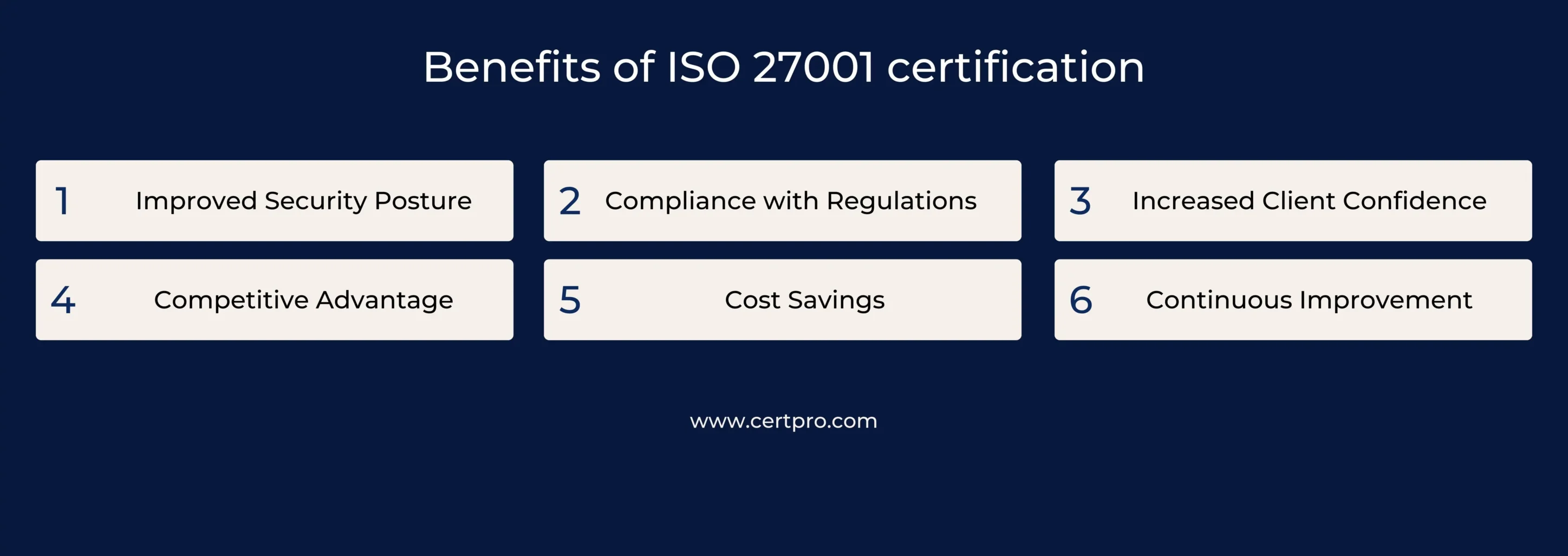
- ✓Independent Verification and Enterprise Procurement Recognition
- ✓Structured ISMS Governance and Risk Management Verification
- ✓Regulatory Alignment and Continual Improvement Framework
ISO 27001 Certification Scope for Queensland Organisations
The scope of ISO 27001 Certification in Queensland for businesses defines which information assets, business processes, systems, locations, and organisational units fall within the assessed ISMS boundary. Scope determination is a critical decision that affects both the ISO 27001 certification audit process and the representativeness of the resulting certificate. An independent certification body evaluates whether the defined scope accurately reflects the organisation’s information security environment and whether scoping decisions are appropriately justified.
Defining an Appropriate ISMS Scope
Under Clause 4.3 of ISO/IEC 27001:2022, organisations must determine the boundaries and applicability of the ISMS by considering external and internal issues identified under Clause 4.1, the requirements of interested parties under Clause 4.2, and the interfaces and dependencies between the organisation’s own activities and those of other organisations. For Queensland organisations, the scope statement commonly identifies the specific information systems, service lines, data types, physical locations, and organisational departments included within the ISMS. A Brisbane-based cloud service provider might scope its certification to cover cloud infrastructure operations, customer data processing environments, and supporting corporate information systems. A Queensland mining company might scope its ISO 27001 certification audit to cover its enterprise IT environment, excluding operational technology systems pending a broader future scope extension. The ISO 27001 audit evaluates whether the defined scope reflects the actual information security boundary and whether exclusions are appropriately justified.
Multi-Site and Cloud Environment Scope Considerations
Queensland organisations frequently operate across multiple sites — including Brisbane headquarters, regional Queensland offices, and remote operational locations — and rely extensively on cloud service providers for information processing and storage. ISO/IEC 27001:2022 specifically addresses cloud services through new Annex A controls introduced in the 2022 update, including controls for information security in use of cloud services and configuration management of cloud environments. When cloud services are within the ISMS scope, the organisation must address the shared responsibility model for cloud security. The cloud provider’s security controls are not automatically included in the organisation’s ISMS certification scope, and the organisation must demonstrate that its ISMS addresses information security risks arising from cloud service use. During the ISO 27001 certification audit, auditors review supplier agreements, cloud security assessments, and monitoring arrangements to evaluate whether cloud-related risks are appropriately addressed within the certified ISMS.
ISO 27001 Standard: Certification Maintenance and Certificate Validity
ISO 27001 certification is not a permanent status. Maintaining ISO 27001 certification requires ongoing ISMS operation, annual surveillance audits, and a recertification audit at the end of the three-year certification cycle. Understanding these maintenance requirements enables Queensland organisations to plan for ongoing ISO 27001 audit activities and maintain the continuous operation of their ISMS throughout the certification period.
Surveillance Audit Requirements and ISMS Continuity
Annual surveillance audits conducted by CertPro assess a defined subset of the certified ISMS to evaluate whether conformity with ISO/IEC 27001:2022 is maintained between recertification audits. Surveillance audits typically focus on changes to the ISMS or its scope since the previous audit, the status of corrective actions from previous findings, internal audit and management review activity, and any information security incidents or significant changes in the organisation’s risk environment. Queensland organisations that experience significant changes — such as a merger or acquisition, a major new cloud adoption, a significant data breach, or an expansion into new markets — should evaluate whether these changes affect their ISMS scope or controls and ensure relevant updates are reflected in ISMS documentation before the next surveillance audit. Suspension of ISO 27001 certification may occur where surveillance audit findings identify continued major nonconformities or where the organisation fails to maintain the conditions required for continued ISO 27001 compliance.
Recertification and Transition to Updated Standards
Recertification audits are conducted before the expiry of the three-year certification cycle and follow a process equivalent to the initial Stage 1 and Stage 2 ISO 27001 certification audit. The recertification audit evaluates the continuing conformity of the ISMS, the effectiveness of the management system over the certification period, and whether the organisation’s information security governance remains appropriate given changes in its operating environment and risk landscape. Queensland organisations previously certified to ISO/IEC 27001:2013 that transitioned to ISO/IEC 27001:2022 prior to the October 2025 deadline will have their recertification audits conducted against the current 2022 version of the ISO 27001 standard. Organisations that did not complete the transition before the deadline are required to achieve certification under ISO/IEC 27001:2022 through a new certification audit process. The 2022 standard’s updated Annex A control set — including new controls for threat intelligence, cloud security, and data masking — must be addressed in the Statement of Applicability for any recertification or new certification audit conducted against the current standard.
ISO 27001 Audit Queensland: Independent Certification Body Framework
CertPro operates as an independent ISO 27001 certification body providing ISO 27001 audit Queensland services to organisations across the state. The independence of the certification body from the organisation being assessed is a fundamental principle of the ISO 27001 certification audit framework. CertPro’s auditors assess ISO 27001 compliance based on objective evidence collected during the audit process — not on prior knowledge, advisory relationships, or assumptions about the organisation’s information security posture.
Independence, Objectivity, and Certification Decision Structure
CertPro maintains structural independence between audit activities and certification decisions. The audit team that conducts Stage 1 and Stage 2 ISO 27001 certification audit activities collects and documents evidence and identifies nonconformities. The certification decision — whether to issue, maintain, suspend, or withdraw certification — is made by a certification committee independent of the audit team. This separation ensures that the certification decision is based on an objective review of documented audit findings rather than on the judgement of individual auditors. The Licensed CPA Firm structure under which CertPro operates provides an established framework for independent professional evaluation of documented evidence against defined criteria — a framework directly applicable to ISO 27001 conformity assessment. Queensland organisations undergoing ISO 27001 audit Queensland activities can rely on this structural independence as the basis for the certification body’s objectivity.
Auditor Competence and Sector-Specific Audit Capability
ISO 27001 certification audits require auditors with documented competence in information security management, the ISO/IEC 27001:2022 standard, and the sector-specific context of the organisation being assessed. CertPro assigns audit teams with relevant sector knowledge to ISO 27001 certification audit engagements involving Queensland organisations in specialised industries — including mining and resources, energy infrastructure, financial services, healthcare, and technology. Sector-relevant auditor competence ensures that evidence collection and evaluation activities account for the specific information assets, risk environments, and regulatory obligations applicable to the organisation’s industry context. This is particularly relevant for Queensland organisations in sectors such as mining — where operational technology environments present distinct information security considerations — and financial services — where APRA regulatory requirements and CPS 234 obligations create specific information security governance expectations that are evaluated in the context of the ISO 27001 certification audit.
FAQ
▶
What is ISO 27001 certification and why is it relevant to Queensland organisations?
▶
What does an ISO 27001 audit in Queensland involve?
▶
Which Queensland industries most commonly pursue ISO 27001 certification?
▶
What is the Statement of Applicability and why is it important in the ISO 27001 certification audit?
▶
How long is ISO 27001 certification valid in Queensland?
▶
Does ISO 27001 compliance in Queensland support alignment with APRA CPS 234?
▶
What is the difference between the ISO 27001 standard’s 2013 and 2022 versions?
▶
Can Queensland organisations certify only part of their operations under ISO 27001?
Get In Touch
have a question? let us get back to you.