
ISO 27001 Certification in Raleigh
ISO 27001 Certification in Raleigh is pursued by organizations across the Research Triangle to obtain independent, third-party verification that their Information Security Management System conforms to the requirements of ISO/IEC 27001:2022. CertPro conducts these ISO 27001 certification audits as a Licensed CPA Firm, evaluating ISMS conformity through objective, evidence-based assessment — not advisory engagement. This distinction matters: organizations receive an independent certification determination, not consulting guidance.
OUR CLIENTS










ISO 27001 Certification for Raleigh’s Technology and Research Triangle Ecosystem
ISO 27001 Certification in Raleigh is pursued by organizations across the Research Triangle to obtain independent, third-party verification that their Information Security Management System conforms to the requirements of ISO/IEC 27001:2022. CertPro conducts these ISO 27001 certification audits as a Licensed CPA Firm, evaluating ISMS conformity through objective, evidence-based assessment — not advisory engagement. This distinction matters: organizations receive an independent certification determination, not consulting guidance.
Raleigh sits at the center of one of the most concentrated technology and innovation corridors in the United States. The Research Triangle — anchored by Raleigh, Durham, and Chapel Hill — hosts a dense concentration of SaaS providers, cybersecurity firms, cloud service providers, biotechnology and life sciences companies, healthcare organizations, financial services and fintech firms, data analytics enterprises, telecommunications operators, advanced manufacturers, research institutions, and government technology contractors.
Each of these sectors handles sensitive information under varying regulatory, contractual, and enterprise procurement obligations. The demand for independently verified information security controls has grown substantially across the region, making ISO 27001 Certification in Raleigh an increasingly essential credential for organizations competing in national and global markets.
ISO 27001 Certification in Raleigh addresses a specific and well-defined need: providing organizations with a formal, accredited certification that demonstrates their ISMS has been evaluated against the ISO/IEC 27001:2022 standard by an independent third party. This certification is recognized in enterprise vendor security reviews, financial sector procurement processes, government contractor evaluations, and international client due diligence.
For Raleigh’s technology companies competing for enterprise contracts — and SaaS providers serving regulated industries — ISO 27001 Certification has become a standard element of vendor qualification and third-party risk management programs. Organizations that hold a current certificate gain a measurable advantage in procurement cycles where information security posture is a scored evaluation criterion.
The ISO 27001 standard — formally ISO/IEC 27001:2022 — specifies the requirements for establishing, implementing, maintaining, and continually improving an Information Security Management System. The standard is structured around ISO’s Plan-Do-Check-Act model and requires organizations to address Clauses 4 through 10 of the management system framework, supplemented by controls selected from Annex A.
The 2022 revision reorganized Annex A into four control domains — Organizational, People, Physical, and Technological — and introduced 11 new controls addressing areas such as threat intelligence, cloud service security, and data masking. Organizations with certifications issued under the 2013 version of the standard were required to transition to ISO/IEC 27001:2022 by October 31, 2025, as established by accreditation bodies. All new ISO 27001 certification audits are now conducted against the 2022 standard.
CertPro’s role in ISO 27001 Certification in Raleigh is strictly that of an independent certification body conducting conformity assessments. The certification determination is made by CertPro’s certification committee based solely on audit findings and documented evidence collected during the ISO 27001 certification audit process. CertPro does not advise organizations on ISMS design, control implementation, policy development, or risk treatment — these responsibilities rest with the organization seeking certification.
This independence is a foundational requirement of third-party certification and is precisely what gives ISO 27001 Certification its credibility in enterprise procurement, regulatory review, and client assurance contexts. Organizations across Raleigh’s Research Triangle ecosystem rely on this independently issued certification to communicate verified information security governance to customers, partners, regulators, and enterprise clients.

What Is ISO 27001 Certification?
ISO 27001 Certification is a formal determination by an accredited or independent certification body that an organization’s Information Security Management System conforms to the requirements of ISO/IEC 27001:2022. The certification is issued following a structured ISO 27001 audit process that evaluates whether the ISMS is properly established, actively implemented, consistently maintained, and subject to continual improvement — all demonstrated through objective documentary and operational evidence. The resulting certificate communicates a verified, standards-based information security posture to clients, partners, and regulators.
The ISO/IEC 27001:2022 Standard and Its Structure
The ISO 27001 standard is organized into two primary components. Clauses 4 through 10 define the mandatory management system requirements, covering: understanding organizational context and interested parties, defining the scope of the ISMS, establishing leadership commitment and information security policy, planning for risks and opportunities, documenting information security objectives, supporting operational processes, conducting performance evaluations through internal audit and management review, and driving continual improvement.
These clauses are mandatory — every certified organization must demonstrate conformity with each clause through documented and operational evidence evaluated during the ISO 27001 certification audit. No clause may be excluded, and auditors collect evidence for each requirement independently.
Annex A of ISO/IEC 27001:2022 contains 93 information security controls organized across four domains: Organizational controls (37 controls), People controls (8 controls), Physical controls (14 controls), and Technological controls (34 controls). Organizations are not required to implement every Annex A control. Instead, they select applicable controls based on their risk assessment and risk treatment process, document their selections and justifications in a Statement of Applicability (SoA), and implement the selected controls.
During the ISO 27001 audit, auditors evaluate whether the organization’s SoA accurately reflects control selection decisions and whether selected controls are effectively designed and operating as intended. Any discrepancy between the documented SoA and actual practice may result in a nonconformity finding.
Information Security Management System (ISMS) Defined
An Information Security Management System is the set of policies, processes, procedures, documented information, organizational structures, and technical controls that an organization establishes to manage information security risks in a systematic and structured manner. The ISMS defines how the organization identifies information assets and associated risks, selects and applies controls to treat those risks to an acceptable level, monitors and measures the effectiveness of those controls, and responds to incidents and nonconformities.
The ISMS is not a product or a technology platform — it is a governed management framework that operates across people, processes, and technology. ISO 27001 compliance requires that this framework be demonstrably operational and subject to regular internal audit and management review, with documented evidence available for evaluation by an external auditor conducting the ISO 27001 certification audit.
Key ISMS Documentation Requirements Under ISO/IEC 27001:2022
ISO/IEC 27001:2022 specifies mandatory documented information that organizations must maintain and retain as evidence of ISMS operation. Core documentation includes the information security policy, the ISMS scope statement, the information security risk assessment methodology and results, the risk treatment plan, the Statement of Applicability, information security objectives and plans to achieve them, internal audit records, management review records, and evidence of corrective actions taken in response to nonconformities.
This documented information is reviewed during the Stage 1 ISO 27001 certification audit to confirm that the organization’s ISMS framework is formally established. It is further evaluated during Stage 2 to confirm that documented processes reflect actual operational practice. Deficiencies in mandatory documented information are recorded as nonconformities that must be addressed before certification is recommended.
ISO 27001 Certification Audit Process in Raleigh
The ISO 27001 certification audit process for Raleigh organizations follows a structured, multi-stage methodology that CertPro conducts as an independent certification body. Each stage is focused exclusively on conformity assessment — evaluating whether documented evidence and operational practice demonstrate conformity with ISO/IEC 27001:2022 requirements. The process is designed to produce an objective, evidence-based ISO 27001 certification determination that organizations can rely on in enterprise and regulatory contexts.
The Stage 1 ISO 27001 audit is a structured review of the organization’s documented ISMS framework. Auditors examine the ISMS scope, information security policy, risk assessment methodology, risk treatment plan, Statement of Applicability, and other mandatory documented information required by ISO/IEC 27001:2022 Clauses 4 through 10.
The Stage 1 audit determines whether the ISMS is formally established and sufficiently documented to proceed to Stage 2 operational evaluation. It also identifies any significant gaps in mandatory documentation or scope definition that would represent nonconformities if confirmed during Stage 2. The output is a formal audit report and a readiness determination — confirming whether the organization is prepared to advance to the operational conformity assessment.
The Stage 2 ISO 27001 certification audit evaluates whether the ISMS is implemented and operating in conformity with the requirements of ISO/IEC 27001:2022. Auditors collect objective evidence through document review, interviews with personnel, observation of processes, and inspection of technical configurations and records. Evidence is evaluated against each applicable clause requirement and each Annex A control included in the organization’s Statement of Applicability.
Auditors assess both the design effectiveness of controls — whether the control is appropriately designed to address the identified risk — and the operating effectiveness of controls — whether the control is functioning as intended in practice. Nonconformities identified during Stage 2 are documented and reported to the organization. The organization must provide documented corrective action evidence before the certification committee renders its determination.
| Audit Stage | Key Activities | Output |
|---|---|---|
| Application Review | Scope confirmation, audit program determination, auditor assignment | Audit plan and engagement confirmation |
| Stage 1 Audit | Review of ISMS documentation, scope, policies, risk assessment records, and Statement of Applicability | Stage 1 audit report; ISMS readiness determination |
| Stage 2 Audit | Operational conformity assessment, evidence collection, Annex A control evaluation, personnel interviews | Stage 2 audit report; nonconformity register |
| Nonconformity Review | Organization submits corrective action evidence; auditor evaluates adequacy and closure | Corrective action closure confirmation |
| Certification Committee Decision | Independent review of full audit record; ISO 27001 certification determination | ISO 27001 certificate issued (3-year validity) |
| Surveillance Audits | Annual review of continued ISMS conformity, improvement activity, and scope changes | Surveillance audit report; certification maintained or escalated |
The ISO 27001 certification determination is made by CertPro’s certification committee, which reviews the complete audit record including Stage 1 findings, Stage 2 findings, and corrective action evidence. The committee makes its determination independently of the audit team, based solely on documented evidence — not advisory relationships or commercial considerations.
When conformity is confirmed, CertPro issues the ISO 27001 certificate, which carries a three-year validity period. During this cycle, annual surveillance audits verify that the ISMS continues to conform to ISO/IEC 27001:2022 and that continual improvement obligations are being met. A recertification audit is conducted prior to certificate expiry to reassess full conformity and renew the certification for a further three-year cycle. Certificates may be suspended or withdrawn if surveillance audits identify significant nonconformities that are not resolved within established timelines.
- ✓Stage 1 Audit: Documentation and Readiness Review
- ✓Stage 2 Audit: Operational Conformity Assessment
- ✓Certification Audit Stages: Summary Table
- ✓Certification Decision, Certificate Issuance, and Recertification
ISO 27001 Requirements: What Raleigh Organizations Must Demonstrate
ISO 27001 compliance requires organizations to demonstrate conformity with specific management system requirements across Clauses 4 through 10 of ISO/IEC 27001:2022, as well as with the information security controls selected and documented in the Statement of Applicability. The ISO 27001 certification audit evaluates documented evidence and operational practice against each of these requirements. Organizations preparing for ISO 27001 Certification in Raleigh should understand what auditors look for at each stage of the assessment.
ISO/IEC 27001:2022 Clause 6.1 requires organizations to define and apply an information security risk assessment process that identifies risks associated with the loss of confidentiality, integrity, and availability of information within the ISMS scope. This process must analyze and evaluate those risks against defined criteria and produce documented risk assessment results.
The risk treatment process under Clause 6.1.3 requires organizations to select treatment options — such as applying controls, accepting risk, avoiding risk, or transferring risk — and to document a risk treatment plan that maps selected Annex A controls to identified risks. During the ISO 27001 certification audit, auditors evaluate whether the risk assessment methodology is consistently applied, whether risk treatment decisions are traceable to assessment results, and whether the Statement of Applicability accurately reflects control selection decisions with documented justifications for inclusions and exclusions.
ISO/IEC 27001:2022 Clause 9.2 requires organizations to conduct internal audits of the ISMS at planned intervals to evaluate whether the management system conforms to both the organization’s own requirements and the ISO 27001 standard, and whether it is effectively implemented and maintained. Internal audit records must be retained as documented evidence.
Clause 9.3 requires top management to conduct periodic management reviews of the ISMS, addressing inputs such as audit results, status of corrective actions, changes in external and internal issues, and feedback on information security performance. Management review records must document outputs including decisions and actions related to continual improvement. During the ISO 27001 certification audit, auditors review internal audit and management review records as primary evidence of the ISMS evaluation cycle. Absence or inadequacy of these records is one of the most common sources of nonconformity findings.
The four Annex A control domains in ISO/IEC 27001:2022 cover distinct dimensions of information security governance. Organizational controls (37 controls) address policies, roles and responsibilities, asset management, supplier relationships, incident management, and business continuity. People controls (8 controls) address personnel screening, terms and conditions of employment, information security awareness, training, and disciplinary processes. Physical controls (14 controls) address physical security perimeters, entry controls, protection of equipment, secure disposal of media, and monitoring of physical premises. Technological controls (34 controls) address access control, cryptography, network security, system acquisition and development, vulnerability management, and logging and monitoring.
Organizations select applicable controls from these domains based on risk assessment results, document their selections in the Statement of Applicability, and implement controls as part of ISMS operation. The ISO 27001 audit evaluates the design and operating effectiveness of selected controls against their stated objectives and the risks they are intended to address.
- ✓Risk Assessment and Risk Treatment Requirements
- ✓Internal Audit and Management Review Requirements
- ✓Annex A Control Domains: Organizational, People, Physical, Technological
Why Raleigh Organizations Pursue ISO 27001 Certification
Organizations across Raleigh’s Research Triangle technology ecosystem pursue ISO 27001 Certification in response to specific, documented business drivers. These include enterprise vendor security requirements, regulated sector procurement obligations, client contractual requirements, international market access, and third-party risk management program standards maintained by their customers and partners. Understanding these drivers helps clarify why ISO 27001 Certification has become a baseline expectation — not merely a differentiator — for many Raleigh companies.
Enterprise Vendor Security Reviews and Procurement Requirements
Enterprise organizations operating in Raleigh and serving national and global clients increasingly require ISO 27001 Certification as a condition of vendor onboarding and contract renewal. A SaaS provider in Raleigh’s technology corridor seeking to sign a multi-year enterprise contract with a Fortune 500 customer may encounter a procurement requirement specifying that the vendor must hold a current ISO 27001 certificate covering the services being procured.
Similarly, cloud service providers and data analytics firms in the Research Triangle that serve financial services institutions, healthcare organizations, or federal agencies face vendor security questionnaires in which ISO 27001 Certification provides documented, independently verified evidence of ISMS conformity. This reduces the burden of completing lengthy security assessment questionnaires and accelerates vendor approval timelines — delivering tangible commercial value alongside the security credential.
Regulated Sector Demand: Healthcare IT, Financial Services, and Government Technology
ISO 27001 Certification that Raleigh healthcare IT organizations pursue reflects the intersection of HIPAA information security obligations and enterprise vendor risk management requirements. Healthcare IT vendors and technology providers serving hospitals, health systems, and research institutions in the Raleigh area are evaluated against information security standards during vendor risk assessments. ISO 27001 Certification provides documented evidence of a structured ISMS, risk-based control selection, and ongoing management review — elements that align with HIPAA Security Rule obligations and that are recognized in vendor security reviews conducted by covered entities.
Similarly, ISO 27001 Certification that Raleigh financial services and fintech organizations pursue reflects requirements from banking institutions, payment processors, and investment management firms. These organizations evaluate vendor information security posture as part of third-party risk management programs governed by OCC, FFIEC, and state regulatory guidance. ISO 27001 compliance provides a recognized, independently verified basis for satisfying these assessments.
International Market Access and Client Due Diligence
Raleigh technology companies expanding into international markets — particularly European Union markets subject to GDPR — encounter procurement environments in which ISO 27001 Certification is a baseline expectation rather than a differentiator. ISO 27001 Certification provides Raleigh tech companies operating internationally with a recognized, standards-based demonstration of information security governance that is understood across jurisdictions without requiring country-specific assessments.
The ISO 27001 standard is recognized globally, and a certificate issued following a conformity assessment against ISO/IEC 27001:2022 is accepted in enterprise procurement processes across North America, Europe, Asia-Pacific, and the Middle East. For Research Triangle companies pursuing global growth, ISO 27001 Certification in Raleigh provides a portable, internationally recognized credential that communicates ISMS conformity to prospective clients, partners, and regulators across markets.
Benefits of ISO 27001 Certification for Raleigh-Based Organizations
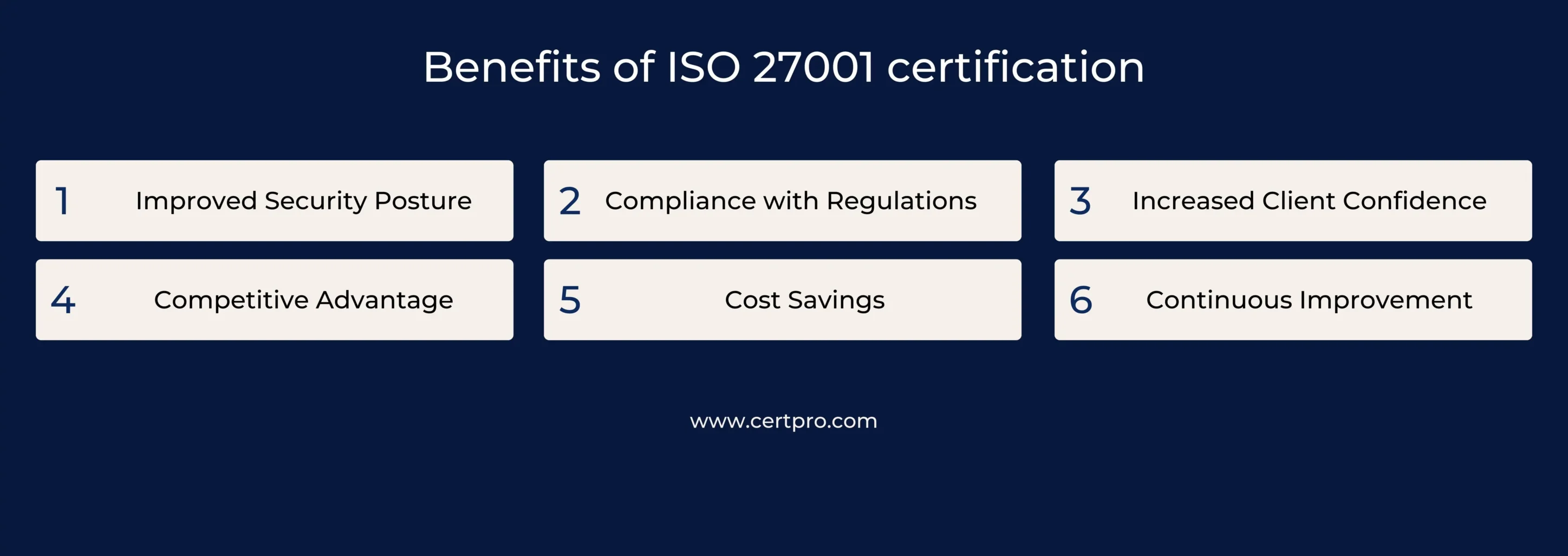
ISO 27001 Certification delivers documented, independently verified evidence of ISMS conformity that serves multiple operational and commercial objectives for organizations across Raleigh’s Research Triangle technology, life sciences, financial services, and healthcare sectors. The benefits below reflect direct outcomes of the ISO 27001 certification audit process and the ongoing value of maintaining a conforming, actively managed ISMS.
- ✓Independent third-party verification that the ISMS conforms to ISO/IEC 27001:2022 requirements, issued by a Licensed CPA Firm following a structured ISO 27001 certification audit
- ✓Recognized credential in enterprise vendor security reviews, reducing the burden of responding to security questionnaires in procurement processes
- ✓Documented evidence of risk-based information security controls for use in client due diligence, financial sector third-party risk assessments, and regulatory reviews
- ✓Structured ISO 27001 compliance framework that aligns with HIPAA Security Rule, GDPR Article 32, and NIST CSF information security expectations
- ✓Ongoing surveillance audit cycle that maintains continuous accountability for ISMS conformity and drives documented continual improvement
- ✓International market recognition enabling Raleigh-based technology companies to demonstrate ISMS conformity to global clients and partners
- ✓Differentiated positioning in competitive RFP and procurement processes where ISO 27001 Certification is a scored evaluation criterion
- ✓Structured basis for managing third-party and supply chain information security risks through Annex A supplier relationship controls
The ISO 27001 certification audit conducted by CertPro as an independent Licensed CPA Firm provides a structured, evidence-based evaluation of the organization’s information security controls that internal assessments cannot replicate. Independent auditors evaluate control design and operating effectiveness against the requirements of ISO/IEC 27001:2022 and the objectives defined in the organization’s Statement of Applicability. Evidence is collected through document review, personnel interviews, and operational observation.
This independent evaluation identifies actual conformity status — including areas where controls are documented but not consistently operating — rather than self-reported compliance status. For Raleigh organizations in sectors subject to enterprise vendor scrutiny, the independent nature of the ISO 27001 certification audit is precisely what gives the resulting certificate its commercial and regulatory credibility.
ISO 27001 compliance provides a structured basis for mapping legal and regulatory information security requirements to documented controls. Organizations subject to HIPAA Security Rule obligations can map required implementation specifications to Annex A controls documented in the Statement of Applicability. Organizations processing personal data of EU residents can reference their ISO/IEC 27001:2022 certificate as evidence of organizational and technical measures under GDPR Article 32.
Organizations subject to North Carolina identity theft protection statutes, NIST Cybersecurity Framework requirements, or CMMC information security requirements can use the ISO 27001 standard as a structured control framework addressing overlapping requirements across multiple regulatory obligations. This cross-framework alignment is particularly relevant for Raleigh’s biotechnology, life sciences, and healthcare IT organizations, which face overlapping federal and state information security obligations alongside enterprise client security requirements.
- ✓Verification of Control Effectiveness Through Independent Audit
- ✓Regulatory Alignment and Cross-Framework Value
Industry Sectors Pursuing ISO 27001 Certification in Raleigh
ISO 27001 Certification for Raleigh companies spans a broad range of industry sectors, reflecting the diversity of the Research Triangle technology and business ecosystem. The sectors below represent the primary demand base for ISO 27001 certification audit services in the Raleigh area, with each sector driven by distinct information security obligations and procurement requirements. Understanding these sector-specific drivers helps organizations contextualize their own certification priorities.
| Industry Sector | Primary ISO 27001 Demand Driver | Relevant Regulatory Context |
|---|---|---|
| SaaS and Cloud Service Providers | Enterprise vendor security requirements; client procurement conditions requiring ISO 27001 Certification | SOC 2, NIST CSF, GDPR data processing agreements |
| Biotechnology and Life Sciences | Clinical data protection; research partner security assessments and due diligence | HIPAA, FDA 21 CFR Part 11, GxP data integrity requirements |
| Healthcare IT and Health Technology | HIPAA Security Rule alignment; covered entity vendor security reviews | HIPAA Security Rule, HITECH, ONC information blocking rules |
| Financial Services and Fintech | Third-party risk management programs; banking and payment sector vendor security reviews | FFIEC, OCC guidance, GLBA Safeguards Rule, PCI DSS |
| Government Technology Contractors | Federal and state agency procurement security requirements and contract conditions | NIST SP 800-53, CMMC, FedRAMP, FISMA |
ISO 27001 Certification for Raleigh Technology and SaaS Companies
Raleigh’s technology and SaaS sector is the largest and most active consumer of ISO 27001 certification audit services in the Research Triangle. Software companies providing enterprise applications, data analytics platforms, cybersecurity tools, cloud infrastructure services, and digital workflow solutions to regulated industries encounter ISO 27001 Certification requirements in enterprise procurement cycles, partner security assessments, and international sales processes.
ISO 27001 Certification that Raleigh tech companies pursue through CertPro represents an independent conformity assessment evaluating whether the company’s ISMS — covering development environments, cloud infrastructure, customer data handling, access control, incident response, and supplier management — meets the requirements of ISO/IEC 27001:2022. The resulting certificate is a documented, independently issued credential that can be presented in RFP responses, vendor security questionnaires, and due diligence reviews without disclosing proprietary security configurations.
ISO 27001 Compliance for Raleigh’s Research and Academic Institutions
Research institutions, universities, and academic medical centers in the Raleigh area — including organizations affiliated with NC State University, Duke University Health System, and UNC Health — handle sensitive research data, clinical trial information, intellectual property, and personally identifiable information subject to federal grant security requirements, institutional review board protocols, and sponsor data security obligations.
ISO 27001 standard compliance provides these institutions with a structured framework for managing information security risks across research data environments, collaborative research networks, and technology transfer operations. For commercially operating research spinouts and technology transfer entities, ISO 27001 Certification in Raleigh provides the independent verification credential required by industry research partners, federal agencies, and international collaborators conducting vendor and partner security assessments.
ISO 27001 Certification Scope and Independent Decision Framework
The scope of an ISO 27001 Certification defines the boundaries and applicability of the certified ISMS. Scope definition is an organizational responsibility governed by ISO/IEC 27001:2022 Clause 4.3, and it is evaluated during both the Stage 1 and Stage 2 certification audits. The ISO 27001 Certification issued by CertPro reflects the scope as defined and documented by the organization and confirmed through the audit process — ensuring that the certified boundary accurately represents operational reality.
ISMS Scope Definition and Boundary Considerations
ISO/IEC 27001:2022 Clause 4.3 requires organizations to determine the boundaries and applicability of the ISMS by considering the external and internal issues identified under Clause 4.1, the requirements of interested parties under Clause 4.2, and the interfaces and dependencies between activities performed by the organization and those performed by external parties. The ISMS scope must be documented and must be specific enough to establish clear boundaries for the ISO 27001 Certification.
Organizations may define the scope to include specific products or services, business units, geographic locations, or technology systems. During the ISO 27001 certification audit, auditors evaluate whether the documented scope accurately reflects the boundaries applied in practice and whether relevant assets, processes, and interfaces within the scope boundary are covered by the ISMS. Scope gaps — where processes or assets within the defined boundary are excluded from ISMS controls — are documented as nonconformities.
Independent Certification Committee and Evidence-Based Determination
CertPro’s certification committee reviews the complete audit record from both the Stage 1 and Stage 2 ISO 27001 certification audit engagements, evaluating whether documented evidence demonstrates conformity with ISO/IEC 27001:2022 requirements across all applicable clauses and selected Annex A controls. The committee’s determination is made independently of the audit team to maintain objectivity, and is based solely on documented audit findings and corrective action evidence.
The committee may request additional clarification or evidence before finalizing its determination. When conformity is confirmed, the committee authorizes issuance of the ISO 27001 certificate specifying the organization’s name, certified scope, applicable standard (ISO/IEC 27001:2022), certificate number, issue date, and expiry date. The ISO 27001 certification determination is not influenced by the organization’s advisory relationships, organizational structure, or commercial relationship with CertPro.
Surveillance Audits and Certification Maintenance
ISO 27001 Certification is maintained through annual surveillance audits conducted during the three-year certification cycle. Surveillance audits evaluate a subset of ISMS requirements and controls to confirm that the organization continues to conform to ISO/IEC 27001:2022 and that the ISMS continues to be implemented, maintained, and improved. The surveillance audit scope is determined based on the organization’s risk profile, previous ISO 27001 audit findings, and changes to the ISMS since the previous audit.
If a surveillance audit identifies significant nonconformities that are not resolved within the specified timeframe, CertPro’s certification committee may suspend or withdraw the certificate. Organizations experiencing significant changes — such as mergers, acquisitions, major system changes, or scope expansions — are required to notify CertPro so that the impact on ISO 27001 Certification can be assessed. A recertification audit at the end of the three-year cycle reassesses full conformity with ISO/IEC 27001:2022 before the certificate is renewed.
ISO 27001 Standard Requirements: Clauses 4 Through 10 in Detail
The ISO 27001 standard’s management system requirements in Clauses 4 through 10 form the mandatory framework that every ISO/IEC 27001:2022 certified organization must demonstrate conformity with. The ISO 27001 certification audit evaluates each clause through document review and operational evidence collection. Understanding these requirements is essential for Raleigh organizations preparing their ISMS for certification assessment — and for understanding what auditors will examine at each stage of the process.
Clause 4 requires organizations to define organizational context — the external and internal factors that affect the organization’s ability to achieve ISMS objectives — and to identify interested parties and their information security requirements. This analysis informs the ISMS scope definition under Clause 4.3. Clause 5 addresses leadership requirements: top management must demonstrate commitment to the ISMS, establish and communicate the information security policy, assign and communicate roles and responsibilities for information security, and ensure that ISMS objectives are aligned with the organization’s strategic direction.
Clause 6 addresses planning: organizations must identify information security risks and opportunities, conduct the risk assessment, develop the risk treatment plan, select Annex A controls, and document the Statement of Applicability. During the ISO 27001 audit, auditors evaluate evidence of top management engagement and the rigor and consistency of the risk assessment and treatment process. Weak or inconsistent risk documentation is among the most frequently cited issues in ISO 27001 certification audits.
Clause 7 addresses the resources, competence, awareness, and communication requirements that support ISMS operation, as well as the documented information requirements that must be maintained and retained as evidence. Clause 8 requires organizations to plan, implement, and control the processes needed to meet ISMS requirements, including conducting the risk assessment and implementing the risk treatment plan at defined intervals or when significant changes occur.
Clause 9 requires performance evaluation through internal audits at planned intervals and management review, with documented outputs. Clause 10 requires organizations to identify nonconformities, take corrective actions to address root causes, and implement actions for continual improvement of the ISMS. The ISO 27001 standard’s PDCA structure means that auditors evaluate not only whether controls are in place, but whether the management system governing those controls is actively operating — reviewing, evaluating, and improving on a continuous cycle. This distinction between having controls and managing them is central to ISO 27001 compliance.
- ✓Clause 4 Through 6: Context, Leadership, and Planning
- ✓Clause 7 Through 10: Support, Operation, Evaluation, and Improvement
FAQ
▶
What is ISO 27001 certification and what does it certify?
▶
Which Raleigh organizations are required to obtain ISO 27001 certification?
▶
How long does the ISO 27001 certification audit process take?
▶
What is the difference between the Stage 1 and Stage 2 ISO 27001 audits?
▶
What happens if nonconformities are identified during the ISO 27001 audit?
▶
Does ISO 27001 certification cover HIPAA or GDPR compliance?
▶
What is the Statement of Applicability and why is it important in the ISO 27001 audit?
▶
How does ISO 27001 certification interact with SOC 2 attestation for Raleigh technology companies?
Get In Touch
have a question? let us get back to you.