
ISO 27001 Certification in Salt Lake City
ISO 27001 Certification in Salt Lake City is pursued by organizations across Utah’s Wasatch Front technology corridor to obtain independent, third-party verification that their Information Security Management System conforms to the requirements of ISO/IEC 27001:2022. Certification is issued by a Licensed CPA Firm following a structured conformity assessment. That assessment evaluates documented policies, risk assessment outputs, risk treatment decisions, the Statement of Applicability, Annex A controls, and the organization’s ongoing management system performance.
OUR CLIENTS








ISO 27001 Certification for Salt Lake City’s Technology and Financial Ecosystem
ISO 27001 Certification in Salt Lake City is pursued by organizations across Utah’s Wasatch Front technology corridor to obtain independent, third-party verification that their Information Security Management System conforms to the requirements of ISO/IEC 27001:2022. Certification is issued by a Licensed CPA Firm following a structured conformity assessment. That assessment evaluates documented policies, risk assessment outputs, risk treatment decisions, the Statement of Applicability, Annex A controls, and the organization’s ongoing management system performance.
Salt Lake City operates as a recognized technology and financial services hub within Utah. The city hosts a concentration of SaaS companies, cybersecurity firms, fintech organizations, cloud service providers, healthcare and life sciences providers, data centers, telecommunications operators, professional services firms, logistics and transportation companies, and emerging technology enterprises. Organizations across these sectors establish and operate Information Security Management Systems to protect sensitive information assets, manage information security risk, and meet the expectations of enterprise clients, regulated counterparties, and procurement stakeholders.
ISO 27001 Certification in Salt Lake City provides the independent audit verification that supports these objectives through a structured, evidence-based certification process governed by ISO/IEC 27001:2022. For organizations operating across Utah’s diverse economy, this certification represents a credible and internationally recognized information security credential.
The ISO 27001 standard establishes requirements for an organization to define the scope of its ISMS, identify information security risks, evaluate those risks against defined criteria, select and implement risk treatment measures, and monitor and improve the management system over time. ISO/IEC 27001:2022 is organized around Clauses 4 through 10, which govern context, leadership, planning, support, operation, performance evaluation, and improvement.
Annex A of the standard specifies 93 controls organized across four domains: Organizational, People, Physical, and Technological. Conformity with these requirements is evaluated during the certification audit — not through preparatory activities or advisory review. Understanding the structure of the ISO 27001 standard is essential for any organization preparing to pursue ISO 27001 Certification in Salt Lake City.
ISO 27001 compliance in Salt Lake City is increasingly relevant as organizations in Utah’s technology and financial services sectors face rising information security expectations from enterprise customers, federal and state regulators, and international business partners. The transition deadline for organizations previously certified under ISO/IEC 27001:2013 was October 31, 2025, as established by accreditation and certification bodies. Conformity with the 2022 standard is now the current requirement for all active and new certifications.
Organizations that have not yet completed the transition to ISO/IEC 27001:2022 must do so through a recertification or surveillance audit conducted under the updated standard. Maintaining current ISO 27001 compliance is critical for organizations that rely on certification to meet contractual and regulatory obligations.
The ISO 27001 certification audit evaluates objective evidence against each applicable requirement of ISO/IEC 27001:2022. Auditors assess documented information, interview personnel, observe processes, and test controls to determine whether the ISMS conforms to the standard’s requirements. The certification body issues a formal certification decision following the audit, and the resulting ISO 27001 certificate is valid for three years, subject to annual surveillance audits.
For organizations operating in Salt Lake City’s competitive technology and financial services markets, ISO 27001 Certification in Salt Lake City represents an independently verified statement of information security management conformity. That verification can be referenced in vendor questionnaires, procurement processes, and contractual requirements — making it a practical and strategic business credential.

ISO 27001 Certification Audit Process for Organizations in Salt Lake City
The ISO 27001 certification audit process follows a structured sequence of stages, each governed by defined audit objectives and evidence evaluation criteria. For organizations pursuing ISO 27001 Certification in Salt Lake City, the process begins with an application review and concludes with a formal certification decision issued by the certification committee. The audit program is determined based on the defined scope of the ISMS, the complexity of the organization’s information environment, and the number of personnel and locations within scope.
The Stage 1 audit evaluates the organization’s ISMS documentation and confirms that the management system is sufficiently developed to proceed to the Stage 2 audit. During Stage 1, the auditor reviews the information security policy, risk assessment methodology, risk treatment plan, Statement of Applicability, and the documented scope of the ISMS. The auditor also assesses whether the organization has identified the applicable Annex A controls, documented justifications for inclusions and exclusions, and established objectives for the management system.
Stage 1 audit findings inform the audit program for Stage 2 and identify any areas requiring clarification before the on-site assessment proceeds. Addressing these findings promptly helps organizations move efficiently through the ISO 27001 certification audit process.
The Stage 2 audit constitutes the primary conformity assessment. During this stage, the auditor evaluates whether the ISMS is effectively implemented and operating in accordance with ISO/IEC 27001:2022 requirements. Auditors collect objective evidence through document review, personnel interviews, and control testing across the four Annex A domains: Organizational, People, Physical, and Technological controls.
The ISO 27001 certification audit at Stage 2 also evaluates internal audit records, management review outputs, corrective action records, and performance monitoring data. This evidence base allows the auditor to assess whether the management system is maintained and continually improved as required by Clauses 9 and 10 of the standard.
Following the Stage 2 audit, the auditor documents all findings, including any nonconformities identified during the evaluation. Nonconformities are classified and reported to the organization, which is required to submit a documented corrective action response within a defined period. The certification committee then reviews the audit report, the auditor’s findings, and the organization’s corrective action responses before issuing the certification decision.
The certification decision is independent of the audit team, ensuring objectivity in the conformity determination. Once the decision is issued, the organization receives its ISO 27001 certificate. That certificate identifies the certified scope, the applicable ISO 27001 standard, the certificate validity period, and the issuing certification body.
| Audit Stage | Key Activities | Output |
|---|---|---|
| Application Review | Scope confirmation, audit program determination, conflict of interest check | Agreed audit plan |
| Stage 1 Audit | Documentation review, ISMS readiness assessment, Statement of Applicability evaluation | Stage 1 findings report |
| Stage 2 Audit | Control testing, evidence collection, personnel interviews, Annex A domain evaluation | Audit report with findings |
| Nonconformity Review | Corrective action submission, supporting evidence review, closure assessment | Verified corrective actions |
| Certification Decision | Independent committee review, conformity determination, certificate issuance | ISO 27001 certificate |
An ISO 27001 certificate is valid for a three-year certification cycle, during which annual surveillance audits are conducted to verify that the ISMS continues to conform to the requirements of ISO/IEC 27001:2022. Surveillance audits evaluate a targeted subset of the ISMS, including internal audit and management review outputs, corrective actions, changes to the organization’s information environment, and the continued effectiveness of selected Annex A controls.
At the end of the three-year cycle, a recertification audit is conducted. This full-scope evaluation determines whether the certificate should be renewed. Organizations in Salt Lake City maintaining ISO 27001 compliance must demonstrate sustained conformity throughout the certification cycle. Failure to do so may result in suspension or withdrawal of the certificate.
- ✓Stage 1 and Stage 2 Certification Audits
- ✓Nonconformity Review and Certification Decision
- ✓Surveillance Audits and Recertification
ISO 27001 Requirements and ISMS Documentation Evaluated in the Audit
The ISO 27001 standard requires organizations to maintain a defined set of documented information as evidence of ISMS conformity. During the ISO 27001 certification audit, auditors evaluate documented information against the specific requirements of Clauses 4 through 10 and the applicable controls identified in the Statement of Applicability. The documentation categories described below represent the core evidence base reviewed during the audit process for organizations seeking ISO 27001 Certification in Salt Lake City.
ISO/IEC 27001:2022 specifies mandatory documented information that organizations must maintain to demonstrate conformity. The information security policy must be documented, approved by top management, communicated to personnel, and available to interested parties as appropriate. The risk assessment process must be documented, including the methodology used to identify and evaluate information security risks, the risk criteria applied, and the outputs of each risk assessment cycle.
The risk treatment plan must document selected treatment options, chosen controls, and the rationale for risk acceptance decisions. Each of these documents is reviewed during the ISO 27001 audit to confirm that documented information reflects the organization’s actual practices and meets the requirements of the ISO 27001 standard.
The Statement of Applicability is a particularly critical document in the ISO 27001 certification audit. The SoA must identify all 93 controls from Annex A, state whether each control is applicable or not applicable to the organization’s ISMS, provide justification for each inclusion and exclusion, and indicate whether applicable controls have been implemented.
The auditor evaluates the SoA against the risk treatment plan to confirm that control selections are consistent with identified risks and treatment decisions. For organizations operating in Salt Lake City’s technology and financial services sectors, the SoA typically reflects controls relevant to cloud security, access management, cryptography, supplier relationships, and information security incident management.
ISO/IEC 27001:2022 reorganized the control structure from the 2013 version into four control domains covering 93 individual controls. The Organizational controls domain includes 37 controls addressing information security policies, roles and responsibilities, threat intelligence, information security in project management, supplier relationships, and incident management. The People controls domain contains 8 controls governing personnel screening, terms of employment, information security awareness, and confidentiality agreements.
The Physical controls domain specifies 14 controls related to physical security perimeters, entry controls, equipment security, and secure disposal of media. The Technological controls domain encompasses 34 controls covering access control, cryptography, network security, secure development, vulnerability management, and configuration management. Each domain is assessed during the Stage 2 ISO 27001 audit through evidence examination and control testing.
- ✓Information security policy — documented, approved by top management, and communicated to all relevant personnel
- ✓Risk assessment records — methodology, risk criteria, and documented risk evaluation outputs
- ✓Risk treatment plan — selected controls, treatment decisions, and risk acceptance rationale
- ✓Statement of Applicability — all 93 Annex A controls addressed with justification for inclusions and exclusions
- ✓Internal audit records — audit program, findings, and corrective actions taken
- ✓Management review records — inputs, outputs, and decisions from each review cycle
- ✓Corrective action records — nonconformity identification, root cause analysis, and verified resolution
- ✓Core ISMS Documentation Requirements
- ✓Annex A Control Domains Under ISO/IEC 27001:2022
Why Salt Lake City Organizations Pursue ISO 27001 Certification
Organizations in Salt Lake City pursue ISO 27001 Certification for a range of business, regulatory, and contractual reasons specific to the city’s technology and financial services ecosystem. Demand for ISO 27001 certification among Salt Lake City organizations is driven by enterprise vendor security review processes, financial sector procurement requirements, international SaaS expansion, and regulatory alignment expectations across healthcare, financial services, and government contracting sectors.
ISO 27001 audit engagements in Salt Lake City reflect the diversity of the local market, spanning software companies, fintech startups, healthcare technology providers, and professional services firms. Each organization’s path to ISO 27001 Certification in Salt Lake City is shaped by its unique combination of customer expectations, regulatory obligations, and information security risk environment.
Enterprise Vendor Security Reviews and Procurement Requirements
Enterprise organizations and government agencies operating in Utah and across the United States routinely require technology vendors and service providers to demonstrate ISO 27001 compliance as a condition of contract award or renewal. For Salt Lake City technology companies supplying SaaS platforms, cloud services, data analytics tools, or managed services to enterprise clients, ISO 27001 Certification in Salt Lake City provides a standardized, independently verified response to vendor security questionnaires and procurement due diligence processes.
Rather than completing custom security questionnaires for each prospective customer, ISO 27001 certified companies in Salt Lake City can reference their certification scope and audit findings as objective evidence of information security management conformity. This efficiency reduces administrative burden while strengthening customer confidence in the organization’s security posture.
Financial services organizations and fintech companies operating in Salt Lake City face heightened scrutiny from enterprise banking partners, payment networks, and regulated counterparties that evaluate third-party information security posture as part of their vendor risk management programs. ISO 27001 certification for Salt Lake City financial services organizations provides an independently audited basis for these evaluations, supporting vendor approval processes without requiring organizations to submit to multiple proprietary security assessments.
The ISO 27001 standard is recognized by financial services regulators and enterprise procurement teams as a credible framework for information security management. This recognition makes ISO 27001 certification a valuable credential for organizations seeking to expand their client base in regulated markets.
International Expansion and Cross-Border Data Compliance
Salt Lake City technology and SaaS companies pursuing international market expansion frequently encounter information security certification requirements from enterprise customers and regulatory bodies in the European Union, United Kingdom, Australia, and other jurisdictions. ISO 27001 certification is recognized as an international standard, and ISO 27001 certified companies in Salt Lake City can reference their certification when responding to procurement requirements in markets where the standard is well established.
Organizations handling personal data subject to the General Data Protection Regulation may also find that ISO 27001 compliance supports their documentation of technical and organizational measures. The standard’s control domains address access management, encryption, incident response, and supplier security — areas directly relevant to GDPR Article 32 compliance obligations. ISO 27001 Certification in Salt Lake City therefore supports both domestic and cross-border business development objectives.
Healthcare Technology and Life Sciences Organizations
Salt Lake City’s healthcare technology and life sciences sector includes electronic health record vendors, health information exchange operators, medical device software developers, and healthcare analytics companies that handle protected health information and sensitive research data. ISO 27001 certification for these organizations provides a documented, independently audited information security management framework that aligns with HIPAA Security Rule requirements and supports compliance with state-level health data protection expectations.
While ISO 27001 certification does not constitute HIPAA certification, the standard’s controls address administrative, physical, and technical safeguards relevant to healthcare information security. Certification provides objective evidence of a structured approach to information risk management — evidence that can be evaluated in the context of broader regulatory requirements and client due diligence processes.
ISO 27001 Certification Scope and Independent Decision Framework
The scope of ISO 27001 Certification in Salt Lake City defines the boundaries of the ISMS subject to the certification audit. Scope definition is the organization’s responsibility and must be documented in the ISMS before the certification audit commences. The scope statement identifies the information assets, processes, organizational units, locations, and technology environments included within the ISMS.
Auditors evaluate the scope definition during Stage 1 to confirm that it is consistent with the organization’s context, that relevant interested party requirements have been considered, and that the scope boundaries are clearly defined. Scope statements that exclude areas which could compromise the integrity of the certification are identified and addressed during this evaluation phase.
Evidence-Based Assessment and Objectivity Standards
The ISO 27001 certification audit is conducted on an evidence-based basis, meaning all audit findings and the certification decision are grounded in objective evidence collected during the audit process. Auditors do not make certification decisions based on representations, intentions, or plans — conformity must be demonstrated through documented information, observable outputs, and verifiable control operation.
For Salt Lake City organizations, this means the ISMS must be operational and producing audit-ready evidence before the Stage 2 audit commences. Evidence evaluated during the ISO 27001 audit includes policy documents, risk registers, treatment plans, access control configurations, incident logs, internal audit reports, management review minutes, and training records, among other documented information relevant to the defined scope.
The independence of the certification decision is a fundamental requirement of accredited ISO 27001 certification. The certification committee that issues the formal conformity determination is independent of the audit team that conducted the assessment. This separation ensures the certification decision reflects an objective evaluation of audit evidence rather than the judgment of a single auditor.
For organizations seeking ISO 27001 compliance verification in Salt Lake City, this independence structure provides assurance that the resulting certificate represents a credible, third-party determination of conformity with the ISO 27001 standard — not a self-assessment or advisory opinion.
Conditions for Certificate Suspension or Withdrawal
An ISO 27001 certificate may be suspended or withdrawn if the certified organization fails to meet conditions established for certificate maintenance. Conditions that may lead to suspension include failure to complete a surveillance audit within the required timeframe, failure to resolve major nonconformities identified during a surveillance or recertification audit, material changes to the ISMS scope without notification to the certification body, or evidence that the ISMS is not being maintained and operated in conformity with ISO/IEC 27001:2022 requirements.
Organizations in Salt Lake City maintaining ISO 27001 compliance must notify the certification body of significant changes to their ISMS, organizational structure, or information environment that may affect the continued validity of the certification scope. Proactive communication with the certification body is essential to preserving certificate integrity throughout the three-year cycle.
Benefits of ISO 27001 Certification for Salt Lake City-Based Organizations
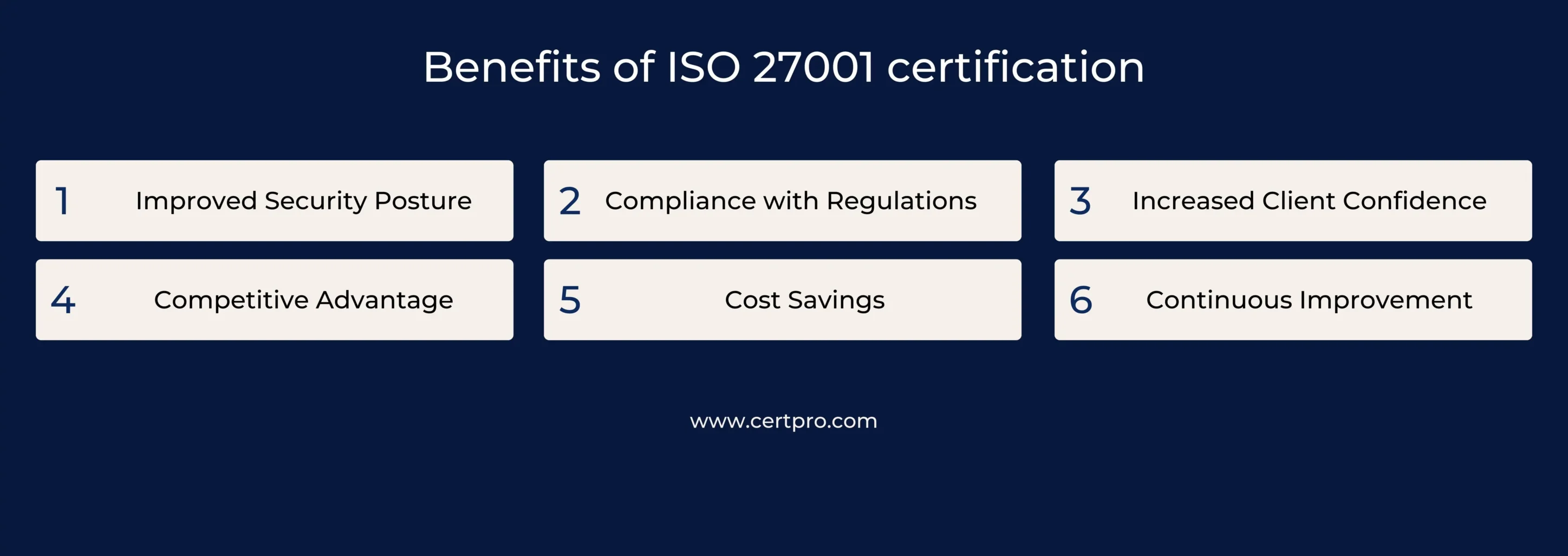
ISO 27001 Certification in Salt Lake City produces verifiable outcomes that support organizations across the technology, financial services, healthcare, and professional services sectors. These outcomes help organizations demonstrate information security management conformity to customers, regulators, and business partners. The benefits listed below reflect the direct outputs of a successful ISO 27001 certification audit rather than projected or advisory outcomes.
- ✓Independent third-party verification that the ISMS conforms to ISO/IEC 27001:2022 requirements
- ✓Structured ISO 27001 audit methodology that evaluates control design and operating effectiveness across all four Annex A domains
- ✓Recognition in enterprise procurement processes as an independently certified information security management organization
- ✓Documented conformity evidence that supports vendor questionnaire responses, RFP submissions, and contractual due diligence
- ✓Annual surveillance audit oversight that maintains continuous conformity verification throughout the three-year certification cycle
- ✓Alignment with international information security expectations relevant to cross-border technology and financial services markets
- ✓Demonstrated ISO 27001 compliance that supports regulatory mapping to HIPAA, GDPR, and related frameworks
- ✓Independently audited Statement of Applicability reflecting risk-based control selection across the organization’s information environment
ISO 27001 certification for Salt Lake City fintech organizations provides an independently audited demonstration of information security management conformity. This demonstration supports financial sector vendor approval processes and regulatory due diligence requirements. Fintech companies operating payment platforms, lending technology, investment analytics, and digital banking infrastructure handle sensitive financial data and personal information subject to heightened security expectations from banking partners, payment networks, and state financial regulators.
ISO 27001 certification for Salt Lake City financial services organizations provides an objective, third-party basis for evaluating information security posture. That basis is recognized across the financial sector and by enterprise procurement teams conducting third-party risk assessments — making ISO 27001 compliance a practical prerequisite for operating in regulated financial markets.
ISO 27001 certification for Salt Lake City tech companies and SaaS providers supports the enterprise sales process by delivering a standardized, independently verified information security credential that enterprise buyers recognize and accept. Technology companies operating in Utah’s Wasatch Front corridor frequently encounter information security certification requirements from Fortune 500 customers, government agencies, and international enterprise clients as a prerequisite for contract award.
ISO 27001 certified companies in Salt Lake City can reference their certification scope, audit findings, and certificate validity in responses to security questionnaires and procurement evaluations. This approach reduces the administrative burden associated with repeated custom security assessments while providing customers with objective evidence of ISMS conformity under the internationally recognized ISO 27001 standard.
- ✓ISO 27001 Certification for Salt Lake City Fintech and Financial Services Organizations
- ✓ISO 27001 Certification for Salt Lake City Tech Companies and SaaS Providers
ISO 27001 Certification for Key Industry Sectors in Salt Lake City
Salt Lake City’s diverse economy encompasses multiple industry sectors for which ISO 27001 Certification is particularly relevant. The table below identifies key sectors operating in the Salt Lake City metropolitan area and the primary ISO 27001 compliance drivers relevant to each sector. ISO 27001 audit engagements in Salt Lake City are conducted across all of these sectors by a Licensed CPA Firm applying ISO/IEC 27001:2022 conformity assessment methodology.
| Industry Sector | Primary ISO 27001 Compliance Drivers | Relevant Annex A Control Areas |
|---|---|---|
| SaaS and Technology Companies | Enterprise vendor security reviews, customer contractual requirements | Access control, cryptography, secure development, supplier security |
| Financial Services and Fintech | Banking partner due diligence, payment network requirements, regulatory expectations | Access management, incident response, cryptography, asset management |
| Healthcare and Life Sciences | HIPAA alignment, health data processor requirements, research partner expectations | Access control, physical security, incident management, data classification |
| Cloud Service Providers and Data Centers | Enterprise client security assessments, international data sovereignty requirements | Network security, cryptography, physical controls, supplier management |
| Professional Services and Consulting Firms | Client data protection requirements, engagement security expectations | Information handling, access control, confidentiality, personnel security |
Cybersecurity Firms and Telecommunications Operators
Cybersecurity firms and telecommunications operators in Salt Lake City face particularly direct information security scrutiny from enterprise clients and government customers that evaluate security posture as a core element of service provider selection. ISO 27001 Certification in Salt Lake City for cybersecurity organizations demonstrates that the firm’s own information security management meets the requirements of the internationally recognized ISO 27001 standard — an outcome that complements the security services the firm provides to its clients.
For telecommunications operators managing network infrastructure, data transmission services, and customer data, ISO 27001 compliance provides a structured framework for managing information security risks across complex, distributed operational environments. These environments are subject to both commercial expectations and regulatory requirements, making ISO 27001 certification a particularly relevant credential in this sector.
Education, Research, and Emerging Technology Organizations
Salt Lake City’s higher education institutions, research organizations, and emerging technology companies — including those affiliated with the University of Utah’s research ecosystem and Utah’s growing startup community — increasingly encounter information security requirements from federal research sponsors, technology transfer partners, and enterprise customers. ISO 27001 certification for these organizations provides a recognized, independently audited basis for demonstrating information security management conformity.
That certification supports federal grant compliance, technology commercialization agreements, and enterprise customer due diligence. Emerging technology companies in areas such as artificial intelligence, data analytics, and digital infrastructure benefit from ISO 27001 compliance as a differentiating credential in competitive sales and partnership processes where information security posture is evaluated alongside technical capability.
ISO 27001 Certification by a Licensed CPA Firm in Salt Lake City
ISO 27001 Certification in Salt Lake City is conducted by a Licensed CPA Firm operating as an independent third-party conformity assessment body. The certification process is governed by ISO/IEC 17021-1, which establishes requirements for bodies providing audit and certification of management systems, and by ISO/IEC 27006, which specifies additional requirements for bodies certifying information security management systems.
These standards ensure that the certification body maintains independence from the organizations it certifies, applies a structured and documented audit methodology, and subjects its certification decisions to independent committee review. Together, these requirements underpin the credibility and market recognition of ISO 27001 certification issued by a qualified certification body.
Independence and Objectivity in ISO 27001 Certification Audits
The independence of the ISO 27001 certification audit is a defining characteristic that distinguishes third-party certification from internal assessments and second-party evaluations. A Licensed CPA Firm conducting ISO 27001 audit engagements in Salt Lake City applies an evidence-based audit methodology that evaluates ISMS conformity against the requirements of ISO/IEC 27001:2022. Critically, the certification body has no involvement in the design, implementation, or operation of the management system under review.
This separation between advisory and audit functions is mandatory for accredited certification bodies and is a prerequisite for the credibility of the resulting ISO 27001 certificate. Organizations in Salt Lake City seeking to use ISO 27001 certification as a response to customer security requirements or regulatory expectations must obtain certification from an independent, qualified certification body — not from self-assessments or internally commissioned reviews.
The ISO 27001 certification audit process conducted by a Licensed CPA Firm in Salt Lake City covers the full scope of the organization’s ISMS as defined in the certification scope statement. Auditors with documented competence in information security management systems, risk assessment, and the applicable control domains are assigned to each engagement based on the sector and technical complexity of the organization’s ISMS.
Audit teams evaluate conformity against each applicable clause of ISO/IEC 27001:2022 and each control identified in the Statement of Applicability. The result is a documented audit report that forms the basis of the certification committee’s decision. The resulting ISO 27001 certificate identifies the certification body, the certified organization, the ISMS scope, and the certificate validity period.
Audit Competence and Sector-Specific Evaluation
ISO/IEC 27006 requires certification bodies to ensure that auditors assigned to ISO 27001 certification engagements possess documented competence in the technical domain of the organization being audited. For organizations in Salt Lake City’s technology and financial services sectors, this means the auditors conducting the ISO 27001 audit must demonstrate knowledge of the relevant information environments, control frameworks, and risk factors applicable to SaaS platforms, cloud infrastructure, financial data systems, and healthcare technology environments.
Sector-specific audit competence ensures that the auditor’s evaluation of Annex A controls, risk assessment outputs, and management system performance reflects an informed understanding of the organization’s operational context. This depth of evaluation goes beyond a generic review of documentation and provides a meaningful, context-aware ISO 27001 compliance assessment.
FAQ
▶
What is ISO 27001 certification and what does it verify?
▶
Which organizations in Salt Lake City need ISO 27001 certification?
▶
How long does the ISO 27001 certification audit process take?
▶
What is the Statement of Applicability and why is it important in the ISO 27001 audit?
▶
What is the difference between a Stage 1 and Stage 2 ISO 27001 audit?
▶
How does ISO 27001 compliance relate to HIPAA and GDPR requirements?
▶
What happens if nonconformities are identified during the ISO 27001 certification audit?
▶
How often are surveillance audits required for ISO 27001 certified organizations in Salt Lake City?
Get In Touch
have a question? let us get back to you.