
ISO 27001 Certification in San Antonio
The ISO 27001 certification audit process for San Antonio organizations follows a structured, multi-stage methodology conducted by CertPro CPA LLC as the independent certification body. Each stage serves a distinct audit function and produces defined outputs. The process begins with an application review and proceeds through documentation assessment, on-site control testing, nonconformity resolution, and a certification committee decision. Understanding each stage allows organizations to prepare appropriate documentation and evidence well in advance of the engagement.
OUR CLIENTS










ISO 27001 Certification for San Antonio-Based Organizations
ISO 27001 Certification in San Antonio is issued by CertPro CPA LLC, a Licensed CPA Firm operating as an independent third-party certification body. CertPro evaluates Information Security Management Systems (ISMS) against the requirements of ISO/IEC 27001:2022 and issues certification decisions based solely on audit evidence. The firm does not perform consulting, implementation, or advisory services for the organizations it certifies, preserving the independence essential to credible third-party assessment. The ISO 27001 certification audit process is structured around Clauses 4 through 10 of the standard and the 93 controls organized across four Annex A domains: Organizational, People, Physical, and Technological.
San Antonio has emerged as one of Texas’s most strategically significant technology and business centers. The city anchors a regional ecosystem spanning cybersecurity, defense technology, financial services, healthcare IT, biotechnology, cloud computing, and government contracting. Organizations across Downtown San Antonio, Stone Oak, Northwest San Antonio, the Texas Research Park corridor, and the broader South Texas metropolitan area operate in environments where information security expectations are driven by enterprise procurement requirements, federal contracting obligations, healthcare data protection mandates, and sector-specific vendor assurance standards. ISO 27001 Certification in San Antonio directly addresses these expectations by providing an independent, evidence-based assessment of an organization’s information security controls and management system.
The demand for ISO 27001 Certification in San Antonio reflects the city’s concentration of regulated industries. The Port San Antonio defense and aerospace technology cluster, USAA and the broader financial services community, South Texas Medical Center health technology organizations, and the expanding SaaS and cloud provider ecosystem collectively create procurement environments in which independent ISMS certification has become a standard vendor assurance requirement. Organizations pursuing federal contracts under DFARS cybersecurity requirements, supplying enterprise financial institutions, or handling protected health information under HIPAA frequently identify ISO 27001 Certification in San Antonio as a documented control assurance mechanism that satisfies third-party risk management reviews.
ISO 27001 compliance in San Antonio is also shaped by Texas-specific regulatory context. The Texas Data Privacy and Security Act (TDPSA) and the Texas Identity Theft Enforcement and Protection Act establish state-level information security and privacy obligations for organizations handling personal data of Texas residents. While ISO 27001 certification does not automatically establish compliance with the TDPSA, HIPAA, or other applicable regulations, an independently certified ISMS provides documented evidence of structured control implementation that regulators, enterprise customers, and auditors can evaluate. CertPro assesses whether an organization’s documented ISMS satisfies the requirements of ISO/IEC 27001:2022 — that determination defines the scope of the certification engagement and does not extend to regulatory compliance conclusions.
CertPro’s position as a Licensed CPA Firm distinguishes its certification from schemes operated by non-accredited registrars or internal assessment programs. The certification body function is maintained separately from any advisory or consulting activities, preserving the independence required for credible third-party assessments. Organizations seeking ISO 27001 Certification in San Antonio submit to a structured audit program that includes documentation review, control effectiveness testing, nonconformity identification, and a certification committee decision. The resulting certificate carries a defined validity period with scheduled surveillance audits, ensuring that ISO 27001 compliance in San Antonio is maintained and periodically re-verified rather than treated as a one-time exercise.

What Is ISO 27001 Certification?
ISO 27001 Certification is a formal, third-party attestation that an organization’s Information Security Management System conforms to the requirements of ISO/IEC 27001:2022 — the international standard for information security management published by the International Organization for Standardization (ISO) and the International Electrotechnical Commission (IEC). Certification is issued following an independent ISO 27001 audit conducted by a qualified certification body. It is not a self-assessment, a consulting deliverable, or an internal compliance declaration. It is an objective determination made by an external auditor based on documented evidence reviewed during a structured audit engagement.
The ISO/IEC 27001:2022 Standard and ISMS Framework
ISO/IEC 27001:2022 defines the requirements for establishing, implementing, maintaining, and continually improving an Information Security Management System. The standard is structured around ten clauses. Clauses 1 through 3 define scope, normative references, and terms. Clauses 4 through 10 contain the mandatory management system requirements, covering organizational context, leadership commitment, planning, support, operation, performance evaluation, and improvement. Organizations must satisfy all requirements in Clauses 4 through 10 to achieve ISO 27001 certification. Annex A lists 93 controls organized into four domains — Organizational (37 controls), People (8 controls), Physical (14 controls), and Technological (34 controls) — which organizations select and apply based on risk assessment outcomes and document in a Statement of Applicability.
The ISMS framework established by ISO/IEC 27001:2022 operates on the Plan-Do-Check-Act (PDCA) cycle. Organizations plan their risk assessment and risk treatment approach, implement selected controls, monitor and measure control effectiveness, and apply corrective actions for identified nonconformities. The standard requires documented information to support each phase — including an information security policy, a risk assessment methodology, a risk treatment plan, and a Statement of Applicability identifying which Annex A controls are applicable, which are implemented, and the justification for any exclusions. The 2022 revision introduced updated control domains and 11 new controls relative to the 2013 version. The transition deadline of October 31, 2025 means only certifications against ISO/IEC 27001:2022 are recognized by certification bodies after that date.
Key ISMS Documentation Requirements
ISO 27001 compliance requires organizations to maintain a defined set of documented information as evidence that the ISMS is operating effectively. During an ISO 27001 certification audit, the certification body reviews this documentation as part of both the Stage 1 and Stage 2 audit activities. Core ISMS documentation evaluated during the audit includes the information security policy, the scope statement, the risk assessment process and results, the risk treatment plan, the Statement of Applicability, and records of management review and internal audit. The auditor assesses whether documentation is complete, consistent with actual operations, and reflective of identified risks. Incomplete or inconsistent documentation is one of the most common sources of nonconformity findings during the Stage 1 review.
| ISMS Document | Standard Clause Reference | Purpose |
|---|---|---|
| Information Security Policy | Clause 5.2 | Defines management commitment and information security objectives |
| Risk Assessment Results | Clause 6.1.2 | Documents identified risks, likelihood ratings, and impact ratings |
| Risk Treatment Plan | Clause 6.1.3 | Records selected Annex A controls and treatment decisions |
| Statement of Applicability | Clause 6.1.3(d) | Lists all 93 Annex A controls with applicability justification and exclusion rationale |
| Internal Audit Records | Clause 9.2 | Provides evidence of systematic internal ISMS review and findings |
ISO 27001 vs. Other Information Security Frameworks
ISO 27001 differs from other information security frameworks in a fundamental way: it requires independent third-party certification rather than self-attestation. NIST Cybersecurity Framework and CIS Controls, for example, are voluntary guidance frameworks adopted without external certification. SOC 2 attestation, issued by CPA firms under AICPA standards, evaluates controls against the Trust Services Criteria and is report-based rather than certificate-based. CMMC (Cybersecurity Maturity Model Certification) applies specifically to Department of Defense contractors. ISO 27001 Certification is internationally recognized, applicable across industries, and results in a formal certificate issued following a structured ISO 27001 audit program. For San Antonio companies operating in international markets or supplying enterprise customers with global procurement standards, ISO 27001 Certification provides recognized assurance that translates across jurisdictions.
ISO 27001 Certification Audit Process in San Antonio
The ISO 27001 certification audit process for San Antonio organizations follows a structured, multi-stage methodology conducted by CertPro CPA LLC as the independent certification body. Each stage serves a distinct audit function and produces defined outputs. The process begins with an application review and proceeds through documentation assessment, on-site control testing, nonconformity resolution, and a certification committee decision. Understanding each stage allows organizations to prepare appropriate documentation and evidence well in advance of the engagement.
The Stage 1 audit is a documentation-focused review conducted to assess whether an organization’s ISMS is sufficiently developed to proceed to the Stage 2 audit. During the Stage 1 audit, the certification body reviews the information security policy, scope statement, risk assessment results, risk treatment plan, Statement of Applicability, internal audit records, and management review outputs. The auditor evaluates whether mandatory documented information required by ISO/IEC 27001:2022 Clauses 4 through 10 is present, complete, and consistent with the defined scope. The Stage 1 ISMS audit also identifies any significant gaps that would prevent an effective Stage 2 audit. All findings are communicated to the organization before the Stage 2 audit is scheduled.
For organizations seeking ISO 27001 Certification in San Antonio with complex or multi-site scopes — such as cloud service providers with distributed infrastructure, healthcare IT organizations spanning multiple clinic networks, or defense technology firms with classified and unclassified processing environments — the Stage 1 scope definition is especially important. The certification body reviews the scope statement to confirm it accurately reflects the information assets, locations, technologies, and organizational units included in the ISMS. Scope boundaries that exclude significant information assets or processing activities without documented justification are flagged as potential nonconformities during the Stage 1 review.
The Stage 2 audit is the primary ISO 27001 certification audit engagement. During this stage, the certification body evaluates the implementation and operating effectiveness of the organization’s ISMS controls. Auditors review evidence of control operation across all four Annex A domains — Organizational, People, Physical, and Technological — and assess whether controls function as documented in the Statement of Applicability and risk treatment plan. The Stage 2 audit involves personnel interviews, observation of operational processes, inspection of technical configurations, and review of records demonstrating consistent control operation over the audit period. Findings are classified as conformities, observations, or nonconformities.
Nonconformities identified during the Stage 2 ISO 27001 certification audit are documented and reported to the organization. The organization must analyze root causes and submit a corrective action plan within a defined timeframe. The certification body then reviews the corrective action evidence before the certification committee makes its determination. Importantly, the certification committee operates independently of the audit team and bases its decision solely on audit evidence and corrective action review outcomes. Where nonconformities cannot be resolved within the required period, the certification decision may be deferred or declined. This structural independence between the audit team and the certification committee is a non-negotiable requirement of the certification process.
ISO 27001 certification is valid for a three-year cycle, subject to annual surveillance audits conducted by the certification body. Surveillance audits are less comprehensive than the initial ISO 27001 certification audit but review critical ISMS processes, internal audit results, management review records, Annex A control operation, and any significant changes to the organization’s information security environment. Organizations that undergo material changes — such as acquiring new systems, expanding to additional locations, or modifying their ISMS scope — must notify the certification body so that surveillance audit scope can be adjusted accordingly. At the end of the three-year cycle, a full recertification audit is conducted to verify continued conformance before a new certificate is issued.
| Audit Stage | Key Activities | Output |
|---|---|---|
| Application Review | Scope confirmation, audit program determination | Audit plan and schedule |
| Stage 1 Audit | ISMS documentation review, scope assessment | Stage 1 findings report |
| Stage 2 Audit | Control implementation and effectiveness testing | Audit report with nonconformities |
| Nonconformity Review | Root cause analysis, corrective action verification | Corrective action closure |
| Certification Decision | Independent committee review of audit evidence | ISO 27001 certificate issued |
| Surveillance Audit | Annual ISMS effectiveness review | Surveillance report |
| Recertification Audit | Full ISMS reassessment at three-year cycle end | Certificate renewal |
- ✓Stage 1 Audit: Documentation and Readiness Review
- ✓Stage 2 Audit: Control Effectiveness Assessment
- ✓Surveillance Audits and Recertification
Why San Antonio Organizations Pursue ISO 27001 Certification
The drivers behind ISO 27001 Certification in San Antonio are rooted in the city’s specific industry composition and the contractual, regulatory, and competitive pressures those industries generate. San Antonio’s economy spans defense and aerospace technology, financial services and fintech, healthcare and health technology, government contracting, cybersecurity, SaaS and cloud computing, telecommunications, energy, biotechnology, and e-commerce. Each sector generates distinct demand for documented, independently verified information security controls. ISO 27001 Certification in San Antonio is the internationally recognized mechanism through which that verification is achieved and communicated to customers, regulators, and partners.
Defense, Government Contracting, and Cybersecurity Sector Demand
San Antonio’s identity as a national cybersecurity hub — anchored by Joint Base San Antonio, Port San Antonio, and a dense concentration of defense technology contractors — creates direct demand for ISO 27001 compliance documentation. Defense contractors and government technology providers operating under DFARS cybersecurity clauses and pursuing CMMC certification frequently use ISO 27001 as a complementary framework that demonstrates structured ISMS operation to government contracting officers and prime contractors. While ISO 27001 certification does not directly satisfy CMMC requirements, it provides documented evidence of risk-based information security management that supports vendor assurance reviews conducted by defense primes and federal agencies evaluating subcontractor security posture.
Cybersecurity firms operating in the San Antonio market — including managed security service providers, threat intelligence companies, and security operations center vendors — also pursue ISO 27001 certification to demonstrate that their own information security practices meet the same standard they recommend to clients. An ISO 27001 audit provides third-party validation of security controls that goes beyond internal assessments or marketing claims. Enterprise customers in regulated industries, including financial institutions and healthcare organizations, increasingly require cybersecurity vendors to hold current ISO 27001 Certification as a condition of vendor approval. For many San Antonio service providers, ISO 27001 compliance has become a business prerequisite rather than an optional differentiator.
Financial Services, Fintech, and Healthcare IT Demand
San Antonio’s financial services sector — centered on USAA, Frost Bank, and a growing fintech ecosystem — generates significant demand for ISO 27001 certification among technology vendors, SaaS providers, and data processing organizations supplying these institutions. Enterprise financial procurement processes typically require technology vendors to demonstrate independently verified information security controls. ISO 27001 Certification in San Antonio provides the documented assurance framework that satisfies these third-party risk management requirements. Fintech startups and established financial technology firms in the San Antonio market also pursue ISO 27001 Certification to access enterprise sales cycles at regional and national financial institutions.
Healthcare IT organizations, biotechnology firms, and life sciences companies operating near the South Texas Medical Center — the largest medical center in the world by geographic area — face information security expectations shaped by HIPAA Privacy and Security Rules, FDA data integrity requirements, and enterprise hospital system vendor approval processes. The ISO 27001 certification audit that San Antonio healthcare IT organizations undergo provides an independently assessed ISMS that complements HIPAA compliance programs by documenting risk-based control selection, treatment decisions, and ongoing monitoring. While ISO 27001 certification is not a substitute for HIPAA compliance, a certified ISMS demonstrates a structured approach to protecting electronic protected health information that enterprise health systems and payers evaluate during vendor qualification reviews.
SaaS, Cloud, and Technology Sector Procurement Requirements
San Antonio’s expanding SaaS and cloud technology sector includes providers serving enterprise customers across regulated industries in Texas and nationally. SaaS organizations in the Northwest San Antonio technology corridor and the Texas Research Park area frequently encounter enterprise procurement requirements that mandate ISO 27001 Certification as a baseline vendor security credential. An ISO 27001 audit for SaaS and cloud providers addresses controls across all four Annex A domains — including access control, cryptography, secure development, supplier relationships, incident management, and business continuity — areas directly relevant to cloud-hosted software services. ISO 27001 Certification in San Antonio gives enterprise customers an independently verified basis for assessing the security posture of their SaaS vendor relationships.
ISO 27001 Requirements and Annex A Controls
ISO/IEC 27001:2022 establishes requirements across two interconnected layers: the management system requirements in Clauses 4 through 10, and the Annex A control reference set. Organizations must satisfy all management system clause requirements without exception. Annex A controls are applied selectively based on risk assessment outcomes. Organizations must document in the Statement of Applicability which controls are applicable to their ISMS, which are implemented, and the justification for any controls determined to be not applicable. During the ISO 27001 certification audit, auditors verify both the management system requirements and the implementation of controls selected in the Statement of Applicability.
The management system requirements of ISO/IEC 27001:2022 address seven operational areas. Clause 4 requires organizations to define their internal and external context, identify interested parties, and establish the ISMS scope. Clause 5 addresses leadership commitment, including assignment of information security responsibilities and establishment of an information security policy. Clause 6 covers planning — requiring a documented risk assessment methodology, risk treatment plan, and information security objectives. Clause 7 addresses support requirements including competence, awareness, communication, and documented information. Clause 8 covers operational planning and control, including execution of risk treatment. Clause 9 requires performance evaluation through internal audits and management review. Clause 10 requires continual improvement through corrective action processes for identified nonconformities.
The 93 controls in Annex A of ISO/IEC 27001:2022 are organized across four domains. The Organizational domain contains 37 controls addressing information security policies, roles and responsibilities, threat intelligence, information security in project management, supplier relationships, incident management, and business continuity. The People domain contains 8 controls covering personnel screening, terms and conditions, information security awareness and training, and disciplinary processes. The Physical domain contains 14 controls addressing physical security perimeters, access controls, equipment security, clear desk and screen policies, and secure disposal. The Technological domain contains 34 controls covering user endpoint security, privileged access, cryptography, network security, secure development, vulnerability management, and monitoring. Organizations document their control selection rationale in the Statement of Applicability, which becomes a primary document reviewed during the ISO 27001 certification audit.
The Statement of Applicability (SoA) is one of the most critically reviewed documents during an ISMS audit. The SoA must list all 93 Annex A controls, identify each as applicable or not applicable, confirm whether applicable controls are implemented, and provide justification for any exclusions. Controls identified as not applicable must have documented justification — typically that the risk they address does not exist within the organization’s defined scope. Auditors cross-reference the SoA against the risk treatment plan to verify that controls selected for implementation directly address identified risks. Discrepancies between the risk treatment plan and the SoA are a common nonconformity finding during ISO 27001 compliance reviews for San Antonio defense contractors and financial services organizations.
- ✓Management System Clause Requirements (Clauses 4–10)
- ✓Annex A Control Domains and Selection
Benefits of ISO 27001 Certification for San Antonio-Based Organizations
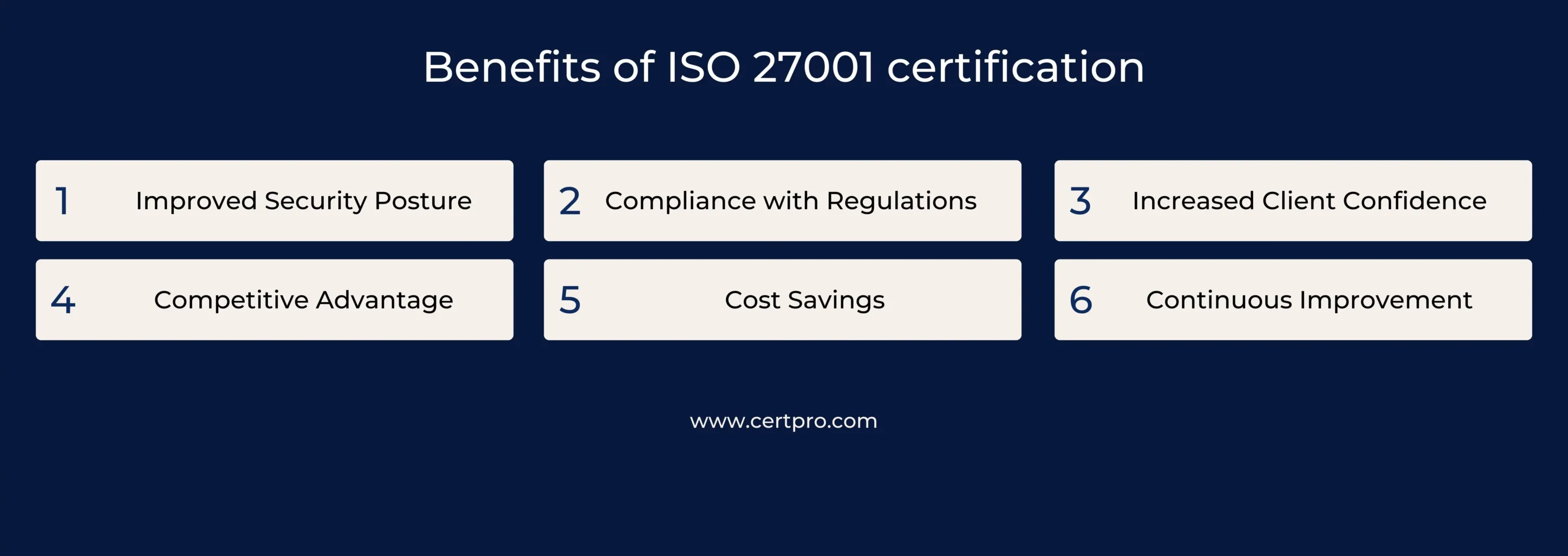
ISO 27001 Certification in San Antonio produces documented, independently verified outcomes that serve organizational, commercial, and regulatory purposes. The benefits of certification are distinct from the benefits of simply implementing an ISMS. Certification provides third-party attestation that the ISMS conforms to the international standard — a materially different basis for assurance than internal compliance claims or self-assessment results. The benefits outlined below reflect what ISO 27001 certification objectively delivers to San Antonio organizations across their relevant industry ecosystems.
- ✓Independent verification of ISMS control design and operating effectiveness by a Licensed CPA Firm certification body
- ✓Recognition in enterprise procurement processes at financial institutions, healthcare systems, defense primes, and government agencies requiring third-party security certification
- ✓Structured evidence of risk-based information security management for regulatory inquiries, including TDPSA and HIPAA-related assessments
- ✓Internationally recognized ISO 27001 certification that supports enterprise sales cycles with customers in North America, Europe, and Asia-Pacific markets
- ✓Ongoing surveillance oversight through annual ISMS audits that verify continued conformance rather than treating certification as a one-time event
- ✓Documented basis for supplier and vendor security assurance reviews, reducing the frequency of individual customer security questionnaire engagements
- ✓Competitive differentiation in RFP and vendor qualification processes where ISO 27001 certification is a listed requirement or evaluation criterion
- ✓Demonstrated alignment with ISO/IEC 27001:2022 updated control framework, including the 11 new controls introduced in the 2022 revision
ISO 27001 Certification provides a standardized, independently verified security credential that enterprise procurement and vendor risk management programs are structured to recognize. In San Antonio, where technology vendors supply major financial institutions, large healthcare systems, defense contractors, and government agencies, presenting a current ISO 27001 certificate from an independent certification body materially reduces friction in vendor qualification processes. Many enterprise customers have replaced lengthy security questionnaire processes with certificate verification for ISO 27001-certified vendors, recognizing that independent third-party audit results deliver more reliable assurance than vendor-completed self-assessments. This procurement efficiency benefit is particularly significant for SaaS providers and cloud vendors managing multiple enterprise customer relationships simultaneously.
Organizations operating in Texas face information security obligations under state law, including the Texas Data Privacy and Security Act (TDPSA) — which applies to entities conducting business in Texas or targeting Texas residents — and the Texas Identity Theft Enforcement and Protection Act, which establishes data breach notification and security requirements. ISO 27001 certification does not establish compliance with these statutes. However, a certified ISMS provides documented evidence of structured risk assessment, control implementation, and incident management processes that may be relevant when regulatory authorities or plaintiffs evaluate an organization’s information security practices. The ISO 27001 compliance that San Antonio organizations demonstrate through certification creates a documented record of control decisions and risk treatment activities that can support regulatory inquiries and due diligence reviews.
- ✓Vendor Assurance and Enterprise Procurement Recognition
- ✓Regulatory Context and Texas-Specific Considerations
ISO 27001 Certification Scope and Independent Decision Framework
The scope of an ISO 27001 certification engagement defines the boundaries of the ISMS subject to audit assessment and the resulting certificate. Scope definition is a critical determinant of both audit depth and certificate value. Organizations with broad, well-defined scopes provide enterprise customers and regulators with more comprehensive assurance than those with narrow or ambiguous scope statements. CertPro’s certification committee reviews scope statements as part of the certification decision process to verify that scope boundaries are consistent with the organization’s actual information security environment.
Defining Certification Scope for San Antonio Organizations
Certification scope for San Antonio organizations is typically defined by reference to information assets, business processes, technology systems, organizational units, and physical locations included in the ISMS. A SaaS provider in Northwest San Antonio might define scope by reference to its cloud-hosted platform and the infrastructure, personnel, and processes that support it. A healthcare IT organization in the South Texas Medical Center area might scope its ISMS around electronic health record systems and supporting technology infrastructure. A defense technology firm at Port San Antonio might define separate scopes for classified and unclassified information environments. During the ISO 27001 certification audit, the auditor reviews the scope statement against actual operations to confirm that significant information assets are not arbitrarily excluded.
Certification Committee Independence and Decision Process
The certification decision is made by a certification committee that operates independently of the audit team that conducted the Stage 1 and Stage 2 audits. This structural separation is a fundamental requirement of third-party certification body operation. The committee reviews the audit report, nonconformity findings, corrective action evidence, and scope documentation before making a determination to issue, defer, or decline certification. This independence ensures that the certification decision reflects an objective review of audit evidence rather than a commercial or relationship-driven outcome. The ISMS audit process conducted by CertPro for San Antonio organizations maintains this independence as a non-negotiable structural element of the certification program.
Conditions under which certification may be suspended or withdrawn include failure to maintain the ISMS in conformance with ISO/IEC 27001:2022 requirements, refusal to permit surveillance audit access, material scope changes not disclosed to the certification body, or discovery of misrepresentation during the audit process. Suspended certifications require documented corrective action and re-verification before reinstatement. Withdrawn certifications require a new ISO 27001 certification audit conducted from the Stage 1 phase. These conditions apply to all ISO 27001 certification audit engagements in San Antonio regardless of industry sector or organizational size.
Industry Sectors Pursuing ISO 27001 Certification in San Antonio
ISO 27001 certification is pursued by a wide range of organizations operating in and around San Antonio across multiple industry sectors. The specific drivers for certification vary by sector, but the common thread is the requirement for independently verified information security management as a condition of enterprise procurement, regulatory compliance positioning, or competitive differentiation. The following sectors represent the primary categories of organizations seeking ISO 27001 Certification in San Antonio through CertPro’s certification program.
Technology, Cloud, and SaaS Organizations
SaaS providers, cloud service organizations, AI companies, e-commerce platforms, and telecommunications providers operating in San Antonio represent a significant segment of ISO 27001 certification demand. These organizations typically hold large volumes of customer data — including personal information, financial records, and business-critical data — and supply enterprise customers with contractual information security obligations. ISO 27001 Certification in San Antonio for technology organizations demonstrates that the ISMS covers the full lifecycle of customer data within the certified scope, including access controls, encryption, incident response, and supplier management. Cloud providers serving regulated industries may also use ISO 27001 Certification as a component of a multi-framework compliance posture alongside SOC 2 attestations.
Energy, Biotechnology, and Multi-Sector Enterprises
Energy companies operating in the South Texas energy sector handle operational technology systems, SCADA environments, and sensitive business data requiring structured information security governance. Biotechnology and life sciences organizations affiliated with research institutions in San Antonio manage intellectual property, clinical trial data, and regulatory submissions with specific information security requirements. Multi-sector enterprises — including those handling combinations of customer personal data, proprietary business information, and regulated industry data — pursue ISO 27001 Certification as a unified framework addressing information security risk across diverse asset categories. The ISO/IEC 27001:2022 standard’s risk-based approach allows organizations across all these sectors to tailor Annex A control selection to their specific threat environments and asset profiles.
FAQ
▶
What is ISO 27001 certification?
▶
Who needs ISO 27001 certification?
▶
How long does ISO 27001 certification take?
▶
What are the benefits of ISO 27001 certification?
▶
What is the cost of ISO 27001 certification?
▶
How do I prepare for ISO 27001 certification?
▶
What happens after ISO 27001 certification?
▶
How long does the ISO 27001 certification process take?
Get In Touch
have a question? let us get back to you.
<!-- WordPress/Divi may strip