
ISO 27001 Certification in San Diego
CertPro CPA LLC – Licensed CPA Firm conducts independent ISO 27001 certification audits for organizations operating across San Diego. ISO 27001 certification evaluates the design and operating effectiveness of an organization’s controls against ISO 27001 requirements and regulatory standards.
OUR CLIENTS










ISO 27001 Certification for San Diego’s Technology, Defense, and Healthcare Organizations
ISO 27001 Certification in San Diego is issued by CertPro, a Licensed CPA Firm operating as an independent third-party certification body. CertPro evaluates Information Security Management Systems (ISMS) against the requirements of ISO/IEC 27001:2022, assessing ISMS design, Annex A control implementation, and risk treatment effectiveness. Certification decisions are made by an independent certification committee based solely on audit evidence — never on consulting relationships or advisory engagements. Organizations across San Diego’s technology, defense, and healthcare sectors rely on this independent process to obtain a credible, internationally recognized ISO 27001 certificate.
San Diego’s Information Security Certification Landscape
San Diego’s economy encompasses one of the most concentrated technology and defense-industrial ecosystems on the U.S. West Coast. SaaS providers and cloud platforms in La Jolla and Sorrento Valley, biotech and life sciences companies in Torrey Pines, AI startups and cybersecurity firms across the county, healthcare technology organizations serving regional hospital networks, and aerospace and defense contractors operating under federal acquisition regulations all generate substantial demand for independent ISMS certification.
These organizations routinely face procurement requirements, enterprise vendor security assessments, and contractual obligations that mandate formal third-party ISO 27001 Certification in San Diego as a condition of doing business with regulated institutions, federal agencies, and multinational enterprise clients. The breadth of this demand reflects how deeply information security expectations are embedded in San Diego’s leading industries.
California’s regulatory environment reinforces this demand. Organizations subject to the California Consumer Privacy Act (CCPA) and the California Privacy Rights Act (CPRA) operate under statutory obligations to implement reasonable security measures for personal information. HIPAA applies to healthcare technology companies and business associates handling protected health information. Defense contractors working within DFARS and CMMC-adjacent frameworks face federal information security requirements that align closely with ISMS certification standards.
ISO 27001 compliance, as independently verified through a third-party certification audit, provides documented evidence that an organization has implemented a structured, risk-based information security program. That evidence is one regulators, enterprise procurement teams, and federal contracting officers can evaluate with confidence. ISO 27001 certification does not automatically establish compliance with CCPA, CPRA, HIPAA, or any other specific regulatory requirement, but it demonstrates a systematic approach to information risk management that supports broader compliance programs.
CertPro as an Independent Certification Body — Not a Consulting Firm
CertPro functions exclusively as an independent third-party certification body. The firm conducts ISO 27001 certification audits — evaluating whether an organization’s ISMS conforms to ISO/IEC 27001:2022 requirements — without performing advisory, implementation, or consulting services for the organizations it certifies. This structural separation preserves auditor independence and ensures that ISO 27001 certification audit findings reflect objective evidence rather than a pre-existing advisory relationship.
As a Licensed CPA Firm, CertPro applies rigorous evidence-based assessment standards consistent with professional attestation practice. Certification decisions are made by an independent certification committee that reviews audit evidence, evaluates nonconformity findings, and determines conformance based solely on the documented ISMS against the standard’s requirements — providing organizations with a credible, unbiased ISO 27001 certificate.
Sectors Pursuing ISO 27001 Certification in San Diego
ISO 27001 Certification in San Diego spans a broad range of industry verticals. SaaS providers seeking to satisfy enterprise security questionnaires, cybersecurity companies demonstrating their own information security posture, biotech and life sciences firms protecting intellectual property and clinical data, healthcare technology organizations managing electronic health records and patient data, fintech companies subject to financial sector vendor due diligence, AI startups handling proprietary training datasets, telecommunications companies managing network infrastructure data, and defense and aerospace technology businesses operating under federal information security expectations all routinely pursue ISMS certification.
ISO 27001 certification for San Diego defense contractors, in particular, provides independently verified documentation of systematic security controls — evidence increasingly required in federal technology procurement and subcontracting relationships across San Diego County’s extensive defense industrial base.

What Is ISO 27001 Certification?
ISO 27001 certification is formal third-party confirmation that an organization has designed, implemented, and is actively operating an Information Security Management System (ISMS) that conforms to the requirements of ISO/IEC 27001:2022. This is the internationally recognized standard for information security management published jointly by the International Organization for Standardization (ISO) and the International Electrotechnical Commission (IEC).
The standard specifies requirements for establishing, implementing, maintaining, and continually improving an ISMS within the context of an organization’s information risk environment. ISO/IEC 27001:2022 — the current version — introduced updated Annex A control domains and restructured controls from the 2013 edition, with a transition deadline of October 31, 2025 set by certification bodies. Organizations pursuing ISO 27001 certification must demonstrate conformance to the 2022 version to receive a valid certificate.
ISMS Certification and the ISO/IEC 27001:2022 Standard
ISMS certification under ISO/IEC 27001:2022 requires an organization to demonstrate conformance across two distinct components: the management system clauses (Clauses 4 through 10) and the Annex A security controls.
Clauses 4 through 10 address the organizational context and scope of the ISMS, leadership and commitment, information security policy, planning and risk assessment, risk treatment, support and resource allocation, operational controls, performance evaluation, and continual improvement. These clauses establish the governance framework within which security controls operate.
Annex A provides a reference set of 93 information security controls organized into four domains: Organizational controls (37), People controls (8), Physical controls (14), and Technological controls (34). An organization’s Statement of Applicability (SoA) documents which Annex A controls are applicable, which are implemented, and the justification for any exclusions — forming a critical bridge between risk treatment decisions and the ISO 27001 certification audit.
Key ISMS Documentation Requirements
ISO 27001 compliance requires organizations to maintain a defined set of documented information as evidence of ISMS operation. During an ISO 27001 certification audit, auditors review this documentation to assess whether the ISMS has been properly established and is actively maintained.
Core documentation includes the information security policy, the risk assessment methodology and results, the risk treatment plan documenting how identified risks are addressed through selected controls, the Statement of Applicability, and records of management reviews and internal audits. The risk assessment identifies information assets, evaluates threats and vulnerabilities, determines likelihood and impact, and produces a prioritized list of information security risks. The risk treatment plan then maps each accepted risk to specific Annex A controls or other treatment options — creating the audit trail that links risk identification to control implementation. These documents form the evidentiary foundation of any ISO 27001 certification audit evaluation.
ISO 27001 Certification Audit Process in San Diego
The ISO 27001 certification audit process conducted by CertPro for organizations seeking ISO 27001 Certification in San Diego follows a structured, multi-stage evaluation methodology. Each stage produces documented findings that are reviewed by an independent certification committee before a certification decision is issued.
The process is designed to evaluate ISMS conformance objectively, based entirely on audit evidence gathered through document review, interviews, observation, and control testing. No advisory or consulting activities occur at any stage. This independence is what gives an ISO 27001 certificate its credibility with enterprise clients, regulators, and federal procurement officers.
| Audit Stage | Key Activities | Output |
|---|---|---|
| Application Review | Scope definition, ISMS boundary confirmation, audit program planning | Audit plan and scope agreement |
| Stage 1 Audit | ISMS documentation review, readiness evaluation against ISO/IEC 27001:2022 clauses | Stage 1 findings report identifying areas for Stage 2 focus |
| Stage 2 Audit | On-site or remote evidence review, Annex A control testing, structured interviews, process observation | Stage 2 audit report with classified nonconformity findings |
| Nonconformity Review | Organization submits documented corrective actions addressing identified nonconformities | Corrective action evidence reviewed and accepted by audit team |
| Certification Decision | Independent certification committee evaluates complete audit evidence and determines conformance | ISO 27001 certificate issued — valid for three years |
The Stage 1 audit functions as a documentation and readiness review. During Stage 1, the auditor evaluates the organization’s ISMS documentation — including the information security policy, risk assessment records, risk treatment plan, Statement of Applicability, and internal audit and management review records — to determine whether the ISMS has been designed in accordance with ISO/IEC 27001:2022 requirements.
Stage 1 identifies gaps in documentation completeness and assesses whether the organization is ready for the more intensive Stage 2 evaluation. It does not constitute a conformance determination — it is a structured review that informs the scope and focus of the Stage 2 audit program. All findings from Stage 1 are documented and communicated to the organization before Stage 2 proceeds.
The Stage 2 audit is a comprehensive conformance assessment. Auditors evaluate the operational effectiveness of the ISMS by reviewing control implementation evidence, conducting structured interviews with personnel responsible for information security activities, observing operational processes, and testing the operating effectiveness of selected Annex A controls.
The Stage 2 ISO 27001 audit San Diego organizations undergo examines whether the controls described in the Statement of Applicability are not merely documented but actively implemented and functioning as designed. Nonconformities identified during Stage 2 are classified and documented in the audit report. The organization must provide documented corrective action evidence addressing all nonconformities before the certification committee can issue a certification decision. The final ISO 27001 certification audit conclusion reflects the totality of evidence gathered across both audit stages.
ISO 27001 certification is valid for a three-year certification cycle. During this period, CertPro conducts annual surveillance audits to verify that the certified ISMS continues to conform to ISO/IEC 27001:2022 requirements. These audits confirm that the organization is maintaining its information security controls, conducting management reviews, performing internal audits, and addressing nonconformities through continual improvement activities.
Surveillance audits are narrower in scope than the initial Stage 2 audit but cover key ISMS processes, risk assessment updates, and any significant changes to the organization’s information security environment. At the end of the three-year cycle, a full recertification audit evaluates the ISMS against the standard’s requirements in full. Organizations that fail to maintain conformance during the surveillance cycle may have their ISO 27001 certificate suspended or withdrawn by the certification committee based on audit evidence.
- ✓Stage 1 and Stage 2 Audit Activities
- ✓Surveillance Audits and Recertification
ISO 27001 Requirements: ISMS Scope, Risk Assessment, and Annex A Controls
Organizations pursuing ISO 27001 Certification in San Diego must satisfy requirements across the full scope of ISO/IEC 27001:2022, including both the management system clauses and the applicable Annex A controls. The standard does not prescribe a fixed set of mandatory controls. Instead, it requires organizations to identify information security risks, determine appropriate treatment options, and implement controls that address those risks in proportion to their assessed likelihood and impact.
The selection and implementation of controls must be documented in the Statement of Applicability — the primary reference document linking risk treatment decisions to specific Annex A controls during the ISO 27001 certification audit.
ISO/IEC 27001:2022 Clause 6.1 requires organizations to conduct a systematic information security risk assessment using a defined and repeatable methodology. The risk assessment must identify information assets within the defined ISMS scope, evaluate relevant threats and vulnerabilities, determine the consequences of potential security incidents, assess the likelihood of occurrence, and calculate a risk level that informs treatment prioritization.
The risk assessment must be reviewed and updated at planned intervals and whenever significant changes occur to the organization’s information environment, technology infrastructure, or business operations. San Diego organizations in rapidly evolving sectors — including AI startups, biotech, and cloud service providers — typically require more frequent risk assessment updates given the pace of change in their technology and threat environments. Risk treatment decisions must be documented in a risk treatment plan recording the controls selected, responsible parties, and implementation timelines — all of which are reviewed during the ISO 27001 certification audit.
ISO/IEC 27001:2022 restructured Annex A into four control domains, replacing the fourteen clause-based domains of the 2013 edition. Organizational controls (37 controls) address information security policies, roles and responsibilities, threat intelligence, supplier relationships, incident management, and business continuity. People controls (8 controls) address personnel screening, terms and conditions of employment, information security awareness and training, and disciplinary processes. Physical controls (14 controls) address physical security perimeters, entry controls, equipment protection, and clear desk and screen policies. Technological controls (34 controls) address user endpoint devices, privileged access management, information access restriction, cryptography, network security, application security in development, and monitoring.
ISO 27001 Certification in San Diego for technology companies frequently involves detailed audit scrutiny of technological controls — particularly those governing cloud service access, software development security, and network monitoring — given the technology-intensive nature of most San Diego-based ISMS scopes.
The Statement of Applicability (SoA) is a mandatory document under ISO/IEC 27001:2022 that records the organization’s justification for including or excluding each of the 93 Annex A controls. The SoA must reference the results of the risk assessment and risk treatment process, demonstrating that control selections are driven by identified risks rather than arbitrary inclusion.
During the ISO 27001 certification audit, auditors cross-reference the SoA against the risk treatment plan, control implementation evidence, and operational records to verify that controls described as implemented are in fact operational. The ISMS scope defines the organizational boundaries within which the ISMS operates — including physical locations, organizational units, technology systems, and information assets covered by the certification. The scope statement is reviewed during Stage 1 and confirmed during Stage 2. ISMS certification is issued only for the defined scope; any scope expansion requires notification to the certification body and may trigger a scope change audit.
- ✓Risk Assessment and Risk Treatment Requirements
- ✓Annex A Control Domains Under ISO/IEC 27001:2022
- ✓Statement of Applicability and Scope Definition
Benefits of ISO 27001 Certification for San Diego-Based Organizations
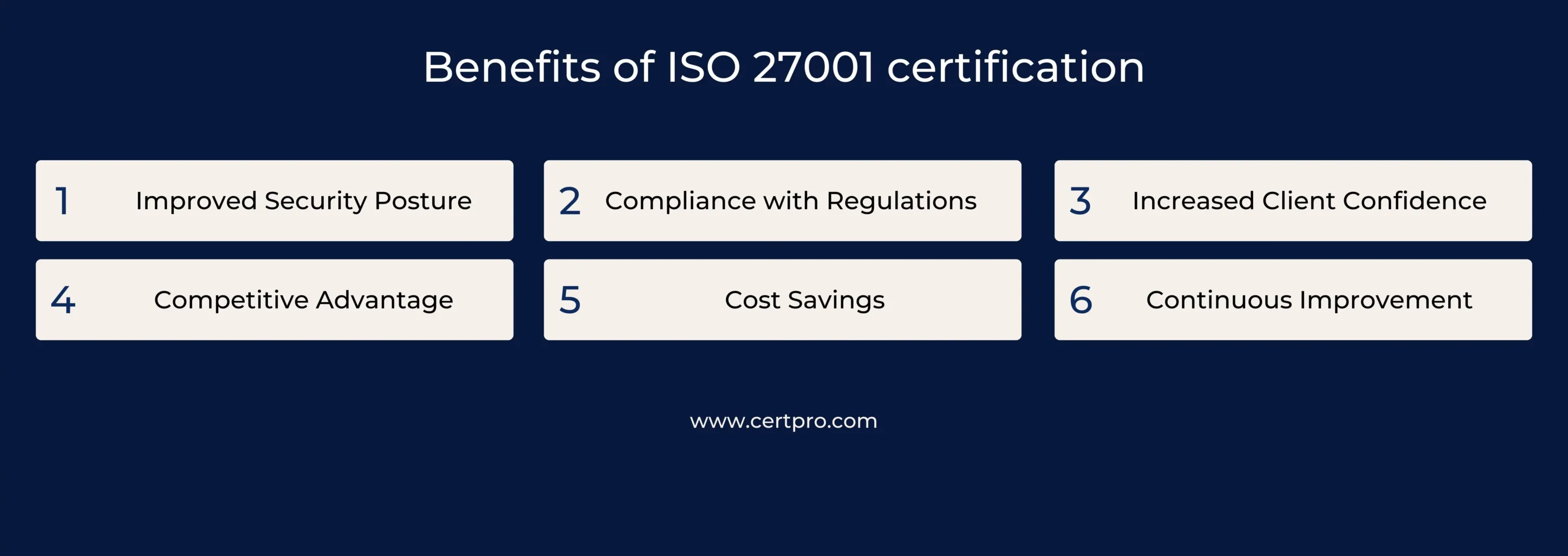
ISO 27001 Certification in San Diego provides independently verified evidence that an organization’s information security management system meets the requirements of an internationally recognized standard. For organizations operating in San Diego’s technology-intensive and regulated business environment, this independent verification carries weight across multiple dimensions — from enterprise procurement evaluations and vendor security assessments to regulatory alignment and operational risk management.
The following represent the principal documented outcomes associated with achieving and maintaining ISO 27001 certification through an independent certification body such as CertPro.
- ✓Independent third-party verification of ISMS design and operating effectiveness against ISO/IEC 27001:2022
- ✓Documented evidence for enterprise vendor security reviews, security questionnaires, and procurement due diligence processes
- ✓Demonstrated risk-based approach to information security management, including formal risk assessment and risk treatment documentation
- ✓Structured Annex A control framework covering organizational, people, physical, and technological security domains
- ✓Annual surveillance audit oversight providing ongoing verification of ISMS maintenance and continual improvement
- ✓Internationally recognized ISO 27001 certificate supporting cross-border business development and global client confidence
- ✓Alignment of information security controls with regulatory frameworks including CCPA, CPRA, and HIPAA requirements (without asserting automatic regulatory compliance)
- ✓Independent certification committee decision providing institutional authority to the ISO 27001 certification determination
Enterprise organizations and regulated institutions increasingly require third-party vendors and technology providers to hold ISO 27001 certification as a condition of procurement. In San Diego’s market, SaaS providers serving financial institutions, healthcare systems, and federal agencies regularly encounter security assessment requirements that specify ISO 27001 certification or equivalent ISMS controls verification.
For example, a San Diego-based cloud security platform seeking to contract with a major healthcare network may be required to demonstrate ISO 27001 compliance through a valid certificate issued by a recognized third-party certification body. ISO 27001 Certification in San Diego for technology companies in this context reduces the volume and frequency of individual customer security assessments by providing a standardized, independently verified baseline. A valid ISO 27001 certificate, supported by the audit report and Statement of Applicability, communicates to procurement teams that the organization’s information security management has been evaluated against a globally accepted benchmark by a qualified, independent auditor.
Organizations that have achieved ISMS certification typically demonstrate more mature and systematic approaches to identifying and managing information security risks compared to those without a certified management system. The requirement for annual surveillance audits and management reviews under ISO/IEC 27001:2022 creates a structured cadence of ISMS evaluation that supports ongoing risk identification and control effectiveness monitoring.
The continual improvement requirements in Clause 10 of the standard oblige certified organizations to track nonconformities, implement corrective actions, and evaluate the effectiveness of those actions over time. For San Diego biotech and life sciences organizations managing proprietary research data and clinical trial information — and for healthcare technology companies handling patient records — this structured approach to risk management contributes to measurable reduction in the likelihood and impact of information security incidents. These outcomes are independently verified through the annual surveillance audit cycle, reinforcing the long-term value of ISO 27001 compliance.
- ✓ISO 27001 Certification in Enterprise Procurement and Vendor Assurance
- ✓Operational Risk Reduction and Continual Improvement
Why San Diego Organizations Pursue ISO 27001 Compliance
ISO 27001 compliance pursued by San Diego organizations reflects the intersection of contractual, regulatory, and competitive pressures unique to the region’s business environment. San Diego County hosts over 500 defense-related companies, one of the largest biotech clusters in the United States, and a growing concentration of SaaS, AI, and cybersecurity firms. Each of these sectors operates under distinct information security expectations that converge on the need for independently verified, standards-based security management.
The demand for ISO 27001 certification audit services in San Diego reflects the breadth and depth of these requirements across the regional economy — and the degree to which ISO 27001 Certification in San Diego has become a baseline expectation rather than a competitive differentiator in many sectors.
Defense, Aerospace, and Federal Contracting Requirements
ISO 27001 certification for San Diego defense contractors addresses the information security documentation and control verification requirements that arise in federal technology procurement and subcontracting contexts. Defense and aerospace technology companies operating as prime contractors or subcontractors under Department of Defense contracts face information security requirements embedded in DFARS clauses and Cybersecurity Maturity Model Certification (CMMC) frameworks.
While ISO 27001 certification does not constitute CMMC certification or independently satisfy DFARS compliance, the structured ISMS framework — particularly its risk assessment methodology, access control requirements, incident response documentation, and continual improvement mandate — aligns substantively with the control domains evaluated in federal information security frameworks. Federal procurement officers and prime contractors increasingly recognize ISO 27001 certification as evidence of a mature security program, making it a meaningful differentiator in competitive federal technology contracting across Naval Base San Diego, SPAWAR, and other regional defense programs.
Healthcare Technology, Biotech, and Life Sciences Information Security
San Diego’s life sciences sector — anchored in Torrey Pines, Sorrento Valley, and Carlsbad — includes organizations that generate and manage some of the most sensitive categories of information: clinical trial data, genomic research datasets, electronic health records, and proprietary drug development data. Healthcare technology companies operating as HIPAA business associates must implement and document administrative, physical, and technical safeguards for protected health information.
ISO 27001 compliance, as independently verified through ISMS certification, provides a structured framework for implementing and documenting these safeguards within a formally audited management system. ISO 27001 certification does not satisfy HIPAA compliance requirements independently, but it supports healthcare technology organizations in demonstrating that their information security controls have been reviewed by a qualified third-party auditor. For biotech firms engaged in licensing negotiations, partnership due diligence, or IPO preparation, a valid ISO 27001 certificate provides institutional-grade evidence of information security maturity.
SaaS, Fintech, and Cloud Service Provider Requirements
ISO 27001 certification for San Diego technology companies in the SaaS and cloud services space directly addresses the vendor security assessment requirements that large enterprise and financial sector customers impose during procurement and contract renewal processes. Fintech companies in San Diego’s growing financial technology sector face security due diligence requirements from banking partners, payment processors, and financial regulators that frequently reference ISO 27001 as a recognized security standard.
A San Diego-based fintech company seeking to integrate with a national bank’s payment infrastructure, for example, may be required to provide a valid ISO 27001 certificate and audit report as part of the bank’s third-party risk management process. ISMS certification obtained through CertPro’s independent audit process provides this documented evidence — reducing the friction associated with individual customer security reviews and supporting faster enterprise sales cycles in regulated markets.
ISO 27001 Certification Scope and Independent Decision Framework
The scope of ISO 27001 Certification in San Diego defines the precise boundaries of the ISMS that has been audited and certified. Certification scope is determined during the application review stage and confirmed through Stage 1 and Stage 2 audit activities. The scope statement specifies the organizational units, physical locations, technology systems, information assets, and business processes included within the ISMS boundary.
Only the activities, systems, and information assets within the defined scope are covered by the issued ISO 27001 certificate. CertPro’s independent certification committee evaluates scope definitions to ensure they are neither unreasonably narrow — excluding material information security risks — nor so broad as to be unmanageable within the ISMS framework. A well-defined scope is foundational to a credible and meaningful ISO 27001 certification audit outcome.
Evidence-Based Assessment and Nonconformity Classification
CertPro’s ISO 27001 audit methodology is evidence-based throughout. Auditors do not issue conformance determinations based on management representations or attestations alone — they require documented evidence that ISMS processes have been established, implemented, and are producing the outputs required by ISO/IEC 27001:2022.
Evidence reviewed during the ISO 27001 certification audit includes information security policies and procedures, risk assessment records, risk treatment plans, Annex A control implementation documentation, internal audit reports, management review minutes, corrective action logs, training records, and system configuration documentation. Nonconformities identified during the audit are documented with sufficient specificity to allow the organization to understand the nature of the gap, the ISO/IEC 27001:2022 clause or Annex A control requirement that has not been met, and the evidence basis for the finding. The organization’s corrective action response is then reviewed by the audit team before the certification committee makes its final determination.
Independent Certification Committee and Certificate Validity
CertPro’s certification committee operates independently from the audit team that conducted the ISMS evaluation. This structural separation is a fundamental requirement of certification body integrity — the individuals who conducted the audit do not make the certification decision. The committee reviews the complete audit package, including Stage 1 and Stage 2 findings, nonconformity records, and corrective action evidence, before issuing a certification determination.
When conformance is confirmed, CertPro issues an ISO 27001 certificate specifying the organization’s name, the scope of certification, the standard version (ISO/IEC 27001:2022), the certificate issuance date, and the certificate expiry date. ISO 27001 certificates issued by CertPro are valid for three years, subject to satisfactory annual surveillance audits. Certificates may be suspended or withdrawn by the certification committee if surveillance audits reveal significant nonconformities or if the organization fails to maintain the ISMS within the certified scope.
ISO 27001 Certification Across San Diego’s Business Ecosystem
The geography and industrial structure of San Diego County creates distinct patterns of ISO 27001 certification demand across different communities and business districts. Organizations in La Jolla’s research and technology corridor, Carlsbad’s technology and life sciences parks, Sorrento Valley’s cybersecurity and software cluster, and the broader San Diego metropolitan area each face information security requirements shaped by their sector, customer base, and regulatory environment.
Understanding how ISO 27001 Certification in San Diego functions within these specific contexts helps organizations define an appropriate ISMS scope and prioritize Annex A control implementation in ways that address their most material information security risks.
La Jolla, Sorrento Valley, and the Technology Corridor
La Jolla and Sorrento Valley host a significant concentration of SaaS providers, cybersecurity companies, and AI research organizations. These firms frequently seek ISO 27001 Certification in San Diego to satisfy enterprise security assessments from Fortune 500 customers and international clients. Cybersecurity companies, in particular, face heightened expectations — their own information security posture is subject to scrutiny by the enterprise organizations they serve.
ISMS certification obtained through an independent ISO 27001 audit provides institutional evidence that the firm applies the same standards of information security management it recommends to its clients. AI startups in this corridor managing large proprietary datasets, model training infrastructure, and sensitive customer data similarly encounter procurement requirements referencing ISO 27001 as a vendor security baseline from early-stage enterprise sales processes.
Carlsbad, Torrey Pines, and the Life Sciences Cluster
The Torrey Pines and Carlsbad biotech and life sciences cluster represents one of the most active areas for ISO 27001 certification audit activity among San Diego organizations managing sensitive research and clinical data. Biotech companies engaged in pharmaceutical development, genomics research, and medical device technology handle information categories that require systematic security controls — not only for HIPAA compliance purposes but for intellectual property protection and partnership due diligence.
Life sciences companies pursuing licensing agreements with multinational pharmaceutical companies, or seeking investment from institutional funds with vendor security requirements, encounter due diligence processes that assess information security maturity. ISO 27001 certification for San Diego biotech organizations provides a standardized, independently audited framework that prospective partners and investors can evaluate without conducting bespoke security assessments. The structured risk treatment documentation required for ISMS certification also supports these organizations in demonstrating regulatory alignment to FDA information security guidance for software as a medical device and digital health applications.
ISO 27001 Audit San Diego — What the Audit Evaluates
The ISO 27001 audit San Diego organizations undergo through CertPro evaluates ISMS conformance across multiple dimensions of the standard. Auditors assess not only whether documentation exists but whether the ISMS is genuinely operational — whether controls described in the Statement of Applicability are implemented, whether the risk assessment reflects the organization’s actual information environment, and whether management is actively engaged in ISMS governance through reviews, internal audits, and continual improvement activities.
The ISO 27001 certification audit methodology combines document review, structured personnel interviews, process observation, and technical control evidence examination to produce a comprehensive, evidence-based conformance assessment.
Management System Audit Activities
Management system audit activities address the governance and operational processes that make the ISMS function as an active management system rather than a static document repository. Auditors review the information security policy for completeness and alignment with the organization’s stated information security objectives. They evaluate the internal audit program — including the audit schedule, auditor qualifications, and completeness of internal audit reports — to determine whether the organization is conducting meaningful self-assessments of ISMS conformance.
Management review records are examined to verify that senior leadership is reviewing ISMS performance, risk treatment effectiveness, and audit results at planned intervals. The results of corrective actions taken in response to previous nonconformities are traced to verify that root causes have been addressed and that similar issues have not recurred. These management system evaluation activities provide auditors with a clear picture of the organization’s genuine commitment to ISMS maintenance and ISO 27001 compliance.
Annex A Control Implementation Evidence
Annex A control audit activities during the ISO 27001 certification audit examine the actual implementation and operational effectiveness of the controls selected in the Statement of Applicability. For technological controls, auditors may review system configuration records, access control lists, network monitoring logs, vulnerability scanning reports, patch management records, and encryption implementation documentation. For organizational controls, auditors examine supplier agreements, information classification records, incident response procedures, and business continuity plan documentation.
For people controls, auditors review employment screening records, information security awareness training completion logs, and disciplinary process documentation. Physical controls are assessed through observation of physical security perimeters, entry control mechanisms, equipment protection measures, and media handling procedures. The depth of control testing in each domain is calibrated to the ISMS scope and the risk profile identified during the risk assessment — organizations with technology-intensive operations typically receive more extensive technological control scrutiny during the Stage 2 ISO 27001 audit.
FAQ
▶
What is ISO 27001 certification and why do San Diego organizations need it?
▶
How long does the ISO 27001 certification audit process take?
▶
What is the difference between the Stage 1 and Stage 2 ISO 27001 audits?
▶
Does ISO 27001 certification satisfy CCPA, CPRA, or HIPAA compliance requirements?
▶
How often must an ISO 27001 certified organization undergo audits?
▶
What documents are required for an ISO 27001 certification audit?
▶
Can San Diego defense contractors use ISO 27001 certification to satisfy CMMC requirements?
▶
What is the current version of the ISO 27001 standard, and when must organizations transition?
Get In Touch
have a question? let us get back to you.