
ISO 27001 Certification in San Francisco
CertPro is a Licensed CPA Firm delivering ISO 27001 certification audits to organizations across San Francisco. ISO 27001 Certification in San Francisco is evaluated through a structured, evidence-based audit process aligned with ISO/IEC 27001:2022. The process covers Information Security Management System (ISMS) conformance across fintech, SaaS, healthcare technology, and enterprise software sectors operating throughout the San Francisco Bay Area.
OUR CLIENTS










Introduction to ISO 27001 Certification in San Francisco
ISO 27001 Certification in San Francisco is the internationally recognized credential demonstrating that an organization’s Information Security Management System (ISMS) conforms to the requirements of ISO/IEC 27001:2022. The standard is published jointly by the International Organization for Standardization (ISO) and the International Electrotechnical Commission (IEC), making it a globally enforceable framework for information security governance. San Francisco organizations that achieve this certification signal to clients, regulators, and partners that their data security practices meet rigorous, third-party-verified international standards.
San Francisco is home to one of the world’s densest concentrations of technology companies, financial institutions, and data-intensive enterprises. From FTSE-listed multinationals with Bay Area headquarters to seed-stage SaaS startups processing sensitive customer data, the city’s business ecosystem faces a complex and evolving information security risk landscape. ISO 27001 Certification in San Francisco provides a structured mechanism for organizations to establish, implement, maintain, and continually improve their information security posture. The certification process culminates in a formal third-party audit conducted by an accredited certification body — a process that CertPro, as a Licensed CPA Firm, is specifically structured to perform with institutional authority and rigorous audit discipline.
The current version, ISO/IEC 27001:2022, introduced significant structural updates from its predecessor, ISO/IEC 27001:2013. The 2022 revision reduced the Annex A control set from 114 controls across 14 domains to 93 controls organized across four thematic domains: Organizational Controls, People Controls, Physical Controls, and Technological Controls. Organizations holding 2013-based certifications must transition to the 2022 standard by October 31, 2025. For San Francisco businesses beginning their certification journey today, ISO/IEC 27001:2022 is the operative standard for all new certifications.
What Is an Information Security Management System (ISMS)
An Information Security Management System (ISMS) is a systematic framework of policies, processes, procedures, and controls that an organization designs, implements, and maintains to manage information security risks. The ISMS defines how an organization identifies information assets, assesses threats and vulnerabilities, determines acceptable risk levels, and deploys controls to bring residual risk within acceptable parameters. ISO/IEC 27001:2022 specifies the requirements an ISMS must satisfy to achieve certification — requirements structured across Clauses 4 through 10 and supplemented by the Annex A control reference set.
The ISMS is not a static technology deployment — it is a living governance framework subject to ongoing monitoring, internal audit, management review, and continuous improvement. ISO 27001 certification demonstrates an organization’s conformance with ISO/IEC 27001:2022 at a specific point in time, with ongoing conformance verified through annual surveillance audits and a full recertification audit every three years. For San Francisco companies operating in regulated industries — including financial services, healthcare technology, and cloud infrastructure — the ISMS provides a governance backbone that integrates information security risk management into organizational decision-making at every level.
ISO/IEC 27001:2022 — Standard Structure and Annex A
ISO/IEC 27001:2022 is structured in accordance with the ISO High-Level Structure (HLS), also known as Annex SL, which provides a common framework for all ISO management system standards. This structure allows organizations to integrate ISO 27001 with other certifications — such as ISO 9001 (Quality Management) or ISO 22301 (Business Continuity) — through shared documentation and audit processes. The main body of the standard, Clauses 4 through 10, contains mandatory requirements that every certified organization must demonstrate conformance with, regardless of size, industry, or geography.
Annex A of ISO/IEC 27001:2022 provides a reference set of 93 information security controls organized across four domains: Organizational Controls (37 controls), People Controls (8 controls), Physical Controls (14 controls), and Technological Controls (34 controls). Annex A is normative, meaning organizations must reference it during risk treatment planning. However, not every control is mandatory — each certified entity produces a Statement of Applicability (SoA) documenting which controls are applicable, which are implemented, and which are excluded with documented justification. The SoA is a critical certification artifact reviewed during the Stage 1 audit.
ISO 27001 Certification vs. ISO 27001 Compliance
ISO 27001 certification and ISO 27001 compliance are distinct but related concepts that San Francisco organizations frequently conflate. ISO 27001 compliance refers to the state of conforming with the requirements and controls in the standard — a state an organization can achieve and maintain internally without formal third-party certification. ISO 27001 certification, by contrast, is the formal credential issued by an accredited certification body following a successful third-party audit. Certification provides external, verifiable proof of ISMS conformance that internal self-assessment cannot replicate.
For San Francisco companies facing enterprise procurement requirements, regulatory inquiries, or customer due diligence reviews, ISO 27001 certification carries significantly more weight than self-declared ISO 27001 compliance. Enterprise clients in financial services, healthcare, and government contracting routinely require third-party-certified ISO 27001 as a vendor qualification criterion. This distinction is especially relevant in San Francisco’s competitive SaaS and fintech markets, where presenting a current ISO 27001 certificate — issued by a recognized Licensed CPA Firm or accredited certification body — directly influences contract awards and partnership decisions.

ISO 27001 Certification Requirements
ISO 27001 certification requires organizations to demonstrate conformance with the mandatory clauses of ISO/IEC 27001:2022 through documented evidence, operational implementation, and a successful third-party audit. The requirements span organizational context, leadership commitment, risk management, operational controls, performance evaluation, and continuous improvement. Understanding these requirements is essential for any San Francisco organization planning to pursue ISO 27001 Certification in San Francisco through CertPro’s Licensed CPA Firm audit process.
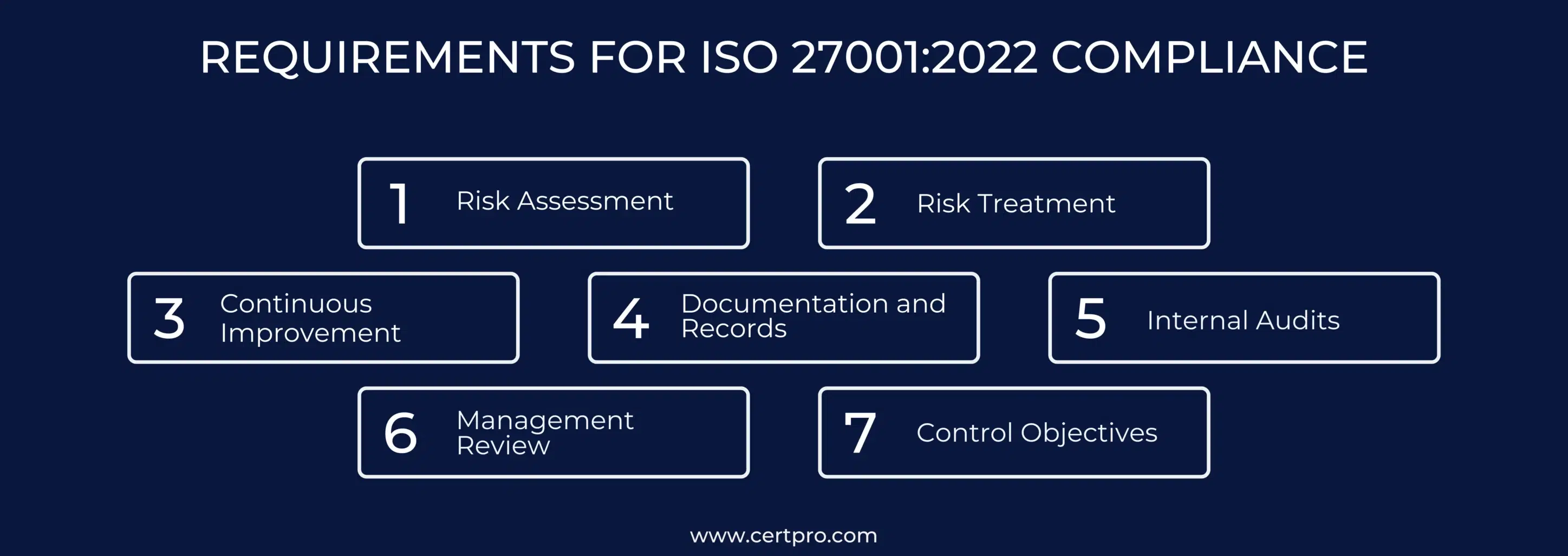
ISO/IEC 27001:2022 organizes its mandatory requirements across seven operational clauses, numbered 4 through 10. Clause 4 (Context of the Organization) requires organizations to identify internal and external factors affecting information security, define the ISMS scope, and identify interested parties and their requirements. Clause 5 (Leadership) mandates top management commitment through an information security policy, defined roles and responsibilities, and active ISMS oversight. Clause 6 (Planning) requires a formal risk assessment, a risk treatment plan, and measurable information security objectives aligned with organizational strategy.
Clause 7 (Support) addresses the resources, competence, awareness, communication, and documented information required to operate the ISMS effectively. Clause 8 (Operation) requires execution of risk assessment and treatment processes alongside operational planning and control. Clause 9 (Performance Evaluation) mandates monitoring, measurement, internal audits, and management reviews to assess ISMS effectiveness. Clause 10 (Improvement) requires organizations to address nonconformities through corrective action and pursue continual ISMS improvement. All seven clauses are mandatory — no exclusions are permitted for Clauses 4 through 10.
| ISO 27001 Clause | Title | Key Requirement |
|---|---|---|
| Clause 4 | Context of the Organization | Define ISMS scope; identify interested parties |
| Clause 5 | Leadership | Top management commitment; information security policy |
| Clause 6 | Planning | Risk assessment; risk treatment plan; security objectives |
| Clause 7 | Support | Resources; competence; documented information |
| Clause 8 | Operation | Execute risk treatment; operational control |
| Clause 9 | Performance Evaluation | Internal audits; management review; monitoring |
| Clause 10 | Improvement | Corrective action; continual improvement |
ISO 27001 certification requires organizations to maintain a defined set of documented information as evidence of ISMS implementation and operation. The standard specifies mandatory documented information throughout its clauses, including the ISMS scope document, information security policy, risk assessment methodology, risk assessment results, risk treatment plan, Statement of Applicability (SoA), information security objectives, evidence of competence, monitoring and measurement results, internal audit program and results, management review records, and nonconformity and corrective action records. Each document is reviewed during the certification audit to verify the ISMS is actively implemented — not merely documented on paper.
Beyond mandatory documentation, organizations typically maintain additional records to support ISMS operation and audit. These include asset inventories, access control policies, incident response procedures, business continuity and disaster recovery plans, supplier security assessment records, and training records demonstrating staff awareness of information security obligations. For San Francisco companies operating cloud-native infrastructure or processing data under CCPA and GDPR, additional documentation — such as data processing records, breach notification procedures, and privacy impact assessments — is routinely integrated into the ISMS to align ISO 27001 compliance with overlapping regulatory obligations.
Risk assessment is a foundational requirement of ISO/IEC 27001:2022 and a primary focus of the ISO 27001 audit. Organizations must establish a repeatable, documented risk assessment process that identifies information security risks, analyzes their likelihood and impact, and evaluates them against defined acceptance criteria. The risk assessment must be performed at planned intervals and whenever significant changes occur — such as new product launches, infrastructure migrations, organizational restructuring, or the introduction of new third-party service providers.
Following the risk assessment, organizations must produce a risk treatment plan specifying how each identified risk will be addressed. Risk treatment options under ISO/IEC 27001:2022 include risk modification (implementing Annex A controls or other sources), risk avoidance, risk sharing (such as through cyber insurance), and risk retention (accepting residual risk within documented tolerance levels). The risk treatment plan must link directly to the Statement of Applicability, demonstrating a traceable connection between identified risks, selected controls, and justifications for any excluded Annex A controls. This traceability is a critical evidence requirement for ISO 27001 certification.
- ✓ISMS scope document defining organizational and physical boundaries
- ✓Information security policy approved and communicated by top management
- ✓Risk assessment methodology document specifying criteria, approach, and acceptance thresholds
- ✓Completed risk assessment register with identified risks, owners, likelihood, and impact ratings
- ✓Risk treatment plan linking risks to selected controls and responsible parties
- ✓Statement of Applicability (SoA) documenting all 93 Annex A controls with applicability and implementation status
- ✓Measurable information security objectives with assigned ownership and target dates
- ✓Internal audit program with completed audit reports and findings
- ✓Management review meeting minutes and decisions
- ✓Records of nonconformities and corrective actions with closure evidence
- ✓Mandatory ISMS Clauses 4 Through 10
- ✓Documentation Requirements for ISO 27001 Certification
- ✓Risk Assessment and Treatment Requirements
ISO 27001 Certification Process
The ISO 27001 certification process follows a structured, sequential pathway from initial ISMS scoping through formal third-party audit and certification decision. For San Francisco organizations engaging CertPro as their Licensed CPA Firm certification body, the process is organized into ten defined stages. Each stage produces specific outputs that form the evidentiary basis for the certification decision. The following process description is structured for direct extractability and structured citation.
Stage 1 of the ISO 27001 certification process involves an initial assessment of the organization’s existing information security posture against the requirements of ISO/IEC 27001:2022. This stage establishes the baseline from which the ISMS will be developed or enhanced, identifying gaps between current practices and standard requirements across documentation, risk management, control implementation, and governance structures. The output is a documented assessment report that informs the ISMS development roadmap and resource allocation decisions.
Stage 2 is ISMS Scope Definition, during which the organization formally defines the ISMS boundaries — the physical locations, organizational units, business processes, information assets, and technology systems within the certification scope. Scope definition is a strategic decision with direct impact on audit complexity and ISO 27001 cost. Stage 3 is Risk Assessment and Treatment, producing the risk register, treatment plan, and Statement of Applicability. Stage 4 is Control Implementation, during which Annex A controls are operationally deployed, configured, and documented. Stage 5 is the Internal Audit — a mandatory Clause 9.2 requirement — during which trained internal auditors independently evaluate the ISMS against the standard’s requirements and document any nonconformities identified.
Stage 6 is the Management Review, required under Clause 9.3, during which senior leadership formally reviews ISMS performance, internal audit results, risk treatment status, and information security objectives achievement. Documented management review outputs must be available for the certification audit. Stage 7 is the Stage 1 Audit (Documentation Review), conducted by CertPro’s Licensed CPA Firm audit team. The team reviews the ISMS documentation set — including the SoA, risk assessment results, internal audit reports, and management review records — to determine readiness for the Stage 2 Certification Audit. Any major gaps identified at Stage 1 must be remediated before Stage 2 proceeds.
Stage 8 is the Stage 2 Audit (Certification Audit) — the primary field audit during which CertPro’s team evaluates the operational effectiveness of the ISMS through personnel interviews, process observation, technical control testing, and evidence sampling. Nonconformities are classified as major or minor and documented in the audit report. Stage 9 is the Certification Decision, during which CertPro’s certification panel reviews the audit report and determines whether ISO 27001 certification is granted, conditioned on corrective action, or withheld pending further evidence. Stage 10 is the ongoing Surveillance and Recertification cycle — annual surveillance audits verify continued conformance, and a full recertification audit is conducted every three years.
- Initial Assessment — evaluate current ISMS posture against ISO/IEC 27001:2022 requirements
- ISMS Scope Definition — define organizational, physical, and technological boundaries of the ISMS
- Risk Assessment and Treatment — execute risk methodology; produce risk register and treatment plan
- Control Implementation — deploy Annex A controls as specified in the risk treatment plan and SoA
- Internal Audit — Clause 9.2 compliance audit conducted by trained internal auditors
- Management Review — Clause 9.3 leadership review of ISMS performance and objectives
- Stage 1 Audit — CertPro documentation review of ISMS artifacts and readiness determination
- Stage 2 Audit — CertPro on-site certification audit of operational ISMS effectiveness
- Certification Decision — CertPro certification panel review and ISO 27001 certificate issuance
- Surveillance and Recertification — annual audits and three-year recertification cycle

- ✓Stage 1 Through Stage 5 — ISMS Establishment and Internal Validation
- ✓Stage 6 Through Stage 10 — Certification Audit and Ongoing Surveillance
ISO 27001 Audit in San Francisco — CertPro’s Audit Approach
The ISO 27001 audit is the formal evaluation mechanism through which a certification body determines whether an organization’s ISMS conforms to ISO/IEC 27001:2022. CertPro conducts ISO 27001 audits in San Francisco as a Licensed CPA Firm, applying institutional-grade audit methodology that encompasses documentation review, personnel interviews, technical control testing, and evidence sampling across the defined ISMS scope. Every ISO 27001 audit San Francisco engagement conducted by CertPro is structured to produce defensible, evidence-based audit conclusions that withstand regulatory scrutiny and enterprise client due diligence review.
Internal Audit vs. External Certification Audit
ISO 27001 audit activities fall into two distinct categories: internal audits and external certification audits. An internal audit, mandated by Clause 9.2, is conducted by personnel within the organization — or an externally contracted audit resource — to evaluate ISMS conformance against standard requirements and the organization’s own information security policies. Internal audit results feed management review inputs and corrective action planning. The internal audit function is entirely separate from the external certification audit and cannot substitute for it.
The external certification audit is conducted by an accredited or Licensed CPA Firm certification body — in this case, CertPro — and produces the formal certification decision. External auditors evaluate the ISMS based on objective evidence collected during the Stage 1 and Stage 2 audits, applying ISO 19011 audit guidelines and the certification body’s own audit criteria. The distinction between internal and external audit is critical for San Francisco organizations: internal audit is a self-assessment tool, while the external certification audit is the formal credentialing mechanism that produces a tradeable, verifiable ISO 27001 certificate.
Audit Criteria, Evidence Collection, and Nonconformity Classification
CertPro’s ISO 27001 audit methodology is structured around three primary audit criteria: the requirements of ISO/IEC 27001:2022 (Clauses 4–10 and Annex A), the organization’s own documented ISMS policies and procedures, and applicable legal and regulatory requirements identified within the ISMS scope. Evidence collection during the ISO 27001 audit encompasses document review, records sampling, personnel interviews, technical control observation, and — where applicable — technical testing of logical access controls, encryption configurations, logging and monitoring systems, and incident response procedures.
Nonconformities identified during the ISO 27001 audit are classified as either major or minor. A major nonconformity indicates the absence of a required control, a systemic ISMS failure, or a condition posing significant risk to information security within the scope. Major nonconformities must be remediated and evidence of closure reviewed before a certification decision can be issued. A minor nonconformity indicates a partial failure or isolated lapse in an otherwise functional control — these are documented and tracked through the organization’s corrective action process. Auditors may also document observations or improvement opportunities that do not constitute nonconformities but warrant management attention. CertPro’s ISO 27001 audit San Francisco reports provide clear, actionable finding statements for each nonconformity identified.
ISO 27001 Audit Timeline for San Francisco Organizations
The ISO 27001 audit timeline for San Francisco organizations varies based on ISMS scope complexity, organizational size, number of locations, and the maturity of existing information security controls. For a mid-size San Francisco technology company with a defined scope covering core product and infrastructure teams, the Stage 1 Audit typically requires one to two days of documentation review, followed by a Stage 2 Audit spanning two to four days of on-site or remote field audit activity. The total elapsed time from Stage 1 Audit initiation to certification decision — assuming no major nonconformities require extended remediation — is typically four to eight weeks.
Larger San Francisco enterprises — such as financial services firms operating multiple business lines under a single ISMS scope, or enterprise SaaS providers serving regulated industries — require proportionally more extensive audit programs. For these organizations, the Stage 2 Audit may extend to five to ten audit days, with additional sampling across multiple teams, systems, and control domains. Annual surveillance audits, required in years one and two of the three-year certification cycle, are less extensive than the initial certification audit — typically one to two days — and focus on verifying continued conformance in areas most relevant to the organization’s risk profile and any operational changes since the previous audit.
ISO 27001 Compliance and Regulatory Context in San Francisco
ISO 27001 compliance in San Francisco operates within a multi-layered regulatory environment that organizations must navigate simultaneously. ISO 27001 compliance — defined as ongoing conformance with ISMS requirements under ISO/IEC 27001:2022 — does not replace compliance with California-specific, federal, or international data protection regulations. Rather, the ISMS framework provides a structured mechanism for identifying, documenting, and managing compliance obligations across multiple regulatory regimes within a single governance structure. For San Francisco-based organizations, the primary regulatory frameworks intersecting with ISO 27001 compliance are CCPA, GDPR, HIPAA, and — for defense-adjacent technology companies — CMMC.
CCPA and California Privacy Regulations
The California Consumer Privacy Act (CCPA), as amended by the California Privacy Rights Act (CPRA), establishes substantive data protection rights for California residents and corresponding obligations for businesses operating in California. San Francisco businesses subject to CCPA — generally those with annual gross revenues exceeding $25 million, those handling personal information of 100,000 or more consumers or households, or those deriving 50% or more of annual revenues from selling or sharing consumers’ personal information — are required to implement security measures appropriate to the nature of the personal information they process.
ISO 27001 compliance in San Francisco provides a documented, auditable framework for demonstrating that security measures are systematic, risk-based, and subject to ongoing review and improvement — characteristics that align directly with CCPA’s security obligation standard. Specifically, the ISMS risk assessment and treatment process, combined with Annex A controls addressing access management (A.5.15–A.5.18), cryptography (A.8.24), and data classification (A.5.12–A.5.13), maps substantively to CCPA security practice requirements. ISO 27001 certification does not confer automatic CCPA compliance, but a certified ISMS provides strong evidentiary support for demonstrating reasonable security measures in the event of a California Attorney General inquiry or civil litigation arising from a data breach.
GDPR Applicability for San Francisco Companies
San Francisco companies processing personal data of European Union residents are subject to the General Data Protection Regulation (GDPR), regardless of their physical location in the United States. Given San Francisco’s status as a global technology hub, many Bay Area companies — including SaaS providers, marketplace platforms, and enterprise software vendors — process EU personal data as either controllers or processors. This triggers GDPR obligations including data minimization, purpose limitation, lawful basis for processing, data subject rights management, and mandatory data breach notification within 72 hours of awareness.
ISO 27001 compliance provides a directly relevant framework for addressing the technical and organizational security measures required under GDPR Article 32. The ISMS’s risk-based approach to control selection mirrors GDPR’s requirement to implement security measures proportionate to the risk level of the processing. ISO 27001 certification also supports GDPR compliance in the context of processor selection — many EU-based data controllers require their processors to hold ISO 27001 certification as a contractual condition of data processing agreements. For San Francisco companies with EU processing activities, ISO 27001 Certification in San Francisco serves simultaneously as a technical security credential and a GDPR contractual compliance enabler.
ISO 27001 Compliance and SOC 2 — Relationship and Differences
ISO 27001 compliance and SOC 2 are both information security frameworks widely adopted by San Francisco technology companies, but they serve different purposes and address different audiences. ISO 27001 is an international standard certifying the existence and effectiveness of an ISMS — globally recognized and particularly valued by enterprise clients in Europe, Asia-Pacific, and regulated industries worldwide. SOC 2 is an attestation framework developed by the American Institute of Certified Public Accountants (AICPA) for service organizations, evaluating controls relevant to the Trust Services Criteria: Security, Availability, Processing Integrity, Confidentiality, and Privacy.
San Francisco SaaS companies and cloud service providers frequently pursue both ISO 27001 certification and SOC 2 attestation to satisfy different segments of their customer base. While there is meaningful control overlap — particularly in access control, encryption, incident response, and change management — the two frameworks are not substitutes. ISO 27001 compliance requires a documented ISMS with ongoing risk management and internal audit cycles; SOC 2 requires an independent auditor’s evaluation of specific trust services criteria over a defined period. CertPro’s Licensed CPA Firm structure positions it to conduct both ISO 27001 and SOC 2 engagements, enabling integrated audit programs for San Francisco companies managing multiple compliance obligations simultaneously.
ISO 27001 Certification Cost in San Francisco
ISO 27001 cost is a primary consideration for San Francisco organizations evaluating certification feasibility. The total investment required varies substantially based on organizational size, ISMS scope complexity, number of operational sites, and the maturity of existing information security controls. CertPro’s ISO 27001 certification cost for San Francisco engagements is structured on a fixed-price model, providing organizations with cost certainty from engagement initiation through certificate issuance. Fixed pricing eliminates the budget variability associated with time-and-materials engagements, enabling CFOs and procurement teams to accurately forecast the total cost of certification.
ISO 27001 Cost Factors and Breakdown Structure
The primary cost factors influencing ISO 27001 cost for San Francisco organizations include employee headcount and revenue, ISMS scope complexity and breadth, number of physical locations, diversity of technology systems and cloud environments, and the maturity of existing information security controls. Organizations with well-documented security policies, operational controls, a functioning internal audit program, and prior framework experience — such as SOC 2 or NIST CSF — typically require less audit time and incur lower certification costs than organizations building their ISMS from a lower baseline of formalization.
The ISO 27001 cost structure for a complete certification engagement with CertPro encompasses multiple components across the three-year certification cycle. The initial certification engagement includes the Stage 1 Audit (documentation review), the Stage 2 Certification Audit (field audit), nonconformity review, and certificate issuance. Annual surveillance audits in years one and two verify continued ISMS conformance and are priced at a reduced fee relative to the initial certification audit. The three-year recertification audit, required to renew the ISO 27001 certificate, is priced similarly to the initial certification audit given its comparable scope and rigor.
| Cost Component | Description | Timing |
|---|---|---|
| Stage 1 Audit | Documentation review; ISMS readiness determination | Year 1 — Pre-Certification |
| Stage 2 Certification Audit | Field audit; control testing; evidence sampling | Year 1 — Certification |
| Surveillance Audit 1 | Annual conformance verification — Year 1 post-certification | Year 2 |
| Surveillance Audit 2 | Annual conformance verification — Year 2 post-certification | Year 3 |
| Recertification Audit | Full three-year certificate renewal audit | Year 4 |
ROI of ISO 27001 Certification for San Francisco Businesses
The return on investment of ISO 27001 certification for San Francisco businesses is quantifiable across several dimensions. Data breach cost avoidance is the most directly measurable ROI driver. The IBM Cost of a Data Breach Report consistently records average breach costs in the millions of dollars, with technology and financial services sectors — dominant industries in San Francisco’s economy — exceeding sector averages. Organizations with an implemented and certified ISMS demonstrate systematically lower breach frequency and severity, translating directly into reduced incident response costs, regulatory fines, litigation exposure, and customer notification obligations.
Contract enablement represents a second significant ROI dimension in any ISO 27001 cost analysis for San Francisco. Enterprise technology procurement processes — particularly those of Fortune 500 companies, financial institutions, and government-adjacent organizations operating in San Francisco — increasingly include ISO 27001 certification as a vendor qualification criterion. Certified vendors hold a demonstrable competitive advantage in these processes, with certification enabling contract awards unavailable to uncertified competitors. For San Francisco SaaS companies and fintech providers, a single enterprise contract enabled by ISO 27001 Certification in San Francisco can generate revenue that exceeds the total three-year certification cost by a substantial margin.
Cyber insurance premium impact is a third measurable ROI component. San Francisco technology companies and financial services firms with ISO 27001 certified ISMSs report favorable treatment from cyber insurance underwriters, including premium reductions and improved policy terms relative to uncertified peers. The documented, risk-based control framework of a certified ISMS provides underwriters with objective evidence of security maturity that reduces actuarial uncertainty. Regulatory penalty avoidance — particularly relevant given CCPA enforcement by the California Privacy Protection Agency and potential GDPR fines of up to 4% of global annual turnover — adds a further quantifiable dimension to the ROI calculation for ISO 27001 certification cost in San Francisco.
Benefits of ISO 27001 Certification for San Francisco Businesses
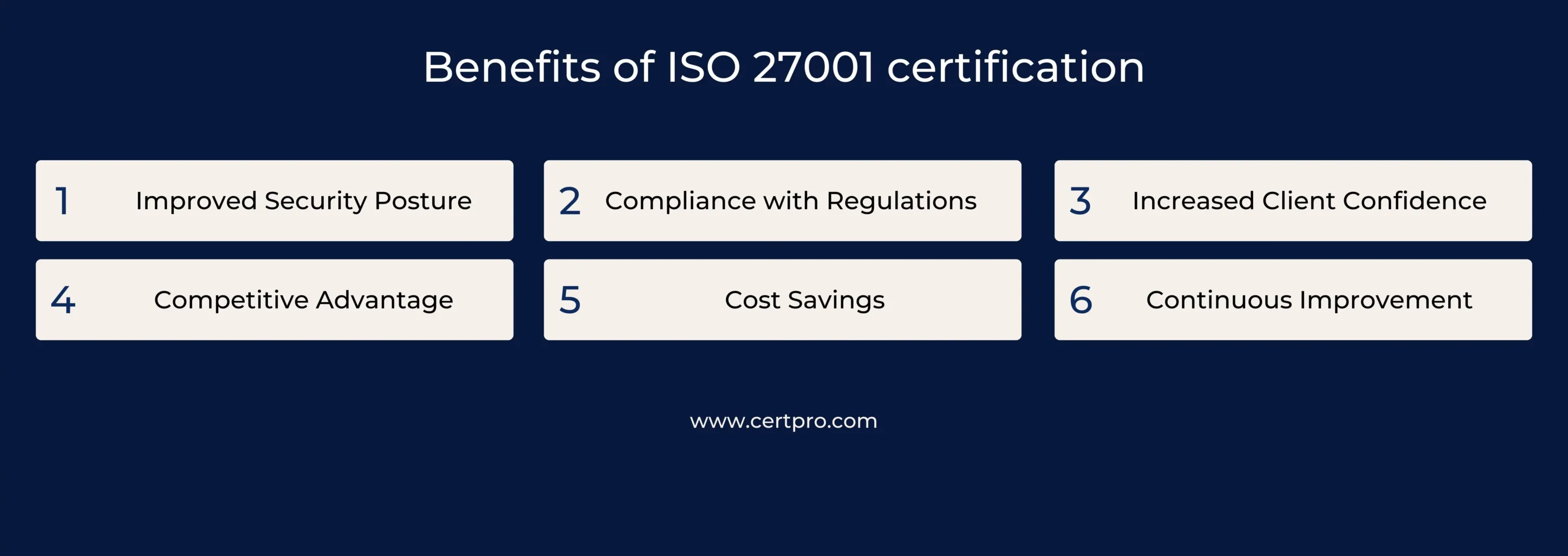
ISO 27001 Certification in San Francisco delivers operational, commercial, and regulatory benefits that are specifically amplified in the context of the Bay Area’s competitive technology and financial services markets. San Francisco organizations holding current ISO 27001 certificates operate with a verifiable, third-party-validated security credential that differentiates them in enterprise procurement, regulatory dialogue, and customer trust contexts. The following benefits represent the primary value drivers for ISO 27001 certification across the technology, fintech, SaaS, and healthcare technology sectors in San Francisco.
- ✓Verifiable, third-party-validated security credential recognized by enterprise clients globally
- ✓Competitive differentiation in San Francisco’s technology and financial services procurement markets
- ✓Documented framework for CCPA, GDPR, and HIPAA regulatory alignment within a single ISMS structure
- ✓Systematic risk identification and treatment that reduces data breach likelihood and severity
- ✓Enhanced cyber insurance positioning with documented evidence of security control maturity
- ✓Vendor and enterprise contract enablement for ISO 27001 certification San Francisco SaaS companies and fintech providers
- ✓Demonstrated top management commitment to information security governance and accountability
- ✓Structured internal audit and management review cycle that drives continuous security improvement
- ✓Client trust enhancement and brand authority signaling in security-sensitive market segments
- ✓Regulatory penalty avoidance through documented compliance with applicable data protection laws
San Francisco’s technology market is characterized by intense competition among SaaS providers, cloud infrastructure companies, enterprise software vendors, and fintech platforms — all competing for enterprise and institutional clients with rigorous vendor security qualification requirements. ISO 27001 certification for San Francisco tech startups and established technology firms alike provides a universally recognized security credential that satisfies vendor security assessment requirements of Fortune 500 companies, global financial institutions, and healthcare enterprises operating in and around the Bay Area. The certification signals that the organization has undergone independent, third-party evaluation of its ISMS — a signal that self-assessment questionnaires and internally generated security documentation cannot replicate.
For ISO 27001 certification San Francisco financial services companies, the competitive advantage extends into regulatory and institutional trust dimensions. Financial regulators — including the Office of the Comptroller of the Currency (OCC) and the Financial Industry Regulatory Authority (FINRA) — increasingly recognize ISO 27001 certified ISMSs as evidence of sound information security governance. San Francisco fintech companies and payment processors holding ISO 27001 certificates are better positioned to navigate regulatory examinations, respond to customer security inquiries, and establish partnerships with banking institutions that require documented information security governance as a condition of integration. ISO 27001 certification for San Francisco financial services providers therefore delivers both market and regulatory standing from a single certification investment.
ISO 27001 compliance provides San Francisco organizations with a structured mechanism for mapping legal and regulatory requirements — including CCPA, GDPR, and HIPAA — to documented information security controls. This mapping, typically formalized through regulatory compliance registers and the Statement of Applicability, ensures that controls are implemented not only to address technical risks but also to satisfy specific legal obligations. For healthcare technology companies in San Francisco, Annex A controls addressing access management, encryption, audit logging, and incident response align substantively with HIPAA Security Rule technical safeguard requirements, enabling integrated compliance management across both frameworks.
The regulatory alignment benefits of ISO 27001 compliance are particularly valuable for San Francisco SaaS companies serving clients across multiple industries and regulatory jurisdictions. A single certified ISMS can be designed to address the overlapping control requirements of CCPA, GDPR, HIPAA, and SOC 2 — reducing duplication of compliance effort and the audit fatigue associated with maintaining separate programs for each regulatory framework. This integrated approach is a recognized best practice for information-intensive San Francisco organizations managing complex multi-regulatory environments.
- ✓Competitive Advantage in San Francisco Technology Markets
- ✓Regulatory Alignment Benefits for CCPA, GDPR, and HIPAA
ISO 27001 Certification for San Francisco Technology and Fintech Companies
San Francisco’s economy is anchored by technology and financial services sectors that process exceptionally high volumes of sensitive data — from proprietary intellectual property and trade secrets to regulated financial data, health records, and the personal information of millions of consumers worldwide. ISO 27001 certification for San Francisco companies in these sectors provides a sector-specific security credential addressing the unique threat landscape, regulatory environment, and client expectations characteristic of Bay Area operations. CertPro’s ISO 27001 certified auditors in San Francisco have direct sector experience across fintech, SaaS, healthcare technology, and enterprise software, enabling audit programs calibrated to the specific control environments and risk profiles of San Francisco organizations.
ISO 27001 for San Francisco SaaS Companies
ISO 27001 certification for San Francisco SaaS companies is driven primarily by enterprise customer requirements and the competitive dynamics of the cloud software market. Enterprise buyers of SaaS solutions — including large financial institutions, healthcare systems, and government agencies — routinely include ISO 27001 certification as a minimum vendor security qualification in procurement processes. A San Francisco SaaS company without ISO 27001 certification is frequently disqualified from enterprise procurement before the evaluation stage, regardless of the quality of its underlying security controls. The certification functions as a market entry credential for the enterprise segment of San Francisco’s SaaS market.
For cloud-native SaaS companies, ISMS scope definition is a critical strategic decision. Many San Francisco SaaS providers scope their ISMS around the cloud infrastructure and software development processes directly involved in delivering their core product, rather than attempting to scope the entire organization from the outset. This targeted approach concentrates audit effort on controls most relevant to customer data security — access management, secure development, vulnerability management, incident response, and supplier security — while enabling the company to achieve ISO 27001 Certification in San Francisco within a commercially viable timeline and budget. Scope can be expanded in subsequent certification cycles as the ISMS matures.
ISO 27001 for San Francisco Fintech Companies
ISO 27001 certification for San Francisco fintech companies addresses a security and compliance landscape that is simultaneously among the most demanding and most consequential in the technology sector. Fintech companies operating in San Francisco process financial transaction data, identity verification records, banking credentials, and investment account information — data categories that attract sophisticated adversaries and trigger extensive regulatory scrutiny. ISO 27001 certification provides fintech organizations with a documented, auditable framework for managing the information security risks associated with these high-value data assets, while demonstrating to banking partners, payment networks, and financial regulators that information security governance is systematically embedded in organizational operations.
The intersection of ISO 27001 compliance with PCI DSS (Payment Card Industry Data Security Standard) is particularly relevant for San Francisco fintech companies processing payment card data. While ISO 27001 and PCI DSS are distinct frameworks with separate audit and compliance requirements, the ISMS framework provides a governance structure within which PCI DSS controls can be systematically managed, documented, and audited. Organizations holding ISO 27001 certification can leverage the ISMS documentation infrastructure — including risk registers, control matrices, and audit programs — to streamline PCI DSS compliance management, reducing the operational burden of dual-framework compliance common among San Francisco fintech companies.
ISO 27001 for Healthcare Technology Companies in San Francisco
Healthcare technology companies headquartered or operating in San Francisco — including electronic health record (EHR) providers, telehealth platforms, medical device software developers, and health data analytics companies — operate under HIPAA Security Rule requirements for protecting electronic Protected Health Information (ePHI). ISO 27001 certification provides these organizations with a systematic framework for addressing HIPAA Security Rule requirements within a certified, internationally recognized information security management structure. The ISMS framework’s risk assessment requirement aligns directly with HIPAA’s risk analysis mandate under 45 CFR § 164.308(a)(1), enabling healthcare technology companies to satisfy a fundamental HIPAA obligation through the same risk management process that drives ISO 27001 control selection.
ISO 27001 Domains and Controls — Annex A Overview
ISO/IEC 27001:2022 Annex A contains 93 information security controls organized across four domains — a significant structural change from ISO/IEC 27001:2013, which organized 114 controls across 14 domains. The 2022 restructuring consolidated overlapping controls, introduced 11 new controls addressing contemporary threat areas including threat intelligence, cloud security, and data masking, and reorganized the full control set into four domains reflecting the operational areas where security controls are applied. For San Francisco organizations pursuing ISO 27001 Certification in San Francisco under the 2022 standard, understanding the Annex A structure is essential for producing an accurate and complete Statement of Applicability.
The Four Annex A Control Domains
The first domain, Organizational Controls (A.5), contains 37 controls addressing the policy, governance, and procedural foundations of the ISMS. Organizational controls cover information security policies, roles and responsibilities, threat intelligence, information security in project management, supplier relationships, incident management, and business continuity. For San Francisco organizations, this domain is particularly relevant to vendor and supplier security management — a critical area given the extensive reliance on third-party cloud services, software components, and outsourced functions characteristic of Bay Area technology companies.
The second domain, People Controls (A.6), contains 8 controls addressing the human dimension of information security — including personnel screening, terms and conditions of employment, information security awareness and training, and management of security responsibilities for personnel who leave or change roles. The third domain, Physical Controls (A.7), contains 14 controls covering clear desk and clear screen policies, physical security perimeters, protection against environmental threats, and secure disposal and reuse of equipment. The fourth domain, Technological Controls (A.8), is the largest at 34 controls, addressing user endpoint devices, privileged access rights, authentication, encryption, network security, secure development, and security event logging and monitoring.
| Annex A Domain | Number of Controls | Key Control Areas |
|---|---|---|
| A.5 Organizational Controls | 37 | Policies, threat intelligence, supplier security, incident management |
| A.6 People Controls | 8 | Screening, training, awareness, offboarding |
| A.7 Physical Controls | 14 | Physical security, clear desk, equipment disposal |
| A.8 Technological Controls | 34 | Access control, encryption, secure development, logging |
New Controls Introduced in ISO/IEC 27001:2022
ISO/IEC 27001:2022 introduced 11 new controls not present in the 2013 version. These additions reflect the evolution of the information security threat landscape and the widespread adoption of cloud computing, remote work, and advanced threat methodologies in the decade since the previous version. The new controls include: A.5.7 Threat Intelligence; A.5.23 Information Security for Use of Cloud Services; A.5.30 ICT Readiness for Business Continuity; A.7.4 Physical Security Monitoring; A.8.9 Configuration Management; A.8.10 Information Deletion; A.8.11 Data Masking; A.8.12 Data Leakage Prevention; A.8.16 Monitoring Activities; A.8.23 Web Filtering; and A.8.28 Secure Coding.
For San Francisco technology companies operating cloud-native infrastructure, several new controls are directly applicable. A.5.23 (Information Security for Use of Cloud Services) requires organizations to establish policies and controls governing the acquisition, use, management, and exit from cloud services — highly relevant for Bay Area companies relying on AWS, Google Cloud, and Azure for core product infrastructure. A.8.28 (Secure Coding) formalizes secure development practices as an Annex A control, requiring documented secure development standards, code review processes, and developer security training. Understanding these new controls is essential for organizations transitioning from ISO 27001:2013 to ISO 27001:2022 before the October 31, 2025 deadline.
Why Choose CertPro for ISO 27001 Certification in San Francisco
CertPro is a Licensed CPA Firm delivering ISO 27001 certification audits to organizations across San Francisco and the Bay Area. As a Licensed CPA Firm, CertPro occupies a distinct institutional position in the ISO 27001 certification market — providing the audit independence, professional accountability, and institutional authority that the certification function requires. CertPro’s ISO 27001 certified auditors in San Francisco bring sector-specific experience across fintech, SaaS, healthcare technology, enterprise software, and cloud infrastructure, enabling audit programs calibrated to the control environments and risk profiles characteristic of San Francisco’s technology economy.
Licensed CPA Firm Credential and Institutional Authority
CertPro’s Licensed CPA Firm credential establishes its institutional authority to conduct certification audits with the independence and professional standards expected by enterprise clients, regulators, and accreditation bodies. Unlike unaccredited certification bodies or advisory firms offering certification-adjacent services, CertPro’s audit function is built around formal audit standards, documented methodologies, and professional accountability frameworks characteristic of CPA-licensed audit practice. This structural differentiation matters directly for San Francisco organizations whose customers, investors, or regulators require certification by a credentialed, independent body rather than a self-designated certification provider.
The Licensed CPA Firm credential is particularly significant for ISO 27001 certification San Francisco financial services companies and fintech organizations, whose institutional clients — including banks, investment managers, and insurance companies — apply heightened scrutiny to the credentials and independence of certification bodies. When a San Francisco fintech company presents its ISO 27001 certificate to a financial institution counterparty, the credentialing of the issuing body directly influences the weight assigned to that certificate in the vendor security assessment process. CertPro’s Licensed CPA Firm positioning provides certification recipients with a credential that carries institutional weight in the most demanding due diligence contexts.
Fixed-Price Certification Model and Audit-First Methodology
CertPro’s fixed-price certification model provides San Francisco organizations with complete budget certainty across the ISO 27001 certification engagement. Fixed pricing eliminates the cost uncertainty associated with time-and-materials engagements, where scope creep, extended audit durations, and additional evidence requests can materially increase final costs relative to initial estimates. Under CertPro’s fixed-price structure, the scope, deliverables, audit days, and reporting requirements are defined at engagement initiation — and the agreed ISO 27001 cost remains fixed regardless of minor variations in audit duration.
CertPro’s audit-first methodology distinguishes its ISO 27001 positioning in San Francisco from firms that combine implementation services with certification audit delivery. As a Licensed CPA Firm conducting certification audits, CertPro’s engagement is structured exclusively around audit evaluation activities — scope definition, audit program development, evidence collection, nonconformity identification, and certification decision — not implementation or remediation activities. This audit-first positioning preserves the independence and objectivity that certification credibility requires, ensuring that CertPro’s decisions are based strictly on objective evidence of ISMS conformance rather than prior involvement in ISMS design or implementation.
Sector Experience Across San Francisco’s Key Industries
CertPro’s ISO 27001 certified auditors in San Francisco have conducted certification audits across the full spectrum of the city’s technology and financial services economy. Audit experience spans SaaS companies operating multi-tenant cloud platforms, fintech organizations processing regulated financial data, healthcare technology companies managing ePHI under HIPAA, enterprise software vendors serving Fortune 500 clients, and data center and cloud infrastructure operators supporting Bay Area business operations. This sector breadth enables CertPro’s audit teams to calibrate programs to industry-specific control environments, reducing audit friction while maintaining the rigor required for credible ISO 27001 certification decisions.
FAQ
▶
What is ISO 27001 certification?
▶
How long does ISO 27001 certification take for a San Francisco company?
▶
What is the ISO 27001 cost for a San Francisco organization?
▶
What is the difference between ISO 27001 compliance and ISO 27001 certification?
▶
What happens during the ISO 27001 audit?
▶
How often does ISO 27001 certification need to be renewed?
▶
Is ISO 27001 certification required for CCPA or GDPR compliance in San Francisco?
▶
What does CertPro’s ISO 27001 audit cover for San Francisco technology companies?
Multi-Framework Compliance Guide: Best Practices and Strategies
Most compliance teams aren’t managing one framework. They’re managing three, four, sometimes five — simultaneously. A SaaS company selling to enterpri…
HOW COMPLIANCE AUDIT SOFTWARE IMPROVES AUDIT READINESS
Today, most companies deal with a growing number of compliance regulations. From data privacy standards to security frameworks like SOC 2 and ISO 2700…

THE ROLE OF GRC IN ISO 27001, SOC 2, AND OTHER FRAMEWORKS
The term GRC stands for Governance Risk and Compliance. It’s a system of integrated and centralized approaches used by organizations. This system comb…
Get In Touch
have a question? let us get back to you.