
ISO 27001 Certification in Singapore
The ISO 27001 certification audit process follows a structured, multi-stage methodology. CertPro conducts each ISO 27001 certification audit as an independent evaluation against the requirements of ISO/IEC 27001:2022, assessing documented information, evidence of implementation, and the operational effectiveness of the ISMS across the defined certification scope. The ISO 27001 audit process is divided into two primary stages before initial certification is issued, followed by periodic surveillance and recertification audits throughout the three-year certification cycle.
OUR CLIENTS









What Is ISO 27001 Certification?
ISO 27001 Certification in Singapore is an independent third-party attestation confirming that an organisation’s Information Security Management System (ISMS) conforms to the requirements of ISO/IEC 27001:2022. Issued by CertPro — a Licensed CPA Firm operating as an independent certification body — ISO 27001 Certification confirms that an organisation has established, implemented, maintained, and continually improved a structured framework governing the confidentiality, integrity, and availability of information assets within a defined scope. The certification evaluates the management framework and controls governing information security across the certified scope of operations, rather than assessing individual products, systems, or services.
The ISO 27001 standard is published jointly by the International Organization for Standardization (ISO) and the International Electrotechnical Commission (IEC). The current version, ISO/IEC 27001:2022, was published in October 2022 and supersedes the 2013 edition. The 2022 revision restructured Annex A controls from 114 controls across 14 domains to 93 controls across four thematic categories: Organisational Controls, People Controls, Physical Controls, and Technological Controls. Organisations previously certified to the 2013 version were required to transition to ISO/IEC 27001:2022 by 31 October 2025, as mandated by accredited certification bodies. CertPro conducts all ISO 27001 certification audits exclusively against the current 2022 standard.
ISO 27001 Certification in Singapore is relevant to any organisation that processes, stores, or transmits sensitive information — regardless of industry sector or organisational size. Singapore’s position as a leading technology hub, financial centre, and regional headquarters location for multinational enterprises makes information security management a business-critical discipline. SaaS providers, cloud computing companies, AI businesses, fintech firms, financial institutions, healthcare organisations, e-commerce platforms, cybersecurity companies, telecommunications providers, data centre operators, and professional services firms across Singapore pursue ISO 27001 Certification to demonstrate verifiable information security governance to customers, regulators, and business partners.
The ISO 27001 standard requires organisations to conduct a formal risk assessment, implement appropriate security controls through a risk treatment plan, and produce a Statement of Applicability (SoA) documenting which Annex A controls apply — along with justification for inclusions and exclusions. The ISMS must also be subject to regular management review and internal audit. ISO 27001 Certification is awarded only after a successful two-stage external audit conducted by an accredited certification body. The certificate remains valid for three years, subject to annual surveillance audits that confirm ongoing conformance throughout the certification cycle.
ISO 27001 compliance demonstrates that an organisation applies a systematic, risk-based approach to information security rather than relying on ad hoc or reactive measures. For Singapore organisations operating under the Personal Data Protection Act (PDPA), the Cybersecurity Act, or Monetary Authority of Singapore (MAS) technology risk management requirements, ISO 27001 Certification provides a structured framework for managing information security risks. This framework aligns with — though does not automatically establish compliance with — these regulatory obligations. Certification provides documentary evidence, issued by an independent third party, that the organisation’s ISMS has been evaluated against internationally recognised requirements.

ENQUIRE NOW
Related Resources
Related Services in Singapore
ISO 27001 Certification Audit Process in Singapore
The ISO 27001 certification audit process follows a structured, multi-stage methodology. CertPro conducts each ISO 27001 certification audit as an independent evaluation against the requirements of ISO/IEC 27001:2022, assessing documented information, evidence of implementation, and the operational effectiveness of the ISMS across the defined certification scope. The ISO 27001 audit process is divided into two primary stages before initial certification is issued, followed by periodic surveillance and recertification audits throughout the three-year certification cycle.
The Stage 1 ISO 27001 audit is a documentation review and readiness assessment conducted by CertPro’s audit team. During Stage 1, auditors evaluate the organisation’s ISMS documentation — including the information security policy, scope statement, risk assessment methodology, risk treatment plan, and Statement of Applicability. The auditor determines whether the ISMS has been sufficiently developed and implemented to proceed to the Stage 2 certification audit. Stage 1 also identifies any areas where documented information is incomplete or where implementation is not yet mature enough to withstand a Stage 2 evaluation. The outcome is a formal audit report communicating findings and confirming whether the organisation is ready to proceed.
The Stage 2 ISO 27001 certification audit evaluates the operational effectiveness of the ISMS against all applicable requirements of ISO/IEC 27001:2022. CertPro auditors assess whether controls defined in the Statement of Applicability have been implemented and are operating effectively, whether the risk assessment and risk treatment processes function as documented, and whether the organisation has demonstrated evidence of management review, internal audit, and continual improvement activities. Auditors examine records, interview personnel, observe processes, and test controls across the certified scope. Nonconformities identified during Stage 2 are documented and must be addressed through a formal corrective action process before ISO 27001 Certification can be issued. Minor nonconformities may be resolved within an agreed timeframe, while major nonconformities require re-audit of the affected areas.
Following successful completion of the Stage 2 ISO 27001 audit, CertPro issues the ISO 27001 certificate, which is valid for three years. Annual surveillance audits are conducted in Year 1 and Year 2 of the certification cycle to confirm that the ISMS continues to conform to the ISO 27001 standard and that identified nonconformities have been resolved. Surveillance audits evaluate a targeted subset of the ISMS — including scope changes, management review outcomes, internal audit results, incident records, and continued effectiveness of key controls. At the end of the three-year cycle, a full recertification audit — equivalent in scope to the original Stage 2 audit — is conducted to renew the certificate for a further three-year period. Organisations that fail to complete surveillance audits within the required timeframes risk suspension or withdrawal of their ISO 27001 certificate.
| Audit Stage | Scope | Outcome |
|---|---|---|
| Stage 1 Audit | ISMS documentation, scope statement, risk assessment, and SoA review | Readiness determination; formal audit findings communicated |
| Stage 2 Audit | Full ISMS implementation effectiveness evaluation against ISO/IEC 27001:2022 | Nonconformity identification; ISO 27001 certification decision |
| Year 1 Surveillance | Subset of ISMS controls, management review evidence, incident records | Continued conformance confirmed or nonconformities raised |
| Year 2 Surveillance | Subset of ISMS controls, corrective actions, operational effectiveness review | Continued conformance confirmed or nonconformities raised |
| Recertification Audit | Full ISMS re-evaluation equivalent in scope to Stage 2 audit | ISO 27001 certificate renewed for a further three-year cycle |
- ✓Stage 1 Audit: Documentation and Readiness Review
- ✓Stage 2 Audit: Implementation Effectiveness Evaluation
- ✓Surveillance Audits and Recertification
Benefits of ISO 27001 Certification for Singapore Companies
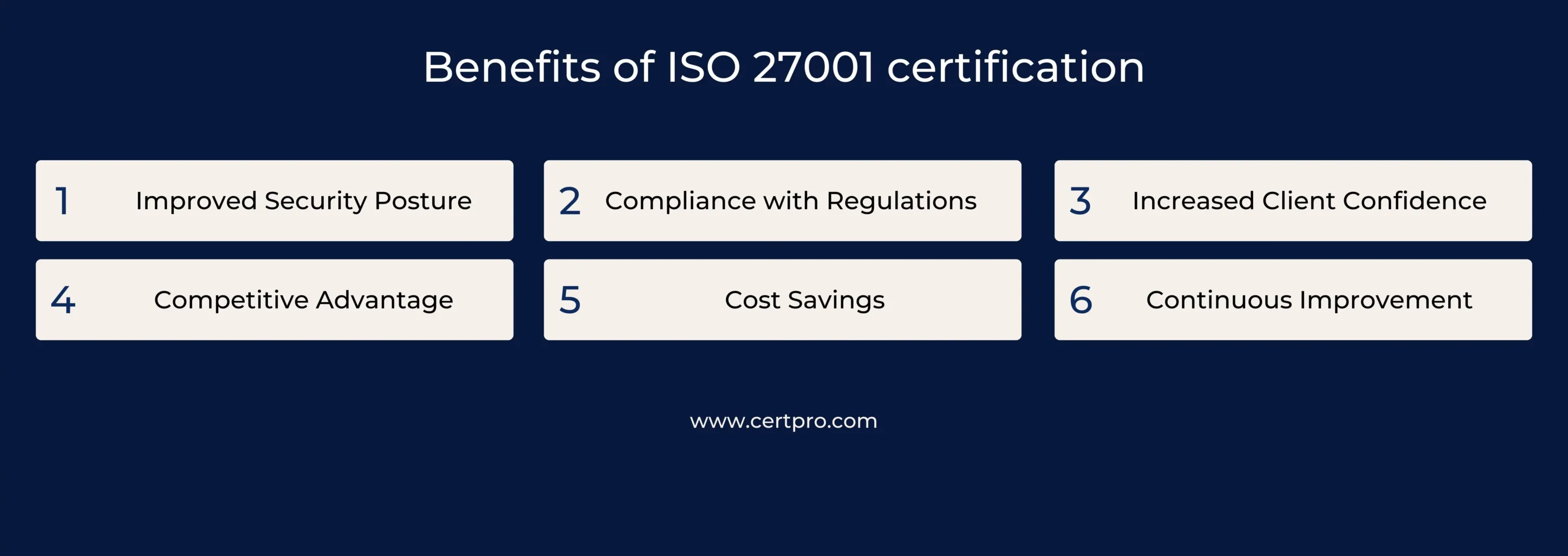
ISO 27001 Certification in Singapore delivers demonstrable business value across multiple dimensions — from regulatory alignment and customer assurance to operational risk reduction and commercial differentiation. For Singapore organisations competing in technology, financial services, and digital economy sectors, ISO 27001 Certification provides a verifiable, internationally recognised credential. It communicates information security governance to stakeholders without requiring individual disclosure of internal controls or audit findings, making it a highly efficient trust signal for enterprise and institutional markets.
ISO 27001 certification is increasingly specified as a mandatory procurement requirement by enterprise customers, government agencies, and multinational organisations conducting vendor due diligence. Singapore-based SaaS providers, managed service providers, cloud companies, and technology firms regularly encounter customer requirements for ISO 27001 Certification as a condition of contract award — particularly when handling sensitive customer data, financial information, or regulated personal data. Certification replaces lengthy customer security questionnaires with a standardised, auditor-verified credential. This reduces the administrative burden of responding to multiple individual assessments while providing a consistent, credible basis for vendor assurance evaluations. Organisations holding ISO 27001 Certification in Singapore gain a measurable competitive advantage in tender responses and enterprise sales processes where information security credentials are formally evaluated.
ISO 27001 compliance provides Singapore organisations with a structured framework for identifying, assessing, and treating information security risks in a manner that aligns with — though does not automatically satisfy — obligations under Singapore’s Personal Data Protection Act (PDPA), the Cybersecurity Act, and MAS Technology Risk Management Guidelines. Organisations in financial services, healthcare, and critical information infrastructure sectors benefit from the risk-based control framework, which maps security measures to identified risks and documents the rationale for control selection through the Statement of Applicability. This documented, auditable approach to risk governance provides regulators, board members, and senior management with clear evidence that information security is managed systematically. ISO 27001 Certification in Singapore also supports vendor assurance obligations, enabling certified organisations to demonstrate independently verified security controls to downstream partners and clients across Asia-Pacific and global markets.
- ✓Independently verified information security credentials accepted by enterprise customers and procurement teams
- ✓Structured risk assessment and risk treatment framework reducing the likelihood of security incidents and data breaches
- ✓Documented Statement of Applicability providing evidence of control selection rationale for regulatory inquiries
- ✓Internationally recognised ISO 27001 certificate supporting market entry across Asia-Pacific, Europe, and North American markets
- ✓Reduced vendor questionnaire burden through a standardised, auditor-issued certification credential
- ✓Board-level assurance through documented management review and continual improvement requirements
- ✓Alignment with PDPA, Cybersecurity Act, and MAS technology risk management expectations
- ✓Enhanced trust with customers, partners, and regulators handling sensitive information assets
- ✓Commercial and Contractual Advantages
- ✓Regulatory Alignment and Risk Governance
Requirements for ISO 27001 Certification
Achieving ISO 27001 Certification in Singapore requires an organisation to satisfy the mandatory requirements of ISO/IEC 27001:2022 across Clauses 4 through 10, as well as to implement applicable controls from Annex A as determined through the risk assessment and treatment process. The ISO 27001 standard applies a Plan-Do-Check-Act (PDCA) cycle to information security management, requiring organisations to establish the ISMS, operate it effectively, monitor and measure its performance, and continually improve it based on audit findings, management review outcomes, and incident analysis.
ISO/IEC 27001:2022 mandates a defined set of documented information that must be maintained and retained as evidence of ISMS conformance. Mandatory documentation includes the ISMS scope statement, information security policy, risk assessment results, risk treatment plan, Statement of Applicability (SoA), information security objectives, competence records, operational planning and control documentation, internal audit programme and results, management review records, and records of nonconformities and corrective actions. The Statement of Applicability is a critical document. It lists all 93 Annex A controls, states whether each control is applicable or excluded, and provides justification for every decision. The SoA must be current, accurate, and consistent with the risk treatment plan at all times. CertPro auditors evaluate all mandatory documented information during the ISO 27001 certification audit to confirm completeness, accuracy, and alignment with the organisation’s operational context.
Beyond documentation, the ISO 27001 standard requires organisations to demonstrate operational implementation of the ISMS across the defined certification scope. This includes conducting a formal information security risk assessment using a documented methodology that produces consistent, comparable, and reproducible results. The risk treatment process must identify appropriate controls from Annex A — and any additional controls determined necessary — with owners assigned to each identified risk and treatment action. Internal audits must be conducted at planned intervals by personnel independent of the areas being audited, with results reported to management. Management review must be conducted at planned intervals and must address performance against objectives, audit findings, risk levels, and opportunities for continual improvement. All operational evidence must be retained in a format suitable for review during the ISO 27001 certification audit.
Annex A of ISO/IEC 27001:2022 contains 93 controls organised across four categories. Organisational Controls (37 controls) address policies, roles, responsibilities, supplier relationships, incident management, and business continuity. People Controls (8 controls) cover personnel security, awareness, and training. Physical Controls (14 controls) address physical security perimeters, equipment protection, and clear desk and screen requirements. Technological Controls (34 controls) cover access management, cryptography, network security, secure development, vulnerability management, and monitoring. Eleven controls are new to the 2022 edition, including controls addressing threat intelligence, information security for cloud services, data masking, web filtering, and secure coding. The applicability of each control is determined through the risk assessment process, and all decisions must be documented in the Statement of Applicability with clear justification for inclusions and exclusions.
- ✓Documentation Requirements
- ✓Technical and Operational Requirements
- ✓Annex A Controls Under ISO/IEC 27001:2022
ISO 27001 Certification Cost in Singapore
The investment associated with obtaining ISO 27001 Certification in Singapore varies based on the organisation’s size, the complexity of the defined certification scope, the number of locations included, the volume of information assets and systems in scope, and the maturity of existing information security controls at the time of the ISO 27001 audit. CertPro structures its ISO 27001 audit engagements based on scope parameters determined through an initial scope evaluation, with audit programmes designed to reflect the actual complexity and risk profile of the organisation being assessed.
Factors Influencing Audit Scope and Effort
The primary factors that determine the scope of an ISO 27001 certification audit — and therefore the audit effort required — include the number of employees within the ISMS scope, the number and types of information systems and processes included, the number of physical locations assessed, the complexity of the technology environment (including cloud infrastructure, third-party services, and data flows), and the sensitivity of information assets being managed. Organisations with narrowly defined scopes — for example, a SaaS product covering a single platform and its supporting infrastructure — typically require less audit time than those with enterprise-wide scopes covering multiple business units, geographies, and operational functions. Organisations seeking ISO 27001 Certification for the first time should ensure that the ISMS scope is clearly defined and fully documented before the Stage 1 audit commences.
Three-Year Certification Cycle Investment
ISO 27001 Certification in Singapore involves audit investment across the full three-year certification cycle — encompassing the initial Stage 1 and Stage 2 certification audits, two annual surveillance audits, and a recertification audit at the end of the cycle. Organisations should account for the full cycle when evaluating total investment, as surveillance audits are mandatory requirements of the ISO 27001 standard and failure to complete them results in certificate suspension. Surveillance audits are typically scoped at a reduced level compared to the full certification audit, focusing on key ISMS processes, management review evidence, internal audit results, and any changes to the organisation’s context or scope since the previous audit. CertPro provides transparent audit scope determinations based on the specific parameters of each organisation’s ISMS.
ISO 27001 Certification for Key Singapore Industries
ISO 27001 Certification in Singapore is pursued across a broad range of industry sectors, reflecting Singapore’s diverse economy and its role as a regional hub for technology, financial services, healthcare, logistics, and professional services. The specific drivers for ISO 27001 Certification vary by industry — from contractual requirements and customer assurance in technology sectors to regulatory expectations and risk governance obligations in financial services and healthcare — but the underlying ISO 27001 standard applied is consistent across all sectors.
Financial Services and Fintech
Financial services organisations in Singapore seek ISO 27001 Certification to demonstrate information security governance aligned with MAS Technology Risk Management Guidelines and the Notice on Cyber Hygiene. Banks, insurance companies, capital markets firms, payment service providers, and fintech companies operating under MAS licensing requirements manage large volumes of sensitive customer financial data and face heightened scrutiny regarding information security controls. ISO 27001 compliance provides a structured, auditable framework for managing technology risks that complements MAS regulatory requirements. While ISO 27001 certification does not constitute regulatory compliance with MAS requirements, it provides documented evidence of a risk-based information security management programme that regulators, auditors, and counterparties can independently verify. Singapore’s fintech sector — spanning digital payment platforms, wealth management applications, insurtech, and regtech companies — relies on ISO 27001 Certification to demonstrate security governance when entering enterprise and institutional markets.
Technology, SaaS, and Cloud Service Providers
Technology companies in Singapore — including SaaS providers, cloud computing platforms, AI and machine learning companies, cybersecurity firms, and data centre operators — are among the most active seekers of ISO 27001 Certification. Enterprise customers across Asia-Pacific, the United States, and Europe increasingly mandate ISO 27001 Certification as a baseline vendor security requirement, particularly for cloud services handling customer data. Singapore’s technology ecosystem encompasses both global technology companies with regional headquarters and home-grown SaaS and AI businesses scaling to international markets. ISO 27001 Certification provides these organisations with a universally recognised security credential that reduces the need to respond to multiple customer security assessments individually. Data centre operators in Singapore — serving as critical regional infrastructure for cloud hosting and colocation — also pursue ISO 27001 Certification alongside other frameworks such as SOC 2 to demonstrate the security of their facilities and operational processes.
Healthcare, E-Commerce, and Multinational Enterprises
Healthcare organisations in Singapore — including hospital groups, digital health platforms, and health technology companies — manage sensitive patient data subject to both PDPA obligations and sector-specific regulations. ISO 27001 Certification provides a structured framework for managing the confidentiality, integrity, and availability of electronic health records and clinical systems. E-commerce businesses operating in Singapore’s digital economy manage large volumes of customer payment data, personal information, and transaction records, making ISO 27001 compliance a meaningful signal of security governance to consumers and payment platform partners. Multinational enterprises headquartered or operating in Singapore frequently require ISO 27001 Certification across their regional entities to satisfy global information security policies mandated by parent company governance frameworks. ISO 27001 Certification in Singapore is recognised by enterprise procurement teams across Asia-Pacific, enabling certified organisations to compete effectively in regional and global markets.
Certification and Auditing Services by CertPro for ISO 27001 in Singapore
CertPro is a Licensed CPA Firm operating as an independent third-party certification body for ISO 27001 Certification in Singapore. CertPro conducts ISO 27001 certification audits under ISO/IEC 27001:2022, evaluating organisations’ Information Security Management Systems against the full requirements of the ISO 27001 standard across defined certification scopes. CertPro’s ISO 27001 audit methodology is based on independent, evidence-based assessment — auditors examine documented information, test operational controls, interview personnel, and review records to form an objective conclusion on ISMS conformance.
Independent Audit Methodology
CertPro’s ISO 27001 audit engagements in Singapore are conducted by qualified information security auditors with domain expertise relevant to the organisation’s industry sector and technology environment. Auditors maintain strict independence from the organisations they certify, with no involvement in ISMS design, implementation, or control selection — a requirement fundamental to the integrity of third-party certification. Each ISO 27001 audit is structured around the organisation’s defined certification scope, with audit programmes designed to provide sufficient coverage of the ISMS to support a defensible certification decision. Audit findings are documented in formal reports communicating nonconformities, observations, and the basis for the certification decision. The certification decision is made by CertPro’s independent certification panel — separate from the audit team — based on the evidence gathered during the ISO 27001 certification audit.
Certification Issuance and Certificate Validity
Upon successful completion of the Stage 2 ISO 27001 certification audit and resolution of any identified nonconformities, CertPro issues the ISO 27001 certificate specifying the certified organisation, certification scope, applicable standard (ISO/IEC 27001:2022), certificate issue date, and expiry date. The certificate is valid for three years from the date of issue, subject to satisfactory completion of annual surveillance audits in Year 1 and Year 2. CertPro maintains a record of all issued ISO 27001 certificates, enabling organisations to reference their certification status in customer communications, tender submissions, and regulatory disclosures. Certificate validity is contingent on continued conformance with the ISO 27001 standard; material changes to the organisation’s ISMS scope, structure, or control environment may require notification to CertPro and, in some cases, an unscheduled audit to confirm continued conformance.
ISO 27001 Compliance and Singapore’s Regulatory Framework
ISO 27001 compliance operates within Singapore’s broader information security and data protection regulatory landscape. Singapore has established a mature regulatory environment encompassing the Personal Data Protection Act (PDPA), the Cybersecurity Act, MAS Technology Risk Management Guidelines, and sector-specific requirements applicable to financial services, healthcare, and critical information infrastructure operators. ISO 27001 Certification in Singapore provides organisations with a structured, internationally recognised framework for managing information security risks that aligns with the intent of these regulatory obligations — though certification does not automatically establish legal compliance with any specific Singapore regulation.
PDPA and ISO 27001 Alignment
Singapore’s Personal Data Protection Act (PDPA) requires organisations to protect personal data using security arrangements that are reasonable and appropriate. ISO 27001 compliance provides a documented, audited set of information security controls that addresses the protection of personal data as part of a broader information asset management framework. The PDPA’s data protection obligations and the ISO 27001 standard’s control requirements overlap in several key areas, including access control, data classification, incident response, vendor management, and business continuity. ISO 27001 Certification is not a PDPA compliance certification — these are distinct frameworks with different scopes and objectives — but organisations that have achieved ISO 27001 Certification in Singapore are typically better positioned to demonstrate reasonable security arrangements to the Personal Data Protection Commission (PDPC) in the event of a data breach or regulatory inquiry.
MAS Requirements and Cybersecurity Act Considerations
The Monetary Authority of Singapore’s Technology Risk Management (TRM) Guidelines set expectations for financial institutions regarding the governance, risk management, and control of technology systems — including information security management, access controls, software security, cyber surveillance, and incident management. ISO 27001 certification audit results and the ISMS documentation produced under the ISO 27001 standard address many of the control domains referenced in the MAS TRM Guidelines, making ISO 27001 compliance a complementary framework for financial institutions subject to MAS oversight. Singapore’s Cybersecurity Act designates Critical Information Infrastructure (CII) sectors — including energy, water, banking and finance, healthcare, and telecommunications — whose operators are subject to specific cybersecurity obligations. ISO 27001 Certification in Singapore does not fulfil CII sector-specific obligations, but provides a foundational information security management framework that CII operators may incorporate into their broader cybersecurity governance programmes.
ISO 27001 Certified Companies in Singapore
The number of ISO 27001 certified companies in Singapore has grown significantly over the past decade, reflecting increasing awareness of information security risks, customer demand for verifiable security credentials, and regulatory expectations across key industry sectors. Singapore consistently ranks among the top countries in Asia-Pacific for ISO 27001 adoption, with certified organisations spanning technology, financial services, telecommunications, healthcare, government-linked entities, and multinational enterprise regional operations.
Sectors with High ISO 27001 Adoption in Singapore
ISO 27001 adoption in Singapore is concentrated in sectors where information security governance is most directly tied to commercial or regulatory imperatives. Technology companies — including cloud service providers, cybersecurity firms, managed service providers, and SaaS businesses — represent the largest segment of ISO 27001 certified organisations in Singapore, driven by enterprise customer requirements and vendor assurance expectations. Financial services organisations — including banks, insurers, payment processors, and fintech companies — represent the second-largest segment, with ISO 27001 Certification frequently specified in counterparty due diligence and outsourcing governance frameworks. Government-linked companies and statutory boards also pursue ISO 27001 Certification in Singapore to demonstrate information security governance aligned with government digital transformation initiatives and Smart Nation cybersecurity objectives. Professional services firms — including legal, accounting, and consulting organisations — increasingly seek ISO 27001 Certification as clients impose information security requirements on service providers handling confidential information.
ISO 27001 Certification as a Market Differentiator
For Singapore organisations competing in regional and global markets, ISO 27001 Certification in Singapore functions as a powerful market differentiator. It signals information security maturity to prospective customers, investors, and partners who may lack the capacity to conduct detailed individual security assessments. The ISO 27001 standard is recognised and accepted across Asia-Pacific markets — including Australia, Japan, South Korea, India, and Southeast Asian countries — as well as in Europe (where it aligns with GDPR accountability expectations) and the United States (where it complements SOC 2 evaluations for cloud service providers). Singapore organisations holding ISO 27001 Certification can reference their certified status in marketing materials, tender submissions, contract negotiations, and regulatory disclosures. This provides a credible, independently verified basis for information security claims that cannot be made by uncertified organisations relying solely on self-assessment.
FAQ
▶
What is ISO 27001 certification?
▶
What does ISO 27001 certification confirm?
▶
How long does the ISO 27001 certification audit process take in Singapore?
▶
Is ISO 27001 certification mandatory in Singapore?
▶
How long is an ISO 27001 certificate valid?
▶
What is the Statement of Applicability in ISO 27001?
▶
Does ISO 27001 certification mean an organisation is compliant with Singapore’s PDPA?
▶
What is the difference between ISO 27001 and SOC 2 for Singapore organisations?
Get In Touch
have a question? let us get back to you.