
SOC 2 Certification in Singapore
SOC 2 examinations produce two distinct report types — Type 1 and Type 2 — each serving a different purpose and providing a different level of assurance. Understanding the difference between these report types is essential for Singapore organizations determining which engagement best suits their circumstances, customer requirements, and timeline.
OUR CLIENTS










What SOC 2 Certification Means for Organizations in Singapore
SOC 2 Certification in Singapore is an independent attestation issued by a Licensed CPA Firm following a formal examination conducted under the American Institute of Certified Public Accountants (AICPA) attestation standards, specifically AT-C Section 205. The attestation confirms that an organization’s internal controls governing security, availability, processing integrity, confidentiality, and privacy have been independently examined and found to satisfy the AICPA Trust Services Criteria (TSC). SOC 2 Certification is not a self-declaration, an internal checklist, or a vendor-issued badge. It is a formal auditor’s opinion produced at the conclusion of a structured SOC 2 examination, signed by a Licensed CPA Firm with the competence and independence to issue attestation opinions under professional standards.
For organizations operating within Singapore’s technology, financial services, and digital business ecosystem, a SOC 2 attestation report carries a specific and well-understood meaning. It provides independent, evidence-based confirmation that the controls described in an organization’s System Description have been tested and found to be designed effectively, operating effectively, or both — depending on the report type issued. Singapore-based SaaS providers, cloud service companies, fintech firms, financial institutions, AI businesses, healthcare organizations, e-commerce operators, cybersecurity firms, telecommunications providers, data center operators, and multinational enterprises handling sensitive data increasingly receive SOC 2 attestation requirements from customers, procurement teams, and institutional counterparties as a condition of doing business.
SOC 2 compliance expectations in Singapore have intensified alongside the growth of the country’s digital economy and the increasing sensitivity of data processed across all sectors. Singapore’s Personal Data Protection Act (PDPA), the Cybersecurity Act, and the Monetary Authority of Singapore (MAS) technology and risk management requirements all reflect a regulatory environment that places significant emphasis on information security governance, third-party risk management, and evidence-based control assurance. While SOC 2 attestation does not automatically establish compliance with Singaporean laws or MAS requirements, a SOC 2 attestation report addresses many of the control domains that regulators, customers, and institutional counterparties evaluate when assessing third-party risk.
Demand for SOC 2 Certification in Singapore originates from several interconnected market forces. United States and European customers routinely require SOC 2 Type 2 attestation reports from Singapore-based service providers as part of vendor due diligence and procurement processes. Singapore’s position as a regional hub for Asia-Pacific operations means that organizations headquartered here frequently serve customers across multiple jurisdictions with distinct vendor assurance expectations. Financial services firms operating under MAS oversight, healthcare organizations subject to data sensitivity obligations, and cloud service providers managing critical customer workloads all face heightened scrutiny from counterparties seeking independent evidence of control effectiveness. SOC 2 attestation in Singapore delivers that independent confirmation in a format that is globally recognized and legally defensible.
A SOC 2 examination produces a formal attestation report containing the Licensed CPA Firm’s opinion, a description of the system under examination, a description of the controls implemented by the organization, the criteria against which those controls were evaluated, and the results of the auditor’s testing procedures. The report is structured according to AICPA standards and is intended for distribution to specified parties — typically existing customers, prospective customers, and their auditors — who have a legitimate need to understand the organization’s control environment. Organizations pursuing SOC 2 Certification in Singapore should understand that the process begins with scoping decisions and culminates in an attestation report reflecting a point-in-time or period-based independent examination of actual control operations, not a declaration of intent or a projected capability assessment.

ENQUIRE NOW
Related Resources
Related Services in Singapore
What Is SOC 2 Certification?
SOC 2 Certification is a formal attestation standard developed by the AICPA under its System and Organization Controls framework. It applies to service organizations that store, process, or transmit customer data on behalf of other entities. The SOC 2 examination evaluates whether the controls a service organization has implemented satisfy one or more of the five AICPA Trust Services Criteria categories: Security (Common Criteria), Availability, Processing Integrity, Confidentiality, and Privacy. Security is the only mandatory category. The remaining four are selected based on the nature of the services provided, customer contractual obligations, and the organization’s system description commitments.
The AICPA Trust Services Criteria Framework
The AICPA Trust Services Criteria provide the evaluative framework against which a Licensed CPA Firm assesses an organization’s control environment during a SOC 2 examination. The Security category — also referred to as the Common Criteria — addresses logical and physical access controls, risk assessment processes, change management procedures, system monitoring, and incident response capabilities. It forms the mandatory foundation of every SOC 2 attestation engagement. The Availability criteria evaluate whether systems are available for operation and use as committed. Processing Integrity addresses whether system processing is complete, valid, accurate, timely, and authorized. Confidentiality covers the protection of information designated as confidential. Privacy addresses the collection, use, retention, disclosure, and disposal of personal information in accordance with the organization’s privacy notice and applicable privacy principles.
For Singapore-based organizations, the selection of applicable Trust Services Criteria categories is driven by the nature of the services provided and the expectations of customers receiving the SOC 2 attestation report. Fintech firms and financial services providers typically include Availability and Confidentiality alongside Security. Healthcare organizations and AI businesses processing personal data commonly include Privacy. Cloud service providers and data center operators with uptime commitments frequently include Availability and Processing Integrity. The Licensed CPA Firm conducting the SOC 2 examination evaluates only the criteria formally included in the engagement scope, and the resulting attestation report reflects the specific combination of criteria examined.
SOC 2 Attestation vs. SOC 2 Compliance
A precise distinction exists between SOC 2 attestation and SOC 2 compliance that organizations pursuing SOC 2 Certification in Singapore must understand. SOC 2 compliance refers to an organization’s internal adherence to the Trust Services Criteria — implementing controls, maintaining documentation, and operating processes that align with the criteria’s requirements. Compliance in this sense can exist without independent verification. SOC 2 attestation, by contrast, is the formal output of an independent examination conducted by a Licensed CPA Firm. The SOC 2 attestation report contains the auditor’s opinion — a professional judgment about whether the organization’s controls satisfy the applicable criteria — based on evidence gathered during the SOC 2 examination. Only organizations that have completed a SOC 2 examination conducted by a Licensed CPA Firm and received an attestation opinion can accurately state that they hold SOC 2 Certification.
This distinction is practically significant for Singapore organizations receiving vendor due diligence requests. Many procurement processes and contractual requirements specify that a SOC 2 attestation report — not a self-assessment or compliance declaration — is required. Customers and their auditors seek the independent opinion of a Licensed CPA Firm as the basis for their own risk assessments. A SOC 2 examination in Singapore produces a report that satisfies this requirement because it reflects independent professional evaluation under AICPA attestation standards, not the organization’s own representation of its control environment. This independent character is precisely what distinguishes SOC 2 attestation from internal audits, vendor questionnaires, and self-certification programs.
SOC 2 Type 1 vs SOC 2 Type 2 in Singapore
SOC 2 examinations produce two distinct report types — Type 1 and Type 2 — each serving a different purpose and providing a different level of assurance. Understanding the difference between these report types is essential for Singapore organizations determining which engagement best suits their circumstances, customer requirements, and timeline.
SOC 2 Type 1 Report: Point-in-Time Design Assessment
A SOC 2 Type 1 report reflects the Licensed CPA Firm’s opinion on two matters as of a specific date: whether the organization’s System Description fairly presents the system as designed, and whether the controls described were suitably designed to satisfy the applicable Trust Services Criteria as of that date. A Type 1 examination does not assess whether controls operated effectively over time — it evaluates design suitability at a single point in time. For Singapore organizations that have recently implemented their control environment and need to demonstrate design adequacy to customers or counterparties, a SOC 2 Type 1 attestation report provides an initial independent evaluation. It is particularly relevant when organizations require attestation documentation within a shorter timeframe than a full Type 2 engagement would require.
The SOC 2 Type 1 examination requires the Licensed CPA Firm to review the System Description, evaluate the completeness and accuracy of the control descriptions, and assess whether the described controls are designed in a manner that would reasonably satisfy the applicable Trust Services Criteria. Evidence collection for a Type 1 engagement focuses on design documentation, policy frameworks, and system configuration evidence as of the report date. Many Singapore organizations pursue a Type 1 attestation as an initial step before undertaking the more extensive Type 2 examination — particularly when entering new markets or responding to customer requests for attestation documentation before a full observation period can be completed.
SOC 2 Type 2 Report: Operating Effectiveness Over an Observation Period
A SOC 2 Type 2 report reflects the Licensed CPA Firm’s opinion on three matters: whether the System Description fairly presents the system as designed and operated, whether controls were suitably designed to satisfy the applicable Trust Services Criteria, and whether controls operated effectively throughout the observation period. The observation period is the duration over which the auditor tests control operation — typically a minimum of six months, and commonly twelve months for mature programs. A SOC 2 Type 2 audit in Singapore involves testing a sample of control operation evidence drawn from across the observation period, allowing the Licensed CPA Firm to form an opinion on whether controls functioned consistently as designed throughout that period.
SOC 2 Type 2 attestation is the standard most frequently required by enterprise customers, financial institutions, and regulated entities evaluating Singapore-based service providers. The operating effectiveness opinion provides a higher level of assurance than a Type 1 report because it reflects actual control performance over time rather than design adequacy at a single point. Organizations in Singapore’s SaaS, fintech, cloud, and data services sectors that receive vendor assurance requests from U.S. or European customers almost universally encounter requirements specifying a SOC 2 Type 2 report. The annual recertification cycle for a SOC 2 Type 2 engagement maintains the currency of the attestation and ensures that customers receive updated independent assurance on a regular basis.
| Dimension | SOC 2 Type 1 | SOC 2 Type 2 |
|---|---|---|
| Examination Focus | Control design as of a specific date | Control design and operating effectiveness over a defined period |
| Observation Period | None — point-in-time assessment only | Minimum 6 months; typically 12 months |
| Assurance Level | Design adequacy | Design adequacy plus operating effectiveness |
| Typical Use | Initial attestation; newly established programs | Ongoing vendor assurance; enterprise and institutional procurement |
| Report Currency | Valid as of the report date | Valid for the observation period covered |
SOC 2 Trust Services Criteria Explained
The AICPA Trust Services Criteria represent the evaluative standards applied during a SOC 2 examination. Each category contains specific criteria defining the control objectives and principles against which a Licensed CPA Firm assesses an organization’s control environment. The criteria are organized into logical groupings that address control environment, risk assessment, control activities, information and communication, and monitoring activities — reflecting a governance structure aligned with the COSO Internal Control — Integrated Framework.
The Security category, designated as the Common Criteria (CC), is the mandatory foundation of every SOC 2 examination and applies regardless of which additional Trust Services Criteria categories are included in scope. The Common Criteria address nine logical groupings: control environment (CC1), communication and information (CC2), risk assessment (CC3), monitoring activities (CC4), control activities (CC5), logical and physical access (CC6), system operations (CC7), change management (CC8), and risk mitigation (CC9). Each grouping contains multiple individual criteria describing specific control requirements. During the SOC 2 examination, the Licensed CPA Firm evaluates whether the organization’s controls address each applicable criterion — and, for Type 2 engagements, whether those controls operated consistently over the observation period.
For Singapore organizations, the Common Criteria address control domains that align closely with information security expectations under the PDPA, MAS Technology Risk Management Guidelines, and Singapore’s Cybersecurity Act. Logical access controls, vulnerability management, incident response, change management, and monitoring are all addressed within the Common Criteria framework. While SOC 2 attestation does not establish regulatory compliance with Singaporean laws, the controls evaluated under the Common Criteria frequently overlap with the requirements that Singapore regulators and institutional counterparties assess during their own vendor risk reviews. This overlap increases the practical value of a SOC 2 attestation report for Singapore-based organizations operating in regulated sectors.
The four additional Trust Services Criteria categories — Availability (A), Processing Integrity (PI), Confidentiality (C), and Privacy (P) — are selected based on the nature of the services provided and the commitments made in the System Description. Availability criteria evaluate whether systems are available for operation as committed, addressing redundancy, failover, backup, and recovery capabilities. Processing Integrity criteria assess whether system processing is complete, valid, accurate, timely, and authorized — particularly relevant for financial transaction processors, data analytics providers, and AI systems producing outputs relied upon by customers. Confidentiality criteria evaluate controls protecting information designated as confidential, including encryption, access restrictions, and data handling procedures. Privacy criteria address the organization’s handling of personal information throughout its lifecycle, from collection through disposal, aligned with the AICPA Generally Accepted Privacy Principles.
Singapore organizations pursuing SOC 2 Certification in Singapore should select additional Trust Services Criteria categories based on the commitments made to customers in service agreements, the data types processed, and the specific assurance requirements communicated by customers. Healthcare organizations and technology firms processing personal data under the PDPA commonly include Privacy criteria. SaaS providers offering services with uptime guarantees typically include Availability. Financial technology firms processing transactions include Processing Integrity. The Licensed CPA Firm conducting the SOC 2 examination will evaluate only the categories included in the agreed engagement scope, and the resulting SOC 2 attestation report will identify which categories were examined and reflect the auditor’s opinion specific to those categories.
- ✓Security — The Common Criteria
- ✓Availability, Processing Integrity, Confidentiality, and Privacy Criteria
SOC 2 Certification Process in Singapore
The SOC 2 audit process in Singapore follows a defined sequence of stages established under AICPA attestation standards. Each stage produces specific outputs that feed into subsequent stages, culminating in the issuance of the attestation report. Understanding this process enables organizations to plan their engagement timeline effectively and ensure that required evidence is available at each stage.
- Scope Definition: The Licensed CPA Firm and the organization agree on the services, systems, infrastructure components, data types, and Trust Services Criteria categories to be included in the examination. The System Description boundaries are established during this stage.
- Audit Program Determination: The Licensed CPA Firm designs the examination procedures, including specific control testing approaches, evidence requirements, and sampling methodologies to be applied during the engagement.
- System Description Review: The organization prepares the System Description — a management-prepared narrative describing the system as designed and operated. The Licensed CPA Firm evaluates whether the description fairly presents the system.
- Control Identification and Documentation: The organization identifies and documents the controls implemented to satisfy each applicable Trust Services Criteria. Controls are mapped to criteria and supported by documentation available for auditor review.
- Type 1 or Type 2 Assessment: For Type 1, the Licensed CPA Firm assesses control design as of the report date. For Type 2, the observation period begins and the auditor collects evidence of control operation across the defined period.
- Control Testing: The Licensed CPA Firm executes testing procedures to evaluate whether controls operated as described. Testing methods include inquiry, observation, inspection of documentation, and re-performance of control procedures.
- Nonconformity Review: The Licensed CPA Firm communicates identified exceptions or control deficiencies to management. Management provides responses and, where applicable, evidence of remediation or compensating controls.
- Certification Decision and Report Issuance: The Licensed CPA Firm forms its attestation opinion and issues the SOC 2 attestation report, including the auditor’s opinion, System Description, control descriptions, and testing results.
The observation period is the defined duration over which the Licensed CPA Firm tests control operation for a SOC 2 Type 2 engagement. A minimum observation period of six months is standard; twelve-month observation periods are common for organizations with established control environments seeking to provide customers with a full annual cycle of assurance. During the observation period, the organization must maintain consistent evidence of control operation — including system logs, access review records, change management tickets, security incident records, vulnerability scan results, backup test documentation, and other control evidence artifacts. The Licensed CPA Firm selects samples from this evidence population to test whether controls operated as described throughout the observation period.
Effective evidence collection requires that organizations establish systematic processes for capturing, retaining, and organizing control evidence before and throughout the observation period. Organizations that implement controls without simultaneously establishing evidence collection processes frequently encounter challenges during the SOC 2 examination when requested evidence is incomplete, inconsistent, or unavailable. For Singapore organizations pursuing SOC 2 Certification in Singapore for the first time, the observation period is typically the stage that requires the most sustained organizational attention. Evidence must reflect actual control operation — whether automated or manual — across the full observation period. Reconstructed documentation created after the fact will not satisfy the Licensed CPA Firm’s examination requirements.
Upon completion of the examination procedures, the Licensed CPA Firm issues the SOC 2 attestation report. The report is a restricted-use document intended for distribution to specified parties — the organization’s management, existing customers, prospective customers under non-disclosure agreements, and their auditors and regulators. It is not a public certification document. The SOC 2 attestation report contains four principal components: the Licensed CPA Firm’s opinion letter, management’s assertion about the System Description and controls, the System Description itself, and — for Type 2 reports — a detailed description of the tests performed and the results obtained. Organizations distributing SOC 2 attestation reports in Singapore must ensure that recipients understand the intended use limitations and restricted distribution provisions specified in the report.
- ✓Stages of the SOC 2 Examination
- ✓Observation Period and Evidence Collection
- ✓Report Issuance and Distribution
SOC 2 Compliance Requirements for Singapore Businesses
SOC 2 compliance requirements for Singapore businesses reflect the AICPA Trust Services Criteria standards applied during the SOC 2 examination. These requirements span organizational governance, technical controls, operational procedures, and documentation practices. Organizations pursuing SOC 2 Certification in Singapore must ensure that their control environment addresses each applicable criterion before and during the examination period.
The Common Criteria’s control environment grouping (CC1) requires organizations to demonstrate a commitment to integrity and ethical values, board oversight of the control structure, assignment of authority and responsibility, commitment to competence, and accountability mechanisms. In practice, this requires documented organizational policies, defined roles and responsibilities, a code of conduct or ethics policy, board or management oversight documentation, and evidence of performance evaluation processes. Singapore organizations in highly governed sectors — financial services, healthcare, and critical information infrastructure — often have governance structures that already address many of these requirements, though the documentation and evidence format must meet the Licensed CPA Firm’s examination standards for SOC 2 compliance purposes.
Risk assessment requirements under the Common Criteria (CC3) require organizations to demonstrate that they have identified and assessed risks to the achievement of their control objectives — including risks arising from changes to the business environment, technology landscape, and regulatory context. A documented risk assessment process, risk register, and evidence of periodic risk review are typically required. For Singapore organizations operating under MAS technology risk management requirements or the Cybersecurity Act, an existing enterprise risk management framework may provide a useful foundation for addressing these criteria. However, the Licensed CPA Firm will evaluate the risk assessment process against the specific Trust Services Criteria requirements rather than against regulatory standards alone.
- ✓Logical access controls: User provisioning, deprovisioning, access review, multi-factor authentication, and privileged access management procedures with documented evidence of consistent operation
- ✓Encryption and data protection: Encryption of data in transit and at rest, key management procedures, and documented configurations demonstrating full implementation
- ✓Vulnerability management: Regular vulnerability scanning, penetration testing at defined intervals, remediation tracking, and documented results demonstrating timely response to identified vulnerabilities
- ✓Change management: Defined change control procedures, approval workflows, testing requirements, and evidence of adherence for all changes to systems within scope
- ✓Incident response: Documented incident response procedures, evidence of incident logging and tracking, escalation processes, and post-incident review documentation
- ✓Business continuity and disaster recovery: Documented recovery procedures, backup verification records, and evidence of periodic testing of recovery capabilities
- ✓Vendor management: Subservice organization identification, vendor risk assessment processes, and contractual controls addressing subservice organizations within the system scope
- ✓Monitoring and logging: System activity logging, log review procedures, alert configuration, and evidence of ongoing security monitoring activities
Management of the organization bears primary responsibility for the System Description, the design and operation of controls, and the completeness and accuracy of evidence provided to the Licensed CPA Firm during the SOC 2 examination. Management’s assertion — a formal written statement included in the SOC 2 attestation report — represents management’s representation that the System Description fairly presents the system, that controls were suitably designed, and (for Type 2) that controls operated effectively throughout the observation period. This assertion carries professional and legal significance and must be supported by the organization’s internal records, policies, and evidence artifacts.
Documentation requirements for a SOC 2 examination extend across policies, procedures, technical configurations, audit logs, and management review records. Organizations pursuing SOC 2 compliance in Singapore must maintain documentation that is current, accurate, and consistent with actual control operation. Policy documents that describe controls not implemented in practice — or logs that do not capture the monitoring activities described in the System Description — create discrepancies that the Licensed CPA Firm will identify during testing. Systematic documentation practices, established and maintained throughout the observation period, are essential for producing the evidence population that supports an unqualified SOC 2 attestation opinion.
- ✓Organizational and Governance Requirements
- ✓Technical and Operational Control Requirements
- ✓Documentation and Management Responsibilities
Why Singapore Businesses Need SOC 2 Certification
SOC 2 Certification in Singapore has become a market expectation rather than a differentiating advantage for organizations in technology-enabled services sectors. The convergence of enterprise procurement requirements, regulatory scrutiny, and customer data protection expectations has made SOC 2 attestation a baseline assurance requirement for Singapore companies serving international and institutional clients.
Vendor Assurance and Enterprise Procurement Requirements
Enterprise customers — particularly those headquartered in the United States, United Kingdom, European Union, and Australia — routinely require SOC 2 Type 2 attestation reports from third-party service providers as a condition of contract execution or renewal. Singapore-based SaaS providers, cloud service operators, data processors, and technology service companies frequently encounter this requirement during procurement processes with large enterprises, financial institutions, healthcare organizations, and government-adjacent entities. The absence of a current SOC 2 attestation report can delay or prevent contract execution, regardless of the organization’s actual security posture, because procurement teams and information security officers require independent evidence rather than self-attestation.
Singapore’s role as a regional headquarters location for multinational corporations amplifies this dynamic. Organizations operating from Singapore frequently serve customers across Asia-Pacific, North America, and Europe simultaneously — each with distinct vendor assurance expectations. SOC 2 attestation in Singapore provides a single independent assessment that addresses the requirements of multiple customer segments and jurisdictions. The SOC 2 framework is specifically designed for service organizations, making it directly applicable to the technology services, data processing, and cloud service models that characterize Singapore’s digital economy. For Singapore organizations with SOC 2 certification already established, annual recertification maintains the currency of the attestation and preserves ongoing customer confidence.
Regulatory Context and Third-Party Risk Management
Singapore’s regulatory environment imposes significant third-party risk management obligations on financial institutions, critical information infrastructure operators, and organizations processing personal data. The Monetary Authority of Singapore’s Technology Risk Management Guidelines require financial institutions to conduct rigorous due diligence on third-party technology service providers and obtain independent assurance of service provider control effectiveness. The Cybersecurity Act imposes security obligations on Critical Information Infrastructure operators and their supply chains. The Personal Data Protection Act requires organizations to implement reasonable security arrangements to protect personal data, including data processed by third-party vendors. While SOC 2 attestation does not automatically satisfy these regulatory obligations, a current SOC 2 Type 2 attestation report provides documented independent evidence of control effectiveness that financial institutions and regulated organizations can use to support their own third-party risk management assessments and regulatory documentation.
Singapore fintech firms, financial technology providers, and financial services technology companies — including payment processors, digital banking technology vendors, and trading system providers — face particularly concentrated SOC 2 demand from MAS-regulated financial institution customers conducting technology vendor due diligence. SOC 2 certification for Singapore fintech organizations frequently includes the Availability and Processing Integrity criteria alongside Security, reflecting the transaction processing and system uptime commitments central to financial technology services. Financial services providers in Singapore operate in an environment where institutional customers, correspondent banks, and international counterparties treat a current SOC 2 Type 2 report as a baseline vendor qualification requirement.
Benefits of SOC 2 Certification for Singapore Organizations
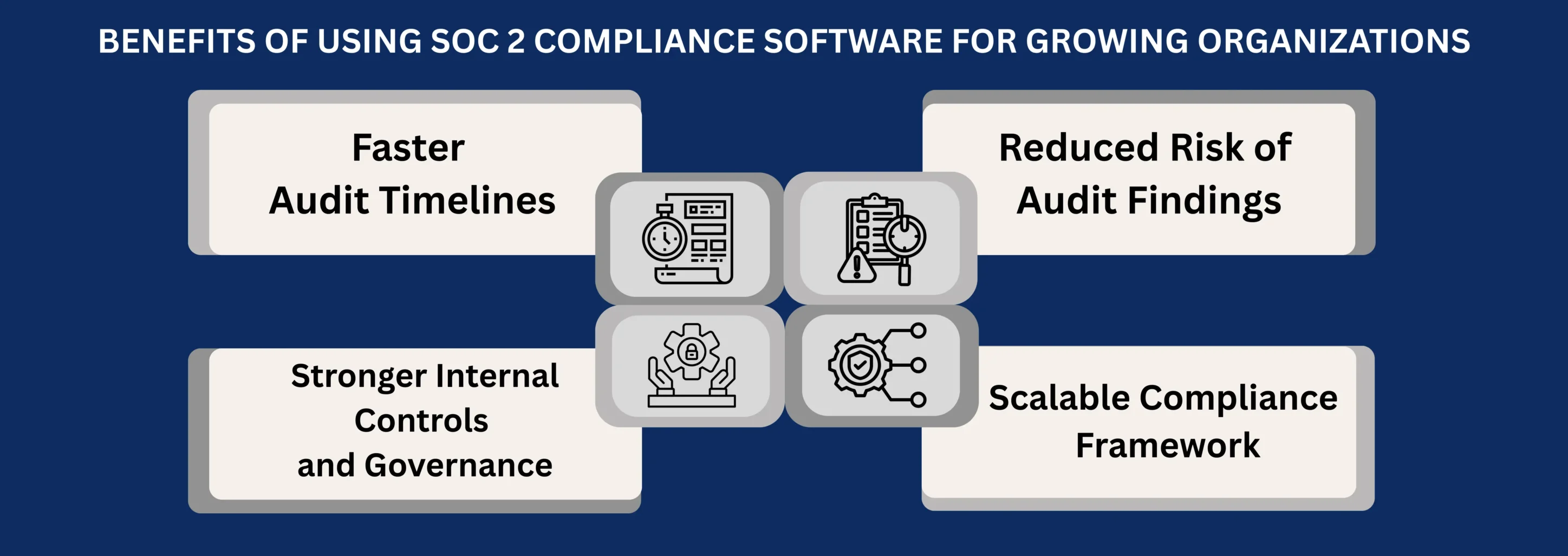
SOC 2 Certification in Singapore delivers measurable organizational outcomes that extend beyond the attestation report itself. These outcomes result directly from the examination process and the control environment that must be established and maintained to sustain certification. The benefits are most pronounced for organizations in competitive markets where independent assurance differentiates qualified vendors from those relying on self-declaration.
- ✓Accelerated enterprise sales cycles: A current SOC 2 attestation report reduces the time required to complete vendor security assessments and procurement due diligence for enterprise customers
- ✓Contract qualification: Organizations with SOC 2 Certification meet the attestation requirements specified in enterprise contracts, government procurement frameworks, and financial institution vendor programs
- ✓Reduced security questionnaire burden: A SOC 2 attestation report provides documented responses to the majority of questions in standard vendor security questionnaires, reducing internal resource requirements
- ✓Expanded market access: SOC 2 attestation enables Singapore organizations to pursue customers in the United States, United Kingdom, European Union, and Australia where SOC 2 is a recognized assurance standard
- ✓Enhanced customer retention: Annual SOC 2 recertification demonstrates ongoing control effectiveness, strengthening customer confidence and supporting contract renewals
- ✓Improved contractual terms: Organizations demonstrating independent control assurance may negotiate more favorable data processing agreements, liability provisions, and customer audit rights
- ✓Competitive differentiation: SOC 2 Certification distinguishes organizations from competitors relying on self-assessment or lower-assurance certification programs in competitive procurement processes
The SOC 2 examination process produces operational benefits through the discipline it imposes on the organization’s control environment. Organizations that establish and maintain controls to satisfy the Trust Services Criteria typically experience improvements in access management consistency, change control discipline, incident detection and response effectiveness, and documentation quality. These improvements reflect genuine enhancements to the organization’s internal governance structure — not cosmetic compliance activities. The ongoing monitoring requirements of the Common Criteria, particularly CC4 (monitoring activities) and CC7 (system operations monitoring), encourage organizations to maintain active visibility into their control environment rather than reviewing control performance only at audit time.
For Singapore organizations also subject to MAS technology risk management requirements, PDPA obligations, or Cybersecurity Act frameworks, the control environment established for SOC 2 compliance in Singapore provides a documented, independently verified foundation that can support internal governance reporting, board-level risk oversight, and regulatory examination responses. The SOC 2 attestation report — as an independent assessment of control design and operation — provides management and the board with a third-party perspective on the organization’s information security and operational control environment that internal audit functions may not provide with equivalent independence.
- ✓Commercial and Contractual Benefits
- ✓Operational and Governance Benefits
SOC 2 vs ISO 27001: Choosing the Right Framework for Singapore
Singapore organizations frequently evaluate SOC 2 Certification alongside ISO 27001 certification when determining which information security assurance framework to pursue. The two frameworks differ in their structure, issuing bodies, geographic recognition, and the nature of the assurance they provide. The choice between them — or the decision to pursue both — depends primarily on customer requirements, target markets, regulatory context, and the specific assurance outcomes sought.
Structural and Assurance Differences
ISO 27001 is an international standard published by the International Organization for Standardization specifying requirements for an Information Security Management System (ISMS). ISO 27001 certification is issued by an accredited certification body following an audit of the ISMS against the standard’s requirements. It confirms that the organization has established an ISMS meeting ISO 27001’s structural requirements and that the ISMS operates within a defined scope. SOC 2, by contrast, is a service organization reporting framework developed by the AICPA under U.S. attestation standards. A SOC 2 examination evaluates specific controls against the Trust Services Criteria and produces an attestation report — not a certificate — reflecting the Licensed CPA Firm’s opinion on control design and operating effectiveness. The SOC 2 examination is more granular in its control testing, evaluating specific control instances against defined criteria rather than assessing the existence of a management system.
| Dimension | SOC 2 | ISO 27001 |
|---|---|---|
| Issuing Body | Licensed CPA Firm (AICPA attestation standards) | Accredited Certification Body (ISO/IEC standards) |
| Output Document | Attestation Report reflecting auditor’s opinion | Certificate of Conformance |
| Geographic Recognition | Strong in U.S., Canada, and for U.S.-facing customers globally | Broad global recognition across all regions |
| Assurance Focus | Specific control testing against Trust Services Criteria | ISMS structural conformance assessment |
| Recertification Cycle | Annual attestation with continuous observation periods | Three-year certification cycle with annual surveillance audits |
Market Requirements and Framework Selection
Customer requirements and target markets are the primary determinants of framework selection for Singapore organizations. Organizations whose primary customer base consists of U.S. enterprises, U.S. financial institutions, or U.S.-regulated entities should prioritize SOC 2 Certification in Singapore, as the SOC 2 framework is the dominant service organization assurance standard in the United States and is specified by name in most U.S. enterprise vendor security programs. Organizations whose customers are primarily located in Europe, the Middle East, Asia-Pacific (excluding U.S.-facing deployments), or within global supply chains where ISO 27001 is a contractual requirement may prioritize ISO 27001 certification. Organizations serving both U.S. and international markets frequently pursue both frameworks, as the control environments required by each have significant overlap and can be maintained simultaneously without duplicative effort.
For Singapore organizations in the fintech, SaaS, and cloud services sectors, the SOC 2 audit engagement in Singapore is frequently the first assurance framework pursued because U.S. enterprise and financial institution customers represent the most immediate source of explicit attestation requirements. ISO 27001 certification may follow as organizations expand into European or Middle Eastern markets or seek to satisfy broader third-party risk management requirements across their customer base. When both frameworks are maintained simultaneously, the documentation discipline, control monitoring processes, and evidence collection practices established for SOC 2 compliance in Singapore provide a substantive foundation for ISO 27001 ISMS management as well.
SOC 2 Certification in Singapore: Regulatory and Market Context
Singapore’s position as a global financial center and Asia-Pacific technology hub creates a distinctive market context for SOC 2 Certification in Singapore. The city-state’s regulatory framework, economic structure, and international connectivity combine to produce a demand environment where SOC 2 attestation is both a market expectation and a governance signal for organizations in technology-enabled services sectors.
Singapore’s Digital Economy and SOC 2 Demand Drivers
Singapore hosts more than 4,000 technology companies and more than 80 of the world’s top 100 financial institutions, creating a concentrated ecosystem where sophisticated institutional customers routinely evaluate the security and operational assurance credentials of their technology service providers. Singapore’s status as the leading Southeast Asian hub for data center investment — with over 70 operational data centers as of 2024 — means that colocation providers, managed service operators, and cloud hosting companies face direct assurance requirements from enterprise and financial institution customers. The city-state’s role as a regional headquarters for U.S. technology firms also means that local procurement decisions are often made against vendor qualification standards developed by U.S. parent companies, where SOC 2 attestation is a standard and frequently non-negotiable requirement.
Singapore’s fintech sector — comprising over 1,000 registered fintech companies and a growing number of digital bank licensees — operates in an environment where MAS-regulated financial institution customers impose rigorous technology vendor assurance requirements. SOC 2 certification for Singapore fintech organizations represents the most concentrated procurement demand, as the financial services sector’s vendor risk management programs typically specify third-party attestation requirements as a condition of vendor approval. The growing adoption of AI-driven financial services, digital payment infrastructure, and cloud-native banking technology in Singapore further increases demand for independent SOC 2 attestation as a mechanism for demonstrating that AI system controls and cloud-based financial processing environments have been independently examined.
SOC 2 and Singapore’s Cybersecurity and Privacy Regulatory Landscape
Singapore’s Cybersecurity Act designates Critical Information Infrastructure (CII) across eleven sectors — energy, water, banking and finance, healthcare, transport, infocomm, media, security and emergency services, government, aviation, and maritime — and imposes cybersecurity obligations on CII owners and their supply chains. Technology service providers to CII operators face enhanced scrutiny of their security control environments. An independent SOC 2 attestation report provides documented evidence of control effectiveness that CII operators can use in their own regulatory compliance and supply chain risk management processes. While the Cybersecurity Act does not mandate SOC 2 certification, the examination’s independent character and control specificity align with the evidence quality that CII operators require from high-risk supply chain vendors.
Singapore’s Personal Data Protection Commission (PDPC) administers the PDPA, which requires organizations to protect personal data in their possession or control by making reasonable security arrangements. Organizations that transfer personal data to third-party data intermediaries or data processors — including cloud service providers, SaaS platforms, and managed service operators — retain PDPA accountability for the adequacy of the data intermediary’s security arrangements. A SOC 2 attestation report covering the Privacy or Confidentiality criteria provides organizations transferring personal data with independent documented evidence of the data processor’s control effectiveness. For PDPA accountability purposes, this independent attestation provides a more defensible basis for the data controller’s vendor assessment than reliance on the data processor’s self-declaration alone.
CertPro SOC 2 Audit Services in Singapore
CertPro conducts SOC 2 examinations in Singapore as a Licensed CPA Firm operating under AICPA attestation standards, specifically AT-C Section 205. CertPro’s SOC 2 audit engagements in Singapore are structured as independent attestation examinations — not consulting, advisory, or implementation engagements — producing formal attestation reports that reflect an independent Licensed CPA Firm’s professional opinion on whether an organization’s controls satisfy the applicable Trust Services Criteria.
Examination Scope and Methodology
CertPro conducts SOC 2 examinations across the full range of Trust Services Criteria categories — Security (Common Criteria), Availability, Processing Integrity, Confidentiality, and Privacy — for Singapore organizations across all relevant industry sectors. Examination scope is determined at the outset of each engagement based on the services provided, the data types processed, and the customer requirements that the attestation report must address. CertPro’s examination methodology follows AICPA attestation standards throughout — from initial scope determination through evidence collection, control testing, exception identification, and report issuance. Each examination produces a formal SOC 2 attestation report signed by CertPro as the Licensed CPA Firm, reflecting an independent professional opinion suitable for distribution to customers, counterparties, and their auditors.
CertPro conducts SOC 2 Type 1 and SOC 2 Type 2 examinations for Singapore organizations at all stages of their attestation program maturity. For organizations completing their first SOC 2 examination, CertPro structures the engagement to establish a clear examination scope, define the System Description boundaries, and execute control testing against the applicable Trust Services Criteria. For organizations with existing SOC 2 programs seeking annual recertification, CertPro conducts the recurring SOC 2 Type 2 audit engagement in Singapore covering the defined observation period and issues an updated attestation report reflecting the examination findings. CertPro serves organizations across Singapore’s SaaS, fintech, cloud, healthcare, AI, cybersecurity, e-commerce, telecommunications, and data center sectors, as well as multinational enterprises managing complex subservice organization structures within their system scope.
Report Delivery and Ongoing Attestation Cycles
CertPro issues SOC 2 attestation reports in the standard AICPA format, containing the Licensed CPA Firm’s opinion letter, management’s assertion, the System Description, and — for Type 2 reports — a detailed description of tests performed and results obtained. Reports are issued in electronic format suitable for secure distribution to customers and counterparties. SOC 2 attestation reports issued by CertPro carry the institutional standing of a Licensed CPA Firm’s professional opinion under AICPA attestation standards, providing recipients with the independent assurance basis required for vendor qualification, procurement approval, and third-party risk documentation purposes.
Organizations maintaining ongoing SOC 2 attestation programs should anticipate annual examination cycles to maintain current SOC 2 Certification status and meet customer expectations for up-to-date independent assurance. SOC 2 attestation reports reflect a specific observation period and are understood by sophisticated customers and procurement teams to represent assurance for that defined period only. A SOC 2 attestation report more than twelve months old is generally considered to have lapsed currency, and customers may request a more recent report or inquire about the status of the organization’s ongoing attestation program. CertPro structures annual SOC 2 audit engagements in Singapore to maintain continuity of the attestation record and provide organizations with current reports that support ongoing customer assurance requirements throughout the year.
SOC 2 Certification Cost in Singapore
The investment associated with SOC 2 Certification in Singapore varies based on factors specific to each organization’s circumstances. Understanding these factors enables Singapore organizations to plan their attestation program with realistic expectations about the resources required at each stage of the SOC 2 examination process.
Factors That Determine Examination Scope and Effort
Several organizational characteristics determine the scope and depth of a SOC 2 examination and therefore influence the overall engagement effort. The number of Trust Services Criteria categories included in scope directly affects examination depth, as each additional category introduces additional criteria requiring testing. The complexity of the system under examination — including the number of infrastructure components, applications, data flows, and subservice organizations within scope — determines the breadth of the System Description and the evidence population that must be assessed. The number of controls implemented to satisfy the applicable criteria, the completeness of existing documentation, and the maturity of the organization’s evidence collection processes all affect the time required to complete the SOC 2 examination and produce the attestation report.
For SOC 2 Type 2 engagements, the observation period length also affects examination effort, as longer observation periods require larger evidence samples and more extensive testing of control operation consistency. Organizations pursuing their first SOC 2 Type 2 audit in Singapore typically require more examination time than organizations with established programs undergoing annual recertification. This is because the Licensed CPA Firm must establish the examination baseline, evaluate the completeness of the System Description, and assess control maturity across the full observation period without the benefit of prior examination findings. Organizations that maintain systematic evidence collection practices throughout the year and organize documentation in a format accessible to the Licensed CPA Firm’s examination team help reduce the time and effort required to complete the engagement and receive the final attestation report.
FAQ
▶
What is SOC 2 certification — formally called a SOC 2 attestation —?
▶
What is SOC 2 Certification and who issues it in Singapore?
▶
What is the difference between SOC 2 Type 1 and SOC 2 Type 2 in Singapore?
▶
How long does the SOC 2 audit process take in Singapore?
▶
Which Trust Services Criteria should Singapore organizations include in their SOC 2 scope?
▶
Does SOC 2 Certification satisfy MAS or PDPA regulatory requirements in Singapore?
▶
How often must SOC 2 attestation be renewed for Singapore organizations?
▶
What is the difference between SOC 2 and ISO 27001 for Singapore organizations?
SOC 1 VS SOC 2: WHICH REPORT YOUR CUSTOMERS ACTUALLY ASK FOR
If you sell SaaS or provide outsourced services, you have likely been asked for a SOC report. However, the follow-up question is rarely easy to answer…

AICPA Issues New Guidance for Peer Reviewers Evaluating SOC 2 Engagements
AICPA SOC 2 guidance has been issued to help peer reviewers identify quality risks associated with SOC 2 engagements as the use of compliance automati…
SOC 2 Certified: What Does It Mean for Your Business
For companies that handle sensitive data or run cloud-based services, the question “Can you provide your SOC 2 report?” carries enormous weight. Yet, …
Get In Touch
have a question? let us get back to you.