
ISO 27001 Certification in South Australia
The ISO 27001 certification audit process for South Australian organisations follows a structured, multi-stage methodology conducted by CertPro as an independent certification body. Each stage is designed to evaluate a distinct dimension of ISMS conformance — from documentation review through operational control testing to certification committee decision. The process is consistent with internationally recognised ISO 27001 certification practices and is applied objectively regardless of the organisation’s size, sector, or ISMS complexity.
OUR CLIENTS










Independent ISO 27001 Certification by a Licensed CPA Firm in South Australia
CertPro is a Licensed CPA Firm delivering independent, third-party ISO 27001 Certification in South Australia to organisations across defence, advanced manufacturing, healthcare, financial services, software, and government technology. CertPro operates exclusively as a certification body, conducting objective conformity assessments of an organisation’s Information Security Management System (ISMS) against the requirements of ISO/IEC 27001:2022. CertPro does not provide consulting, implementation, or readiness services — its sole function is the independent evaluation of whether an ISMS conforms to the ISO 27001 standard through a structured, evidence-based ISO 27001 certification audit process.
ISO 27001 Certification in South Australia is pursued by organisations operating under a range of regulatory obligations, including the Australian Privacy Act 1988, the Security of Critical Infrastructure Act 2018 (SOCI Act), APRA CPS 234, and the Australian Cyber Security Strategy. South Australian organisations in financial services, critical infrastructure, and government technology sectors are increasingly required to demonstrate ISO 27001 compliance to satisfy procurement requirements, enterprise vendor assurance processes, and regulatory expectations. Defence contractors in the Osborne Naval Shipyard precinct, technology firms in the Lot Fourteen innovation district, and energy and utilities operators across regional South Australia are among the industries for which independent ISO 27001 certification audit is a recognised mechanism for demonstrating information security governance maturity.
The ISO/IEC 27001:2022 standard specifies requirements for establishing, implementing, maintaining, and continually improving an ISMS within the context of an organisation’s overall risk environment. The ISO 27001 standard comprises management system clauses (Clauses 4 through 10) and Annex A, which references 93 information security controls organised across four domains: Organisational, People, Physical, and Technological. An ISO 27001 certification audit evaluates whether an organisation has implemented these requirements and controls in a manner consistent with its documented risk assessment, risk treatment plan, and Statement of Applicability (SoA). The certification decision is made independently by CertPro’s certification committee, based solely on objective audit evidence.
Consider a common cross-border scenario: a South Australian SaaS provider serving enterprise clients in the United Kingdom or European Union may be required to demonstrate ISO 27001 compliance as part of a vendor assurance programme or multinational procurement process. In such cases, ISO 27001 Certification in South Australia — issued by an independent certification body — provides a globally recognised attestation that the organisation’s ISMS has been externally assessed and found to conform to the ISO/IEC 27001:2022 standard. This enables South Australian technology exporters to satisfy international buyer security requirements without submitting to individual client audits, reducing procurement friction and reinforcing information security credibility across jurisdictions.
CertPro’s ISO 27001 certification audit process is structured, repeatable, and independent of any advisory or implementation relationship. Audit teams evaluate the design and operating effectiveness of ISMS controls, review documented information including policies, risk registers, treatment plans, and SoA, and assess whether management system clauses have been satisfied. Nonconformities identified during the ISO 27001 audit are documented and reported, and organisations must address these before a certification decision is made. The resulting ISO 27001 certificate is valid for three years, subject to annual surveillance audits that verify ongoing ISO 27001 compliance. Organisations seeking ISO 27001 Certification in South Australia are assessed on the basis of objective evidence — not on assurances or representations made by management alone.

What Is ISO 27001 Certification?
ISO 27001 Certification is the formal recognition, issued by an independent third-party certification body, that an organisation’s Information Security Management System conforms to the requirements of the ISO 27001 standard. Certification is distinct from self-declaration of compliance: it requires an independent ISO 27001 certification audit conducted by a qualified auditor who examines objective evidence of ISMS design, implementation, operation, and continual improvement. The ISO/IEC 27001:2022 version — the current edition of the standard — introduced updated Annex A controls and restructured the control framework to align with contemporary threat environments, including cloud security, data leakage prevention, and threat intelligence.
The ISO/IEC 27001:2022 Standard and Its Structure
The ISO 27001 standard is published jointly by the International Organization for Standardization (ISO) and the International Electrotechnical Commission (IEC). The 2022 edition superseded ISO/IEC 27001:2013, with a mandatory transition deadline of 31 October 2025 for all existing certified organisations. The standard is structured around two core components: management system clauses (Clauses 4–10) that govern planning, support, operation, performance evaluation, and improvement of the ISMS; and Annex A, which provides a reference set of 93 controls across Organisational (37 controls), People (8 controls), Physical (14 controls), and Technological (34 controls) domains. An organisation’s Statement of Applicability documents which Annex A controls have been selected or excluded — along with justification for each decision — and forms a central evidence document reviewed during the ISO 27001 certification audit.
The management system clauses require organisations to define the ISMS scope, conduct an information security risk assessment, document a risk treatment plan, establish measurable information security objectives, conduct internal audits, and perform management reviews. These activities collectively demonstrate that the ISMS is systematically governed rather than informally managed. During the ISO 27001 audit, auditors assess documented information, interview personnel, observe operational controls, and test whether the outputs of ISMS processes — such as risk assessments and corrective actions — conform to the requirements of Clauses 4 through 10. Importantly, the ISO 27001 standard does not prescribe specific technical implementations; it requires that controls be proportionate to identified risks and documented in the SoA.
ISMS Scope and the Statement of Applicability
The scope of an ISMS defines the boundaries and applicability of the Information Security Management System — specifying which information assets, business processes, locations, and technologies are covered by the certification. A South Australian defence contractor may scope its ISMS to cover classified project environments and supply chain data flows, while a SaaS provider may scope to its cloud-hosted platform and associated development and operations environments. The SoA is the definitive document linking the organisation’s risk treatment decisions to Annex A controls, and it serves as a primary reference during the ISO 27001 certification audit. Auditors use the SoA to verify that excluded controls are substantiated and that included controls have been implemented in accordance with the organisation’s risk treatment plan.
An accurately maintained SoA is one of the most scrutinised documents during an ISO 27001 audit. It must reflect the current state of the ISMS, align with the risk register and risk treatment plan, and demonstrate management’s informed decisions about control applicability. Organisations operating in multiple jurisdictions — for example, a South Australian technology firm with data processing activities in Asia-Pacific — must ensure the SoA accounts for all in-scope environments and the associated regulatory and contractual obligations. The SoA, combined with the risk assessment and risk treatment documentation, provides the evidential foundation on which the ISO 27001 certification audit is conducted and the certification decision is based.
ISO 27001 Certification Audit Process in South Australia
The ISO 27001 certification audit process for South Australian organisations follows a structured, multi-stage methodology conducted by CertPro as an independent certification body. Each stage is designed to evaluate a distinct dimension of ISMS conformance — from documentation review through operational control testing to certification committee decision. The process is consistent with internationally recognised ISO 27001 certification practices and is applied objectively regardless of the organisation’s size, sector, or ISMS complexity.
| Audit Stage | Key Activities | Output |
|---|---|---|
| Application Review | Scope confirmation, ISMS boundary definition, audit programme determination | Agreed audit scope and programme |
| Stage 1 Audit | Review of ISMS documentation, policies, risk assessment, SoA, and management system readiness | Stage 1 findings report; Stage 2 readiness determination |
| Stage 2 Audit | On-site evaluation of control implementation, operating effectiveness, internal audit records, and management review outputs | Audit findings report with any nonconformities identified |
| Nonconformity Review | Assessment of corrective action evidence submitted in response to identified nonconformities | Closure confirmation or further audit activity required |
| Certification Decision | Independent certification committee review of audit evidence and findings | ISO 27001 certificate issuance or deferral |
The Stage 1 audit is a documentation-focused assessment that evaluates whether the organisation’s ISMS documentation is sufficiently developed to proceed to Stage 2. The auditor reviews the ISMS scope definition, information security policy, risk assessment methodology and outputs, risk treatment plan, Statement of Applicability, internal audit programme, and management review records. For South Australian organisations in regulated sectors such as defence, healthcare, or financial services, the Stage 1 ISO 27001 audit also examines whether the ISMS documentation reflects applicable regulatory obligations — including APRA CPS 234 requirements for entities in the financial sector or SOCI Act obligations for critical infrastructure operators. The Stage 1 output is a findings report identifying any areas where documentation does not yet support a Stage 2 audit.
The Stage 1 audit is typically conducted at the organisation’s premises or via a structured document review process, producing a clear determination of Stage 2 readiness. Where significant documentation gaps are identified, the organisation must address these before the Stage 2 audit commences. The Stage 1 ISO 27001 audit does not itself constitute a conformity assessment of operational controls — that evaluation occurs at Stage 2. Stage 1 findings are documented and inform the Stage 2 audit programme, ensuring that the on-site assessment is focused on the highest-risk areas of the ISMS. This staged approach provides a structured basis for the ISO 27001 certification audit and reduces the risk of material findings at the certification decision stage.
The Stage 2 audit is the principal conformity assessment stage of the ISO 27001 certification audit process. Auditors evaluate the implementation and operating effectiveness of ISMS controls across the defined scope, examining objective evidence including access control configurations, incident response records, security awareness training completion logs, asset inventories, supplier security agreements, vulnerability management records, and physical security controls. For South Australian organisations in Adelaide’s technology and defence precincts, Stage 2 auditors may evaluate controls governing classified information handling, network segmentation, and third-party access management in the context of defence industry security requirements.
During the Stage 2 ISO 27001 audit, auditors conduct personnel interviews, observe control operation, and sample documented evidence to assess whether controls are functioning as designed. They also determine whether the outputs of ISMS processes — such as corrective actions from internal audits and management review decisions — are consistent with the requirements of ISO/IEC 27001:2022. Nonconformities identified at Stage 2 are classified and reported. The organisation must submit objective evidence of corrective action before the certification committee proceeds to a certification decision. The Stage 2 audit report, together with Stage 1 findings and corrective action evidence, forms the complete evidential package submitted to CertPro’s certification committee for the independent ISO 27001 certification decision.
An ISO 27001 certificate is valid for three years from the date of issue. During this period, annual surveillance audits are conducted to verify that the ISMS continues to conform to the ISO 27001 standard and that the organisation is maintaining and improving its information security controls. Surveillance audits are scope-targeted assessments focusing on specific elements of the ISMS — such as risk assessment currency, corrective action effectiveness, and changes to the ISMS scope or control environment. For South Australian organisations whose operating environments evolve — for example, a mining technology firm that onboards new cloud infrastructure or a healthcare organisation that expands its data processing footprint — surveillance audits verify that ISMS controls remain proportionate to the updated risk profile.
Recertification audits are conducted prior to certificate expiry and involve a comprehensive re-evaluation of the ISMS against the full requirements of ISO/IEC 27001:2022. The recertification audit assesses whether the ISMS has been continually improved, whether risks have been reassessed in response to changes in the organisation’s context, and whether Annex A controls remain effective in the current threat environment. ISO 27001 compliance in South Australia is not a static achievement — it requires ongoing management system operation, internal auditing, and management review to maintain certification validity. Organisations that allow ISMS activities to lapse risk nonconformity findings at surveillance or recertification audits, which may result in suspension or withdrawal of the ISO 27001 certificate.
- ✓Stage 1 Audit — Documentation and Readiness Review
- ✓Stage 2 Audit — Operational Control Evaluation
- ✓Surveillance Audits and Recertification
ISO 27001 Requirements and ISMS Documentation
The ISO/IEC 27001:2022 standard specifies a set of documented information requirements that organisations must maintain as evidence of ISMS operation. These requirements are evaluated during the ISO 27001 certification audit and form the evidential basis for the certification decision. South Australian organisations seeking ISO 27001 Certification in South Australia must ensure that their ISMS documentation is current, proportionate to the scope of certification, and aligned with the outputs of risk assessment and risk treatment processes.
The ISO 27001 standard mandates specific documented information as minimum requirements for a conforming ISMS. These include: an information security policy authorised by top management; an ISMS scope statement defining boundaries and applicability; a risk assessment that identifies information security risks, assesses their likelihood and impact, and prioritises treatment; a risk treatment plan specifying selected controls and responsible owners; a Statement of Applicability documenting all Annex A controls with inclusion or exclusion justification; internal audit reports; and management review records. These documents are reviewed during the Stage 1 ISO 27001 certification audit and re-examined during Stage 2 to verify that operational activities are consistent with documented processes.
Beyond the mandatory documented information, organisations typically maintain additional records as evidence of control operation — including asset registers, access control reviews, security incident logs, supplier assessment records, business continuity test reports, and security awareness training records. These operational records are examined during the Stage 2 ISO 27001 certification audit to determine whether controls are functioning effectively and consistently. For South Australian organisations in regulated sectors, documentation must also reflect applicable legal and regulatory obligations — including Privacy Act 1988 data handling requirements, SOCI Act security obligations for critical infrastructure assets, and sector-specific standards such as APRA CPS 234 for financial institutions. Auditors assess whether these obligations are reflected in the ISMS scope, risk assessment, and control framework.
Information security risk assessment is a foundational requirement of the ISO 27001 standard. Clause 6.1 requires organisations to define and apply an information security risk assessment process that identifies risks associated with the loss of confidentiality, integrity, and availability of information within the ISMS scope. The risk assessment must produce comparable and reproducible results, and its outputs must be documented. Risk owners must be assigned, and each identified risk must be evaluated against defined acceptance criteria before treatment decisions are made. The ISO 27001 certification audit evaluates whether the risk assessment methodology has been consistently applied and whether the risk register accurately reflects the organisation’s actual threat and vulnerability landscape.
Risk treatment under ISO/IEC 27001:2022 requires organisations to select appropriate options — including applying controls from Annex A, applying additional controls not listed in Annex A, accepting risk, or avoiding or transferring risk — and document these decisions in the risk treatment plan. The SoA must then reflect the selected Annex A controls, with exclusions substantiated by reference to the risk assessment outputs. During the ISO 27001 audit, South Australian auditors evaluate whether risk treatment decisions are proportionate, documented, and approved by risk owners, and whether implemented controls can be demonstrated to be operating effectively. Organisations in South Australia’s advanced manufacturing or energy sectors may face sector-specific risks — such as operational technology (OT) exposure or supply chain compromise — that must be explicitly addressed in the risk assessment and treatment plan.
- ✓Core ISMS Documentation Requirements
- ✓Risk Assessment and Risk Treatment Under ISO/IEC 27001:2022
Industry Sectors in South Australia Seeking ISO 27001 Certification
ISO 27001 Certification in South Australia is pursued across a diverse range of industry sectors, driven by procurement requirements, regulatory obligations, and international market access expectations. Adelaide’s position as Australia’s defence capital — combined with its growing technology, life sciences, and energy sectors — creates a broad demand base for independent ISO 27001 certification audit services. The following sectors represent the primary cohorts of South Australian organisations currently seeking or holding ISO 27001 Certification.
Defence, Aerospace, and Government Technology
Demand for ISO 27001 Certification in South Australia’s defence industry is substantial, driven by the scale of naval shipbuilding, submarine programmes, and aerospace manufacturing centred in the Osborne precinct and Edinburgh Parks. Prime contractors and their supply chains are increasingly required to demonstrate independent information security assurance as a condition of Defence Industry Security Programme (DISP) participation and Commonwealth procurement. ISO 27001 Certification in South Australia provides defence contractors with a recognised third-party attestation of ISMS conformance, applicable to environments handling controlled unclassified information (CUI), export-controlled technical data, and commercially sensitive project information. Government technology providers in the SA Government ICT ecosystem similarly seek ISO 27001 Certification to satisfy whole-of-government vendor assurance requirements.
Adelaide’s Lot Fourteen innovation precinct hosts a growing concentration of defence technology, cybersecurity, artificial intelligence, and space sector organisations — many of which operate in environments where information security governance is a contractual prerequisite. ISO 27001 compliance for South Australian government contractors means demonstrating that their ISMS addresses the specific information security risks associated with government data handling, cloud service delivery, and multi-tenant technology environments. The ISO 27001 certification audit for these organisations typically covers cloud infrastructure controls, data sovereignty requirements, access management for government systems, and supply chain security — all assessed against the Annex A Technological and Organisational control domains.
Healthcare, Financial Services, and SaaS Providers
ISO 27001 Certification demand within South Australia’s healthcare sector is driven by the sensitivity of personal health information, obligations under the Privacy Act 1988 and Australian Privacy Principles, and the increasing digitisation of clinical environments across SA Health, private hospital networks, and health technology providers. Healthcare organisations and health IT vendors — including those delivering electronic health records, telehealth platforms, and medical device management systems — are assessed during the ISO 27001 certification audit against controls governing access to sensitive personal information, incident response, and data integrity. The ISMS scope for healthcare organisations typically covers patient data systems, clinical network environments, and supplier relationships with pathology, radiology, and pharmacy providers.
Financial services organisations in South Australia, including those regulated by APRA, are subject to CPS 234 Information Security requirements that align closely with the ISO 27001 standard. ISO 27001 compliance provides South Australian financial institutions with a structured mechanism for evidencing CPS 234 conformance to regulators and board stakeholders. South Australian SaaS and cloud service providers — including those operating from Adelaide’s technology district and serving enterprise clients nationally and internationally — increasingly require ISO 27001 Certification in South Australia to satisfy enterprise procurement security questionnaires, client contract requirements, and international vendor assurance frameworks. For companies in the SaaS sector, ISO 27001 Certification demonstrates that information security controls have been independently assessed and found to conform to an internationally recognised standard.
Benefits of ISO 27001 Certification for South Australia-Based Organisations
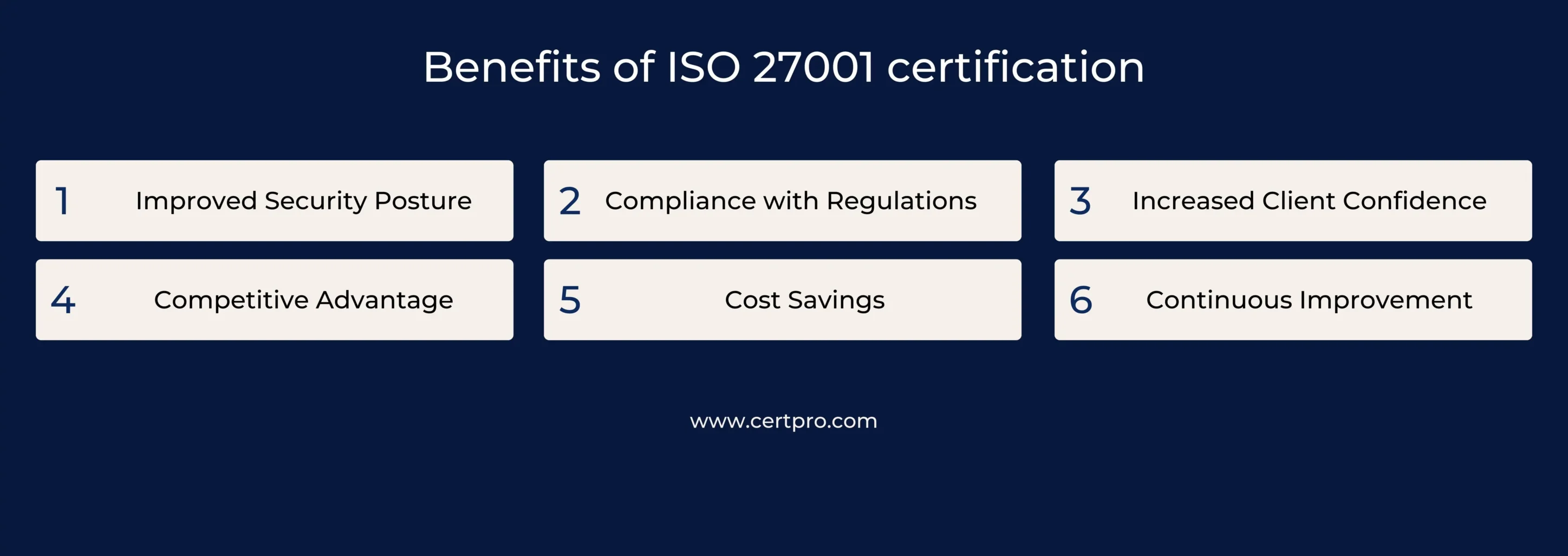
ISO 27001 Certification in South Australia provides organisations with independently verified assurance of ISMS conformance — a credential that carries weight in procurement processes, regulatory engagements, and enterprise vendor assessments. The benefits of ISO 27001 Certification are grounded in the structured discipline that the ISO 27001 certification audit process imposes on information security governance, not merely in the certificate itself.
- ✓Independent third-party verification that ISMS controls conform to ISO/IEC 27001:2022 requirements, providing assurance beyond self-declaration
- ✓Recognition in enterprise and government procurement processes, including defence supply chain, financial services vendor panels, and SA Government ICT panels
- ✓Structured evidence of information security risk management maturity, applicable to APRA CPS 234, SOCI Act, and Privacy Act 1988 compliance contexts
- ✓Globally recognised ISO 27001 Certification enabling South Australian SaaS and technology exporters to satisfy international client vendor assurance requirements
- ✓Annual surveillance audit oversight that verifies ongoing ISO 27001 compliance and identifies control degradation before it becomes a material risk
- ✓Demonstrated alignment with the Australian Cyber Security Strategy and whole-of-government information security expectations
- ✓Certification committee independence ensuring that the ISO 27001 audit outcome reflects objective evidence rather than organisational self-assessment
- ✓Defined corrective action process that requires documented resolution of nonconformities before ISO 27001 Certification is issued or maintained
ISO 27001 Certification in South Australia is increasingly specified as a mandatory or preferred requirement in enterprise and government procurement frameworks. South Australian organisations tendering for Commonwealth defence contracts, SA Government technology panels, and private sector enterprise agreements are frequently required to demonstrate third-party ISO 27001 Certification as evidence of information security governance maturity. The ISO 27001 certification audit provides the independent assessment that procurement frameworks require — distinguishing certified organisations from those relying on self-attested compliance statements. For South Australian technology companies seeking to expand into Asian, European, or North American markets, ISO 27001 Certification provides a universally recognised credential that reduces the compliance burden associated with individual client security assessments.
The surveillance audit structure embedded in ISO 27001 Certification — with annual audits between initial certification and recertification — provides procurement stakeholders with ongoing assurance that the certified organisation’s ISMS remains conformant. This is particularly relevant for South Australian organisations in long-duration contract environments, such as naval shipbuilding supply chains or multi-year government technology service agreements, where information security requirements persist over extended periods. South Australian organisations that maintain active ISO 27001 compliance demonstrate to clients and regulators that their information security governance is subject to independent oversight on a continuous basis — not merely at the point of initial certification.
The risk assessment and risk treatment framework required by ISO/IEC 27001:2022 imposes a structured discipline on information security governance that aligns with the risk management expectations of Australian regulators. For APRA-regulated South Australian financial institutions, the ISO 27001 standard’s requirements for documented risk assessment, control implementation, and management review closely mirror CPS 234 obligations. For critical infrastructure operators subject to the SOCI Act, the ISMS framework provides a documented basis for demonstrating that information security risks to critical assets have been systematically identified, assessed, and treated. ISO 27001 certification audit findings can directly inform regulatory reporting and board-level risk governance, providing independent validation of the organisation’s information security risk posture.
ISO 27001 compliance also supports organisations in mapping their information security controls to multiple legal and regulatory requirements simultaneously. A South Australian organisation subject to the Privacy Act 1988, the SOCI Act, and APRA CPS 234 can use its ISO 27001 ISMS framework to maintain a unified set of documented controls that address obligations across all three regulatory instruments. The ISO 27001 certification audit independently verifies that this unified control framework is implemented and operating effectively — providing regulators, boards, and clients with a single point of assurance rather than requiring separate assessments for each regulatory obligation. This integration of regulatory obligations within the ISMS is assessed during the certification audit as part of the Clause 4.2 interested parties and Clause 6.1 risk treatment evaluation.
- ✓Procurement Recognition and Market Access
- ✓Regulatory Alignment and Risk Management Discipline
Annex A Controls and the ISO 27001 Control Framework
Annex A of ISO/IEC 27001:2022 provides a reference set of 93 information security controls that organisations select and implement based on the outcomes of their risk assessment and risk treatment process. Annex A controls are organised into four domains: Organisational controls (37 controls), People controls (8 controls), Physical controls (14 controls), and Technological controls (34 controls). The ISO 27001 certification audit evaluates whether selected Annex A controls have been implemented and are operating effectively, and whether the SoA accurately reflects the organisation’s control selection decisions.
Organisational and People Controls
Organisational controls in Annex A address governance structures, policies, risk management processes, supplier relationships, and incident management frameworks. Key organisational controls assessed during an ISO 27001 audit include information security policies (A.5.1), information security roles and responsibilities (A.5.2), threat intelligence (A.5.7), information security in project management (A.5.8), and supplier relationship security (A.5.19–A.5.22). For South Australian organisations with complex supply chains — including defence prime contractors managing subcontractors or healthcare providers managing pathology and pharmacy suppliers — supplier security controls receive significant audit attention. The ISO 27001 certification audit evaluates whether supplier agreements contain appropriate security requirements and whether supplier performance is monitored against those requirements.
People controls in Annex A address information security awareness, training, and personnel screening obligations. These eight controls — including background verification (A.6.1), security awareness (A.6.3), and remote working (A.6.7) — are assessed during the Stage 2 ISO 27001 certification audit through examination of training completion records, personnel screening documentation, and remote access policy implementation evidence. For South Australian organisations with geographically distributed workforces — including remote mining technology operations, regional healthcare networks, or dispersed government technology teams — remote working controls and associated access management configurations receive particular scrutiny. Auditors assess whether security awareness activities are documented, regularly conducted, and proportionate to the roles and responsibilities of personnel with access to in-scope information assets.
Physical and Technological Controls
Physical controls in Annex A govern the security of facilities, equipment, and physical information assets. The 14 physical controls — covering physical security perimeters (A.7.1), physical entry controls (A.7.2), securing offices and facilities (A.7.3), and equipment maintenance (A.7.9) — are assessed during on-site Stage 2 ISO 27001 audit activities. For South Australian organisations in manufacturing, laboratory, or data centre environments, physical controls are a significant component of the certification audit. Auditors observe physical access controls, visitor management systems, clean desk implementations, and the handling of physical media. Adelaide’s Lot Fourteen precinct — which houses defence technology and AI organisations in shared-use facilities — presents specific physical security considerations around shared common areas and co-located tenancies that are evaluated in the context of the ISMS scope boundary.
Technological controls — the largest Annex A domain with 34 controls — cover user endpoint devices (A.8.1), privileged access rights (A.8.2), information access restriction (A.8.3), cryptography (A.8.24), vulnerability management (A.8.8), network security (A.8.20), and web filtering (A.8.23), among others. During the ISO 27001 audit, auditors review configuration evidence, access control matrices, patch management records, penetration testing outputs, and security monitoring logs to assess whether technological controls are implemented and operating in accordance with the organisation’s risk treatment decisions. For South Australian SaaS and cloud service providers, cloud-specific controls — including those addressing cloud service use (A.8.23) and data masking (A.8.11) — are evaluated against the organisation’s documented cloud security policies and the risk assessment outputs for cloud-hosted environments.
Internal Audit and Management Review Under ISO 27001
Clauses 9.2 and 9.3 of ISO/IEC 27001:2022 require organisations to conduct regular internal audits and management reviews of the ISMS as part of the performance evaluation cycle. These activities are mandatory requirements of the ISO 27001 standard and are assessed during the ISO 27001 certification audit as evidence that the ISMS is subject to systematic internal oversight. The outputs of internal audits and management reviews are among the most important documented information reviewed during both the Stage 1 and Stage 2 audit stages.
Internal Audit Requirements and Evidence
Clause 9.2 requires organisations to plan and conduct internal ISMS audits at planned intervals to determine whether the ISMS conforms to the organisation’s own requirements and to the requirements of ISO/IEC 27001:2022, and whether it is effectively implemented and maintained. Internal auditors must be objective and impartial, and audit results must be reported to relevant management. The internal audit programme, individual audit reports, and any corrective actions arising from internal audits are reviewed during the ISO 27001 certification audit to assess whether internal oversight is functioning effectively. For South Australian organisations, internal audit programmes should reflect the risk profile of the ISMS — with higher-risk control areas such as access management, incident response, and supplier security receiving proportionate internal audit attention.
Auditors assessing ISO 27001 compliance for South Australian organisations pay particular attention to the completeness and objectivity of internal audit evidence. Internal audit reports must demonstrate that auditors examined objective evidence — not merely accepted management assertions — and that findings were reported without bias. Corrective actions arising from internal audits must be documented, assigned to responsible owners, and tracked to completion. The ISO 27001 certification audit verifies that the corrective action process functions as a closed-loop mechanism, ensuring that internal audit findings result in demonstrable improvement to ISMS controls. Organisations that treat internal audits as a tick-box exercise — with superficial scope, limited evidence review, or unresolved corrective actions — are likely to receive nonconformity findings during the ISO 27001 audit.
Management Review and Continual Improvement
Clause 9.3 requires top management to review the ISMS at planned intervals to ensure its continuing suitability, adequacy, and effectiveness. Management review inputs specified by the standard include internal and external audit results, security incident trends, risk assessment outcomes, performance against information security objectives, and stakeholder feedback. Management review outputs must include decisions about continual improvement opportunities and any changes needed in the ISMS — including resources, policies, and control configurations. The ISO 27001 certification audit examines management review records to determine whether top management is actively engaged in ISMS oversight and whether review decisions are implemented. A management review that lacks documented inputs, produces no meaningful outputs, or is conducted without top management participation represents a nonconformity against Clause 9.3.
Continual improvement under Clause 10.2 requires organisations to improve the suitability, adequacy, and effectiveness of the ISMS on an ongoing basis. Evidence of continual improvement — such as updates to the risk assessment in response to emerging threats, enhancements to technical controls following incident analysis, or expansion of the internal audit programme — is reviewed during surveillance audits to verify that the ISMS is not static. For South Australian organisations operating in dynamic threat environments — including energy infrastructure operators, healthcare networks, and defence technology firms — the ability to demonstrate responsive, evidence-based ISMS improvement is a critical element of maintaining ISO 27001 Certification over the three-year certificate cycle.
FAQ
▶
What is ISO 27001 Certification in South Australia?
▶
Who conducts the ISO 27001 certification audit in South Australia?
▶
Which South Australian organisations need ISO 27001 Certification?
▶
How long does the ISO 27001 certification audit process take?
▶
What is the difference between Stage 1 and Stage 2 ISO 27001 audits?
▶
How long is an ISO 27001 certificate valid?
▶
What is the Statement of Applicability and why is it important?
▶
Does ISO 27001 Certification satisfy APRA CPS 234 requirements?
Get In Touch
have a question? let us get back to you.