
ISO 27001 Certification in St. Louis
ISO 27001 compliance in St. Louis is pursued by many organizations within the context of a broader regulatory and contractual information security environment that includes Missouri state law, federal sector-specific regulations, and enterprise contractual requirements. Understanding the relationship between ISO 27001 certification and applicable regulatory frameworks is important for organizations evaluating the role of ISMS certification in their overall information security governance programs.
OUR CLIENTS










ISO 27001 Certification in St. Louis for Financial, Technology, and Healthcare Organizations
ISO 27001 Certification in St. Louis is issued by CertPro CPA LLC, a Licensed CPA Firm operating as an independent third-party certification body. CertPro conducts structured, evidence-based ISO 27001 certification audits for organizations across the Greater St. Louis metropolitan area — including Clayton, Chesterfield, Creve Coeur, St. Charles, and the broader Missouri business corridor. Each audit evaluates whether an organization’s Information Security Management System (ISMS) conforms to the requirements of ISO/IEC 27001:2022. CertPro issues certification decisions based solely on audit findings and does not provide consulting, implementation, or remediation services — preserving the impartiality required of a credible third-party ISO 27001 certification body.
St. Louis hosts a broad and growing ecosystem of financial institutions, SaaS providers, health technology companies, biotechnology and life sciences organizations, logistics and supply-chain businesses, manufacturing and industrial technology companies, cybersecurity firms, e-commerce businesses, cloud service providers, and AI-driven enterprises. Many of these organizations operate under enterprise vendor security requirements, sector-specific regulatory expectations, and third-party risk management frameworks that reference ISO/IEC 27001:2022 as a recognized information security standard. ISO 27001 Certification in St. Louis has become increasingly relevant for organizations seeking to demonstrate independently verified information security controls to customers, regulators, and procurement teams across the financial, healthcare, technology, and government contracting sectors.
ISO/IEC 27001:2022 is the current edition of the international standard for Information Security Management Systems. The 2022 update restructured Annex A controls from 114 controls across 14 categories — as defined in the 2013 version — to 93 controls organized across four domains: Organizational, People, Physical, and Technological. The standard also introduced 11 new controls and merged or revised existing ones to reflect the current information security landscape, including cloud security, threat intelligence, and data masking. Organizations that received ISMS certification under ISO/IEC 27001:2013 were required to transition to the 2022 standard by October 31, 2025, as established by international accreditation bodies. CertPro conducts all ISO 27001 certification audits against ISO/IEC 27001:2022 requirements.
The scope of ISO 27001 Certification in St. Louis is defined by the organization and reflects the boundaries of the Information Security Management System subject to audit. This scope may encompass a specific business unit, product line, data environment, geographic location, or the entire organization. The certification scope is documented, reviewed during the Stage 1 audit, and confirmed as part of certification issuance. Organizations operating in regulated Missouri industries — including financial services, healthcare, and state-contract businesses — often define their ISMS scope to align with the systems, processes, and data environments subject to applicable regulatory and contractual requirements. The Missouri Data Breach Notification Law and sector-specific obligations may inform how organizations structure their ISMS scope, though ISO 27001 certification does not automatically establish compliance with Missouri or U.S. statutory requirements.
CertPro’s ISO 27001 certification audit methodology follows a structured sequence of defined stages — from initial application and audit program determination through Stage 1 and Stage 2 audits, nonconformity review, certification committee decision, surveillance audit cycles, and recertification. Each stage produces documented audit findings based on objective evidence. CertPro does not provide pre-audit consulting, readiness assessments, or implementation services. The certification decision is made by an independent certification committee based on the documented audit record. This structure maintains the integrity and impartiality required for recognized third-party ISMS certification and positions the CertPro audit report as a credible, independently issued artifact — suitable for use in enterprise vendor reviews, regulatory inquiries, and procurement processes across the St. Louis business community.

What Is ISO 27001 Certification?
ISO 27001 Certification is a formal attestation issued by an independent third-party certification body confirming that an organization’s Information Security Management System conforms to the requirements of ISO/IEC 27001:2022. The certification is based on a structured audit of the ISMS against the standard’s management system clauses (Clauses 4 through 10) and its Annex A security controls. ISO 27001 certification is internationally recognized and is used by organizations to demonstrate independently verified information security governance to customers, regulators, business partners, and enterprise procurement teams. Certification is valid for three years, subject to annual surveillance audits, and requires recertification at the end of each three-year cycle.
ISO/IEC 27001:2022 Standard Requirements
ISO/IEC 27001:2022 requires organizations to establish, implement, maintain, and continually improve an Information Security Management System. The standard is organized around ten management system clauses. Clauses 4 through 10 contain the mandatory requirements: understanding the organization and its context (Clause 4), leadership and commitment (Clause 5), planning including risk assessment and risk treatment (Clause 6), support including documentation and competence (Clause 7), operational planning and control (Clause 8), performance evaluation including internal audit and management review (Clause 9), and improvement including nonconformity and corrective action (Clause 10). Annex A contains 93 information security controls organized across four domains — Organizational, People, Physical, and Technological — from which organizations select applicable controls documented in the Statement of Applicability.
The Statement of Applicability (SoA) is a central ISMS document that identifies which Annex A controls are applicable, which are excluded, and the justification for each decision. It also references the risk treatment plan and demonstrates the linkage between identified information security risks and the controls selected to address them. During the ISO 27001 certification audit, auditors review the Statement of Applicability to verify that control selection aligns with risk assessment outcomes and that all applicable controls are implemented and operating as documented. Key mandatory ISMS documents also include the information security policy, risk assessment methodology, risk treatment plan, internal audit records, and management review records — all of which are subject to examination during both Stage 1 and Stage 2 audits.
ISMS Certification and the Role of Annex A Controls
ISMS certification under ISO/IEC 27001:2022 requires organizations to demonstrate that Annex A controls are not only selected and documented but also implemented and operating effectively within the defined ISMS scope. The four Annex A control domains each address distinct areas of information security governance. Organizational controls (A.5) cover policies, roles, responsibilities, and information classification. People controls (A.6) address personnel security, awareness, and acceptable use. Physical controls (A.7) cover physical access, equipment security, and environmental protections. Technological controls (A.8) address access management, cryptography, network security, secure development, and threat intelligence — including 11 controls introduced in the 2022 revision such as cloud service security, data masking, and web filtering. During the ISO 27001 audit, auditors assess whether each applicable control is implemented in a manner consistent with the organization’s documented risk treatment decisions.
| Annex A Domain | Control Count | Key Focus Areas |
|---|---|---|
| Organizational Controls | 37 | Policies, roles, asset management, supplier security, incident management |
| People Controls | 8 | Screening, terms of employment, security awareness, remote working |
| Physical Controls | 14 | Physical access controls, equipment security, clear desk and screen policy |
| Technological Controls | 34 | Access control, cryptography, network security, secure development, cloud security |
ISO 27001 Certification Audit Process in St. Louis
The ISO 27001 certification audit process for organizations in St. Louis follows a defined sequence of stages conducted by CertPro as an independent third-party certification body. Each stage is structured to produce documented audit findings based on objective evidence, with no advisory or consulting activities incorporated at any point. The process begins with an application review and audit program determination, then proceeds through Stage 1 and Stage 2 audits, nonconformity review, a certification committee decision, and ongoing surveillance. This structured methodology ensures that the resulting ISMS certification reflects an evidence-based, independently verified assessment of conformance to ISO/IEC 27001:2022.
The Stage 1 audit is a documentation-focused review in which the auditor examines the organization’s ISMS documentation against the requirements of ISO/IEC 27001:2022. The Stage 1 audit evaluates whether the defined ISMS scope is appropriate, whether the information security policy and objectives are established and documented, whether the risk assessment methodology is defined and applied, whether the risk treatment plan and Statement of Applicability are complete, and whether internal audit and management review processes have been conducted. The Stage 1 audit identifies areas where the documented ISMS may not satisfy the standard’s requirements and determines whether the organization is ready to proceed to the Stage 2 audit. All Stage 1 findings are recorded and communicated to the organization before scheduling the Stage 2 audit.
The Stage 2 audit is an on-site or remote evidence-based assessment of whether the ISMS is implemented and operating effectively as documented. During the Stage 2 ISO 27001 audit, auditors examine objective evidence — including system configurations, access control records, training logs, incident records, internal audit reports, management review minutes, and vendor management documentation — to verify that controls are functioning in accordance with the Statement of Applicability and risk treatment plan. The Stage 2 audit also evaluates conformance with all mandatory Clauses 4 through 10 requirements. Any nonconformities identified are documented, classified, and communicated to the organization for response before the certification committee proceeds to a certification decision.
ISO 27001 certification is valid for a three-year period from the date of issuance, subject to satisfactory annual surveillance audits. Surveillance audits are conducted in Years 1 and 2 of the certification cycle and evaluate ongoing conformance with selected clauses and controls, the status of previously identified nonconformities, and whether the ISMS continues to function within the defined scope. At the end of the three-year cycle, a recertification audit — similar in scope to the original Stage 2 audit — is conducted to renew the certification. Failure to maintain conformance during the surveillance period, or failure to complete the recertification audit, may result in suspension or withdrawal of the ISO 27001 certification. CertPro manages this lifecycle through a structured audit program documented at the outset of the certification relationship.
| Audit Stage | Key Activities | Output |
|---|---|---|
| Application Review | Scope confirmation, audit program determination, conflict of interest check | Signed audit agreement and audit plan |
| Stage 1 Audit | ISMS documentation review, scope validation, readiness assessment | Stage 1 findings report |
| Stage 2 Audit | Evidence-based control testing, Clauses 4–10 conformance assessment | Nonconformity report and audit findings |
| Nonconformity Review | Organization response to findings, corrective action evidence review | Nonconformity closure determination |
| Certification Decision | Independent committee review of full audit record | ISO 27001 certificate issuance |
| Surveillance Audit | Annual ongoing conformance review (Years 1 and 2) | Surveillance audit report |
| Recertification Audit | Full ISMS reassessment at end of three-year cycle | Renewed ISO 27001 certificate |
- ✓Stage 1 Audit: Documentation and Readiness Review
- ✓Stage 2 Audit: Implementation and Effectiveness Assessment
- ✓Surveillance Audits and Recertification
Why St. Louis Organizations Pursue ISO 27001 Certification
Organizations across the Greater St. Louis metropolitan area pursue ISO 27001 Certification in St. Louis in response to enterprise vendor security requirements, sector-specific regulatory expectations, and third-party risk management frameworks that recognize ISO/IEC 27001:2022 as a baseline information security standard. The drivers for ISO 27001 compliance in St. Louis reflect the city’s diverse industrial base and its concentration of organizations operating in regulated, data-intensive sectors — where independently verified information security governance is both a procurement prerequisite and an operational requirement.
Financial Services and Fintech Organizations in St. Louis
St. Louis is home to a significant concentration of financial institutions, insurance companies, and fintech organizations — including firms headquartered in Clayton and Chesterfield — that operate under enterprise vendor due diligence programs requiring independently verified information security controls. Banks, credit unions, investment management firms, insurance carriers, and payment processors in the St. Louis area increasingly reference ISO 27001 certification as a component of third-party vendor assessments and information security questionnaire responses. SaaS providers serving St. Louis financial institutions, as well as fintech companies seeking to expand relationships with regulated financial entities, commonly pursue ISO 27001 Certification in St. Louis to demonstrate that their information security management systems have been independently assessed against an internationally recognized standard.
ISO 27001 compliance that St. Louis financial services organizations seek often aligns with obligations under the Gramm-Leach-Bliley Act (GLBA), the FTC Safeguards Rule, and state banking regulatory expectations. While ISO 27001 certification does not automatically satisfy these statutory requirements, the structured risk assessment, documented controls, and management review processes required by the standard create a traceable audit record. This record helps financial institutions and their technology vendors demonstrate information security governance to examiners and procurement teams. CertPro’s ISO 27001 certification audit for St. Louis financial technology companies evaluates ISMS conformance against ISO/IEC 27001:2022 requirements and produces a certification artifact suitable for use in regulatory inquiries and vendor assurance documentation packages.
Healthcare, Health Technology, and Life Sciences Organizations
ISO 27001 compliance that St. Louis healthcare and life sciences organizations pursue reflects the sector’s dual exposure to HIPAA Security Rule requirements and enterprise health system vendor security programs. St. Louis is a significant center for healthcare delivery, health technology development, biotechnology, and academic medical research — with major health systems, academic medical centers, health IT vendors, and pharmaceutical and biotech firms operating across the metropolitan area. Health technology companies and digital health SaaS providers serving St. Louis health systems frequently encounter vendor security assessment requirements that reference ISO 27001 as a recognized framework for evaluating information security management systems. ISO 27001 Certification in St. Louis provides an independently issued audit artifact that healthcare technology vendors can present in response to hospital and health system vendor risk questionnaires.
Technology, Cloud, Logistics, and Manufacturing Organizations
ISO 27001 certification that St. Louis technology companies pursue spans cloud service providers, cybersecurity firms, AI-driven enterprises, e-commerce businesses, SaaS providers, and data hosting organizations operating throughout the region. Technology corridor firms in Creve Coeur, Chesterfield, and the broader Missouri innovation ecosystem often encounter ISO 27001 requirements from enterprise customers, international business partners, and government procurement programs. Logistics, supply-chain, and manufacturing organizations — a significant sector in the St. Louis and St. Charles areas — increasingly face vendor security requirements that reference ISO 27001 as part of supplier information security risk management programs. Industrial technology companies handling proprietary design data, supply-chain systems, and connected manufacturing environments pursue ISO 27001 Certification in St. Louis to demonstrate structured information security governance across their operational and IT environments.
ISO 27001 Certification Requirements for St. Louis Organizations
Achieving ISO 27001 Certification in St. Louis requires an organization to establish, implement, maintain, and continually improve an Information Security Management System that conforms to all mandatory requirements of ISO/IEC 27001:2022. The ISO 27001 certification audit evaluates both the management system structure (Clauses 4–10) and the implementation and effectiveness of applicable Annex A controls as documented in the Statement of Applicability. The following sections describe the primary documentation, risk management, and control requirements subject to assessment during the ISO 27001 certification audit.
ISO/IEC 27001:2022 specifies mandatory documented information that must be maintained and retained as part of the ISMS. The core documentation set subject to audit includes the information security policy, the defined ISMS scope, the risk assessment methodology and results, the risk treatment plan, the Statement of Applicability, information security objectives, internal audit program and results, management review records, and records of nonconformities and corrective actions. Additional documented information may be required to demonstrate the operation of specific Annex A controls — for example, access control policies, asset inventories, incident response records, supplier agreements, and business continuity plans. During the ISO 27001 audit, auditors verify that documented information is current, controlled, accessible to relevant personnel, and accurately reflects the actual state of the implemented ISMS.
ISO/IEC 27001:2022 Clause 6.1 requires organizations to establish and apply a systematic information security risk assessment process. The risk assessment must define criteria for evaluating risk acceptability, identify information security risks associated with the loss of confidentiality, integrity, and availability of information within the ISMS scope, and assess the likelihood and consequence of each identified risk. The risk treatment plan documents how the organization addresses risks that exceed the defined acceptance threshold — identifying selected Annex A controls and other measures to reduce risk to an acceptable level. The risk assessment and risk treatment plan must be reviewed and updated at planned intervals and whenever significant changes occur within the ISMS scope. These documents form a central part of both Stage 1 and Stage 2 ISO 27001 audit reviews, as auditors trace the link between risk findings and control selection through the Statement of Applicability.
ISO/IEC 27001:2022 Clause 9.2 requires organizations to conduct internal audits of the ISMS at planned intervals to evaluate conformance with the standard’s requirements and effective implementation of the management system. Internal audits must be planned, conducted by competent auditors who are independent of the area being audited, documented, and their results reported to relevant management. Clause 9.3 requires management review of the ISMS at planned intervals — evaluating information security performance measurements, audit results, nonconformities, risk assessment outcomes, and opportunities for improvement. Records of management reviews must be retained and are examined by CertPro auditors during the ISO 27001 certification audit as evidence that top management is actively engaged in ISMS governance, as mandated by the standard’s leadership clauses.
- ✓Defined and documented ISMS scope aligned with organizational context
- ✓Information security policy approved by top management and communicated to personnel
- ✓Completed risk assessment identifying confidentiality, integrity, and availability risks
- ✓Risk treatment plan with selected Annex A controls and documented justifications
- ✓Statement of Applicability identifying applicable and excluded controls
- ✓Internal audit program with documented results and corrective action records
- ✓Management review records demonstrating top management ISMS oversight
- ✓Evidence of implemented and operating Annex A controls within the ISMS scope
- ✓Documentation Requirements
- ✓Risk Assessment and Risk Treatment Requirements
- ✓Internal Audit and Management Review Requirements
Benefits of ISO 27001 Certification for St. Louis-Based Organizations
ISO 27001 Certification in St. Louis provides organizations with an independently issued attestation of ISMS conformance that carries recognition in enterprise procurement processes, regulatory inquiries, and third-party vendor assurance programs. The certification artifact produced by a structured ISO 27001 certification audit is distinct from a self-assessment or internal audit report — it reflects an independent third-party evaluation of both the design and operating effectiveness of the information security management system. The following sections describe the primary benefits of ISO 27001 certification for organizations operating in the St. Louis metropolitan area and the broader Missouri business ecosystem.
The primary function of ISO 27001 certification is the independent, third-party verification that an organization’s ISMS and its associated information security controls conform to the requirements of ISO/IEC 27001:2022. This verification is fundamentally different from self-declared compliance or internal program reviews. The ISO 27001 certification audit produces a documented audit record — including Stage 1 and Stage 2 findings, nonconformity reports, corrective action closures, and the certification committee’s decision rationale — that can be presented to enterprise customers, financial institution procurement teams, health system vendor management programs, government contracting offices, and regulatory bodies. For St. Louis organizations competing for enterprise contracts in financial services, healthcare, and technology sectors, the ISO 27001 certificate represents a credible, auditable credential backed by independent assessment.
Enterprise organizations in financial services, healthcare, government, and technology routinely require technology vendors, SaaS providers, and data processors to demonstrate information security certifications as part of vendor onboarding and annual vendor risk review processes. ISO 27001 certification is specifically referenced in many enterprise vendor security questionnaires and third-party risk management frameworks — including those used by St. Louis financial institutions, Missouri state government contracting programs, and multinational corporations with regional operations. For St. Louis SaaS providers, cloud service providers, managed security service providers, and data-intensive technology companies, ISO 27001 compliance that enterprise customers require is frequently a prerequisite for vendor approval — making ISMS certification an operational enabler, not merely a compliance credential.
ISO 27001 certification requires organizations to implement a structured, documented risk management process — including periodic risk assessments, risk treatment decisions, and control monitoring — that supports the continual improvement of information security posture over time. The surveillance audit cycle embedded in the three-year certification lifecycle creates regular, scheduled touchpoints at which the ISMS is independently reviewed for ongoing conformance. This structure enables organizations to identify control gaps, address emerging threats, and update risk treatment decisions in a documented, auditable manner. For St. Louis organizations in rapidly evolving sectors such as AI, cloud computing, and health technology, the structured improvement cycle embedded in ISMS certification provides a governance mechanism that adapts to changing information security risks as the organization’s technology environment evolves.
- ✓Independently issued ISO 27001 certificate suitable for enterprise vendor assurance programs
- ✓Documented audit record supporting regulatory inquiries and procurement due diligence
- ✓Recognition in ISO 27001 audit reviews conducted by St. Louis financial institutions and health systems
- ✓Structured ISMS governance framework aligned with ISO/IEC 27001:2022 requirements
- ✓Annual surveillance audit cycle maintaining ongoing third-party oversight of the ISMS
- ✓Documented risk assessment and risk treatment record traceable to Annex A control selection
- ✓Alignment with an internationally recognized information security management standard
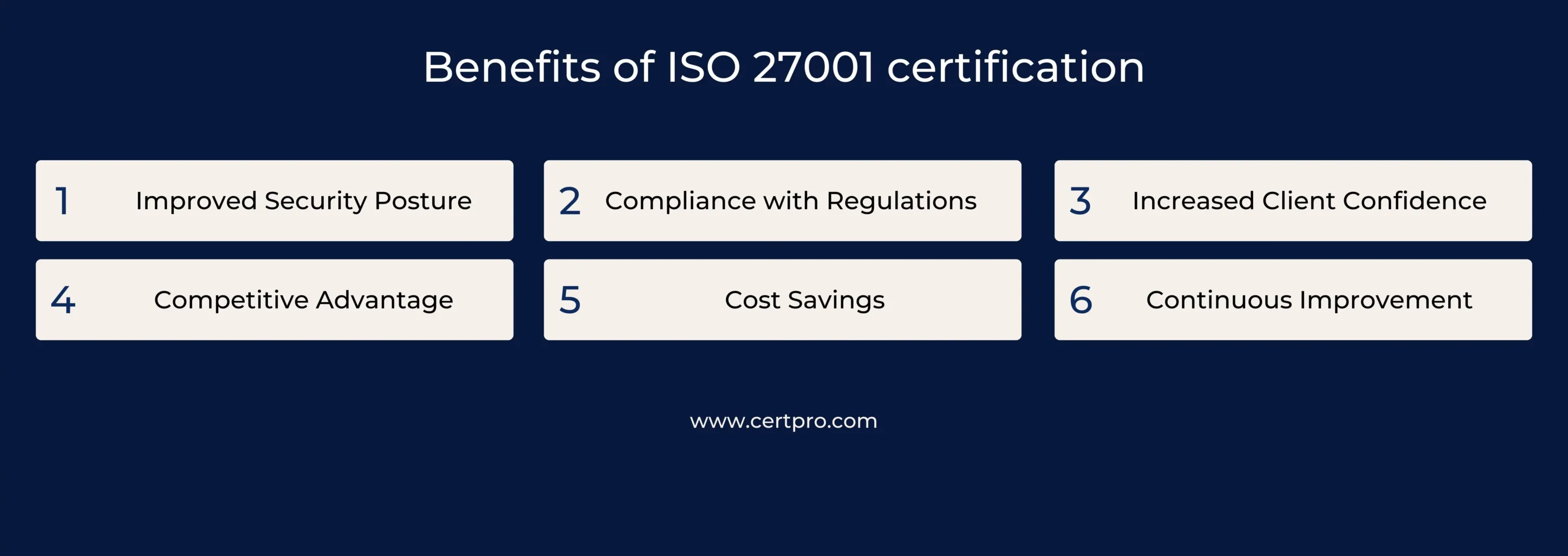
- ✓Independent Verification of Information Security Controls
- ✓Recognition in Enterprise Vendor and Procurement Programs
- ✓Structured Risk Management and Continual Improvement
ISO 27001 Compliance and the Missouri Regulatory Context
ISO 27001 compliance in St. Louis is pursued by many organizations within the context of a broader regulatory and contractual information security environment that includes Missouri state law, federal sector-specific regulations, and enterprise contractual requirements. Understanding the relationship between ISO 27001 certification and applicable regulatory frameworks is important for organizations evaluating the role of ISMS certification in their overall information security governance programs.
Missouri Data Breach Notification Law and Information Security Governance
Missouri’s Data Breach Notification Law (RSMo § 407.1500) requires businesses that own or license personal information of Missouri residents to notify affected individuals and the Missouri Attorney General following a qualifying security breach. The law establishes a notification requirement but does not mandate a specific information security management framework. ISO 27001 certification does not automatically establish compliance with Missouri’s breach notification law or any other Missouri or U.S. statutory requirement. However, the structured risk assessment, incident management controls, and documented information security policies required by ISO/IEC 27001:2022 — particularly Annex A controls addressing incident response and security event management — may support an organization’s ability to detect, assess, and respond to security incidents in a documented, timely manner consistent with the law’s expectations.
Federal Regulatory Frameworks and ISO 27001 Alignment
Organizations operating in St. Louis under federal regulatory frameworks — including HIPAA for healthcare data, GLBA and the FTC Safeguards Rule for financial information, CMMC for defense contractors, and FedRAMP for cloud services sold to federal agencies — may find that the ISMS structure required by ISO 27001 creates documented alignment with certain regulatory control expectations. ISO 27001 certification does not substitute for, or automatically satisfy, compliance with HIPAA, GLBA, CMMC, or other federal regulatory requirements. The standard addresses information security risk management broadly, and its Annex A controls map to concepts found in many regulatory frameworks. Organizations pursuing ISO 27001 certification alongside regulatory compliance programs should treat the ISMS certification as an independently issued artifact demonstrating structured information security governance — not as a substitute for regulatory-specific compliance determinations made by qualified legal or regulatory counsel.
CertPro as an Independent ISO 27001 Certification Body in St. Louis
CertPro CPA LLC is a Licensed CPA Firm that operates exclusively as an independent third-party certification body for ISO 27001 certification audits. CertPro does not provide consulting, implementation, control design, policy development, or remediation services — maintaining the structural impartiality required of a certification body conducting ISO 27001 certification audits. All certification decisions are made by an independent certification committee based on the documented audit record produced by the assigned audit team. This clear separation of audit and consulting functions ensures that CertPro’s ISO 27001 audit findings for St. Louis organizations are based solely on objective evidence and are not influenced by advisory relationships with the organization under audit.
Audit Methodology and Independence
CertPro’s ISO 27001 audit methodology is structured around evidence-based assessment of conformance with ISO/IEC 27001:2022 requirements. Auditors review documentation, interview personnel, observe processes, and test the implementation of controls using objective evidence — including system-generated records, configuration outputs, access logs, training records, vendor contracts, and management review minutes. Nonconformities identified during the ISO 27001 audit are classified, documented, and communicated to the organization. The organization must provide evidence of corrective action before the certification committee proceeds to a certification decision. CertPro does not provide guidance on how to remediate nonconformities, as that activity falls within the scope of consulting services that a certification body must not perform. The audit record, findings, and certification decision are documented in accordance with the audit program established at the outset of each engagement.
Certification Scope, Suspension, and Withdrawal
The ISO 27001 certificate issued by CertPro identifies the certified organization, the defined ISMS scope, the standard against which conformance was assessed (ISO/IEC 27001:2022), and the validity period of the certification. The certificate is subject to ongoing maintenance through satisfactory surveillance audits in Years 1 and 2 of the three-year cycle. If an organization fails to demonstrate continued conformance during a surveillance audit, or if significant control failures are identified, the certification may be placed under suspension pending corrective action. Certification may be withdrawn if conformance cannot be restored within the suspension period. These conditions are documented in the certification agreement and reflect the standard requirements for maintaining an active ISMS certification. Organizations seeking ISO 27001 Certification in St. Louis should review the certification scope, maintenance requirements, and conditions for suspension with CertPro prior to application.
FAQ
▶
What is ISO 27001 Certification in St. Louis?
▶
Which organizations in St. Louis typically pursue ISO 27001 certification?
▶
What is the difference between Stage 1 and Stage 2 of the ISO 27001 audit?
▶
How long is ISO 27001 certification valid?
▶
Does ISO 27001 certification satisfy HIPAA or Missouri data security law requirements?
▶
What is the Statement of Applicability in ISO 27001?
▶
Does CertPro provide ISO 27001 consulting or implementation services?
▶
What areas in the Greater St. Louis region does CertPro serve for ISO 27001 audits?
Get In Touch
have a question? let us get back to you.