
ISO 27001 Certification in Victoria
CertPro is a Licensed CPA Firm providing independent ISO 27001 Certification in Victoria to organizations across financial services, technology, healthcare, education, government, and related sectors. As an independent third-party certification body, CertPro evaluates conformity with ISO/IEC 27001:2022 through a structured ISO 27001 certification audit process — distinct from any advisory, consulting, or implementation role. The certification decision is based solely on objective evidence gathered during the audit, free from commercial bias or conflict of interest.
OUR CLIENTS










Independent ISO 27001 Certification by a Licensed CPA Firm in Victoria
CertPro is a Licensed CPA Firm providing independent ISO 27001 Certification in Victoria to organizations across financial services, technology, healthcare, education, government, and related sectors. As an independent third-party certification body, CertPro evaluates conformity with ISO/IEC 27001:2022 through a structured ISO 27001 certification audit process — distinct from any advisory, consulting, or implementation role. The certification decision is based solely on objective evidence gathered during the audit, free from commercial bias or conflict of interest.
Victoria is Australia’s recognized hub for financial services, fintech, software development, artificial intelligence, biomedical research, advanced manufacturing, and professional services. Melbourne, as the state’s capital, hosts headquarters and major operational facilities for banking institutions, insurance companies, superannuation funds, SaaS providers, cloud service providers, health technology companies, logistics firms, and government-facing technology vendors. Organizations across these sectors increasingly face enterprise procurement requirements, regulatory expectations, and contractual obligations that require demonstrable information security governance — making ISO 27001 Certification in Victoria a recognized and often mandated credential for doing business.
The ISO 27001 standard — formally designated ISO/IEC 27001:2022 — specifies requirements for establishing, implementing, maintaining, and continually improving an Information Security Management System (ISMS). An ISMS is a systematic framework through which an organization identifies information security risks, selects appropriate controls, documents its risk treatment decisions, and demonstrates ongoing conformity through internal audits and management review. The organization is solely responsible for operating its ISMS. CertPro’s role is to independently evaluate whether that ISMS conforms to all mandatory requirements of the ISO 27001 standard.
Victoria’s regulatory environment adds important context to information security obligations. The Privacy Act 1988 and the Australian Privacy Principles (APPs) impose obligations on organizations handling personal information. Breaches must be assessed and potentially reported under the Notifiable Data Breaches (NDB) scheme administered by the Office of the Australian Information Commissioner (OAIC). Victoria’s public sector organizations are also subject to the Privacy and Data Protection Act 2014 (Vic). The Australian Government’s Essential Eight cybersecurity strategies and the Attorney-General’s Department cybersecurity frameworks provide additional reference points for organizations pursuing ISO 27001 compliance as part of a broader security posture. ISO 27001 Certification in Victoria provides documented, independently verified evidence that an organization’s ISMS addresses these regulatory dimensions through a structured, risk-based control framework.
The transition to ISO/IEC 27001:2022 — which supersedes the 2013 edition — introduced a revised Annex A control set organized into four domains: Organizational controls, People controls, Physical controls, and Technological controls. Organizations certified under the 2013 edition were required to transition to the 2022 standard, with certification bodies setting October 31, 2025 as the transition deadline. CertPro conducts all ISO 27001 certification audits against the current ISO/IEC 27001:2022 standard, evaluating conformity with both the management system clauses (Clauses 4 through 10) and the Annex A controls referenced in the organization’s Statement of Applicability (SoA). The SoA is a mandatory document that identifies which Annex A controls the organization has determined are applicable, which have been excluded, and the justification for those decisions.

What Is ISO 27001 Certification?
ISO 27001 certification is the formal process by which an accredited or licensed third-party certification body evaluates whether an organization’s Information Security Management System conforms to the requirements of the ISO 27001 standard and issues a certificate of conformity when that evaluation is satisfied. Certification is not a self-declaration. It requires an independent ISO 27001 audit conducted by qualified auditors who assess documented information, interview personnel, observe processes, and test controls against objective criteria defined in the standard. For Victoria-based organizations, ISO 27001 certification provides independently verified evidence that information security risks are identified, assessed, and managed through a documented and auditable framework.
The ISO/IEC 27001:2022 Standard and Its Structure
The ISO 27001 standard is structured around a high-level management system framework consistent with other ISO management system standards. Clauses 4 through 10 define the mandatory ISMS requirements: understanding the organization and its context (Clause 4), leadership and commitment (Clause 5), planning including risk assessment and treatment (Clause 6), support including documented information and competence (Clause 7), operational controls (Clause 8), performance evaluation including internal audit and management review (Clause 9), and improvement including nonconformity and corrective action (Clause 10). Annex A provides a reference set of 93 controls organized across four domains — Organizational (37 controls), People (8 controls), Physical (14 controls), and Technological (34 controls). These controls are not all mandatory. The organization selects applicable controls based on its risk assessment and documents those decisions in the Statement of Applicability.
Information Security Management System (ISMS) Requirements
An ISMS under ISO/IEC 27001:2022 requires the organization to define its scope, establish an information security policy, conduct a formal risk assessment, produce a risk treatment plan, and maintain a Statement of Applicability. The scope defines the boundaries and applicability of the ISMS — including locations, processes, assets, and technologies covered. The risk assessment process must identify information assets and associated risks, evaluate the likelihood and impact of potential security events, and determine which controls are required to bring risks to an acceptable level. The risk treatment plan documents how selected controls address identified risks. During an ISO 27001 certification audit, auditors evaluate whether these documents exist, are complete, reflect actual operations, and are supported by objective evidence of implementation and effectiveness.
Who Requires ISO 27001 Certification in Victoria
ISO 27001 Certification in Victoria is pursued by organizations that handle sensitive information and face formal certification requirements from enterprise customers, government procurement bodies, or regulated industry frameworks. Financial institutions and fintech companies in Melbourne seek certification to satisfy due diligence requirements from major banking counterparties and institutional investors. Cloud service providers and SaaS companies pursue ISO 27001 certification as a condition of enterprise sales — particularly when selling to healthcare systems, government agencies, or financial services organizations. Healthcare and life sciences companies handling patient data use ISO 27001 certification to demonstrate structured information security governance. Government-facing technology vendors frequently encounter ISO 27001 certification requirements in Victorian and Commonwealth government procurement processes. Research institutions and universities handling research data increasingly pursue certification to satisfy grant conditions and data-sharing agreements.
ISO 27001 Certification Audit Process for Organizations in Victoria
The ISO 27001 certification audit process conducted by CertPro for Victoria-based organizations follows a structured, multi-stage methodology aligned with ISO/IEC 17021-1 conformity assessment requirements. Each stage produces documented outputs and is conducted by qualified ISO 27001 auditors with relevant sector knowledge. The process evaluates conformity with all mandatory requirements of ISO/IEC 27001:2022, encompassing both the management system clauses and the Annex A controls referenced in the organization’s Statement of Applicability. Stages are sequenced so that documentation is reviewed before on-site or virtual evidence assessment, and all identified nonconformities are addressed before a certification decision is made.
| Audit Stage | Key Activities | Output |
|---|---|---|
| Application Review | Scope confirmation, ISMS boundary definition, audit program determination | Audit plan and scope agreement |
| Stage 1 Audit | Review of ISMS documentation, risk assessment, SoA, policies, and management system readiness | Stage 1 findings report; identification of areas requiring attention before Stage 2 |
| Stage 2 Audit | On-site or virtual evidence assessment, control testing, personnel interviews, process observation | Audit report with conformity determination and any nonconformities raised |
| Nonconformity Review | Review of corrective action evidence submitted by the organization in response to nonconformities | Closure confirmation or escalation decision |
| Certification Decision | Independent review by certification committee; issuance of ISO 27001 certificate if conformity is demonstrated | ISO 27001 certificate (3-year validity) with surveillance conditions |
The Stage 1 audit reviews the organization’s ISMS documentation to determine whether the management system is sufficiently developed and implemented to proceed to Stage 2 evidence assessment. Auditors examine the ISMS scope document, information security policy, risk assessment methodology and outputs, risk treatment plan, Statement of Applicability, internal audit program and results, and management review records. The Stage 1 audit identifies significant gaps in documented information or management system implementation that would prevent a meaningful Stage 2 assessment. For Victoria-based organizations, the Stage 1 ISO 27001 audit may be conducted remotely or at the organization’s premises, depending on scope and operational complexity. The output is a Stage 1 findings report that communicates the auditor’s assessment and any areas the organization must address before Stage 2 proceeds.
The Stage 2 audit constitutes the primary ISO 27001 certification audit, during which auditors collect and evaluate objective evidence of control implementation and operational effectiveness across the defined ISMS scope. Auditors review documented information, conduct structured interviews with personnel in relevant roles, observe operational processes and technical environments, and test the design and operating effectiveness of controls referenced in the Statement of Applicability. For organizations in Victoria operating cloud-based platforms, distributed IT environments, or sector-specific technologies — such as health information systems, financial trading platforms, or AI-based services — the Stage 2 audit is scoped to reflect those operational characteristics. Nonconformities identified during Stage 2 are classified and formally reported. The organization must provide documented corrective action evidence before a positive certification decision can be made.
ISO 27001 certification is issued for a three-year period, subject to annual surveillance audits that verify the ISMS continues to conform to ISO/IEC 27001:2022 requirements and that information security controls remain effective. Surveillance audits are conducted at least once per calendar year during the certification cycle. They focus on areas identified as higher risk during prior audits, changes in scope or organizational context, and the effectiveness of the internal audit and management review processes. At the conclusion of the three-year certification cycle, a recertification audit re-evaluates the full scope of the ISMS against the ISO 27001 standard. If the organization has made material changes — such as expanding its ISMS scope, adopting new technologies, or entering new markets — those changes are reflected in the recertification audit program.
- ✓Stage 1 Audit: Documentation and Readiness Review
- ✓Stage 2 Audit: Evidence Assessment and Control Evaluation
- ✓Surveillance Audits and Recertification
ISO 27001 Requirements and Evaluation Criteria
ISO 27001 compliance requires that an organization satisfy all mandatory requirements defined in ISO/IEC 27001:2022 Clauses 4 through 10 and implement the Annex A controls determined to be applicable through its risk assessment. During the ISO 27001 certification audit, auditors evaluate conformity against each clause of the standard using objective evidence — including documented information, interview responses, observation outputs, and technical records. Conformity is assessed at the level of each clause requirement. Any finding of nonconformity against a mandatory requirement must be addressed through documented corrective action before the certification decision is finalized.
ISO/IEC 27001:2022 specifies categories of documented information the organization must maintain as evidence of ISMS conformity. These mandatory documents are evaluated during the ISO 27001 audit as primary evidence of management system implementation. Core mandatory documents include the ISMS scope, information security policy, information security risk assessment process and results, risk treatment plan, Statement of Applicability, information security objectives, internal audit program and reports, management review records, and documented corrective actions. Organizations operating in Victoria’s regulated sectors — including financial services, healthcare, and government technology — typically maintain additional documented information to address sector-specific regulatory requirements. Auditors assess whether those additional controls are accurately reflected in the Statement of Applicability and risk treatment plan.
The Statement of Applicability (SoA) is a central document in ISO 27001 compliance that identifies all 93 Annex A controls, specifies which are applicable to the organization, documents the justification for inclusion or exclusion of each control, and records the implementation status of applicable controls. During the ISO 27001 certification audit, auditors cross-reference the SoA against the risk assessment outputs to verify that control selection is risk-justified rather than arbitrary. Key Annex A control domains evaluated during an ISO 27001 certification audit include access management, cryptography, supplier relationships, incident management, business continuity, network security, and threat intelligence. Organizations in Victoria operating cloud infrastructure, handling payment card data, processing health information, or delivering AI-based services will have sector-specific Annex A controls evaluated in detail — including controls related to cloud service use, data classification, and secure development practices.
ISO/IEC 27001:2022 Clause 9 requires organizations to conduct internal audits at planned intervals to evaluate whether the ISMS conforms to the organization’s own requirements and to the ISO 27001 standard’s requirements, and to determine whether the ISMS is effectively implemented and maintained. Internal audit results must be documented and reported to relevant management. The management review — also required under Clause 9 — evaluates the continuing suitability, adequacy, and effectiveness of the ISMS based on inputs including audit results, nonconformity and corrective action status, security incident data, and changes in external and internal context. During the ISO 27001 certification audit, CertPro auditors evaluate the internal audit program, individual audit reports, and management review records as primary evidence that the organization’s ISMS operates as a continual improvement system — not merely a point-in-time compliance exercise.
- ✓Mandatory Documentation Requirements
- ✓Annex A Controls and the Statement of Applicability
- ✓Internal Audit and Management Review Requirements
Why Organizations in Victoria Pursue ISO 27001 Certification
Victoria-based organizations pursue ISO 27001 certification in response to a combination of enterprise procurement requirements, sector-specific regulatory expectations, contractual obligations, and risk management objectives. Demand for ISO 27001 Certification in Victoria has grown significantly as enterprise customers — particularly in financial services, healthcare, and government — formalize vendor security review processes and require independent evidence of information security controls before onboarding technology suppliers, cloud service providers, and professional services firms.
Enterprise Vendor Security Reviews and Procurement Requirements
Major Australian banks, insurance companies, superannuation funds, and government agencies operating in Victoria routinely require technology vendors, SaaS providers, and cloud service suppliers to hold ISO 27001 certification as a condition of vendor approval. In Melbourne’s financial services ecosystem, the concentration of banking headquarters, wealth management firms, and payment technology companies creates strong downstream demand for ISO 27001 Certification in Victoria among technology suppliers at every tier of the supply chain. A SaaS company providing software to a major bank, for example, will typically encounter a formal vendor security questionnaire requiring ISO 27001 certification as the accepted standard for demonstrating ISMS conformity. Holding an ISO 27001 certification provides the independently verified evidence required to pass these procurement assessments — without repeated ad hoc security questionnaire responses.
Regulatory Alignment and Privacy Act Obligations
ISO 27001 compliance supports alignment with the Privacy Act 1988 and the Australian Privacy Principles by providing a structured framework through which organizations identify personal information assets, assess privacy-related risks, implement protective controls, and maintain documented evidence of those controls. The Notifiable Data Breaches scheme requires organizations covered by the Privacy Act to assess and report eligible data breaches to the OAIC and affected individuals — creating direct accountability for information security governance. An ISMS certified under ISO/IEC 27001:2022 provides documented evidence that the organization has a structured process for identifying, containing, assessing, and responding to information security incidents, directly supporting the organization’s ability to meet NDB scheme obligations. Victoria’s health sector organizations are additionally subject to the My Health Records Act 2012 and Victorian health privacy obligations, which align with ISO 27001’s controls for access management, audit logging, and data protection.
International Expansion and Cross-Border Data Requirements
Victoria-based technology companies pursuing international markets — particularly in the European Union, United Kingdom, United States, and Southeast Asia — encounter ISO 27001 certification requirements as part of cross-border enterprise sales and regulatory compliance frameworks. ISO 27001 is recognized internationally as the leading information security management standard, and certification issued by a credible third-party body provides globally recognized evidence of ISMS conformity. For Victorian fintech companies entering EU markets, ISO 27001 certification supports alignment with the General Data Protection Regulation (GDPR) by demonstrating that personal data is protected through a documented, audited control framework — though ISO 27001 certification alone does not constitute GDPR compliance. Victorian SaaS companies contracting with US healthcare organizations or federal agencies may also encounter SOC 2 and ISO 27001 requirements simultaneously; holding ISO 27001 certification strengthens the vendor’s position in those procurement assessments.
Victoria Industry Sectors Seeking ISO 27001 Certification
ISO 27001 Certification in Victoria is pursued across a broad range of industry sectors reflecting the state’s diverse economic base. Melbourne’s role as Australia’s financial and professional services capital — combined with Victoria’s strong technology, healthcare, research, and manufacturing sectors — creates certification demand across organizations of varying size and operational complexity. The following sectors represent the primary sources of ISO 27001 certification demand among Victoria-based organizations.
Financial Services, Fintech, and Insurance
ISO 27001 certification demand from Victoria’s financial services sector encompasses banks, credit unions, insurance companies, wealth management firms, superannuation fund administrators, payment technology providers, and fintech companies operating from Melbourne and across the state. The Australian Prudential Regulation Authority (APRA) Prudential Standard CPS 234 (Information Security) imposes specific information security requirements on APRA-regulated entities, and ISO 27001 certification provides a recognized framework for demonstrating structured information security governance consistent with CPS 234 expectations. ISO 27001 compliance for Victorian fintech organizations — including buy now pay later providers, digital lending platforms, cryptocurrency exchanges, and open banking technology vendors — supports institutional investor due diligence requirements and enterprise customer procurement assessments. The ISMS structure required by ISO/IEC 27001:2022, including formalized risk assessment, access control, cryptographic controls, and supplier security management, directly addresses the information security risks inherent in financial data processing environments.
Healthcare, Life Sciences, and Biotechnology
Victoria’s healthcare and life sciences sector is one of Australia’s most significant, anchored by major hospital networks, medical research institutes, biotechnology companies, pharmaceutical manufacturers, and digital health technology developers operating across Melbourne and regional Victoria. Healthcare organizations handling patient health records, clinical trial data, genomic information, and medical device data face heightened information security obligations under federal and Victorian privacy legislation. ISO 27001 certification provides a structured, independently audited framework for demonstrating that information security controls are in place and operating effectively. Digital health technology companies developing telehealth platforms, clinical decision support tools, electronic medical records systems, and AI-assisted diagnostic tools use ISO 27001 certification as evidence of information security governance when contracting with public health networks and private hospital groups. Biotechnology and pharmaceutical companies managing clinical research data and intellectual property pursue ISO 27001 certification to satisfy research partner and regulatory body expectations.
Technology, SaaS, AI, and Cloud Service Providers
Melbourne and Victoria’s broader technology ecosystem encompasses established software companies, high-growth SaaS businesses, artificial intelligence developers, cloud infrastructure providers, cybersecurity firms, and data analytics organizations. ISO 27001 Certification in Victoria is a frequently sought credential among technology companies entering enterprise sales cycles, government procurement frameworks, or international markets. SaaS companies providing enterprise software to regulated industries must demonstrate that their platforms and underlying infrastructure are protected by a certified ISMS. AI companies handling large-scale data sets, training data, and model outputs face increasing scrutiny from enterprise customers regarding data governance and information security — and ISO 27001 certification provides independently verified evidence of a structured approach to managing those risks. Cloud service providers hosting regulated workloads for healthcare, financial services, or government customers frequently encounter ISO 27001 certification requirements as a baseline vendor qualification criterion.
Government Technology, Education, and Research
Victorian and Commonwealth government agencies increasingly require technology vendors and managed service providers to hold ISO 27001 certification as a condition of participation in government procurement panels and ICT supply arrangements. The Victorian Government’s Digital Strategy and associated ICT procurement frameworks reference information security standards, and ISO 27001 certification is recognized as evidence of structured ISMS governance in government vendor assessments. Research institutions, universities, and academic medical centers in Victoria handling research data, intellectual property, and grant-funded project information pursue ISO 27001 certification to satisfy conditions imposed by government research funding bodies, international research partners, and commercial research sponsors. Education technology companies providing learning management systems, student information systems, and assessment platforms to Victorian schools and universities also encounter ISO 27001 certification requirements in departmental procurement assessments.
Benefits of ISO 27001 Certification for Victoria-Based Organizations
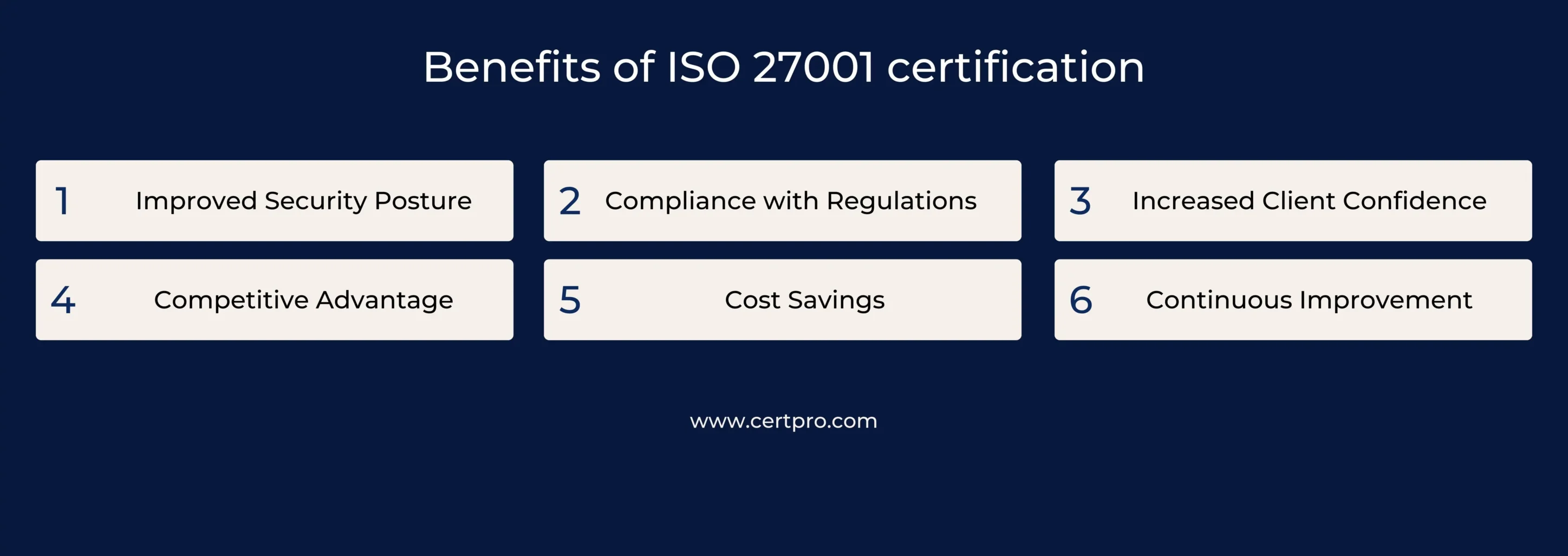
ISO 27001 Certification in Victoria provides organizations with independently verified evidence of ISMS conformity that supports enterprise procurement qualification, regulatory alignment, and structured information security governance. The benefits of ISO 27001 certification are realized across operational, commercial, and risk management dimensions — and extend beyond initial certification to the ongoing surveillance audit cycle that verifies continued conformity. The following benefits are characteristic of organizations that have achieved ISO 27001 certification through an independent certification audit process.
- ✓Independent third-party verification of ISMS conformity with ISO/IEC 27001:2022, recognized by enterprise customers, government procurement bodies, and regulated industry partners across Victoria and internationally
- ✓Structured evidence of information security risk assessment, risk treatment, and control implementation — directly relevant to Privacy Act 1988 obligations, APRA CPS 234 expectations, and Victorian health privacy requirements
- ✓Recognized credential in enterprise vendor security reviews, replacing repeated ad hoc security questionnaire responses with a single independently audited ISO 27001 certification
- ✓Demonstrated conformity with Annex A controls across Organizational, People, Physical, and Technological domains — covering access management, incident response, supplier security, cryptography, and network security
- ✓Annual surveillance audit cycle providing ongoing independent assurance that ISMS controls remain effective as the organization’s technology environment and risk landscape evolve
- ✓Support for international market entry, particularly in EU, UK, and US markets where ISO 27001 certification is a recognized vendor qualification standard
- ✓Documented corrective action framework through which identified nonconformities are addressed and closed, supporting continual ISMS improvement aligned with ISO 27001 compliance requirements
- ✓Credible basis for demonstrating information security governance to boards, senior management, regulators, and institutional counterparties
The ISO 27001 certification audit evaluates not only whether controls are documented but whether they are implemented and operating effectively in practice. This distinction is important: many organizations document information security policies and controls without demonstrating that those controls are consistently applied across the ISMS scope. During the Stage 2 audit, CertPro auditors assess control operating effectiveness through personnel interviews, process observation, and review of operational evidence such as access logs, change management records, incident reports, and supplier assessment outputs. For Victoria-based organizations operating complex technology environments — including multi-cloud architectures, distributed development teams, or third-party-managed infrastructure — the operating effectiveness assessment provides meaningful independent validation that controls function as intended across the full scope of the ISMS.
ISO 27001 certification is recognized across Victoria’s financial services, healthcare, and government procurement ecosystems as the standard independent credential for demonstrating ISMS conformity. Major Victorian financial institutions — including the four major banks’ Melbourne operations, leading superannuation fund managers, and insurance groups — include ISO 27001 certification requirements in their third-party risk management frameworks and vendor onboarding questionnaires. Technology vendors that hold ISO 27001 certification issued by a credible independent certification body can provide prospective enterprise customers with the certificate and audit scope documentation in lieu of completing lengthy security questionnaires for each procurement engagement. This recognition accelerates vendor qualification processes and reduces the administrative burden of repeated security assessments for technology companies managing multiple enterprise customer relationships simultaneously.
- ✓Verification of Control Design and Operating Effectiveness
- ✓Recognition in Financial Sector Procurement and Regulated Industry Supply Chains
ISO 27001 Certification Scope and Independent Decision Framework
The scope of ISO 27001 Certification in Victoria is defined by the organization’s ISMS scope document, which specifies the boundaries within which the ISMS operates and is assessed during the certification audit. Scope definition is a critical step in the certification process, as it determines which organizational units, locations, processes, information assets, and technologies are included in the certified ISMS. An ISO 27001 certification audit evaluates conformity only within the defined scope. Activities, systems, or locations excluded from the ISMS scope are not covered by the resulting certificate.
Defining ISMS Scope for Victoria-Based Organizations
Victoria-based organizations defining their ISMS scope must account for the full range of information assets, systems, people, processes, and physical environments that handle information within the defined boundary. For a Melbourne-headquartered SaaS company, the scope might include the software development environment, cloud hosting infrastructure, customer support operations, and corporate IT systems. For a financial services organization, the scope might encompass trading systems, client data platforms, and the IT operations team. ISO/IEC 27001:2022 Clause 4.3 requires the organization to determine scope by considering internal and external issues identified under Clause 4.1 and the requirements of interested parties identified under Clause 4.2. During the ISO 27001 audit, auditors assess whether the defined scope is appropriate, whether scope boundaries are clearly documented, and whether the ISMS adequately addresses the information security risks present within that scope.
Independent Certification Committee and Certification Decision
The ISO 27001 certification decision is made by CertPro’s independent certification committee, which reviews the complete audit file — including the Stage 1 findings report, Stage 2 audit report, nonconformity records, and corrective action evidence — and determines whether the organization’s ISMS conforms to all mandatory requirements of ISO/IEC 27001:2022. The certification committee is independent of the audit team that conducted the fieldwork, ensuring the certification decision is objective and free from commercial influence. If the committee determines that conformity has been demonstrated and all nonconformities have been addressed, an ISO 27001 certificate is issued specifying the organization’s name, the standard edition, the ISMS scope, and the certification validity period. The certificate remains valid for three years, subject to continued conformity demonstrated through annual surveillance audits.
Suspension, Withdrawal, and Certificate Maintenance
ISO 27001 certification may be suspended or withdrawn if the organization fails to maintain the conditions under which the certificate was issued. Conditions for suspension include failure to conduct the annual surveillance audit within the required timeframe, failure to address major nonconformities identified during a surveillance audit, significant changes to the ISMS scope or organizational context that have not been communicated to the certification body, or evidence that the ISMS has ceased to operate effectively. Withdrawal of certification occurs when suspension conditions are not resolved within a defined timeframe, or when the organization voluntarily surrenders the certificate. For Victoria-based organizations, maintaining ISO 27001 certification requires active ISMS operation — including ongoing internal audits, management reviews, corrective action processes, and annual surveillance audit participation — throughout the three-year certification cycle.
ISO 27001 Standard: Clauses 4–10 and Annex A Control Domains
A thorough understanding of the ISO 27001 standard’s structure is essential for interpreting what the ISO 27001 certification audit evaluates. ISO/IEC 27001:2022 is organized into mandatory management system clauses and a normative Annex A that provides a reference set of information security controls. The management system clauses define how the ISMS must be structured, governed, and maintained. The Annex A controls define the security measures from which the organization selects applicable controls based on its risk assessment. Together, these elements form the complete framework assessed during the ISO 27001 audit.
Management System Clauses: Requirements and Audit Evaluation
Clauses 4 through 10 of ISO/IEC 27001:2022 define the requirements that every certified organization must satisfy, regardless of sector, size, or geography. Clause 4 (Context of the Organization) requires identification of internal and external issues affecting information security and the needs of interested parties. Clause 5 (Leadership) requires top management commitment, an information security policy, and defined roles and responsibilities. Clause 6 (Planning) requires formalized risk assessment and risk treatment, including production of the Statement of Applicability. Clause 7 (Support) addresses resource management, competence, awareness, communication, and documented information. Clause 8 (Operation) covers operational planning, execution of the risk assessment process, and implementation of risk treatment plans. Clause 9 (Performance Evaluation) requires internal audits and management reviews. Clause 10 (Improvement) requires a process for identifying and addressing nonconformities and driving continual improvement. Each clause is evaluated during the ISO 27001 audit using objective evidence gathered from documented information and operational assessment.
Annex A Control Domains: Organizational, People, Physical, and Technological
The 93 Annex A controls in ISO/IEC 27001:2022 are organized into four domains that cover the full spectrum of information security management activities. Organizational controls (37 controls) address information security policies, roles and responsibilities, threat intelligence, supplier relationships, information classification, and incident management. People controls (8 controls) cover pre-employment screening, terms of employment, information security awareness and training, and disciplinary processes. Physical controls (14 controls) address physical security perimeters, entry controls, equipment security, clear desk and screen policies, and physical media handling. Technological controls (34 controls) cover access control, authentication, cryptography, network security, vulnerability management, secure development, data masking, web filtering, and audit logging. During the ISO 27001 certification audit, auditors evaluate controls from all four domains that are identified as applicable in the organization’s Statement of Applicability, assessing both design adequacy and operational effectiveness.
ISO 27001 Certification Body in Victoria: CertPro’s Independent Role
CertPro operates as an ISO 27001 certification body in Victoria, providing independent third-party conformity assessment services to organizations seeking ISO 27001 certification across financial services, technology, healthcare, government, and related sectors. As a Licensed CPA Firm conducting ISO 27001 certification audits, CertPro maintains strict independence from advisory, consulting, and implementation activities — ensuring that the certification process is objective and the certification decision is based solely on audit evidence. CertPro’s auditors hold relevant qualifications and sector-specific knowledge applicable to Victoria’s diverse industry landscape, making ISO 27001 Certification in Victoria assessments thorough and contextually informed.
Qualified Auditors and Sector-Specific Knowledge
ISO 27001 certification audits require auditors with demonstrated competence in information security management systems, audit methodology, and the technical and operational characteristics of the sectors being audited. CertPro’s ISO 27001 auditors conducting certification audits for Victoria-based organizations bring relevant sector knowledge applicable to financial services technology environments, healthcare information systems, cloud-based SaaS architectures, AI platform operations, and government ICT environments. Sector-specific competence is particularly relevant to the Stage 2 ISO 27001 audit, where auditors must interpret control evidence in the context of the organization’s specific operational environment — assessing, for example, whether a financial technology company’s access controls are appropriate for its transaction processing environment, or whether a cloud service provider’s cryptographic controls adequately protect customer data across its service tiers.
Independence and Objectivity in the Certification Process
The independence of the ISO 27001 certification body from the organization being audited is a fundamental requirement of the ISO/IEC 17021-1 conformity assessment standard. CertPro does not provide advisory services, implementation support, policy development, risk assessment consulting, or ISMS design services to organizations for which it conducts ISO 27001 certification audits. This strict separation ensures that the certification decision reflects an objective evaluation of the organization’s ISMS against the requirements of the ISO 27001 standard — not a validation of work performed by the same organization. For Victoria-based organizations engaging CertPro for ISO 27001 certification, this independence provides confidence that the resulting certificate accurately represents independent third-party verification of ISMS conformity, rather than a commercially motivated endorsement.
FAQ
▶
What is ISO 27001 certification and why is it relevant for Victoria-based organizations?
▶
Which version of the ISO 27001 standard is currently in effect?
▶
How long does an ISO 27001 certification audit take for a Victoria-based organization?
▶
What is the Statement of Applicability and why is it important in the ISO 27001 audit?
▶
Does ISO 27001 certification in Victoria satisfy Australian privacy law obligations?
▶
What is the difference between Stage 1 and Stage 2 of the ISO 27001 certification audit?
▶
How frequently must surveillance audits be conducted after ISO 27001 certification is issued?
▶
Which Victoria industries most commonly require ISO 27001 certification from their vendors?
Get In Touch
have a question? let us get back to you.