
ISO 27001 Certification in Vienna
ISO 27001 certification for Vienna companies is pursued by banking institutions, fintech operators, SaaS providers, cloud service providers, life sciences firms, managed service providers, IT services organizations, and regional headquarters managing Central and Eastern European operations. Organizations in regulated sectors — including financial services and life sciences — and technology companies serving enterprise customers with security certification requirements are the primary applicants for ISO 27001 Certification in Vienna.
OUR CLIENTS










ISO 27001 Certification for Vienna-Based Financial and Technology Organizations
ISO 27001 Certification in Vienna is conducted by a Licensed CPA Firm operating as an independent certification body, issuing certification decisions exclusively on the basis of audit evidence reviewed against the requirements of ISO/IEC 27001:2022. Vienna functions as a primary financial and technology hub for Central and Eastern Europe, hosting a concentrated ecosystem of banking institutions, fintech operators, life sciences firms, enterprise software providers, SaaS companies, cloud service providers, and regional headquarters managing sensitive information assets across multiple jurisdictions.
The ISO 27001 certification body does not perform consulting, implementation, or remediation services. All certification decisions are made independently by a certification committee following completion of the audit program — ensuring that every ISO 27001 attestation issued in Vienna reflects objective, evidence-based findings free from conflict of interest.
Vienna’s Role as a Regional Information Security Hub
Vienna occupies a strategically significant position as a gateway between Western Europe and Central and Eastern European markets. The city hosts the headquarters of major Austrian banking institutions — including Raiffeisen Bank International, Erste Group, and UniCredit Bank Austria — along with a growing concentration of international financial services firms, insurance groups, and asset management organizations.
These institutions manage extensive portfolios of customer financial data, personal information, and cross-border payment records, all of which fall within the scope of ISO/IEC 27001:2022 certification. Vienna’s status as a United Nations headquarters city and home to numerous international organizations further intensifies demand for independently verified information security credentials.
Organizations operating in Vienna increasingly face vendor due diligence requirements from international counterparts that mandate ISO 27001 Certification in Vienna as a baseline condition of contract award — particularly in financial services procurement, cloud infrastructure selection, and enterprise software evaluation processes.
Technology and Life Sciences Ecosystem in Vienna
Vienna’s technology sector encompasses enterprise software developers, managed service providers, SaaS platforms, and cloud infrastructure operators. The Vienna Biocenter and associated life sciences cluster host biotechnology companies, pharmaceutical research organizations, and clinical data management firms that process sensitive health information subject to stringent data protection obligations under the EU General Data Protection Regulation.
ISO 27001 Certification in Vienna is particularly relevant for life sciences organizations managing electronic health records, clinical trial data, and research intellectual property. The Austrian Federal Act on the Protection of Personal Data — amended to align with GDPR — establishes enforceable data protection obligations that ISO 27001 compliance frameworks directly address through documented risk assessment, control selection, and operational monitoring.
For technology companies serving regulated industries, including health information systems, financial software vendors, and cloud service providers hosting regulated workloads, ISO 27001 certification provides independent verification of the control environment required by enterprise procurement standards.
Independent Certification Body Positioning
ISO 27001 Certification in Vienna is issued by a Licensed CPA Firm functioning exclusively as an independent third-party certification body. The firm evaluates each organization’s Information Security Management System against the documented requirements of ISO/IEC 27001:2022 — including Clauses 4 through 10 covering context, leadership, planning, support, operation, performance evaluation, and improvement — as well as the Annex A control domains covering Organizational, People, Physical, and Technological controls.
The certification body operates under a strict separation of functions: audit teams evaluate evidence, and the certification committee issues independent decisions. No individual who has provided consulting, implementation, or advisory services to a client organization may serve on the audit or certification committee for that organization.
This independence framework preserves the integrity of the ISO 27001 attestation and ensures that certified organizations can present their certification to customers, regulators, and international counterparts with full confidence in its objectivity and evidentiary basis.

What Is ISO 27001 Certification?
ISO 27001 Certification is a formal third-party attestation confirming that an organization’s Information Security Management System conforms to the requirements specified in the ISO/IEC 27001 international standard. Published jointly by the International Organization for Standardization and the International Electrotechnical Commission, ISO/IEC 27001 establishes a systematic framework for identifying information security risks, selecting and implementing controls to treat those risks, and maintaining ongoing oversight of the control environment through structured management review and internal audit processes.
ISO 27001 certification is not a self-declaration. It requires independent examination by a licensed certification body that evaluates documented evidence of ISMS design, implementation, and operational effectiveness before issuing a formal certification decision. This distinction — between self-assessed ISO 27001 compliance and independently verified ISO 27001 certification — is increasingly material to enterprise customers, regulators, and procurement teams evaluating vendor security credentials.
ISO/IEC 27001:2022 Standard Structure
ISO/IEC 27001:2022 superseded the 2013 edition and introduced significant structural changes to the Annex A control set. The 2022 update reduced the number of controls from 114 to 93, reorganized across four domains: Organizational controls (37 controls), People controls (8 controls), Physical controls (14 controls), and Technological controls (34 controls).
The standard also introduced 11 new controls addressing areas including threat intelligence, information security for cloud services, ICT readiness for business continuity, physical security monitoring, configuration management, and data masking. Organizations holding ISO 27001 certification under the 2013 standard were required to transition to the 2022 edition by October 31, 2025, as mandated by the International Accreditation Forum.
For organizations pursuing ISO 27001 Certification in Vienna for the first time, all audits are conducted exclusively against the ISO/IEC 27001:2022 requirements from the point of application.
ISMS Documentation Requirements
The Information Security Management System evaluated during an ISO 27001 examination must be supported by a defined set of documented information. Core ISMS documentation required by the standard includes the information security policy, the scope statement defining organizational boundaries and interfaces, the information security risk assessment methodology and results, the risk treatment plan specifying how identified risks are addressed through selected controls, and the Statement of Applicability documenting all Annex A controls, their applicability status, and justification for inclusion or exclusion.
Additional documented information requirements arise from specific clauses of the standard — including records of management review, competence evidence for personnel with information security responsibilities, results of internal audits, and records of nonconformity and corrective action. During the ISO 27001 audit, auditors systematically verify the existence, completeness, and operational currency of all required documented information as a foundational component of the certification examination.
ISO 27001 Certification Audit Process for Organizations in Vienna
The ISO 27001 audit process for organizations in Vienna follows a structured multi-stage methodology that evaluates both the design adequacy and operational effectiveness of the Information Security Management System against ISO/IEC 27001:2022 requirements. The audit program is determined following review of the organization’s application, including the defined ISMS scope, the number of employees within scope, the complexity of the information processing environment, and the number of physical locations or cloud environments included.
Each stage of the ISO 27001 audit Vienna process generates documented findings that are reviewed by the independent certification committee prior to issuing a final certification decision. The process is designed to provide Vienna-based organizations with a rigorous, evidence-based ISO 27001 examination that meets internationally recognized certification standards.
| Audit Stage | Key Activities | Output |
|---|---|---|
| Application Review | Scope verification, audit program determination, conflict of interest check | Audit plan confirmation |
| Stage 1 Audit | ISMS documentation review, scope boundary evaluation, readiness determination | Stage 1 findings report |
| Stage 2 Audit | Control effectiveness testing, evidence sampling, personnel interviews, nonconformity identification | Stage 2 audit report |
| Nonconformity Review | Review of corrective action evidence submitted for identified nonconformities | Closure confirmation |
| Certification Decision | Independent committee review of audit evidence and findings; ISO 27001 certification issued or deferred | ISO 27001 Certificate |
The Stage 1 ISO 27001 audit focuses on evaluating the organization’s documented ISMS against the requirements of ISO/IEC 27001:2022. Auditors review the information security policy, ISMS scope statement, risk assessment results, risk treatment plan, Statement of Applicability, and management system records to determine whether the documented system is sufficiently developed to proceed to operational testing.
During the Stage 1 audit, auditors also assess the organization’s understanding of its internal and external context as required by Clause 4, confirm that leadership responsibilities are documented as required by Clause 5, and verify that information security objectives are established and measurable. The Stage 1 ISO 27001 audit for Vienna-based organizations may be conducted on-site at the organization’s principal office or through structured remote review sessions, depending on the complexity and geographic distribution of the ISMS scope.
Stage 1 findings — including any areas of concern that must be addressed before Stage 2 — are documented in a formal Stage 1 report provided to the organization prior to scheduling the Stage 2 audit.
The Stage 2 ISO 27001 audit evaluates whether the controls documented in the Statement of Applicability are implemented and operating effectively across the defined ISMS scope. Auditors collect and assess evidence through document inspection, configuration review, system walkthroughs, and structured interviews with personnel holding information security responsibilities.
Evidence sampling covers controls across all four Annex A domains — Organizational, People, Physical, and Technological — as well as management system requirements under Clauses 4 through 10. For Vienna-based financial services organizations, Stage 2 audit evidence commonly includes access control logs, encryption configuration records, incident response records, supplier agreement documentation, vulnerability management records, and business continuity test results.
Where auditors identify gaps between documented controls and observed operational practice, nonconformities are formally raised, classified, and documented. The organization must submit objective evidence of corrective action prior to the certification committee’s review and issuance of the ISO 27001 certification decision.
ISO 27001 certification is valid for a three-year certification cycle, subject to successful completion of annual surveillance audits during the first and second years following initial certification. Surveillance audits verify that the ISMS continues to conform to ISO/IEC 27001:2022 requirements and that the organization has maintained operational effectiveness of its selected controls.
Surveillance audits are narrower in scope than the initial Stage 2 audit. They typically focus on areas identified as higher risk during initial certification, changes to the ISMS scope or organizational context since the prior audit, management review records, internal audit results, and corrective action status.
At the end of the three-year cycle, a recertification audit — equivalent in scope to the original Stage 1 and Stage 2 program — is required to renew the ISO 27001 attestation for a further three-year period. Failure to complete surveillance audits within required intervals results in suspension or withdrawal of ISO 27001 certification.
- ✓Stage 1 Audit: Documentation and Scope Review
- ✓Stage 2 Audit: Operational Effectiveness Testing
- ✓Surveillance Audits and Certificate Maintenance
Why Organizations in Vienna Pursue ISO 27001 Certification
ISO 27001 certification for Vienna companies is pursued for a range of regulatory, commercial, and operational reasons that reflect the city’s position as a Central European financial and technology center. Demand for independently verified information security credentials has intensified as enterprise procurement processes, financial sector vendor reviews, and international client due diligence requirements increasingly mandate ISO 27001 compliance as a baseline condition of engagement.
Vienna-based organizations operating across multiple European jurisdictions face compound security obligations arising from GDPR, the EU Network and Information Security Directive (NIS2), and sector-specific regulations applicable to financial services and critical infrastructure operators. ISO 27001 Certification in Vienna provides a structured, internationally recognized framework for demonstrating conformity with these overlapping obligations through a single, independently verified certification program.
Financial Sector and Fintech Procurement Requirements
ISO 27001 certification Vienna financial services organizations pursue reflects the specific procurement expectations of Austria’s banking and insurance sector. Major financial institutions operating from Vienna — including regional headquarters of international banking groups — incorporate ISO 27001 certification as a standard requirement in technology vendor agreements, cloud service provider contracts, and outsourcing arrangements.
A Vienna-based fintech company seeking to serve as a payment processing vendor to a regulated bank, for example, would typically be required to hold a current ISO 27001 certificate as a prerequisite for vendor approval. ISO 27001 compliance demonstrated through independent certification provides banks with objective evidence that the fintech’s ISMS controls meet recognized international standards — reducing the bank’s own third-party risk exposure and satisfying the European Banking Authority’s outsourcing guidelines.
The Austrian Financial Market Authority also references internationally recognized security standards in its supervisory expectations for financial technology firms operating under Austrian licensing, making ISO 27001 Certification in Vienna a commercially and regulatorily significant credential for fintech operators.
Technology Companies and SaaS Providers
ISO 27001 certification Vienna technology companies pursue is driven by the requirements of enterprise customers in regulated industries, international SaaS expansion, and competitive differentiation in cloud service procurement. For SaaS providers headquartered in Vienna and serving customers across the European Union, ISO 27001 certification provides independently verified documentation of the security controls governing customer data processing — a material requirement in enterprise software evaluation processes.
Cloud service providers hosting regulated workloads — including financial data, health information, or personally identifiable information subject to GDPR — are evaluated by prospective customers against published security certifications as a core component of vendor security reviews. ISO 27001 certification is frequently cited in Request for Proposal responses, security questionnaires, and data processing agreement negotiations as primary evidence of information security control maturity.
The ISO 27001 attestation also supports GDPR Article 32 compliance by demonstrating that appropriate technical and organizational security measures have been independently assessed through a structured ISO 27001 examination — providing SaaS providers with a defensible, audit-backed security credential.
Life Sciences, Biotech, and International Organizations
Vienna’s life sciences cluster, anchored by the Vienna Biocenter and associated research institutions, generates significant volumes of sensitive clinical and research data requiring structured information security governance. Biotechnology firms, clinical research organizations, and pharmaceutical companies operating from Vienna engage with international regulatory agencies, research partners, and contract manufacturing organizations that require independently certified information security controls as a condition of data sharing and collaborative research agreements.
International organizations headquartered in Vienna — including United Nations agencies, OPEC, and the International Atomic Energy Agency — also generate demand for certified information security management from their vendors, contractors, and technology service providers. ISO 27001 Certification in Vienna for life sciences organizations focuses particularly on controls governing research data integrity, access restriction to proprietary scientific information, and incident response procedures relevant to sensitive health and biological data environments.
ISO 27001 Certification Scope and ISMS Evaluation Framework
The scope of ISO 27001 Certification in Vienna defines the boundaries of the Information Security Management System subject to audit and certification. Scope determination is a foundational activity completed prior to the audit program and must accurately reflect the information assets, business processes, organizational units, physical locations, and technology environments included within the certified ISMS.
The certification body evaluates the adequacy of the defined scope as part of the Stage 1 audit — assessing whether scope boundaries are clearly documented, whether interfaces with out-of-scope elements are identified and controlled, and whether the scope statement accurately represents the organization’s information processing activities. A well-defined scope is essential to producing an ISO 27001 attestation that is credible, defensible, and useful in enterprise procurement and regulatory contexts.
Risk Assessment and Statement of Applicability
The ISO 27001 examination of the risk assessment process evaluates whether the organization has established and applied a consistent methodology that identifies information security risks, assesses the likelihood and impact of those risks, and determines risk treatment decisions based on documented risk acceptance criteria. Auditors review the risk register, risk treatment decisions, and the linkage between identified risks and selected Annex A controls documented in the Statement of Applicability.
The Statement of Applicability is a critical ISMS document that must identify all 93 Annex A controls, state whether each control is applicable or excluded, provide justification for each exclusion, and confirm the implementation status of each applicable control. During the ISO 27001 audit, auditors verify that controls listed as implemented in the Statement of Applicability are supported by objective evidence of operational effectiveness — not merely documented as policies without demonstrated operational practice.
Annex A Control Domain Evaluation
ISO/IEC 27001:2022 Annex A organizes 93 reference controls across four domains that auditors systematically evaluate during the Stage 2 ISO 27001 audit. The Organizational controls domain (Controls 5.1 through 5.37) covers policies, roles, responsibilities, supplier relationships, incident management, business continuity, and legal compliance. The People controls domain (Controls 6.1 through 6.8) addresses personnel screening, terms of employment, information security awareness, and disciplinary processes.
The Physical controls domain (Controls 7.1 through 7.14) governs physical security perimeters, access controls, equipment protection, and clear desk and screen practices. The Technological controls domain (Controls 8.1 through 8.34) encompasses user endpoint security, privileged access management, cryptography, network segmentation, malware protection, vulnerability management, and logging and monitoring.
For organizations operating complex technology environments — including Vienna-based cloud service providers and financial technology firms — the Technological controls domain typically requires the most extensive audit sampling and evidence collection during the ISO 27001 examination.
Nonconformity Classification and Certification Committee Decision
Following completion of the Stage 2 audit, the lead auditor prepares a formal audit report documenting all findings, including any nonconformities identified against ISO/IEC 27001:2022 requirements. Nonconformities are reported with reference to the specific standard clause or Annex A control that the observed evidence fails to satisfy.
The organization must submit a corrective action plan and objective evidence of corrective action implementation before the certification committee conducts its review. The certification committee — operating independently of the audit team — reviews the complete audit record, the auditor’s recommendation, and the corrective action evidence before issuing the ISO 27001 certification decision.
Where corrective action evidence is assessed as insufficient, the committee may request additional evidence or defer the certification decision. ISO 27001 certification is issued only where the committee is satisfied that the ISMS conforms to ISO/IEC 27001:2022 requirements based on the totality of audit evidence reviewed.
ISO 27001 Certification Requirements for Vienna Organizations
ISO 27001 compliance for Vienna-based organizations requires demonstrating conformity with the full requirements of ISO/IEC 27001:2022 across both the management system clauses (Clauses 4 through 10) and the Annex A controls selected through the risk treatment process. The standard applies to organizations of any size and sector; however, the depth and complexity of the ISMS required to achieve certification will vary based on the scope of information processing activities, personnel within scope, the nature of information assets processed, and the regulatory environment in which the organization operates.
Organizations pursuing ISO 27001 Certification in Vienna are evaluated against the same international standard requirements regardless of industry vertical, with audit depth calibrated to organizational complexity. This consistency ensures that the ISO 27001 attestation carries uniform credibility across sectors — from banking and fintech to SaaS, life sciences, and managed services.
- ✓Clause 4 — Context of the Organization: Documented understanding of internal and external issues relevant to information security, identification of interested parties and their requirements, and a clearly defined ISMS scope.
- ✓Clause 5 — Leadership: Demonstrated top management commitment, a documented information security policy approved by leadership, and defined information security roles and responsibilities.
- ✓Clause 6 — Planning: Completed risk assessment with documented methodology, a risk treatment plan with selected controls, and measurable information security objectives.
- ✓Clause 7 — Support: Competence records for personnel with ISMS responsibilities, a documented information security awareness program, and controlled documented information.
- ✓Clause 8 — Operation: Implemented and controlled processes for risk assessment and risk treatment, including records demonstrating consistent operational execution.
- ✓Clause 9 — Performance Evaluation: Completed internal ISMS audits with documented results, management review records demonstrating leadership oversight, and monitoring and measurement evidence.
- ✓Clause 10 — Improvement: Documented nonconformity and corrective action records, and evidence of continual improvement activities within the ISMS.
Beyond documentation, ISO 27001 certification requires objective evidence that technical and operational controls are functioning as described in the Statement of Applicability. For Vienna-based technology organizations, this typically includes access control configurations demonstrating least privilege enforcement, encryption implementation records for data at rest and in transit, network security architecture documentation, vulnerability scanning and patch management records, security incident logs and response records, business continuity and disaster recovery test results, and supplier security assessment documentation.
Physical security evidence — particularly relevant for organizations operating data center facilities or office environments with server infrastructure — includes access control system records, visitor logs, and physical security inspection results. The ISO 27001 audit team evaluates each category of evidence against the specific control objectives defined in Annex A, assessing both the design adequacy of implemented controls and their consistent operational effectiveness over the period under review.
- ✓Management System Clause Requirements
- ✓Technical and Operational Control Evidence
Benefits of ISO 27001 Certification for Vienna-Based Organizations
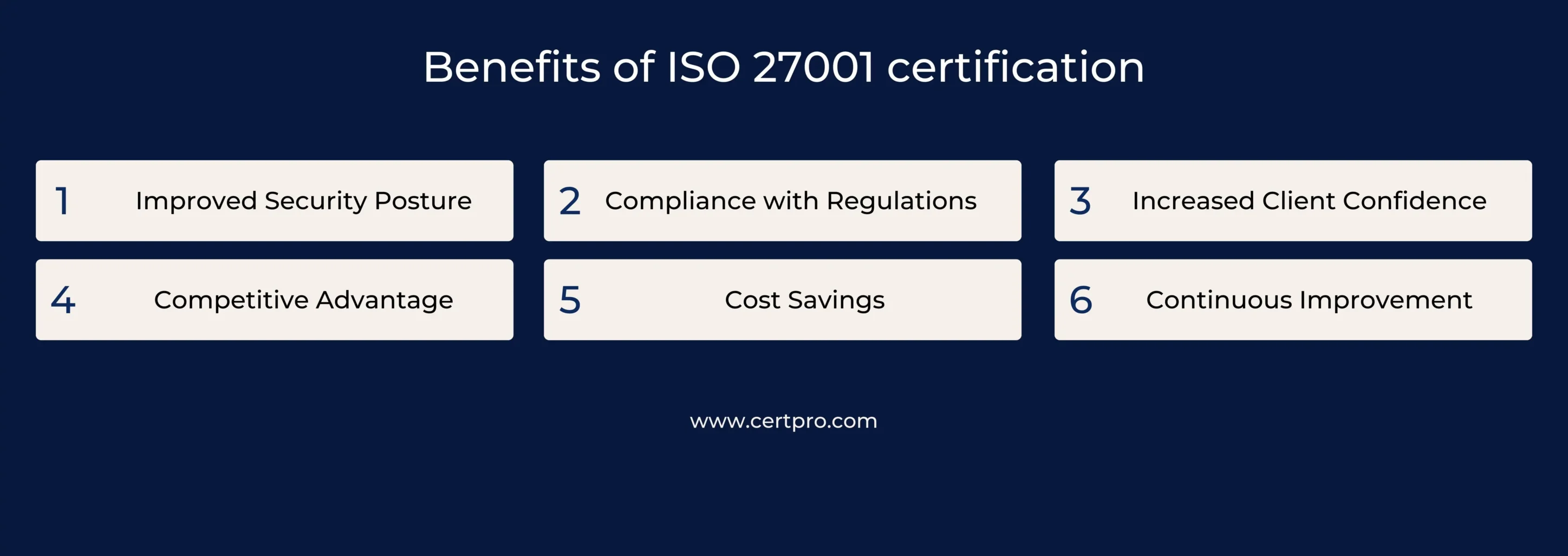
ISO 27001 Certification in Vienna provides organizations with independently verified documentation of information security control effectiveness that carries recognized weight in enterprise procurement, regulatory engagement, and international business development. The certification’s value derives from the rigor of the independent examination process — not from self-assessment or internal declaration. This distinction is increasingly material in vendor security review processes where customers require third-party verification of security control claims.
The ISO 27001 attestation issued following a completed audit program is a credible, evidence-based credential that Vienna-based organizations can present with confidence to international customers, financial sector regulators, and data protection authorities alike.
- ✓Independent third-party verification of ISMS control design and operational effectiveness against ISO/IEC 27001:2022 requirements.
- ✓Recognition in enterprise vendor security reviews conducted by financial institutions, international organizations, and regulated industry customers operating from or engaging with Vienna.
- ✓Demonstrated ISO 27001 compliance with GDPR Article 32 obligations by evidencing appropriate technical and organizational security measures through independent audit.
- ✓Structured ISO 27001 examination methodology that identifies control gaps and nonconformities through objective evidence review, supporting ongoing ISMS improvement.
- ✓ISO 27001 attestation that supports cross-border business development by meeting security certification requirements of EU, US, and Asia-Pacific enterprise customers.
- ✓Annual surveillance audit oversight providing ongoing independent verification of ISMS operational effectiveness throughout the three-year certification cycle.
- ✓Competitive differentiation in Austrian and regional procurement processes where ISO 27001 Certification in Vienna is a scored evaluation criterion.
- ✓Support for NIS2 Directive compliance obligations applicable to Vienna-based organizations classified as essential or important entities under Austrian implementing legislation.
ISO 27001 compliance frameworks are structurally aligned with the technical and organizational security requirements of the EU General Data Protection Regulation, the NIS2 Directive, and Austria’s Data Protection Act. ISO/IEC 27001:2022 Annex A controls directly address GDPR Article 32 requirements — including access control, encryption, logging, pseudonymization, and incident response.
For Vienna-based data processors and data controllers subject to GDPR, holding ISO 27001 certification provides documented evidence of security measures that can be referenced in response to data protection authority inquiries and presented to enterprise customers during due diligence processes. The Austrian Data Protection Authority (Datenschutzbehörde) recognizes internationally certified security frameworks as relevant evidence when assessing organizational security posture.
ISO 27001 certification does not constitute full legal compliance with GDPR, but it provides substantive documented evidence of the security control environment that regulators assess under Article 32 — making the ISO 27001 attestation a practical and widely accepted component of GDPR accountability documentation.
ISO 27001 certification is globally recognized across North American, European, Middle Eastern, and Asia-Pacific markets as a primary indicator of organizational information security maturity. For Vienna-based organizations seeking to expand into US markets — including SaaS providers targeting US financial services customers, managed service providers seeking FedRAMP adjacency, or life sciences firms engaging with US FDA-regulated partners — ISO 27001 certification provides a recognized security credential that US enterprise procurement teams and security review committees actively evaluate.
The ISO 27001 attestation is accepted as evidence of information security control effectiveness in vendor qualification processes conducted by US-listed corporations, US government contractors, and internationally operating financial institutions. Vienna-based organizations holding current ISO 27001 certification are better positioned to respond to security questionnaires, satisfy contract security requirements, and accelerate vendor approval timelines in international procurement contexts.
- ✓Regulatory Alignment and GDPR Mapping
- ✓International Business Development and Cross-Border Recognition
Business Sectors in Vienna Pursuing ISO 27001 Certification
ISO 27001 certification for Vienna companies spans a broad range of industry sectors, reflecting the city’s diversified role as a financial center, technology hub, life sciences cluster, and international organization host city. Demand for ISO 27001 Certification in Vienna is concentrated in sectors where information security control verification is required by enterprise customers, mandated by sector regulators, or expected as a standard component of vendor qualification processes.
The ISO 27001 audit Vienna organizations undergo is calibrated to the specific information assets, processing activities, and regulatory obligations relevant to each sector — ensuring that the resulting ISO 27001 attestation accurately reflects the organization’s real-world control environment.
| Sector | Primary ISO 27001 Driver | Key Annex A Focus Areas |
|---|---|---|
| Banking and Financial Services | EBA outsourcing guidelines, vendor due diligence, regulatory expectations | Access control, incident management, supplier security, audit logging |
| Fintech and Payment Processing | Bank vendor qualification, PSD2 obligations, enterprise customer ISO 27001 compliance requirements | Cryptography, network security, privileged access management, vulnerability management |
| SaaS and Cloud Service Providers | Enterprise customer security reviews, GDPR Article 28 processor obligations | Data encryption, logical access control, business continuity, change management |
| Life Sciences and Biotechnology | Clinical data partner requirements, research data sharing agreements | Data integrity, access restriction, incident response, configuration management |
| IT Services and Managed Service Providers | Client contract requirements, financial sector procurement, ISO 27001 certification mandates | Endpoint security, network segmentation, logging and monitoring, supplier management |
Regional Headquarters and International Operations
Vienna functions as the regional headquarters location for numerous multinational corporations managing Central and Eastern European operations from a single Austrian legal entity. These regional headquarters organizations typically process information assets across multiple jurisdictions — including personnel data, customer financial records, and proprietary operational data — subject to both Austrian data protection law and the legal frameworks of the countries in which subsidiaries or branches operate.
ISO 27001 Certification in Vienna for regional headquarters organizations provides a unified ISMS certification that can be presented to group-level information security functions, external auditors, and regulators across the operating region. The ISMS scope for regional headquarters certifications typically encompasses the information processing activities conducted from Vienna, along with the policies, controls, and oversight mechanisms that apply group-wide. Subsidiary-level activities are either included in scope or addressed through documented supplier or affiliate security agreements.
ISO 27001 Examination: Evidence Collection and Audit Methodology
The ISO 27001 examination methodology applied during certification audits in Vienna follows established audit principles of evidence sufficiency, appropriateness, and objectivity. Auditors collect evidence through multiple channels — document review, configuration inspection, personnel interviews, and process observation — to build a comprehensive picture of ISMS control design and operational effectiveness.
The ISO 27001 audit Vienna process is risk-based: audit sampling depth and focus areas are determined in part by the complexity of the organization’s information processing environment, the sensitivity of information assets in scope, and findings identified during the Stage 1 documentation review. This risk-based approach ensures that the ISO 27001 examination is proportionate, efficient, and focused on the controls that matter most to the organization’s security posture.
Evidence Types and Sampling Approach
During the ISO 27001 audit, auditors collect and evaluate multiple categories of objective evidence to assess control operating effectiveness. Documentary evidence includes policies, procedures, risk registers, supplier contracts, training completion records, and internal audit reports. Configuration evidence includes system-level settings for access management systems, network security appliances, encryption implementations, and vulnerability management tools — reviewed directly from system outputs or through structured technical demonstrations.
Testimonial evidence is gathered through structured interviews with personnel holding information security responsibilities, including information security officers, IT administrators, incident response team members, and business process owners within the ISMS scope. Process observation evidence is collected by reviewing records of operational activities — including change management approvals, access request workflows, security incident records, and management review minutes — to verify that documented processes are consistently applied in practice.
Remote and On-Site Audit Execution
ISO 27001 audit Vienna engagements may be conducted on-site at the organization’s Vienna premises, remotely through structured virtual audit sessions, or through a combination of both modalities — depending on the nature of the controls under review and the complexity of the ISMS scope. Physical security controls, including office physical access controls, server room security, and clean desk compliance, require on-site audit activities and cannot be adequately assessed through remote review alone.
Technical controls governing cloud-hosted systems may be assessed remotely through screenshare sessions, system output documentation, and configuration exports provided under controlled conditions. The audit program specifies the modality for each audit activity in advance, and any proposed changes to modality are subject to agreement between the audit team and the organization prior to execution. All audit activities — regardless of modality — generate documented evidence retained in the audit file and reviewed by the certification committee as part of the ISO 27001 examination record.
FAQ
▶
What is ISO 27001 Certification in Vienna?
▶
Which organizations in Vienna typically pursue ISO 27001 certification?
▶
What is the difference between Stage 1 and Stage 2 in the ISO 27001 audit process?
▶
How long is ISO 27001 certification valid?
▶
What is the Statement of Applicability in ISO 27001?
▶
Does ISO 27001 compliance satisfy GDPR requirements?
▶
What is a surveillance audit in the context of ISO 27001 certification?
▶
What are the four Annex A control domains in ISO/IEC 27001:2022?
Get In Touch
have a question? let us get back to you.