
ISO 42001 Certification in Boston
ISO/IEC 42001:2023 is the first international standard establishing requirements for an Artificial Intelligence Management System (AIMS). Published by the International Organization for Standardization (ISO) and the International Electrotechnical Commission (IEC) in 2023, ISO 42001 provides organizations with a structured framework to develop, deploy, operate, monitor, and continually improve AI systems responsibly. The standard applies to any organization — regardless of size, sector, or geographic location — that develops, provides, or uses AI-based products and services.
OUR CLIENTS





What Is ISO 42001?
ISO/IEC 42001:2023 is the first international standard establishing requirements for an Artificial Intelligence Management System (AIMS). Published by the International Organization for Standardization (ISO) and the International Electrotechnical Commission (IEC) in 2023, ISO 42001 provides organizations with a structured framework to develop, deploy, operate, monitor, and continually improve AI systems responsibly. The standard applies to any organization — regardless of size, sector, or geographic location — that develops, provides, or uses AI-based products and services.
The standard is organized around the Plan-Do-Check-Act (PDCA) cycle, a foundational management system methodology also used in ISO 9001 (quality management) and ISO 27001 (information security management). ISO 42001 comprises Clauses 4 through 10, each addressing a distinct dimension of AI governance: organizational context, leadership commitment, planning, support resources, operational controls, performance evaluation, and continual improvement. This clause hierarchy ensures that AI governance is embedded into organizational processes rather than treated as a standalone compliance exercise.
Key Technical Definitions in ISO 42001
ISO 42001 introduces precise technical definitions that govern how organizations interpret and implement the standard. An Artificial Intelligence Management System (AIMS) refers to the set of interrelated processes, policies, and controls an organization establishes to manage AI-related risks and objectives. AI governance is defined as the framework of accountability structures, policies, and oversight mechanisms that guide responsible AI use. Risk-based thinking under ISO 42001 requires organizations to identify AI-specific risks — including algorithmic bias, data quality failures, model drift, and unintended outputs — and address them proactively within the management system.
The AI system lifecycle, as defined by ISO 42001, encompasses all stages from design and data acquisition through training, testing, deployment, monitoring, and decommissioning. Interested parties include any individual or group affected by or having an interest in the organization’s AI activities — such as customers, regulators, employees, and the public. Understanding these definitions is essential before conducting a valid ISO 42001 assessment, as each term carries specific audit implications and documentation requirements under the standard’s normative references.
Scope and Applicability of ISO 42001
ISO 42001 applies to organizations that develop AI systems for commercial deployment, organizations that procure and integrate third-party AI tools into their operations, and organizations that use AI in automated decision-making processes affecting individuals or business outcomes. The standard does not prescribe specific AI technologies or algorithms. Instead, it establishes management system requirements that are technology-neutral and scalable. This makes ISO 42001 applicable to a Boston biotech firm using machine learning for drug discovery, a fintech startup deploying algorithmic credit scoring, or a healthcare provider using AI-assisted diagnostic tools.
ISO 42001 also aligns with and references several normative standards, including ISO/IEC 22989 (AI concepts and terminology), ISO/IEC 23894 (AI risk management), and ISO/IEC TR 24028 (overview of trustworthiness in AI). These normative relationships allow organizations to integrate ISO 42001 compliance with broader data governance, privacy, and information security frameworks — creating a comprehensive AI governance architecture. For Boston-based organizations subject to U.S. federal AI governance expectations and sector-specific regulations, ISO 42001 provides a recognized, internationally benchmarked compliance baseline.

Why ISO 42001 Certification Matters for Boston Businesses
Boston occupies a unique position in the global AI landscape. Home to world-class research institutions including MIT and Harvard, a dense concentration of biotech and life sciences firms along the Innovation District and Kendall Square corridor, and one of the fastest-growing fintech ecosystems in the United States, Boston-based organizations are among the most active adopters of artificial intelligence. This concentration of AI usage creates proportionate governance obligations. ISO 42001 Certification in Boston is increasingly recognized as the foundational credential for organizations that must demonstrate responsible AI practices to clients, regulators, and institutional partners.
Regulatory Alignment and Risk Mitigation
Boston businesses operating AI systems face a converging set of regulatory expectations. At the federal level, the National Institute of Standards and Technology (NIST) AI Risk Management Framework (AI RMF), Executive Order 14110 on Safe, Secure, and Trustworthy AI, and sector-specific regulations from the FDA, SEC, and HIPAA all impose governance requirements on AI systems. ISO 42001 compliance provides a structured, auditable mechanism for satisfying these overlapping obligations. Organizations that obtain ISO 42001 Certification in Boston demonstrate to regulators that their AI management system has been independently evaluated against an internationally recognized standard.
Risk mitigation is a primary driver for pursuing ISO 42001 certification. Boston healthcare organizations using AI in clinical decision support face liability exposure if AI outputs are not properly governed. Boston financial services firms using algorithmic trading or credit underwriting systems face enforcement risk under fair lending laws if bias controls are inadequate. ISO 42001 certification requires organizations to implement documented risk assessments, control frameworks, and monitoring procedures that directly reduce the probability of AI-related incidents — and provide defensible evidence of due diligence if incidents do occur.
Competitive Advantage in Boston’s AI Market
ISO 42001 Certification in Boston signals to enterprise clients, institutional investors, and government procurement officers that an organization’s AI systems meet defined governance standards. In competitive procurement scenarios — particularly in defense technology, healthcare, and financial services sectors prominent in the Boston market — certification can be a decisive differentiator. Large enterprises increasingly require AI governance certifications from technology vendors as part of third-party risk management programs. Boston tech startups seeking contracts with major healthcare networks or financial institutions will find ISO 42001 certification a practical prerequisite.
Beyond procurement, ISO 42001 certification strengthens an organization’s position in fundraising and investor relations. Institutional investors applying ESG criteria now evaluate AI governance practices as part of due diligence. Venture capital and private equity firms investing in Boston’s AI-native companies increasingly request evidence of structured AI management systems. ISO 42001 certification provides this evidence in an internationally recognized, auditable format — converting governance maturity into a measurable, communicable asset.
Public Trust and Ethical AI Accountability
Boston’s higher education institutions and research-driven culture place significant emphasis on ethical AI practices. Organizations operating AI systems that affect public welfare — such as AI tools used in academic admissions, public health analytics, or urban planning — face heightened scrutiny from community stakeholders. ISO 42001 certification provides an audited, third-party validated declaration that the organization’s AI systems are governed according to principles of transparency, fairness, accountability, and human oversight. This certification is particularly relevant for Boston-based nonprofit organizations, public-sector agencies, and academic institutions that rely on AI in mission-critical applications.
ISO 42001 AI Management System (AIMS) Framework
The ISO 42001 AI Management System (AIMS) framework defines the structural and operational requirements an organization must establish to govern its AI activities systematically. The AIMS framework is not a single document or policy — it is an integrated system of processes, controls, roles, and records that spans the full AI lifecycle, from initial concept through deployment, monitoring, and retirement. ISO 42001 compliance requires that this system be formally defined, documented, implemented, and subject to regular evaluation and improvement.
Clause 4: Organizational Context and Interested Parties
Clause 4 of ISO 42001 requires organizations to define the internal and external context relevant to their AI activities. This includes identifying all AI systems in operation, the business processes they support, the data they consume, and the interested parties affected by their outputs. For a Boston biotech firm, this might include clinical AI tools, the patients and clinicians affected by their outputs, regulatory bodies such as the FDA, and institutional partners. The scope of the AIMS must be formally defined and documented, establishing clear boundaries for what the management system governs.
Identifying interested parties under Clause 4 is a critical input to the risk management process. Interested parties may have requirements — contractual, regulatory, or ethical — that the organization’s AIMS must address. ISO 42001 requires organizations to determine which of these requirements are relevant to the AIMS and to document how they are addressed. This analysis directly informs the scope of the ISO 42001 assessment and the criteria against which auditors evaluate the organization’s AI governance practices.
Clauses 5–7: Leadership, Planning, and Support
Clause 5 establishes leadership and commitment requirements. Top management must demonstrate active engagement with the AIMS by establishing an AI governance policy, assigning roles and responsibilities, and ensuring adequate resources are allocated to AI risk management. ISO 42001 requires that the AI governance policy be formally documented, communicated to relevant personnel, and aligned with the organization’s overall strategic objectives. Leadership accountability is a central audit criterion — auditors evaluate whether AI governance responsibilities are clearly assigned and whether management reviews are conducted at defined intervals.
Clause 6 addresses planning, requiring organizations to identify AI-specific risks and opportunities, establish measurable AI governance objectives, and develop plans for achieving those objectives. The planning process must integrate risk-based thinking, ensuring that identified risks are addressed through specific controls rather than general policy statements. Clause 7 covers support requirements — including human competence, organizational awareness, documentation controls, and communication processes. Each of these requirements generates specific evidence that auditors evaluate during the ISO 42001 audit to determine whether the AIMS is effectively implemented.
Clauses 8–10: Operations, Evaluation, and Improvement
Clause 8 governs operational planning and control, requiring organizations to implement processes for managing AI system development, procurement, deployment, and monitoring. This includes controls for data quality management, model validation, algorithmic bias testing, and incident response. Clause 9 establishes performance evaluation requirements, mandating internal audits, management reviews, and ongoing monitoring of AI governance metrics. Clause 10 addresses improvement, requiring organizations to address nonconformities and drive continual enhancement of the AIMS based on audit findings, performance data, and changes in the AI risk landscape.
| ISO 42001 Clause | Requirement Area | Key Deliverable |
|---|---|---|
| Clause 4 | Organizational Context | AIMS Scope Document, Interested Parties Register |
| Clause 5 | Leadership & Policy | AI Governance Policy, Role Assignments |
| Clause 6 | Planning & Risk Management | AI Risk Register, Governance Objectives |
| Clause 8 | Operational Controls | AI Lifecycle Procedures, Bias Testing Records |
| Clause 9 | Performance Evaluation | Internal Audit Reports, Management Review Minutes |
ISO 42001 Certification Requirements
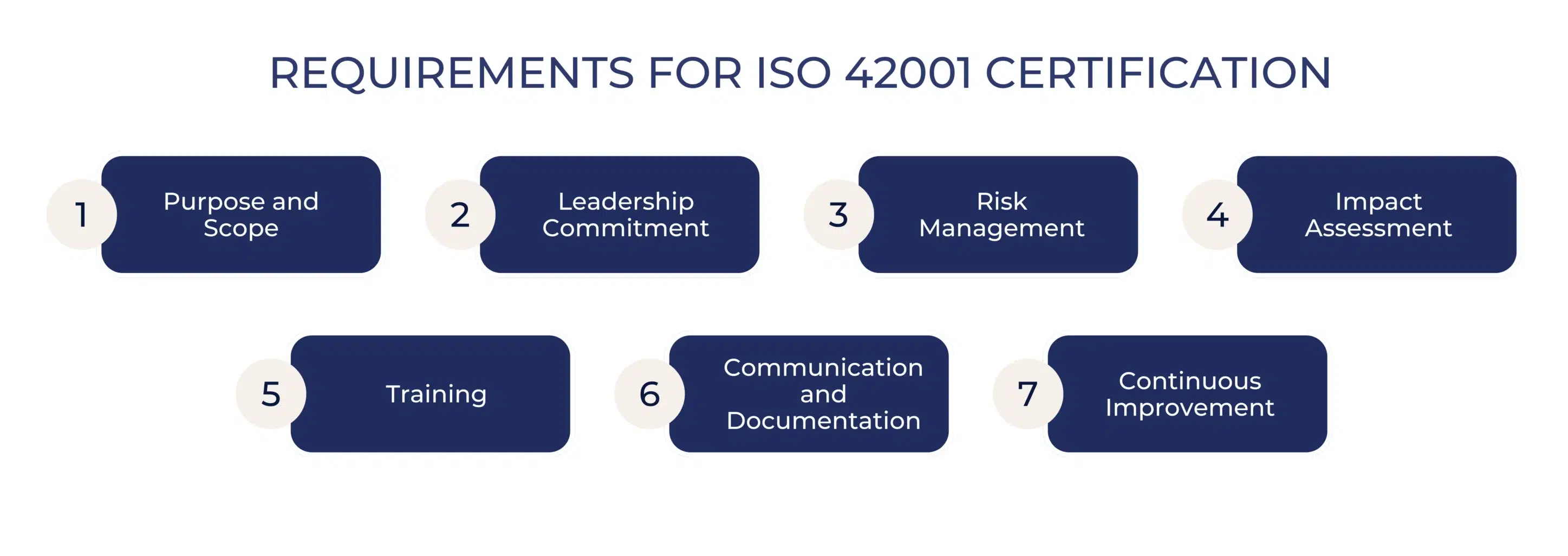
ISO 42001 certification requires organizations to satisfy a defined set of documentation, technical, and governance requirements that collectively demonstrate the effective implementation of an AI Management System. These requirements are not aspirational guidelines — they are auditable criteria against which an accredited certification body evaluates the organization’s actual AI governance practices. Understanding these requirements before the ISO 42001 assessment is essential for organizations pursuing certification in Boston’s competitive AI market.
ISO 42001 mandates a comprehensive documentation framework that provides auditable evidence of AIMS implementation. Required documentation includes a formally approved AI governance policy aligned with organizational objectives, a defined AIMS scope document specifying which AI systems and processes are covered, a documented risk assessment process with methodology and outputs, and an AI objectives register with associated plans. Organizations must also maintain procedure documents for each operational control required under Clause 8, records of competence and awareness activities, and evidence of management review meetings.
Documentation controls under ISO 42001 require that all AIMS documents are reviewed, approved, version-controlled, and accessible to relevant personnel. Records — which differ from documents in that they provide evidence of activities performed — must be retained according to defined retention schedules. During the ISO 42001 audit, auditors systematically review documentation to verify that it is current, complete, and consistent with the organization’s actual AI practices. Gaps between documented procedures and operational reality constitute findings that must be resolved before certification can be granted.
Technical requirements under ISO 42001 address the specific controls that organizations must implement across the AI system lifecycle. Organizations must establish processes for evaluating AI systems at the design stage — including specification of intended use, identification of potential misuse scenarios, and assessment of data quality and representativeness. Model validation procedures must be documented and consistently applied, with records demonstrating that AI outputs have been evaluated for accuracy, fairness, and reliability before deployment. Ongoing monitoring requirements mandate that deployed AI systems are continuously evaluated against defined performance metrics and that anomalies trigger defined response procedures.
Organizations pursuing ISO 42001 compliance must also establish controls for third-party AI systems and components. Many Boston organizations integrate AI capabilities from external providers — cloud AI services, pre-trained models, or specialized AI tools procured from vendors. ISO 42001 requires that the organization maintain oversight of these externally provided AI components, including supplier evaluation criteria, contractual AI governance requirements, and processes for monitoring third-party AI performance. This is particularly relevant for Boston financial services firms that rely on vendor-provided AI for fraud detection or credit risk modeling.
ISO 42001 places explicit requirements on human oversight of AI systems, particularly in high-stakes decision contexts. Organizations must define which AI decisions require human review, establish escalation pathways for AI outputs that fall outside defined confidence thresholds, and maintain accountability structures that assign responsibility for AI system performance to named individuals or roles. These requirements are directly relevant to Boston healthcare organizations, where AI-assisted diagnostic or treatment recommendations must be subject to clinician review before being acted upon.
- ✓Formal AIMS scope document defining covered AI systems and processes
- ✓Documented AI governance policy approved by top management
- ✓AI risk register with identified risks, likelihood ratings, and control assignments
- ✓AI system inventory listing all deployed and in-development AI tools
- ✓Procedures for AI data quality management and model validation
- ✓Algorithmic bias testing records and corrective action documentation
- ✓Third-party AI supplier evaluation and oversight procedures
- ✓Internal audit program with completed audit reports and findings
- ✓Management review records demonstrating leadership engagement with AIMS
- ✓Competence records for personnel responsible for AI system governance
- ✓Documentation Requirements
- ✓Technical and Operational Requirements
- ✓Human Oversight and Accountability Requirements
ISO 42001 Certification Process
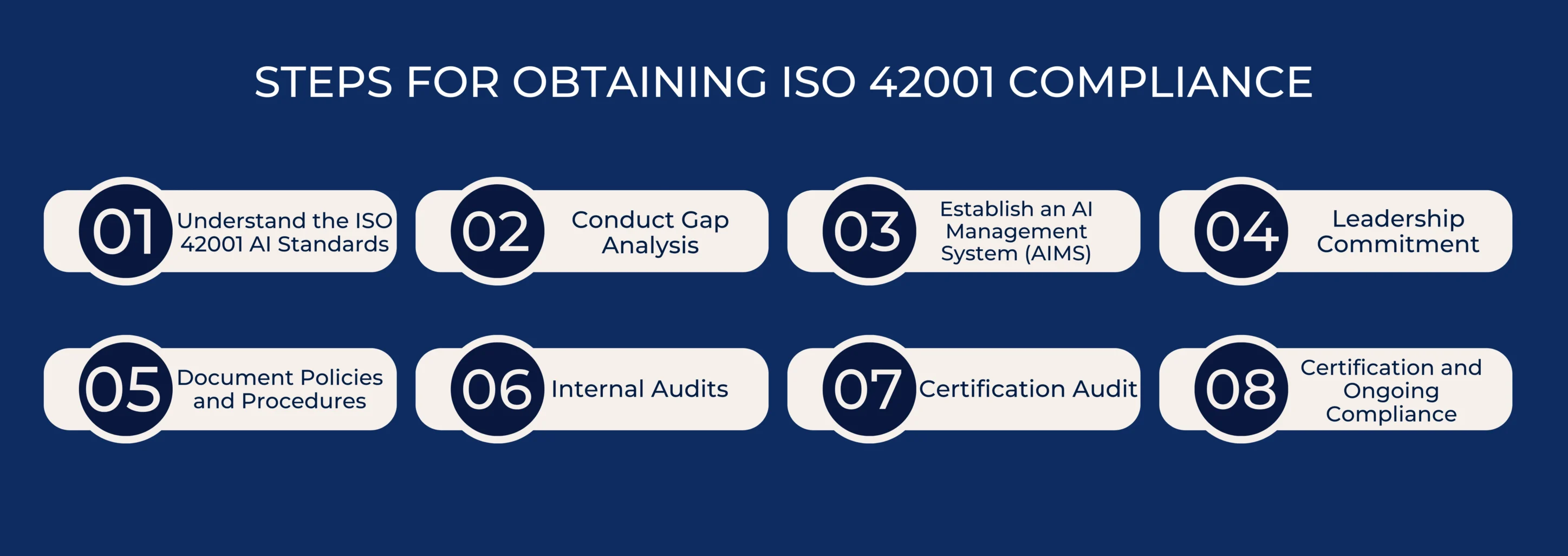
The ISO 42001 certification process follows a structured, multi-stage evaluation pathway conducted by an accredited certification body. CertPro, operating as a Licensed CPA Firm, executes this process according to established audit standards — ensuring that each stage produces auditable evidence and that certification decisions are based on objective evaluation criteria. The process is designed to be systematic, transparent, and reproducible, providing Boston organizations with a clear, predictable path to ISO 42001 Certification in Boston.
The certification process begins with a formal scope definition exercise. The organization, in coordination with the certification body, defines the boundaries of the AIMS subject to certification — specifying which AI systems, organizational units, geographic locations, and business processes are included. Scope definition determines the complexity of the audit program and the resources required for evaluation. For a Boston organization with multiple AI applications across different business functions, scope definition may result in a phased certification approach, beginning with the highest-risk or most strategically significant AI systems.
Following scope definition, the audit program is formally determined. This includes establishing the audit timeline, identifying the audit team and their required competencies, defining the audit criteria applicable to the defined scope, and scheduling Stage 1 and Stage 2 audit activities. The audit program determination stage produces a formal audit plan that the organization reviews and confirms before field work commences. This transparency is a defining feature of the CertPro ISO 42001 audit process — organizations understand exactly what will be evaluated, by whom, and according to which criteria.
The Stage 1 audit consists primarily of a documentation review to evaluate whether the organization’s AIMS documentation meets ISO 42001 requirements. Auditors examine the AI governance policy, AIMS scope document, risk register, and procedure documentation to assess completeness, consistency, and alignment with the standard’s requirements. Stage 1 also includes interviews with key personnel to verify organizational understanding of AIMS requirements. The Stage 1 audit produces a formal report identifying any documentation gaps or areas requiring clarification before the Stage 2 audit proceeds.
The Stage 2 audit is the primary conformity assessment, during which auditors evaluate the effective implementation of the AIMS in practice. This involves on-site or virtual interviews with personnel at multiple organizational levels, observation of AI governance processes in operation, testing of specific controls through sampling and evidence review, and evaluation of records demonstrating that the AIMS has been operating as documented. The ISO 42001 audit at Stage 2 is evidence-based — auditors reach conclusions from objective evidence rather than assertions or representations from management.
Following the Stage 2 audit, auditors issue formal findings categorized as major nonconformities, minor nonconformities, or observations. Major nonconformities represent failures to meet a specific ISO 42001 requirement and must be resolved before certification can be granted. Minor nonconformities indicate partial conformance and must be addressed within a defined timeframe — typically 90 days. Organizations must submit objective evidence demonstrating that corrective actions have been implemented and that the underlying nonconformity has been resolved. Auditors review this evidence to confirm effectiveness before closing nonconformities.
Once all major nonconformities are resolved and the certification body’s technical review committee confirms that audit findings support certification, a formal certification decision is issued. The organization receives a certificate of conformance to ISO 42001, specifying the certified scope, certification date, and validity period. ISO 42001 certificates are typically valid for three years, subject to annual surveillance audits that verify continued compliance. CertPro conducts these surveillance activities as part of its ongoing ISO 42001 compliance engagement, ensuring that the organization’s AIMS remains effective and current throughout the certification cycle.
- Scope Definition — Formal determination of AIMS boundaries and covered AI systems
- Audit Program Determination — Establishment of audit timeline, team, and criteria
- Stage 1 Audit — Documentation review and AIMS adequacy evaluation
- Stage 2 Audit — On-site conformity assessment and evidence-based control testing
- Nonconformity Review — Formal finding categorization and corrective action evaluation
- Certification Decision — Technical review committee determination based on audit evidence
- Certificate Issuance — Formal ISO 42001 certificate with defined scope and validity
- Annual Surveillance Audit — Ongoing verification of continued AIMS conformance
- Three-Year Recertification — Full audit cycle renewal at end of certification period
- ✓Stage 1: Scope Definition and Program Determination
- ✓Stage 2: Documentation Review and AIMS Evaluation
- ✓Stage 3: Nonconformity Review and Certification Decision
Benefits of ISO 42001 Certification in Boston
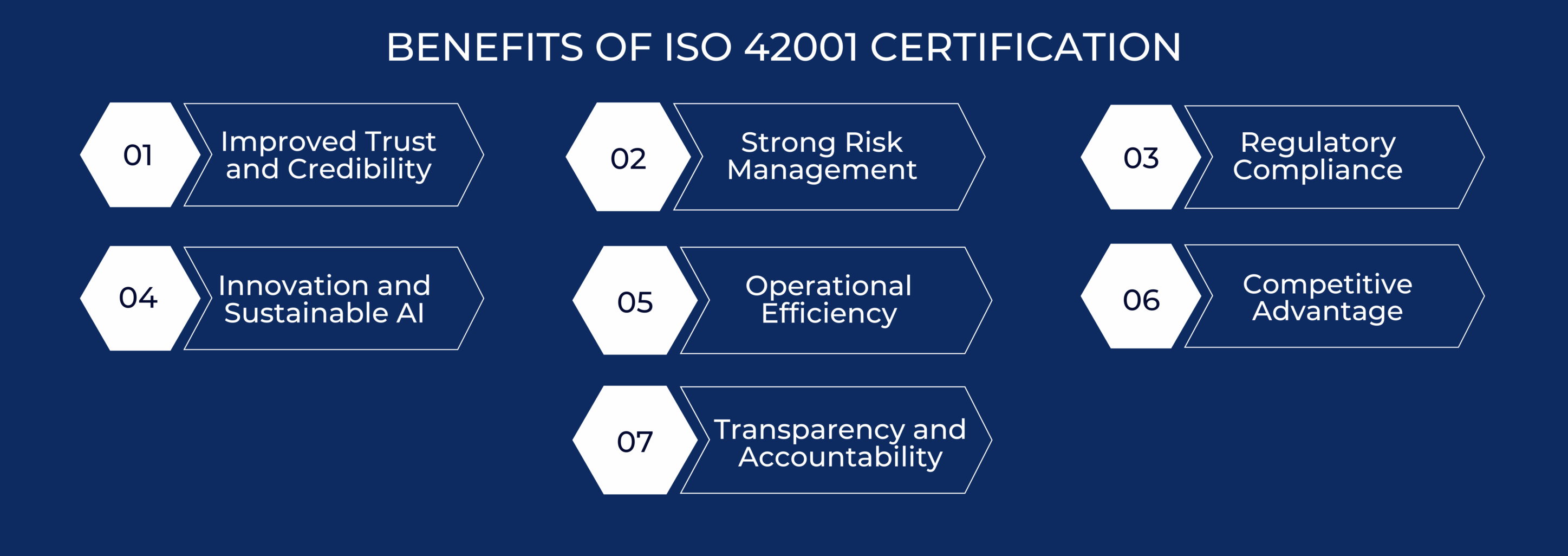
Securing ISO 42001 Certification in Boston delivers measurable, concrete benefits across organizational, commercial, and regulatory dimensions. These benefits extend beyond formal compliance to encompass operational improvements, stakeholder trust, and long-term competitive positioning. The following analysis outlines the primary value delivered by ISO 42001 certification, organized by benefit category.
ISO 42001 certification enforces a systematic approach to AI risk identification, assessment, and control. Organizations that complete the certification process have, by definition, established a functioning AI risk register, implemented controls for their highest-priority risks, and verified that those controls operate effectively. This translates directly into reduced probability of AI incidents — including model failures, biased outputs, data quality errors, and unauthorized AI use cases. For Boston organizations operating AI in regulated environments, this risk reduction has direct financial value: avoided regulatory penalties, reduced litigation exposure, and lower cyber liability insurance premiums.
The governance structure required for ISO 42001 compliance also improves internal decision-making about AI investments and deployments. Organizations with a certified AIMS have defined processes for evaluating new AI initiatives against risk and governance criteria before deployment — preventing the accumulation of ungoverned AI systems that create audit and liability exposure. This governance discipline is particularly valuable for Boston tech startups that are scaling AI capabilities rapidly and may otherwise prioritize development velocity over governance rigor.
ISO 42001 Certification in Boston provides organizations with a formally recognized credential that can be referenced in procurement responses, contract negotiations, and investor presentations. Enterprise procurement teams increasingly require AI governance certifications from vendors as part of vendor onboarding. Healthcare networks, financial institutions, and government agencies across Boston’s market are beginning to incorporate ISO 42001 certification as a qualification criterion for AI technology providers. Organizations that hold this certification gain access to procurement opportunities that are closed to uncertified competitors.
- ✓Formally recognized AI governance credential accepted across 170+ ISO member countries
- ✓Expanded access to enterprise and government procurement opportunities requiring AI governance verification
- ✓Strengthened investor relations through documented ESG-aligned AI management practices
- ✓Reduced regulatory examination risk through demonstrated ISO 42001 compliance
- ✓Improved third-party risk management posture for organizations relying on AI vendor ecosystems
- ✓Operational efficiency gains through standardized AI lifecycle management procedures
- ✓Workforce confidence and accountability through clearly defined AI governance roles
- ✓Faster incident response through pre-established AI incident management procedures
- ✓Long-term certification value through three-year validity with annual surveillance
- ✓Governance and Risk Management Benefits
- ✓Commercial and Market Access Benefits
Industries in Boston That Require ISO 42001 Compliance
Boston’s economy is concentrated in several industries where artificial intelligence is both a primary driver of innovation and a source of significant governance risk. ISO 42001 compliance is particularly critical in sectors where AI outputs directly affect human welfare, financial outcomes, or regulated activities. The following industry analysis identifies the primary sectors in Boston’s market where ISO 42001 certification is either required, strongly recommended, or increasingly expected by stakeholders.
Biotech and Life Sciences
Boston biotech organizations pursuing ISO 42001 certification face some of the highest-stakes AI governance requirements of any industry. AI applications in drug discovery, genomic analysis, clinical trial optimization, and regulatory submission processes carry direct patient safety implications. The FDA’s evolving guidance on AI/ML-based software as a medical device (SaMD) creates specific oversight requirements that ISO 42001 compliance directly supports. Boston’s Kendall Square biotech cluster — home to firms including Biogen, Moderna, and hundreds of early-stage life sciences companies — represents a major market for ISO 42001 certification services.
For Boston biotech firms, the ISO 42001 assessment process evaluates AI controls across the full drug development pipeline — from AI-assisted target identification through clinical data analysis and post-market surveillance. Organizations that obtain ISO 42001 Certification in Boston demonstrate to the FDA, institutional review boards, and partner organizations that their AI governance framework meets internationally recognized standards, reducing regulatory scrutiny and accelerating pathway to market for AI-enabled products.
Healthcare and Health Technology
ISO 42001 certification for Boston healthcare organizations is driven by HIPAA compliance requirements, hospital accreditation standards, and the ethical obligations of healthcare providers. AI applications in clinical decision support, patient triage, diagnostic imaging analysis, and revenue cycle management create governance obligations under multiple regulatory frameworks simultaneously. ISO 42001 compliance provides a structured mechanism for satisfying these obligations through a single, integrated management system — rather than through fragmented, point-solution compliance efforts.
Financial Services and Fintech
ISO 42001 certification for Boston financial services organizations addresses governance requirements for AI in credit decisioning, fraud detection, algorithmic trading, regulatory reporting, and customer service automation. The Consumer Financial Protection Bureau (CFPB), Office of the Comptroller of the Currency (OCC), and Securities and Exchange Commission (SEC) have all issued guidance on AI governance in financial services. ISO 42001 compliance for Boston fintech companies provides an audited framework for demonstrating adherence to these expectations, reducing examination risk and supporting model risk management programs required under SR 11-7 model risk management guidance.
Higher Education, Defense Technology, and Research
Boston’s concentration of research universities and defense technology contractors creates additional demand for ISO 42001 certification. Universities using AI in admissions, academic integrity monitoring, and research data analysis face governance obligations to students, faculty, and funding agencies. Defense technology contractors developing AI for government clients face requirements under the Department of Defense’s AI Ethics Principles and the Algorithmic Warfare Cross-Functional Team’s governance standards. Boston tech startups in the defense and government sectors benefit from ISO 42001 Certification in Boston by obtaining the documented governance evidence required for federal contracting and security clearance processes.
| Industry Sector | Primary AI Use Cases | Relevant Regulations |
|---|---|---|
| Biotech / Life Sciences | Drug discovery, clinical trial AI, SaMD | FDA AI/ML Guidance, ICH E6(R3) |
| Healthcare / Healthtech | Clinical decision support, diagnostic AI | HIPAA, Joint Commission Standards |
| Financial Services / Fintech | Credit scoring, fraud detection, trading | CFPB Guidance, SR 11-7, SEC AI Rules |
| Defense Technology | Autonomous systems, intelligence analysis | DoD AI Ethics Principles, CMMC |
| Higher Education | Admissions AI, research data analytics | FERPA, NSF Research Integrity Standards |
ISO 42001 Audit Process by CertPro
CertPro executes ISO 42001 audits as a Licensed CPA Firm, applying structured, evidence-based evaluation methodologies consistent with international audit standards. The CertPro ISO 42001 audit process is designed to be rigorous, transparent, and efficient — providing Boston organizations with a certification pathway that is credible, defensible, and aligned with the technical requirements of ISO/IEC 42001:2023. Each audit stage is documented in formal audit reports that constitute the evidentiary basis for the certification decision.
CertPro’s ISO 42001 audit teams consist of auditors with demonstrated competence in both ISO management system auditing and AI-specific technical domains. Audit team members hold relevant qualifications in AI system evaluation, information technology, and sector-specific knowledge corresponding to the client’s industry. Independence requirements are strictly observed — CertPro auditors do not provide advisory services, implementation support, or any form of consulting to organizations they audit. This independence is fundamental to the integrity of the ISO 42001 audit process and the validity of the certification credential it produces.
Audit team composition for ISO 42001 audit engagements in Boston is determined based on the client’s industry sector, the complexity of the AI systems in scope, and the technical domains relevant to the defined audit criteria. For a Boston healthcare organization, the audit team includes auditors with clinical AI and HIPAA compliance expertise. For a fintech organization, auditors with algorithmic model risk management knowledge are assigned. This sector-specific competence ensures that audit findings are technically accurate and commercially relevant — not generic observations that fail to address the organization’s actual AI governance challenges.
The CertPro ISO 42001 audit methodology employs multiple evidence collection techniques to ensure comprehensive coverage of the defined audit criteria. Document review assesses whether required documentation exists and meets the standard’s requirements. Personnel interviews evaluate organizational understanding of AI governance responsibilities and consistency with documented procedures. Process observation involves direct examination of AI governance activities — such as model validation meetings, risk review sessions, and incident response exercises — to verify that documented processes are operationally embedded. Technical sampling reviews specific AI system records, testing logs, and monitoring outputs to verify control effectiveness.
All audit evidence is documented in standardized working papers that link specific evidence items to the ISO 42001 clause requirements they address. This traceability ensures that audit findings are objectively supported by evidence and that the certification decision is fully defensible. The ISO 42001 assessment engagement concludes with a formal closing meeting at which the lead auditor presents preliminary findings to organizational management, providing an opportunity for factual corrections before the final audit report is issued.
ISO 42001 certification is subject to annual surveillance audits conducted in Years 1 and 2 of the three-year certification cycle. Surveillance audits verify that the certified AIMS continues to meet ISO 42001 requirements and that the organization is addressing identified nonconformities while driving continual improvement. Surveillance audits are typically narrower in scope than initial certification audits, focusing on areas of identified risk, previous nonconformities, and changes in the organization’s AI environment since the last audit. At the end of the three-year cycle, a full recertification audit is conducted to renew the ISO 42001 certificate for a further three-year period.
- ✓Audit Team Qualification and Independence
- ✓Evidence Collection and Audit Methodology
- ✓Surveillance and Recertification Audits
ISO 42001 Certification Cost in Boston
The cost of ISO 42001 Certification in Boston is determined by several factors specific to the organization seeking certification. CertPro offers transparent, fixed-fee certification pricing structured to provide Boston organizations with cost certainty from the outset of the engagement. Unlike variable-fee models that create cost uncertainty as audit scope expands, CertPro’s fixed-fee approach allows organizations to budget accurately and plan certification timelines with financial predictability.
Factors Influencing Certification Cost
The primary cost drivers for ISO 42001 certification are organizational size (measured by number of employees and AI system users), the number and complexity of AI systems within the defined certification scope, the maturity of the organization’s existing AI governance documentation, and the industry sector’s regulatory complexity. A Boston-based AI startup with two or three AI applications and fewer than 50 employees will face substantially lower certification costs than a major financial institution with dozens of AI systems deployed across multiple business units and regulatory jurisdictions.
Organizations with existing ISO management system certifications — such as ISO 27001 or ISO 9001 — typically achieve ISO 42001 certification more efficiently because they already have documentation frameworks, internal audit programs, and management review processes in place. This existing infrastructure reduces the time and resources required for the ISO 42001 assessment, translating into lower certification costs. CertPro’s fixed-fee pricing model accounts for these efficiency factors, providing cost-adjusted pricing for organizations with existing certification portfolios.
Cost Components and Pricing Transparency
CertPro’s ISO 42001 certification pricing encompasses all stages of the certification process: audit planning and program determination, Stage 1 documentation review, Stage 2 conformity assessment, nonconformity review and corrective action verification, certification decision and certificate issuance, and first-year surveillance audit scheduling. There are no hidden fees, scope expansion charges, or variable rate components. This pricing transparency reflects CertPro’s commitment to client-focused certification services and positions it distinctively in Boston’s ISO 42001 certification market, where variable-fee competitors may present lower initial quotes that escalate significantly as audit scope is refined.
| Organization Profile | Estimated Certification Scope | Typical Cost Range |
|---|---|---|
| Startup (< 50 employees, 1-3 AI systems) | Narrow AIMS scope, single business unit | Lower cost tier |
| Mid-size organization (50-500 employees) | Multiple AI systems, 2-3 business units | Mid-range cost tier |
| Large enterprise (500+ employees) | Complex AIMS, multiple AI portfolios | Higher cost tier |
| Multi-site or regulated entity | Cross-site AIMS, regulatory overlay | Premium cost tier |
Why Choose CertPro for ISO 42001 Certification in Boston
CertPro is a Licensed CPA Firm delivering ISO 42001 certification and audit services to organizations across Boston and the broader New England region. CertPro’s institutional positioning as a Licensed CPA Firm — rather than a consulting or advisory practice — is fundamental to the integrity and market value of the ISO 42001 certificates it issues. Organizations that obtain ISO 42001 Certification in Boston through CertPro receive a credential backed by licensed professional accountability, structured audit methodology, and sector-specific technical expertise.
Licensed CPA Firm Authority and Institutional Credibility
CertPro’s status as a Licensed CPA Firm distinguishes it from certification bodies that operate without licensed professional oversight. The CPA licensing framework imposes professional standards of independence, objectivity, due care, and competence that are directly applicable to the ISO 42001 audit function. When a Boston organization presents an ISO 42001 certificate issued by CertPro to an enterprise client, regulatory examiner, or institutional investor, the credential carries the professional authority of a licensed audit firm — not merely the commercial representation of a certification vendor. This distinction is material in regulated industries where certification credibility is subject to scrutiny.
CertPro’s ISO 42001 audit process maintains strict independence standards that prohibit auditors from providing advisory services, implementation support, or consulting to the organizations they certify. This independence ensures that the ISO 42001 assessment produces an objective evaluation of the organization’s AIMS — not a confirmation of work previously performed by the same firm. This structural independence is a prerequisite for certification credibility and is the defining characteristic that separates legitimate certification bodies from vendors offering bundled consulting and certification services.
Sector Expertise Across Boston’s Key Industries
CertPro’s ISO 42001 audit teams possess demonstrated expertise across the industry sectors that dominate Boston’s AI market. Audit teams serving biotech and life sciences clients understand FDA AI/ML guidance, clinical trial data governance requirements, and the specific AI lifecycle controls relevant to drug development. Teams serving financial services clients are versed in model risk management, fair lending AI requirements, and the SEC’s emerging AI disclosure standards. This sector-specific competence means that ISO 42001 certification for Boston companies through CertPro produces technically accurate, commercially relevant certification outcomes — not generic management system evaluations that overlook industry-specific requirements.
Fixed-Fee Pricing and Certification Efficiency
CertPro’s fixed-fee ISO 42001 certification pricing model provides Boston organizations with complete cost certainty from engagement initiation. The fixed-fee structure encompasses all audit stages — from initial scope definition through certificate issuance and first surveillance audit scheduling — without variable charges. This pricing discipline reflects CertPro’s operational efficiency and commitment to client-focused certification delivery. Organizations considering ISO 42001 Certification in Boston can obtain a fixed-fee quote from CertPro that specifies all cost components upfront, enabling accurate budget planning and certification timeline management.
Secure Your ISO 42001 Certification in Boston With CertPro
ISO 42001 Certification in Boston represents a definitive organizational commitment to responsible, transparent, and accountable artificial intelligence. For Boston organizations operating in the AI-intensive sectors of biotech, healthcare, financial services, defense technology, and higher education, this certification is not merely a compliance milestone — it is a foundational governance credential that underpins market access, regulatory credibility, and stakeholder trust. CertPro, as a Licensed CPA Firm, delivers ISO 42001 certification through a structured, evidence-based audit process that produces certifications of unquestioned professional integrity.
CertPro’s ISO 42001 certification services for Boston companies are structured around transparent, fixed-fee pricing that eliminates cost uncertainty and enables accurate budget planning. The certification process is managed by audit teams with demonstrated sector-specific expertise, ensuring that the ISO 42001 audit produces technically accurate, commercially relevant, and fully defensible certification outcomes. Organizations that engage CertPro for ISO 42001 Certification in Boston receive the institutional authority of a Licensed CPA Firm, the technical rigor of a structured audit methodology, and the commercial value of an internationally recognized AI governance credential.
Contact CertPro today to initiate your ISO 42001 certification engagement. CertPro will issue a fixed-fee certification quote based on your organization’s AI system inventory, defined scope, and industry sector. The quote specifies all cost components, the proposed audit timeline from Stage 1 through certificate issuance, and the audit team qualifications relevant to your industry. Boston organizations that initiate ISO 42001 Certification in Boston now position themselves ahead of the governance curve — establishing the AI management system infrastructure and certification credentials that clients, regulators, and investors will increasingly expect across all of Boston’s key industry sectors in the years ahead.
FAQ
▶
What Is ISO 42001 Certification in Boston and Who Needs It?
▶
How Long Does the ISO 42001 Certification Process Take in Boston?
▶
What Is the Difference Between ISO 42001 and ISO 27001?
▶
How Does ISO 42001 Compliance Align With U.S. AI Regulations?
▶
What Happens During an ISO 42001 Audit Boston Engagement?
▶
How Is ISO 42001 Assessment Different From a Risk Assessment?
▶
Can Boston Tech Startups Achieve ISO 42001 Certification?
▶
How Often Is ISO 42001 Recertification Required?

MindSec Launches AI Compliance for Law 25 & ISO 42001
Excerpt from Barchart Article, Published on December 3, 2025 Today, Canadian organizations face increasing pressure to comply with stringent privacy a…

UNDERSTANDING ISO 42001: A GUIDE FOR RESPONSIBLE AI MANAGEMENT SYSTEMS
The invention of artificial intelligence (AI) has changed the operational processes of many industries. However, the rapid growth of technology increa…
ENSURING AI DATA PRIVACY COMPLIANCE WITH ISO 42001
According to Stanford’s AI report, the private AI investment in the U.S. alone reached more than $109 billion last year, which is equal to 12 times th…
Get In Touch
have a question? let us get back to you.