
SOC 2 Certification in Boston
The SOC 2 audit process is a structured, multi-stage examination conducted exclusively by a Licensed CPA Firm under AICPA attestation standards. Each stage of the SOC 2 audit produces specific outputs that inform the CPA Firm’s attestation conclusion. Boston service organizations should understand the examination sequence to anticipate evidence requests, personnel involvement, and milestone timelines throughout the engagement. A well-prepared organization will move through the SOC 2 audit more efficiently and with fewer unexpected findings.
OUR CLIENTS










What Is SOC 2 Certification?
SOC 2 Certification is a formal attestation issued by a Licensed CPA Firm confirming that a service organization’s internal controls meet the AICPA Trust Services Criteria. Unlike regulatory compliance checkboxes, SOC 2 attestation represents an independent, evidence-based examination of whether controls are suitably designed and operating effectively to protect the security, availability, processing integrity, confidentiality, and privacy of customer data.
For Boston organizations processing sensitive client information, SOC 2 examination results carry significant weight in enterprise procurement and vendor risk management programs. SOC 2 compliance alone—without independent third-party verification—does not provide the same level of assurance that a formal SOC 2 audit delivers. Obtaining SOC 2 Certification in Boston signals to enterprise buyers that your organization has undergone rigorous, objective scrutiny by a qualified CPA Firm.
The AICPA Trust Services Criteria Framework
The Trust Services Criteria (TSC) framework, developed by the American Institute of Certified Public Accountants (AICPA), defines the control categories against which SOC 2 examinations are conducted. The Security criterion—also called the Common Criteria—is mandatory for every SOC 2 engagement. It addresses logical and physical access controls, system operations, change management, and risk mitigation.
Organizations may elect to include one or more additional criteria based on their services and customer commitments:
- Availability evaluates system uptime and performance commitments.
- Processing Integrity examines whether systems process data completely, accurately, and in a timely manner.
- Confidentiality covers how sensitive information is protected throughout its lifecycle.
- Privacy addresses the collection, use, retention, and disclosure of personal information in accordance with the organization’s privacy notice and applicable regulations such as HIPAA or GDPR.
Boston organizations in healthcare technology and life sciences frequently include both Confidentiality and Privacy criteria to address industry-specific data protection obligations and customer contractual requirements.
SOC 2 Type 1 and Type 2 Reports Defined
SOC 2 examinations produce two distinct report types, each serving different assurance purposes. A SOC 2 Type 1 certification in Boston evaluates the design suitability of controls at a single point in time. The Licensed CPA Firm determines whether the organization has implemented controls appropriately structured to meet the selected Trust Services Criteria as of a specified date.
A SOC 2 Type 2 certification in Boston, by contrast, evaluates both the design and operating effectiveness of controls over a defined observation period—typically 6 to 12 months. Type 2 reports are substantially more rigorous and carry greater assurance value. The CPA Firm collects and tests evidence demonstrating that controls functioned consistently throughout the entire audit period.
Enterprise customers, cloud marketplace procurement teams, and regulated industries in Boston typically require SOC 2 Type 2 reports as a condition of vendor onboarding and ongoing relationship management.
| Report Type | Evaluation Scope | Time Dimension | Primary Use Case |
|---|---|---|---|
| SOC 2 Type 1 | Design suitability of controls | Point in time | Initial vendor qualification |
| SOC 2 Type 2 | Design and operating effectiveness | 6–12 month observation period | Ongoing enterprise vendor assurance |
| SOC 2 + Privacy | All five Trust Services Criteria | Point in time or observation period | Healthcare, life sciences, and consumer data organizations |
SOC 2 Certification vs. SOC 2 Compliance: A Critical Distinction
A fundamental distinction exists between SOC 2 compliance and SOC 2 Certification. SOC 2 compliance refers to an organization’s internal adherence to control requirements and policies without independent third-party verification. SOC 2 Certification—more precisely termed SOC 2 attestation—results from a formal examination conducted by a Licensed CPA Firm under AICPA attestation standards, producing a signed attestation report.
Only the attestation report provides the independent assurance that enterprise customers, regulators, and institutional buyers in Boston require. Organizations that self-declare SOC 2 compliance without an independent SOC 2 audit cannot provide the same level of assurance as those holding a formal SOC 2 attestation report. Boston-area procurement teams and risk managers consistently distinguish between self-assessed compliance and independently attested certification when evaluating vendor security posture.

ENQUIRE NOW
Related Resources
Related Services in Boston
Why Boston Organizations Require SOC 2 Certification
Boston’s technology and innovation ecosystem is among the most sophisticated in the United States. The Greater Boston area hosts thousands of SaaS companies, fintech firms, biotech and pharmaceutical organizations, AI startups, healthcare technology providers, cloud service providers, cybersecurity companies, financial institutions, academic medical centers, and research-driven enterprises.
Organizations operating in this environment frequently handle sensitive customer data, protected health information, financial records, and proprietary research data. SOC 2 Certification in Boston has become a standard prerequisite for vendor qualification across these sectors, driven by enterprise procurement requirements, contractual obligations, and institutional risk management expectations. Completing a SOC 2 audit is no longer optional for Boston companies seeking to compete for enterprise contracts.
Enterprise Procurement and Vendor Risk Management
Enterprise organizations in Boston—including major financial institutions, hospital networks, academic research institutions, and large technology companies—require vendors to present current SOC 2 attestation reports as part of their third-party risk management programs. Vendor security questionnaires distributed by procurement and information security teams in Greater Boston routinely include specific requests for SOC 2 Type 2 reports covering the Security criterion and applicable additional criteria.
Organizations lacking a current SOC 2 attestation report are frequently excluded from enterprise vendor shortlists or subjected to additional, time-intensive security reviews. SOC 2 Certification in Boston serves as an objective, standardized mechanism through which service organizations demonstrate control effectiveness—without requiring customers to conduct their own on-site security assessments. This accelerates the sales cycle and reduces the administrative burden on both the vendor and the customer’s procurement team.
Regulatory Context in Massachusetts and the Healthcare Sector
Massachusetts operates under the Massachusetts Data Security Regulation (201 CMR 17.00), one of the most detailed state-level data security regulations in the United States. This regulation mandates written information security programs for organizations handling personal information of Massachusetts residents. While SOC 2 attestation is not a direct legal requirement under this regulation, it serves as authoritative evidence of a mature information security program.
Boston-based healthcare technology companies and life sciences organizations additionally face HIPAA Security Rule obligations governing electronic protected health information. A SOC 2 examination in Boston, when structured to include the Privacy and Confidentiality criteria, provides a documented, independently verified record of control effectiveness that supports regulatory defensibility. Financial institutions operating in Greater Boston also find SOC 2 attestation aligned with federal financial regulatory expectations and OCC guidance on third-party risk management.
SOC 2 Certification for Boston Fintech and AI Organizations
SOC 2 Certification in Boston for fintech companies and AI startups represents a specific and growing demand segment in the Greater Boston market. Fintech firms handling payment processing, lending, investment management, or financial data aggregation face heightened scrutiny from bank partners, broker-dealers, and institutional clients who require verified security attestations.
AI companies developing machine learning platforms, data analytics tools, or intelligent automation systems increasingly encounter contractual requirements for SOC 2 attestation from enterprise customers who need assurance that training data, model outputs, and API integrations are protected by independently verified controls. The combination of Boston’s strong venture capital ecosystem and its concentration of enterprise buyers creates a market environment where a completed SOC 2 audit functions as both a sales enablement tool and a signal of operational maturity for early-stage and growth-stage technology companies.
SOC 2 Certification Requirements for Boston Companies
SOC 2 Certification requirements are defined by the AICPA Trust Services Criteria and applied through the independent examination conducted by a Licensed CPA Firm. Boston service organizations pursuing SOC 2 attestation must satisfy documentation requirements, technical control requirements, and evidence collection standards appropriate to the criteria selected and the observation period under examination.
Requirements are not prescriptive in the manner of a checklist standard. Instead, the CPA Firm assesses whether controls are suitably designed and operating effectively relative to the organization’s stated system description and service commitments. Understanding these requirements early helps Boston organizations prepare for a smooth SOC 2 audit process.
SOC 2 compliance requires Boston organizations to maintain documented policies, procedures, and control descriptions that accurately reflect the organization’s control environment. The system description—a management-prepared narrative included in the SOC 2 report—must describe the services provided, the components of the system (infrastructure, software, people, procedures, and data), and the controls implemented to address the Trust Services Criteria. Documentation must be current, version-controlled, and consistently applied.
The CPA Firm will test whether documented policies are actually followed in practice, examining evidence such as access control records, change management tickets, incident response logs, vendor management documentation, and risk assessment outputs. Boston organizations in regulated sectors such as healthcare, financial services, and biotechnology frequently maintain more extensive documentation due to overlapping regulatory requirements. This additional documentation can streamline the evidence production process during the SOC 2 audit.
Technical controls are central to every SOC 2 examination. Under the Security criterion, the CPA Firm evaluates logical access controls including multi-factor authentication, role-based access management, privileged access governance, and user access review processes. Network security controls—firewalls, intrusion detection systems, network segmentation, and encryption protocols—are examined for both design suitability and consistent operation.
System monitoring and logging capabilities are assessed to verify that the organization maintains centralized log management, alert thresholds, and incident detection mechanisms. For organizations selecting the Availability criterion, the examination includes backup and recovery controls, system redundancy, and capacity management. Processing Integrity examinations address input validation, error handling, and output reconciliation controls.
Boston cloud service providers and managed service providers typically operate complex multi-tenant environments where technical control evidence must clearly demonstrate logical separation between customer environments and consistent application of security controls across all customer systems.
For SOC 2 Type 2 examinations, the CPA Firm collects and evaluates evidence spanning the full observation period. Evidence collection methods include inspection of policies and configuration records, inquiry of personnel responsible for control execution, observation of control operations, and re-performance of specific control procedures.
The observation period for SOC 2 Type 2 certification in Boston typically spans a minimum of six months, with twelve-month periods standard for mature organizations seeking to demonstrate a full annual control cycle. Evidence must be contemporaneous—generated during the observation period—rather than reconstructed after the fact.
Boston organizations that maintain automated log management systems, ticketing platforms, and version-controlled configuration management databases are better positioned to produce audit-ready evidence efficiently. The CPA Firm also evaluates whether complementary user entity controls (CUECs) are clearly communicated to customers and whether subservice organization controls are appropriately addressed through carve-out or inclusive methods.
- ✓Documented information security policies aligned to Trust Services Criteria
- ✓Logical access control records including provisioning, de-provisioning, and periodic access reviews
- ✓Multi-factor authentication implementation across critical systems and administrative accounts
- ✓Centralized logging and monitoring with defined alert thresholds and incident response procedures
- ✓Change management records demonstrating authorization, testing, and approval workflows
- ✓Vendor and subservice organization management documentation
- ✓Risk assessment records covering identification, evaluation, and mitigation activities
- ✓Business continuity and disaster recovery test results with documented recovery time objectives
- ✓Documentation and Policy Requirements
- ✓Technical Control Requirements
- ✓Evidence Collection and Observation Period Standards
The SOC 2 Audit Process for Boston Service Organizations
The SOC 2 audit process is a structured, multi-stage examination conducted exclusively by a Licensed CPA Firm under AICPA attestation standards. Each stage of the SOC 2 audit produces specific outputs that inform the CPA Firm’s attestation conclusion. Boston service organizations should understand the examination sequence to anticipate evidence requests, personnel involvement, and milestone timelines throughout the engagement. A well-prepared organization will move through the SOC 2 audit more efficiently and with fewer unexpected findings.
The SOC 2 audit begins with scope definition, during which the CPA Firm and the service organization establish the boundaries of the examination. Scope definition identifies which services, systems, infrastructure components, personnel, and locations fall within the examination boundary. The Trust Services Criteria to be included are determined based on the organization’s service commitments and the assurance expectations of its user entities.
Following scope agreement, management prepares the system description—a formal, written representation of the services provided, system components, and controls implemented. The system description must be fair, complete, and accurate. The CPA Firm evaluates whether the system description is presented fairly and whether controls described therein are implemented as stated. For Boston organizations operating across multiple data centers, cloud regions, or hybrid environments, the system description must accurately capture the full technical architecture supporting the in-scope services.
The Stage 1 audit focuses on reviewing documentation supporting the organization’s control environment and assessing whether controls are suitably designed to meet the Trust Services Criteria. The CPA Firm examines policies, procedures, system configurations, and organizational structure to determine whether the control framework is logically constructed and capable of addressing identified risks.
During Stage 1, the CPA Firm identifies any design deficiencies—instances where a control, even if operating as designed, would not be sufficient to meet a specific Trust Services Criterion. Design deficiencies identified during Stage 1 must be addressed before Stage 2 operating effectiveness testing commences for a SOC 2 Type 2 engagement. For a SOC 2 Type 1 certification in Boston, Stage 1 findings directly inform the attestation conclusion, as the report addresses only design suitability at the point-in-time evaluation date.
Operating effectiveness testing is the core of the SOC 2 Type 2 examination. The CPA Firm selects samples of control execution evidence from across the observation period and tests whether each control operated consistently and as designed. Testing methodologies include inspection of records, corroborating inquiry with control owners, independent re-performance of control procedures, and observation of live system configurations.
The CPA Firm applies professional judgment in determining sample sizes based on control frequency. Automated controls executed continuously may require smaller samples than manual controls performed monthly or quarterly. When testing reveals instances where a control did not operate as designed, the CPA Firm evaluates whether the deviation constitutes a control exception that must be reported. Material control exceptions result in qualified or adverse attestation opinions.
Boston organizations with mature internal audit functions and continuous control monitoring capabilities typically produce cleaner evidence populations and experience fewer unexpected exceptions during operating effectiveness testing.
Upon completing the SOC 2 examination, the Licensed CPA Firm issues the attestation report containing four primary components: the independent service auditor’s report (including the attestation opinion), management’s assertion, the system description, and the description of tests of controls with results. The attestation opinion may be unqualified (no exceptions noted or exceptions deemed not material), qualified (material exceptions identified for specific criteria), or adverse (controls fail to meet the criteria).
The SOC 2 attestation report is typically distributed to the service organization, which may then share it with customers and prospects under non-disclosure agreements. SOC 2 attestation reports are generally considered valid for twelve months from the period end date. After that point, customers expect organizations to present a current report covering a more recent observation period. Boston organizations frequently time their SOC 2 audit cycles to align with major enterprise contract renewal dates or fiscal year-end periods.
- ✓Scope Definition and System Description Development
- ✓Stage 1 Review and Control Design Assessment
- ✓Operating Effectiveness Testing and Evidence Evaluation
- ✓Attestation Report Issuance and Opinion
SOC 2 Certification Process Steps: A Detailed Overview
The SOC 2 Certification process follows a defined sequence of examination activities. Boston service organizations pursuing SOC 2 attestation for the first time should understand each step to manage internal resource allocation, personnel availability, and audit timeline expectations effectively. Familiarity with the full SOC 2 audit process helps organizations avoid delays and produce cleaner evidence throughout the engagement.
- Scope Definition: Identify in-scope services, systems, infrastructure, and Trust Services Criteria with the Licensed CPA Firm.
- System Description Preparation: Management prepares the formal system description covering all five system components and applicable controls.
- Stage 1 Audit: The CPA Firm reviews documentation and evaluates control design suitability against the selected Trust Services Criteria.
- Observation Period Commencement: For Type 2 engagements, the formal observation period begins; controls must operate consistently throughout this period.
- Evidence Collection: The organization produces contemporaneous evidence of control execution across the observation period.
- Operating Effectiveness Testing: The CPA Firm selects and tests control evidence samples to assess whether controls operated as designed.
- Nonconformity Review: Any control exceptions identified are evaluated for materiality and communicated to management for response.
- Attestation Report Issuance: The Licensed CPA Firm issues the signed SOC 2 attestation report including the auditor’s opinion and test results.
- Report Distribution and Annual Recertification Planning: The organization distributes the report under NDA and plans the subsequent annual SOC 2 audit cycle.
Benefits of SOC 2 Certification for Boston Businesses
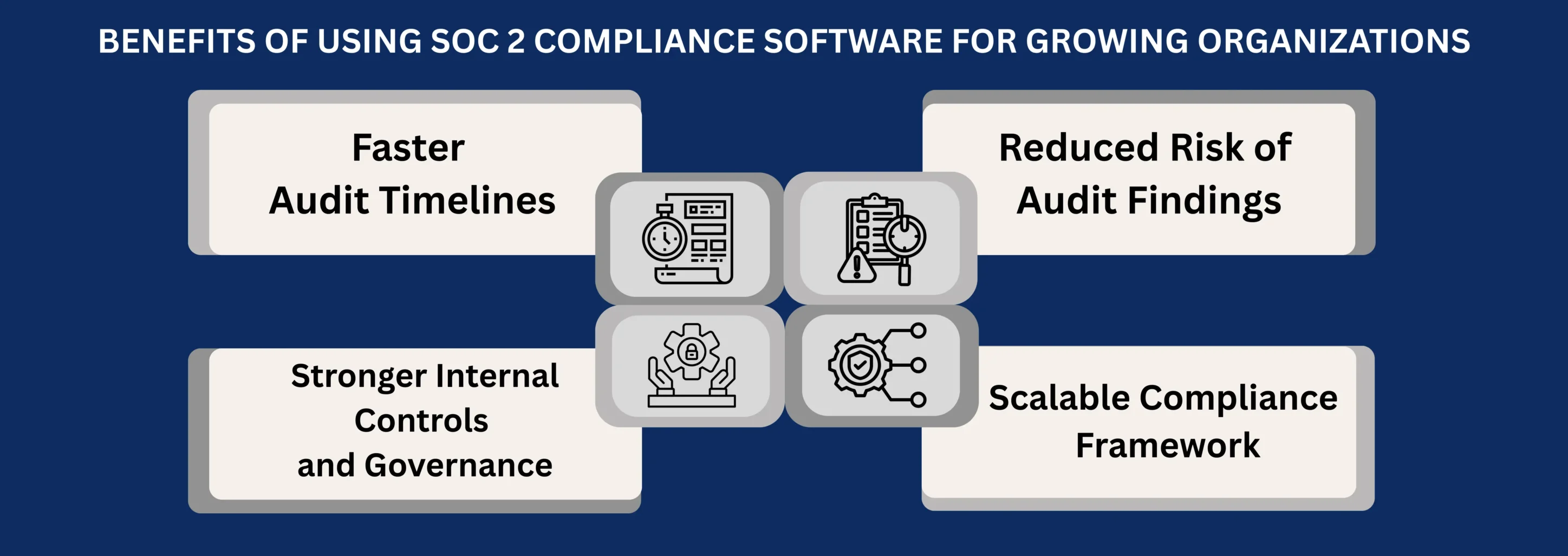
SOC 2 Certification in Boston delivers measurable, concrete benefits for service organizations across technology, healthcare, financial services, and research-driven sectors. These benefits extend beyond regulatory posture to directly influence revenue growth, customer acquisition, enterprise contract qualification, and operational risk management outcomes. For many Boston companies, completing a SOC 2 audit is the single most impactful step toward unlocking enterprise sales opportunities.
SOC 2 attestation functions as a critical sales enablement asset for technology companies pursuing enterprise customers in Boston. Large organizations—including the financial institutions, hospital networks, pharmaceutical companies, and technology enterprises concentrated in Greater Boston—routinely require current SOC 2 Type 2 reports before executing vendor contracts.
Without SOC 2 Certification in Boston, SaaS and cloud service providers may face extended security review timelines ranging from weeks to months, or may be disqualified from competitive evaluations entirely. Organizations presenting a current SOC 2 Type 2 report typically satisfy the majority of enterprise security questionnaire requirements through report review alone, eliminating the need for on-site assessments or custom audit engagements. This acceleration in the procurement process translates directly to shorter sales cycles, faster contract execution, and earlier revenue recognition for Boston technology companies serving enterprise markets.
The SOC 2 audit process drives measurable improvements in an organization’s internal control environment beyond the external assurance value of the attestation report. Boston organizations undergoing their first SOC 2 examination frequently identify control gaps in areas such as user access review frequency, privileged account management, vendor due diligence processes, and security incident logging completeness.
Addressing these gaps to satisfy the Trust Services Criteria produces a more mature, consistently governed security program that reduces the probability of data breaches, system outages, and unauthorized access events. The discipline of maintaining audit-ready evidence throughout a 12-month Type 2 observation period establishes organizational habits around control documentation, exception management, and accountability that persist beyond the audit itself. This continuous control discipline is particularly valuable for Boston organizations in regulated industries where regulatory examinations or customer audits may occur at any time.
In Boston’s competitive SaaS, AI, and technology services market, SOC 2 Certification serves as a meaningful differentiator among vendors competing for the same enterprise accounts. Buyers who evaluate multiple vendors with similar functional capabilities frequently use the presence and quality of SOC 2 attestation as a tie-breaking criterion. Organizations holding current SOC 2 Type 2 reports covering comprehensive Trust Services Criteria signal a higher level of operational maturity and security governance commitment than those with only Type 1 reports or self-declared SOC 2 compliance postures.
Additionally, SOC 2 Certification in Boston supports listing eligibility on enterprise cloud marketplaces including AWS Marketplace, Google Cloud Marketplace, and Microsoft Azure Marketplace, where security certification requirements gate access to large enterprise customer audiences. Boston technology companies that obtain SOC 2 Certification expand their total addressable market and remove a significant friction point in enterprise sales conversations.
- ✓Satisfies enterprise vendor security questionnaire requirements through independent SOC 2 attestation
- ✓Accelerates procurement timelines by eliminating the need for customer-conducted on-site security assessments
- ✓Demonstrates control effectiveness to institutional investors, board members, and audit committees
- ✓Supports cloud marketplace listing eligibility on AWS, Azure, and Google Cloud platforms
- ✓Provides documented evidence of security program maturity for regulatory examinations and customer due diligence
- ✓Establishes a repeatable annual SOC 2 audit cycle that sustains control discipline and evidence readiness
- ✓Strengthens contractual negotiating position in enterprise agreements requiring security attestation
- ✓Enterprise Customer Acquisition and Sales Cycle Acceleration
- ✓Risk Management and Internal Control Maturity
- ✓Competitive Differentiation in Boston’s Technology Market
SOC 2 vs. Other Security Certifications for Boston Organizations
Boston organizations frequently evaluate SOC 2 Certification alongside other security frameworks including ISO 27001, PCI DSS, HITRUST CSF, and FedRAMP. Each framework addresses distinct assurance objectives, customer audiences, and regulatory contexts. Understanding the specific differences enables Boston service organizations to select the certification pathway most aligned with their customer requirements and strategic market positioning.
SOC 2 vs. ISO 27001
SOC 2 and ISO 27001 are frequently compared because both address information security management, but they differ significantly in scope, structure, and geographic recognition. SOC 2 is a U.S.-origin attestation standard conducted by a Licensed CPA Firm under AICPA attestation standards, producing a detailed report that includes test results and control descriptions. ISO 27001 is an internationally recognized certification standard issued by accredited certification bodies, certifying that an organization has implemented an Information Security Management System (ISMS) conforming to ISO/IEC 27001 requirements.
SOC 2 is more commonly required by U.S. enterprise customers and is deeply embedded in North American technology procurement processes. ISO 27001 carries stronger recognition in European and Asia-Pacific markets. Boston organizations serving primarily U.S.-based enterprise customers should prioritize SOC 2 attestation, while those with significant international operations may benefit from pursuing both certifications. The two frameworks have meaningful control overlap, and organizations maintaining both often achieve efficiency in evidence collection and control design.
SOC 2 vs. HITRUST CSF for Healthcare Organizations
Boston-based healthcare technology organizations and health IT companies frequently encounter questions about SOC 2 versus HITRUST CSF. HITRUST is a comprehensive security framework incorporating requirements from HIPAA, NIST, ISO, and other standards. It is widely recognized among health systems, payers, and pharmaceutical organizations as a rigorous security assurance mechanism.
A SOC 2 examination in Boston provides flexibility to focus on the Trust Services Criteria most relevant to healthcare data protection, including Confidentiality and Privacy, and is conducted by a Licensed CPA Firm with full independence under AICPA standards. HITRUST is generally considered more prescriptive and involves a separate HITRUST-authorized assessor. Some Boston health tech organizations pursue SOC 2 Certification as their primary attestation and use it alongside HIPAA compliance documentation. Larger organizations serving hospital networks or major health systems may pursue HITRUST r2 certification to satisfy specific customer contractual requirements. The decision depends on the specific requirements of the organization’s target customer base in the Greater Boston healthcare market.
| Framework | Issuing Body | Primary Market | Report / Certificate | Key Boston Use Case |
|---|---|---|---|---|
| SOC 2 | Licensed CPA Firm (AICPA) | U.S. enterprise buyers | Attestation Report | SaaS, fintech, AI, and cloud services |
| ISO 27001 | Accredited certification body | International markets | Certificate of Conformity | Global operations and EU customers |
| HITRUST CSF | HITRUST-authorized assessor | U.S. healthcare sector | HITRUST Validated Report | Health IT and hospital vendors |
| PCI DSS | Qualified Security Assessor | Payment card industry | Report on Compliance | Fintech and payment processors |
| FedRAMP | Third-Party Assessment Organization (3PAO) | U.S. federal government | Authority to Operate (ATO) | GovTech and federal cloud services |
Industry-Specific SOC 2 Considerations for Boston Companies
SOC 2 Certification in Boston is relevant across multiple industries, but the specific Trust Services Criteria selected, control requirements emphasized, and evidence expectations encountered during the SOC 2 audit vary meaningfully by sector. Boston’s diverse technology ecosystem means that the SOC 2 examination must be scoped appropriately for the organization’s specific services, customer base, and data types. Selecting the right scope from the outset avoids gaps that could delay attestation or limit the report’s usefulness to enterprise customers.
SaaS and Cloud Service Providers
Boston’s extensive SaaS ecosystem—spanning enterprise software, marketing technology, HR platforms, project management tools, and business intelligence applications—represents the largest single category of organizations pursuing SOC 2 Certification in Boston. SaaS providers typically operate multi-tenant cloud environments where logical separation between customer data environments, access control governance, and API security are central examination focus areas.
The CPA Firm examines how the organization manages infrastructure security across cloud service provider environments such as AWS, Azure, or Google Cloud Platform, including shared responsibility model documentation and compensating controls for areas where cloud provider controls are relied upon. Subservice organization management—the process by which the SaaS organization oversees its own third-party technology vendors—is also examined during the SOC 2 audit to determine whether complementary controls adequately address risks not mitigated by subservice organizations. Boston SaaS organizations frequently pursue 12-month Type 2 observation periods covering the Security and Availability criteria to satisfy enterprise customer requirements across the full annual contract cycle.
Biotechnology, Pharmaceutical, and Life Sciences Organizations
Boston is a global center of biotechnology and pharmaceutical research, with organizations in Kendall Square, the Longwood Medical Area, and across Greater Boston managing highly sensitive research data, clinical trial information, intellectual property, and regulated electronic records. Life sciences technology vendors providing research data management platforms, electronic lab notebooks, clinical trial management systems, or bioinformatics services to pharma and biotech organizations frequently require SOC 2 attestation as part of vendor qualification.
The Confidentiality criterion is particularly important in this sector, as research data, genomic information, and drug development data must be protected against unauthorized disclosure throughout their lifecycle. Processing Integrity is relevant for organizations providing data analysis or reporting services where completeness and accuracy of output directly affects research validity. CertPro’s SOC 2 Certification process for Boston life sciences technology organizations addresses the intersection of AICPA Trust Services Criteria and the data integrity expectations of pharmaceutical and biotech customers operating under FDA 21 CFR Part 11 and GxP requirements.
Financial Services and Fintech Organizations
SOC 2 Certification for Boston fintech organizations and financial services technology providers addresses a specific set of control expectations driven by banking regulators, broker-dealers, investment managers, and institutional financial services customers. Fintech companies providing payment processing, lending platforms, wealth management tools, regulatory compliance technology, or financial data services to Boston’s financial services sector encounter SOC 2 Type 2 report requirements as a standard component of bank partner due diligence and institutional client onboarding.
The Security criterion controls for fintech SOC 2 audits typically include elevated scrutiny of encryption standards, key management practices, payment data handling procedures, and fraud detection system controls. Financial services customers in Boston frequently require audit periods covering 12 months and may request that reports include system descriptions addressing specific data flows relevant to their regulatory obligations. The SOC 2 examination report provides institutional buyers with the independent attestation evidence required to satisfy their own third-party risk management programs under OCC and FFIEC guidance.
SOC 2 Attestation: Understanding the Final Report
The SOC 2 attestation report is the formal output of the SOC 2 examination conducted by the Licensed CPA Firm. Understanding the structure and contents of the report enables Boston service organizations to communicate its assurance value effectively to customers, prospects, and stakeholders. The report is not a pass/fail certificate—it is a detailed, structured attestation document that provides transparency into the organization’s control environment and the CPA Firm’s examination findings. Organizations should be prepared to walk enterprise buyers through key sections of the SOC 2 attestation report as part of the vendor qualification conversation.
Report Structure and Key Components
The SOC 2 attestation report produced following a SOC 2 examination in Boston contains four primary sections. Section 1 is the independent service auditor’s report, which states the attestation opinion—unqualified, qualified, or adverse—and describes the scope of the examination, the Trust Services Criteria evaluated, and the observation period covered. Section 2 is management’s assertion, a formal representation by the service organization’s management that controls were suitably designed and operated effectively.
Section 3 is the system description, which describes the services provided, system components, and controls implemented to address the Trust Services Criteria. Section 4—applicable to Type 2 reports—contains the description of tests of controls and results, providing detailed evidence of which controls were tested, the testing procedures applied, and any exceptions identified. This level of transparency distinguishes the SOC 2 attestation report from certification documents produced by other frameworks and enables sophisticated buyers to conduct substantive review of the SOC 2 examination findings.
Report Validity, Distribution, and Annual Renewal
SOC 2 attestation reports are generally considered current for twelve months from the end of the observation period. Enterprise customers in Boston typically request reports with a period end date no older than twelve months and may request bridge letters for the period between the most recent report’s end date and the current date. Bridge letters—also termed comfort letters—are prepared by management and reviewed by the CPA Firm to provide limited assurance that no significant changes to the control environment have occurred during the gap period.
Organizations that allow their SOC 2 attestation to lapse—by failing to complete the next annual SOC 2 audit before the previous report expires—risk disrupting active enterprise relationships and triggering additional customer due diligence requests. Boston service organizations with multiple large enterprise customers frequently structure their SOC 2 audit cycles on a rolling 12-month basis to ensure a current report is always available. CertPro supports annual SOC 2 examination cycles through structured recertification engagements that build on the previous year’s findings and control documentation.
CertPro’s SOC 2 Audit Services in Boston
CertPro is a Licensed CPA Firm providing independent SOC 2 audit and attestation services to service organizations in Boston and across the Greater Boston technology and innovation ecosystem. CertPro conducts SOC 2 examinations exclusively as an independent audit and attestation provider under AICPA AT-C Section 205 attestation standards, issuing signed attestation reports that carry the institutional authority of a Licensed CPA Firm examination. CertPro’s SOC 2 audit engagements in Boston serve organizations across SaaS, fintech, healthcare technology, biotechnology, AI, cloud services, cybersecurity, financial services, and managed service provider sectors.
Independent Examination Under AICPA Attestation Standards
CertPro’s SOC 2 examinations are conducted in strict accordance with AICPA AT-C Section 205 attestation standards and the AICPA SOC 2 Guide. As a Licensed CPA Firm, CertPro maintains independence from the service organizations it examines, ensuring that attestation reports reflect objective, evidence-based evaluation rather than the organization’s own self-assessment.
CertPro’s audit professionals apply structured testing methodologies to evaluate both control design suitability and operating effectiveness, producing attestation reports that satisfy the disclosure requirements expected by enterprise customers, institutional investors, and regulatory bodies. The CPA Firm’s SOC 2 examination approach addresses all five Trust Services Criteria categories—Security, Availability, Processing Integrity, Confidentiality, and Privacy—with scoping customized to the specific services, system boundaries, and customer commitments of each Boston organization under examination. SOC 2 compliance assessments conducted by CertPro reflect the full rigor of AICPA attestation standards, distinguishing the firm’s reports from self-assessment tools and compliance automation outputs that lack CPA Firm attestation authority.
SOC 2 Examination Coverage for Boston’s Diverse Technology Sectors
CertPro’s SOC 2 examination experience encompasses the full range of technology sectors active in Boston’s innovation economy. For SaaS companies, CertPro’s audit teams evaluate multi-tenant architecture controls, API security governance, and cloud infrastructure configurations. For fintech organizations, the SOC 2 examination addresses payment security controls, financial data integrity, and regulatory interface control procedures.
Healthcare technology and life sciences organizations benefit from CertPro’s familiarity with HIPAA-adjacent control frameworks and the intersection of Trust Services Criteria with FDA data integrity requirements. AI and machine learning companies receive examination coverage addressing model governance, training data protection, and API access control relevant to the unique system architectures of AI-driven service platforms. CertPro issues SOC 2 Type 1 certification and SOC 2 Type 2 certification reports for Boston organizations that are recognized by enterprise procurement teams, institutional investors, and regulatory bodies as authoritative attestations of control effectiveness from an independent Licensed CPA Firm.
Getting Started with SOC 2 Certification in Boston
Initiating a SOC 2 Certification engagement in Boston begins with engaging a Licensed CPA Firm to conduct a formal scoping discussion. The scoping process identifies the services to be included, the Trust Services Criteria applicable to the organization’s service commitments, and the appropriate report type—Type 1 or Type 2—based on the organization’s timeline and customer requirements.
Boston organizations that have never undergone a SOC 2 audit should anticipate an initial engagement period that includes system description development, control documentation review, and Stage 1 assessment prior to commencing the observation period for a Type 2 examination. Early preparation—especially around access control records and policy documentation—significantly reduces the time and effort required to reach attestation.
Selecting the Right SOC 2 Scope for Your Organization
Scope selection is among the most consequential early decisions in the SOC 2 Certification process. Organizations that define scope too narrowly risk producing a report that does not satisfy customer requirements, while overly broad scope increases examination complexity and evidence production burden. The Licensed CPA Firm evaluates the organization’s service description, system boundaries, and customer contractual commitments to recommend an appropriate scope.
Boston organizations should review their existing customer contracts and security questionnaire responses to identify which Trust Services Criteria are most frequently cited by their enterprise customers. SaaS and cloud providers typically need the Security and Availability criteria at minimum. Organizations handling personal information should include Privacy. Those providing data processing, analytics, or reporting services should consider Processing Integrity. The criteria selected are disclosed in the SOC 2 attestation report and communicated to customers reviewing the SOC 2 examination findings.
Frequently Asked Questions About SOC 2 Certification in Boston
| Question | Answer |
|---|---|
| What is SOC 2 Certification? | SOC 2 Certification is a formal attestation issued by a Licensed CPA Firm under AICPA AT-C Section 205 standards, confirming that a service organization’s controls meet the Trust Services Criteria for security, availability, processing integrity, confidentiality, and/or privacy. |
| Who can issue a SOC 2 attestation report? | Only a Licensed CPA Firm is authorized to issue a SOC 2 attestation report under AICPA attestation standards. Compliance automation platforms, consultants, and non-CPA firms cannot produce a valid SOC 2 attestation. |
| How long does a SOC 2 Type 2 audit take in Boston? | A SOC 2 Type 2 audit typically requires a 6 to 12-month observation period plus fieldwork and report issuance. The total calendar time from engagement initiation to report issuance is generally 9 to 15 months for first-time organizations. |
| What is the difference between SOC 2 Type 1 and Type 2? | SOC 2 Type 1 evaluates control design suitability at a point in time. SOC 2 Type 2 evaluates both design suitability and operating effectiveness over a defined observation period, typically 6 to 12 months. |
| Is SOC 2 Certification required by law in Massachusetts? | SOC 2 Certification is not a direct legal requirement under Massachusetts law. However, it provides documented evidence of control effectiveness supporting compliance with the Massachusetts Data Security Regulation (201 CMR 17.00) and is required by many enterprise customers. |
| How long is a SOC 2 attestation report valid? | SOC 2 attestation reports are generally considered current for twelve months from the observation period end date. Enterprise customers typically require a current report with a period end date within the last twelve months. |
| Which Trust Services Criteria should a Boston SaaS company include? | Boston SaaS companies should include the Security criterion (mandatory) and typically Availability to address uptime commitments. Organizations handling personal information should add Privacy, while those providing data processing services may include Processing Integrity. |
| How does SOC 2 differ from ISO 27001 for Boston organizations? | SOC 2 is a U.S.-origin attestation conducted by a Licensed CPA Firm, producing a detailed report with test results recognized by U.S. enterprise buyers. ISO 27001 is an internationally recognized certification with stronger recognition in European and Asia-Pacific markets. |
FAQ
▶
What is SOC 2 compliance refers to an organization’s adherence to internal?
▶
What is SOC 2 certification?
▶
Who needs SOC 2 certification?
▶
How long does the SOC 2 certification process take?
▶
What are the benefits of SOC 2 certification?
▶
How should an organization prepare for SOC 2 certification?
▶
What does the SOC 2 audit assess?
▶
What happens after SOC 2 certification is achieved?
SOC 1 VS SOC 2: WHICH REPORT YOUR CUSTOMERS ACTUALLY ASK FOR
If you sell SaaS or provide outsourced services, you have likely been asked for a SOC report. However, the follow-up question is rarely easy to answer…

AICPA Issues New Guidance for Peer Reviewers Evaluating SOC 2 Engagements
AICPA SOC 2 guidance has been issued to help peer reviewers identify quality risks associated with SOC 2 engagements as the use of compliance automati…
SOC 2 Certified: What Does It Mean for Your Business
For companies that handle sensitive data or run cloud-based services, the question “Can you provide your SOC 2 report?” carries enormous weight. Yet, …
Get In Touch
have a question? let us get back to you.