
ISO 42001 Certification Certification in Cebu
Executive Summary: CertPro is a Licensed CPA Firm delivering ISO 42001 Certification in Cebu through structured audit evaluation, standards-based assessment, and formal certification decisions. CertPro evaluates AI Management System (AIMS) compliance against ISO/IEC 42001:2023 requirements, serving Cebu-based organizations across BPO, IT, healthcare, and financial services sectors. Our fixed-pricing audit programs make ISO 42001 Certification accessible and cost-predictable for organizations of all sizes.
OUR CLIENTS









What Is ISO 42001?
ISO/IEC 42001:2023 is the internationally recognized standard published jointly by the International Organization for Standardization (ISO) and the International Electrotechnical Commission (IEC). It specifies requirements for establishing, implementing, maintaining, and continually improving an Artificial Intelligence Management System (AIMS) within any organization that develops, deploys, or uses AI-based products and services. ISO 42001 Certification represents formal, third-party verified conformance to this standard. It is issued following a structured ISO 42001 audit conducted by an accredited certification body.
Standard Definition and Publication Context
ISO/IEC 42001:2023 was published in December 2023, making it the first globally recognized management system standard explicitly designed to govern artificial intelligence. The standard was developed under ISO/IEC Joint Technical Committee 1, Subcommittee 42 (JTC 1/SC 42), which focuses specifically on AI standardization. Its publication reflects the international regulatory community’s recognition that AI systems present unique governance challenges — including algorithmic bias, lack of transparency, uncontrolled automation risk, and societal impact — that existing management system standards do not fully address.
The standard applies universally. Any organization — regardless of size, industry sector, or geographic location — that develops, provides, or uses AI-based products and services falls within its scope. For businesses pursuing ISO 42001 Certification in Cebu, this scope encompasses organizations operating AI-driven customer service platforms, automated data analytics pipelines, machine learning-based fraud detection systems, natural language processing tools, and any other AI-enabled operational function. The standard does not prescribe specific AI technologies. Instead, it establishes a governance and control framework applicable across all AI modalities.
Relationship to the ISO Management System Family
ISO 42001 follows the ISO High-Level Structure (HLS), formerly known as Annex SL, which provides a common framework architecture shared across all modern ISO management system standards. This structural alignment makes ISO 42001 directly compatible with ISO 9001 (Quality Management), ISO 27001 (Information Security Management), ISO 22301 (Business Continuity Management), and ISO 27701 (Privacy Information Management). Organizations in Cebu that have already implemented one or more of these standards can integrate AIMS requirements into their existing management system infrastructure, reducing duplication of documentation, policy frameworks, and internal audit activities.
The shared clause structure — covering context of the organization, leadership, planning, support, operation, performance evaluation, and improvement — means that Cebu enterprises with ISO 27001 or ISO 9001 certifications already possess governance infrastructure transferable to ISO 42001 compliance requirements. This integration potential is particularly relevant for Cebu IT companies and BPO operators who maintain dual certification portfolios to satisfy client and regulatory requirements simultaneously. ISO 42001 Certification in Cebu therefore represents a natural extension of existing compliance frameworks rather than a standalone undertaking for many local enterprises.
AI-Specific Risk Governance Purpose
The core governance purpose of ISO 42001 is to establish systematic controls over AI-specific risks that existing management standards were not designed to address. These risks include algorithmic bias and discriminatory outputs, lack of explainability and transparency in AI decision-making, data quality and integrity failures that propagate errors through AI systems, security vulnerabilities unique to machine learning models, and unintended societal consequences from large-scale AI deployment. The standard requires organizations to identify, assess, treat, and monitor these risks within a documented, auditable management framework — precisely the function that an ISO 42001 AIMS audit evaluates and certifies.

AI Management System (AIMS) Framework
An Artificial Intelligence Management System (AIMS) is a structured set of policies, processes, controls, and governance mechanisms designed to ensure that an organization’s AI systems are developed, deployed, and operated responsibly, ethically, and in compliance with applicable legal and regulatory requirements. ISO 42001 defines the requirements that an AIMS must fulfill to achieve certification. The AIMS framework is not a technology system — it is a management discipline that governs how AI is managed within an organization rather than prescribing which AI technologies to use.
Core Components of the AIMS Framework
The AIMS framework under ISO 42001 comprises several interconnected components that together form a comprehensive AI governance structure. First, the organizational context component requires enterprises to identify internal and external factors affecting AI governance, including stakeholder expectations, regulatory obligations, and the nature of AI systems in use. Second, the leadership component mandates top management commitment to AI policy, resource allocation, and accountability assignment. Third, the planning component requires systematic AI risk assessment and opportunity identification, including documented risk treatment plans with defined controls.
Fourth, the support component addresses competence requirements for personnel involved in AI development and oversight, awareness programs, communication protocols, and documentation management. Fifth, the operational component governs AI system lifecycle management — from design and data acquisition through model training, deployment, monitoring, and decommissioning. Sixth, performance evaluation requires internal audits, management reviews, and key performance indicators tracking AIMS effectiveness. Seventh, the improvement component drives corrective action on nonconformities and continual enhancement of AI governance practices. For organizations seeking AI Management System certification in Cebu, each of these components must be demonstrably implemented and auditable before ISO 42001 Certification can be issued.
Annex A Controls Specific to AI Governance
ISO 42001 includes Annex A, which provides a catalog of AI-specific controls that organizations may apply based on their risk assessment outcomes. These controls address areas including AI policy documentation, AI risk and impact assessments, data governance for AI training and validation datasets, AI system transparency and explainability requirements, human oversight mechanisms for automated AI decisions, AI supplier management, third-party AI system governance, and incident response procedures for AI system failures or adverse outputs. Unlike ISO 27001’s Annex A — which contains 93 mandatory-reference controls — ISO 42001’s Annex A controls are selected based on applicability to the organization’s specific AI risk profile.
During an ISO 42001 AIMS audit, auditors evaluate not only whether the required Annex A controls have been selected and documented in a Statement of Applicability, but also whether they are effectively implemented and operationally embedded within the organization’s AI governance processes. This distinction — between documented intent and operational reality — is central to the audit evaluation methodology. For Cebu companies that integrate AI into customer-facing operations, the human oversight and transparency controls carry particular weight in ISO 42001 audit assessments.
AI Impact Assessment Requirements
A distinctive feature of the ISO 42001 AIMS framework is the mandatory requirement for AI impact assessments. Unlike traditional risk assessments that focus solely on organizational risk, AI impact assessments under ISO 42001 extend the evaluation scope to include potential impacts on individuals, communities, and society at large. Organizations must systematically identify scenarios in which AI system outputs could cause harm — including discriminatory treatment, privacy violations, economic harm, or erosion of human autonomy — and implement controls to prevent or mitigate such outcomes. This requirement aligns directly with the Philippines’ Data Privacy Act of 2012 and emerging AI governance expectations applicable to Cebu-based enterprises operating internationally.
ISO 42001 Certification Requirements in Cebu
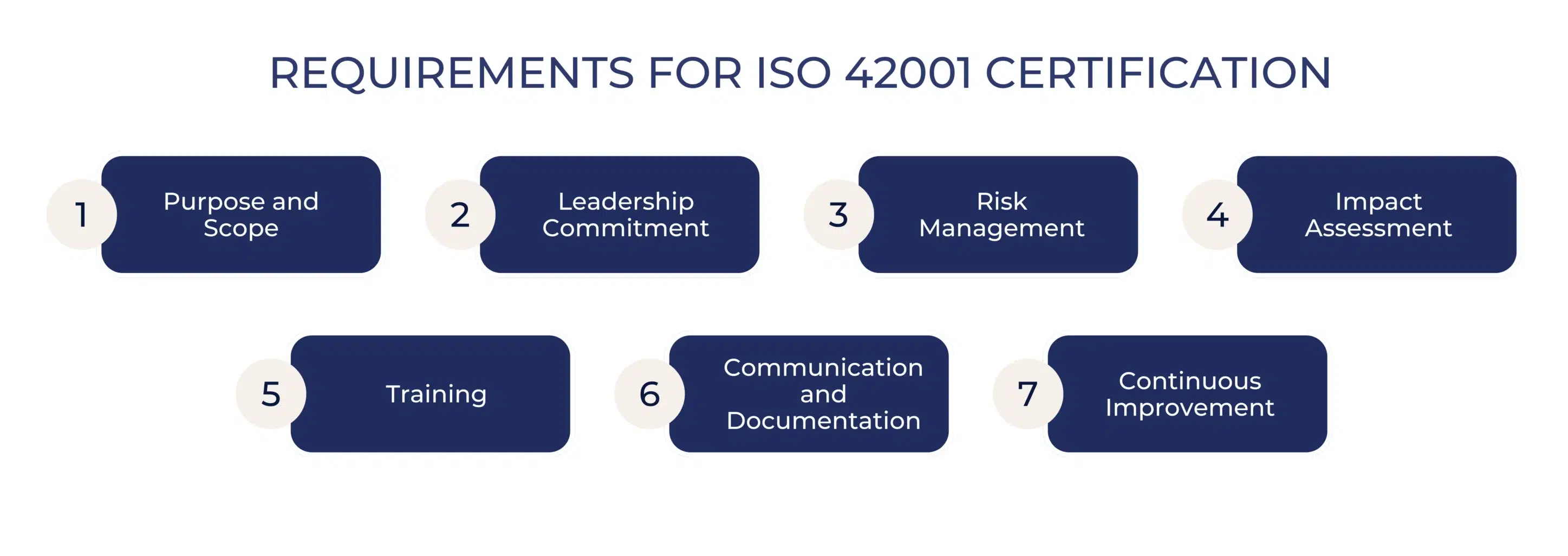
ISO 42001 compliance in Cebu requires organizations to fulfill a structured set of clause-level requirements drawn directly from ISO/IEC 42001:2023. These requirements span documentation, governance, operational controls, and performance monitoring. Understanding each requirement category is essential for organizations preparing for an ISO 42001 audit in Cebu. The following outlines the primary compliance criteria that a certification body evaluates during the formal audit process.
ISO 42001 mandates that organizations maintain a defined set of documented information as evidence of AIMS implementation and operational control. Required documentation includes an AI policy approved and communicated by top management, a scope statement defining the boundaries of the AIMS, an AI risk assessment report with documented risk treatment decisions, a Statement of Applicability identifying selected Annex A controls with justifications for inclusions and exclusions, documented AI objectives with measurable targets, records of management reviews, and records of internal audit findings and corrective actions. Each document must be version-controlled, accessible to relevant personnel, and protected from unauthorized modification.
For Cebu organizations in the BPO sector, documentation requirements extend to records of AI system inventories — cataloging every AI tool, algorithm, and automated decision system in operational use. This inventory requirement is frequently underestimated by organizations new to ISO 42001 compliance in Cebu. A comprehensive AI inventory must include system purpose, data inputs, output types, decision authority level (automated versus human-reviewed), and applicable risk classification. Documentation completeness and traceability are primary evaluation criteria in Stage 1 of the ISO 42001 audit process.
ISO 42001 places explicit requirements on top management to demonstrate active leadership of the AIMS. These requirements include establishing and communicating an AI policy that reflects the organization’s commitment to responsible AI governance, assigning roles and responsibilities for AIMS oversight, ensuring adequate resources are allocated to AIMS implementation and maintenance, and integrating AI governance objectives with overall organizational strategy. Top management must also demonstrate awareness of AI-specific risks and their potential organizational and societal consequences. This awareness is directly evaluated during management interviews conducted as part of the ISO 42001 audit process in Cebu.
Operational requirements under ISO 42001 govern the complete AI system lifecycle. Organizations must establish controlled processes for AI system design and specification, data acquisition and quality validation, model training and testing, system deployment and integration, operational monitoring for performance degradation or adverse outputs, and system retirement or replacement. Technical controls must address data provenance, model version control, performance benchmarking, and anomaly detection. For Cebu IT companies operating AI platforms for international clients, these operational controls must also address cross-border data transfer governance and client-specific AI use policy compliance.
| ISO 42001 Clause | Requirement Area | Key Evidence Required |
|---|---|---|
| Clause 4 | Organizational Context | Stakeholder analysis, AI inventory, scope statement |
| Clause 5 | Leadership | AI policy, roles and responsibilities documentation |
| Clause 6 | Planning | Risk assessment report, Statement of Applicability |
| Clause 9 | Performance Evaluation | Internal audit records, management review minutes |
| Clause 10 | Improvement | Corrective action records, AIMS improvement log |
- ✓Documentation Requirements
- ✓Leadership and Governance Requirements
- ✓Operational and Technical Requirements
ISO 42001 Certification Process
The ISO 42001 Certification process follows a structured, sequenced pathway from initial organizational preparation through formal audit evaluation and final certification decision. CertPro, operating as a Licensed CPA Firm, administers this process through defined audit stages with clear deliverables at each phase. The following numbered sequence describes the complete certification pathway for organizations pursuing ISO 42001 Certification in Cebu.
- AI System Inventory and Scope Definition: The organization catalogs all AI systems, platforms, and automated decision tools in operational use and defines the AIMS scope boundaries, identifying which AI systems fall within the certification perimeter.
- AIMS Policy and Governance Structure Establishment: Top management approves a formal AI policy and assigns AIMS roles including an AI Management Representative, risk owners, and data governance leads.
- AI Risk Assessment Execution: A structured risk assessment evaluates all in-scope AI systems for bias risk, transparency gaps, data integrity vulnerabilities, security exposures, and societal impact potential.
- Statement of Applicability Development: The organization documents selected Annex A controls, with justifications for inclusions and exclusions, signed off by authorized management.
- AIMS Controls Implementation: Selected controls are operationally embedded across AI system lifecycle processes, including data governance procedures, human oversight protocols, and monitoring mechanisms.
- Internal AIMS Audit Execution: An internal audit evaluates AIMS conformance against ISO 42001 clause requirements, generating findings and corrective action records prior to the external ISO 42001 audit.
- Management Review Completion: Top management formally reviews AIMS performance, audit findings, risk status, and objectives achievement, with minutes documented as mandatory certification evidence.
- Stage 1 Certification Audit (Document Review): CertPro auditors conduct a structured review of all AIMS documentation to assess scope adequacy, policy completeness, and readiness for Stage 2.
- Stage 2 Certification Audit (Operational Assessment): CertPro auditors conduct on-site or remote operational evaluation, interviewing personnel, observing AI system controls, and testing implementation effectiveness.
- Nonconformity Resolution: Any major or minor nonconformities identified during Stage 2 are addressed by the organization through documented corrective actions and objective evidence submission.
- Certification Decision and Issuance: CertPro’s certification panel reviews the complete audit record and issues ISO 42001 Certification upon confirmed conformance, with a certificate valid for three years subject to annual surveillance.
- Surveillance Audits and Recertification: Annual surveillance audits verify continued AIMS conformance; a full recertification audit is conducted at the three-year mark to renew ISO 42001 Certification.
The typical timeline for completing the full ISO 42001 Certification process — from initial scope definition through certificate issuance — ranges from three to six months for organizations with established management system infrastructure, and six to twelve months for organizations implementing an AIMS from baseline. Organizations in Cebu that already hold ISO 27001 or ISO 9001 certifications commonly complete the process within the shorter timeframe, due to the compatibility of existing governance infrastructure with ISO 42001 requirements.

ISO 42001 Audit Process
The ISO 42001 audit is a formal, evidence-based evaluation conducted by CertPro as a Licensed CPA Firm to determine whether an organization’s AIMS conforms to the requirements of ISO/IEC 42001:2023. The ISO 42001 AIMS audit is structured across defined stages, each with specific objectives, evidence requirements, and evaluation criteria. CertPro’s audit methodology is grounded in ISO 19011 (Guidelines for Auditing Management Systems) and calibrated to the unique governance dimensions of AI systems.
Stage 1 of the ISO 42001 AIMS audit focuses on documentary evaluation. CertPro auditors systematically review the organization’s AIMS documentation portfolio to assess scope completeness, policy adequacy, risk assessment methodology, and documentation system integrity. The Stage 1 audit produces a formal finding report identifying areas of conformance, minor gaps requiring attention before Stage 2, and any systemic documentation deficiencies that would constitute major nonconformities if left unresolved. Stage 1 is typically conducted remotely, with document packages submitted electronically for structured auditor review.
A critical output of Stage 1 is the determination of Stage 2 audit readiness. If documentation review reveals material gaps — such as an incomplete Statement of Applicability, an AI risk assessment that excludes significant in-scope systems, or absent management review records — Stage 2 cannot proceed until the organization addresses identified deficiencies. This gate function ensures that the Stage 2 operational assessment focuses on genuine conformance evaluation rather than basic documentation verification. For organizations undergoing an ISO 42001 audit in Cebu for the first time, Stage 1 findings frequently identify AI system inventory gaps as the most common documentation deficiency.
Stage 2 of the ISO 42001 AIMS audit in Cebu is the primary operational conformance evaluation. CertPro auditors conduct structured interviews with key personnel — including top management, AI system owners, data governance leads, IT operations staff, and compliance officers — to assess AIMS understanding, role clarity, and operational execution. Auditors also examine operational records, system monitoring logs, training completion records, incident registers, and corrective action tracking documentation. Physical or virtual observation of AI system controls in operation may be conducted where applicable.
The Stage 2 evaluation produces a formal audit report classifying findings as major nonconformities (systemic failures in AIMS implementation that prevent certification), minor nonconformities (isolated deviations from requirements that can be resolved post-audit), or observations (improvement opportunities not constituting formal nonconformities). Major nonconformities must be fully resolved with verified objective evidence before the certification decision can be issued. Minor nonconformities require documented corrective action plans with defined timelines and are verified at the first surveillance audit. The ISO 42001 AIMS audit at Stage 2 typically requires two to four audit days, depending on organizational size and AIMS scope complexity.
ISO 42001 Certification is valid for a three-year certification cycle, subject to successful annual surveillance audits. Surveillance audits — conducted approximately twelve months and twenty-four months after initial certification — evaluate continued AIMS conformance, verify resolution of minor nonconformities from the previous audit cycle, assess whether significant changes to AI systems or organizational context have been reflected in AIMS updates, and confirm that management review and internal audit activities remain active. Surveillance audits are typically narrower in scope than initial certification audits, focusing on specific clauses and high-risk areas rather than the full AIMS. At the end of the three-year cycle, a full recertification audit reassesses the complete AIMS against current ISO 42001 requirements.
- ✓Stage 1 Audit: Document and Readiness Evaluation
- ✓Stage 2 Audit: Operational Conformance Assessment
- ✓Surveillance Audits and Recertification
ISO 42001 Compliance and Regulatory Alignment in Cebu
ISO 42001 compliance in Cebu operates within a broader regulatory environment that includes the Philippines’ Data Privacy Act of 2012 (Republic Act 10173), National Privacy Commission (NPC) issuances, and emerging international AI governance frameworks that affect Cebu-based enterprises with global operations. Understanding the alignment between ISO 42001 requirements and these regulatory obligations is essential for organizations seeking comprehensive AI governance compliance rather than fragmented point solutions.
Alignment with the Philippines Data Privacy Act
The Philippines Data Privacy Act of 2012 establishes data protection obligations for organizations processing personal information of Philippine residents, including requirements for lawful basis of processing, data subject rights, security of personal data, and breach notification. ISO 42001’s data governance controls — particularly those addressing AI training data quality, data lineage documentation, and individual impact assessments — directly support DPA compliance in the context of AI system operation. When AI systems process personal data (as is common in BPO customer service automation, healthcare AI tools, and financial services fraud detection), ISO 42001 and DPA obligations converge. The AIMS framework provides a documented governance structure that satisfies both regulatory and certification requirements simultaneously.
For Cebu BPO operators processing client personal data through AI-driven automation tools, ISO 42001 Certification provides an auditable governance record demonstrating to the National Privacy Commission and international clients that AI-related data risks are systematically identified, controlled, and monitored. This dual compliance value — satisfying both ISO 42001 certification requirements and DPA accountability obligations — makes ISO 42001 AIMS audit engagements in Cebu particularly valuable for organizations with high volumes of personal data processed through automated systems.
International AI Regulatory Alignment
Cebu-based organizations serving international clients — particularly those operating in the European Union, United States, or Singapore — face increasing exposure to international AI governance regulations. The EU AI Act, enacted in 2024, establishes risk-based requirements for AI systems operating in or affecting EU markets, with significant obligations for high-risk AI applications in areas such as employment, credit assessment, and biometric identification. ISO 42001 Certification in Cebu provides organizations with an internationally recognized governance framework that demonstrates alignment with the principles underlying the EU AI Act, including risk-based AI classification, transparency obligations, human oversight requirements, and continuous monitoring mandates.
Singapore’s Model AI Governance Framework and the US National Institute of Standards and Technology (NIST) AI Risk Management Framework similarly align with ISO 42001’s governance principles, enabling Cebu organizations to use their ISO 42001 Certification as evidence of AI governance maturity across multiple regulatory jurisdictions. This multi-jurisdictional alignment is a strategic compliance advantage for technology hub enterprises in Cebu that serve globally distributed client bases from Cebu City operations centers.
AI Governance and Contractual Compliance
Beyond statutory regulation, ISO 42001 compliance in Cebu increasingly intersects with contractual AI governance requirements imposed by enterprise clients on their service providers. Global technology companies, financial institutions, and healthcare organizations routinely include AI governance requirements in vendor and supplier contracts, requiring evidence of structured AI risk management, data governance controls, and documented human oversight mechanisms. ISO 42001 Certification provides the most comprehensive and internationally recognized evidence of such governance capability. It enables Cebu organizations to satisfy client contractual requirements through a single, auditable certification rather than responding to fragmented client questionnaires and ad-hoc compliance requests.
Benefits of ISO 42001 Certification for Cebu Businesses
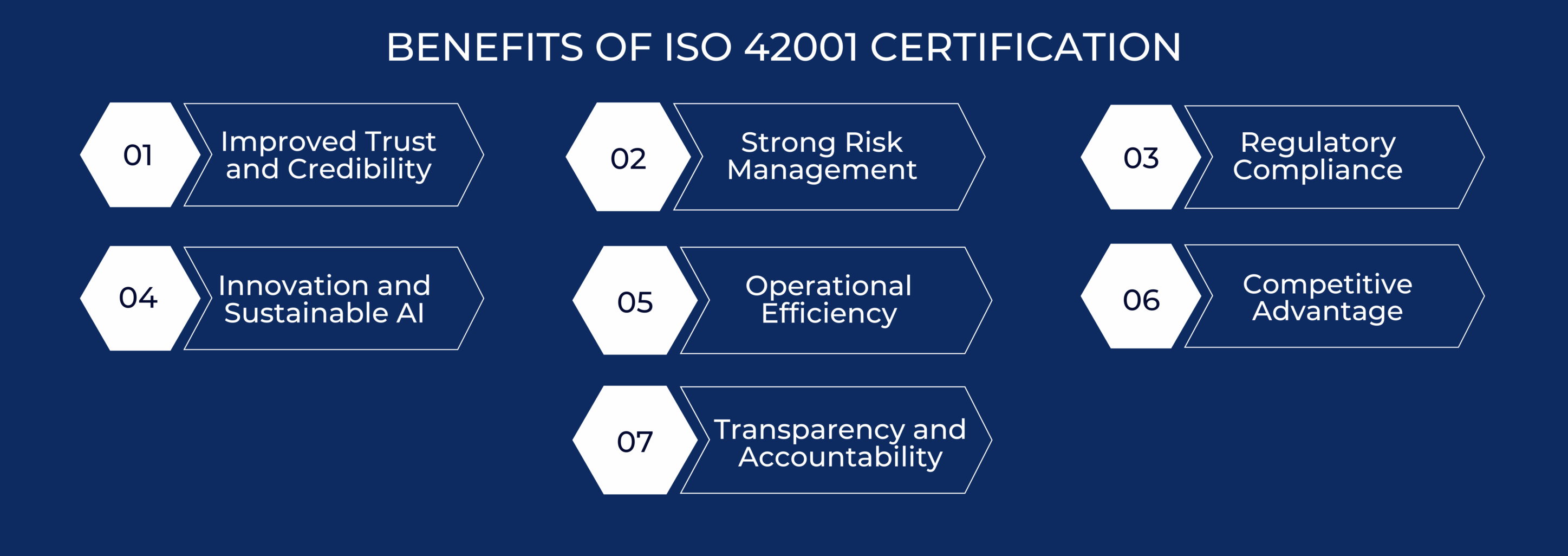
ISO 42001 Certification in Cebu delivers measurable, multi-dimensional benefits for organizations operating AI systems in competitive, regulated, and internationally exposed markets. These benefits span operational risk reduction, market differentiation, regulatory compliance, stakeholder trust, and long-term governance sustainability. The following outlines the primary benefits realized by Cebu organizations that achieve and maintain ISO 42001 Certification.
- ✓Demonstrated AI governance credibility: ISO 42001 Certification provides internationally recognized, third-party verified evidence that an organization’s AI systems are governed by structured, auditable controls — establishing credibility with clients, regulators, and partners.
- ✓Regulatory compliance assurance: Certification creates documented evidence of AI risk management and governance controls that satisfy regulatory expectations under the Philippines Data Privacy Act, EU AI Act, and other applicable frameworks.
- ✓Competitive differentiation in global markets: For BPO and IT companies pursuing ISO 42001 Certification in Cebu, certification distinguishes organizations in competitive procurement processes where AI governance capabilities are evaluated.
- ✓Reduction of AI-related operational risk: Systematic identification and treatment of AI risks — including bias, transparency failures, and data integrity issues — reduces the probability and impact of costly AI system failures or adverse outputs.
- ✓Enhanced client and investor trust: Certification signals organizational commitment to responsible AI use, supporting client retention, new business development, and investor confidence in AI governance maturity.
- ✓Alignment with international standards and frameworks: ISO 42001 alignment positions Cebu organizations to efficiently respond to international AI governance requirements without redundant compliance activities.
- ✓Improved internal AI governance culture: AIMS implementation drives organizational awareness of AI risks and governance responsibilities, building a culture of accountability across all AI system stakeholders.
- ✓Support for AI innovation with controlled risk: A certified AIMS provides the governance guardrails within which organizations can responsibly innovate and expand AI use without uncontrolled risk accumulation.
- ✓Supply chain and vendor AI risk management: ISO 42001 controls include third-party AI governance requirements, enabling organizations to systematically manage AI risks introduced by suppliers and technology vendors.
- ✓Continuous improvement of AI system governance: The AIMS framework’s built-in review and improvement cycles ensure that AI governance evolves alongside AI technology developments and regulatory changes.
For financial services organizations seeking ISO 42001 Certification in Cebu, the benefit of regulatory alignment is particularly significant. Financial institutions using AI for credit scoring, fraud detection, anti-money laundering screening, and customer risk profiling face heightened scrutiny regarding algorithmic fairness, explainability, and data governance. ISO 42001 Certification provides these organizations with a structured governance record demonstrating that AI systems are subject to documented risk controls, periodic audits, and management oversight — directly satisfying Bangko Sentral ng Pilipinas (BSP) expectations for AI governance in supervised financial institutions.
Industries in Cebu That Require ISO 42001 Certification
Multiple industry sectors operating in Cebu face compelling drivers — regulatory, contractual, and competitive — to pursue ISO 42001 Certification. Cebu’s position as a major BPO, IT-BPM, healthcare, and financial services hub means that AI adoption is widespread, and AI governance requirements are correspondingly diverse. The following sector-specific analysis identifies the primary industries in Cebu for which ISO 42001 Certification is particularly relevant and increasingly expected.
BPO and IT-BPM Sector
Cebu’s BPO and IT-BPM sector — concentrated in Cebu IT Park, Asiatown IT Park, and the Cebu Business Park — is among the most AI-intensive in the Philippines. BPO organizations deploy AI across customer service (chatbots, virtual agents), quality assurance (AI-powered call monitoring and scoring), workforce management (predictive scheduling and performance analytics), and back-office automation (intelligent document processing and robotic process automation). BPO industry participants pursuing ISO 42001 Certification in Cebu increasingly encounter client requirements for AI governance certification as global companies impose AI vendor governance standards on their outsourcing partners.
The BPO sector’s exposure to personal data — including sensitive customer information processed on behalf of global clients — makes the convergence of ISO 42001 and data protection governance particularly relevant. BPO operators in Cebu that achieve ISO 42001 Certification alongside ISO 27001 and ISO 27701 certifications present a comprehensive governance posture that satisfies both AI-specific and information security client requirements. This positions them as preferred governance-mature outsourcing partners in competitive global procurement processes.
IT and Technology Companies
ISO 42001 Certification for Cebu IT companies encompasses software development firms, cloud service providers, AI product developers, and technology platform operators based in Cebu. These organizations face dual exposure: they develop AI systems for clients (triggering ISO 42001 obligations as AI providers) and operate internal AI tools for business operations (triggering obligations as AI users). For AI product developers specifically, ISO 42001 Certification demonstrates to enterprise clients that AI systems embedded in products are governed by certified risk management controls — a growing procurement requirement in regulated sectors such as healthcare technology, financial technology, and government technology.
Financial Services and Banking
Financial services organizations in Cebu — including banks, fintech companies, insurance providers, and credit institutions — face both regulatory expectations and competitive pressures to demonstrate responsible AI governance. The Bangko Sentral ng Pilipinas has issued guidance on AI governance and model risk management for supervised financial institutions, creating regulatory expectations that align directly with ISO 42001 AIMS requirements. ISO 42001 Certification provides Cebu-based financial institutions with an auditable governance framework that satisfies BSP expectations, client trust requirements, and international correspondent banking due diligence inquiries regarding AI risk management practices.
Healthcare and Medical Technology
Healthcare organizations in Cebu — including hospitals, clinical laboratories, telemedicine platforms, and health information technology providers — are rapidly adopting AI for clinical decision support, diagnostic imaging analysis, patient risk stratification, and administrative automation. Medical AI applications carry the highest potential for harm if AI governance controls fail: misdiagnoses, inappropriate treatment recommendations, and privacy violations involving sensitive health data are among the risk scenarios requiring systematic governance. ISO 42001 Certification provides healthcare organizations with the governance framework necessary to deploy medical AI responsibly, satisfying Department of Health (DOH) oversight expectations and international medical device regulatory requirements applicable to AI-enabled medical technologies.
| Industry Sector | Primary AI Applications | Key ISO 42001 Driver |
|---|---|---|
| BPO / IT-BPM | Customer service AI, automation, analytics | Client contractual AI governance requirements |
| IT / Technology | AI product development, cloud AI services | Enterprise client procurement requirements |
| Financial Services | Credit scoring, fraud detection, AML | BSP AI governance guidance, regulatory alignment |
| Healthcare | Clinical decision support, diagnostic AI | DOH oversight, patient safety governance |
| Retail / E-Commerce | Recommendation engines, demand forecasting | Consumer protection and data privacy alignment |
Why CertPro for ISO 42001 Certification in Cebu
CertPro is a Licensed CPA Firm delivering ISO 42001 Certification in Cebu through a structured, standards-grounded audit methodology that prioritizes evaluation rigor, certification integrity, and organizational clarity. CertPro’s engagement model is exclusively focused on certification audit services — not consulting, not advisory, not implementation support. This singular focus ensures that CertPro’s role as an independent, objective certification body is preserved throughout the ISO 42001 audit and certification process, maintaining the credibility and international recognition of all certificates issued.
Licensed CPA Firm Positioning and Audit Authority
CertPro’s identity as a Licensed CPA Firm distinguishes it from non-certified consultancies offering informal AI governance assessments. As a Licensed CPA Firm, CertPro operates under professional licensing obligations, ethical standards, and audit methodology requirements that govern the quality and integrity of all certification engagements. ISO 42001 Certification issued by CertPro carries the institutional authority of a formally licensed audit organization — not the informal opinion of an advisory firm — providing organizations in Cebu with certification that withstands regulatory scrutiny, client due diligence, and third-party verification.
CertPro’s audit teams include professionals with verified expertise in AI governance frameworks, ISO management system auditing, and the regulatory environments applicable to Cebu-based industries. Auditors evaluate AIMS implementation against the specific clause requirements of ISO/IEC 42001:2023 using structured audit programs tailored to the organization’s AI system scope, industry context, and risk profile. This tailored-yet-standards-grounded approach ensures that each ISO 42001 audit engagement in Cebu generates actionable, accurate conformance assessments rather than generic evaluations.
Fixed-Pricing Audit Programs
CertPro offers fixed-pricing audit programs for ISO 42001 Certification in Cebu, providing organizations with cost certainty across the complete certification engagement. Fixed pricing eliminates the budget uncertainty associated with hourly-billed audit engagements and enables organizations to plan certification expenditure as a defined compliance investment. CertPro’s pricing structure is calibrated to organizational size (employee count, AI system complexity, and operational scope) and the level of integration with existing ISO certification programs. Organizations combining ISO 42001 with existing ISO 27001 or ISO 9001 certifications under an integrated audit program benefit from reduced total audit scope and corresponding pricing efficiency.
The ISO 42001 certification cost in Cebu varies based on the number of AI systems within scope, organizational size, existing management system maturity, and whether the certification is pursued as a standalone engagement or integrated with existing ISO certification surveillance cycles. CertPro provides a formal pricing proposal following an initial scope assessment, ensuring that organizations receive accurate cost information before committing to the certification engagement. This transparent pricing model reflects CertPro’s institutional commitment to clear, auditable engagement governance.
Local Cebu Presence and Market Understanding
CertPro’s audit teams serving Cebu organizations possess direct knowledge of the local business environment — including the BPO sector’s AI adoption patterns, the technology infrastructure of Cebu IT Park and Asiatown IT Park, the regulatory landscape applicable to Cebu-based enterprises, and the competitive dynamics driving ISO 42001 Certification demand in Central Visayas. This local market understanding enables CertPro auditors to contextualize ISO 42001 requirements within the specific operational realities of Cebu-based organizations, producing audit findings that are directly relevant to local business contexts rather than generic assessments detached from operational reality.
ISO 42001 Certification Requirements: What Organizations Must Prepare
Organizations pursuing ISO 42001 Certification in Cebu must prepare across six distinct areas to achieve audit readiness. Each area corresponds to specific ISO 42001 clause requirements that will be evaluated during the formal certification audit. The following describes the preparation requirements across each area with sufficient specificity to guide organizational preparation activities ahead of the ISO 42001 audit.
- ✓AI System Inventory Completeness: A comprehensive inventory of all AI systems, platforms, and automated decision tools in operational use, including system purpose, data inputs, output types, risk classification, and accountability assignment.
- ✓AI Policy Documentation: A formally approved AI policy signed by top management that articulates the organization’s commitment to responsible AI governance, ethical AI principles, and AIMS objectives.
- ✓AI Risk Assessment Documentation: A structured risk assessment covering all in-scope AI systems, with documented risk identification methodology, risk evaluation criteria, risk treatment decisions, and residual risk acceptance records.
- ✓Statement of Applicability: A formal document identifying selected Annex A controls with documented justifications for inclusions, exclusions, and risk-based applicability determinations.
- ✓Operational Procedure Documentation: Documented procedures for AI system lifecycle management activities including data acquisition, model training and testing, deployment authorization, operational monitoring, and decommissioning.
- ✓Competence and Training Records: Evidence that personnel involved in AI system development, operation, and oversight possess required competencies, with training completion records and competence assessment documentation.
- ✓Internal Audit Records: Evidence of at least one complete internal AIMS audit conducted against ISO 42001 clause requirements, with documented findings, corrective action plans, and follow-up verification records.
- ✓Management Review Records: Minutes and outputs from at least one formal management review of AIMS performance, covering audit results, risk status, objectives achievement, and resource adequacy.
- ✓Corrective Action Records: Documented corrective actions addressing identified nonconformities, with root cause analysis, corrective action implementation evidence, and effectiveness verification records.
- ✓AI Incident Register: A maintained register of AI system incidents, adverse outputs, and near-misses, with documented investigation and corrective action records demonstrating operational AIMS effectiveness.
Organizations that systematically prepare across all ten areas prior to the Stage 1 audit are best positioned to progress efficiently through the certification process with minimal nonconformity findings. CertPro’s Stage 1 documentation review evaluates each of these preparation areas against specific ISO 42001 clause requirements, providing organizations with a structured conformance evaluation that identifies targeted preparation gaps before the operational Stage 2 assessment.
ISO 42001 Certification Cost in Cebu
The cost of ISO 42001 Certification in Cebu is determined by multiple organizational and audit-scope variables. CertPro’s fixed-pricing model structures certification costs based on clearly defined scope parameters, enabling organizations to receive accurate pricing information before engagement commencement. Understanding the primary cost drivers helps organizations plan certification budgets accurately and identify opportunities for cost efficiency through integration with existing certification programs.
Primary Cost Determinants
The primary determinants of ISO 42001 Certification cost in Cebu include organizational size (measured by employee count and number of personnel involved in AI system development, operation, and governance), the number and complexity of AI systems within the AIMS scope, the maturity of existing management system infrastructure (organizations with ISO 27001 or ISO 9001 certifications incur reduced audit scope for overlapping requirements), the physical locations included in the audit scope, and whether surveillance audits are bundled with initial certification in a multi-year pricing package.
Smaller Cebu organizations with limited AI system deployment — such as SMEs using a single AI-powered customer service platform — typically incur significantly lower certification costs than large BPO operators with extensive multi-system AI deployments across multiple operational locations. For technology hub enterprises operating complex AI platforms with multiple data pipelines, model training environments, and automated decision systems, the ISO 42001 audit scope reflects the breadth of AI governance controls requiring evaluation, with corresponding cost implications. CertPro provides a no-obligation scope assessment and fixed-price proposal for all organizations initiating the ISO 42001 Certification inquiry process in Cebu.
Integration Cost Efficiencies
Organizations in Cebu that hold existing ISO certifications — particularly ISO 27001, ISO 9001, or ISO 27701 — can realize material cost efficiencies by integrating ISO 42001 certification audit activities with existing surveillance and recertification cycles. Integrated audit programs evaluate conformance across multiple standards simultaneously, reducing total auditor-days, minimizing organizational disruption, and eliminating redundant documentation reviews. CertPro’s integrated audit programs are specifically designed to leverage the shared HLS architecture across ISO standards, producing efficiency savings that make multi-standard certification portfolios cost-competitive for organizations in Cebu’s BPO and IT sectors.
Secure ISO 42001 Certification in Cebu with CertPro
ISO 42001 Certification in Cebu represents a foundational investment in AI governance credibility, regulatory alignment, and market competitiveness for organizations operating AI systems in one of the Philippines’ most dynamic technology and outsourcing environments. As AI adoption accelerates across Cebu’s BPO, IT, financial services, and healthcare sectors, governance expectations from clients, regulators, and partners are rising correspondingly — making ISO 42001 Certification an increasingly essential rather than optional organizational capability.
CertPro, as a Licensed CPA Firm, delivers ISO 42001 Certification in Cebu through a structured, standards-grounded audit process that produces internationally recognized, institutionally credible certification outcomes. CertPro’s engagement is exclusively audit-focused — evaluating AIMS conformance through a rigorous ISO 42001 audit, issuing formal certification, and maintaining certification integrity through structured surveillance — with fixed pricing, local market expertise, and a professional audit methodology calibrated to the requirements of ISO/IEC 42001:2023 and the operational realities of Cebu-based enterprises.
Organizations in Cebu seeking to initiate the ISO 42001 Certification process are invited to contact CertPro for a formal scope assessment and fixed-price certification proposal. CertPro’s certification teams are available to evaluate organizational AI system scope, assess existing management system compatibility with AIMS requirements, and provide a structured engagement timeline for achieving ISO 42001 Certification in Cebu. Formal certification inquiries may be submitted through CertPro’s Cebu office or the organization’s centralized certification engagement portal, with initial scope assessment responses provided within five business days of inquiry receipt.
FAQ
▶
What is ISO 42001 Certification and who needs it in Cebu?
▶
How long does the ISO 42001 audit process take in Cebu?
▶
What is the difference between ISO 42001 and ISO 27001?
▶
Does ISO 42001 Certification satisfy Philippines Data Privacy Act requirements for AI systems?
▶
What AI systems must be included in the ISO 42001 AIMS scope?
▶
Can small and medium enterprises in Cebu achieve ISO 42001 Certification?
▶
What is an ISO 42001 AIMS audit and how is it structured?
▶
How does ISO 42001 Certification benefit Cebu BPO companies specifically?
AI COMPLIANCE AND RISK MANAGEMENT WITH ISO 42001 CERTIFICATION
A recent McKinsey survey states that more than 78 percent of businesses are using AI in one or more core business functions in their organization (Sou…

More articles about ISO 42001 Certification are coming soon. Check back for updates!
More articles about ISO 42001 Certification are coming soon. Check back for updates!
Get In Touch
have a question? let us get back to you.