
ISO 42001 Certification in New York
CertPro is a Licensed CPA Firm specializing in ISO 42001 certification in New York, conducting ISO 42001 audits and AI management system assessments for organizations across the state. Our audit scope encompasses AI governance frameworks, risk controls, leadership accountability, and operational compliance. Every engagement is structured around objective evaluation criteria aligned with ISO 42001 requirements and applicable New York regulatory expectations, ensuring a thorough and credible certification process.
OUR CLIENTS


What Is ISO 42001?
ISO 42001 Standard Overview
ISO 42001 is the first internationally recognized standard for Artificial Intelligence Management Systems (AIMS), published by the International Organization for Standardization in 2023. The standard establishes requirements for organizations to develop, implement, maintain, and continually improve a structured management system governing the responsible development and deployment of AI technologies. Achieving ISO 42001 certification demonstrates that an organization’s AI systems operate within a defined governance framework — one that addresses risk, transparency, accountability, and ethical responsibility in a verifiable, auditable way.
The standard applies to any organization — regardless of size, sector, or geography — that develops, provides, or uses AI-based products and services. ISO 42001 certification requires organizations to define the scope of their AI activities, establish leadership accountability for AI governance, identify and treat AI-related risks, and implement operational controls that ensure consistent and responsible AI behavior. The certification framework shares a high-level structure with other ISO management system standards, enabling seamless integration with ISO 27001, ISO 9001, and ISO 31000 where applicable.
AI Management System (AIMS) Framework Defined
An AI Management System (AIMS) is the structured set of policies, processes, controls, and documentation that an organization uses to govern its AI activities in conformance with ISO 42001. The AIMS framework addresses the full lifecycle of AI systems — from initial design and data acquisition through deployment, monitoring, and decommissioning. Each lifecycle stage is subject to defined controls and evaluation criteria that form the basis of ISO 42001 audit procedures, providing a consistent and repeatable governance foundation.
The AIMS framework under ISO 42001 is built on the Plan-Do-Check-Act (PDCA) cycle, which drives continual improvement across all AI governance activities. The Plan phase requires organizations to define AI objectives, assess risks and opportunities, and establish policies. The Do phase involves implementing controls and operational procedures. The Check phase requires monitoring, measurement, and internal audit activities. The Act phase addresses corrective actions and management reviews. ISO 42001 compliance is evaluated against each phase of this cycle during the certification audit — ensuring that AI governance is an embedded organizational capability rather than a one-time exercise.
ISO 42001 also introduces AI-specific annexes that address topics unique to artificial intelligence: bias identification and mitigation, explainability of AI decisions, data governance for AI training datasets, human oversight mechanisms, and documentation of AI system objectives. These annexes provide normative and informative guidance that organizations must consider when scoping their AIMS and preparing for an ISO 42001 assessment. The depth of coverage required in each area is determined during the audit scope definition stage, in alignment with the organization’s specific AI use cases and risk profile.
Why ISO 42001 Certification Matters for New York Businesses
New York’s AI Regulatory Landscape
New York operates within one of the most complex and rapidly evolving regulatory environments for AI in the United States. The New York SHIELD Act establishes baseline data protection obligations that intersect directly with AI data governance requirements under ISO 42001. New York City’s Local Law 144 — which governs the use of automated employment decision tools — represents one of the first municipal AI-specific regulations in the country and signals the direction of broader state-level AI policy. Organizations that pursue ISO 42001 certification in New York position their AI governance programs in alignment with these existing and anticipated regulatory requirements.
Federal-level AI governance expectations are also intensifying. Executive orders and agency-level guidance from bodies including the FTC, CFPB, and EEOC increasingly reference principles of AI accountability, transparency, and risk management that align directly with ISO 42001 compliance requirements. For New York-based financial institutions subject to DFS oversight, an ISO 42001 audit provides documented evidence of responsible AI use — satisfying both internal audit requirements and regulatory examination expectations.
New York’s role as a global financial center means many organizations headquartered or operating here face cross-border regulatory requirements, including the EU AI Act and international client contractual obligations. ISO 42001 certification in New York provides a globally recognized credential that satisfies AI governance due diligence requirements across multiple regulatory jurisdictions simultaneously. This international recognition is particularly valuable for New York-based multinationals, financial services firms, and technology companies with global operations and client bases.
Industry Applications in New York
New York’s economy encompasses a concentration of industries that are among the most active deployers of AI technology globally. Financial services firms on Wall Street use AI for algorithmic trading, credit risk modeling, fraud detection, and regulatory compliance automation. Healthcare organizations across New York City use AI for diagnostic imaging, clinical decision support, and patient outcome prediction. Media and advertising companies use AI for content recommendation, audience targeting, and programmatic advertising. Each of these applications carries distinct AI risks that must be managed within a structured governance framework to achieve ISO 42001 compliance.
The fintech sector in New York presents a particularly strong case for ISO 42001 certification. Fintech companies use AI extensively for underwriting, transaction monitoring, customer onboarding, and fraud prevention — applications that involve high-stakes decision-making affecting consumer rights and financial access. Transparent and accountable AI governance is therefore essential. ISO 42001 certification for New York fintech companies provides independent verification that AI systems are governed by documented policies, tested for bias, and subject to human oversight mechanisms — criteria that increasingly appear in institutional investor due diligence questionnaires and bank partnership requirements.
| Industry Sector | Primary AI Applications | Key ISO 42001 Governance Areas |
|---|---|---|
| Financial Services | Algorithmic trading, credit scoring, fraud detection | Risk management, explainability, bias controls |
| Healthcare | Diagnostic imaging, clinical decision support | Data governance, human oversight, accountability |
| Fintech | Underwriting, transaction monitoring, onboarding | Transparency, bias mitigation, operational controls |
| Media & Advertising | Content recommendation, programmatic targeting | Fairness, data privacy, AI system documentation |
| Technology Companies | AI product development, ML platform services | Lifecycle management, supplier controls, security |
ISO 42001 Certification Requirements
ISO 42001 certification requires organizations to satisfy a defined set of management system requirements spanning multiple clauses of the standard. These requirements cover organizational context, leadership commitment, planning, support, operational controls, performance evaluation, and improvement activities. Each requirement must be addressed through documented policies, implemented procedures, and verifiable records that demonstrate conformance during the ISO 42001 audit. Organizations seeking ISO 42001 certification in New York must ensure their AIMS documentation and operational evidence satisfy the full scope of applicable standard requirements before advancing to the Stage 2 conformance assessment.
Clause 4 of ISO 42001 requires organizations to determine the internal and external factors that affect their AI management system. This includes identifying interested parties — such as regulators, clients, employees, and affected communities — and understanding their requirements and expectations regarding AI governance. The organization must define the scope of its AIMS, specifying which AI systems, processes, and organizational units are covered by the certification. Scope definition is a critical first step because it determines the boundaries of the ISO 42001 audit and the depth of evidence required for each area.
Context analysis under ISO 42001 also requires organizations to document the purposes and objectives of their AI systems, the data inputs and outputs involved, the decision-making processes that AI influences, and the populations affected by AI-driven decisions. For New York organizations, this context analysis must account for local regulatory obligations, sector-specific requirements, and the specific risk profile of AI use cases in their industry. Financial services organizations, for example, must address the context of AI in consumer-facing decisions and the heightened regulatory scrutiny applicable to such systems under DFS oversight and federal agency guidance.
Clause 5 of ISO 42001 requires top management to demonstrate genuine leadership and commitment to the AI management system. This includes establishing an AI policy that articulates the organization’s commitment to responsible AI development and use, defining roles and responsibilities for AI governance, and ensuring that the AIMS receives adequate resources and organizational priority. The AI policy must be documented, communicated throughout the organization, and made available to relevant external parties where appropriate.
Leadership accountability is a core requirement that distinguishes ISO 42001 from less structured AI governance approaches. The standard requires that specific individuals or roles be assigned responsibility for AI risk management, AI system oversight, and AIMS performance reporting. These assignments must be documented and verifiable, and the individuals in these roles must have the competence and authority to fulfill their responsibilities. During an ISO 42001 audit, auditors evaluate whether leadership accountability structures are genuinely operationally effective — not merely documented on paper.
Clause 6 of ISO 42001 requires organizations to establish a systematic process for identifying, assessing, and treating AI-related risks and opportunities. AI risk assessment under ISO 42001 encompasses technical risks (model failure, data quality issues, adversarial attacks), operational risks (over-reliance on AI, inadequate human oversight), and societal risks (bias, discrimination, privacy violations, and environmental impact). Each identified risk must be evaluated for likelihood and consequence, and the organization must determine appropriate risk treatment options — including controls, monitoring mechanisms, and acceptance criteria.
AI impact assessment is a specific requirement introduced by ISO 42001 that goes beyond traditional risk management. Organizations must assess the potential impacts of their AI systems on individuals, groups, and society — including impacts related to fairness, privacy, autonomy, and access to services. For New York organizations using AI in consumer-facing applications such as credit decisions, healthcare diagnostics, or employment screening, impact assessment documentation must show that affected populations have been identified, potential harms evaluated, and mitigation measures put in place. This documentation is a critical component of the ISO 42001 assessment evidence package.
Clause 8 of ISO 42001 requires organizations to implement and maintain operational controls addressing the specific requirements of AI system development, deployment, and use. These controls include data management procedures ensuring training data is accurate, representative, and appropriately consented; model development controls documenting design decisions, testing methodologies, and validation results; deployment controls governing how AI systems enter production environments; and monitoring controls that detect and respond to AI system performance degradation or unexpected behavior. ISO 42001 compliance in this area demands operational rigor across the entire AI lifecycle.
Human oversight is a mandatory operational control requirement under ISO 42001. Organizations must define and implement mechanisms that allow human intervention in AI-driven processes — particularly where AI decisions carry significant consequences for individuals or organizations. The nature and extent of human oversight controls must be proportionate to the risk level of the AI system and clearly documented within the AIMS. Organizations that deploy AI in high-stakes contexts — such as medical diagnosis support, credit underwriting, or security monitoring — must demonstrate robust human oversight mechanisms during the ISO 42001 audit.
Clauses 9 and 10 of ISO 42001 address the evaluation and improvement of the AI management system. Organizations must establish monitoring and measurement programs that track AI system performance against defined objectives, assess AIMS effectiveness, and identify opportunities for improvement. Internal audits of the AIMS must be conducted at planned intervals, with documented findings reviewed by top management. Management review meetings must address AIMS performance, resource adequacy, and strategic AI governance priorities on a regular, scheduled basis.
Continual improvement under ISO 42001 requires organizations to address nonconformities identified through audits, monitoring activities, or incident response — and to implement corrective actions that prevent recurrence. The improvement process must be fully documented, with evidence of root cause analysis, corrective action implementation, and effectiveness verification. ISO 42001 certification maintenance — through annual surveillance audits and three-year recertification cycles — requires ongoing demonstration that the organization’s AIMS continues to meet standard requirements and that improvement activities are embedded in normal operations.
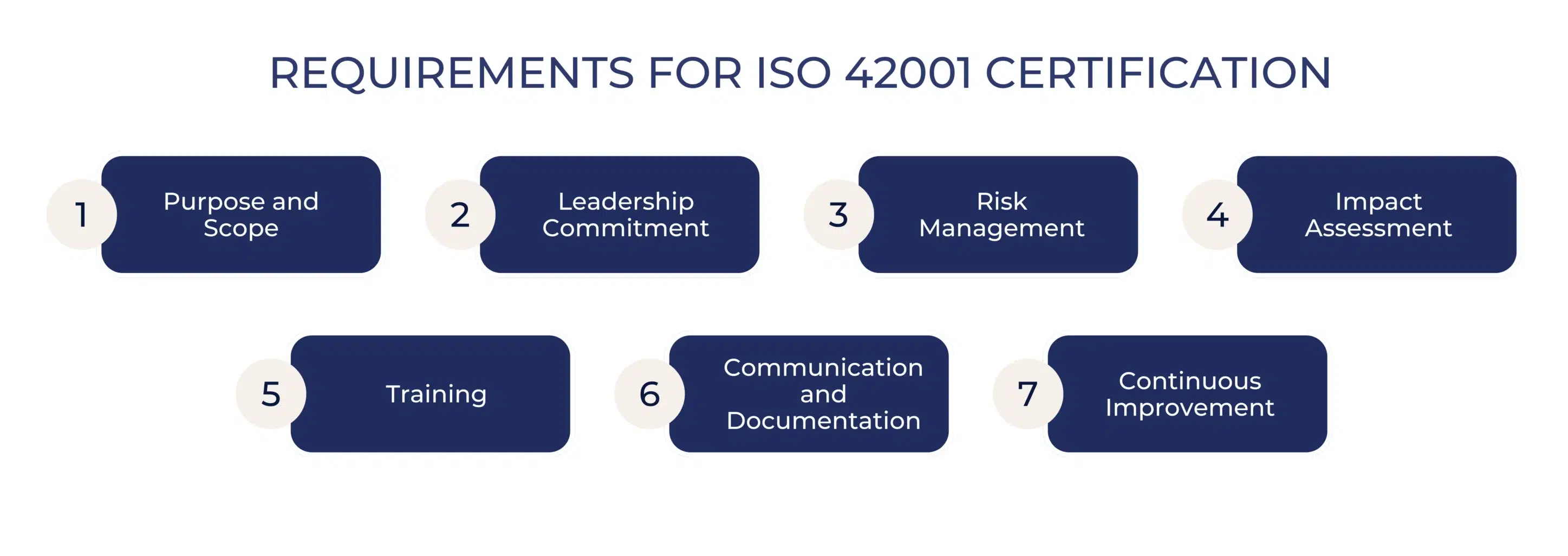
- ✓Scope and Context of the Organization
- ✓Leadership and AI Policy
- ✓Risk Assessment and AI Impact
- ✓Operational Controls
- ✓Performance Evaluation and Continual Improvement
ISO 42001 Certification Process
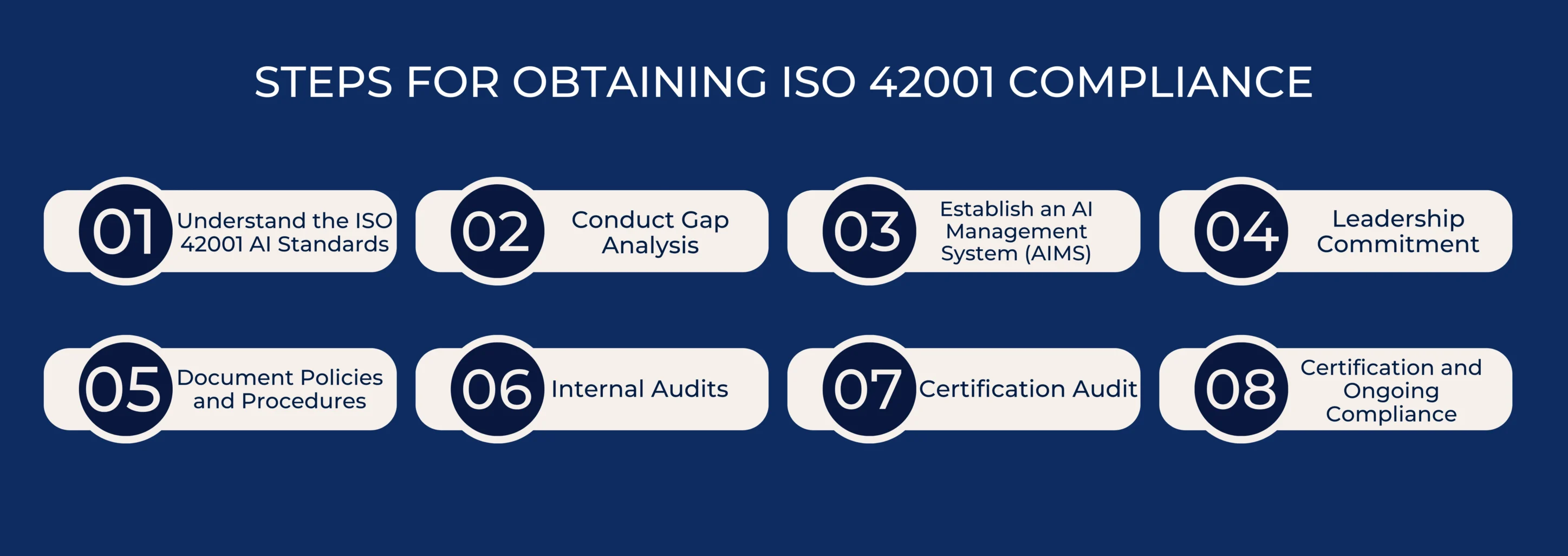
The ISO 42001 certification process follows a structured sequence of activities progressing from initial scope definition through formal audit and certification decision. Each stage produces documented outputs that inform subsequent activities and contribute to the overall evidence base evaluated during the certification audit. Organizations pursuing ISO 42001 certification in New York should expect a process spanning several months, with the total duration determined by the complexity of AI systems in scope, the maturity of existing governance documentation, and the organization’s size and structure.
- Scope Definition and Context Analysis: Identify all AI systems, processes, and organizational units to be included within the AIMS certification boundary. Document the organizational context, interested parties, and applicable regulatory requirements specific to New York operations.
- AI Risk Assessment and Impact Evaluation: Conduct a systematic assessment of AI-related risks across all in-scope systems. Document risk treatment decisions, control selections, and residual risk acceptances. Complete AI impact assessments for consumer-facing or high-risk AI applications.
- AIMS Documentation Development: Establish the documented information required by ISO 42001, including the AI policy, risk assessment records, operational procedure documentation, roles and responsibilities assignments, and management review records.
- Operational Control Implementation: Deploy the controls identified in the risk treatment plan. Establish data governance procedures, model validation processes, human oversight mechanisms, and incident response protocols across all in-scope AI systems.
- Internal Audit of the AIMS: Conduct a formal internal audit of the AI management system against ISO 42001 requirements. Document findings, identify nonconformities, and initiate corrective action processes prior to the Stage 1 external audit.
- Stage 1 Audit — Documentation Review: CertPro auditors conduct an off-site review of AIMS documentation to assess whether the documented management system is sufficiently developed to proceed to Stage 2. A Stage 1 audit report is issued identifying any areas requiring clarification or correction.
- Stage 2 Audit — On-Site Conformance Assessment: CertPro auditors conduct an on-site ISO 42001 audit to evaluate the effective implementation of the AIMS. Auditors test operational controls, interview personnel, review records, and assess whether the management system functions as documented.
- Nonconformity Resolution: Organizations address any nonconformities identified during the Stage 2 audit by submitting corrective action plans with supporting evidence. CertPro auditors review and verify the adequacy of corrective actions before proceeding to the certification decision.
- Certification Decision and Issuance: Upon satisfactory resolution of all nonconformities, CertPro issues the ISO 42001 certification credential. The certificate specifies the organization name, AIMS scope, certification standard, and validity period.
- Surveillance Audits and Recertification: Annual surveillance audits verify continued conformance with ISO 42001 requirements. A full recertification audit is conducted at the end of the three-year certificate validity period to renew the certification.
The total duration from scope definition to certificate issuance typically ranges from four to nine months for most New York organizations, depending on the complexity of the AI systems in scope and the maturity of existing governance controls. Organizations with well-documented AI governance programs and mature risk management processes complete the process more rapidly. Organizations implementing formal AI governance for the first time require additional time to establish and operationalize the required controls before proceeding to the Stage 2 audit — making early engagement with the ISO 42001 certification process a strategic advantage.
- ✓Step-by-Step ISO 42001 Certification Process
Benefits of ISO 42001 Certification in New York
ISO 42001 certification in New York provides organizations with a structured, independently verified AI governance framework that satisfies the AI accountability and transparency expectations of multiple regulatory bodies. Organizations subject to DFS oversight benefit from documented evidence of AI risk management that can be presented during regulatory examinations. Organizations deploying AI in employment decisions can demonstrate alignment with NYC Local Law 144 requirements through the bias audit and human oversight controls required for ISO 42001 compliance. Healthcare organizations can align ISO 42001 governance requirements with FDA guidance on AI-enabled medical devices and clinical decision support software.
ISO 42001 compliance also provides a documented framework for responding to regulatory inquiries and investigations. When regulators request evidence of AI governance practices, organizations holding ISO 42001 certification can produce structured documentation — including risk assessments, control inventories, audit reports, and management review records — that demonstrates the existence and effectiveness of their AI governance program. This documentation capability reduces regulatory response burden and provides a credible, standardized basis for regulatory dialogue that is far more defensible than ad hoc governance narratives.
ISO 42001 certification in New York confers measurable competitive advantages in procurement and partnership contexts. Enterprise clients, institutional investors, and government agencies increasingly include AI governance requirements in vendor qualification criteria and due diligence processes. Organizations holding ISO 42001 certification can satisfy these requirements with a recognized third-party credential — rather than responding to individual questionnaires and audit requests. This efficiency translates directly into reduced sales cycle friction and higher win rates in competitive procurement situations where AI governance is a qualification criterion.
For New York technology companies developing AI products and platforms, ISO 42001 certification signals to the market that their AI systems are built on a governance foundation addressing bias, transparency, and accountability. This signal is particularly valuable in enterprise sales contexts where legal, compliance, and risk teams scrutinize AI vendor governance practices before approving deployments. ISO 42001 certification for New York tech companies functions as a trust credential that accelerates procurement approvals and reduces the scope of client-side due diligence requirements.
- ✓Independently verified AI governance framework recognized across regulatory jurisdictions
- ✓Documented evidence of AI risk management for regulatory examinations and inquiries
- ✓Reduced vendor qualification burden through recognized third-party certification credential
- ✓Accelerated enterprise procurement approvals by satisfying AI governance due diligence requirements
- ✓Alignment with EU AI Act requirements for organizations with European clients or operations
- ✓Enhanced institutional investor confidence through demonstrated AI accountability structures
- ✓Structured incident response capabilities that reduce AI-related liability exposure
- ✓Workforce competence development through formalized AI governance training and awareness programs
- ✓Integration pathway with existing ISO 27001, ISO 9001, and ISO 31000 management systems
- ✓Reputational differentiation in New York’s competitive AI technology and services market
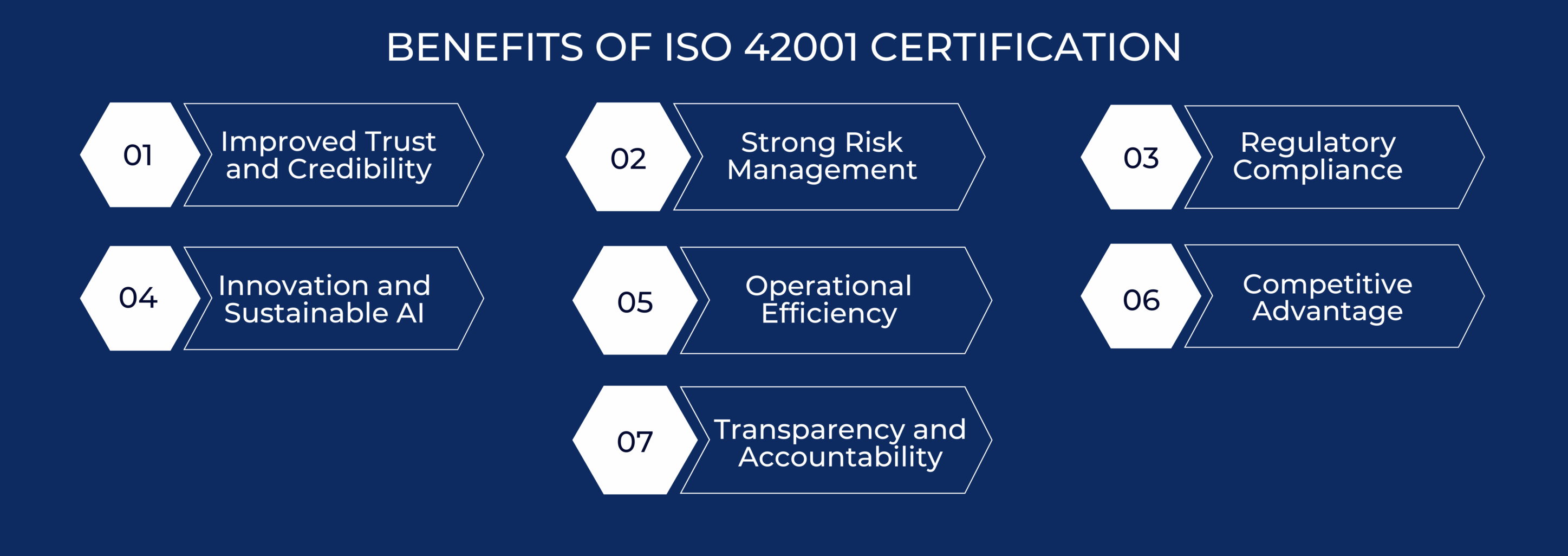
- ✓Regulatory and Compliance Benefits
- ✓Competitive and Business Benefits
CertPro’s ISO 42001 Audit and Assessment Services in New York
Certification Approach
CertPro conducts ISO 42001 audits and assessments for organizations operating across New York’s diverse industry sectors. Our ISO 42001 audit methodology follows a structured, evidence-based evaluation approach that systematically examines each clause of the standard against the documented management system and operational evidence provided by the organization. CertPro’s ISO 42001 audit process begins with a formal scope agreement and audit program determination — establishing the boundaries, objectives, and criteria for the entire certification engagement.
The Stage 1 audit conducted by CertPro focuses on reviewing the completeness and adequacy of AIMS documentation against ISO 42001 requirements. Auditors examine the AI policy, risk assessment records, scope documentation, and control framework to determine whether the organization’s documented management system is sufficiently developed to support a Stage 2 conformance assessment. The Stage 1 audit report identifies any documentation gaps or areas requiring clarification — providing the organization with specific, actionable findings before the on-site Stage 2 audit begins.
The Stage 2 ISO 42001 audit involves on-site evaluation of AIMS implementation across all functions and AI systems within the defined certification scope. CertPro auditors conduct personnel interviews, observe operational processes, test control effectiveness, and review records to determine whether the management system is implemented as documented and achieves its intended outcomes. The Stage 2 audit produces a formal audit report documenting findings, identifying any nonconformities, and supporting the certification decision process. All audit activities are conducted in accordance with ISO 19011 auditing principles and CertPro’s internal quality standards.
Why Choose CertPro as a Licensed CPA Firm
CertPro’s status as a Licensed CPA Firm distinguishes its ISO 42001 audit services from those offered by non-credentialed certification bodies. The CPA firm credential imposes professional standards of objectivity, independence, and quality enforced through state licensing requirements and professional accountability frameworks. Organizations engaging CertPro for ISO 42001 certification in New York receive audit services delivered by professionals subject to rigorous professional standards — providing an additional layer of credibility and assurance beyond what non-CPA certification bodies can offer.
CertPro’s audit teams bring sector-specific knowledge of New York’s key industries — including financial services, healthcare, fintech, and technology — enabling accurate evaluation of AI governance controls in the context of each sector’s specific risk environment and regulatory obligations. This expertise enables CertPro auditors to conduct ISO 42001 assessments precisely calibrated to the organization’s actual AI risk profile, rather than applying generic evaluation criteria that may not reflect the specific governance challenges of the industry in question.
CertPro’s ISO 42001 certification services in New York are structured around fixed-scope audit engagements with defined deliverables at each stage. Organizations receive a formal Stage 1 audit report, a Stage 2 audit report with nonconformity documentation, corrective action verification records, and the ISO 42001 certificate upon successful completion. Surveillance audit services are available on an annual basis to maintain certification currency. The fixed-scope structure of CertPro’s engagements provides organizations with predictable audit processes and clearly defined certification milestones throughout the entire cycle.
ISO 42001 Certification Cost in New York
Pricing Factors
The cost of ISO 42001 certification in New York is determined by several factors that define the scope and complexity of the required audit activities. The number and complexity of AI systems within the certification scope is the primary driver of audit duration and cost. Organizations with a single, well-documented AI application require substantially less audit time than organizations with multiple AI systems operating across different business functions and data environments. The size of the organization and the number of personnel, processes, and organizational units within scope also directly influence audit resource requirements.
The maturity of existing AI governance documentation and controls affects the duration of Stage 1 audit activities. Organizations that have previously implemented related management systems — such as ISO 27001 or SOC 2 — typically have foundational governance infrastructure that accelerates the ISO 42001 documentation review process. Organizations implementing formal AI governance for the first time require more extensive documentation development before the Stage 1 audit can be completed, extending the overall certification timeline and associated audit fees. The geographic distribution of AI operations also affects cost, as multi-site organizations require audit activities across multiple locations.
Fixed Pricing Positioning
CertPro structures ISO 42001 certification engagements with fixed-scope pricing based on a defined set of inputs collected during the initial scoping conversation. The scoping process captures the number of AI systems in scope, the size of the organization, the industry sector, the geographic footprint of AI operations, and the existence of any related management system certifications. These inputs enable CertPro to produce a defined audit scope and fixed-fee engagement proposal — providing organizations with full cost visibility before committing to the ISO 42001 certification process.
For early-stage technology companies and AI startups in New York with limited AI system complexity and focused certification scopes, ISO 42001 certification costs are structured accordingly — reflecting the reduced audit scope. Large enterprises and financial services organizations with complex AI portfolios and multi-site operations receive cost proposals scaled to the appropriate audit depth and duration. Annual surveillance audit fees are fixed at the time of initial certification and included in the engagement proposal, enabling organizations to plan AI governance certification costs across the full three-year certificate cycle.
| Organization Type | Scope Complexity | Typical Certification Timeline | Key Cost Drivers |
|---|---|---|---|
| AI Startup / Early-Stage Tech | Limited AI systems, focused scope | 4–6 months | Number of AI systems, documentation maturity |
| Mid-Size Technology Company | Multiple AI systems, single site | 5–7 months | AI system complexity, risk assessment depth |
| Financial Services Firm | Multiple AI systems, regulatory overlay | 6–9 months | Regulatory requirements, multi-function scope |
| Large Enterprise | Complex AI portfolio, multi-site | 7–10 months | Multi-site operations, organizational size |
| Healthcare Organization | Clinical AI systems, data governance | 6–9 months | Data governance complexity, oversight requirements |
ISO 42001 Certification Requirements Summary
Organizations pursuing ISO 42001 certification in New York must satisfy requirements across all clauses of the standard. The following summary identifies the key documentation and operational requirements that form the basis of the ISO 42001 audit evidence package. Each requirement must be addressed within the defined AIMS scope and supported by verifiable records available for examination during the Stage 1 and Stage 2 audit activities. Gaps in any of these areas may result in nonconformities that delay the certification decision.
- ✓Documented AIMS scope statement specifying the AI systems, processes, and organizational units covered by the certification
- ✓AI policy approved by top management and communicated throughout the organization
- ✓Documented roles, responsibilities, and authorities for AI governance and AIMS management
- ✓Completed AI risk assessment covering technical, operational, and societal risk dimensions for all in-scope AI systems
- ✓AI impact assessments for consumer-facing or high-risk AI applications within the certification scope
- ✓Risk treatment plan documenting selected controls, residual risk acceptances, and implementation status
- ✓Operational procedures governing AI data management, model development, deployment, monitoring, and decommissioning
- ✓Human oversight mechanism documentation specifying intervention procedures for each in-scope AI system
- ✓Internal audit program records including audit schedules, findings reports, and corrective action documentation
- ✓Management review records demonstrating top management engagement with AIMS performance and strategic AI governance priorities
ISO 42001 Compliance: New York Regulatory Alignment
ISO 42001 compliance provides New York organizations with a structured framework that maps directly to the requirements of applicable state, municipal, and federal AI-related regulations. The alignment between ISO 42001 and New York’s regulatory environment is not incidental — the standard’s requirements for risk assessment, transparency, human oversight, and accountability directly address the governance expectations articulated in New York City Local Law 144, the New York SHIELD Act’s data protection provisions, and DFS guidance on model risk management in financial services. Achieving ISO 42001 compliance in New York is one of the most effective ways for regulated organizations to demonstrate structured AI governance across multiple regulatory frameworks simultaneously.
ISO 42001 compliance for New York organizations also supports alignment with federal regulatory expectations — including FTC guidance on algorithmic accountability, CFPB guidance on AI in consumer financial decisions, and EEOC guidance on AI in employment decisions. By establishing a documented management system that addresses each of these regulatory dimensions under a single framework, ISO 42001 compliance reduces the burden of navigating multiple, overlapping regulatory requirements applicable to AI systems deployed across New York.
For organizations with operations or clients in the European Union, ISO 42001 compliance provides structural alignment with the EU AI Act’s risk-based governance requirements. The EU AI Act’s requirements for high-risk AI systems — including technical documentation, conformity assessment, human oversight, and accuracy and robustness requirements — have direct counterparts in ISO 42001’s operational control and risk management clauses. Organizations that achieve ISO 42001 certification in New York establish a governance foundation that facilitates EU AI Act compliance for international operations, reducing duplication of effort across regulatory jurisdictions.
| Regulatory Requirement | Jurisdiction | ISO 42001 Alignment |
|---|---|---|
| NYC Local Law 144 — Automated Employment Decision Tools | New York City | Bias audit requirements, human oversight controls, explainability documentation |
| NY SHIELD Act — Data Protection | New York State | AI data governance requirements, privacy risk assessment, data management controls |
| DFS Model Risk Management Guidance | New York State | AI risk assessment, validation procedures, performance monitoring controls |
| EU AI Act — High-Risk AI Systems | European Union | Conformity assessment, technical documentation, human oversight, monitoring requirements |
| FTC Algorithmic Accountability Guidance | Federal (USA) | Transparency requirements, fairness documentation, impact assessment procedures |
ISO 42001 Assessment: Evaluation Criteria and Audit Standards
The ISO 42001 assessment process applies defined evaluation criteria to determine whether an organization’s AIMS conforms to the requirements of the standard. Assessment criteria are derived directly from the normative requirements of ISO 42001 and are applied consistently across all organizations in scope, regardless of industry sector or organizational size. The ISO 42001 assessment New York organizations undergo through CertPro is structured to evaluate both documentation adequacy and operational effectiveness — ensuring that the certified AIMS functions as intended in practice, not merely in written policy.
ISO 42001 assessment activities include document examination, personnel interviews, process observation, and records review. Document examination evaluates whether required documented information exists, is current, and accurately reflects the organization’s AIMS design. Personnel interviews assess whether individuals with AI governance responsibilities understand their roles and apply required procedures in practice. Process observation verifies that AI development, deployment, and monitoring activities are conducted in accordance with documented procedures. Records review confirms that required activities — such as risk assessments, internal audits, and management reviews — have been completed and documented at required intervals.
Nonconformities identified during the ISO 42001 assessment are classified as major or minor based on their significance. A major nonconformity represents a failure to meet a fundamental requirement of the standard or a systemic breakdown in the management system that could undermine the effectiveness of the AIMS. A minor nonconformity represents an isolated or limited departure from a standard requirement that does not indicate a systemic failure. Major nonconformities must be resolved before the certification decision can be made, while minor nonconformities must be addressed within the first surveillance audit cycle following initial ISO 42001 certification.
FAQ
▶
What is ISO 42001 certification?
▶
Which organizations in New York need ISO 42001 certification?
▶
How long does ISO 42001 certification take in New York?
▶
What does an ISO 42001 audit in New York involve?
▶
How does ISO 42001 differ from other ISO standards like ISO 27001?
▶
What is the cost of ISO 42001 certification in New York?
▶
Is ISO 42001 certification mandatory for New York businesses?
▶
How does CertPro conduct ISO 42001 assessments for New York organizations?
ISO 42001 CERTIFIED: WHY AI GOVERNANCE CERTIFICATION IS BECOMING A BOARD-LEVEL REQUIREMENT
AI is now an inevitable component of major business activities in the current corporate world. To elaborate, it is now part of product design, custome…

MindSec Launches AI Compliance for Law 25 & ISO 42001
Excerpt from Barchart Article, Published on December 3, 2025 Today, Canadian organizations face increasing pressure to comply with stringent privacy a…

UNDERSTANDING ISO 42001: A GUIDE FOR RESPONSIBLE AI MANAGEMENT SYSTEMS
The invention of artificial intelligence (AI) has changed the operational processes of many industries. However, the rapid growth of technology increa…
Get In Touch
have a question? let us get back to you.