
ISO 42001 Certification in Norway
CertPro is a Licensed CPA Firm delivering structured ISO 42001 certification in Norway for organizations developing, deploying, or operating artificial intelligence systems. Operating under a defined audit framework, CertPro evaluates AI Management Systems (AIMS) against the requirements of ISO/IEC 42001:2023, issuing formal certification decisions based on documented evidence and structured control testing. Services are scoped to Norwegian enterprises across technology, financial services, oil and gas, public administration, and healthcare sectors.
OUR CLIENTS








Assessment and Certification Services by CertPro for ISO 42001 in Norway
CertPro is a Licensed CPA Firm delivering structured ISO 42001 certification in Norway for organizations developing, deploying, or operating artificial intelligence systems. Operating under a defined audit framework, CertPro evaluates AI Management Systems (AIMS) against the requirements of ISO/IEC 42001:2023, issuing formal certification decisions based on documented evidence and structured control testing. Services are scoped to Norwegian enterprises across technology, financial services, oil and gas, public administration, and healthcare sectors.
Norway ranks among the most digitally advanced economies in Northern Europe. Public and private sector organizations have adopted AI-driven systems across multiple domains — from automated financial risk assessment in fintech to predictive maintenance in offshore energy operations. This widespread AI adoption creates a corresponding demand for structured governance frameworks.
ISO 42001 certification in Norway provides organizations with a formal, internationally recognized mechanism for demonstrating that their AI systems are governed responsibly, transparently, and in alignment with both Norwegian regulatory expectations and EU/EEA compliance obligations.
The Norwegian Data Protection Authority (Datatilsynet) has published guidance on AI and automated decision-making under GDPR, reinforcing the need for documented AI governance. As the EU AI Act takes effect across EEA member states, Norwegian organizations face increasing obligations to demonstrate risk-based AI management. ISO 42001 certification provides the auditable, structured evidence base required to satisfy these obligations.
CertPro’s certification services are delivered under fixed pricing structures with defined audit timelines, enabling Norwegian organizations to plan and execute their ISO 42001 certification programs with clarity and predictability.

What Is ISO 42001 Certification?
ISO 42001 certification is the formal third-party verification that an organization’s Artificial Intelligence Management System (AIMS) conforms to the requirements established in ISO/IEC 42001:2023. Published by the International Organization for Standardization in 2023, ISO 42001 is the world’s first international standard specifically designed to govern artificial intelligence management.
ISO 42001 certification in Norway confirms that an organization has implemented, documented, and operationalized a structured system for managing AI responsibly across its development, deployment, and monitoring activities.
ISO 42001 Standard: Scope and Structure
ISO/IEC 42001:2023 is structured around the Plan-Do-Check-Act (PDCA) management cycle, consistent with other ISO management system standards such as ISO 27001 and ISO 9001. The standard contains ten clauses governing context, leadership, planning, support, operations, performance evaluation, and continual improvement.
Annex A provides 38 controls organized across nine control categories — including AI policy, AI risk management, AI impact assessment, data management, and human oversight. Annex B provides corresponding implementation guidance and control objectives. The standard applies to any organization, regardless of size or sector, that provides or operates AI systems.
The standard distinguishes between two primary roles: the AI provider, defined as an organization that develops or makes an AI system available, and the AI operator, defined as an organization that deploys an AI system developed by a third party. Norwegian organizations may occupy one or both roles simultaneously.
For example, a Norwegian fintech firm that develops proprietary credit-scoring algorithms functions as an AI provider, while a Norwegian bank that deploys a third-party fraud detection system functions as an AI operator. ISO 42001 certification requirements apply to both roles, with specific controls mapped to each role’s responsibilities within the AIMS framework.
The standard’s applicability is not restricted to large enterprises. Norwegian small and medium-sized enterprises (SMEs) that use AI-powered tools in customer service, logistics optimization, or HR screening are within scope. The standard explicitly accommodates organizations at different stages of AI maturity by requiring that the AIMS be proportionate to the organization’s context, the nature of its AI systems, and the level of risk those systems present to affected individuals and society.
This proportionality principle makes ISO 42001 certification accessible to Norwegian organizations across the full spectrum of AI complexity.
ISO 42001 vs. Other AI Governance Frameworks
ISO 42001 certification differs fundamentally from regulatory compliance obligations. The EU AI Act — which applies to Norwegian organizations under EEA jurisdiction — imposes legal requirements with enforcement mechanisms including fines and market access restrictions. ISO 42001, by contrast, is a voluntary management system standard whose certification is obtained through third-party audit.
However, the two frameworks are complementary. An organization that achieves ISO 42001 certification in Norway will have established many of the documented controls, risk assessments, and governance structures required to demonstrate EU AI Act conformity. Certification therefore serves as auditable evidence supporting regulatory compliance, not a substitute for it.
The NIST AI Risk Management Framework (AI RMF), published by the United States National Institute of Standards and Technology, provides a voluntary framework for AI risk management structured around four core functions: Govern, Map, Measure, and Manage. ISO 42001 and the NIST AI RMF address similar domains but differ in their approach. ISO 42001 is a certifiable management system standard with explicit conformance requirements and audit clauses, while the NIST AI RMF is a non-certifiable guidance document.
Norwegian organizations operating in US markets may benefit from aligning both frameworks — using ISO 42001 as the certifiable governance layer and the NIST AI RMF as supplementary guidance. ISO/IEC 23894, which provides AI risk management guidance, is explicitly referenced in ISO 42001 and may be used to inform Annex A control implementation.
| Framework | Type | Certifiable | Relevant to Norway |
|---|---|---|---|
| ISO 42001:2023 | Management System Standard | Yes | Yes — international standard adopted globally |
| EU AI Act | Regulation | No (conformity assessment) | Yes — applies under EEA jurisdiction |
| NIST AI RMF | Guidance Framework | No | Partial — relevant for US market access |
| ISO/IEC 23894 | Guidance Standard | No | Supplementary to ISO 42001 implementation |
| GDPR / Norwegian DPA Guidance | Regulation / Guidance | No | Yes — governs AI and automated decisions |
Key Definitions Under ISO 42001
ISO 42001 establishes precise definitions for the terms used throughout its requirements. An AI system is defined as a machine-based system that, for a given set of objectives, makes predictions, recommendations, decisions, or content influencing real or virtual environments. An AI provider is an organization that develops an AI system or makes it available for use by AI operators or affected parties. An AI operator is an organization that deploys an AI system within a product or service.
An AI impact assessment is a documented evaluation of the actual or potential effects of an AI system on individuals, groups, or society. An AI policy is the organization’s formal statement of intent regarding the responsible use and management of AI systems. A management review is the periodic formal evaluation by top management of the AIMS to ensure its continuing suitability, adequacy, and effectiveness.
These definitions establish the conceptual boundaries within which the ISO 42001 audit is conducted. During an ISO 42001 audit in Norway, the auditor will verify that the organization has correctly identified its role as provider or operator, has scoped its AIMS to include all relevant AI systems, and has documented its AI policy in a manner accessible to all relevant internal and external parties.
The precision of these definitions supports consistent, comparable certification outcomes across jurisdictions — making ISO 42001 certification internationally recognized and commercially significant for Norwegian organizations operating in global markets.
Why ISO 42001 Certification in Norway Is Essential
Norway’s digital economy is characterized by high technology adoption, a sophisticated regulatory environment, and close integration with EU policy frameworks through its EEA membership. Norwegian organizations across all sectors — from offshore energy and maritime logistics to fintech, healthtech, and public administration — are deploying AI systems at scale.
Without structured governance, these deployments carry compounding risks: biased algorithmic outputs, inadequate data protection, non-transparent decision-making, and exposure to regulatory sanction under the EU AI Act and GDPR. ISO 42001 certification in Norway provides the formal governance infrastructure to manage these risks systematically.
Regulatory Context: Norway’s AI Governance Landscape
Norway’s regulatory environment for AI is shaped by multiple overlapping frameworks. As an EEA member state, Norway is subject to GDPR, enforced domestically by Datatilsynet (the Norwegian Data Protection Authority). Datatilsynet has issued specific guidance on AI and automated decision-making, requiring organizations to document the logic of automated systems, assess their impact on data subjects, and implement appropriate safeguards.
Norwegian organizations that deploy AI systems affecting individuals’ rights or interests — including credit scoring, medical diagnosis support, and HR screening — are directly within the scope of this guidance, making ISO 42001 compliance a practical necessity for managing regulatory exposure.
The EU AI Act, which entered into force in August 2024 and applies progressively through 2026, classifies AI systems into risk categories — unacceptable risk, high risk, limited risk, and minimal risk — and imposes corresponding conformity assessment obligations. High-risk AI systems, including those used in critical infrastructure, employment, education, law enforcement, and migration, require documented risk management systems, data governance measures, transparency documentation, and human oversight mechanisms before market deployment.
ISO 42001 compliance provides Norwegian organizations with a structured, auditable framework for satisfying these technical documentation requirements, significantly reducing the effort required to demonstrate EU AI Act conformity.
Norway’s National Strategy for Artificial Intelligence, published by the Norwegian government, identifies AI as a strategic priority for economic competitiveness and public sector efficiency. The strategy emphasizes responsible AI development grounded in human rights, democratic values, and transparency. ISO 42001 certification directly supports these national policy objectives by providing an internationally recognized mechanism for demonstrating responsible AI governance.
Norwegian public sector organizations procuring AI systems are increasingly requiring supplier certification as a condition of procurement contracts, creating direct commercial incentives for ISO 42001 certification Norway-wide.
Sector-Specific Drivers in Norway
Norwegian fintech organizations prioritize ISO 42001 certification for its structured approach to AI risk in credit assessment, fraud detection, and algorithmic trading. Fintech companies in Norway operate under the supervision of Finanstilsynet (the Financial Supervisory Authority of Norway), which has issued guidance on algorithmic accountability and model risk management. ISO 42001 certification provides fintech firms with a documented governance framework that aligns with Finanstilsynet’s expectations and supports due diligence requirements in partnership and investment contexts.
Norwegian oil and gas sector organizations pursue ISO 42001 certification for AI systems managing predictive maintenance, safety monitoring, and environmental compliance on offshore installations. Equinor and other Norwegian energy majors have publicly committed to responsible AI deployment. ISO 42001 certification provides the auditable governance structure required to demonstrate that AI systems used in safety-critical environments are subject to formal impact assessment, human oversight, and continual improvement processes.
Norwegian financial services firms also pursue ISO 42001 certification to satisfy institutional investor ESG requirements, which increasingly include AI governance as a material disclosure item.
Norwegian technology companies — including SaaS providers, AI platform developers, and data analytics firms — pursue ISO 42001 certification to demonstrate product trustworthiness to enterprise customers in regulated industries. Norwegian tech companies exporting AI products to EU markets must demonstrate conformity with EU AI Act requirements, and ISO 42001 certification provides a recognized mechanism for doing so.
Public sector technology providers in Norway face additional procurement requirements, with government agencies increasingly specifying AI governance certifications as eligibility criteria in tender processes.
Risks of Operating Without ISO 42001 Compliance
Organizations operating AI systems without a structured governance framework face multiple categories of risk. Regulatory risk includes enforcement action by Datatilsynet under GDPR Articles 22 and 35 — which require impact assessments for high-risk automated processing — and future EU AI Act sanctions for non-compliant AI system deployment. Operational risk includes algorithmic failures that produce discriminatory or inaccurate outputs, which can result in legal liability under Norwegian anti-discrimination law. Reputational risk includes public disclosure of AI-related incidents, which can damage customer trust and investor confidence in ways that are difficult to quantify or reverse.
ISO 42001 compliance establishes the documented risk management processes, control mechanisms, and monitoring procedures that reduce each of these risk categories. The standard’s requirement for documented AI impact assessments, incident response procedures, and continual improvement cycles creates an auditable evidence trail demonstrating that the organization has taken proportionate, structured steps to manage its AI-related risks.
This evidence trail is directly applicable to regulatory inquiries, procurement due diligence, and investor ESG assessments — reinforcing the value of ISO 42001 compliance well beyond the certification itself.
Requirements for ISO 42001 Certification in Norway
ISO 42001 certification requirements are organized across the standard’s ten clauses and 38 Annex A controls. Norwegian organizations seeking certification must demonstrate documented conformity with each applicable clause and control through evidence presented during the ISO 42001 audit. The following sections detail the primary requirement categories that form the basis of the certification assessment.
Clause 4 of ISO 42001 requires the organization to determine its internal and external context relevant to AI management, identify interested parties and their requirements, and define the scope of its AIMS. For Norwegian organizations, relevant external context includes GDPR obligations, EU AI Act applicability, Datatilsynet guidance, and sector-specific regulatory requirements.
The organization must document a formal AIMS scope statement that identifies the AI systems covered, the organizational boundaries, and any exclusions with justification. This scope statement forms the foundation of the ISO 42001 audit program and determines which controls and requirements are applicable.
Clause 5 requires demonstrable top management commitment to the AIMS. This is evidenced through a formally approved AI policy, clear assignment of AI governance roles and responsibilities, and documented management review records. The AI policy must state the organization’s commitments regarding responsible AI development and deployment, alignment with relevant laws and regulations, and continual improvement of the AIMS.
During the ISO 42001 audit, auditors will interview senior leadership to verify that AI governance is actively managed at the executive level — not delegated entirely to technical teams without oversight.
Clause 6 and Annex A control A.6 require the organization to conduct and document AI risk assessments covering the risks and opportunities associated with its AI systems. The risk assessment process must be systematic, documented, and repeatable. It must identify risks to individuals, groups, and society arising from the AI system’s outputs — including risks of harm from inaccurate predictions, discriminatory outputs, privacy violations, and safety failures.
The risk assessment must produce documented risk treatment decisions, with selected controls traced to Annex A. Norwegian organizations must ensure that their risk assessment methodology is proportionate to the complexity and sensitivity of their AI systems.
The AI impact assessment, required by Annex A control A.8, is distinct from the risk assessment in that it evaluates the actual or potential effects of the AI system on affected individuals and society. The impact assessment must be conducted before deployment of significant AI systems and must be reviewed when the AI system or its operating context changes materially.
For Norwegian organizations deploying AI systems that affect personal data, the AI impact assessment must be integrated with — or reference — the Data Protection Impact Assessment (DPIA) required under GDPR Article 35. This integration ensures that privacy and AI impact assessments are coordinated rather than conducted in isolation, supporting both ISO 42001 compliance and GDPR obligations simultaneously.
ISO 42001 requires a comprehensive set of documented information, including the AIMS scope, AI policy, AI risk assessment results, AI impact assessments, control objectives and controls, operational procedures, monitoring and measurement results, internal audit reports, and management review records. The standard specifies that documented information must be controlled — meaning it must be identified, appropriately formatted, reviewed, approved, and retained for defined periods.
Norwegian organizations must establish document control procedures that ensure current versions of AIMS documentation are available at points of use and that obsolete documentation is appropriately managed.
Operational requirements under Clause 8 include planning and control of AI system development and deployment processes, implementation of Annex A controls, and management of AI-related changes. Annex A controls cover a broad range of operational domains: AI data management (A.7), AI system lifecycle management (A.9), human oversight of AI systems (A.10), third-party AI supplier management (A.5.3), and AI incident response (A.11).
Each control requires documented procedures, assigned responsibilities, and evidence of implementation. The depth of operational documentation required makes systematic preparation essential for Norwegian organizations approaching their initial ISO 42001 certification audit.
- ✓Documented AIMS scope statement identifying all in-scope AI systems and organizational boundaries
- ✓Formally approved AI policy signed by top management
- ✓Completed AI risk assessments with documented risk treatment decisions
- ✓AI impact assessments for all significant AI system deployments
- ✓Annex A control applicability statement (Statement of Applicability equivalent)
- ✓Documented operational procedures for AI system development, deployment, and monitoring
- ✓AI supplier and third-party management procedures
- ✓Human oversight and intervention procedures for AI system outputs
- ✓Internal audit program with completed audit records
- ✓Management review records demonstrating executive engagement with AIMS performance
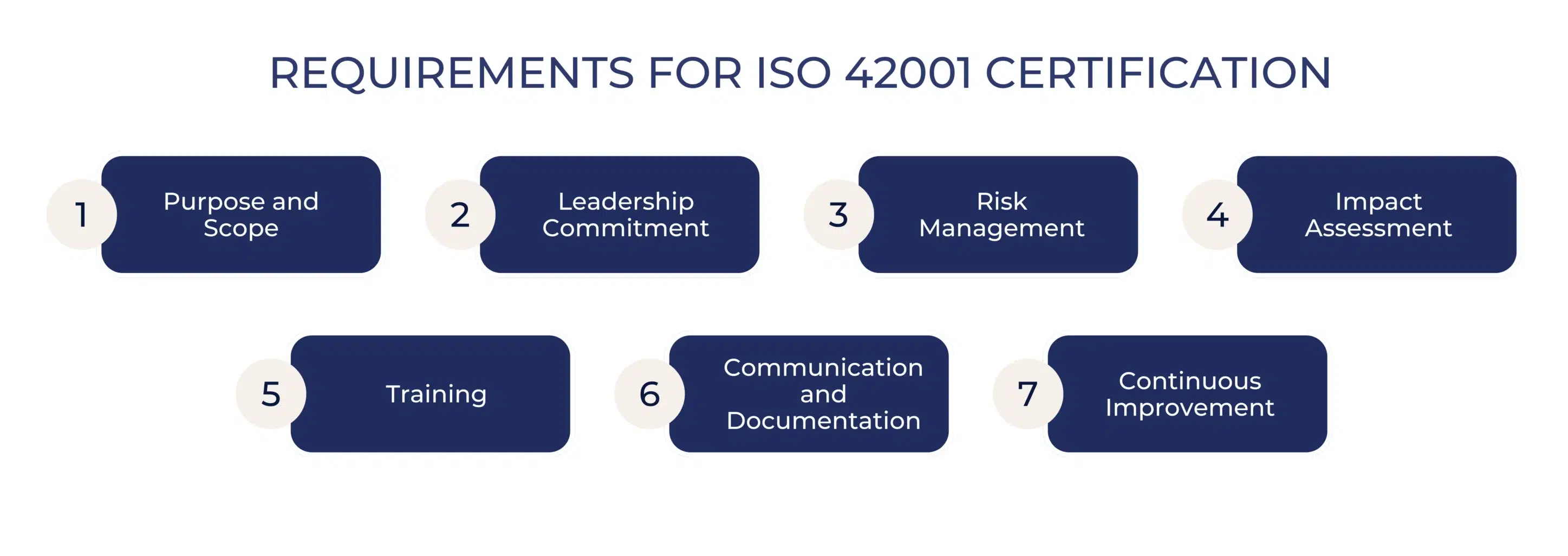
- ✓Organizational Context and Leadership Requirements
- ✓AI Risk Assessment and Impact Assessment Requirements
- ✓Documentation and Operational Requirements
Steps for ISO 42001 Certification in Norway
The ISO 42001 certification process in Norway follows a structured sequence of audit stages. Each stage produces documented outputs that form the basis for the subsequent stage. The following steps describe the standard certification pathway applicable to Norwegian organizations engaging CertPro as their certification body.
The certification process begins with a formal scope definition exercise. The organization identifies all AI systems within the proposed AIMS scope, documents the organizational boundaries, and prepares an initial inventory of applicable Annex A controls. CertPro conducts a Stage 1 audit — a documentation review and site readiness assessment — to evaluate whether the organization’s AIMS documentation is sufficiently developed to proceed to Stage 2.
The Stage 1 audit produces a formal audit report identifying any areas where documentation is incomplete or where the organization’s understanding of requirements needs clarification. Stage 1 is typically conducted over one to three days depending on organizational complexity.
During the Stage 1 audit, CertPro auditors review the AIMS scope statement, AI policy, risk assessment methodology, and key procedure documents. The auditors assess whether the organization has correctly identified its role as AI provider or operator, whether the scope covers all relevant AI systems, and whether the documentation framework is aligned with ISO 42001 clause requirements.
The Stage 1 audit report classifies identified gaps as either nonconformities or observations. Major nonconformities identified at Stage 1 must be resolved before Stage 2 proceeds. The report also includes the Stage 2 audit plan, specifying the processes, functions, and locations to be audited.
The Stage 2 audit is the primary conformity assessment. CertPro auditors evaluate the implementation and operational effectiveness of the organization’s AIMS, including all applicable Annex A controls. The Stage 2 ISO 42001 audit involves document review, process observation, personnel interviews, and evidence sampling.
Auditors verify that AI risk assessments have been completed for all in-scope AI systems, that AI impact assessments have been conducted and documented, that control procedures are implemented as documented, and that monitoring and measurement activities are producing meaningful performance data. The Stage 2 audit typically spans two to five days for Norwegian organizations of medium complexity.
Following the Stage 2 audit, CertPro produces a detailed audit report classifying all findings as conformities, minor nonconformities, major nonconformities, or observations. Minor nonconformities do not prevent certification but must be resolved within a defined correction period — typically 90 days — with evidence submitted to CertPro for verification. Major nonconformities require resolution and re-audit before the certification decision can be made. The absence of major nonconformities and the satisfactory closure of all minor nonconformities triggers the certification decision process.
The certification decision is made by a CertPro certification committee that is independent of the audit team. The committee reviews the Stage 2 audit report, nonconformity closure evidence, and audit team recommendations to determine whether the organization’s AIMS conforms to ISO 42001 requirements.
Upon a positive certification decision, CertPro issues an ISO 42001 certificate valid for three years. The certificate specifies the certified organization’s name, registered address, AIMS scope, and the standard to which certification has been granted. Norwegian organizations may display the certificate and associated certification marks in commercial communications, procurement submissions, and stakeholder reports.
ISO 42001 certification is maintained through annual surveillance audits conducted in Years 1 and 2 of the three-year certification cycle. Surveillance audits are narrower in scope than the full Stage 2 audit, focusing on areas identified during the initial certification audit, changes to the organization’s AI systems or operating context, and evidence of continual improvement activities.
Surveillance audits verify that the AIMS remains effectively implemented and that the organization continues to meet ISO 42001 requirements. At the end of the three-year cycle, a full recertification audit is conducted to renew the certificate for a further three-year period.
Norwegian organizations must notify CertPro of significant changes to their AI systems, organizational structure, or operating context between scheduled audits. Changes that materially affect the AIMS scope or the risk profile of certified AI systems may trigger an unscheduled surveillance visit.
Maintaining accurate and current AIMS documentation throughout the certification cycle is essential for sustaining ISO 42001 certification and ensuring surveillance audits proceed efficiently.
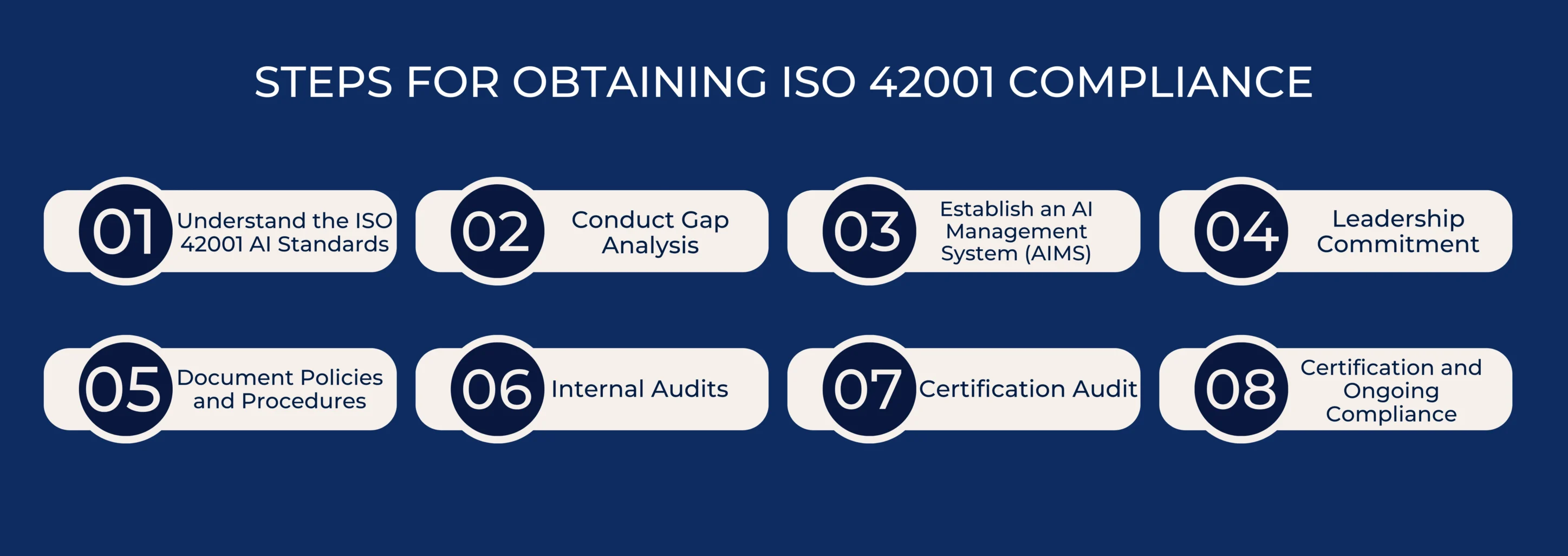
- ✓Stage 1: Scope Definition and Initial Assessment
- ✓Stage 2: Control Testing and Conformity Evaluation
- ✓Certification Decision and Certificate Issuance
- ✓Surveillance Audits and Recertification
How to Get ISO 42001 Certification in Norway
Obtaining ISO 42001 certification in Norway begins with a structured program of internal preparation followed by engagement of an accredited certification body. The following process describes the actions Norwegian organizations must take to establish a conforming AIMS and successfully complete the certification audit program.
Establishing the AI Management System
The foundational step in pursuing ISO 42001 certification is establishing a formal AI Management System. This requires the organization to define the AIMS scope, develop an AI policy, assign AI governance roles and responsibilities, and establish a risk management process for AI systems. The AIMS must be documented in accordance with the standard’s documented information requirements.
Norwegian organizations should begin by conducting a systematic inventory of all AI systems in use or under development, classifying each by function, risk level, and data inputs. This inventory forms the basis for scope definition and risk assessment prioritization.
Leadership engagement is a critical prerequisite for effective AIMS establishment. ISO 42001 requires that top management demonstrate active commitment to the AIMS through visible leadership behaviors — not merely through formal document approval. Norwegian organizations should establish an AI governance committee or equivalent body with senior representation, clear terms of reference, and a defined meeting cadence.
This committee should be responsible for approving AI policies, reviewing AI impact assessments for significant deployments, and overseeing the AIMS performance monitoring program.
Conducting the ISO 42001 Assessment
Before engaging a certification body for the formal audit, Norwegian organizations should conduct a thorough internal ISO 42001 assessment to evaluate AIMS maturity and identify documentation gaps. The internal ISO 42001 assessment should evaluate conformity with each of the standard’s ten clauses and each applicable Annex A control. The assessment should produce a documented findings report identifying areas of conformity, areas requiring development, and areas where controls are absent.
This internal ISO 42001 assessment provides the organization with a structured view of its certification readiness and enables targeted remediation efforts before the formal audit.
The internal ISO 42001 assessment must be conducted by personnel with sufficient knowledge of the standard’s requirements and the organization’s AI systems. For Norwegian organizations without in-house ISO 42001 expertise, training programs and internal audit competency development are essential prerequisites.
The assessment findings should be documented in a formal internal audit report, reviewed by management, and used as the basis for a corrective action plan that addresses identified gaps before the Stage 1 certification audit.
Selecting a Certification Body and Engaging CertPro
Norwegian organizations should select a certification body that is accredited to conduct ISO 42001 certification audits and has demonstrable experience with AI management system assessments. CertPro operates as a Licensed CPA Firm with structured audit methodologies, defined timelines, and fixed pricing for ISO 42001 certification in Norway.
Engagement begins with a formal scoping discussion to confirm the organization’s AI system inventory, proposed AIMS scope, and organizational structure. CertPro then provides a formal audit proposal specifying the audit program, audit team composition, estimated audit days, and fee structure.
- Conduct AI system inventory and classify all in-scope AI systems by function and risk level
- Define formal AIMS scope and document organizational boundaries and exclusions
- Develop and obtain executive approval for the AI policy
- Assign AI governance roles including an AI management system owner and risk assessment leads
- Complete AI risk assessments for all in-scope AI systems and document risk treatment decisions
- Conduct AI impact assessments for all significant AI system deployments
- Implement Annex A controls applicable to the organization’s role as provider and/or operator
- Establish internal audit program and conduct formal internal ISO 42001 audit
- Conduct management review of AIMS performance and document outcomes
- Engage CertPro for Stage 1 and Stage 2 ISO 42001 certification audit
- Address audit findings and obtain certification decision
- Maintain AIMS and participate in annual surveillance audit program
ISO 42001 Certification Cost in Norway
The cost of ISO 42001 certification in Norway is determined by four primary variables: organizational size, number and complexity of in-scope AI systems, the organization’s role as AI provider or operator, and geographic distribution of AI operations. CertPro provides fixed-fee pricing for ISO 42001 certification services, enabling Norwegian organizations to budget with certainty and avoid the cost unpredictability associated with variable daily-rate audit structures.
Pricing Factors and Fee Structure
Small Norwegian organizations with a limited number of AI systems of low to moderate complexity typically incur lower certification costs, as the audit program requires fewer audit days and the AIMS documentation set is proportionately smaller. Organizations with multiple high-risk AI systems, complex data pipelines, or operations across multiple Norwegian locations require extended audit programs with higher associated fees.
Organizations serving as both AI providers and operators face more comprehensive audit scope requirements, as auditors must evaluate controls applicable to both roles simultaneously.
The total investment in ISO 42001 certification in Norway encompasses the certification body’s fees for Stage 1 and Stage 2 audits, surveillance audit fees for Years 1 and 2 of the certification cycle, and recertification audit fees at the three-year renewal point. Norwegian organizations should also account for internal costs including personnel time for documentation development, internal audit delivery, and management review activities.
For organizations requiring staff competency development in ISO 42001 requirements, training program costs should be included in the total investment estimate.
| Organization Profile | Estimated Audit Days | Indicative Fee Range (EUR) | Certification Cycle |
|---|---|---|---|
| Small enterprise, 1-3 AI systems, low complexity | 3–5 days (Stage 1 + Stage 2) | 5,000–12,000 | 3 years with annual surveillance |
| Medium enterprise, 4-10 AI systems, moderate complexity | 6–10 days (Stage 1 + Stage 2) | 12,000–25,000 | 3 years with annual surveillance |
| Large enterprise, 10+ AI systems, high complexity | 10–20+ days (Stage 1 + Stage 2) | 25,000–50,000+ | 3 years with annual surveillance |
| Annual surveillance audit (any size) | 1–3 days | 3,000–8,000 | Year 1 and Year 2 of cycle |
| Recertification audit (three-year renewal) | Approximately 75% of initial audit | Variable by profile | Every 3 years |
Return on Investment Considerations
Norwegian organizations evaluating the cost of ISO 42001 certification in Norway should assess the investment in the context of tangible returns. Certified organizations frequently report measurable benefits including accelerated enterprise procurement cycles, reduced due diligence burden in customer and partner assessments, and preferential consideration in public sector tender processes where AI governance certification is specified. The cost of ISO 42001 certification is typically recoverable within the first twelve months for organizations competing in markets where AI governance is a procurement differentiator.
Risk mitigation value must also be considered. GDPR enforcement actions by Datatilsynet can result in administrative fines of up to 4% of global annual turnover or EUR 20 million, whichever is higher. EU AI Act violations for high-risk AI systems can result in fines of up to EUR 30 million or 6% of global annual turnover.
The structured governance controls implemented as part of ISO 42001 certification reduce the probability of these outcomes, providing risk mitigation value that substantially exceeds the certification cost for most Norwegian organizations operating AI systems at scale.
Benefits of ISO 42001 Certification in Norway
ISO 42001 certification in Norway delivers benefits across strategic, operational, regulatory, and reputational dimensions. The following sections detail the primary benefit categories applicable to Norwegian organizations across different sectors and sizes.
ISO 42001 certification provides Norwegian organizations with a formal, internationally recognized signal of AI governance maturity. In procurement contexts, certification serves as auditable evidence that the organization manages AI risks systematically, reducing the due diligence burden for both the certified organization and its customers.
Norwegian companies competing for enterprise contracts in regulated industries — including financial services, healthcare, energy, and public administration — increasingly encounter AI governance requirements in RFP and tender specifications. ISO 42001 certification provides a documented, third-party verified response to these requirements.
For Norwegian technology companies seeking to expand into EU markets, ISO 42001 certification supports market access by demonstrating conformity with EU AI Act governance expectations. European enterprise customers, particularly those in regulated industries, increasingly require AI supplier certifications as part of third-party risk management programs.
ISO 42001 certification obtained by Norway-based tech companies provides a competitive advantage in these market segments that is difficult for uncertified competitors to replicate without equivalent governance investment.
ISO 42001 compliance establishes a documented evidence base that Norwegian organizations can reference in regulatory inquiries, audits, and enforcement proceedings. Datatilsynet investigations into AI-related GDPR breaches typically focus on whether the organization had implemented appropriate technical and organizational measures.
ISO 42001 certification provides auditable evidence of systematic risk management, impact assessment, and control implementation — measures that align directly with GDPR Article 25 (data protection by design) and Article 35 (data protection impact assessment) requirements.
The EU AI Act’s technical documentation requirements for high-risk AI systems include detailed descriptions of the AI system’s design, training data, performance metrics, and risk management measures. Organizations that have implemented ISO 42001 controls for AI documentation, data governance, and risk management will have produced the majority of this documentation as a standard output of their AIMS operations.
ISO 42001 compliance therefore reduces the marginal cost and effort of EU AI Act technical documentation preparation, creating direct regulatory efficiency benefits for Norwegian organizations subject to both frameworks.
ISO 42001 certification drives internal governance improvements that produce operational benefits independent of external recognition. Organizations that implement the standard’s requirements for AI risk assessment, impact assessment, and human oversight frequently identify previously unrecognized risks in their AI systems — enabling proactive remediation before harm occurs.
The standard’s requirement for continual improvement — including internal audit, management review, and corrective action processes — creates a structured mechanism for ongoing AIMS enhancement that improves AI system reliability and governance maturity over time.
- ✓International recognition of AI governance maturity through third-party certified AIMS
- ✓Enhanced competitive positioning in procurement processes requiring AI governance evidence
- ✓Structured regulatory alignment with GDPR, EU AI Act, and Norwegian AI governance expectations
- ✓Reduced regulatory risk and auditable evidence base for Datatilsynet inquiries
- ✓Improved AI system reliability through systematic risk assessment and impact evaluation
- ✓Accelerated enterprise sales cycles through pre-verified AI governance documentation
- ✓ESG reporting support for investors and stakeholders requiring AI governance disclosures
- ✓Demonstrated ethical AI commitment supporting talent attraction and retention
- ✓Structured supplier management framework for third-party AI systems and data providers
- ✓Continual improvement framework driving ongoing AIMS maturity and AI governance advancement
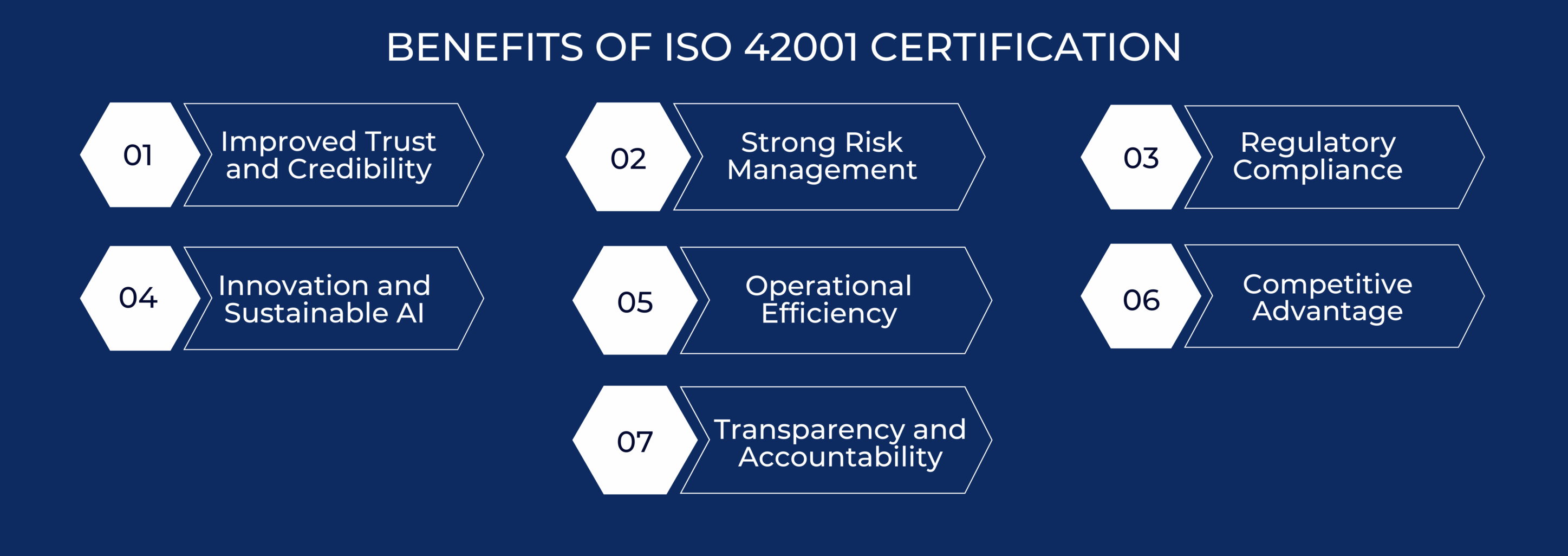
- ✓Strategic and Commercial Benefits
- ✓Regulatory and Compliance Benefits
- ✓Operational and Governance Benefits
Why Choose CertPro for ISO 42001 Assessment and Certification?
CertPro is a Licensed CPA Firm delivering ISO 42001 assessment and certification services to Norwegian organizations under a structured, evidence-based audit methodology. CertPro’s approach to ISO 42001 certification in Norway is distinguished by sector-specific audit expertise, defined audit timelines, fixed pricing, and institutional-grade audit rigor that produces certification decisions of recognized commercial and regulatory value.
Sector Expertise Across Norwegian Industries
CertPro’s ISO 42001 audit teams include auditors with domain expertise in the sectors most actively deploying AI in Norway. This expertise is directly relevant to ISO 42001 assessment quality: auditors with fintech domain knowledge can more effectively evaluate AI risk assessments for credit scoring models, while auditors with energy sector experience can more accurately assess human oversight controls for AI systems used in offshore safety monitoring.
Sector-relevant audit expertise produces more accurate conformity findings and more meaningful audit reports than those delivered by generic management system auditors without AI or sector-specific background.
CertPro has conducted ISO 42001 assessment engagements across Norwegian fintech, financial services, oil and gas, technology, and public sector organizations. This experience enables CertPro audit teams to recognize sector-specific risk patterns, evaluate control adequacy in context, and produce audit findings that reflect the practical realities of AI deployment in each sector.
For ISO 42001 certification of Norwegian financial services firms, CertPro’s auditors understand the interaction between ISO 42001 controls and Finanstilsynet model risk management expectations. For Norwegian oil and gas organizations, auditors understand the safety-critical context within which AI systems operate.
Defined Timelines and Fixed Pricing
CertPro delivers ISO 42001 certification in Norway under fixed-fee pricing structures with defined audit timelines established at the point of engagement. Norwegian organizations receive a formal audit proposal specifying the Stage 1 audit duration and deliverables, the Stage 2 audit duration and deliverables, the expected timeline from Stage 1 commencement to certification decision, and the annual surveillance audit schedule.
Fixed pricing eliminates cost uncertainty and enables Norwegian organizations to obtain budget approval and plan internal resource allocation with confidence.
CertPro’s standard timeline for ISO 42001 certification in Norway — from Stage 1 audit commencement to certification decision — is typically eight to sixteen weeks depending on organizational complexity and the speed of nonconformity closure. This defined timeline enables Norwegian organizations to plan certification completion against commercial or regulatory deadlines, such as tender submission dates or EU AI Act compliance timelines. The timeline commitment is contractually defined, providing Norwegian organizations with recourse in the event of certification body delays.
Institutional Audit Rigor and Certification Value
The commercial and regulatory value of ISO 42001 certification is directly dependent on the rigor and credibility of the certification body’s audit methodology. CertPro’s ISO 42001 audit methodology is structured around documented audit programs, independent certification committee review, and systematic evidence sampling across all applicable Annex A controls.
This methodology produces certification decisions that withstand scrutiny from enterprise procurement teams, regulatory bodies, and institutional investors — counterparties whose acceptance of certification as evidence of governance maturity depends on the certification body’s institutional credibility.
ISO 42001 Audit Norway: The CertPro Audit Methodology
The ISO 42001 audit conducted by CertPro in Norway follows a structured methodology that ensures comprehensive, consistent, and defensible conformity findings. The audit methodology is aligned with ISO 19011 (guidelines for auditing management systems) and IAF mandatory documents for management system certification, providing a recognized international basis for audit conduct and reporting.
Audit Program Determination
The ISO 42001 audit program is determined based on a formal assessment of the organization’s size, the number and complexity of in-scope AI systems, the organization’s role as provider and/or operator, geographic distribution of AI operations, and the results of any prior certification audits. The audit program specifies the total number of audit days, the allocation between Stage 1 and Stage 2, the processes and functions to be audited in each stage, and the sampling approach for Annex A control evaluation.
Norwegian organizations with operations in multiple locations may require multi-site audit programs, with audit days allocated across sites proportionate to the AI activities conducted at each location.
Evidence Sampling and Control Testing
During the Stage 2 ISO 42001 audit in Norway, CertPro auditors employ systematic evidence sampling to evaluate the implementation and effectiveness of Annex A controls. Sampling is designed to provide reasonable assurance of control conformity across the full population of in-scope AI systems. For organizations with large numbers of AI systems, auditors apply risk-based sampling — prioritizing higher-risk AI systems for more intensive control testing.
Evidence sources include documentation review, system demonstrations, personnel interviews, process observations, and data analytics outputs where available.
Control testing for the ISO 42001 audit evaluates three dimensions of conformity: the existence of documented procedures (design adequacy), evidence that procedures have been followed in practice (implementation), and evidence that control outcomes meet the objectives stated in Annex B (effectiveness). A control that exists in documentation but is not implemented in practice will be classified as a nonconformity regardless of documentation quality.
This three-dimensional testing approach ensures that ISO 42001 certification reflects genuine operational governance rather than documentation compliance alone.
Nonconformity Classification and Resolution
CertPro classifies ISO 42001 audit findings under a four-category scheme: major nonconformity, minor nonconformity, observation, and conformity. A major nonconformity is defined as the absence of a required process, the complete failure of a required control, or a systematic pattern of failures across multiple instances of a control. A minor nonconformity is a single, contained failure of a requirement that does not indicate systematic AIMS breakdown. An observation is a noted concern that does not currently constitute a nonconformity but may develop into one if unaddressed.
All nonconformities are documented with specific reference to the ISO 42001 clause or Annex A control violated, the objective evidence supporting the finding, and the required corrective action.
Secure Your ISO 42001 Certification in Norway with CertPro
ISO 42001 certification in Norway positions organizations as leaders in responsible AI governance at a moment when AI oversight has become a strategic imperative for regulators, customers, and investors alike. CertPro delivers structured, rigorous ISO 42001 certification services that produce internationally recognized certification decisions with clear commercial and regulatory value. Norwegian organizations that certify with CertPro receive a formal audit report, a certification decision from an independent certification committee, and an ISO 42001 certificate valid for three years with annual surveillance.
The ISO 42001 certification process with CertPro begins with a scoping discussion that defines the AIMS boundaries, identifies the applicable Annex A controls, and establishes the audit timeline and fee structure. Norwegian organizations can initiate the certification process by contacting CertPro through the scheduling interface on this page. A CertPro audit program manager will conduct an initial scoping call — typically within five business days — to review the organization’s AI system inventory, proposed scope, and certification objectives. Following the scoping discussion, CertPro will provide a formal audit proposal within ten business days.
Norwegian organizations that have already initiated AIMS implementation and require a structured evaluation of their certification readiness may engage CertPro for a formal ISO 42001 assessment prior to commencing the certification audit program. This pre-certification ISO 42001 assessment provides an objective evaluation of AIMS conformity against the standard’s requirements, producing a documented findings report that enables targeted remediation and reduces the probability of major nonconformities at Stage 2. Contact CertPro to initiate your ISO 42001 certification in Norway program today.
FAQ
▶
What is the purpose of ISO 42001 certification in Norway?
▶
Which Norwegian organizations need ISO 42001 certification?
▶
How long does the ISO 42001 audit process take in Norway?
▶
How does ISO 42001 compliance relate to GDPR requirements in Norway?
▶
What is the difference between an ISO 42001 audit and an ISO 42001 assessment?
▶
Does ISO 42001 certification satisfy EU AI Act requirements for Norwegian organizations?
▶
How often must ISO 42001 certification be renewed in Norway?
▶
What documentation must be prepared before the ISO 42001 audit in Norway?
ISO 42001 CERTIFIED: WHY AI GOVERNANCE CERTIFICATION IS BECOMING A BOARD-LEVEL REQUIREMENT
AI is now an inevitable component of major business activities in the current corporate world. To elaborate, it is now part of product design, custome…

MindSec Launches AI Compliance for Law 25 & ISO 42001
Excerpt from Barchart Article, Published on December 3, 2025 Today, Canadian organizations face increasing pressure to comply with stringent privacy a…

UNDERSTANDING ISO 42001: A GUIDE FOR RESPONSIBLE AI MANAGEMENT SYSTEMS
The invention of artificial intelligence (AI) has changed the operational processes of many industries. However, the rapid growth of technology increa…
Get In Touch
have a question? let us get back to you.