
ISO 42001 Certification in San Francisco
CertPro is a Licensed CPA Firm delivering independent third-party ISO 42001 Certification in San Francisco for organizations developing, deploying, or utilizing artificial intelligence systems. As a globally recognized independent audit firm, CertPro conducts structured ISO 42001 assessments aligned with ISO/IEC 42001:2023—the first international standard for Artificial Intelligence Management Systems (AIMS). CertPro’s certification scope covers AI governance frameworks, risk-based controls, algorithmic accountability, and responsible AI practices across all sectors operating in San Francisco’s dynamic technology landscape.
OUR CLIENTS






Assessment and Certification Services by CertPro for ISO 42001 in San Francisco
CertPro is a Licensed CPA Firm delivering independent third-party ISO 42001 Certification in San Francisco for organizations developing, deploying, or utilizing artificial intelligence systems. As a globally recognized independent audit firm, CertPro conducts structured ISO 42001 assessments aligned with ISO/IEC 42001:2023—the first international standard for Artificial Intelligence Management Systems (AIMS). CertPro’s certification scope covers AI governance frameworks, risk-based controls, algorithmic accountability, and responsible AI practices across all sectors operating in San Francisco’s dynamic technology landscape.
San Francisco occupies a singular position in the global AI economy. Home to leading AI research institutions, multinational technology enterprises, fintech innovators, SaaS providers, and early-stage AI startups, the city’s business ecosystem demands certification frameworks that address both innovation velocity and regulatory accountability. ISO 42001 Certification in San Francisco enables organizations to demonstrate that their AI management systems meet internationally recognized requirements for transparency, fairness, security, and ongoing improvement. CertPro’s audit-focused approach ensures that every ISO 42001 certification reflects objective, evidence-based evaluation—not advisory or consulting services.

What Is ISO 42001 Certification?
ISO 42001 Certification is the formal third-party recognition that an organization’s Artificial Intelligence Management System (AIMS) conforms to the requirements established by ISO/IEC 42001:2023. Published by the International Organization for Standardization (ISO) and the International Electrotechnical Commission (IEC) in 2023, ISO/IEC 42001:2023 is the world’s first international standard specifically designed to govern AI systems across their full lifecycle. ISO AIMS certification under this standard covers the policies, processes, controls, and governance structures an organization uses to develop, deploy, monitor, and continuously improve AI-based products and services.
Scope of ISO/IEC 42001:2023
The scope of ISO/IEC 42001:2023 extends to any organization—regardless of size, sector, or geography—that provides or uses AI-based products and services. The standard establishes requirements for an AIMS that enables organizations to identify, assess, and treat AI-specific risks including algorithmic bias, lack of explainability, data quality failures, model drift, and adverse societal impacts. ISO 42001 compliance requires organizations to define the context of their AI operations, establish clear roles and responsibilities for AI governance, implement risk-based controls, and subject their AIMS to periodic internal and external audits.
ISO 42001 differs from other management system standards by targeting AI-specific challenges absent from general information security or quality management frameworks. While ISO 27001 governs information security risks and ISO 9001 addresses quality management, ISO 42001 specifically governs AI models, training data, algorithmic decision-making, and human oversight mechanisms. ISO 42001 and ISO 27001 do overlap in areas such as risk management methodology, access control, and data privacy—making integrated implementation structurally efficient for organizations already certified to other ISO standards. Organizations pursuing ISO AIMS certification can leverage existing policy frameworks and review processes from related standards rather than constructing entirely new governance systems from the ground up.
Key Clauses and Control Structure of ISO 42001
ISO/IEC 42001:2023 is structured around ten primary clauses that follow the High-Level Structure (HLS) common to all modern ISO management system standards. Clauses 1 through 3 establish scope, normative references, and definitions. Clauses 4 through 10 contain the normative requirements organizations must satisfy to achieve ISO 42001 Certification. Clause 4 requires organizations to analyze their internal and external context, identify interested parties, and define the AIMS scope. Clause 5 addresses leadership commitment, AI policy establishment, and assignment of organizational roles. Clause 6 governs AI risk assessment planning and objective-setting. Clauses 7 through 10 address support resources, operational controls, performance evaluation, and continual improvement mechanisms.
Annex A of ISO/IEC 42001:2023 provides a reference control set of 38 controls organized across nine domains, including AI system impact assessment, data management, human oversight, transparency, and accountability. Organizations undergoing an ISO 42001 assessment must produce a Statement of Applicability (SoA) that documents which Annex A controls apply to their AI operations and provides justification for any exclusions. This SoA serves as a central audit artifact during the ISO 42001 audit process, enabling auditors to evaluate the alignment between declared controls and actual operational practices. The control structure is designed to be scalable, allowing both large enterprises and smaller AI startups to implement controls proportionate to their AI risk profile.
ISO 42001 and AI Governance Relationships
ISO 42001 Certification establishes a structured relationship between an organization’s AI governance posture and internationally recognized accountability standards. The standard requires organizations to articulate how AI systems align with ethical principles, human rights considerations, and applicable legal obligations. For organizations operating in San Francisco, this includes alignment with the California Consumer Privacy Act (CCPA), emerging U.S. federal AI governance expectations, and sector-specific regulations governing AI in healthcare, financial services, and employment decisions. ISO 42001 compliance provides a documented, auditable record of how AI risks are identified, evaluated, treated, and monitored over time.
ISO 42001 also harmonizes with the EU AI Act’s risk-based categorization approach and shares structural alignment with the NIST AI Risk Management Framework (AI RMF). Organizations that achieve ISO AIMS certification demonstrate to regulators, customers, and board-level stakeholders that AI governance is institutionally embedded rather than informally managed. This institutional embedding is increasingly a board-level requirement, with global executives recognizing AI governance as both an ethical obligation and a commercial differentiator. ISO 42001 Certification in San Francisco positions organizations at the forefront of responsible AI practice within one of the world’s most competitive and scrutinized AI markets.
Why Do Organizations Need ISO 42001 Certification in San Francisco?
San Francisco is the operational center of the global AI industry. The city hosts headquarters and regional offices of leading AI companies, major cloud infrastructure providers, venture-backed AI startups, and established multinational technology enterprises. This concentration of AI activity creates both extraordinary opportunity and heightened accountability. Organizations deploying AI systems in San Francisco face scrutiny from regulators, enterprise customers conducting vendor due diligence, and an increasingly informed public aware of AI’s societal implications. ISO 42001 Certification in San Francisco provides a credible, internationally recognized mechanism for demonstrating that AI governance meets established global standards.
Regulatory Environment in San Francisco
Organizations operating in San Francisco are subject to the California Consumer Privacy Act (CCPA) and its amendment, the California Privacy Rights Act (CPRA), which impose strict obligations on the collection, processing, and use of personal data in automated systems. AI systems that make or influence decisions about consumers—including recommendation engines, credit scoring models, hiring algorithms, and fraud detection systems—fall within the scope of these regulations. ISO 42001 compliance provides a structured framework for documenting how AI systems handle personal data, how decisions are made and explained, and how adverse outcomes are identified and remediated. This documentation directly supports regulatory defensibility under California law.
Beyond California state law, San Francisco organizations with international operations or customers face requirements under the EU AI Act, which came into force in 2024 and imposes mandatory conformity assessments on high-risk AI systems. ISO 42001 assessment provides a recognized international baseline that can be mapped to EU AI Act obligations, reducing compliance duplication for globally operating firms. U.S. federal AI governance expectations—including those arising from Executive Order 14110 on the Safe, Secure, and Trustworthy Development and Use of Artificial Intelligence—further reinforce the strategic value of ISO 42001 Certification in San Francisco, which organizations can present to federal procurement authorities and enterprise customers evaluating AI supply chains.
AI Risk Profile of San Francisco Industries
San Francisco’s AI risk landscape spans multiple high-stakes industries. In financial technology, AI systems power credit decisioning, fraud detection, algorithmic trading, and customer risk profiling—all domains where biased or opaque AI outputs carry significant legal and reputational consequences. ISO 42001 Certification for San Francisco fintech companies establishes auditable controls over model development, validation, and monitoring processes, reducing the risk of regulatory action and customer harm. Fintech firms certified to ISO 42001 can demonstrate to banking regulators, investors, and enterprise clients that their AI systems meet established governance standards.
In the healthcare technology sector, AI systems used for diagnostic support, patient triage, drug discovery, and clinical decision-making must meet stringent standards of accuracy, explainability, and safety. ISO 42001 Certification provides San Francisco tech companies in healthcare with verifiable evidence of systematic AI risk management to present to the FDA, hospital procurement committees, and health insurance partners. For SaaS providers and cloud platform companies, ISO 42001 Certification addresses the growing demand from large enterprise customers for vendor AI governance certifications as a condition of procurement. The standard delivers credible third-party attestation confirming that AI governance controls are operational and independently verified.
Competitive and Commercial Drivers
ISO 42001 Certification serves as a market differentiator in an increasingly crowded AI vendor landscape. Enterprise customers in banking, insurance, healthcare, and government are introducing AI governance requirements into their vendor selection criteria, requesting evidence of certified AI management systems before awarding contracts. ISO AIMS certification signals to procurement teams that AI governance is institutionally managed, independently audited, and continuously improved. This signal reduces the due diligence burden on customers and accelerates commercial decision-making in favor of certified vendors throughout San Francisco’s competitive technology market.
Venture capital investors and private equity firms evaluating AI companies in San Francisco increasingly assess AI governance maturity as part of their due diligence processes. ISO 42001 compliance provides investors with objective evidence that AI risk is systematically managed, reducing the perceived regulatory and reputational risk of investment. Board directors of publicly listed companies operating AI systems face fiduciary obligations to ensure AI governance is adequate. ISO 42001 Certification converts this obligation from an aspirational commitment into a documented, audited, and periodically re-evaluated management system—directly supporting board-level accountability and institutional credibility.
Requirements for ISO 42001 Assessment and Certification
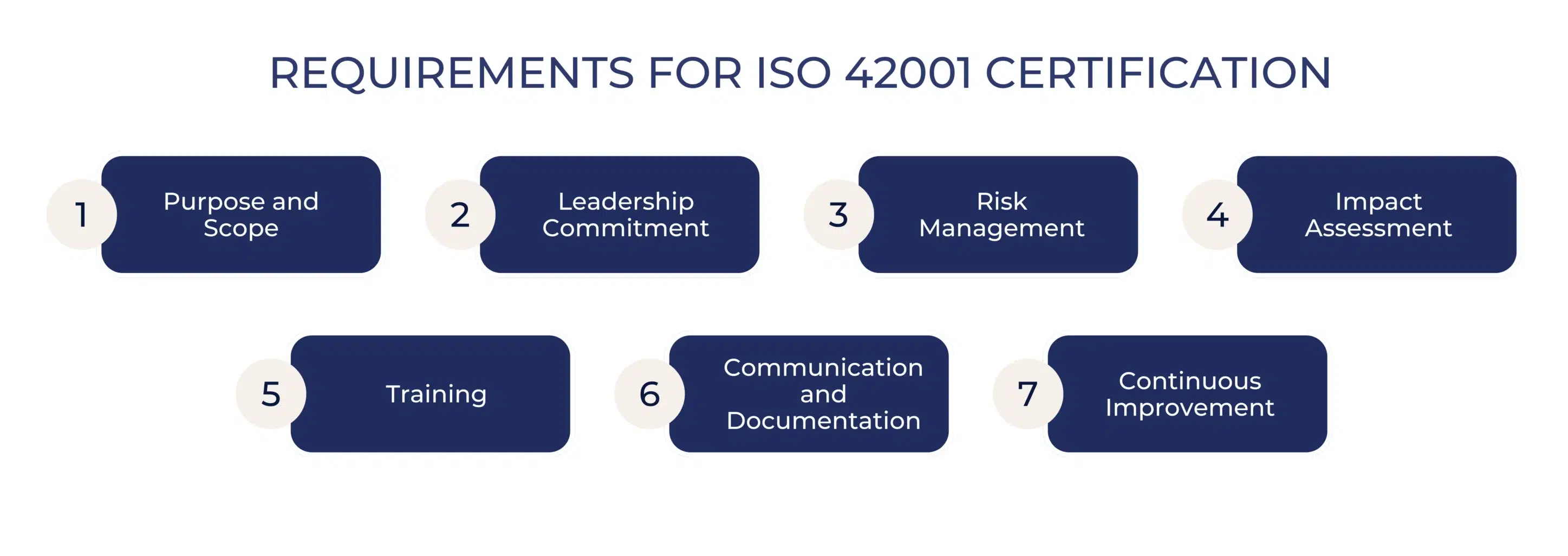
ISO 42001 Certification requires organizations to establish, document, implement, and maintain an Artificial Intelligence Management System that conforms to all normative clauses of ISO/IEC 42001:2023. The certification requirements are structured, specific, and auditable. Organizations in San Francisco must fulfill several foundational requirements before achieving accreditation under this standard. These requirements span leadership commitment, documented policies, risk management procedures, operational controls, internal audit programs, and management review processes. Understanding these requirements in advance helps organizations structure their AIMS preparation systematically and efficiently.
ISO 42001 requires demonstrable top management commitment to the AIMS. This requirement is not satisfied by a signed policy statement alone—auditors evaluate evidence that leadership actively participates in AI governance, allocates adequate resources for AIMS operation, and receives regular performance reports on AI management objectives. Top management must establish an AI policy that articulates the organization’s commitments to responsible AI development, ethical principles, legal compliance, and continual improvement. This policy must be communicated throughout the organization and made available to relevant external parties. Organizations pursuing ISO 42001 Certification in San Francisco must document how leadership accountability for AI governance is assigned and exercised at the board and executive levels.
Role clarity is a specific ISO 42001 compliance requirement. The standard mandates that organizations define and assign responsibilities for AI system development, deployment, monitoring, and incident management. In larger San Francisco technology organizations, this typically involves designating an AI governance committee, a Chief AI Officer or equivalent role, and clearly documented accountability matrices for each AI system in scope. For smaller AI startups, role assignment may be more concentrated but must still be explicit and documented. Auditors examine organizational charts, job descriptions, and governance committee meeting records to verify that role assignments are genuinely operational rather than merely nominal.
ISO 42001 assessment requires a comprehensive documentation suite covering all aspects of the AIMS. Mandatory documented information includes the AIMS scope statement, AI policy, AI risk assessment methodology and results, AI risk treatment plan, Statement of Applicability, objectives and achievement plans, operational procedures for AI system development and deployment, internal audit program and results, management review records, and records of nonconformities and corrective actions. Each document must be version-controlled, approved by authorized personnel, and retained for defined periods. The completeness and quality of this documentation suite is a primary focus of the ISO 42001 audit, as it forms the auditable evidence base for the entire certification evaluation.
At the operational level, ISO 42001 compliance requires organizations to implement controls governing the full AI system lifecycle. This includes data governance controls covering training data quality, data provenance, and data bias assessment; model development controls covering algorithm selection rationale, testing protocols, and validation procedures; deployment controls covering human oversight mechanisms, monitoring systems, and incident response procedures; and decommissioning controls governing how AI systems are retired and their associated data managed. Organizations in San Francisco with complex multi-model AI architectures must document the interactions between AI systems and the controls governing those interactions—particularly where AI outputs feed into other automated decision processes.
- ✓Defined AIMS scope with explicit AI system inventory and boundaries
- ✓Documented AI policy approved by top management and communicated organization-wide
- ✓Completed AI risk assessment covering all in-scope AI systems and use cases
- ✓Risk treatment plan with assigned owners, controls, and target completion dates
- ✓Statement of Applicability (SoA) covering all 38 Annex A controls with justifications
- ✓Operational procedures for AI development, testing, deployment, and monitoring
- ✓Internal audit program with documented audit results and findings
- ✓Management review records demonstrating executive engagement with AIMS performance
- ✓Corrective action records for all identified nonconformities
- ✓Training records demonstrating AI governance competency across relevant personnel
- ✓Leadership and Governance Requirements
- ✓Documentation Requirements
- ✓Technical and Operational Requirements
Steps for ISO 42001 Assessment and Certification
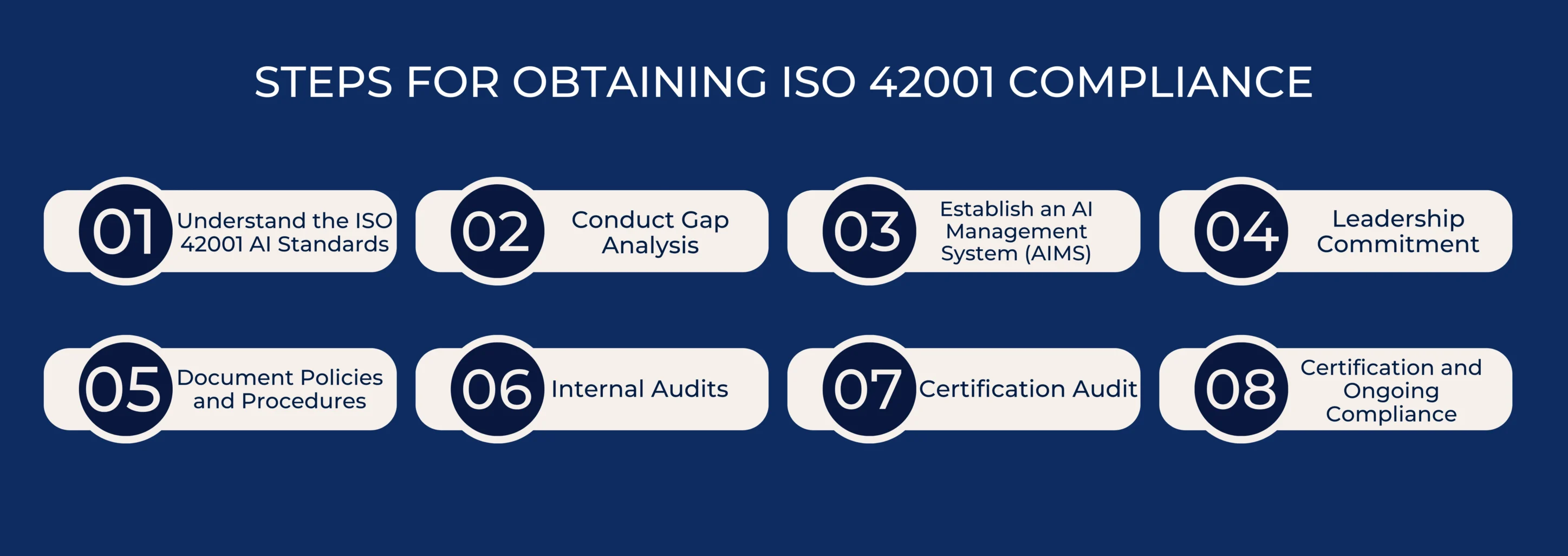
The ISO 42001 certification process follows a structured sequence of evaluation stages that progress from initial scope definition through formal certificate issuance and ongoing surveillance. This process is conducted by an accredited certification body such as CertPro, which operates as an independent Licensed CPA Firm. Each stage of the ISO 42001 audit is distinct and produces specific outputs that feed into subsequent stages. Organizations in San Francisco following this structured process can approach ISO 42001 Certification with clarity about timelines, evidence requirements, and audit objectives at every stage.
The ISO 42001 audit process begins with a Stage 1 audit—also referred to as a documentation review or readiness review. During Stage 1, the CertPro audit team evaluates the organization’s AIMS documentation against the requirements of ISO/IEC 42001:2023. The primary objective of Stage 1 is to confirm that the organization has established the fundamental elements of the AIMS—including scope, policy, risk assessment, and Statement of Applicability—and that these documents are sufficiently mature to proceed to Stage 2 field auditing. Stage 1 also defines the Stage 2 audit program, identifying the specific processes, controls, and locations to be examined during on-site evaluation.
Stage 1 findings are categorized as major nonconformities, minor nonconformities, or observations. Major nonconformities indicate that fundamental AIMS elements are absent or significantly deficient, requiring remediation before Stage 2 can proceed. Minor nonconformities and observations are documented and tracked but do not prevent Stage 2 progression if addressed within agreed timelines. The Stage 1 audit report produced by CertPro provides a detailed assessment of documentation completeness, identifies gaps requiring remediation, and establishes the audit plan for Stage 2. This report is a proprietary deliverable of the ISO 42001 assessment process and is retained as part of the certification record.
Stage 2 of the ISO 42001 audit is the primary field evaluation, conducted at the organization’s San Francisco premises or via remote audit protocols where operationally appropriate. During Stage 2, CertPro auditors evaluate the implementation and effectiveness of the AIMS by examining objective evidence across all in-scope processes and controls. Evidence examination methods include document review, interviews with personnel at all organizational levels, observation of AI development and operational processes, and technical evaluation of AI system monitoring and incident management capabilities. Stage 2 verifies that the AIMS documented in Stage 1 is genuinely operational—not merely existing on paper.
Control testing during Stage 2 focuses on the organization’s ability to demonstrate that each applicable Annex A control is implemented and producing intended outcomes. Auditors assess data governance controls by examining training data documentation, bias assessment records, and data quality management procedures. Model governance controls are evaluated through review of model validation records, testing protocols, and change management documentation. Human oversight controls are tested by examining how AI-generated outputs are reviewed, challenged, and overridden by human operators. The Stage 2 ISO 42001 audit typically requires two to five days of on-site evaluation, depending on the organization’s size, AI system complexity, and AIMS scope.
Following Stage 2, CertPro auditors compile all findings into a formal audit report that categorizes each nonconformity by severity. Major nonconformities represent failures to meet a specific ISO 42001 requirement or systematic breakdowns in AIMS control effectiveness; these must be resolved before certification can be issued. Minor nonconformities represent isolated deviations that do not indicate systematic failure and must be corrected within agreed timelines after certification. Organizations are required to submit documented corrective action plans for all major nonconformities. CertPro auditors then evaluate the adequacy of those plans and the evidence of their implementation before proceeding to the certification decision stage.
The certification decision is made by a CertPro certification panel independent of the audit team, ensuring objectivity throughout the decision-making process. This independence between auditors and certification decision-makers is a fundamental requirement of ISO/IEC 17021-1, the accreditation standard governing certification body operations. When the panel determines that all major nonconformities have been resolved and the AIMS demonstrates conformance to ISO/IEC 42001:2023, a formal ISO 42001 Certification is issued. The certificate specifies the certified organization’s name, AIMS scope, certification date, certificate validity period, and the accreditation body under which CertPro operates.
ISO 42001 Certification is valid for three years from the date of issuance, subject to annual surveillance audits conducted in years one and two of the certification cycle. Surveillance audits are abbreviated field evaluations that verify the AIMS remains operational and continues to conform to ISO/IEC 42001:2023 requirements. CertPro surveillance audits focus on changes to the organization’s AI systems or governance structure since the previous audit, the status of corrective actions from prior findings, results of internal audits and management reviews, and performance against AIMS objectives. Organizations that fail to maintain conformance during the surveillance period risk suspension or withdrawal of their ISO 42001 Certification prior to the three-year recertification date.
| Certification Stage | Primary Activity | Typical Duration | Key Output |
|---|---|---|---|
| Stage 1 Audit | Documentation and readiness review | 1–2 days | Stage 1 audit report and Stage 2 audit plan |
| Stage 2 Audit | On-site operational evaluation and control testing | 2–5 days | Stage 2 audit report with nonconformity findings |
| Nonconformity Review | Corrective action submission and verification | 2–8 weeks | Resolved nonconformities, certification recommendation |
| Certification Decision | Independent panel review and certificate issuance | 1–2 weeks | ISO 42001 certification certificate |
| Surveillance Audit | Annual conformance verification (Years 1 and 2) | 1–2 days | Surveillance audit report, continued certification |
- ✓Stage 1: Scope Definition and Documentation Review
- ✓Stage 2: On-Site Operational Audit
- ✓Nonconformity Review and Certification Decision
- ✓Surveillance Audits and Recertification
How to Get ISO 42001 Certification in San Francisco
Obtaining ISO 42001 Certification in San Francisco requires a methodical approach that begins with a clear understanding of the organization’s AI system landscape and governance baseline. The certification pathway involves both internal preparation activities—which the organization conducts autonomously—and external audit activities conducted by CertPro as an independent certification body. Understanding the distinction between internal preparation and external audit is essential: CertPro does not provide consulting or advisory services related to AIMS implementation. CertPro’s role is strictly that of an independent auditor evaluating the AIMS against ISO/IEC 42001:2023 requirements.
Internal Preparation Activities
Prior to engaging CertPro for an ISO 42001 audit, organizations in San Francisco must complete internal preparation activities that establish the AIMS as a functioning management system. This preparation begins with conducting a comprehensive inventory of all AI systems in operation or development—documenting their intended purpose, data inputs, decision outputs, and risk profile. This AI system inventory forms the factual basis for defining the AIMS scope and identifying which Annex A controls are applicable to the organization’s specific AI operations. Organizations with multiple AI systems across different business functions must document each system individually and establish cross-cutting governance mechanisms that apply to all systems in scope.
Following system inventory, organizations must conduct a formal AI risk assessment using a documented methodology that identifies threats, vulnerabilities, and potential impacts across all in-scope AI systems. The risk assessment must consider technical risks such as model failure and adversarial attacks, operational risks such as human override failures and training data contamination, legal risks such as non-compliant automated decisions and data protection violations, and reputational risks such as biased AI outputs or lack of explainability. Risk treatment options must be evaluated and selected, with treatment decisions documented and assigned to responsible owners. The completed risk assessment and treatment plan become central audit artifacts during the ISO 42001 assessment conducted by CertPro.
Internal Audit Requirement
ISO 42001 requires organizations to conduct at least one complete internal audit of the AIMS before applying for external certification. The internal audit must cover all clauses of ISO/IEC 42001:2023 applicable to the organization’s AIMS scope and must be conducted by personnel who are competent in audit methodology and independent from the activities being audited. Internal audit findings must be documented, reported to management, and addressed through corrective action processes. Evidence of completed internal audits—including audit plans, audit reports, and corrective action records—is a mandatory exhibit during the CertPro Stage 1 documentation review. Organizations that have not completed an internal audit cycle are not ready for external ISO 42001 Certification.
- Conduct a comprehensive AI system inventory documenting all in-scope AI systems, their purpose, data flows, and risk profiles
- Define the AIMS scope with explicit boundaries covering organizational units, AI systems, and geographic locations
- Establish an AI policy approved by top management and communicate it throughout the organization
- Perform a documented AI risk assessment using a defined methodology covering all in-scope AI systems
- Develop a risk treatment plan assigning controls, owners, and completion timelines to each identified risk
- Produce a Statement of Applicability (SoA) covering all 38 ISO 42001 Annex A controls with inclusion/exclusion justifications
- Implement operational controls and document procedures covering AI development, deployment, monitoring, and incident response
- Conduct a complete internal audit of the AIMS against all applicable ISO/IEC 42001:2023 clauses
- Hold a formal management review meeting and document outcomes, decisions, and action items
- Engage CertPro as the independent certification body and submit the AIMS documentation for Stage 1 audit
Benefits of ISO 42001 Certification
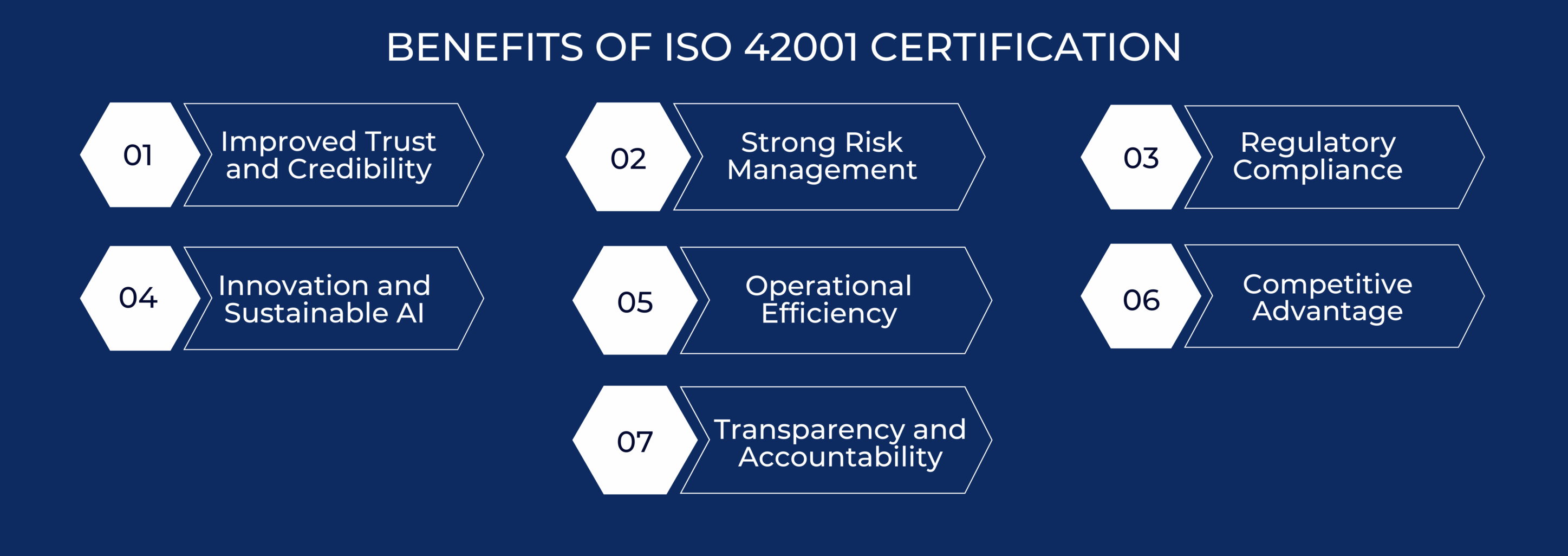
Organizations that achieve ISO 42001 Certification in San Francisco realize measurable benefits across regulatory compliance, commercial competitiveness, operational risk management, and stakeholder trust. The benefits of ISO 42001 assessment and certification are distinct from those of general compliance programs because the standard requires ongoing operational effectiveness—not merely one-time documentation completeness. The following benefits reflect outcomes that organizations achieve through genuine AIMS implementation and successful certification, not aspirational outcomes of advisory engagement.
ISO 42001 compliance provides organizations in San Francisco with a documented defense against regulatory investigations related to AI system failures, biased decisions, or data misuse. When California regulators, federal agencies, or international authorities inquire about an organization’s AI governance practices, ISO 42001 Certification provides an independently verified record of systematic risk management. This regulatory defensibility is particularly valuable in high-stakes domains such as credit decisioning, employment screening, healthcare diagnostics, and law enforcement support—where AI system failures can trigger investigations, fines, and litigation. The certification record, including audit reports, risk assessments, and corrective action documentation, constitutes objective evidence of governance due diligence.
ISO 42001 Certification in San Francisco also positions companies favorably in EU AI Act compliance contexts. High-risk AI systems under the EU AI Act must undergo conformity assessments before market placement, and ISO 42001 Certification provides a recognized baseline that auditors and notified bodies can reference. For San Francisco companies with European operations or customers, ISO AIMS certification reduces the duplication of governance documentation required across multiple regulatory frameworks—since AIMS documentation produced for ISO 42001 can be directly mapped to EU AI Act technical documentation requirements.
ISO 42001 Certification functions as a procurement enabler in enterprise and government sales cycles for San Francisco companies. Large enterprise customers in financial services, healthcare, and technology are introducing AI governance certification requirements into their vendor assessment processes, requesting evidence of certified AI management systems before contracting. ISO AIMS certification shortens procurement cycles by providing procurement teams with an independently verified governance attestation that reduces the need for extensive vendor-specific AI audits. This certification advantage is particularly significant for AI startups competing against established vendors, where ISO 42001 Certification provides objective evidence of governance maturity that compensates for limited operational history.
The process of achieving and maintaining ISO 42001 Certification instills systematic risk identification and control disciplines that reduce the probability and impact of AI system failures. Organizations that implement the AIMS framework develop structured processes for identifying when AI systems are producing biased, inaccurate, or harmful outputs—before those outputs cause significant damage. Early detection of model drift, training data contamination, or control failures enables timely remediation rather than post-incident crisis management. The ongoing surveillance audit cycle further reinforces this discipline by requiring organizations to demonstrate, at least annually, that their AI risk controls remain effective as their AI systems and operating environments evolve.
- ✓Internationally recognized third-party attestation of AI governance conformance
- ✓Documented regulatory defensibility under CCPA, EU AI Act, and U.S. federal AI governance requirements
- ✓Accelerated procurement cycles in enterprise and government sales by satisfying AI governance vendor requirements
- ✓Reduced duplicate governance documentation across multiple regulatory frameworks
- ✓Structured AI risk identification and control disciplines reducing probability of AI system failures
- ✓Enhanced stakeholder trust among customers, investors, regulators, and board directors
- ✓Board-level AI governance accountability embedded in a documented management system
- ✓Competitive differentiation in San Francisco’s AI market through certified governance maturity
- ✓Integration efficiency with ISO 27001, ISO 9001, and other management system certifications
- ✓Annual surveillance audits providing ongoing assurance of AIMS operational effectiveness
- ✓Regulatory and Legal Benefits
- ✓Commercial and Market Benefits
- ✓Operational Risk and Internal Control Benefits
Cost of ISO 42001 Assessment and Certification in San Francisco
The cost of obtaining ISO 42001 Certification in San Francisco is determined by multiple objective factors that CertPro evaluates during the scoping phase. These factors include the organization’s size measured by number of employees and revenue, the number and complexity of AI systems within the AIMS scope, the maturity of existing governance documentation and controls at the time of initial inquiry, the number of locations or data centers included in the certification scope, and whether the organization is pursuing integrated certification alongside other ISO standards such as ISO 27001 or ISO 9001. CertPro provides fixed-fee pricing proposals following an initial scoping discussion, ensuring cost certainty for San Francisco organizations planning their ISO 42001 certification investment.
Cost Factors and Investment Components
The primary cost components of ISO 42001 assessment and certification include Stage 1 documentation review fees, Stage 2 on-site or remote audit fees, certification decision and certificate issuance fees, and annual surveillance audit fees for years one and two of the certification cycle. Organizations with more complex AI system portfolios or broader geographic scope incur higher Stage 2 audit fees due to increased auditor time required to evaluate all in-scope systems and controls. Organizations that have completed comprehensive internal preparation—including a well-documented risk assessment, complete AIMS documentation suite, and a prior internal audit cycle—typically require fewer auditor days than those commencing the certification process with limited documentation in place.
For AI startups in San Francisco with a focused AI product portfolio and a small team, ISO 42001 Certification costs are typically lower due to the narrower AIMS scope and reduced audit time requirements. For large technology enterprises with multiple AI systems, international operations, and complex governance structures, the certification investment is proportionally higher but delivers correspondingly greater value through comprehensive enterprise-wide AI risk coverage. Organizations pursuing integrated management system certification—combining ISO 42001 with ISO 27001 or ISO 9001—benefit from audit efficiency, as CertPro can conduct combined audits that reduce total audit time and cost compared to separate certification processes for each standard.
| Organization Profile | Estimated AIMS Scope | Typical Audit Duration | Relative Cost Range |
|---|---|---|---|
| AI Startup (< 50 employees) | 1–3 AI systems, single location | Stage 1: 1 day, Stage 2: 2 days | Lower investment tier |
| Mid-size Tech Company (50–500 employees) | 3–10 AI systems, 1–2 locations | Stage 1: 1–2 days, Stage 2: 3–4 days | Mid investment tier |
| Large Enterprise (500+ employees) | 10+ AI systems, multiple locations | Stage 1: 2 days, Stage 2: 4–5 days | Higher investment tier |
| Integrated ISO 42001 + ISO 27001 | Combined AIMS and ISMS scope | Combined audit approach | Efficiency discount applied |
Why Choose CertPro for ISO 42001 Assessment and Certification?
CertPro is a Licensed CPA Firm operating as an accredited independent certification body for ISO management system standards, including ISO 42001. CertPro’s positioning as a Licensed CPA Firm distinguishes it from certification consultants and advisory firms: CertPro’s engagement with San Francisco organizations is strictly an audit and certification relationship—not an advisory or implementation partnership. This independence is foundational to the credibility of ISO 42001 Certification issued by CertPro, ensuring that every certificate reflects objective, evidence-based evaluation rather than a commercial relationship incentivizing favorable outcomes.
Audit Expertise and AI Governance Specialization
CertPro’s audit team brings specialized expertise in AI governance, data science operations, and management system auditing to each ISO 42001 assessment conducted in San Francisco. Auditors assigned to ISO 42001 engagements hold relevant qualifications in both management system auditing and AI/data science domains, enabling them to evaluate technical AI controls—such as model validation protocols, bias testing procedures, and monitoring system architectures—with the same rigor applied to governance and documentation controls. This dual competency is essential for producing ISO 42001 audit findings that reflect a genuine understanding of how AI systems operate, not merely a review of policy documents divorced from technical reality.
CertPro has conducted ISO 42001 assessments across a range of industries represented in San Francisco’s technology sector, including AI-native startups, established SaaS platforms, financial technology companies, healthcare technology providers, and enterprise software vendors. This cross-industry audit experience enables CertPro auditors to contextualize ISO 42001 requirements within the specific operational realities of each client’s AI use cases, identifying industry-specific risks and control practices relevant to the certification evaluation. Organizations seeking ISO 42001 Certification in San Francisco with auditors who have genuine AI sector expertise should engage CertPro for their certification program.
Structured Certification Process and Fixed Pricing
CertPro’s ISO 42001 certification process is fully structured, with defined deliverables, timelines, and pricing at each stage. Organizations in San Francisco receive a detailed scoping proposal following an initial inquiry, specifying the audit program, estimated audit durations, deliverables at each stage, and fixed fees for the complete three-year certification cycle including surveillance audits. This fixed-fee approach provides cost certainty and eliminates the budget uncertainty associated with time-and-materials engagements. CertPro’s structured process minimizes disruption to client operations by aligning audit scheduling with organizational calendars and providing clear evidence requirements in advance of each audit stage.
CertPro’s ISO 42001 audit engagements in San Francisco are designed to be conducted efficiently without compromising audit rigor. Remote audit protocols, where operationally appropriate, reduce travel costs and scheduling constraints while maintaining full compliance with ISO/IEC 17021-1 audit requirements. Audit reports are delivered within defined timeframes following field audit completion, and CertPro’s certification panel reviews findings and issues certification decisions on a published schedule—ensuring organizations can plan their ISO 42001 certification timeline with confidence. The combination of institutional audit expertise, fixed pricing, and a structured process makes CertPro the preferred choice for ISO 42001 Certification in San Francisco across all industry sectors and organization sizes.
ISO 42001 Compliance: Key Clauses and Control Domains
Understanding the specific clauses and control domains that govern ISO 42001 compliance is essential for organizations preparing for certification in San Francisco. ISO/IEC 42001:2023 contains both mandatory normative requirements (Clauses 4–10) and informative guidance (Annexes A through E). ISO 42001 compliance requires conformance to all applicable normative clauses; the Annexes provide additional context and reference controls that organizations use to design their AIMS. The following overview of key clauses and control domains offers actionable detail for organizations structuring their AIMS documentation and operational practices.
Clause 4: Context of the Organization
Clause 4 of ISO/IEC 42001:2023 requires organizations to conduct a structured analysis of their internal and external context as it relates to AI. Internal context factors include the organization’s AI strategy, governance culture, technical capabilities, existing management systems, and resource constraints. External context factors include regulatory requirements, customer expectations, competitive landscape, societal concerns about AI, and industry-specific standards applicable to AI deployment in the organization’s sector. For San Francisco organizations, external context analysis must include California’s regulatory environment, the U.S. federal AI governance landscape, and the expectations of sophisticated, AI-literate enterprise customers who are themselves subject to AI governance obligations.
Clause 4 also requires organizations to identify interested parties relevant to the AIMS and their specific requirements. Interested parties for a San Francisco AI company typically include regulators (California CPPA, FTC, sector-specific regulators), customers, business partners in the AI supply chain, investors, employees whose work involves AI system development or oversight, and affected individuals whose data or decisions are processed by AI systems. The organization must determine which requirements of these interested parties are relevant to the AIMS and ensure they are addressed within the AIMS framework. This stakeholder mapping activity directly informs the AI risk assessment required by Clause 6.
Annex A Control Domains
Annex A of ISO/IEC 42001:2023 organizes 38 AI management controls into nine functional domains. Domain 1 covers policies for AI, requiring organizations to establish documented policies governing AI objectives, ethical commitments, and governance principles. Domain 2 addresses internal organization, specifying controls for roles, responsibilities, and governance committee structures. Domain 3 governs resources, requiring adequate infrastructure, tools, and personnel competence for AI operations. Domain 4 covers AI system impact assessment, requiring organizations to systematically evaluate the potential positive and negative impacts of AI systems before deployment. Domain 5 addresses third-party AI supplier management—a critical domain for San Francisco organizations using third-party AI models, APIs, or data services from external providers.
Domain 6 of Annex A governs AI system lifecycle management, covering controls for development, testing, validation, deployment, monitoring, and decommissioning of AI systems. This domain is the most technically detailed section of the control set and requires organizations to document their AI development methodology, model selection rationale, testing protocols, and validation criteria. Domain 7 addresses data management for AI systems, covering training data quality, bias assessment, data provenance, and data retention. Domain 8 covers information for interested parties, requiring organizations to communicate relevant AI system information to customers, regulators, and affected individuals in an accessible and accurate manner. Domain 9 addresses use of AI, specifying controls for human oversight, monitoring of AI outputs, and management of AI-related incidents and complaints.
Secure Your ISO 42001 Certification in San Francisco with CertPro
Achieving ISO 42001 Certification in San Francisco represents a definitive organizational commitment to responsible, transparent, and accountable AI governance. For organizations operating in San Francisco’s technology-driven, regulation-conscious environment, this certification is both a strategic imperative and a competitive necessity. CertPro, operating as a Licensed CPA Firm and independent certification body, conducts rigorous, structured ISO 42001 audits that produce internationally recognized certifications trusted by regulators, enterprise customers, investors, and board directors. ISO 42001 Certification in San Francisco issued by CertPro reflects objective, evidence-based evaluation of AIMS conformance—not a commercial certification transaction.
Organizations that have completed their internal AIMS preparation and are ready to engage an independent certification body should contact CertPro to initiate the scoping process. CertPro’s scoping process involves a structured inquiry covering the organization’s AI system inventory, AIMS documentation status, organizational size, and certification timeline objectives. Based on this scoping information, CertPro provides a detailed audit proposal specifying the Stage 1 and Stage 2 audit program, fixed fees for the complete three-year certification cycle, and an estimated timeline from initial engagement to certificate issuance. ISO 42001 audit engagements in San Francisco are scheduled on a rolling basis, with audit slots allocated in the order inquiries are received and confirmed.
ISO 42001 Certification in San Francisco is not merely a regulatory compliance exercise. It is an institutional commitment to building AI ecosystems that are safe, ethical, and sustainable—commitments that resonate deeply with the values of San Francisco’s technology community and the expectations of its global customer base. Organizations that achieve and maintain ISO 42001 Certification position themselves as leaders in responsible AI, attracting customers, talent, and investors who share these values. CertPro’s ISO 42001 certification services provide the independent, credible attestation that transforms organizational AI governance commitments into verifiable, market-recognized proof of conformance.
FAQ
▶
What is ISO 42001 certification and who needs it?
▶
How long does the ISO 42001 audit process take in San Francisco?
▶
What is the difference between ISO 42001 and ISO 27001?
▶
How does ISO 42001 compliance relate to CCPA requirements?
▶
How often does ISO 42001 certification need to be renewed?
▶
What documentation is required for the ISO 42001 audit?
▶
Does ISO 42001 certification apply to AI systems purchased from third-party vendors?
▶
Can small AI startups in San Francisco achieve ISO 42001 certification?
ISO 42001 CERTIFIED: WHY AI GOVERNANCE CERTIFICATION IS BECOMING A BOARD-LEVEL REQUIREMENT
AI is now an inevitable component of major business activities in the current corporate world. To elaborate, it is now part of product design, custome…

MindSec Launches AI Compliance for Law 25 & ISO 42001
Excerpt from Barchart Article, Published on December 3, 2025 Today, Canadian organizations face increasing pressure to comply with stringent privacy a…

UNDERSTANDING ISO 42001: A GUIDE FOR RESPONSIBLE AI MANAGEMENT SYSTEMS
The invention of artificial intelligence (AI) has changed the operational processes of many industries. However, the rapid growth of technology increa…
Get In Touch
have a question? let us get back to you.