
ISO 42001 Certification in Seattle
ISO 42001 certification is the formal confirmation that an organization’s Artificial Intelligence Management System (AIMS) meets the requirements of ISO/IEC 42001:2023—the first international standard dedicated exclusively to governing the development, deployment, and use of AI systems. Certification is issued following an independent third-party audit conducted by a qualified certification body. The resulting certificate provides documented assurance to customers, regulators, partners, and stakeholders that an organization’s AI governance framework is structured, operational, and independently verified.
OUR CLIENTS


What Is ISO 42001 Certification?
ISO 42001 certification is the formal confirmation that an organization’s Artificial Intelligence Management System (AIMS) meets the requirements of ISO/IEC 42001:2023—the first international standard dedicated exclusively to governing the development, deployment, and use of AI systems. Certification is issued following an independent third-party audit conducted by a qualified certification body. The resulting certificate provides documented assurance to customers, regulators, partners, and stakeholders that an organization’s AI governance framework is structured, operational, and independently verified.
ISO 42001 Certification in Seattle is increasingly relevant as the region’s technology sector—spanning cloud computing, machine learning, enterprise software, and generative AI—faces growing expectations around responsible AI governance. Seattle-based companies that develop or deploy AI systems are using ISO 42001 compliance as a structured mechanism for demonstrating organizational accountability and ethical AI practices to clients and regulators alike. ISO 42001 assessment provides the independent verification that internal governance statements and self-assessments cannot replicate.
Definition and Scope of ISO/IEC 42001:2023
ISO/IEC 42001:2023 is a management system standard published by the International Organization for Standardization (ISO) and the International Electrotechnical Commission (IEC). It specifies requirements for establishing, implementing, maintaining, and continually improving an Artificial Intelligence Management System within an organizational context. The standard applies to any organization—regardless of size, type, or sector—that develops, provides, or uses AI-based products and services. Its structural alignment with other ISO management system standards, including ISO 9001 and ISO 27001, follows the High-Level Structure (HLS), enabling seamless integration with existing management systems.
The standard’s scope encompasses the full AI lifecycle—from initial design and data governance through model development, testing, deployment, monitoring, and decommissioning. It establishes requirements for defining organizational roles and responsibilities related to AI, conducting AI risk assessments, implementing documented controls drawn from Annex A, and demonstrating continual improvement through performance measurement and internal audit cycles. ISO 42001 certification confirms that each of these operational requirements has been independently evaluated and found to conform with the standard’s clauses.
What ISO AIMS Certification Confirms
ISO AIMS certification—the shorthand reference to ISO 42001 certification—confirms three distinct outcomes. First, it confirms that an organization has established a documented management system governing its AI activities, with defined scope, objectives, and policies. Second, it confirms that risk management processes are operational, meaning the organization actively identifies, assesses, and treats risks associated with its AI systems before and after deployment. Third, it confirms that selected Annex A controls have been implemented and are functioning as intended at the time of the audit.
ISO AIMS certification does not certify individual AI models, algorithms, or datasets. It certifies the management system under which those AI assets are developed and governed. This distinction is important for organizations in Seattle evaluating what ISO 42001 certification actually demonstrates to their customers. The certificate attests to systemic governance controls—not to the technical performance or accuracy of any specific AI output. Organizations that conflate model quality with AIMS certification risk misrepresenting the scope of their certification to clients and auditors.
ISO 42001 Compared to Other AI Governance Frameworks
ISO 42001 differs from other AI governance frameworks by providing a certifiable management system structure rather than a voluntary guideline or regulatory checklist. The NIST AI Risk Management Framework (AI RMF), for example, offers structured guidance but does not produce a third-party certification. The EU AI Act establishes regulatory obligations but operates through conformity assessments under EU law rather than ISO certification. ISO 42001 compliance, by contrast, produces an internationally recognized third-party certificate that organizations can present to clients, procurement bodies, and regulators as formal evidence of AI governance maturity.
ISO 42001 shares structural DNA with ISO 27001 for information security and ISO 31000 for risk management. Organizations in Seattle that already hold ISO 27001 certification can leverage existing policies, documented risk processes, roles, and review cycles when building their AIMS—significantly reducing duplication. The overlap in management system architecture means that security controls, internal audit programs, and top management review processes can be mapped across both standards. The result is an integrated governance framework that addresses AI-specific risks within a broader information security posture.
| Framework | Type | Produces Certificate? | AI-Specific? |
|---|---|---|---|
| ISO 42001 | Management System Standard | Yes | Yes |
| NIST AI RMF | Voluntary Guidance Framework | No | Yes |
| EU AI Act | Regulatory Legislation | Conformity Assessment | Yes |
| ISO 27001 | Management System Standard | Yes | No (security focus) |
| ISO 9001 | Management System Standard | Yes | No (quality focus) |
Organizations That Require ISO 42001 Compliance
ISO 42001 compliance applies to any organization that develops AI-based products or services, deploys AI within its operational processes, procures or integrates AI systems from third parties, or uses AI to support decision-making with material impact on individuals or business operations. This broad applicability means that ISO 42001 certification is relevant not only to AI developers and research organizations but also to enterprises using AI tools for customer service automation, fraud detection, predictive analytics, content generation, or hiring processes.
For Seattle-based organizations specifically, ISO 42001 Certification in Seattle is particularly relevant to cloud service providers embedding AI into platform offerings, healthcare systems using AI for diagnostics or patient management, financial technology firms deploying algorithmic decision tools, eCommerce operators using machine learning for personalization and pricing, and enterprise software companies integrating generative AI capabilities. In each case, ISO 42001 assessment provides the governance documentation and independent verification that enterprise clients, government agencies, and healthcare regulators increasingly require before entering or renewing service agreements.

ISO 42001 Certification Audit Process in Seattle
The ISO 42001 audit process in Seattle follows a structured evaluation sequence designed to independently assess whether an organization’s AIMS conforms with all applicable clauses of ISO/IEC 42001:2023. CertPro, as a Licensed CPA Firm, conducts ISO 42001 audits in Seattle as independent third-party certification engagements. The audit is not advisory in nature—it is an objective evaluation of documented evidence, implemented controls, and organizational practices measured against defined standard requirements. Each stage of the ISO 42001 audit produces documented findings that inform the final certification decision.
The Stage 1 audit begins with scope definition, during which the auditor evaluates the boundaries of the organization’s AIMS as documented in the scope statement. The scope must identify the AI systems, functions, processes, and organizational units covered by the management system. Auditors verify that the scope is consistent with the organization’s actual AI activities and that no significant AI functions have been excluded without documented justification. An incomplete or inaccurate scope statement constitutes a nonconformity at Stage 1.
During Stage 1, auditors also conduct a documentation review to assess whether the organization has established all mandatory documented information required by ISO 42001. This includes the AI policy, risk assessment methodology, Statement of Applicability (SoA), AI system impact assessments, treatment plans, objectives documentation, and internal audit records. The Stage 1 audit determines readiness for Stage 2 assessment and identifies any documentation gaps that must be addressed before the on-site evaluation proceeds.
The Stage 2 audit is the primary on-site or remote assessment during which auditors verify the implementation and operational effectiveness of the AIMS controls. Auditors examine whether documented procedures are being followed in practice, whether AI risk assessments have been completed for in-scope systems, and whether Annex A controls selected in the Statement of Applicability have been implemented as documented. The Stage 2 assessment includes interviews with personnel in AI-related roles, review of AI system documentation and monitoring records, and observation of relevant operational processes.
Control testing during Stage 2 focuses on whether each applicable Annex A control is not merely documented but operationally active. For example, if an organization has selected the control requiring AI system impact assessments, auditors verify that completed impact assessments exist for each AI system in scope, that they follow the documented methodology, and that identified risks have been treated through documented plans. Similarly, controls related to human oversight of AI decisions must be tested against evidence of actual oversight activities, escalation records, and documented intervention criteria.
During the ISO 42001 audit, findings are classified as major nonconformities, minor nonconformities, or observations. A major nonconformity indicates a complete failure to implement a required element of the standard or a documented control—representing a systemic breakdown in the AIMS. A minor nonconformity identifies a partial implementation or isolated deviation from a requirement. Observations note potential improvements or areas of concern that do not constitute current nonconformities but warrant monitoring in future surveillance audits.
Organizations with major nonconformities cannot receive certification until those findings are resolved and verified. Resolution requires the organization to provide documented corrective actions, root cause analyses, and evidence of implementation. Auditors evaluate this evidence before approving progression to the certification decision stage. Minor nonconformities may be resolved through documented corrective action plans with defined timelines, with resolution verified at the subsequent surveillance audit. This structured nonconformity process is integral to the integrity of ISO 42001 certification outcomes.
Following Stage 2 assessment, the lead auditor prepares a final audit report summarizing findings, nonconformities, and recommendations. A certification decision is then made by a technically qualified reviewer independent of the audit team, who evaluates the audit report for completeness and conformity with certification criteria. If the AIMS is found to conform with ISO 42001, a certificate is issued confirming the scope, standard version, certification date, and expiry date. ISO 42001 certificates are typically valid for a three-year certification cycle.
Surveillance audits are conducted annually during the three-year cycle to verify that the AIMS remains operational, that previously identified nonconformities have been resolved, and that continual improvement processes are active. Surveillance audits cover a representative subset of AIMS controls rather than a full re-audit of all requirements. At the end of the three-year cycle, a recertification audit is conducted—a full Stage 2 re-evaluation of the AIMS. Organizations must successfully complete recertification to maintain their ISO 42001 certification status.
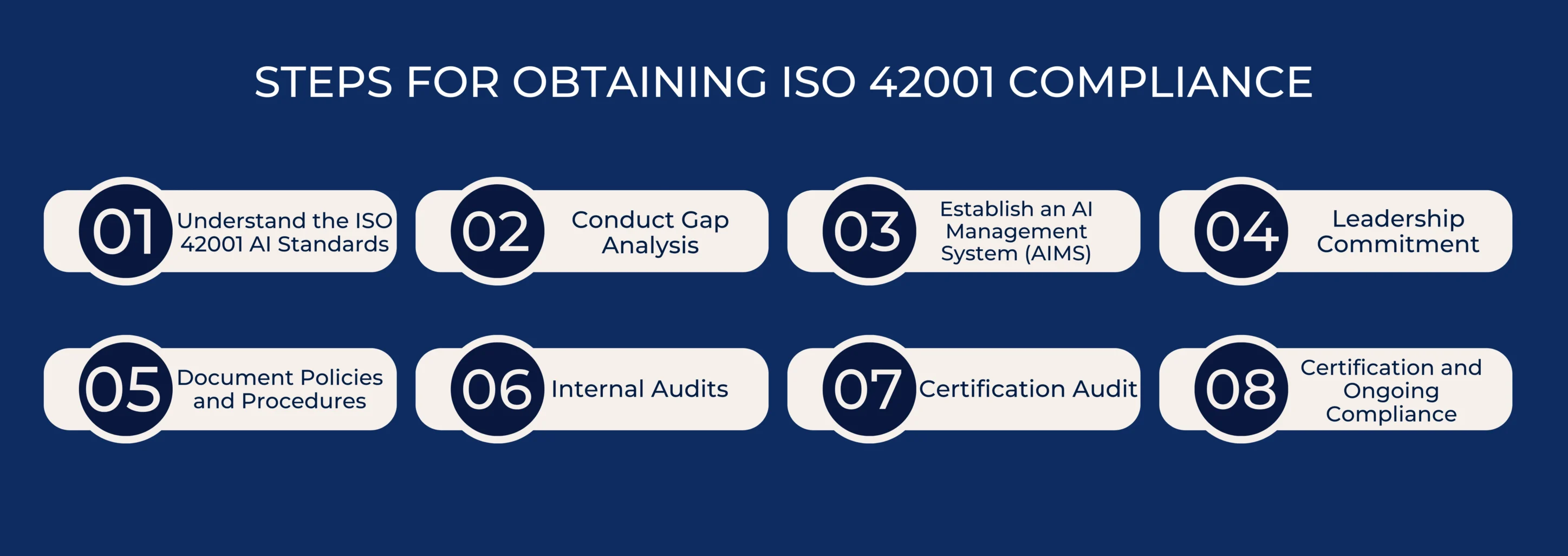
- Scope definition: Auditor evaluates documented AIMS scope for completeness and accuracy against actual AI activities
- Documentation review (Stage 1): Mandatory documented information assessed for existence and adequacy
- Stage 1 report: Readiness determination and identification of gaps requiring resolution before Stage 2
- Stage 2 on-site assessment: Implementation and operational effectiveness of AIMS controls verified through evidence
- Control testing: Annex A controls tested against documented evidence of operational activity
- Personnel interviews: Roles, responsibilities, and AI governance knowledge assessed across relevant functions
- Nonconformity identification: Findings classified as major, minor, or observation with documented rationale
- Corrective action verification: Resolution of major nonconformities confirmed before certification decision
- Certification decision: Independent technical review of audit report determines conformity outcome
- Certificate issuance: ISO 42001 certificate issued confirming scope, standard version, and validity period
- Annual surveillance audit: Continued conformity verified against representative AIMS controls
- Recertification audit: Full Stage 2 re-evaluation conducted at end of three-year certification cycle
- ✓Stage 1: Scope Definition and Documentation Review
- ✓Stage 2: On-Site Assessment and Control Verification
- ✓Nonconformity Classification and Resolution
- ✓Certification Decision, Issuance, and Surveillance
Benefits of ISO 42001 Certification for Seattle-Based Organizations
ISO 42001 Certification in Seattle delivers measurable, documented benefits to organizations operating in one of the world’s most concentrated technology markets. Seattle’s AI ecosystem—anchored by major cloud computing enterprises, a dense population of AI startups, research institutions, healthcare technology firms, and enterprise software companies—creates a competitive environment where third-party governance assurance is increasingly a differentiator in procurement and partnership decisions. ISO 42001 certification provides a structured, internationally recognized mechanism for demonstrating that AI activities are governed with accountability and rigor.
Seattle is home to one of the highest concentrations of AI talent and technology investment in the United States. Organizations certified to ISO 42001 in this environment gain a documented, verifiable governance credential that distinguishes them from competitors relying on self-assessed AI ethics policies or internal governance statements. Enterprise buyers—particularly those in regulated industries such as healthcare, financial services, and government contracting—are increasingly requiring independent AI governance assurance as a procurement condition. ISO 42001 certification satisfies this requirement with a globally recognized third-party certificate.
For ISO 42001 certification Seattle tech companies, the certificate signals to prospective enterprise clients that AI systems are not only technically functional but also governed under a structured management system with documented risk controls, oversight procedures, and continual improvement obligations. This distinction is particularly valuable in competitive RFP processes where technology vendors must demonstrate compliance with customer data governance, AI risk management, and third-party assurance requirements. ISO 42001 certification for Seattle companies translates directly into a documented evidence package that procurement and legal teams can evaluate with confidence.
ISO 42001 compliance requires organizations to systematically identify, assess, and treat risks associated with their AI systems before and after deployment. This structured risk management process reduces the probability of AI-related incidents—such as biased algorithmic outputs, model failures, data governance breaches, or unintended automated decisions—by embedding risk controls into the AI development and operations lifecycle. Organizations that have completed the ISO 42001 assessment process maintain documented evidence that risk identification was conducted, treatments were selected and implemented, and residual risks were accepted through a defined authority process.
From a liability perspective, ISO 42001 certification creates a documented audit trail demonstrating that the organization exercised due diligence in governing its AI systems. In the event of an AI-related incident, the existence of a certified AIMS with documented risk assessments, treatment decisions, and oversight procedures provides evidence of organizational responsibility that may be relevant in regulatory investigations, client disputes, or litigation proceedings. This documented due diligence posture is increasingly important for Seattle-based organizations facing growing scrutiny from regulators and enterprise clients regarding AI accountability.
ISO 42001 compliance aligns with the risk management and accountability principles embedded in major AI regulatory frameworks, including the EU AI Act, the NIST AI Risk Management Framework, and emerging U.S. federal guidance on responsible AI deployment. For Seattle-based organizations serving international clients or operating in regulated markets, ISO 42001 certification demonstrates that AI governance practices meet internationally recognized standards—reducing the compliance burden when expanding into markets with formal AI regulatory requirements. The standard’s documented risk assessment methodology, Annex A controls, and human oversight requirements map directly to obligations under multiple regulatory regimes.
ISO 42001 certification for Seattle healthcare organizations is particularly significant given the intersection of AI governance with HIPAA obligations, FDA guidance on AI-enabled medical devices, and Centers for Medicare and Medicaid Services expectations regarding algorithmic decision-making in care delivery. Seattle’s healthcare technology sector—including telehealth providers, clinical decision support developers, and health data analytics firms—can use ISO 42001 assessment as a structured framework for documenting AI risk management practices that simultaneously align with both ISO governance requirements and healthcare regulatory expectations.
Beyond external market benefits, ISO 42001 certification produces meaningful internal governance improvements by requiring organizations to formalize AI roles and responsibilities, document AI system inventories, establish objective performance metrics, and implement structured review cycles. These requirements prompt organizations to examine their AI operations systematically—often surfacing undocumented AI uses, unclear ownership of AI decision processes, or inconsistent risk assessment practices. The ISO 42001 assessment process produces an organizational AI register, documented policies, and a Statement of Applicability that provide operational clarity across all AI governance functions.
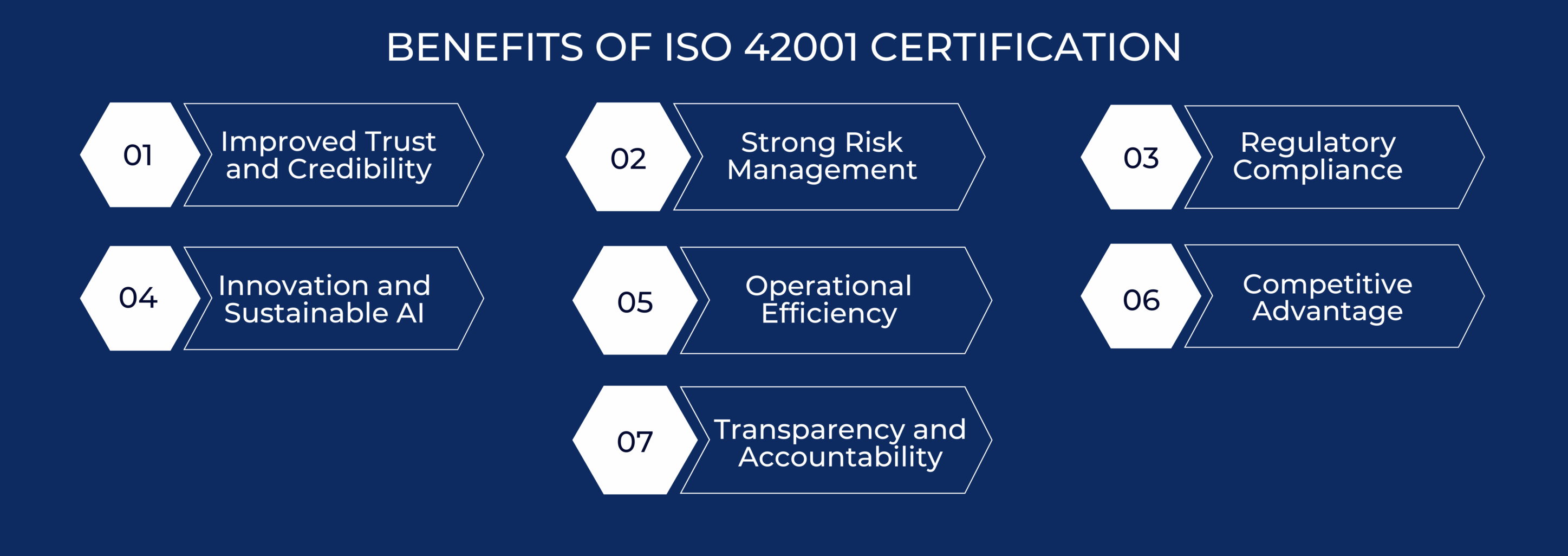
- ✓Documented third-party certification credential recognized internationally across regulated industries
- ✓Structured risk management framework reducing AI-related incident probability and documented liability exposure
- ✓Competitive differentiation in enterprise procurement, government contracting, and regulated-sector sales cycles
- ✓Alignment with EU AI Act, NIST AI RMF, and U.S. federal AI governance expectations
- ✓Integration with existing ISO 27001 and ISO 9001 management systems reducing governance duplication
- ✓Documented AI system inventory and operational controls enabling internal governance clarity
- ✓Annual surveillance structure ensuring the AIMS remains operational and continually improving
- ✓Evidence package demonstrating organizational due diligence for regulatory investigations and client audits
- ✓Market access enablement for international clients requiring AI governance certification as a procurement condition
- ✓Board-level assurance mechanism confirming AI risk management is independently verified and operational
- ✓Competitive Differentiation in Seattle’s AI Market
- ✓Risk Management and Liability Reduction
- ✓Regulatory Alignment and Cross-Border Market Access
- ✓Internal Governance and Operational Efficiency
Requirements for ISO 42001 Certification
ISO 42001 certification requires organizations to establish and demonstrate conformity with all applicable clauses of ISO/IEC 42001:2023. The standard is organized into ten core clauses (Clauses 4 through 10) that define mandatory requirements, supplemented by Annex A—a catalog of AI-specific controls from which organizations select based on their risk assessment outcomes. Meeting ISO 42001 requirements is not a documentation exercise alone. Auditors evaluate whether requirements are operationally implemented and producing intended governance outcomes across the organization’s AI activities.
Clause 4 requires organizations to define the context of the AIMS by identifying internal and external factors that affect AI activities, determining interested parties and their requirements, and establishing the scope of the management system. The context analysis must specifically address AI-related considerations such as the organization’s role as an AI provider versus an AI user, the types of AI systems operated, and the regulatory environment applicable to those systems. For Seattle-based organizations, the context analysis should address Washington State AI-related legislative developments, federal U.S. AI executive orders, and sector-specific regulations affecting the organization’s AI systems.
Clause 5 places explicit requirements on top management to demonstrate leadership and commitment to the AIMS by establishing an AI policy, assigning AI governance roles and responsibilities, and ensuring that AIMS requirements are integrated into the organization’s business processes. The AI policy must address the organization’s commitments to responsible AI development, ethical principles, human oversight, and continual improvement. Auditors evaluate top management’s actual engagement with the AIMS—not merely their signature on policy documents. Evidence of management review meetings, resource allocation decisions, and AI governance agenda items in board or executive reporting is required.
Clause 6 establishes planning requirements for the AIMS, including the obligation to conduct AI risk assessments using a defined methodology that produces consistent, comparable, and reproducible results. The risk assessment must identify risks associated with AI systems across their lifecycle—including risks related to data quality, model behavior, unintended outputs, bias, security vulnerabilities, and third-party AI components. Each identified risk must be evaluated for likelihood and impact, and risk treatment options must be selected and documented. ISO 42001 compliance requires that risk treatment decisions reference applicable Annex A controls as the primary mechanism for risk reduction.
The risk treatment plan must document which Annex A controls have been selected, which have been excluded and why, and what residual risks remain after treatment. This treatment plan—combined with the Statement of Applicability—forms the core evidentiary document that auditors evaluate during ISO 42001 audit procedures. Organizations must ensure that risk assessments are updated whenever significant changes occur to AI systems, operating environments, or regulatory requirements—not only as a periodic annual exercise. Auditors verify the currency of risk assessments against the organization’s change management records and AI system update logs.
Clause 8 governs operational planning and control, requiring organizations to implement processes for managing AI systems throughout their lifecycle. This includes requirements for AI system impact assessments—which evaluate potential consequences of AI systems on individuals, groups, and society before deployment. Impact assessments must address fairness considerations, potential for discriminatory outcomes, privacy implications, and the proportionality of AI system decisions relative to their potential harm. Completed impact assessments with documented findings, risk ratings, and mitigation decisions must be maintained as documented information available for auditor review.
Clause 8 also requires organizations to establish controls for the procurement and integration of third-party AI systems, recognizing that many organizations use externally developed AI components, APIs, or models within their own products or operations. Auditors evaluate whether the organization has assessed governance risks associated with third-party AI dependencies, whether contractual requirements for AI transparency and accountability have been established with AI suppliers, and whether monitoring controls are in place for third-party AI system performance within the organization’s operational environment.
Clause 9 requires organizations to monitor, measure, analyze, and evaluate the performance of the AIMS through defined metrics and monitoring processes. This includes conducting internal AIMS audits at planned intervals to assess conformity with ISO 42001 requirements and to identify improvement opportunities. Internal audits must be conducted by personnel who are competent in AI management system auditing and independent of the activities being audited. Management reviews must be conducted by top management at defined intervals, covering AIMS performance data, audit findings, risk treatment status, and inputs relevant to continual improvement decisions.
| ISO 42001 Clause | Requirement Category | Key Documented Evidence Required |
|---|---|---|
| Clause 4 | Context and Scope | Scope statement, context analysis, interested parties register |
| Clause 5 | Leadership and Policy | AI policy, roles and responsibilities, management review records |
| Clause 6 | Risk Assessment and Planning | Risk assessment, risk treatment plan, Statement of Applicability |
| Clause 8 | Operational Controls | AI impact assessments, AI system documentation, third-party AI controls |
| Clause 9 | Performance Evaluation | Internal audit reports, performance metrics, management review minutes |
- ✓Context, Leadership, and Policy Requirements
- ✓Risk Assessment and Treatment Documentation
- ✓Operational Controls and AI System Impact Assessments
- ✓Performance Evaluation, Internal Audit, and Management Review
ISO 42001 Certification Process: Step-by-Step Overview
The ISO 42001 certification process follows a defined sequence of steps from initial AIMS establishment through certificate issuance. For organizations pursuing ISO 42001 Certification in Seattle, understanding this process enables accurate planning of organizational resources, documentation timelines, and audit scheduling. Each step produces specific outputs that feed into the subsequent stage, and the integrity of the certification outcome depends on rigorous completion of each phase. CertPro conducts the independent audit phases of this process as a Licensed CPA Firm with qualified AI management system auditors.
- Define the AIMS scope: Document the organizational boundaries, AI systems, processes, and functions covered by the management system, ensuring alignment with actual AI activities
- Conduct context analysis: Identify internal and external factors affecting AI governance, determine interested parties and their requirements, and assess applicable regulatory obligations
- Establish AI governance framework: Develop the AI policy, assign roles and responsibilities for AI governance, and integrate AIMS into organizational management processes
- Perform AI risk assessment: Apply the documented risk assessment methodology to identify, evaluate, and prioritize risks across all AI systems within scope
- Complete AI system impact assessments: Evaluate potential consequences of in-scope AI systems on individuals, groups, and broader societal interests before and after deployment
- Select and implement Annex A controls: Determine applicable controls from ISO 42001 Annex A based on risk assessment outcomes and document the selection rationale in the Statement of Applicability
- Develop and maintain documented information: Establish all mandatory documented information required by standard clauses, including policies, procedures, risk records, and operational controls
- Conduct internal AIMS audit: Evaluate conformity of the established AIMS with ISO 42001 requirements and identify nonconformities requiring corrective action before the third-party audit
- Hold management review: Top management reviews AIMS performance data, audit findings, and risk treatment status to confirm the system’s continued suitability, adequacy, and effectiveness
- Engage CertPro for Stage 1 audit: Submit documentation for independent review; receive a readiness assessment and identification of any documentation gaps
- Complete Stage 2 on-site assessment: Auditors verify operational implementation and effectiveness of AIMS controls through evidence examination and personnel interviews
- Receive certification decision: Upon resolution of any nonconformities, a certification decision is made and the ISO 42001 certificate is issued for a three-year cycle
The timeline from AIMS establishment to certification issuance varies based on the complexity of an organization’s AI systems, the maturity of existing governance practices, the number of AI systems in scope, and the organization’s capacity to build and document required controls. Organizations with existing ISO 27001 or ISO 9001 management systems typically achieve ISO 42001 certification faster by reusing established policy frameworks, internal audit programs, and management review processes. Organizations building an AIMS from the ground up with no existing management system structures should anticipate a longer preparation period before reaching Stage 1 audit readiness.
Understanding ISO 42001: Key Clauses and Annex A Controls
ISO/IEC 42001:2023 contains ten clauses, with Clauses 1 through 3 covering scope, normative references, and terms and definitions, and Clauses 4 through 10 establishing binding requirements for the AIMS. The standard’s Annex A provides a structured reference set of AI-specific controls organized into control domains, from which organizations select applicable controls based on their risk assessment outcomes. Understanding the clause structure and Annex A control domains is essential for organizations preparing for ISO 42001 certification and for stakeholders evaluating what a certified organization’s AIMS encompasses.
Core AIMS Requirements: Clauses 4 Through 7
Clause 4 (Context of the Organization) requires understanding the organization’s AI activities, the external and internal environment in which those activities occur, and the expectations of interested parties with stakes in AI governance outcomes. Clause 5 (Leadership) establishes top management accountability for the AIMS, requiring demonstrable commitment through policy, resource allocation, and role assignment—not merely formal endorsement. Clause 6 (Planning) governs how the organization addresses risks and opportunities through its AIMS, requiring AI risk assessments, treatment plans, and the Statement of Applicability documenting which Annex A controls apply.
Clause 7 (Support) establishes requirements for the resources, competence, awareness, communication, and documented information that sustain the AIMS. Resource requirements include both human competence—personnel must have verified AI governance knowledge appropriate to their roles—and organizational infrastructure for maintaining the management system. Competence requirements are particularly significant in the Seattle context, where AI organizations may have deep technical AI expertise but limited AI governance knowledge. Auditors evaluate competence against the specific roles and responsibilities defined in the AIMS, not against general AI technical qualifications.
Annex A Control Domains and Their Audit Relevance
ISO 42001 Annex A contains controls organized across multiple domains addressing the full scope of AI governance requirements. Key Annex A control domains include AI system design and development controls, data governance and quality controls, AI system testing and validation controls, human oversight and intervention controls, transparency and explainability controls, and AI system monitoring and performance controls. Each domain contains multiple individual controls, and organizations must assess the applicability of each control to their specific AI systems and risk profile—documenting justifications for any controls deemed not applicable.
The human oversight and intervention domain within Annex A is one of the most heavily audited control areas in ISO 42001 assessments. Controls in this domain require organizations to establish mechanisms for human review of AI decisions, define criteria triggering human intervention, and maintain records of oversight activities. For high-stakes AI applications—such as AI systems supporting medical decisions, financial determinations, or personnel actions—auditors scrutinize whether oversight controls are proportionate to the potential impact of AI decisions on affected individuals. Organizations that deploy AI in high-impact domains without documented human oversight mechanisms will face major nonconformities during the ISO 42001 audit.
The Statement of Applicability in ISO 42001 Certification
The Statement of Applicability (SoA) is a mandatory documented information requirement under ISO 42001 that records which Annex A controls the organization has determined to be applicable, the justification for their inclusion, whether they have been implemented, and the justification for any excluded controls. The SoA is the primary reference document linking the organization’s risk assessment outcomes to its control implementation status. Auditors compare the SoA against the risk treatment plan to verify that all identified risks have been addressed through selected controls, and they verify implementation of selected controls through evidence examination.
A common finding in ISO 42001 audits is a mismatch between the risks identified in the risk assessment and the controls selected in the SoA—where controls have been included or excluded without clear linkage to documented risk treatment decisions. Organizations should ensure that every control selection in the SoA traces directly to a risk treatment decision in the risk treatment plan, and that every risk identified in the risk assessment has at least one corresponding control or documented acceptance decision. This traceability is a specific audit evaluation criterion that experienced ISO 42001 auditors prioritize during Stage 2 assessment.
Local Considerations for ISO 42001 Certification in Seattle
ISO 42001 Certification in Seattle carries distinct local relevance given the city’s position as one of the most active artificial intelligence markets in the United States. Seattle’s technology sector accounts for a disproportionate share of U.S. AI development activity, with major multinational enterprises, cloud infrastructure providers, AI research labs, SaaS companies, and a dense population of AI startups all operating within the metropolitan area. This concentration creates both elevated demand for AI governance assurance and heightened scrutiny of AI practices from enterprise clients, institutional investors, and regulatory bodies.
Seattle’s AI Industry Landscape and Certification Demand
Seattle is home to some of the world’s largest cloud computing and AI infrastructure providers, whose enterprise clients are increasingly incorporating AI governance certification requirements into vendor qualification processes. ISO 42001 certification for Seattle AI startups provides a structured mechanism for demonstrating AI governance maturity to potential acquirers, enterprise clients, and Series B and later-stage investors who are beginning to incorporate AI governance due diligence into their evaluation frameworks. The ability to present an ISO 42001 certificate during customer security reviews or investor due diligence represents a tangible governance signal that self-attestation cannot replicate.
The Seattle healthcare technology sector represents one of the most active certification markets for ISO 42001 assessment in the region. Organizations developing AI-powered clinical decision support tools, patient engagement platforms, predictive diagnostics systems, and health data analytics applications operate under overlapping governance obligations—including HIPAA, FDA AI guidance, Washington State health data privacy laws, and increasing hospital and health system vendor governance requirements. ISO 42001 compliance provides a documented management system structure that addresses AI-specific risk management and accountability elements across these overlapping frameworks within a single certified system.
Washington State and U.S. Federal AI Governance Context
Washington State has been among the more active U.S. states in developing AI-related legislative and regulatory frameworks, with proposals addressing automated decision-making in employment, algorithmic accountability in public-facing services, and AI use in government operations. Organizations operating in Washington State that develop or deploy AI systems for regulated applications—including employment, credit, housing, healthcare, and education—face increasing requirements to document AI risk management practices, conduct impact assessments, and maintain human oversight mechanisms. ISO 42001 compliance provides a structured framework for satisfying these documentation and accountability requirements through a single certified management system.
At the federal level, U.S. executive orders on safe, secure, and trustworthy AI have directed federal agencies to establish AI governance standards and incorporate AI risk management requirements into procurement and vendor qualification processes. Federal contractors and subcontractors in the Seattle area—including defense technology firms, cloud service providers with federal contracts, and government technology vendors—are beginning to evaluate ISO 42001 certification as a mechanism for demonstrating AI governance conformity with federal requirements. ISO 42001 audit Seattle engagements increasingly include federal contractor context analysis as a standard element of scope definition.
Sector-Specific ISO 42001 Considerations in Seattle
Seattle’s eCommerce sector presents specific ISO 42001 compliance considerations related to recommendation algorithms, dynamic pricing systems, fraud detection models, and customer service automation. These AI systems operate at significant scale and interact directly with millions of consumers, creating material risks related to consumer protection, fairness, and transparency. ISO 42001 assessment for eCommerce organizations focuses on whether risk assessments have addressed consumer-facing AI risks, whether impact assessments have evaluated potential discriminatory outcomes in personalization and pricing algorithms, and whether monitoring controls track AI system performance against defined fairness and accuracy thresholds.
Seattle’s financial technology sector—including payment processors, lending platforms, investment analytics tools, and insurance technology providers—operates AI systems with direct financial impact on individuals and businesses. ISO AIMS certification for fintech organizations provides a documented governance framework addressing model risk management, algorithmic fairness in credit and pricing decisions, explainability requirements for automated financial determinations, and oversight mechanisms for AI-assisted advisory functions. Regulators including the Consumer Financial Protection Bureau and state financial regulators are increasingly attentive to AI governance practices in financial services, making ISO 42001 certification increasingly valuable for Seattle fintech companies.
Why ISO 42001 Certification Is Needed: The Case for AI Governance Assurance
The case for ISO 42001 certification rests on a fundamental tension in AI deployment: organizations are integrating AI systems into consequential decisions and operational processes at an accelerating pace, while governance frameworks, risk management practices, and accountability mechanisms for those systems remain inconsistently developed and largely self-assessed. ISO 42001 certification addresses this tension by requiring organizations to submit their AI governance practices to independent third-party evaluation against internationally defined requirements—producing verifiable evidence that governance structures are operational rather than aspirational.
The Governance Gap in AI Deployment
Research consistently identifies a governance gap between the pace of AI deployment and the maturity of organizational AI risk management practices. Many organizations deploying AI systems have established technical AI capabilities without corresponding governance infrastructure—lacking documented AI risk assessment methodologies, formal AI impact assessment processes, defined human oversight procedures, or structured monitoring controls. This governance gap creates material organizational risks, including regulatory exposure, client liability, reputational damage from AI incidents, and inability to demonstrate accountability to stakeholders with legitimate interests in AI governance outcomes.
ISO 42001 certification directly addresses this governance gap by requiring organizations to build and maintain structured AIMS controls that close the distance between AI technical capability and AI governance maturity. The certification process itself—through the documentation requirements, risk assessment obligations, Annex A control implementation, and internal audit cycle—drives organizations to formalize governance practices that may have previously existed only as informal technical norms or undocumented practitioner knowledge. The resulting certified AIMS represents a qualitatively different governance posture from self-assessed AI ethics policies or compliance checklists.
Board-Level AI Governance Expectations
AI governance is increasingly a board-level concern as directors recognize that AI risks—including regulatory exposure, ethical controversies, operational failures, and reputational damage—are material risks requiring board oversight. ISO 42001 certification provides boards with an independent, third-party validated confirmation that AI governance management systems are in place, operational, and have been externally evaluated. This is qualitatively different from management representations about AI governance practices and delivers the kind of independent assurance that boards and audit committees expect for material operational risks.
For publicly listed companies in Seattle or those with institutional investors, ISO 42001 certification also addresses growing expectations from environmental, social, and governance (ESG) frameworks regarding responsible AI deployment. Institutional investors are beginning to incorporate AI governance maturity into ESG assessments, and third-party certification provides a verifiable governance signal that qualitative disclosures about AI ethics commitments cannot substitute. ISO AIMS certification Seattle organizations that hold this credential can include it in investor communications, sustainability reports, and proxy disclosures as documented evidence of verified AI governance assurance.
Supply Chain AI Governance Requirements
Enterprise organizations are increasingly imposing AI governance requirements on their technology vendors and supply chain partners. As large enterprises establish their own AI governance frameworks—including internal policies requiring third-party AI certification for vendors integrating AI into delivered services—ISO 42001 certification is becoming a supply chain access requirement rather than a purely voluntary credential. Organizations in Seattle’s technology supply chain that develop or provide AI-enabled services to enterprise customers must anticipate that AI governance certification requirements will appear in procurement terms, master service agreements, and vendor qualification questionnaires with increasing frequency over the next three to five years.
How to Get ISO 42001 Certified in Seattle
Organizations pursuing ISO 42001 Certification in Seattle engage CertPro as an independent, Licensed CPA Firm to conduct the third-party certification audit. The engagement follows a defined sequence that begins with scope determination and proceeds through document submission, Stage 1 audit, Stage 2 assessment, nonconformity resolution, certification decision, and certificate issuance. Each phase involves defined organizational obligations and specific auditor activities that together produce the final certification outcome.
Determining Audit Scope and Engaging CertPro
The first formal step in obtaining ISO 42001 certification from CertPro is defining the certification scope—the specific AI systems, organizational units, processes, and locations to be covered by the certificate. Scope determination affects the depth and duration of the audit, the number of Annex A controls assessed, and the specificity of the resulting certificate. Organizations should define their scope to be both accurate and meaningful, covering the AI activities most material to their business operations and most relevant to the governance assurance interests of their clients and stakeholders.
Organizations engaging CertPro for ISO 42001 audit Seattle services should ensure their AIMS documentation package is complete before Stage 1 audit initiation. The documentation package must include the finalized AIMS scope statement, AI policy, risk assessment and treatment documentation, Statement of Applicability, AI system impact assessments for in-scope systems, internal audit records, and management review minutes. Auditors assess the completeness, consistency, and adequacy of this documentation during Stage 1, and deficiencies identified at this stage must be resolved before the Stage 2 assessment can proceed.
Preparing Key Stakeholders for Audit Interviews
ISO 42001 auditors conduct structured interviews with personnel in roles relevant to AI governance, including senior leadership with AIMS oversight responsibilities, AI development and operations personnel responsible for implementing specific controls, risk management personnel conducting AI risk assessments, and internal audit personnel responsible for AIMS internal audit activities. Auditors evaluate whether interviewees understand their AI governance responsibilities, can describe how relevant controls are implemented in practice, and can provide evidence of control activities when requested. Inconsistencies between documented procedures and personnel descriptions of actual practice are a frequent source of audit findings.
Organizations preparing for ISO 42001 assessment should ensure that personnel in auditable roles are familiar with the AIMS documentation relevant to their functions—not merely aware that a management system exists. Auditors frequently test whether operational personnel can identify where AI risk assessments are maintained, how AI incidents are reported and escalated, what criteria trigger human oversight review of AI decisions, and how AI system performance is monitored against defined objectives. The depth of personnel awareness is a direct indicator of AIMS operational maturity that auditors evaluate throughout the Stage 2 assessment.
Post-Certification Obligations and Maintaining Conformity
ISO 42001 certification creates ongoing obligations that extend beyond the initial certificate issuance. Certified organizations must maintain their AIMS in an operational state, conduct internal audits and management reviews at defined intervals, update risk assessments when material changes occur to AI systems or operating environments, and notify CertPro of significant changes to the AIMS scope that may affect certification boundaries. Failure to maintain these obligations or to cooperate with surveillance audit requirements may result in suspension or withdrawal of certification.
Surveillance audits conducted annually between initial certification and recertification verify continued conformity without requiring a full re-audit of all AIMS controls. Organizations should treat surveillance audits as ongoing governance accountability mechanisms rather than administrative obligations. Surveillance findings that identify deterioration in previously conforming controls signal AIMS effectiveness problems requiring corrective action—not merely documentation updates. CertPro’s surveillance audit process evaluates actual operational AIMS performance, including changes to AI systems since the previous audit cycle, new AI implementations added to scope, and progress on any minor nonconformities from the previous audit.
Cost of ISO 42001 Certification
The investment associated with ISO 42001 certification in Seattle reflects several determinant factors that affect the scope and duration of the audit engagement. Understanding these factors enables organizations to assess audit effort accurately and allocate appropriate organizational resources for the certification process. CertPro provides transparent, scope-based audit determinations rather than variable-rate engagements, ensuring that organizations understand the full audit program structure before commitment.
Factors Determining ISO 42001 Audit Scope and Effort
The primary determinants of ISO 42001 audit scope and effort include the number and complexity of AI systems within the certification scope, the size and organizational complexity of the entity being audited, the maturity of existing management system documentation and controls, the number of locations from which AI activities are conducted, and the degree to which AI governance functions are integrated with or separate from existing management systems. Organizations with a small number of clearly scoped AI systems, well-maintained documentation, and existing ISO management system infrastructure require less audit time than organizations with broad, complex AI portfolios across multiple organizational units.
For ISO 42001 certification Seattle AI startups with a focused AI product suite and a single organizational location, the audit scope may be relatively contained—with Stage 1 and Stage 2 audit activities concentrated on a manageable set of AI systems and governance controls. For larger enterprises with diverse AI applications across multiple business units, the audit scope expands to address the full breadth of AIMS controls and the organizational structures governing AI activities across each unit. Accurate scope definition at the outset of the certification process is the most effective way for organizations to ensure audit effort is proportionate to their actual AI governance activities.
Three-Year Certification Cycle Investment Considerations
ISO 42001 certification involves audit investment across the three-year certification cycle, encompassing the initial certification audit (Stage 1 and Stage 2), two annual surveillance audits, and the recertification audit at the end of the cycle. Organizations should evaluate the three-year total audit investment rather than considering only the initial certification audit, as surveillance audits are obligatory conditions of maintaining certification status. Annual surveillance audits are typically less extensive than the initial Stage 2 audit, focusing on a representative subset of controls and verifying continued conformity rather than conducting a full AIMS re-evaluation.
The organizational investment in building and maintaining an AIMS—including personnel time, documentation development, internal audit activities, and management review processes—is separate from the external certification audit investment and represents the primary resource commitment for most organizations. Organizations that have already established documented management systems for information security, quality, or privacy can significantly reduce internal AIMS establishment costs by reusing existing governance infrastructure. The value of ISO 42001 certification over the three-year cycle should be evaluated against the business outcomes it enables, including enterprise sales opportunities, regulatory positioning, and board-level governance assurance that would otherwise be unavailable.
ISO 42001 Certification in Seattle: Summary and Next Steps
ISO 42001 Certification in Seattle represents an independently verified governance credential for organizations developing, deploying, or using AI systems within one of the world’s most active AI technology markets. CertPro, a Licensed CPA Firm, conducts ISO 42001 audit engagements in Seattle as structured, evidence-based evaluations of organizational AIMS conformity with ISO/IEC 42001:2023. The certification outcome—a third-party certificate confirming AIMS conformity—provides documented AI governance assurance to clients, regulators, investors, and business partners that self-attestation cannot replicate.
ISO 42001 compliance is increasingly a baseline expectation for Seattle organizations operating AI systems in regulated industries, supplying AI-enabled services to enterprise clients, or pursuing federal contracts with AI components. ISO 42001 assessment conducted by a qualified, independent certification body establishes the documented evidence package that enterprise procurement, legal, and risk teams require to approve AI governance credentials. As AI regulatory requirements continue to develop at both the state and federal level—and as enterprise AI governance standards are formalized in procurement and contracting frameworks—ISO 42001 certification provides a durable, internationally recognized governance foundation.
Organizations seeking ISO 42001 Certification in Seattle should begin by defining the AIMS scope covering their material AI systems, confirming documentation completeness against standard clause requirements, and engaging CertPro to schedule Stage 1 audit activities. The ISO 42001 audit process is designed to evaluate actual governance maturity objectively. Organizations that have systematically built their AIMS against the standard’s requirements will find the audit process a confirmation of documented governance practices rather than an externally imposed compliance burden.
- ✓ISO 42001 Certification in Seattle is issued following an independent third-party audit by CertPro, a Licensed CPA Firm
- ✓ISO 42001 certification confirms AIMS conformity with ISO/IEC 42001:2023, not the performance of individual AI models
- ✓The ISO 42001 audit process includes Stage 1 documentation review, Stage 2 on-site assessment, nonconformity resolution, and certification decision
- ✓ISO 42001 compliance requires documented risk assessments, Annex A control implementation, and a completed Statement of Applicability
- ✓ISO 42001 assessment must address the full AI lifecycle including design, deployment, monitoring, and decommissioning
- ✓ISO AIMS certification is valid for a three-year cycle with annual surveillance audits verifying continued conformity
- ✓ISO 42001 certification for Seattle companies provides documented assurance for enterprise procurement, regulatory positioning, and board-level AI governance
- ✓ISO 42001 audit Seattle engagements cover all AI systems within the defined certification scope across organizational units and locations
- ✓ISO 42001 compliance aligns with NIST AI RMF, EU AI Act requirements, and U.S. federal AI governance expectations
- ✓Organizations with existing ISO 27001 certification can integrate ISO 42001 AIMS requirements within a unified management system structure
FAQ
▶
What is ISO 42001 certification?
▶
What is the validity period of ISO 42001 certification?
▶
Can ISO 42001 certification be revoked?
ISO 42001 CERTIFIED: WHY AI GOVERNANCE CERTIFICATION IS BECOMING A BOARD-LEVEL REQUIREMENT
ISO 42001 Certified: Board-Level AI Governance Guide | CertPro CPA LLC HERO ══════════════════════════════ –> src=”https://certpro.com/wp-content/uplo…

MindSec Launches AI Compliance for Law 25 & ISO 42001
Excerpt from Barchart Article, Published on December 3, 2025 Today, Canadian organizations face increasing pressure to comply with stringent privacy a…
Get In Touch
have a question? let us get back to you.