
SOC 2 Certification in Atlanta
SOC 2 Certification in Atlanta is pursued across a broad range of industry sectors, reflecting the city’s diverse technology and financial services economy. The organizations most frequently engaging in SOC 2 examination share a common characteristic: they manage, process, store, or transmit customer data or sensitive business information on behalf of other organizations. This profile creates both commercial demand for attestation from enterprise clients and regulatory expectations from industry-specific compliance frameworks.
OUR CLIENTS










SOC 2 Certification for Atlanta-Based Financial and Technology Organizations
SOC 2 Certification in Atlanta is issued exclusively by a Licensed CPA Firm conducting an independent examination under the American Institute of Certified Public Accountants (AICPA) attestation standards — specifically AT-C Section 205 — and evaluated against the applicable Trust Services Criteria (TSC). Atlanta ranks among the Southeast’s premier technology and financial services hubs, hosting a dense concentration of SaaS providers, fintech companies, cloud infrastructure organizations, healthcare technology platforms, logistics technology firms, cybersecurity companies, telecommunications businesses, payment processors, and AI startups. These organizations operate across Midtown Atlanta, Alpharetta, Sandy Springs, and the broader Metro Atlanta corridor. Businesses in this ecosystem routinely encounter SOC 2 attestation as a formal condition of vendor onboarding, enterprise contract execution, or ongoing relationships with regulated financial institutions, healthcare entities, and government-adjacent agencies.
CertPro operates exclusively as an independent third-party attestation body — not a consulting, advisory, or implementation provider. The SOC 2 examination evaluates whether an organization’s controls are suitably designed and, for Type 2 engagements, have operated effectively over a defined observation period against the applicable Trust Services Criteria. This independent positioning is not incidental — it is mandated by AICPA standards, which reserve the authority to issue SOC 2 attestation reports to Licensed CPA Firms meeting independence, competence, and professional standards requirements. Organizations across Metro Atlanta seeking to satisfy enterprise vendor security reviews, financial sector procurement requirements, and regulated client due diligence processes must engage a Licensed CPA Firm for a formal SOC 2 examination and attestation.
Atlanta’s Technology and Financial Services Ecosystem
Atlanta and its surrounding technology corridors — including Alpharetta’s Technology Park, the Sandy Springs financial district, and Midtown Atlanta’s growing technology cluster — host a significant concentration of organizations subject to enterprise-level security assurance requirements. SaaS companies serving regulated industries, managed service providers, cloud infrastructure organizations, healthcare data platforms, payment processors, and financial technology firms in this ecosystem frequently encounter SOC 2 attestation as a formal condition of vendor onboarding or contract execution with regulated institutions.
The presence of major financial institutions, insurance companies, and healthcare networks in the Atlanta metropolitan area creates sustained demand for independently verified security assurance among technology vendors and data processors. SOC 2 Certification in Atlanta signals that an organization’s controls have been examined by an independent Licensed CPA Firm against objectively defined criteria — providing a structured, credible basis for procurement decisions that vendor security questionnaires or self-attestations simply cannot replicate.
Independent Certification Body Positioning
SOC 2 Certification is not issued by a consulting firm, a software compliance platform, or an internal audit function. Under AICPA standards — specifically AT-C Section 205 and the Trust Services Criteria — only a Licensed CPA Firm has the authority to conduct a SOC 2 examination and issue an attestation report. CertPro functions exclusively as an independent examination and attestation body, conducting evidence-based evaluations of control design and operating effectiveness without performing consulting, implementation, or remediation activities for the organizations under examination.
This independence is essential to the credibility of any SOC 2 attestation report. Clients of Atlanta-based technology organizations — particularly those in financial services, healthcare, and government contracting — rely on the examining CPA firm’s independence as the foundation for their trust in the attestation. Any firm that combines consulting services with attestation activities introduces a conflict of interest that directly undermines that reliance.
Georgia Regulatory and Industry Context
Organizations operating in Georgia function within a regulatory environment that includes the Georgia Computer Systems Protection Act, the Georgia Personal Identity Protection Act, and industry-specific federal frameworks such as HIPAA for healthcare entities, the Gramm-Leach-Bliley Act (GLBA) for financial institutions, and PCI DSS for payment card processors. Enterprise clients also impose additional contractual security obligations. SOC 2 attestation provides an independently verified evaluation of an organization’s controls across the five Trust Services Criteria categories: security, availability, processing integrity, confidentiality, and privacy.
SOC 2 attestation does not automatically establish legal compliance with Georgia state laws or applicable federal regulations. However, it provides documented, independently examined evidence of control effectiveness that is widely recognized across regulatory contexts. Atlanta-based organizations in regulated sectors frequently cite SOC 2 compliance as a core component of their overall regulatory response and information security strategy.

What Is SOC 2 Certification?
SOC 2 Certification is an attestation issued by a Licensed CPA Firm following a formal examination of a service organization’s controls against the AICPA Trust Services Criteria. The term “SOC” stands for System and Organization Controls. The SOC 2 framework is specifically designed for technology and cloud-based service organizations that handle customer data on behalf of other businesses.
A SOC 2 examination evaluates whether an organization’s controls — relevant to one or more of the five Trust Services Criteria (Security, Availability, Processing Integrity, Confidentiality, and Privacy) — are suitably designed and, in a Type 2 examination, have operated effectively over a defined review period of typically six to twelve months. The Security criterion, also called the Common Criteria, is mandatory in every SOC 2 examination. The remaining four criteria are selected based on the nature of the services provided and the commitments made to user organizations.
SOC 2 Type 1 and Type 2 Reports Explained
A SOC 2 Type 1 report evaluates the design of controls at a specific point in time. It answers one key question: are the controls described in the service organization’s system description suitably designed to meet the applicable Trust Services Criteria as of the report date? A SOC 2 Type 2 report goes further — evaluating both the design and the operating effectiveness of those controls over a defined observation period.
Type 2 reports are generally preferred by enterprise clients and regulated-industry buyers because they provide evidence that controls functioned consistently over time, not merely that they existed on a single date. For Atlanta-based SaaS companies, fintech organizations, and managed service providers engaged in enterprise sales cycles, a SOC 2 Type 2 report typically satisfies vendor security review requirements more effectively. A Type 1 report may serve as a useful interim attestation while an organization’s observation period accumulates toward a full Type 2 engagement.
Trust Services Criteria: The Evaluation Framework
The Trust Services Criteria, published by the AICPA, define the control objectives and criteria against which a Licensed CPA Firm evaluates a service organization’s control environment during a SOC 2 examination. The five TSC categories address distinct aspects of a service organization’s operational and security posture:
Security controls address logical and physical access, risk assessment, system monitoring, and incident response. Availability controls address system uptime commitments and performance monitoring. Processing Integrity controls address completeness, accuracy, and authorization of system processing. Confidentiality controls address the protection of information designated as confidential. Privacy controls address the collection, use, retention, disclosure, and disposal of personal information. Each criterion is further broken down into common criteria and points of focus that guide the examiner’s assessment of control design and operating effectiveness.
| Trust Services Criterion | Primary Focus | Common Applicability |
|---|---|---|
| Security (Common Criteria) | Logical and physical access controls, risk management, monitoring | All SOC 2 examinations — mandatory criterion |
| Availability | System uptime, performance monitoring, disaster recovery | Cloud providers, SaaS platforms, managed service providers |
| Processing Integrity | Accuracy, completeness, and authorization of data processing | Payment processors, financial technology platforms |
| Confidentiality | Protection of designated confidential information | Financial institutions, legal technology, enterprise SaaS |
| Privacy | Personal information lifecycle management | Healthcare technology, HR platforms, consumer-facing applications |
SOC 2 vs. Other Security Frameworks
SOC 2 differs from other security frameworks and certifications in several important respects. Unlike ISO 27001 — a management system certification awarded by accredited certification bodies following an audit against defined control requirements — SOC 2 is an attestation engagement conducted by a Licensed CPA Firm under AICPA attestation standards. SOC 2 reports are issued as attestation reports rather than certificates, and they are typically restricted-use documents shared with specific user organizations rather than publicly disclosed.
Unlike PCI DSS, which applies specifically to payment card data environments, SOC 2 applies broadly to any service organization managing customer data across security, availability, processing integrity, confidentiality, or privacy dimensions. For Atlanta technology companies serving enterprise clients across multiple regulated industries, SOC 2 attestation provides a broadly recognized, independently verified security assurance mechanism that supplements — rather than replaces — industry-specific compliance obligations.
SOC 2 Certification Audit Process for Organizations in Atlanta
The SOC 2 audit process in Atlanta follows a defined sequence of stages established under AICPA attestation standards. Each stage produces specific outputs that feed into subsequent phases, culminating in the issuance of a formal SOC 2 attestation report by the Licensed CPA Firm. The process begins with scope definition and concludes with report issuance, with ongoing surveillance obligations for organizations maintaining annual attestation cycles.
The SOC 2 examination is conducted entirely by the independent CPA firm. The service organization’s management is responsible for preparing and asserting the accuracy of the system description, operating the controls under examination, and making personnel and documentation available to the examining team throughout the engagement.
The SOC 2 examination begins with the definition of the system boundary — the specific services, infrastructure components, software, personnel, and data flows that fall within the scope of the attestation. Management is responsible for defining this boundary accurately in the system description, which forms the subject matter of the examination. The Licensed CPA Firm then determines the audit program: which Trust Services Criteria apply, which controls will be evaluated, what evidence types are required, and whether the engagement will produce a Type 1 or Type 2 report.
For Atlanta-based organizations pursuing SOC 2 Certification for the first time, the scope definition stage is especially important. Over-scoping increases examination complexity, while under-scoping may produce an attestation that fails to satisfy the requirements of enterprise clients in financial services, healthcare, or other regulated sectors. Getting this stage right is foundational to the entire SOC 2 audit.
The Stage 1 examination involves a review of the service organization’s system description and the design of controls mapped to the applicable Trust Services Criteria. The examining team assesses whether the system description accurately represents the system as designed and implemented, and whether the described controls are suitably designed to meet the applicable criteria. Stage 1 produces design adequacy findings that directly inform the Stage 2 examination.
The Stage 2 examination — applicable only to Type 2 engagements — involves testing the operating effectiveness of controls over the observation period, which typically spans six to twelve months. The examining team collects and evaluates evidence through inquiry, observation, inspection of documentation, and re-performance of control procedures. Evidence collected during Stage 2 forms the evidentiary basis for the examiner’s opinion on operating effectiveness in the final SOC 2 attestation report.
Following the completion of examination fieldwork, the Licensed CPA Firm conducts a nonconformity review to identify any deviations from the applicable Trust Services Criteria. Nonconformities identified during the SOC 2 examination are documented in the report, along with any complementary user entity controls (CUECs) and subservice organization considerations. The examining team then formulates its attestation opinion — either unmodified (clean), qualified, adverse, or a disclaimer of opinion — based on examination findings.
The completed SOC 2 attestation report is issued to the service organization and is typically shared with specified user organizations under the report’s distribution provisions. Because SOC 2 reports cover a defined period, organizations maintaining ongoing attestation status must engage in annual examination cycles. Each annual SOC 2 audit in Atlanta constitutes a new examination covering the subsequent observation period, with the examining firm independently reassessing control design and operating effectiveness.
| Audit Stage | Key Activities | Output |
|---|---|---|
| Scope Definition | System boundary determination, TSC selection, engagement planning | Defined scope, audit program, engagement letter |
| Stage 1 Examination | System description review, control design assessment | Design adequacy findings, Stage 1 report |
| Stage 2 Examination (Type 2) | Control testing over observation period, evidence collection | Operating effectiveness findings, exception documentation |
| Nonconformity Review | Deviation identification, management response review | Documented nonconformities, opinion formulation |
| Report Issuance | Attestation opinion, report finalization, distribution | SOC 2 attestation report (Type 1 or Type 2) |
- ✓Scope Definition and Audit Program Determination
- ✓Stage 1 and Stage 2 Examination Activities
- ✓Nonconformity Review, Report Issuance, and Recertification
Why Organizations in Atlanta Pursue SOC 2 Certification
SOC 2 Certification in Atlanta is pursued primarily in response to demand from enterprise clients, regulated-industry buyers, and institutional partners who require independently verified evidence of a service organization’s security and data protection controls. The demand drivers in the Atlanta market reflect the city’s specific economic composition: a large base of financial services institutions, healthcare systems, logistics and transportation companies, and government-adjacent organizations that treat vendor security assurance as a standard procurement requirement.
For Atlanta-based technology companies competing for enterprise contracts, the absence of a current SOC 2 attestation report frequently results in exclusion from vendor consideration lists or extended due diligence timelines that delay contract execution. Pursuing SOC 2 Certification is, in many cases, a prerequisite to competing in Atlanta’s enterprise technology market.
Enterprise Vendor Security Reviews and Financial Sector Procurement
Enterprise vendor security reviews conducted by Atlanta’s major financial institutions, healthcare networks, and insurance companies increasingly require SOC 2 attestation as a condition of vendor qualification. A vendor security questionnaire submitted without an accompanying SOC 2 report requires the procuring organization to independently verify every security control assertion — a process that adds weeks or months to vendor onboarding and frequently results in disqualification when that verification cannot be completed efficiently.
SOC 2 compliance demonstrated through a formal attestation report gives procuring organizations a standardized, third-party-verified basis for vendor risk assessment. For Atlanta fintech companies seeking contracts with regional banks, credit unions, insurance carriers, and investment management firms, SOC 2 attestation is often a contractual prerequisite — not a differentiator. Its absence disqualifies a vendor before technical or commercial evaluation even begins.
SaaS and Cloud Vendor Requirements for Regulated Industry Clients
SaaS providers and cloud vendors serving regulated industries from Atlanta must address the vendor due diligence programs of clients operating under HIPAA, GLBA, PCI DSS, and other regulatory frameworks that impose third-party risk management obligations. These programs require covered entities and regulated institutions to obtain and periodically review evidence of their vendors’ security controls. A current SOC 2 Type 2 attestation report serves as that evidence — providing regulated clients with an independently examined assessment of the vendor’s control environment that satisfies their own regulatory obligations.
Atlanta-based healthcare technology companies, health information exchanges, cloud-hosted electronic health record platforms, and revenue cycle management providers frequently maintain SOC 2 attestation specifically to support the HIPAA business associate agreement requirements of their healthcare clients. Those clients require documentation of the business associate’s security controls — a need that SOC 2 compliance directly addresses.
International SaaS Expansion and Multi-Framework Alignment
Atlanta-based SaaS companies pursuing international expansion — particularly into European markets subject to GDPR or Asia-Pacific markets with local data protection requirements — frequently pursue SOC 2 Certification as part of a broader multi-framework compliance posture. SOC 2 attestation is recognized by enterprise buyers in the United States and internationally as a credible, independently verified security assurance mechanism.
For organizations pursuing both SOC 2 and ISO 27001 certifications, the control environments assessed under each framework overlap substantially. Organizations with mature SOC 2 programs typically find that ISO 27001 certification activities can be coordinated efficiently with existing SOC 2 evidence collection processes. However, the SOC 2 examination remains a distinct engagement conducted by a Licensed CPA Firm under AICPA standards — separate from ISO 27001 certification audits conducted by accredited certification bodies under ISO/IEC 17021 requirements.
SOC 2 Certification Requirements for Atlanta Organizations
SOC 2 examination requirements center on demonstrating that controls relevant to the applicable Trust Services Criteria exist, are suitably designed, and — for Type 2 examinations — have operated effectively over the observation period. Management of the service organization bears primary responsibility for designing, implementing, and operating the controls under examination, as well as for the accuracy of the system description that defines the SOC 2 audit scope.
Atlanta organizations preparing for a SOC 2 examination must ensure that their control environment is thoroughly documented, that evidence of control operation is systematically captured and retained, and that management is prepared to assert the accuracy of the system description in the management assertion letter accompanying the SOC 2 report. These obligations are not optional — they are foundational to a successful SOC 2 compliance program.
The SOC 2 examination relies on documentary evidence as the primary basis for assessing control design and operating effectiveness. Required documentation typically includes:
Information security policies and procedures aligned to the applicable Trust Services Criteria; risk assessment documentation identifying threats and vulnerabilities relevant to in-scope systems; access control records demonstrating that logical access is provisioned, reviewed, and revoked per defined procedures; incident response records documenting the detection, response, and resolution of security events; vendor and subservice organization management records; change management documentation; and system configuration and monitoring records.
For Type 2 engagements, evidence must span the entire observation period — typically twelve months for annual SOC 2 audits — and must be sufficient to support the examiner’s assessment of consistent control operation rather than point-in-time compliance.
Technical controls evaluated during a SOC 2 examination include logical access controls such as multi-factor authentication, role-based access provisioning, and privileged access management; encryption of data at rest and in transit; network security controls including firewalls, intrusion detection systems, and network segmentation; vulnerability management programs including periodic scanning and patching; system monitoring and logging capabilities supporting detection and investigation of security events; and backup and recovery controls relevant to availability commitments.
Operational controls include personnel security measures such as background checks and security awareness training; physical security controls for facilities housing in-scope systems; change management procedures governing system modifications; and business continuity and disaster recovery planning. The examining team assesses whether these controls are suitably designed to achieve the applicable Trust Services Criteria and — for Type 2 engagements — whether the evidence collected demonstrates consistent operation throughout the SOC 2 audit observation period.
- ✓Information security policies aligned to applicable Trust Services Criteria
- ✓Risk assessment documentation covering in-scope systems and data flows
- ✓Access control records demonstrating provisioning, review, and revocation procedures
- ✓Incident response and security event documentation spanning the observation period
- ✓Vendor and subservice organization management records and agreements
- ✓System monitoring logs and alert records demonstrating continuous oversight
- ✓Change management documentation for system modifications during the review period
- ✓Business continuity and disaster recovery plans with evidence of testing
Management of the service organization is required to provide a written assertion — included in the SOC 2 report — stating that the system description fairly presents the system as designed and implemented, that the controls described therein are suitably designed to provide reasonable assurance that the applicable Trust Services Criteria are met, and — for Type 2 reports — that the controls operated effectively throughout the specified period.
This management assertion is a formal representation that the examining CPA firm uses alongside independently collected evidence. Management is also responsible for identifying and disclosing complementary user entity controls (CUECs) — controls the system description indicates must be implemented by user entities for the overall system to meet the applicable Trust Services Criteria. Atlanta organizations engaged in SOC 2 compliance must ensure that management fully understands and accepts these assertion responsibilities before the SOC 2 examination commences.
- ✓Documentation and Evidence Requirements
- ✓Technical and Operational Control Requirements
- ✓Management Responsibilities and Assertion Requirements
Industries and Organizations in Atlanta Seeking SOC 2 Certification
SOC 2 Certification in Atlanta is pursued across a broad range of industry sectors, reflecting the city’s diverse technology and financial services economy. The organizations most frequently engaging in SOC 2 examination share a common characteristic: they manage, process, store, or transmit customer data or sensitive business information on behalf of other organizations. This profile creates both commercial demand for attestation from enterprise clients and regulatory expectations from industry-specific compliance frameworks.
Financial Technology and Financial Services Organizations
SOC 2 Certification pursued by Atlanta financial services organizations includes fintech companies providing payment processing, lending platforms, investment management technology, and banking infrastructure services to regulated financial institutions. Atlanta’s fintech ecosystem — anchored by major payment technology companies, regional banking technology providers, and an emerging cluster of digital banking and wealth management platforms — generates significant SOC 2 demand from both fintech organizations and the financial institutions they serve as vendors.
Banks, credit unions, and insurance companies operating in Atlanta that engage technology vendors for core system processing, cloud hosting, data analytics, or customer-facing applications routinely require current SOC 2 Type 2 attestation reports as part of their third-party risk management programs. SOC 2 Certification for Atlanta fintech organizations typically includes Security and Availability criteria at minimum, with Confidentiality and Processing Integrity criteria added for platforms handling sensitive financial data.
Healthcare Technology, SaaS, and Cloud Service Providers
Atlanta’s healthcare technology sector — including electronic health record platforms, health information exchanges, revenue cycle management providers, clinical data analytics companies, and telehealth platforms — represents a significant concentration of SOC 2 examination activity. Healthcare technology organizations serving HIPAA-covered entities operate under contractual obligations to demonstrate security control effectiveness. SOC 2 attestation — particularly with the Privacy criterion included — provides an independently verified basis for satisfying those obligations.
Atlanta-based SaaS providers and cloud service organizations serving enterprise clients across multiple industries similarly pursue SOC 2 Certification as a standard component of enterprise sales enablement and vendor qualification. The SOC 2 examination covers the specific systems and services described in the system description — not the organization as a whole — allowing SaaS providers to scope their attestation precisely to the services most relevant to their enterprise clients’ security review requirements.
Logistics, Cybersecurity, Telecommunications, and AI Organizations
Atlanta’s broader technology economy includes logistics and transportation technology platforms, cybersecurity companies, telecommunications providers, e-commerce infrastructure organizations, and AI startups — each of which may encounter SOC 2 examination requirements from enterprise clients, government-adjacent procurement processes, or industry-specific vendor assurance programs.
Logistics technology platforms processing supply chain data or customs documentation for regulated clients may be required to demonstrate security and processing integrity controls through SOC 2 attestation. Cybersecurity companies providing managed detection and response, security operations center services, or identity management platforms frequently maintain SOC 2 Certification as evidence that their own controls meet or exceed the standards they deliver to clients. AI and machine learning platform providers handling proprietary client data increasingly encounter SOC 2 attestation requirements from enterprise clients managing the security risks of AI vendor relationships.
Benefits of SOC 2 Certification for Atlanta-Based Organizations
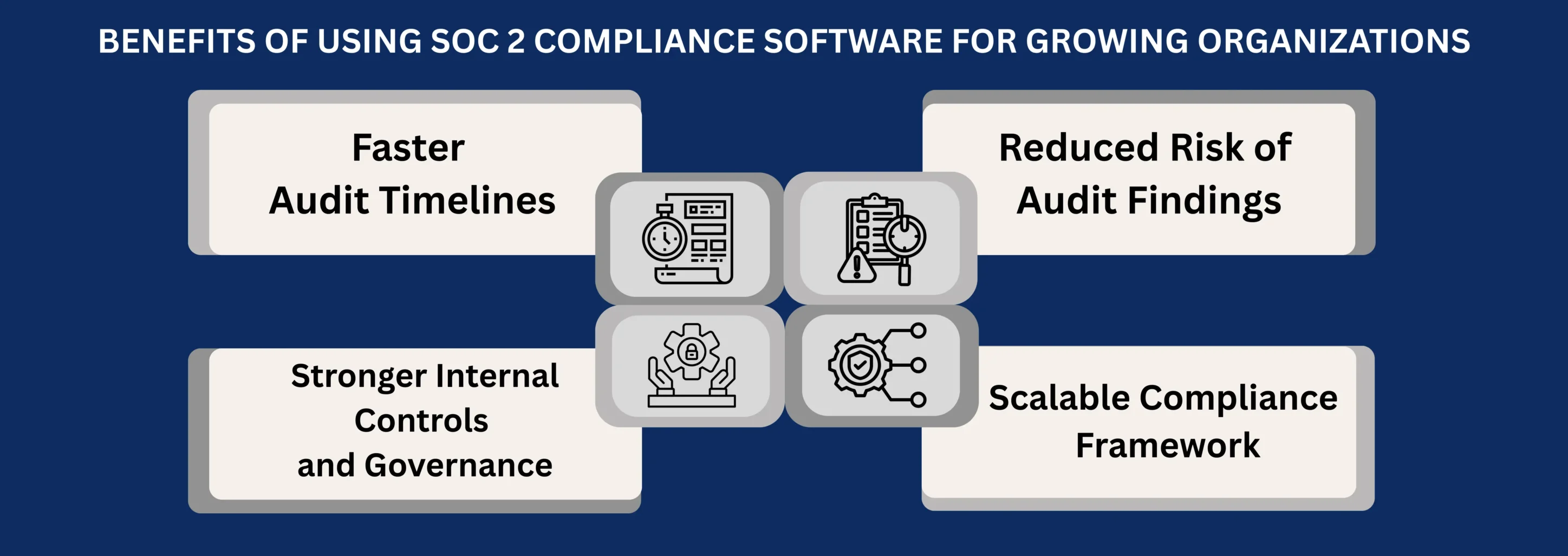
SOC 2 Certification in Atlanta delivers a defined set of organizational outcomes directly tied to the attestation process itself. These outcomes result from the independent examination and the issuance of the attestation report — not from preparatory activities or consulting engagements. The benefits are most directly realized in commercial, operational, and risk management contexts where independently verified evidence of control effectiveness is required or expected.
- ✓Independent third-party verification of security and data protection controls by a Licensed CPA Firm
- ✓Structured basis for satisfying enterprise vendor security review requirements in regulated industries
- ✓Documented evidence of control effectiveness for inclusion in procurement and contract due diligence responses
- ✓Recognition in financial sector procurement processes across Atlanta’s banking, insurance, and investment management sectors
- ✓Support for HIPAA, GLBA, and PCI DSS third-party risk management documentation requirements
- ✓Annual SOC 2 audit cycle that promotes systematic review and maintenance of operational security controls
- ✓Formally issued attestation report suitable for distribution to specified user organizations and prospective clients
The most immediately realized benefit of SOC 2 attestation for Atlanta organizations is the removal of security assurance friction from enterprise sales and vendor onboarding processes. Organizations with a current SOC 2 Type 2 report can respond to vendor security questionnaires by referencing the attestation report rather than providing control-by-control self-attestations that require independent verification by the procuring organization. This reduces the time required to complete vendor security reviews from weeks to days in many cases, accelerating contract execution and reducing administrative burden on both sides.
For Atlanta-based technology companies competing for contracts with financial institutions, healthcare systems, or large enterprises, a current SOC 2 report functions as a commercial qualification credential. It distinguishes the organization from vendors who rely on unverified self-attestation — a distinction that can determine vendor selection outcomes in competitive procurement processes where SOC 2 compliance is a baseline expectation.
Beyond commercial outcomes, the annual SOC 2 audit cycle promotes systematic review and maintenance of internal security controls that serves the service organization’s own operational interests. The examination process requires organizations to document their control environment comprehensively, collect evidence of control operation systematically, and address any deviations identified during the examination. This discipline, reinforced by the annual attestation cycle, supports a culture of continuous control monitoring and improvement that reduces the likelihood of undetected control failures.
For Atlanta-based organizations managing sensitive customer data — whether financial records, healthcare information, or proprietary business data — the operational discipline of maintaining SOC 2 compliance supports the organization’s own risk management objectives independent of the commercial benefits of attestation. The independent SOC 2 examination also provides management with an objective assessment of control effectiveness from a qualified external examiner — a perspective that internal audit functions or self-assessments cannot replicate.
- ✓Commercial and Procurement Outcomes
- ✓Operational and Risk Management Outcomes
Certification Scope and Independent Decision Framework
The scope of a SOC 2 examination is defined by the system description prepared by management, which identifies the specific services, infrastructure, software, personnel, and third-party components that fall within the boundary of the attestation. The Licensed CPA Firm conducting the SOC 2 examination evaluates controls within this defined scope against the applicable Trust Services Criteria selected for the engagement. The examination does not address controls or systems outside the defined scope, and the attestation report is explicitly limited to the systems and services described therein.
Scope definition is therefore a consequential decision — one that determines both the SOC 2 audit’s depth and the report’s utility to user organizations evaluating the attestation. Organizations that define their scope too narrowly risk issuing a report that fails to satisfy client requirements; those that define it too broadly increase examination complexity and cost unnecessarily.
Evidence-Based Assessment and Control Evaluation
The SOC 2 examination is an evidence-based engagement. The Licensed CPA Firm’s attestation opinion is formed on the basis of independently collected and evaluated evidence — not management representations alone. Evidence collection methods include inquiry of personnel responsible for control operation, observation of control procedures in practice, inspection of documentary evidence such as access control logs and change management records, and re-performance of control procedures to verify they function as described.
The weight assigned to each evidence type reflects its reliability: re-performance and inspection of objective documentation carry greater evidential weight than management inquiry alone. For Type 2 engagements, evidence must span the entire observation period to support an opinion on operating effectiveness — a requirement that distinguishes the SOC 2 Type 2 examination from point-in-time assessments and questionnaire-based vendor reviews.
Independent Certification Decision and Report Validity
The attestation opinion included in the SOC 2 report is formed independently by the Licensed CPA Firm based on examination findings. The opinion is not subject to modification by the service organization’s management and is not conditioned on commercial considerations. An unmodified opinion indicates no material deviations from the applicable Trust Services Criteria within the defined scope. A qualified or adverse opinion indicates that material deviations were identified. A disclaimer of opinion indicates that the examiner was unable to obtain sufficient evidence to form an opinion.
The SOC 2 report — including the system description, management assertion, examiner’s opinion, and description of tests and results — is valid for the period covered by the examination and does not have an indefinite useful life. Enterprise clients typically require attestation reports covering periods ending no more than twelve months prior to their vendor security review date, making annual SOC 2 audit cycles a practical necessity for organizations maintaining continuous attestation status in Atlanta’s enterprise market.
SOC 2 Type 1 vs. Type 2: Selecting the Appropriate Examination
The selection between a SOC 2 Type 1 and Type 2 examination is determined primarily by the requirements of the service organization’s clients and the maturity of the organization’s control environment. Both report types are issued by a Licensed CPA Firm following an independent SOC 2 examination under AICPA attestation standards, but they differ in scope, evidence requirements, and the assurance they provide to user organizations.
Understanding these differences is essential for Atlanta-based service organizations determining their attestation strategy and responding accurately to client security review requirements that specify a particular report type. Choosing the wrong report type — or misrepresenting a Type 1 as equivalent to a Type 2 — can create friction in procurement processes and erode client trust.
When to Pursue SOC 2 Type 1 Attestation
A SOC 2 Type 1 attestation is appropriate when an organization’s controls are newly implemented and have not yet operated for a sufficient period to support a Type 2 opinion on operating effectiveness, or when a client’s immediate requirement can be satisfied by a point-in-time assessment of control design. Type 1 reports are also used by organizations that need to demonstrate progress toward full SOC 2 Certification while their observation period for a Type 2 engagement accumulates.
For Atlanta-based technology organizations in early-stage enterprise sales cycles — where a prospective client requires initial evidence of a SOC 2 program before executing a contract — a Type 1 report can satisfy the immediate requirement while the observation period progresses. However, Type 1 reports do not satisfy the requirements of enterprise clients that specifically require evidence of operating effectiveness over time. This limitation should be clearly disclosed to prospective clients reviewing a Type 1 attestation.
When to Pursue SOC 2 Type 2 Attestation
A SOC 2 Type 2 attestation is the standard requirement for organizations maintaining ongoing enterprise relationships in regulated industries. The Type 2 examination covers a defined observation period — typically six to twelve months — during which the examining team collects evidence of control operation and assesses whether controls functioned consistently and effectively throughout that period. Type 2 reports provide user organizations with the most comprehensive form of SOC 2 assurance available under the AICPA framework, addressing not only whether controls were appropriately designed but also whether they operated as designed over an extended period.
For Atlanta organizations in financial services, healthcare technology, cloud infrastructure, and enterprise SaaS — where clients impose annual vendor security review requirements — a current SOC 2 Type 2 report is the practical standard. The annual renewal cycle requires organizations to maintain their observation periods continuously, making the initial engagement the foundation of an ongoing annual SOC 2 audit program rather than a one-time activity.
FAQ
▶
What is SOC 2 Certification and which organizations in Atlanta need it?
▶
Who can issue a SOC 2 attestation report in Atlanta?
▶
What is the difference between SOC 2 Type 1 and Type 2 reports?
▶
How long does the SOC 2 audit process take for Atlanta organizations?
▶
Which Trust Services Criteria should Atlanta organizations include in their SOC 2 examination?
▶
Does SOC 2 attestation confirm compliance with Georgia state law or federal regulations?
▶
How often must Atlanta organizations renew their SOC 2 attestation?
▶
What is the role of subservice organizations in a SOC 2 examination?
SOC 1 VS SOC 2: WHICH REPORT YOUR CUSTOMERS ACTUALLY ASK FOR
If you sell SaaS or provide outsourced services, you have likely been asked for a SOC report. However, the follow-up question is rarely easy to answer…

AICPA Issues New Guidance for Peer Reviewers Evaluating SOC 2 Engagements
AICPA SOC 2 guidance has been issued to help peer reviewers identify quality risks associated with SOC 2 engagements as the use of compliance automati…
SOC 2 Certified: What Does It Mean for Your Business
For companies that handle sensitive data or run cloud-based services, the question “Can you provide your SOC 2 report?” carries enormous weight. Yet, …
Get In Touch
have a question? let us get back to you.