
SOC 2 Certification in Charlotte
SOC 2 Certification in Charlotte is pursued by organizations across banking, fintech, SaaS, healthcare technology, insurance, cloud services, cybersecurity, logistics, e-commerce, and AI sectors. CertPro operates as a Licensed CPA Firm and independent third-party SOC 2 examination body. Examinations are conducted under AICPA attestation standards (AT-C Section 205) and evaluate controls against the Trust Services Criteria. SOC 2 examination engagements are strictly audit and attestation in nature — no consulting, readiness, or implementation services are provided.
OUR CLIENTS









SOC 2 Certification for Charlotte-Based Financial, Technology, and Healthcare Organizations
SOC 2 Certification in Charlotte is pursued by organizations across banking, fintech, SaaS, healthcare technology, insurance, cloud services, cybersecurity, logistics, e-commerce, and AI sectors. CertPro operates as a Licensed CPA Firm and independent third-party SOC 2 examination body. Examinations are conducted under AICPA attestation standards (AT-C Section 205) and evaluate controls against the Trust Services Criteria. SOC 2 examination engagements are strictly audit and attestation in nature — no consulting, readiness, or implementation services are provided.
Charlotte as a Hub for SOC 2 Certification Demand
Charlotte ranks among the largest financial centers in the United States. It is home to major banking institutions, regional financial services firms, and a rapidly expanding fintech corridor. Organizations headquartered in Uptown Charlotte, Ballantyne, University City, and the broader Charlotte metropolitan area operate in environments where enterprise clients, regulated institutions, and international business partners routinely require independent verification of internal control environments.
SOC 2 Certification in Charlotte has become a standard expectation across vendor procurement workflows — particularly for organizations handling customer data, financial records, health information, and proprietary technology systems. The volume of SaaS providers, cloud infrastructure operators, and data-intensive businesses in the Charlotte region reflects a local economy deeply interconnected with enterprise technology and financial services at a national scale.
Organizations serving regulated clients in banking, healthcare, insurance, and government contracting face consistent pressure to demonstrate that their systems and controls meet the security, availability, processing integrity, confidentiality, and privacy standards codified in the AICPA Trust Services Criteria. SOC 2 Certification provides the independently verified evidence those clients require.
CertPro as an Independent SOC 2 Examination Body
CertPro conducts SOC 2 examinations exclusively as a Licensed CPA Firm performing independent third-party attestation under AICPA AT-C Section 205. The SOC 2 examination evaluates whether an organization’s controls are suitably designed and — in the case of a Type 2 report — operating effectively over a defined observation period.
No consulting, readiness, implementation, or control design services are performed. The SOC 2 audit delivers an independent attestation report — either a SOC 2 Type 1 or SOC 2 Type 2 report — that organizations present to customers, enterprise buyers, regulators, and business partners as evidence of independent control verification.
The attestation report reflects the auditor’s professional opinion, formed through evidence collection, control testing, and evaluation against the applicable Trust Services Criteria. For Charlotte-based organizations competing in national and international markets, a report issued by a Licensed CPA Firm carries the institutional weight required by enterprise procurement and third-party risk management programs.
North Carolina Regulatory Context and SOC 2 Attestation
Organizations operating in Charlotte and across North Carolina are subject to state-level data security and privacy requirements, including the North Carolina Identity Theft Protection Act. This statute establishes obligations related to the protection of personal information and breach notification. While SOC 2 attestation does not automatically establish compliance with North Carolina statutes, U.S. federal regulations, or industry-specific laws, the Trust Services Criteria examined during a SOC 2 audit — including security, confidentiality, and privacy — address control domains directly relevant to the information protection expectations embedded in North Carolina law.
Enterprises, financial institutions, healthcare technology organizations, and SaaS providers in the Charlotte market frequently reference SOC 2 attestation reports in vendor risk assessments, regulatory inquiries, and customer due diligence processes. The SOC 2 examination provides structured, evidence-based documentation of control design and effectiveness that organizations present alongside their own compliance representations.

What Is SOC 2 Certification?
SOC 2 Certification refers to the process by which a Licensed CPA Firm conducts an independent examination of a service organization’s controls and issues an attestation report under AICPA attestation standards. The SOC 2 examination evaluates controls against the Trust Services Criteria established by the AICPA, covering five categories: Security (Common Criteria), Availability, Processing Integrity, Confidentiality, and Privacy.
SOC 2 is specifically designed for service organizations that store, process, or transmit customer data — making it the predominant attestation framework for SaaS providers, cloud platforms, managed service providers, and data processing entities. For organizations in Charlotte’s technology and financial services sectors, SOC 2 Certification represents the recognized standard for demonstrating independent control verification to enterprise buyers and regulated-sector clients.
SOC 2 Type 1 vs. SOC 2 Type 2 Reports
A SOC 2 Type 1 report evaluates whether an organization’s controls are suitably designed to meet the applicable Trust Services Criteria as of a specific point in time. The auditor assesses control design and description accuracy but does not evaluate how controls operated over a period.
A SOC 2 Type 2 report covers both the design and operating effectiveness of controls over a defined observation period — typically six to twelve months. The Type 2 report provides a higher level of assurance because it demonstrates that controls functioned consistently throughout the examination period, not merely at a single date.
Enterprise customers, financial institutions, and regulated-sector buyers in Charlotte and nationally most frequently require a SOC 2 Type 2 report as part of vendor security assessments and third-party risk management reviews. The distinction between the two report types affects how SOC 2 compliance is demonstrated and how the attestation report is interpreted by relying parties.
Trust Services Criteria: The Foundation of SOC 2 Examination
The Trust Services Criteria (TSC) form the evaluative framework against which controls are assessed during a SOC 2 examination. The Security category — also called the Common Criteria — is mandatory for all SOC 2 engagements. It addresses logical and physical access controls, system monitoring, change management, risk assessment, and incident response.
Organizations may elect to include additional criteria categories — Availability, Processing Integrity, Confidentiality, or Privacy — based on their service commitments and contractual obligations to customers. Each Trust Services Criterion specifies what the control environment must achieve; the auditor determines whether the organization’s controls are designed and operating in a manner that satisfies those requirements.
For Charlotte organizations in financial services, healthcare technology, and SaaS, the applicable criteria categories are typically determined by the nature of data processed, customer contractual requirements, and regulatory expectations relevant to the industries served.
| Trust Services Criteria Category | Primary Focus | Common for Charlotte Sectors |
|---|---|---|
| Security (Common Criteria) | Logical access controls, system monitoring, change management, incident response | All sectors — mandatory for every SOC 2 examination |
| Availability | System uptime, performance commitments, disaster recovery | SaaS providers, cloud infrastructure operators, fintech |
| Processing Integrity | Complete, accurate, and timely data processing | Fintech, payment processors, healthcare technology |
| Confidentiality | Protection of designated confidential information | Financial services, insurance carriers, legal technology |
| Privacy | Collection, use, retention, and disclosure of personal information | Healthcare technology platforms, HR systems, e-commerce |
SOC 2 Certification Audit Process for Organizations in Charlotte
The SOC 2 audit process for Charlotte-based organizations follows a structured sequence of stages defined under AICPA attestation standards. Each stage produces documented outputs that form the basis of the final attestation report. The process is conducted entirely by the Licensed CPA Firm in its capacity as an independent examination body.
The following stages describe the examination methodology applied during a SOC 2 audit in Charlotte — from initial scope definition through attestation report issuance and ongoing annual examination cycles.
The SOC 2 examination begins with a scope definition phase in which the auditor and the organization’s management establish the boundaries of the engagement. Scope covers the systems, services, infrastructure components, and data flows subject to examination, as well as the Trust Services Criteria categories applicable to the engagement.
For Charlotte organizations, scope definition typically accounts for systems hosted in cloud environments, third-party subservice organizations, and the specific service commitments made to customers. The audit program is then determined based on scope complexity and whether the engagement is a Type 1 or Type 2 examination.
The audit program documents the specific control areas to be tested, the evidence procedures to be applied, and the criteria against which controls will be evaluated. This program governs all subsequent SOC 2 audit activities.
During the fieldwork phase of the SOC 2 audit, the Licensed CPA Firm collects evidence through document review, system configuration inspection, personnel interviews, and process walkthroughs. For a SOC 2 Type 2 examination, control testing is performed across the full observation period — typically six to twelve months — to assess whether controls operated effectively and consistently throughout that time.
Evidence types include access control logs, change management records, security incident documentation, vulnerability scan results, backup verification records, and vendor management artifacts. The auditor evaluates each piece of evidence against the applicable Trust Services Criteria to form a professional judgment about whether the control meets the criterion requirements. Exceptions identified during testing are documented and assessed for their significance to the overall opinion.
The observation period for Charlotte-based organizations conducting their first SOC 2 examination is often set at six months. Subsequent annual examinations typically cover a full twelve-month period to provide continuous attestation coverage.
Following the completion of evidence collection and control testing, the auditor reviews findings and identifies any exceptions or deviations from the Trust Services Criteria. Identified exceptions are documented in the attestation report, and management is provided an opportunity to respond.
The Licensed CPA Firm then issues a formal SOC 2 attestation report — a SOC 2 Type 1 or SOC 2 Type 2 report — that includes the auditor’s opinion, a description of the service organization’s system, management’s assertion, and the results of control testing. The report is issued to the organization and may be shared with customers and business partners under a non-disclosure agreement.
Because SOC 2 attestation reports cover a defined period and are not indefinitely valid, organizations maintain SOC 2 compliance through annual examination cycles. Charlotte-based organizations that have completed a SOC 2 Type 2 examination typically undergo annual SOC 2 audits to maintain a current, valid attestation for use in ongoing customer and vendor assurance processes.
| Audit Stage | Key Activities | Output |
|---|---|---|
| Scope Definition | System boundary identification, TSC category selection, subservice organization review | Defined examination scope |
| Audit Program Determination | Control area mapping, evidence procedure planning, Type 1 or Type 2 determination | Documented audit program |
| Evidence Collection & Control Testing | Document review, log analysis, interviews, walkthroughs, full observation period coverage | Evidence workpapers |
| Nonconformity Review | Exception identification, management response collection, significance assessment | Findings documentation |
| Attestation Report Issuance | Auditor opinion formation, report drafting, final report issuance | SOC 2 Type 1 or Type 2 attestation report |
- ✓Scope Definition and Audit Program Determination
- ✓Evidence Collection, Control Testing, and Observation Period
- ✓Nonconformity Review, Attestation Report Issuance, and Ongoing Examination
Why Organizations in Charlotte Pursue SOC 2 Certification
SOC 2 Certification in Charlotte is driven by a convergence of enterprise procurement requirements, regulated-sector client expectations, and competitive positioning demands across the city’s technology and financial services economy. Charlotte’s concentration of major banks, regional financial institutions, insurance carriers, and healthcare systems creates a procurement environment where vendor security assessments are standard practice.
Technology vendors, SaaS providers, and cloud platforms serving these industries are routinely required to produce a SOC 2 attestation report as a condition of vendor approval or contract renewal. The following describes the primary drivers that make SOC 2 Certification a functional business requirement for Charlotte-based service organizations.
Enterprise Vendor Security Reviews and Financial Sector Procurement
Enterprise organizations in Charlotte — particularly those in banking, insurance, and healthcare — conduct structured third-party risk management programs that require technology vendors and service providers to demonstrate control effectiveness through independent attestation. A SOC 2 Type 2 report issued by a Licensed CPA Firm satisfies the independent verification requirement embedded in these procurement programs.
Charlotte-area financial institutions operating under federal banking regulations and FFIEC guidance treat SOC 2 attestation as a primary mechanism for evaluating the control environments of third-party technology vendors. For a SaaS provider or managed service organization headquartered in Ballantyne or University City seeking to serve a major bank or insurance carrier in Uptown Charlotte, producing a current SOC 2 Type 2 report is frequently a non-negotiable condition of the vendor approval process.
SOC 2 compliance expectations in Charlotte’s financial services procurement have become standardized — making attestation a functional requirement rather than a differentiating option for organizations competing in this market.
Cloud Vendors, Fintech Firms, and International SaaS Expansion
Charlotte’s fintech ecosystem — anchored by payment technology firms, digital lending platforms, insurtech companies, and blockchain-based financial services organizations — competes nationally and internationally for enterprise contracts. SOC 2 attestation serves as the recognized mechanism for demonstrating control effectiveness to U.S. and international enterprise buyers who require independent verification before engaging cloud-based or SaaS-delivered services.
For Charlotte-based SaaS companies expanding into regulated markets — including healthcare, financial services, and government contracting — SOC 2 examination provides a structured, AICPA-governed attestation that domestic and international buyers recognize. Organizations in Charlotte’s AI startup community and cybersecurity sector similarly pursue SOC 2 Certification as evidence that security controls embedded in their platforms meet independently verified standards.
The SOC 2 audit process provides this evidence in a structured, professionally issued report format that relying parties can evaluate, retain, and reference throughout vendor risk management reviews.
Healthcare Technology and Data-Intensive Organizations
Healthcare technology organizations in Charlotte — including health information exchange platforms, electronic health record vendors, telehealth providers, and medical data analytics companies — operate in environments where both HIPAA obligations and enterprise customer requirements create parallel demands for control verification. SOC 2 compliance for healthcare technology organizations addresses the security and availability of systems that process protected health information. The Privacy criteria category within the Trust Services Criteria provides a structured framework for evaluating how personal information is collected, used, retained, and disclosed.
While a SOC 2 attestation report does not constitute a HIPAA compliance determination, healthcare enterprise buyers frequently require it as part of business associate vendor assessments. Logistics organizations, e-commerce platforms, and AI companies in the Charlotte metropolitan area similarly use SOC 2 Certification as evidence of control effectiveness when handling customer data, supply chain information, and algorithmically processed personal information at scale.
SOC 2 Certification Requirements for Charlotte Organizations
SOC 2 Certification requirements are established by the AICPA Trust Services Criteria and the attestation standards governing the examination. Organizations seeking SOC 2 Certification in Charlotte must demonstrate that their control environment is designed — and, for a Type 2 report, operating — in a manner that satisfies the criteria applicable to their selected Trust Services categories.
The following describes the primary control and documentation requirements evaluated during a SOC 2 examination, covering security controls, system description obligations, evidence requirements, and subservice organization considerations.
The Security category — mandatory for all SOC 2 examinations — requires organizations to maintain controls across logical access management, physical security, system monitoring, risk assessment, change management, and incident response. Logical access controls must restrict system access to authorized users and include mechanisms such as multi-factor authentication, privileged access management, access provisioning and de-provisioning procedures, and periodic access reviews.
Risk assessment processes must identify threats to system security, evaluate the likelihood and impact of identified risks, and document how the organization responds. Change management controls must govern the deployment of software changes, patches, and configuration modifications to production systems. Incident response procedures must define how security events are detected, escalated, investigated, and remediated.
Each of these control areas is evaluated by the Licensed CPA Firm through evidence review and testing during the SOC 2 audit. For Charlotte organizations undergoing their first SOC 2 examination, understanding these requirements early in the process supports a more efficient and well-documented engagement.
A SOC 2 examination requires the service organization’s management to prepare a written description of the system subject to examination. This system description must cover the nature of the services provided, the infrastructure components in scope, the software and data involved, the people responsible for system operation, and the procedures used to deliver services.
Management must also provide a formal assertion that the system description is accurate and that controls are suitably designed — and, for a Type 2 report, operating effectively. The system description and management assertion are included in the final SOC 2 attestation report and are evaluated by the auditor for completeness and accuracy.
Evidence requirements during the SOC 2 audit include access logs, configuration documentation, policy records, incident reports, vendor agreements, training records, and system monitoring outputs. The auditor assesses the sufficiency of evidence collected against each applicable Trust Services Criterion before forming an opinion.
- ✓Written system description prepared by management covering infrastructure, software, data, people, and procedures
- ✓Management assertion on the design suitability and operating effectiveness of controls
- ✓Documented logical access controls including multi-factor authentication configurations and access review records
- ✓Risk assessment documentation identifying threats, likelihood, impact, and organizational response procedures
- ✓Change management records covering software deployment, patch management, and configuration control
- ✓Incident response documentation including detection, escalation, investigation, and remediation records
- ✓Vendor and subservice organization management documentation including contracts and ongoing monitoring evidence
- ✓System monitoring outputs including audit logs, security alerts, and performance and availability metrics
Many Charlotte-based organizations rely on subservice organizations — such as cloud infrastructure providers, colocation data centers, or third-party payment processors — whose controls may be relevant to the SOC 2 examination scope. The auditor determines whether subservice organization controls are carved out of the examination scope or included, and the system description must disclose the role of subservice organizations and the controls they are expected to maintain.
Where subservice organizations are carved out, the auditor may review the organization’s vendor management controls and assess whether the organization obtains and reviews SOC 2 reports from its subservice providers. Complementary user entity controls (CUECs) represent controls that customers of the service organization must implement for the service organization’s own controls to function as intended.
The SOC 2 attestation report identifies applicable CUECs. Relying parties must understand that the attestation addresses the service organization’s controls within the defined scope — not the broader control environments of its subservice providers or customers.
- ✓Security Control Requirements Under the Common Criteria
- ✓System Description, Management Assertion, and Evidence Requirements
- ✓Subservice Organizations and Complementary User Entity Controls
Benefits of SOC 2 Certification for Charlotte-Based Organizations
SOC 2 Certification in Charlotte delivers measurable value across vendor procurement, enterprise contracting, regulatory positioning, and internal control accountability. The attestation report produced through an independent SOC 2 examination provides relying parties — customers, enterprise buyers, investors, and regulators — with structured, professionally issued documentation of an organization’s control environment.
The following describes the primary benefits associated with completing a SOC 2 audit and obtaining an attestation report issued by a Licensed CPA Firm.
The primary benefit of SOC 2 Certification for Charlotte financial services and technology organizations is independent third-party verification of the control environment. Unlike self-assessments or internal compliance declarations, a SOC 2 attestation report is issued by a Licensed CPA Firm that has examined evidence, tested controls, and formed a professional opinion.
This independent verification is recognized across enterprise procurement programs, financial sector vendor assessments, healthcare technology vendor reviews, and international SaaS sales processes. For financial services organizations in Charlotte specifically, the attestation report satisfies vendor risk management requirements embedded in bank procurement frameworks and FFIEC third-party guidance.
For fintech companies in Charlotte seeking enterprise banking clients, the SOC 2 Type 2 report provides the structured assurance that financial institution security teams require before extending vendor approval. The report format — standardized under AICPA guidance — is recognized by relying parties across the United States and in international markets where U.S.-based service organizations operate.
The SOC 2 examination process imposes a structured audit methodology that produces documented evidence of control design and operating effectiveness. For Charlotte organizations that have not previously undergone a formal SOC 2 audit, the examination creates a structured record of control activities across access management, monitoring, risk assessment, incident response, and vendor management.
Annual SOC 2 examination cycles reinforce ongoing control accountability within the organization. Management must maintain control effectiveness throughout each observation period to support the auditor’s annual opinion. This recurring examination structure provides a disciplined framework for internal control monitoring that supports broader information security and risk management objectives.
For Charlotte-area cybersecurity firms, AI startups, and cloud service providers that represent their security posture to enterprise clients, the SOC 2 attestation report provides an independently verified record of control effectiveness that internal representations alone cannot deliver.
- ✓Independent third-party verification of control design and operating effectiveness, issued by a Licensed CPA Firm
- ✓Recognition in enterprise procurement programs, vendor risk management workflows, and financial sector security reviews
- ✓Standardized AICPA-governed attestation report format accepted by domestic and international relying parties
- ✓Structured documentation of the control environment covering access management, system monitoring, and incident response
- ✓Annual SOC 2 examination cycle that reinforces ongoing control accountability and internal control monitoring
- ✓Demonstration of SOC 2 compliance for regulated-sector clients in banking, insurance, and healthcare
- ✓Support for international SaaS expansion requiring U.S.-standard independent attestation
- ✓Evidence base for management assertion and third-party risk management program requirements
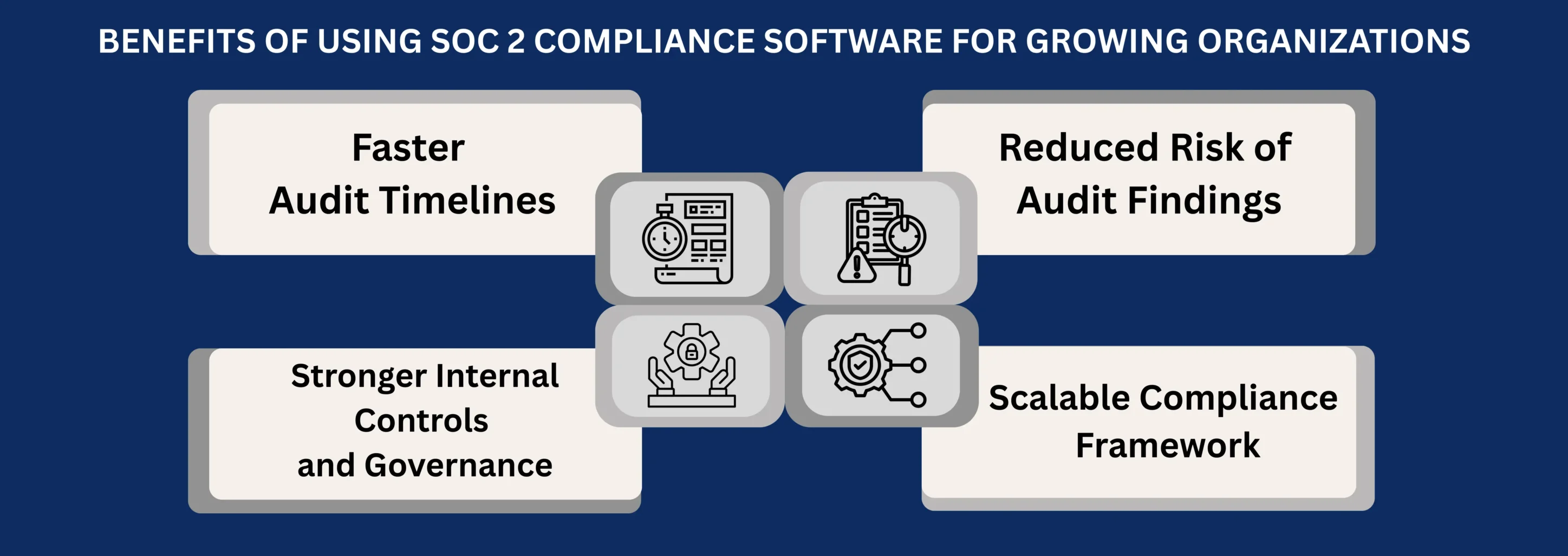
- ✓Independent Verification and Enterprise Procurement Recognition
- ✓Structured Audit Methodology and Ongoing Control Accountability
SOC 2 Certification Scope and Independent Decision Framework
The scope of a SOC 2 examination determines which systems, processes, controls, and Trust Services Criteria categories are subject to the auditor’s evaluation. For Charlotte organizations, scope decisions directly affect the breadth of the attestation report and how it is interpreted by relying parties.
The independent decision framework applied by the Licensed CPA Firm ensures that scope, opinion, and report content reflect an objective evaluation — free from management influence and aligned with AICPA attestation standards governing the SOC 2 audit.
Defining Examination Scope for Charlotte Service Organizations
Examination scope for a SOC 2 audit in Charlotte encompasses the specific systems and services for which the organization is seeking attestation, the Trust Services Criteria categories selected, and the boundaries of the control environment to be examined. Scope is documented in the engagement letter and reflected in the system description prepared by management.
For Charlotte-based SaaS providers, scope typically includes the application platform, underlying cloud infrastructure, data processing pipelines, and the operational processes that support service delivery. For fintech and payment processing organizations, scope may extend to transaction processing systems, encryption and tokenization controls, and third-party payment network integrations.
The auditor’s evaluation of control design and operating effectiveness is limited to the controls within the defined scope. Organizations must understand that a SOC 2 attestation report addresses only the in-scope systems and criteria — controls outside the examination boundary are not evaluated or covered by the auditor’s opinion.
Independent Certification Decision and Report Validity
The SOC 2 attestation opinion is formed independently by the Licensed CPA Firm based on evidence collected during the examination. The auditor’s opinion reflects whether the controls examined are suitably designed (Type 1) or both suitably designed and operating effectively (Type 2) against the applicable Trust Services Criteria. The opinion may be unqualified — indicating that controls meet the criteria requirements — or qualified, if the auditor identifies exceptions significant enough to affect the overall opinion.
The attestation report issued following a SOC 2 examination is valid for the period covered and does not have an indefinite shelf life. Most enterprise buyers and market participants treat a SOC 2 report older than twelve months as requiring renewal. Organizations that have undergone a SOC 2 examination should maintain a schedule of annual audits to ensure a current, valid SOC 2 attestation is available at all times for customer due diligence and procurement qualification processes.
SOC 2 Examination vs. SOC 2 Compliance: Key Distinctions
A common question among Charlotte organizations beginning the SOC 2 process concerns the distinction between SOC 2 compliance and SOC 2 attestation. Understanding this distinction is essential for accurately representing the organization’s status to customers, regulators, and enterprise buyers — and for ensuring the organization delivers the correct deliverable during vendor procurement assessments.
SOC 2 Compliance vs. SOC 2 Attestation
SOC 2 compliance refers to an organization’s internal adherence to the controls and policies that align with the Trust Services Criteria — without independent external verification. An organization may describe itself as following SOC 2-aligned practices without having undergone a formal SOC 2 examination.
SOC 2 attestation, by contrast, refers specifically to the independently issued report resulting from a SOC 2 examination conducted by a Licensed CPA Firm under AICPA attestation standards. Only an organization that has completed a SOC 2 examination and received an attestation report can represent that it has undergone independent SOC 2 examination.
Enterprise customers and regulated-sector buyers in Charlotte’s financial and healthcare markets routinely distinguish between these two states. They require a formal SOC 2 attestation report rather than accepting self-declarations of compliance. Organizations that describe themselves as SOC 2 compliant without having completed a formal examination may face challenges in procurement processes where an independently issued attestation report is the required deliverable.
SOC 2 vs. ISO 27001: Choosing the Right Framework for Charlotte Organizations
Charlotte-based organizations frequently evaluate whether to pursue SOC 2 Certification, ISO 27001 certification, or both. The primary driver is customer and market requirements. SOC 2 is the dominant framework for U.S.-based service organizations serving enterprise customers in financial services, SaaS, and healthcare — where AICPA-issued attestation reports are the recognized standard. ISO 27001 is more prevalent in international markets and global enterprise procurement contexts.
SOC 2 examinations test specific controls based on the Trust Services Criteria and the organization’s service commitments. ISO 27001 certifications assess the design and implementation of an information security management system against an international standard. Organizations serving both U.S. financial sector clients and international enterprise buyers sometimes pursue both certifications in parallel.
For Charlotte organizations whose primary market is U.S.-based enterprise, SOC 2 attestation typically represents the higher-priority certification — given the prevalence of SOC 2 requirements in domestic vendor risk management and procurement programs.
Industries Pursuing SOC 2 Certification in Charlotte
SOC 2 Certification in Charlotte spans a broad range of industries, reflecting the city’s status as a diversified center of financial services, technology, healthcare, logistics, and professional services activity. The following describes the primary industry sectors in Charlotte pursuing SOC 2 attestation and the specific control areas most relevant to each sector’s examination scope.
Financial Services, Fintech, and Insurance Organizations
Charlotte’s financial services sector — encompassing major retail and commercial banks, regional financial institutions, payment technology firms, digital lending platforms, wealth management technology providers, and insurance carriers — represents one of the largest concentrations of SOC 2 examination demand in the southeastern United States.
SOC 2 Certification for Charlotte financial services organizations is used in two primary contexts: as vendors demonstrating control effectiveness to their own customers, and as regulated institutions evaluating the controls of their technology vendors. Insurtech companies operating in Charlotte’s insurance technology corridor pursue SOC 2 compliance to demonstrate to carrier clients that their platforms maintain adequate controls over policyholder data, claims processing systems, and actuarial data management environments.
Payment technology organizations serving Charlotte-area financial institutions must demonstrate security and availability controls that meet the expectations of banking clients operating under federal financial regulation and FFIEC guidance. SOC 2 attestation provides the independently issued, AICPA-governed report that satisfies these demands efficiently and at a recognized standard.
Healthcare Technology, SaaS, Cloud, and Emerging Technology Organizations
Healthcare technology organizations in Charlotte — including electronic health record platforms, telehealth providers, health data analytics firms, and medical device software companies — pursue SOC 2 examination to demonstrate security, availability, and privacy controls to health system clients and business associate oversight programs. SaaS providers serving regulated industries from Charlotte’s University City and Ballantyne technology corridors routinely encounter SOC 2 requirements in enterprise sales cycles. Procurement teams at large organizations typically require a current SOC 2 Type 2 report before approving new vendor relationships.
Cloud service providers and managed security operations centers operating in Charlotte use SOC 2 attestation to demonstrate the control effectiveness of the infrastructure and services upon which their customers depend. AI startups and machine learning platform providers in Charlotte increasingly face SOC 2 Certification requirements from enterprise buyers concerned about how customer data is processed, retained, and protected within AI-driven systems.
Logistics technology organizations and e-commerce platform providers rounding out Charlotte’s technology sector similarly use SOC 2 Certification as evidence of control effectiveness across supply chain data, customer information, and transaction processing systems.
FAQ
▶
What is SOC 2 Certification and which organizations in Charlotte need it?
▶
What is the difference between a SOC 2 Type 1 and SOC 2 Type 2 report?
▶
How long does a SOC 2 audit take for a Charlotte-based organization?
▶
Which Trust Services Criteria categories are most commonly selected by Charlotte organizations?
▶
Is SOC 2 attestation the same as SOC 2 compliance?
▶
Does SOC 2 attestation establish compliance with North Carolina privacy law?
▶
How often must a SOC 2 examination be renewed for Charlotte organizations?
▶
What evidence does a Charlotte organization need to provide during a SOC 2 audit?
SOC 1 VS SOC 2: WHICH REPORT YOUR CUSTOMERS ACTUALLY ASK FOR
If you sell SaaS or provide outsourced services, you have likely been asked for a SOC report. However, the follow-up question is rarely easy to answer…

AICPA Issues New Guidance for Peer Reviewers Evaluating SOC 2 Engagements
AICPA SOC 2 guidance has been issued to help peer reviewers identify quality risks associated with SOC 2 engagements as the use of compliance automati…
SOC 2 Certified: What Does It Mean for Your Business
For companies that handle sensitive data or run cloud-based services, the question “Can you provide your SOC 2 report?” carries enormous weight. Yet, …
Get In Touch
have a question? let us get back to you.