
SOC 2 Certification in Columbus
CertPro CPA LLC – Licensed CPA Firm conducts independent SOC 2 certification audits for organizations operating across Columbus. SOC 2 certification evaluates the design and operating effectiveness of an organization’s controls against SOC 2 requirements and regulatory standards.
OUR CLIENTS









SOC 2 Certification for Columbus-Based Financial, Technology, and Healthcare Organizations
SOC 2 Certification in Columbus is conducted by a Licensed CPA Firm under AICPA attestation standards — specifically AT-C Section 105 and AT-C Section 205 — and constitutes an independent third-party attestation of an organization’s controls governing security, availability, processing integrity, confidentiality, and privacy. The resulting SOC 2 report is a formal attestation opinion, not a self-declaration or advisory assessment. It is issued following a rigorous SOC 2 examination of documented controls and operating evidence, providing stakeholders with independently verified assurance about the organization’s control environment.
Columbus as a Technology and Financial Services Hub
Columbus ranks among the Midwest’s leading technology and financial services centers, anchoring a broad Central Ohio business ecosystem that includes SaaS providers, fintech companies, financial institutions, insurance headquarters, healthcare technology organizations, biotechnology and life sciences companies, cloud service providers, cybersecurity firms, AI businesses, e-commerce platforms, logistics and supply-chain operators, and government technology providers.
Business activity is concentrated across Downtown Columbus, the Short North, Easton, Dublin, Westerville, New Albany, and surrounding Central Ohio areas. The presence of major financial institutions — including Nationwide Insurance, JPMorgan Chase’s operations, and an expanding fintech sector — alongside university-anchored technology startups and enterprise software companies creates concentrated demand for SOC 2 Certification in Columbus as a vendor assurance mechanism in enterprise procurement and third-party risk management programs.
Enterprise customers across financial services, healthcare, and government technology sectors routinely require SOC 2 attestation from vendors and service providers as a condition of procurement, contractual engagement, or ongoing operational relationship. Organizations that complete a SOC 2 examination and receive an unqualified attestation opinion are positioned to respond directly to these requirements with independently verified documentation of control effectiveness.
Independent Third-Party Attestation Under AICPA Standards
SOC 2 examinations are conducted exclusively by Licensed CPA Firms operating under AICPA attestation standards. The examination evaluates an organization’s controls against the Trust Services Criteria (TSC) published by the AICPA, which address five trust service categories: Security, Availability, Processing Integrity, Confidentiality, and Privacy. The Security category — also referred to as the Common Criteria — is mandatory for all SOC 2 examinations. Additional categories are included based on the nature of services provided and the commitments made to customers and system users.
The SOC 2 attestation opinion issued by the Licensed CPA Firm reflects the auditor’s independent evaluation of whether the organization’s controls were suitably designed and, in a Type 2 examination, operating effectively over a defined observation period. SOC 2 Certification in Columbus is not issued by a government agency or industry body; it is an independent attestation produced through a formal examination process governed by professional auditing standards. This distinction is significant for organizations presenting SOC 2 reports in enterprise vendor due diligence programs, financial sector procurement reviews, and regulated industry evaluations across Ohio and beyond.
Ohio Regulatory and Privacy Context for SOC 2
Organizations operating in Columbus and across Ohio function within a state regulatory environment that includes the Ohio Data Protection Act (ODPA), which provides an affirmative defense to organizations that implement and maintain a cybersecurity program aligned with recognized frameworks, and Ohio data breach notification requirements under Ohio Revised Code Section 1347.12.
SOC 2 attestation demonstrates independent verification of control effectiveness against the AICPA Trust Services Criteria but does not, on its own, establish legal compliance with Ohio, U.S. federal, or industry-specific laws and regulations. Organizations subject to HIPAA, GLBA, FTC Safeguards Rule, FERPA, or other regulatory frameworks should evaluate applicable legal obligations separately from SOC 2 attestation scope.
SOC 2 compliance Columbus organizations pursue may intersect with these regulatory requirements — particularly where independent control verification and documented security programs are relevant considerations — but legal compliance determinations rest with qualified legal counsel, not the SOC 2 auditor. Columbus organizations handling healthcare data, financial records, government information, or proprietary intellectual property should evaluate SOC 2 attestation as one component of a broader information governance and risk management structure.

What Is SOC 2 Certification?
SOC 2 Certification refers to the process by which an organization engages a Licensed CPA Firm to conduct an independent SOC 2 examination under AICPA attestation standards and receive a formal attestation report evaluating the design and operating effectiveness of controls relevant to the security, availability, processing integrity, confidentiality, and privacy of the systems used to deliver services to customers.
The term “SOC 2 Certification” is widely used in enterprise procurement and vendor assurance contexts, though technically the output is an attestation report rather than a certification badge issued by an accreditation body. The SOC 2 examination produces either a Type 1 or Type 2 report, each serving distinct purposes in documenting control environments for customer and stakeholder review.
SOC 2 Type 1 and Type 2 Reports Explained
A SOC 2 Type 1 report evaluates whether an organization’s controls are suitably designed to meet the applicable Trust Services Criteria as of a specific point in time. The Type 1 examination does not test operating effectiveness over a period; it assesses control design at a defined date. Organizations pursuing SOC 2 Certification in Columbus for the first time often use a Type 1 report to establish an initial baseline and demonstrate control design to prospective customers before completing a full observation period.
A SOC 2 Type 2 report, by contrast, evaluates both the suitability of control design and the operating effectiveness of those controls over a defined observation period — typically a minimum of six months. Type 2 reports are more widely required in enterprise vendor security reviews, financial sector procurement processes, and regulated industry vendor due diligence programs because they provide evidence that controls functioned consistently over time, not merely at a single point in time. Most Columbus organizations that have completed an initial Type 1 examination proceed to Type 2 reporting in subsequent audit cycles.
Trust Services Criteria and Applicable Categories
The AICPA Trust Services Criteria define the control requirements against which a SOC 2 examination is conducted. The five TSC categories are: Security (mandatory for all SOC 2 examinations), Availability, Processing Integrity, Confidentiality, and Privacy.
The Security category encompasses logical and physical access controls, system operations, change management, risk mitigation, and monitoring controls that form the foundation of the control environment. Availability criteria apply when service commitments include uptime, performance, or continuity obligations. Processing Integrity criteria apply when accuracy and timeliness of system processing are material to service commitments. Confidentiality criteria apply when information is designated confidential and must be protected throughout its lifecycle. Privacy criteria apply when personal information is collected, used, retained, disclosed, or disposed of in connection with service delivery.
SOC 2 compliance in Columbus requires organizations to identify which TSC categories are relevant based on their service commitments, system descriptions, and contractual obligations before defining the scope of the SOC 2 examination.
SOC 2 Versus Other Attestation and Certification Frameworks
SOC 2 differs from other certification frameworks in several important respects. ISO 27001 is an internationally recognized information security management system (ISMS) certification issued by accredited certification bodies and widely recognized in global markets. SOC 2 is a U.S.-origin attestation standard conducted by Licensed CPA Firms under AICPA standards, primarily recognized in North American enterprise procurement and vendor assurance programs.
SOC 2 tests specific controls based on Trust Services Criteria, service commitments, and contractual requirements, while ISO 27001 evaluates the design and implementation of a management system against a defined set of requirements and Annex A controls. Columbus organizations with U.S.-centric customer bases and enterprise procurement requirements often prioritize SOC 2 attestation, while organizations targeting international markets may evaluate ISO 27001 in parallel or sequentially.
The choice between SOC 2 and other frameworks should be driven by customer requirements, target markets, and contractual obligations rather than perceived ease of certification.
SOC 2 Certification Audit Process for Organizations in Columbus
The SOC 2 audit process follows a structured sequence of stages governed by AICPA attestation standards. Each stage produces defined outputs that collectively form the basis for the Licensed CPA Firm’s attestation opinion. Understanding this sequence is essential for Columbus organizations planning a SOC 2 examination, establishing realistic timelines, and managing internal responsibilities throughout the audit engagement.
| Audit Stage | Key Activities | Output |
|---|---|---|
| Scope Definition & Planning | Identify applicable TSC categories, system boundaries, service commitments, and examination period | Agreed-upon scope and audit engagement letter |
| Stage 1 — Documentation Review | Review system description, control documentation, policies, risk assessments, and control design evidence | Identification of controls mapped to TSC criteria; readiness observations |
| Stage 2 — Control Testing (Type 2) | Test operating effectiveness of controls over the observation period through inquiry, inspection, observation, and re-performance | Control testing workpapers and exception identification |
| Nonconformity Review | Evaluate identified exceptions, assess materiality, and obtain management responses and supplementary evidence | Disposition of exceptions; management’s response documentation |
| Attestation Opinion & Report Issuance | Issue SOC 2 Type 1 or Type 2 report with independent CPA attestation opinion | Final SOC 2 attestation report distributed to authorized parties |
The SOC 2 audit process for Columbus organizations begins with scope definition, during which the Licensed CPA Firm and management establish the boundaries of the examination. The scope encompasses the systems, infrastructure, software, people, processes, and data involved in delivering the services covered by the SOC 2 report.
Management prepares the System Description — a written narrative included in the SOC 2 report that describes the services provided, system components, relevant aspects of the control environment, and complementary user entity controls. The System Description is management’s representation and is subject to auditor evaluation for completeness and accuracy.
Columbus organizations should ensure that the System Description accurately reflects all systems and processes in scope, including cloud infrastructure components, third-party service providers, and subservice organizations whose services are relevant to the control environment. Subservice organizations may be included in scope (inclusive method) or excluded with disclosure of their functions (carve-out method), and this decision directly affects the scope of the SOC 2 examination.
During the Stage 2 audit, the Licensed CPA Firm tests the operating effectiveness of controls over the defined observation period using four primary testing methods: inquiry, inspection, observation, and re-performance.
Inquiry involves discussions with personnel responsible for executing controls to understand how those controls function in practice. Inspection involves reviewing documentary evidence — including system-generated logs, access review records, change management tickets, incident reports, and policy acknowledgments — to assess whether controls operated as described. Observation involves direct review of processes and control activities during the examination period. Re-performance involves independently executing control procedures to verify that each control produces the expected result.
Evidence collection for a SOC 2 examination Columbus auditors conduct is population-based: the auditor selects samples from the full population of control occurrences over the observation period and tests each sample against the applicable Trust Services Criteria. The sufficiency and appropriateness of evidence collected determines the auditor’s ability to form a conclusion on control operating effectiveness.
The observation period for a SOC 2 Type 2 examination is the defined timeframe over which control operating effectiveness is tested. While AICPA standards do not mandate a specific minimum observation period, market practice generally requires a minimum of six months for a first-year Type 2 report, with subsequent annual reports typically covering twelve-month periods. The observation period is agreed upon between management and the Licensed CPA Firm before the examination commences and is disclosed in the final SOC 2 report.
SOC 2 reports do not carry a fixed expiration date under AICPA standards; however, most enterprise customers and vendor security programs treat reports older than twelve months as stale and require updated documentation. Columbus organizations that complete annual SOC 2 audit cycles maintain a current attestation for use in ongoing vendor due diligence programs, enterprise customer requirements, and contractual obligations. Organizations that allow SOC 2 reports to lapse risk losing vendor approval status with enterprise customers who require current attestation.
- ✓Scope Definition and System Description
- ✓Control Testing and Evidence Collection
- ✓Observation Period and Report Validity
Why Columbus Organizations Pursue SOC 2 Certification
SOC 2 Certification in Columbus is pursued primarily in response to enterprise customer requirements, financial sector procurement standards, and contractual obligations imposed by regulated counterparties across Ohio and beyond. Understanding the specific demand drivers that motivate Columbus organizations to undergo SOC 2 examination clarifies why attestation has become a prerequisite in certain market segments — rather than a discretionary compliance activity.
Enterprise Vendor Security Reviews and Third-Party Risk Management
Enterprise customers across financial services, healthcare, government technology, and insurance sectors operate formal third-party risk management programs that require vendors to demonstrate independent verification of control effectiveness as a condition of vendor approval and ongoing contractual engagement.
A Columbus SaaS provider serving a regional bank, for example, may be required to provide a current SOC 2 Type 2 report as part of the bank’s vendor due diligence process under OCC or FDIC third-party risk management guidance. Similarly, a health technology company operating in Dublin or Westerville that provides services to a large health system may be required to produce SOC 2 attestation covering security and availability controls as a condition of the service agreement.
These requirements are driven by the customer’s regulatory obligations and internal risk management policies — not any direct regulatory mandate on the Columbus vendor itself. SOC 2 attestation Columbus vendors produce allows enterprise customers to rely on an independent auditor’s assessment rather than conducting their own on-site reviews of each vendor’s control environment.
Financial Sector and Fintech Procurement Requirements
Columbus’s concentration of financial institutions, insurance companies, and fintech firms creates specific demand for SOC 2 Certification that Columbus financial services organizations recognize as a standard component of vendor assurance programs. Fintech startups operating in the Short North or Downtown Columbus that process payment data, provide lending technology, or deliver financial data aggregation services frequently encounter SOC 2 requirements from bank partners, payment networks, and institutional investors during due diligence reviews.
Insurance technology companies headquartered in the Columbus area and serving national carriers are commonly required to demonstrate SOC 2 attestation covering security and confidentiality controls before gaining access to policyholder data systems. The financial sector’s reliance on SOC 2 Type 2 reports as the primary independent verification mechanism reflects its preference for evidence-based, third-party validated assurance over self-reported questionnaire responses.
SOC 2 Certification Columbus fintech organizations obtain positions them to meet these requirements with formal attestation documentation — rather than responding to customer-by-customer security questionnaires individually.
Healthcare Technology, Government Technology, and Regulated Sector Requirements
Healthcare technology and health information exchange organizations operating in the Columbus metropolitan area commonly pursue SOC 2 attestation alongside HIPAA compliance programs. SOC 2 provides independent third-party verification of security and availability controls that complements HIPAA’s self-assessment framework.
Biotechnology and life sciences companies managing clinical data, intellectual property, and research information across Central Ohio use SOC 2 attestation to demonstrate control effectiveness to pharmaceutical partners, research institutions, and government funding agencies. Government technology providers operating in Columbus that support state and local government systems encounter SOC 2 requirements in Ohio state procurement processes and federal contracting programs where independent security attestation is a specified vendor qualification requirement.
Logistics and supply-chain technology companies serving regulated industries across the Columbus area similarly face SOC 2 requirements from customers whose own regulatory obligations extend to vendor security controls. SOC 2 examination Columbus, Ohio providers conduct for these sectors evaluates controls relevant to the specific trust service categories applicable to each organization’s service commitments and data handling obligations.
SOC 2 Certification Requirements and Control Environment
SOC 2 Certification requires organizations to establish, document, and operate a control environment that addresses the applicable Trust Services Criteria relevant to their service commitments and system boundaries. The control environment is evaluated by the Licensed CPA Firm through the SOC 2 examination process, and the resulting attestation opinion reflects the auditor’s independent assessment of control design and operating effectiveness.
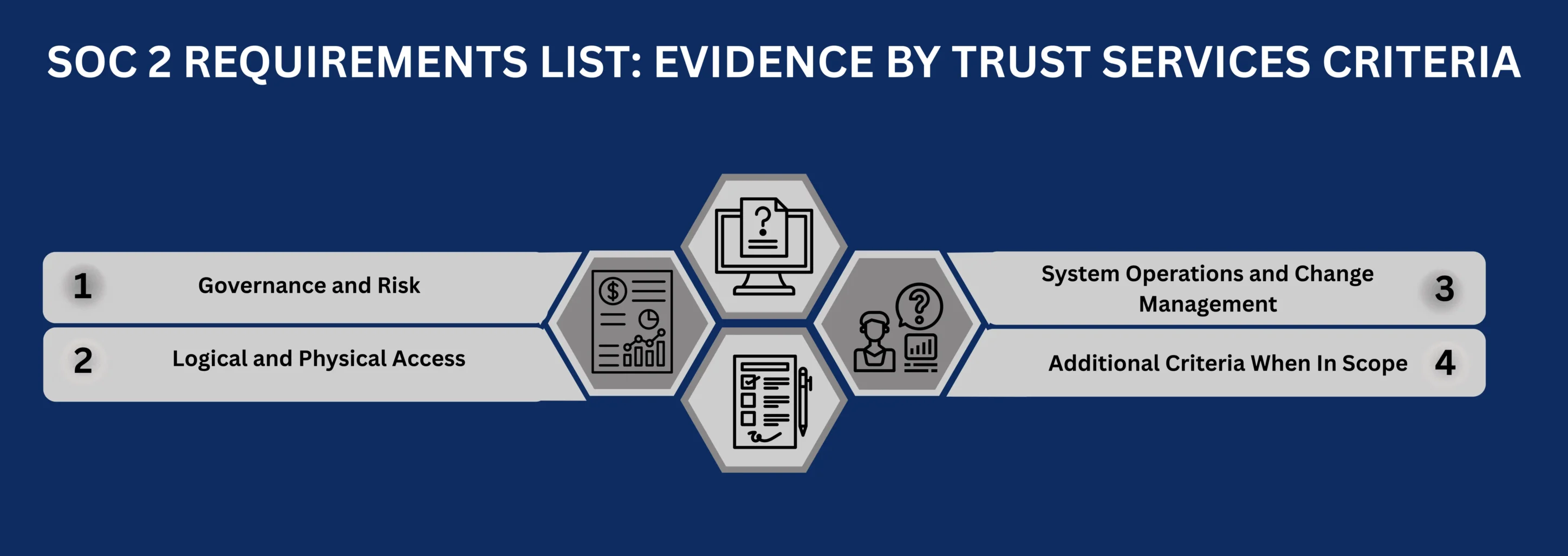
The SOC 2 examination evaluates documented policies, procedures, and control activities that management has designed to meet the applicable Trust Services Criteria. Core documentation elements reviewed during a SOC 2 audit include:
An information security policy establishing management’s commitment to security and the organization’s security objectives; a risk assessment process that identifies and evaluates risks to the confidentiality, integrity, and availability of systems and data; a risk treatment approach documenting how identified risks are addressed through control activities; access management policies and procedures governing logical access provisioning, modification, and termination; change management policies and procedures governing system and software changes; incident response procedures documenting how security incidents are identified, contained, investigated, and remediated; and vendor management policies addressing how third-party service providers are evaluated and monitored.
Columbus organizations should ensure that these documentation elements are current, reflect actual operating practices, and are maintained in a manner that produces consistent evidence of operation throughout the observation period.
Technical controls evaluated during a SOC 2 examination include logical and physical access controls, network security controls, encryption controls, system monitoring and alerting, vulnerability management, and business continuity and disaster recovery capabilities.
For the Security category, controls must address the Common Criteria related to control environment, communication, risk assessment, monitoring, logical and physical access, system operations, and change management. For the Availability category, controls must address performance monitoring, capacity planning, incident response, and continuity planning relevant to service uptime commitments. For Confidentiality and Privacy categories, controls must address data classification, access restrictions, data retention and disposal, and privacy notice and consent management.
The SOC 2 compliance Columbus organizations demonstrate through these technical controls is evidence-based: the auditor evaluates system-generated logs, access review documentation, configuration settings, monitoring alerts, and other technical evidence to assess whether controls operated as designed. Organizations relying on cloud infrastructure providers such as AWS, Azure, or Google Cloud should document how they leverage the cloud provider’s SOC 2 controls through complementary subservice organization controls.
Management of the organization undergoing SOC 2 examination bears responsibility for the System Description, the design and operation of controls, and the assertion included in the SOC 2 report. Management’s written assertion — which accompanies the auditor’s attestation opinion in the final report — states that the System Description fairly presents the system as designed and implemented, that controls included in the description were suitably designed to meet the applicable Trust Services Criteria, and (for Type 2 reports) that controls operated effectively throughout the observation period.
Management is also responsible for providing the Licensed CPA Firm with access to personnel, systems, documentation, and evidence required to conduct the SOC 2 examination. Where exceptions are identified during control testing, management is responsible for providing factual corrections, supplementary evidence, or written responses to be included in the final report.
Columbus organizations undergoing annual SOC 2 audit cycles develop internal processes for evidence collection, control monitoring, and exception management that support efficient examination conduct across successive reporting periods.
- ✓Control Environment Documentation Requirements
- ✓Technical Control Requirements Across Trust Services Categories
- ✓Management Responsibilities During SOC 2 Examination
Benefits of SOC 2 Certification for Columbus-Based Organizations
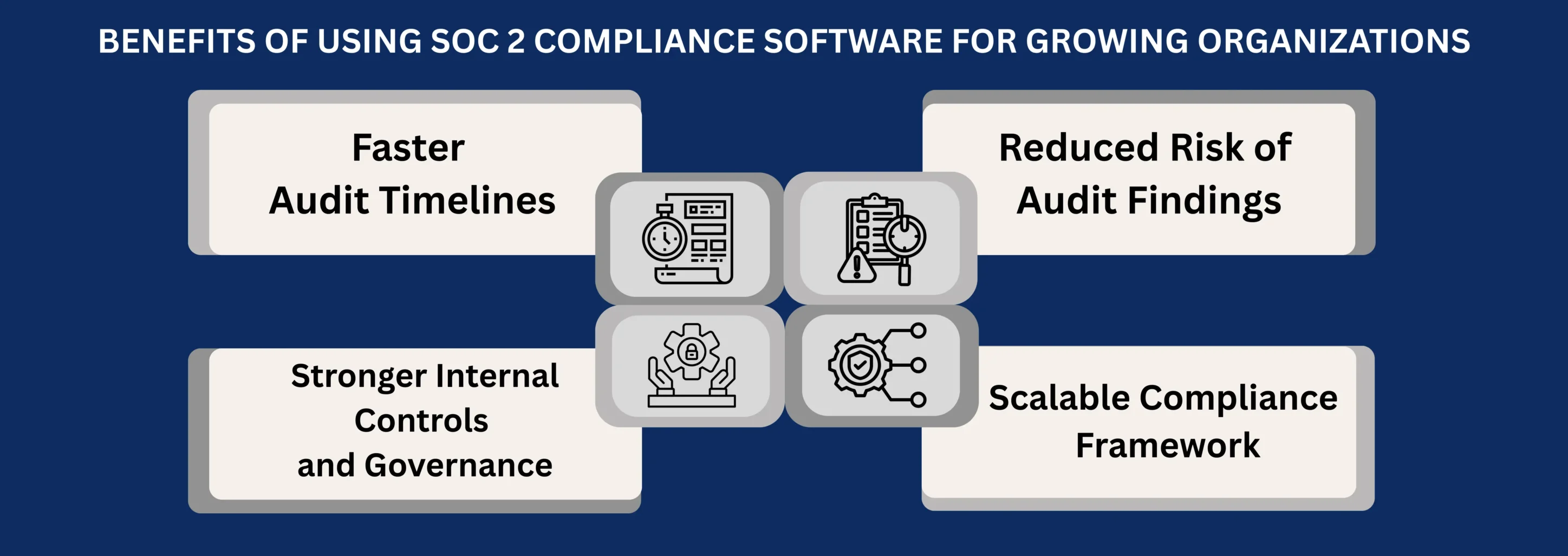
SOC 2 Certification in Columbus delivers independently verified documentation of control effectiveness that is recognized across enterprise vendor security review programs, financial sector procurement processes, and regulated industry vendor assurance frameworks. The following benefits reflect the objective outcomes of completing a formal SOC 2 examination under AICPA attestation standards.
- ✓Independent verification of security, availability, processing integrity, confidentiality, and privacy controls by a Licensed CPA Firm under AICPA attestation standards
- ✓Formal attestation documentation satisfying enterprise vendor due diligence requirements across financial services, healthcare, government technology, and other regulated sectors
- ✓Reduction in customer-by-customer security questionnaire burden through provision of a single, independently validated SOC 2 report
- ✓Structured evidence of control operating effectiveness over the observation period, demonstrating consistency rather than point-in-time control design only
- ✓Positioning to respond to SOC 2 requirements in enterprise sales cycles without delaying contract execution pending security reviews
- ✓Ongoing annual SOC 2 audit cycles that maintain current attestation status and support continuous control monitoring and improvement
- ✓Differentiation in competitive procurement processes where SOC 2 attestation is a vendor qualification threshold requirement
- ✓Documentation supporting board-level and executive reporting on information security governance and control effectiveness
Columbus technology companies and SaaS providers that complete SOC 2 Certification are positioned to respond to enterprise vendor qualification requirements without initiating lengthy security review processes for each prospective customer engagement. Enterprise customers that operate formal vendor risk management programs accept current SOC 2 Type 2 reports as primary evidence of vendor control effectiveness, reducing the volume of security questionnaires, on-site assessments, and supplementary documentation requests that vendors without attestation routinely face.
For Columbus-based SaaS companies targeting financial services customers, healthcare organizations, or government technology procurement programs, holding a current SOC 2 attestation can be a threshold qualification requirement that determines whether a vendor is even invited to participate in a procurement process.
Columbus organizations that establish annual SOC 2 audit cycles maintain continuously current attestation, allowing sales and procurement teams to respond immediately to customer security review requests — without internal delays caused by lapsed or unavailable attestation documentation.
The SOC 2 examination process provides Columbus organizations with a structured, externally validated framework for evaluating control effectiveness across the applicable Trust Services Criteria. Unlike self-assessments or advisory evaluations, the SOC 2 audit produces an independent attestation opinion based on evidence collected by a Licensed CPA Firm using professional auditing standards.
Organizations that complete recurring annual SOC 2 audit cycles develop internal control monitoring capabilities, evidence collection processes, and control documentation practices that support sustained control effectiveness between examination periods. The SOC 2 attestation report itself — particularly the detailed description of controls and testing results — provides management, boards of directors, and audit committees with structured information about the organization’s control environment that supports governance reporting and risk oversight responsibilities.
Columbus organizations operating in regulated industries use SOC 2 attestation as an input to broader enterprise risk management programs, internal audit activities, and regulatory examination preparation.
- ✓Vendor Qualification and Enterprise Sales Cycle Acceleration
- ✓Structured Audit Methodology and Ongoing Control Monitoring
Industries Seeking SOC 2 Certification in Columbus
SOC 2 Certification in Columbus is pursued across a wide range of industries and organizational types that handle sensitive customer data, financial information, healthcare records, government data, or proprietary intellectual property in connection with digital service delivery. The following sectors represent the primary categories of Columbus organizations that undergo SOC 2 examination.
| Industry Sector | Typical TSC Categories | Common SOC 2 Trigger |
|---|---|---|
| SaaS and Cloud Service Providers | Security, Availability, Confidentiality | Enterprise customer vendor due diligence requirements |
| Fintech and Financial Technology | Security, Confidentiality, Processing Integrity | Bank partner requirements and financial sector procurement standards |
| Healthcare Technology and Health IT | Security, Availability, Privacy | Health system vendor security requirements and HIPAA-adjacent controls |
| Insurance and Insurtech | Security, Confidentiality | Carrier and policyholder data protection contractual obligations |
| Government Technology Providers | Security, Availability, Confidentiality | Ohio state procurement requirements and federal contracting qualifications |
SaaS Providers, Cloud Platforms, and Technology Companies
SaaS providers and cloud service companies operating across Columbus, Dublin, and the broader Central Ohio technology corridor are among the most frequent seekers of SOC 2 Certification. These organizations deliver software and infrastructure services to enterprise customers across multiple industries and face SOC 2 requirements as a standard component of vendor qualification in nearly every enterprise procurement program.
Columbus technology companies providing HR technology, marketing automation, data analytics, cybersecurity services, AI-powered platforms, or logistics management software to enterprise customers in regulated industries encounter SOC 2 requirements from customers whose own regulatory obligations extend to vendor security assurance. Cloud service providers hosting regulated data — including financial records, healthcare information, or government data — on behalf of Columbus-area customers may also be required to produce SOC 2 attestation as evidence that the hosting environment’s security and availability controls meet contractual and regulatory standards.
SOC 2 Certification for Columbus companies in the technology sector has become a standard market expectation rather than a differentiating attribute in enterprise procurement contexts.
Biotechnology, Life Sciences, and E-Commerce Organizations
Biotechnology and life sciences companies operating in the Columbus area — including those engaged in clinical data management, research informatics, laboratory information systems, and pharmaceutical technology — pursue SOC 2 attestation to demonstrate control effectiveness to research institution partners, pharmaceutical companies, and government funding agencies that require independent security verification for access to sensitive research data and intellectual property systems.
E-commerce platforms and digital retail organizations based in Columbus or serving the Central Ohio market process payment card data, customer personal information, and transaction records that may be subject to SOC 2 requirements from payment processors, marketplace platforms, or enterprise retail partners. Logistics and supply-chain technology operators serving regulated industries — including those supporting pharmaceutical distribution, food safety tracking, or government logistics programs — encounter SOC 2 requirements from regulated customers whose vendor risk management programs extend security verification obligations to technology service providers.
AI companies developing machine learning platforms, data processing services, or automated decision-making systems for regulated industry customers in Columbus are increasingly subject to SOC 2 requirements as enterprise customers evaluate AI vendor security and data handling practices.
SOC 2 Certification Scope and Independent Decision Framework
The scope of a SOC 2 examination is defined by the systems, services, and Trust Services Criteria included in the engagement. The Licensed CPA Firm’s attestation opinion is limited to the defined scope, and the SOC 2 report clearly communicates the boundaries of the examination to report users. Scope definition decisions affect which controls are evaluated, which evidence is collected, and which attestation opinion the auditor can render.
Evidence-Based Assessment and Attestation Opinion
The SOC 2 attestation opinion is based exclusively on evidence collected during the examination. The Licensed CPA Firm evaluates whether controls are suitably designed to meet the applicable Trust Services Criteria and, in a Type 2 examination, whether controls operated effectively over the observation period.
The attestation opinion may be unqualified (indicating that controls met the criteria), qualified (indicating that controls generally met the criteria with identified exceptions), adverse (indicating that controls did not meet the criteria), or disclaimed (indicating that the auditor was unable to form a conclusion due to scope limitations). Identified exceptions — instances where controls did not operate as designed or where testing results did not support the control’s effectiveness — are reported in the exceptions section of the SOC 2 report, along with management’s response.
Columbus organizations should understand that exceptions in a SOC 2 Type 2 report do not automatically result in a qualified or adverse opinion. The materiality and nature of exceptions are evaluated in the context of the overall control environment before the auditor determines the appropriate opinion. A small number of isolated exceptions in an otherwise effective control environment may not affect the overall attestation opinion.
Complementary User Entity Controls and Subservice Organizations
SOC 2 reports frequently include Complementary User Entity Controls (CUECs) — controls that the service organization’s system description assumes customer organizations have implemented for the overall system to meet the applicable Trust Services Criteria. CUECs are disclosed in the SOC 2 report and are relevant to customers who rely on the report as evidence of vendor control effectiveness; customers must evaluate whether they have implemented the assumed complementary controls on their side of the control boundary.
Where a Columbus service organization uses subservice organizations — third-party providers such as cloud infrastructure vendors, data center operators, or managed security service providers — that perform functions relevant to the SOC 2 scope, the service organization must decide whether to include those subservice organizations within the examination scope (inclusive method) or exclude them using the carve-out method with disclosure of their functions and the controls assumed to be in place at the subservice organization.
Many Columbus organizations using major cloud providers such as AWS, Azure, or Google Cloud use the carve-out method and reference the cloud provider’s own SOC 2 reports as evidence of subservice organization controls.
Annual SOC 2 Audit Cycles and Report Maintenance
SOC 2 attestation is not a one-time achievement. Organizations must complete annual SOC 2 audit cycles to maintain current certified status and meet customer expectations for up-to-date attestation documentation. Enterprise customers that accept SOC 2 reports in vendor due diligence programs typically require reports issued within the preceding twelve months and may request bridge letters or gap period coverage for examinations that do not fully cover the requested period.
Columbus organizations that establish consistent annual examination cycles — maintaining the same or expanded observation period, scope, and TSC categories across successive reports — develop institutional knowledge in evidence collection, control monitoring, and examination management that reduces the effort required for each successive annual SOC 2 audit.
Organizations that expand their service offerings, enter new markets, or take on new customer categories may need to expand the scope of their SOC 2 examination to include additional TSC categories or system components. Any changes to system boundaries, control structures, or applicable Trust Services Criteria should be communicated to the Licensed CPA Firm at the beginning of the annual planning phase to ensure the examination scope accurately reflects current service commitments and organizational context.
FAQ
▶
Common Questions About SOC 2 Audit Columbus Engagements
▶
What is SOC 2 certification?
▶
Who needs SOC 2 certification?
▶
How long does the SOC 2 certification process take?
▶
What are the benefits of SOC 2 certification?
▶
How should an organization prepare for SOC 2 certification?
▶
What does the SOC 2 audit assess?
▶
What happens after SOC 2 certification is achieved?
SOC 1 VS SOC 2: WHICH REPORT YOUR CUSTOMERS ACTUALLY ASK FOR
If you sell SaaS or provide outsourced services, you have likely been asked for a SOC report. However, the follow-up question is rarely easy to answer…

AICPA Issues New Guidance for Peer Reviewers Evaluating SOC 2 Engagements
AICPA SOC 2 guidance has been issued to help peer reviewers identify quality risks associated with SOC 2 engagements as the use of compliance automati…
SOC 2 Certified: What Does It Mean for Your Business
For companies that handle sensitive data or run cloud-based services, the question “Can you provide your SOC 2 report?” carries enormous weight. Yet, …
Get In Touch
have a question? let us get back to you.