
SOC 2 Certification in Estonia
SOC 2 Certification in Estonia is a formal attestation engagement conducted by a Licensed CPA Firm under AICPA AT-C Section 205 standards. CertPro, operating as a Licensed CPA Firm, delivers SOC 2 audit and examination services to Estonian technology companies, SaaS providers, and data processors seeking independently verified assurance over their information security controls. Engagements are scoped against the AICPA Trust Services Criteria and result in a formal SOC 2 attestation report issued to management and specified user entities.
OUR CLIENTS










What Is SOC 2 Certification in Estonia
SOC 2 Certification in Estonia refers to an attestation examination conducted by a Licensed CPA Firm, in which auditors evaluate whether a service organization’s controls meet the AICPA Trust Services Criteria. The term “certification” is used commercially to describe the outcome of this examination. Technically, SOC 2 is an attestation engagement under AICPA AT-C Section 205 — not a certification in the ISO sense.
The result is a formal SOC 2 attestation report — not a certificate — that documents the auditor’s opinion on the design and operating effectiveness of controls. Estonian companies pursuing SOC 2 attestation receive a restricted-use report addressed to management and specified user entities. This report is then shared with clients, prospects, and business partners as evidence of control maturity.
Estonia’s position as a digital-first economy makes SOC 2 Certification in Estonia particularly relevant. As the birthplace of e-governance, Skype, and TransferWise, Estonia has cultivated one of the world’s most advanced digital ecosystems. The country’s e-Residency program has attracted thousands of international entrepreneurs and technology companies, many of which process sensitive customer data across borders.
Estonian SaaS companies, cloud service providers, and IT service organizations targeting US enterprise clients are routinely required to present a current SOC 2 attestation report as a precondition for contract execution. SOC 2 Certification in Estonia therefore operates as a direct market access mechanism for organizations competing in US and international technology markets.
SOC 2 differs fundamentally from ISO 27001 in its structure and purpose. ISO 27001 is a certification issued by an accreditation body confirming that an organization’s information security management system conforms to a defined standard. SOC 2, by contrast, is an attestation in which a Licensed CPA Firm expresses an opinion on whether controls at a service organization meet specified Trust Services Criteria.
ISO 27001 is controls-framework-based and globally recognized; SOC 2 is criteria-based and primarily recognized in North American markets. For Estonian companies serving US-based clients, SOC 2 attestation is the required instrument, and many organizations ultimately pursue both frameworks for comprehensive international coverage. The AICPA, as the standard-setting body for SOC 2, defines the Trust Services Criteria, examination procedures, and report content requirements that govern every SOC 2 audit globally — including SOC 2 audit Estonia engagements.
AICPA Standards Governing SOC 2 Examinations
Every SOC 2 audit is governed by AICPA AT-C Section 205, which establishes the professional standards for examination engagements. Under AT-C Section 205, the Licensed CPA Firm performing the SOC 2 examination must obtain sufficient appropriate evidence to form an opinion on whether the service organization’s controls were suitably designed and — for Type 2 engagements — operated effectively throughout the specified review period.
The examination includes procedures such as inquiry, observation, inspection of documentation, and re-performance of controls. The auditor’s opinion is then expressed in the SOC 2 attestation report, which constitutes the formal output of the engagement. Estonian companies engaging CertPro for SOC 2 audit services receive an examination conducted strictly in accordance with these AICPA standards, ensuring global recognition and acceptance by US enterprise clients.
Estonia’s regulatory environment reinforces the relevance of SOC 2 compliance. The Estonian Data Protection Inspectorate (Andmekaitse Inspektsioon) oversees personal data processing activities under the General Data Protection Regulation (GDPR) and the Estonian Personal Data Protection Act. While SOC 2 is not a GDPR requirement, the Privacy Trust Services Criterion within SOC 2 closely aligns with GDPR’s requirements for data subject rights, consent management, and privacy notices.
Organizations that achieve SOC 2 Certification in Estonia therefore demonstrate controls aligned with both AICPA standards and Estonia’s GDPR-governed data protection obligations. This dual alignment strengthens the credibility of the SOC 2 attestation report with both US clients and European regulators.
SOC 2 as a Trust Assurance Mechanism for Estonian Tech Companies
SOC 2 certification functions as a structured trust assurance mechanism rather than a regulatory mandate. Estonian technology companies are not legally required to hold a SOC 2 attestation report under Estonian or EU law. However, the commercial reality for organizations serving US enterprise clients — including healthcare technology platforms, financial services companies, and SaaS marketplaces — is that SOC 2 attestation is contractually required or functionally necessary to close deals.
US procurement teams, legal departments, and vendor risk management programs routinely request SOC 2 Type 2 reports as part of third-party due diligence. For Estonian startups and scale-ups targeting US markets, SOC 2 Certification in Estonia provides a formalized, independently verified assurance instrument that satisfies these requirements and removes a critical barrier to enterprise sales.

SOC 2 Trust Services Criteria
The AICPA Trust Services Criteria (TSC) define the categories of controls evaluated during a SOC 2 audit. There are five Trust Services Criteria: Security, Availability, Processing Integrity, Confidentiality, and Privacy. Security is mandatory in every SOC 2 engagement; the remaining four criteria are selected based on the nature of services the organization provides and the commitments made to user entities.
The selection of applicable criteria is determined during the scoping phase of the SOC 2 audit and documented in the system description included in the attestation report. Each criterion contains a set of points of focus and common criteria that auditors use to evaluate the design and operating effectiveness of controls. Understanding the TSC framework is essential for any organization pursuing SOC 2 compliance in Estonia.
The Security criterion — also referred to as the Common Criteria — is mandatory in every SOC 2 examination. It evaluates whether the service organization protects information and systems against unauthorized access, unauthorized disclosure, and damage that could compromise the availability, integrity, confidentiality, and privacy of information or systems.
The Security criterion covers nine categories of common criteria, including the control environment, communication and information, risk assessment, monitoring of controls, logical and physical access controls, system operations, change management, and risk mitigation. For Estonian SaaS companies and cloud service providers, this criterion typically requires evidence of access control policies, multi-factor authentication, encryption practices, vulnerability management programs, incident response procedures, and security awareness training records. Auditors test these controls through documentation review, system configuration inspection, and re-performance procedures during the SOC 2 audit.
The Availability criterion evaluates whether the systems used to deliver services are available for operation and use as committed or agreed. This criterion is particularly relevant to cloud infrastructure providers, SaaS platforms, and managed service organizations that make explicit uptime commitments to their clients.
Controls tested under the Availability criterion include capacity management procedures, environmental protections (such as redundant power and cooling), backup and recovery processes, disaster recovery planning, and performance monitoring. Evidence required typically includes infrastructure monitoring dashboards, backup logs, disaster recovery test results, and incident response records documenting system restoration activities. For Estonian cloud service providers hosting client data in European data centers, the Availability criterion provides a structured framework for demonstrating that uptime commitments are backed by tested, operational controls — not just policy statements.
The Processing Integrity criterion addresses whether system processing is complete, valid, accurate, timely, and authorized. This criterion is most commonly included in SOC 2 engagements for organizations that process financial transactions, payroll data, healthcare claims, or other high-stakes data workflows where errors or omissions could cause material harm to user entities.
Controls evaluated under this criterion include input validation procedures, error handling and exception reporting, transaction reconciliation processes, authorization workflows, and quality assurance checkpoints. Estonian fintech companies, payment processors, and data analytics platforms that process client transactions are the primary candidates for including Processing Integrity in their SOC 2 audit scope. SOC 2 certification Estonia fintech engagements frequently include this criterion as a differentiating assurance element for clients in regulated industries.
The Confidentiality criterion evaluates whether information designated as confidential is protected as committed or agreed. Confidential information includes business data, intellectual property, trade secrets, and other non-personal information that organizations are contractually obligated to protect.
Controls tested under this criterion include data classification policies, encryption of confidential data at rest and in transit, access restrictions based on the principle of least privilege, confidentiality agreements with employees and subprocessors, and secure data disposal procedures. This criterion is distinct from Privacy, which specifically addresses personal information; Confidentiality covers commercially sensitive data more broadly. For Estonian B2B SaaS companies and professional services firms handling client proprietary data, the Confidentiality criterion provides independently verified assurance that contractual confidentiality obligations are supported by operating controls.
The Privacy criterion evaluates whether personal information is collected, used, retained, disclosed, and disposed of in conformity with the organization’s privacy notice and the AICPA’s Generally Accepted Privacy Principles (GAPP). The Privacy criterion maps closely to GDPR requirements, making it highly relevant for Estonian organizations subject to both AICPA SOC 2 standards and EU data protection law.
Controls evaluated under the Privacy criterion include consent mechanisms, privacy notice accuracy and accessibility, data subject rights procedures (access, rectification, erasure), data retention and deletion schedules, and cross-border data transfer safeguards. For SOC 2 Certification in Estonia engagements that include the Privacy criterion, auditors review evidence of GDPR-aligned privacy controls — creating a comprehensive assurance package that satisfies both US client requirements and Estonian Data Protection Inspectorate expectations. Organizations pursuing SOC 2 attestation in Estonia with the Privacy criterion included demonstrate the highest level of personal data protection assurance available under the AICPA framework.

- ✓Security (Common Criteria) — Mandatory
- ✓Availability
- ✓Processing Integrity
- ✓Confidentiality
- ✓Privacy
SOC 2 Type 1 vs SOC 2 Type 2 Audit in Estonia
SOC 2 examinations are conducted as either Type 1 or Type 2 engagements, and the distinction is material to the scope, duration, cost, and market value of the resulting attestation report. Understanding the difference between a SOC 2 Type 1 audit Estonia engagement and a SOC 2 Type 2 certification Estonia engagement is essential for organizations planning their audit program.
A SOC 2 Type 1 audit evaluates the design of controls at a specific point in time — it answers whether controls were suitably designed as of a stated date. A SOC 2 Type 2 audit evaluates both the design and operating effectiveness of controls over a defined review period, which must be a minimum of six months under AICPA standards. The Type 2 report provides a higher level of assurance and is the report type that US enterprise clients and sophisticated procurement teams primarily require.
| Attribute | SOC 2 Type 1 | SOC 2 Type 2 |
|---|---|---|
| Scope | Design of controls at a point in time | Design and operating effectiveness over a review period |
| Minimum Review Period | Not applicable — single date | Minimum 6 months |
| Audit Duration | 6–10 weeks | 3–6 months (depending on review period) |
| Market Use | Initial assurance signal; early-stage organizations | Required by US enterprise clients; full assurance standard |
| Auditor Opinion | Suitably designed controls as of stated date | Suitably designed and operating effectively over defined period |
SOC 2 Type 1 Audit: Point-in-Time Design Assessment
A SOC 2 Type 1 audit evaluates whether the service organization’s controls are suitably designed to meet the applicable Trust Services Criteria as of a specific date. The auditor inspects control documentation, policy frameworks, system configurations, and organizational structures to form an opinion on design adequacy. The examination does not include testing of whether controls operated consistently over time — that is the province of the Type 2 engagement.
SOC 2 Type 1 audit Estonia engagements are appropriate for organizations formalizing their control environment for the first time and needing an independently verified starting point before committing to a full Type 2 review period. Many Estonian technology startups and e-Residency companies entering enterprise sales cycles use a Type 1 report to demonstrate control maturity while operating controls are established and run for the minimum six-month period required for a Type 2 engagement.
SOC 2 Type 2 Certification: Operating Effectiveness Over Time
A SOC 2 Type 2 certification Estonia engagement evaluates both the design and the operating effectiveness of controls over a defined review period of not less than six months. Operating effectiveness testing requires auditors to examine evidence that controls functioned consistently throughout the review period — not just at a single point in time. This includes sampling of control executions, review of exception logs, inspection of system-generated records, and re-performance of control procedures.
The resulting Type 2 attestation report includes detailed descriptions of each control tested, the auditor’s testing procedures, the results of each test, and any exceptions identified. SOC 2 Type 2 certification in Estonia is the standard required by US enterprise procurement processes, SOC 2 audit service agreements, and vendor risk management programs. Organizations that have completed a Type 1 audit typically proceed to a Type 2 engagement following a six-to-twelve-month period of operating their formalized control environment.
The annual renewal cycle for SOC 2 Type 2 certification in Estonia is a structural feature of the attestation model. Unlike ISO 27001, which involves three-year certification cycles with annual surveillance audits, SOC 2 Type 2 engagements are typically conducted annually to maintain a current attestation report. Enterprise clients expect SOC 2 reports dated within the past twelve months; reports older than twelve months are generally considered stale by US procurement standards.
Estonian organizations maintaining SOC 2 compliance through annual Type 2 audit cycles demonstrate sustained control effectiveness rather than one-time compliance. This is the primary reason US clients value Type 2 reports over Type 1 — and why annual recertification is a commercial priority for Estonian companies with active US client portfolios.
Who Needs SOC 2 Certification in Estonia
SOC 2 Certification in Estonia is relevant to any service organization that stores, processes, or transmits customer data on behalf of user entities and is subject to contractual or commercial requirements to demonstrate information security control assurance. While no Estonian or EU regulation mandates SOC 2, the practical demand originates from client procurement requirements — particularly from US-based enterprise organizations. The following categories of Estonian organizations most frequently pursue SOC 2 audit engagements.
- ✓SaaS companies and software product organizations serving US enterprise clients across sectors including HR, finance, healthcare, and legal technology
- ✓Cloud infrastructure and hosting providers operating data centers in Estonia or the broader EU region
- ✓Managed IT service providers and outsourced IT support organizations processing client system access credentials and sensitive configurations
- ✓Fintech companies and payment processors handling financial transaction data subject to US partner bank and processor requirements
- ✓Data analytics and business intelligence platforms processing large volumes of client-owned structured and unstructured data
- ✓Cybersecurity service organizations providing managed detection, monitoring, or incident response services to international clients
- ✓E-Residency program participants operating technology companies through Estonian legal structures and serving US or Canadian enterprise clients
- ✓Healthcare technology organizations processing protected health information under US client contracts that reference HIPAA-aligned security requirements
- ✓Legal technology and contract management platforms storing privileged client communications or sensitive legal documentation
- ✓Startup companies at Series A or later funding stages where institutional investors or enterprise clients require SOC 2 attestation as a condition of engagement
SOC 2 compliance for Estonian tech startups represents one of the fastest-growing segments for attestation engagements. Estonia’s startup ecosystem — centered in Tallinn and supported by organizations such as Startup Estonia and Enterprise Estonia — has produced a significant number of B2B SaaS companies that enter enterprise sales cycles requiring SOC 2 reports. For these organizations, SOC 2 Certification in Estonia functions as a commercial prerequisite rather than a voluntary compliance exercise.
SOC 2 certification for e-Residency companies represents a distinct sub-segment — international entrepreneurs operating Estonian legal entities that process customer data across multiple jurisdictions, where US client requirements drive the need for a formal attestation report regardless of the company’s physical headquarters location.
Industry-Specific SOC 2 Requirements for Estonian Organizations
Different industries impose distinct SOC 2 requirements that shape the scope and criteria selection for Estonian organizations. In the financial services sector, SOC 2 certification Estonia fintech engagements routinely include Security, Availability, and Processing Integrity criteria — reflecting the criticality of transaction accuracy and system uptime in payment processing environments. Healthcare technology organizations typically include Security and Confidentiality criteria, with Privacy added when the system processes personal health information under US client contracts.
Legal technology platforms generally scope Security and Confidentiality criteria given their obligation to protect attorney-client privileged information. Understanding the industry-specific criteria combinations that US clients expect is a key input to the scoping phase of every SOC 2 audit Estonia engagement. CertPro’s examination team conducts a formal scoping determination at the outset of each engagement to ensure the attestation report meets the specific expectations of the client’s user entity base.
SOC 2 Audit Process in Estonia
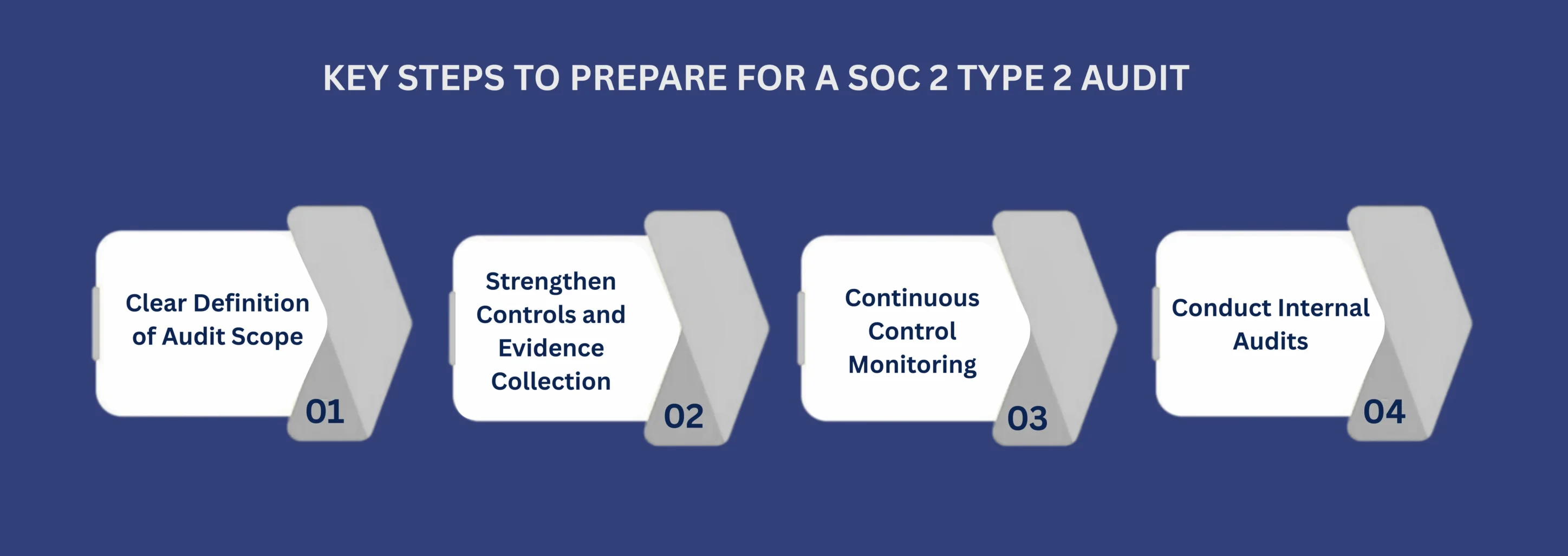
The SOC 2 audit process in Estonia follows a structured sequence of examination activities conducted by CertPro as a Licensed CPA Firm in accordance with AICPA AT-C Section 205 standards. Each stage of the process produces documented outputs that feed into subsequent stages, culminating in the issuance of a formal SOC 2 attestation report. The following numbered steps describe the SOC 2 audit process as conducted by CertPro for SOC 2 audit services Estonia engagements.
- Scope Definition: CertPro’s audit team meets with the service organization’s management to determine the systems in scope, the applicable Trust Services Criteria, the review period (for Type 2 engagements), and the boundaries of the system description. Scope definition results in a formal engagement letter documenting the examination parameters.
- Audit Program Determination: CertPro develops a tailored audit program specifying the control objectives, control activities to be tested, evidence requirements, and sampling methodology applicable to the scoped criteria. The audit program is calibrated to the service organization’s technical environment and operational complexity.
- System Description Review: Management prepares a written description of the service organization’s system, covering the infrastructure, software, people, procedures, and data relevant to the in-scope services. CertPro evaluates whether the system description is fairly presented and complete.
- Evidence Collection and Fieldwork: CertPro’s auditors conduct fieldwork — requesting and reviewing documentation (policies, procedures, configuration records, access logs, training records), performing system walkthroughs, conducting interviews with control owners, and inspecting technical configurations. For Type 2 engagements, evidence is collected across the entire review period using statistical and risk-based sampling.
- Control Testing and Evaluation: Each control identified in the audit program is tested against the applicable Trust Services Criteria. Testing procedures include inspection of documents, observation of control performance, re-performance of control activities, and inquiry of personnel. Test results are documented in the audit workpapers.
- Nonconformity Review: Identified control deficiencies, exceptions, and deviations are evaluated for materiality and impact on the auditor’s opinion. Management is provided with the opportunity to review identified exceptions and provide explanations or compensating control evidence.
- Report Drafting: CertPro drafts the SOC 2 attestation report, including management’s assertion, the auditor’s opinion letter, the system description, and — for Type 2 reports — the detailed description of tests and results. Management reviews the draft report for factual accuracy.
- Issuance of Attestation Report: Upon completion of the review process and resolution of any factual issues, CertPro issues the final signed SOC 2 attestation report. The report is a restricted-use document addressed to the service organization’s management and specified user entities.
- Surveillance and Recertification: For organizations maintaining annual SOC 2 compliance, CertPro conducts subsequent annual Type 2 engagements to produce updated attestation reports covering successive twelve-month review periods.
Evidence collection is the most operationally intensive phase of the SOC 2 audit process. AICPA standards require auditors to obtain sufficient appropriate evidence to support the audit opinion — “sufficient appropriate” is defined in terms of both quantity (sufficient coverage across the review period) and quality (relevance and reliability of the evidence type).
In SOC 2 audit Estonia engagements, CertPro requests evidence across multiple categories: access provisioning and deprovisioning records, change management tickets, security incident logs, vulnerability scan reports, penetration test results, backup verification logs, vendor management records, employee security training completion records, and board-approved information security policies. For Type 2 engagements covering a twelve-month period, sampling methodology determines which specific instances of each control execution are examined, with sample sizes calibrated to the frequency of the control and the associated risk. Poor evidence collection is the most common reason SOC 2 audits are delayed or result in qualified opinions; organizations that maintain well-organized, audit-ready evidence repositories complete fieldwork faster and with fewer exceptions.
A distinctive feature of the SOC 2 attestation examination is the requirement for a management assertion. Under AICPA AT-C Section 205, management of the service organization must provide a written assertion stating that the system description is fairly presented, that the controls stated therein were suitably designed, and — for Type 2 reports — that the controls operated effectively throughout the review period.
The management assertion is included in the SOC 2 attestation report as a separate section and is the subject of the auditor’s opinion. This structure means management bears direct responsibility for the accuracy of the system description and the claims made about control performance; the auditor’s role is to independently examine and opine on those assertions. Estonian organizations undergoing a SOC 2 audit for the first time frequently require guidance from CertPro’s examination team on the technical requirements for a complete and accurate management assertion.
- ✓Evidence Collection Standards in SOC 2 Audit Estonia Engagements
- ✓Management Assertion in the SOC 2 Examination
SOC 2 Compliance Requirements in Estonia
SOC 2 compliance requirements in Estonia are defined by the AICPA Trust Services Criteria and the specific commitments and system requirements documented in the service organization’s system description. There is no additional Estonian statutory requirement that modifies or supplements the AICPA framework. However, Estonian organizations must account for applicable GDPR obligations, the Estonian Personal Data Protection Act, and any sector-specific regulations when designing controls that will be evaluated against the Privacy and Security criteria. The following requirements apply to all organizations pursuing SOC 2 Certification in Estonia.
Documentation requirements for SOC 2 compliance Estonia engagements are extensive and cover every major control domain evaluated against the applicable Trust Services Criteria. At minimum, the service organization must maintain a board-approved information security policy, an asset inventory, access control policies and procedures, change management procedures, incident response plans and post-incident review records, business continuity and disaster recovery plans with test results, vendor management policies and third-party risk assessments, employee security training completion records, and data classification and handling policies.
For organizations including the Privacy criterion, additional documentation requirements include a current privacy notice, data processing records (Article 30 GDPR records), data subject rights request logs, and data protection impact assessments where applicable. All documentation must be current, version-controlled, and demonstrably implemented — policies that exist only on paper without evidence of implementation will result in control exceptions during the SOC 2 audit.
Technical controls form the operational core of SOC 2 compliance and are the primary focus of fieldwork testing during the SOC 2 audit. Under the Security criterion’s Common Criteria, organizations must demonstrate technical controls covering logical access management (including multi-factor authentication for all privileged access), encryption of data in transit and at rest using industry-standard protocols, vulnerability management (including regular scanning and documented remediation timelines), intrusion detection and prevention capabilities, audit logging and log review procedures, and network segmentation.
For cloud-native Estonian SaaS companies, technical control evidence typically includes cloud infrastructure configuration exports (AWS, Azure, or GCP), identity and access management audit logs, endpoint detection and response (EDR) system records, and security information and event management (SIEM) alert logs. Technical controls must be configured and operating before the review period commences for a Type 2 engagement — controls implemented mid-period can only be evaluated for the portion of the period during which they were active.
SOC 2 compliance Estonia organizations subject to GDPR benefit from significant overlap between SOC 2 Trust Services Criteria and GDPR’s security and privacy requirements. Article 32 of the GDPR requires organizations to implement appropriate technical and organizational measures to ensure a level of security appropriate to the risk — including encryption, confidentiality, integrity, availability, and resilience of processing systems. These requirements map directly to the Security and Availability Trust Services Criteria.
The Estonian Data Protection Inspectorate (Andmekaitse Inspektsioon) enforces GDPR in Estonia and has issued guidance on the technical and organizational security measures expected of data controllers and processors. Organizations that design their SOC 2 control environment with GDPR alignment build a framework that simultaneously satisfies AICPA examination requirements and Estonian data protection obligations, reducing duplicative compliance effort and producing a more coherent security posture. AICPA AT-C Section 205 governs the examination itself; GDPR governs the underlying data processing activities — the two frameworks operate in parallel and reinforce each other.
- ✓Documentation Requirements
- ✓Technical Control Requirements
- ✓GDPR Alignment and the Estonian Data Protection Framework
SOC 2 Report: What It Contains
The SOC 2 attestation report is a structured document produced at the conclusion of a SOC 2 examination. Unlike a certification certificate, the SOC 2 report is a detailed examination output containing multiple components, each serving a distinct purpose. Understanding the structure of the SOC 2 report is essential for Estonian organizations preparing to share the report with US clients and for those evaluating what the report communicates about control performance.
- ✓Independent Service Auditor’s Report: The formal opinion letter signed by the Licensed CPA Firm, stating whether controls were suitably designed (Type 1) or suitably designed and operating effectively (Type 2) in conformity with the applicable Trust Services Criteria
- ✓Management’s Assertion: A written statement by the service organization’s management asserting the fairness of the system description and the suitability of control design and operating effectiveness
- ✓System Description: A comprehensive narrative description of the service organization’s system, covering its infrastructure components, software applications, people, procedures, and the data processed — this is typically the longest section of most SOC 2 reports
- ✓Description of Tests and Results (Type 2 only): A detailed matrix listing each control tested, the nature of the testing procedures performed, the results of each test, and any exceptions identified — this section provides the most granular evidence of control performance
- ✓Other Information (Optional): Management may include supplementary information such as future plans for control improvements or contextual explanations — this information is not covered by the auditor’s opinion
- ✓Subservice Organization Disclosures: Where the service organization relies on subservice organizations (third-party cloud providers, payment processors, data centers), the report discloses these relationships and their relevance to the scope of the examination
Restricted-Use Nature of SOC 2 Reports
SOC 2 attestation reports are restricted-use documents under AICPA standards. This means the report is intended solely for the service organization’s management, its board of directors, and specified user entities — the clients and business partners identified during the scoping of the engagement. The report must not be shared publicly or made generally available without restriction, as doing so could create legal and professional liability for the service organization and the issuing CPA Firm.
Estonian organizations that receive SOC 2 attestation reports from CertPro typically share them under non-disclosure agreement with prospective and current enterprise clients as part of vendor due diligence processes. Some organizations publish a SOC 2 bridge letter or executive summary on their website to confirm the existence of a current attestation report, while the full report is shared only upon request under NDA. This restricted-use framework ensures that the detailed control testing information contained in Type 2 reports does not become a security risk by disclosing exploitable control weaknesses to unauthorized parties.
Benefits of SOC 2 Certification for Estonian Businesses
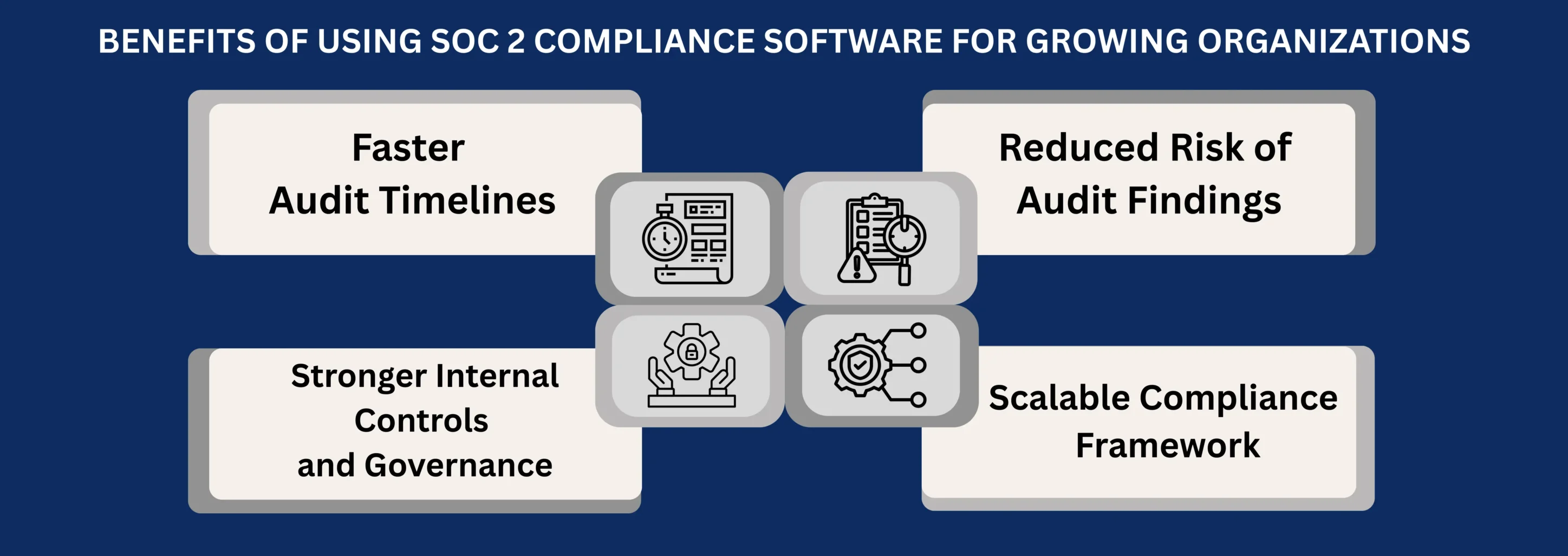
The benefits of SOC 2 Certification in Estonia extend across commercial, operational, regulatory, and strategic dimensions. For Estonian technology companies competing in international markets, SOC 2 attestation delivers measurable business outcomes — not merely compliance checkboxes. The following benefits are consistently observed across organizations that achieve SOC 2 certification through CertPro’s examination program.
- ✓US Market Access: SOC 2 attestation satisfies the vendor security requirements of US enterprise procurement teams, removing a primary barrier to closing enterprise contracts with North American clients
- ✓Client Trust and Retention: An independently verified SOC 2 report provides clients with auditor-attested evidence of control effectiveness, strengthening trust relationships and supporting contract renewals
- ✓Competitive Differentiation: In competitive B2B SaaS and cloud services markets, holding a current SOC 2 Type 2 report distinguishes Estonian organizations from competitors that rely on self-certification or questionnaire-based assurance
- ✓Regulatory Alignment: SOC 2 compliance Estonia engagements that include the Privacy criterion produce a control framework aligned with GDPR obligations, supporting compliance with the Estonian Data Protection Inspectorate’s expectations
- ✓Investor Confidence: Institutional investors conducting due diligence on Estonian technology companies treat SOC 2 attestation as evidence of mature information security governance, supporting Series A and later funding rounds
- ✓Reduced Security Questionnaire Burden: Organizations holding a current SOC 2 Type 2 report can respond to most vendor security questionnaires by providing the attestation report, significantly reducing the time and internal resources spent on procurement-driven security assessments
- ✓Operational Security Improvement: The process of preparing for and completing a SOC 2 audit systematically identifies and remediates control gaps, producing a stronger security posture as a direct outcome of the examination process
- ✓Insurance Premium Reduction: Some cyber insurance underwriters offer premium discounts to organizations holding current SOC 2 Type 2 attestation reports as evidence of reduced cyber risk exposure
- ✓Partner Ecosystem Requirements: Technology platform ecosystems (AWS Marketplace, Salesforce AppExchange, Microsoft Azure Marketplace) increasingly require listed vendors to hold SOC 2 reports, making attestation a prerequisite for marketplace participation
Estonia’s digital trust ecosystem — built on X-Road data exchange infrastructure, the e-Identity system, and legally binding digital signatures — creates a uniquely advanced environment in which SOC 2 compliance Estonia organizations operate. Estonian organizations that achieve SOC 2 Certification in Estonia add an internationally recognized US-standard assurance layer to this existing digital trust infrastructure.
For multinational clients evaluating Estonian technology vendors, the combination of GDPR compliance under the supervision of the Andmekaitse Inspektsioon and SOC 2 attestation issued by a Licensed CPA Firm constitutes a comprehensive, dual-framework assurance package that exceeds the security assurance levels of most comparable vendors in competing technology hubs. This dual compliance positioning is a distinctive competitive advantage for Estonian organizations in international procurement processes — particularly in financial services, healthcare, and legal technology sectors where both EU data protection standards and US security attestation frameworks are contractually required.
- ✓SOC 2 and Estonia’s Digital Trust Ecosystem
SOC 2 Certification Cost and Timeline in Estonia
SOC 2 certification cost in Estonia varies based on the type of engagement (Type 1 or Type 2), the number of Trust Services Criteria in scope, the complexity of the service organization’s technical environment, and the length of the Type 2 review period. CertPro operates a fixed-pricing model for SOC 2 audit services Estonia engagements, providing organizations with cost certainty from engagement commencement.
Fixed pricing eliminates the open-ended billing exposure that can arise from time-and-materials audit arrangements — a benefit that is particularly valuable for Estonian startups and early-stage companies managing tight operational budgets.
| Engagement Type | Typical Timeline | Key Cost Drivers |
|---|---|---|
| SOC 2 Type 1 Audit | 6–10 weeks from engagement commencement | Number of criteria, system complexity, documentation completeness |
| SOC 2 Type 2 (6-month review period) | 3–4 months (fieldwork + reporting) | Criteria scope, control count, sampling volume, exception resolution |
| SOC 2 Type 2 (12-month review period) | 4–6 months (fieldwork + reporting) | Extended evidence collection, larger sample sizes, subservice organization complexity |
| Annual Type 2 Renewal | Reduced timeline relative to initial engagement | Continuity of controls, prior-period findings resolution, scope changes |
Factors That Influence SOC 2 Certification Cost
Several organizational factors directly influence the cost of SOC 2 certification in Estonia. The number of Trust Services Criteria selected is one of the most significant cost drivers — each additional criterion beyond Security adds testing scope and evidence collection requirements. Organizations with complex multi-cloud infrastructure environments (combining AWS, Azure, and GCP services) require more extensive technical fieldwork than those operating on a single cloud platform.
The number of in-scope systems and applications determines the breadth of the system description and the volume of controls to be tested. Subservice organizations — third-party providers such as hosting companies, payment processors, and identity providers — add complexity because the service organization must demonstrate how it monitors and manages these relationships. For Type 2 engagements, the review period length (six months versus twelve months) affects sample sizes and evidence collection volume. Organizations that maintain organized, audit-ready evidence throughout the review period consistently achieve lower total SOC 2 audit costs because fieldwork is completed faster with fewer re-requests.
Fixed Pricing Model for SOC 2 Audit Services Estonia
CertPro’s fixed pricing model for SOC 2 audit services Estonia engagements provides Estonian organizations with a defined engagement cost established at contract execution, based on a scoping assessment of the organization’s systems, applicable criteria, review period, and control environment complexity. Fixed pricing covers all examination activities from scope definition through attestation report issuance — including fieldwork, control testing, exception review, report drafting, and final report delivery. Travel costs for on-site examination activities, where required, are scoped separately.
The fixed pricing model aligns CertPro’s incentive with efficient execution — completing the examination to the required standard within the agreed timeline — rather than billing incremental hours. For Estonian organizations that have experienced unpredictable audit costs under time-and-materials arrangements with other firms, CertPro’s fixed pricing model provides a materially different cost management experience. Organizations are advised to contact CertPro directly for a formal engagement proposal following an initial scoping conversation.
SOC 2 Certification Requirements
Achieving SOC 2 Certification in Estonia requires the service organization to satisfy a defined set of organizational, documentation, and technical requirements before and during the examination period. These requirements apply regardless of the organization’s size, industry, or technical architecture. The following requirements are evaluated during every SOC 2 audit Estonia engagement conducted by CertPro.
- ✓Defined System Scope: A clearly documented description of the in-scope system — including infrastructure boundaries, software components, data flows, and personnel roles — must be prepared by management prior to examination commencement
- ✓Applicable Trust Services Criteria Selection: Management must determine which Trust Services Criteria apply to the in-scope system based on the commitments made to user entities and the nature of data processed
- ✓Implemented Control Framework: Controls addressing each applicable Trust Services Criterion must be implemented and operating — for Type 2 engagements, controls must have been in operation for the entire review period
- ✓Information Security Policies: A comprehensive suite of documented information security policies, approved by senior management or the board, must cover all domains relevant to the applicable criteria
- ✓Access Management Procedures: Formal procedures for provisioning, reviewing, modifying, and revoking access to in-scope systems must be documented and consistently applied, with evidence maintained for the review period
- ✓Incident Response Program: A documented incident response plan must be in place, with evidence of at least one annual review and — for Type 2 engagements — records of any security incidents handled during the review period
- ✓Vendor Management Program: For organizations relying on subservice organizations, a formal vendor management program with documented third-party risk assessments must be maintained
- ✓Change Management Procedures: Documented procedures for managing changes to in-scope systems — including change request records, approval evidence, and testing documentation — must be available for the review period
- ✓Audit Evidence Repository: Organized, retrievable evidence of control execution throughout the review period must be maintained, including logs, screenshots, signed documents, tickets, and configuration records
- ✓Management Assertion Preparation: Management must be prepared to execute a formal written assertion attesting to the fairness of the system description and the suitability of control design and operating effectiveness
Most Estonian technology organizations rely on subservice organizations — third-party providers such as Amazon Web Services, Microsoft Azure, Google Cloud Platform, payment gateways, or identity providers — for components of their service delivery infrastructure. Under AICPA SOC 2 standards, the service organization must identify all subservice organizations material to the in-scope system and determine whether to use the carve-out method or the inclusive method for presenting their role in the system description.
Under the carve-out method (most common), the subservice organization’s controls are excluded from the scope of the SOC 2 examination. Management’s assertion and the system description identify the carve-out and describe what complementary user entity controls the service organization must implement. Under the inclusive method, the subservice organization’s controls are included in scope, and the same Licensed CPA Firm must examine those controls as well. The carve-out method is standard practice for well-known cloud infrastructure providers that issue their own SOC 2 reports, which the service organization can reference as evidence of subservice organization control assurance.
- ✓Subservice Organization Management Requirements
Why Choose CertPro for SOC 2 Audit in Estonia
CertPro is a Licensed CPA Firm that conducts SOC 2 attestation examinations in accordance with AICPA AT-C Section 205 standards. CertPro’s SOC 2 audit team delivers examination services to Estonian technology organizations, SaaS companies, cloud service providers, and e-Residency program companies seeking formally attested assurance over their security and privacy controls. The following attributes distinguish CertPro’s SOC 2 audit services Estonia practice from alternative providers.
Licensed CPA Firm Status and AICPA Standards Compliance
Only a Licensed CPA Firm can issue a SOC 2 attestation report under AICPA standards. This is a categorical requirement — management consulting firms, cybersecurity advisory firms, and ISO certification bodies are not authorized to issue SOC 2 reports regardless of their technical expertise. CertPro’s status as a Licensed CPA Firm is therefore not merely a credential; it is the legal and professional prerequisite for the validity of the SOC 2 attestation reports it issues.
Estonian organizations that engage non-CPA providers for purported SOC 2 certification services receive documents that do not constitute valid SOC 2 attestation reports under AICPA standards and will not satisfy the requirements of US enterprise procurement programs. Every SOC 2 attestation report issued by CertPro is signed by a licensed CPA, complies with AICPA AT-C Section 205, and is recognized as a valid SOC 2 report by US clients, investors, and regulatory bodies.
Examination Expertise and Process Efficiency
CertPro’s SOC 2 examination team brings deep technical expertise across the full range of Trust Services Criteria and the technology environments common to Estonian SaaS companies and cloud service providers. This includes proficiency in evaluating cloud-native architectures (AWS, Azure, GCP), containerized microservices environments, DevOps CI/CD pipelines, and SaaS multi-tenant architectures.
The examination team’s familiarity with these environments enables efficient fieldwork — auditors know precisely what evidence to request, what configurations to inspect, and what testing procedures to apply to common control designs. This technical depth reduces the elapsed time between evidence request and testing completion, accelerating the path to report issuance. For SOC 2 certification Estonia fintech engagements and SOC 2 compliance Estonia tech startups where time-to-report is commercially important for active contract negotiations, CertPro’s examination efficiency delivers measurable value beyond the attestation report itself.
Estonia-Specific Audit Experience
CertPro’s examination team has direct experience conducting SOC 2 audit services Estonia engagements for organizations operating within Estonia’s specific regulatory and business environment. This includes familiarity with Estonia’s GDPR implementation as enforced by the Andmekaitse Inspektsioon, the technical characteristics of Estonian digital identity and e-signature infrastructure (which frequently appear in the system descriptions of Estonian organizations), and the commercial context of e-Residency companies that operate internationally.
CertPro understands how Estonian organizations typically structure their cloud infrastructure, how they use Estonian digital signature mechanisms for access control and approval workflows, and how GDPR documentation requirements intersect with SOC 2 evidence collection. This local knowledge base enables CertPro to conduct SOC 2 audit Estonia engagements with greater precision and relevance than firms applying generic international audit templates without local context.
FAQ
▶
What is SOC 2 certification and how does it differ from ISO 27001?
▶
How long does a SOC 2 Type 2 audit take for an Estonian company?
▶
Is SOC 2 certification mandatory for Estonian companies under Estonian law?
▶
What is the difference between SOC 2 certified and SOC 2 compliant?
▶
Which Trust Services Criteria should an Estonian SaaS company include in its SOC 2 audit?
▶
Can an e-Residency company registered in Estonia obtain a SOC 2 attestation report?
▶
How does annual SOC 2 recertification work for Estonian organizations?
▶
What happens if control exceptions are identified during the SOC 2 audit?

SOC 1 VS SOC 2: WHICH REPORT YOUR CUSTOMERS ACTUALLY ASK FOR
If you sell SaaS or provide outsourced services, you have likely been asked for a SOC report. However, the follow-up question is rarely easy to answer…

Secure Email Platform Exclaimer Renews ISO, SOC 2
Excerpt from The Manila Times Article, Published on February 26, 2026 Secure email solutions provider Exclaimer has renewed its ISO and SOC 2 certific…
SOC 2 FRAMEWORK REQUIREMENTS IN 2026. WHAT HAS CHANGED?
Security reviews used to happen at the tail end of a deal. Today, they happen in the first conversation. Enterprise buyers come prepared. They ask abo…
Get In Touch
have a question? let us get back to you.