
SOC 2 Certification in France
A SOC 2 audit produces one of two report types depending on the scope of the examination. Understanding the distinction between Type 1 and Type 2 is essential for organizations pursuing SOC 2 Certification in France — and equally important for the customer organizations that rely on these reports for vendor assurance decisions. The two report types differ in evaluation scope, evidence requirements, and the level of assurance they provide.
OUR CLIENTS





What Is SOC 2 Certification in France?
SOC 2 Certification in France is a formal third-party attestation issued by a Licensed CPA Firm following an independent examination of a service organization’s controls against the AICPA Trust Services Criteria (TSC). This attestation is not a government-issued licence and does not originate from a French regulatory authority. Instead, it results from a structured SOC 2 examination conducted under the AICPA’s attestation standards — specifically AT-C Section 205, which governs examination engagements. The resulting SOC 2 attestation report documents whether an organization’s controls were designed and operating effectively at a specified point in time (Type 1) or throughout a defined observation period (Type 2).
France’s technology and business ecosystem has made SOC 2 Certification increasingly relevant for organizations across multiple sectors. Paris functions as a major European technology hub, home to a dense concentration of SaaS providers, AI startups, fintech businesses, and cloud service operators. Lyon hosts significant life sciences and pharmaceutical organizations. Toulouse anchors aerospace and industrial technology firms. Marseille, Bordeaux, and Lille each contribute active digital and enterprise technology clusters.
Across all of these environments, service organizations that store, process, or transmit customer data face growing demand from enterprise clients, financial institutions, and multinational corporations for independently verified assurance. SOC 2 Certification in France directly addresses that demand by providing a recognized, audit-backed framework for demonstrating control effectiveness.
The AICPA Trust Services Criteria define five categories against which controls are evaluated during a SOC 2 audit: Security, Availability, Processing Integrity, Confidentiality, and Privacy. Security — also called the Common Criteria — is mandatory in every SOC 2 examination. Organizations select the remaining four criteria based on their service commitments and contractual obligations to user entities.
For a SaaS provider in Paris processing financial data, the Security and Availability criteria are commonly included. For a healthcare technology firm in Lyon handling patient information, the Privacy criterion may be added. The Trust Services Criteria provide a structured framework that the Licensed CPA Firm applies during evidence collection, control testing, and report preparation.
SOC 2 compliance in the French market reflects both international procurement requirements and the broader European regulatory environment. Organizations subject to the EU General Data Protection Regulation (GDPR), the French Data Protection Act (Loi Informatique et Libertés), CNIL guidance, the NIS2 Directive, or the Digital Operational Resilience Act (DORA) often find that a SOC 2 attestation provides a structured, audit-evidenced foundation that informs — though does not automatically establish — conformance with those frameworks.
Customers, regulators, and procurement teams across France and the European Union increasingly require SOC 2 reports as part of vendor due diligence, third-party risk management programs, and supply chain security assessments. The SOC 2 attestation provides independently verified documentation that is difficult to replicate through self-assessment alone.
CertPro operates as a Licensed CPA Firm providing independent SOC 2 audit and attestation services to organizations across France. The firm conducts SOC 2 examinations strictly under AICPA attestation standards, maintaining full independence from the organizations it audits. CertPro does not provide consulting, control design, remediation, or advisory services. Its engagement scope is limited to independent examination, evidence evaluation, control testing, and attestation report issuance.
Organizations seeking SOC 2 Certification in France through CertPro receive a formal SOC 2 attestation report prepared by licensed professionals who apply the Trust Services Criteria consistently. This enables each organization to present verified assurance to customers, partners, and regulators operating both within France and internationally.

ENQUIRE NOW
Related Resources
Related Services in France
Why SOC 2 Certification in France Matters for Service Organizations
Service organizations operating in France face a demanding landscape of enterprise procurement requirements, European regulatory expectations, and cross-border data protection obligations. SOC 2 Certification in France has become a standard element of vendor qualification processes used by large enterprises, financial institutions, and public-sector bodies when evaluating technology suppliers.
An organization that holds a current SOC 2 attestation report can respond to security questionnaires, vendor risk assessments, and due diligence requests with independently verified documentation — rather than self-attested claims. This materially accelerates sales cycles and reduces procurement friction across both domestic and international markets.
Enterprise and Regulatory Demand Drivers in France
The demand for SOC 2 attestation among French service organizations is driven by several converging forces. Enterprise buyers in the financial services sector — including banks, insurance companies, and asset managers subject to DORA — increasingly require third-party assurance reports from their technology vendors. Healthcare organizations and pharmaceutical companies operating under French and EU data protection requirements demand evidence of controlled data handling.
US-headquartered multinationals with French subsidiaries or French vendor relationships apply group-level procurement standards that mandate SOC 2 compliance across their supplier base. Each of these demand sources produces direct, contractual pressure on service organizations to obtain and maintain SOC 2 Certification in France.
France’s fintech sector — concentrated in Paris but expanding across major cities — is particularly active in pursuing SOC 2 certification. Fintech firms processing payment data, managing investment portfolios, or providing banking-as-a-service infrastructure serve customers who require assurance that controls over data security, availability, and processing integrity have been independently tested.
SOC 2 certification for France-based fintech companies frequently addresses the Security, Availability, and Processing Integrity criteria, reflecting the operational commitments these organizations make to their user entities. The SOC 2 attestation report produced at the conclusion of the examination provides the documented evidence that client security and compliance teams require.
SOC 2 and the European Regulatory Environment
SOC 2 attestation does not establish or substitute for compliance with GDPR, CNIL requirements, the NIS2 Directive, or DORA. Each of those frameworks imposes distinct legal obligations with their own enforcement mechanisms. However, the control categories examined during a SOC 2 audit — particularly Security, Availability, and Privacy under the Trust Services Criteria — address control domains that are also relevant to GDPR Article 32 technical and organisational measures and NIS2 security requirements.
Organizations that have successfully completed a SOC 2 examination possess audit-evidenced documentation of their control environment. This documentation can inform regulatory assessments, internal compliance reviews, and responses to CNIL inquiries — without the SOC 2 report itself constituting a regulatory compliance certification.
DORA, which applies to financial entities and their critical ICT third-party providers operating within the EU, introduces specific requirements for ICT risk management and third-party oversight. French financial institutions subject to DORA must assess the security practices of their technology vendors. A SOC 2 Type 2 attestation report from a vendor provides structured, independently tested evidence of control effectiveness over an observation period.
Financial institution compliance teams can incorporate this evidence into their ICT third-party risk assessments. While the SOC 2 examination does not map directly to DORA’s contractual requirements, its evidence-based structure supports the due diligence process that DORA mandates for regulated entities and their service providers.
SOC 2 Type 1 and Type 2 Reports: Definitions and Differences
A SOC 2 audit produces one of two report types depending on the scope of the examination. Understanding the distinction between Type 1 and Type 2 is essential for organizations pursuing SOC 2 Certification in France — and equally important for the customer organizations that rely on these reports for vendor assurance decisions. The two report types differ in evaluation scope, evidence requirements, and the level of assurance they provide.
SOC 2 Type 1: Point-in-Time Design Assessment
A SOC 2 Type 1 report evaluates whether an organization’s controls were suitably designed as of a specific date. The Licensed CPA Firm examines the control environment — including policies, procedures, system configurations, and organizational responsibilities — and forms an opinion on whether the controls described in management’s system description are designed appropriately to meet the selected Trust Services Criteria.
A Type 1 report does not assess whether those controls operated effectively over time. It is a point-in-time snapshot. For organizations that are new to the SOC 2 certification process in France or that have recently implemented significant control changes, a Type 1 report provides an accessible entry point into the SOC 2 attestation process and a documented baseline for subsequent Type 2 examinations.
SOC 2 Type 2: Operating Effectiveness Over an Observation Period
A SOC 2 Type 2 report covers both the design and the operating effectiveness of controls over a defined observation period, typically six to twelve months. The Licensed CPA Firm tests controls throughout that period by examining evidence — log records, access review documentation, incident response records, change management tickets, and other artifacts — to determine whether controls functioned as intended.
The SOC 2 examination at Type 2 level produces an opinion on both suitability of design and operating effectiveness. Enterprise customers across France, the EU, and North America consistently prefer SOC 2 Type 2 audit reports over Type 1 reports because they provide longitudinal evidence of control performance rather than a single-date snapshot. Most procurement standards and financial sector requirements specify Type 2 as the minimum acceptable report level.
| Attribute | SOC 2 Type 1 | SOC 2 Type 2 |
|---|---|---|
| Evaluation Scope | Control design assessed at a specific date | Control design and operating effectiveness assessed over a defined period |
| Observation Period | None — point-in-time assessment | Typically 6–12 months |
| Evidence Requirement | Design documentation and system description | Design documentation plus operational evidence collected throughout the period |
| Customer Preference | Accepted for initial or preliminary assurance | Required by most enterprise and financial sector buyers |
| Report Output | SOC 2 Type 1 attestation report | SOC 2 Type 2 attestation report |
SOC 2 Certification Audit Process in France
The SOC 2 audit process follows a structured sequence of stages governed by AICPA attestation standards. Each stage produces defined outputs that collectively form the basis for the attestation report. This process applies consistently for organizations across France — whether they operate as SaaS platforms in Paris, data center operators in Lyon, or telecommunications providers in Marseille.
The SOC 2 audit process begins with scope definition. The Licensed CPA Firm works with organization management to identify the systems, services, and infrastructure included in the examination. Scope boundaries determine which Trust Services Criteria apply and which controls fall within the examination perimeter.
Following scope definition, the audit program is established: the firm selects control testing procedures appropriate for the organization’s service commitments and the criteria in scope. For a Type 2 engagement, the observation period start date is confirmed at this stage. An initial baseline review then examines the organization’s system description — the formal management-prepared document describing services, system components, and control objectives — to confirm it accurately reflects the in-scope environment before the observation period begins.
The audit program document specifies the nature, timing, and extent of control testing procedures the Licensed CPA Firm will execute. For each Trust Services Criterion in scope, the program identifies the controls that management asserts address that criterion and the evidence the firm will examine to evaluate control design and operating effectiveness.
Audit programs for SOC 2 compliance engagements in France reflect the specific technology environment of the organization — including cloud infrastructure configurations relevant to French data localization preferences, access control architectures, encryption implementations, and incident response procedures. This ensures that the examination is responsive to the actual control environment rather than a generic template.
Control testing is the core technical phase of the SOC 2 examination. The Licensed CPA Firm examines evidence across the observation period to evaluate whether each in-scope control operated effectively. Evidence types include access provisioning and de-provisioning records, vulnerability scan reports, penetration testing documentation, backup verification logs, security awareness training completion records, change management approvals, and vendor risk assessment documentation.
The firm applies inquiry, observation, inspection, and re-performance procedures as appropriate for each control. Where evidence is insufficient or where controls deviated from their described operation, the firm identifies exceptions and assesses their materiality relative to the Trust Services Criteria.
Following control testing, the firm conducts a nonconformity review to evaluate any identified exceptions. Management has the opportunity to provide additional evidence or context before the firm finalizes its conclusions. The attestation report is then drafted, incorporating the system description, management’s assertion, and the firm’s opinion.
The opinion may be unqualified (no material exceptions found), qualified (exceptions found but the overall control environment is substantially effective), or adverse (material exceptions undermine the effectiveness of the control environment). The completed SOC 2 attestation report is issued to management and made available for distribution to specified user entities — typically customers and their auditors — under the confidentiality provisions of the report. Ongoing control monitoring and annual recertification maintain the currency of the SOC 2 attestation.
- Scope Definition — Identify in-scope systems, services, and Trust Services Criteria
- Audit Program Determination — Establish control testing procedures and observation period start date
- System Description Review — Confirm management’s system description is complete and accurate
- Observation Period Commencement — Begin evidence collection for Type 2 engagements
- Control Testing — Execute inquiry, inspection, observation, and re-performance procedures
- Nonconformity Review — Evaluate exceptions and assess materiality against Trust Services Criteria
- Attestation Report Drafting — Prepare report incorporating system description and auditor opinion
- Report Issuance — Deliver completed SOC 2 attestation report to management
- Surveillance and Recertification — Maintain attestation currency through annual examination cycles
- ✓Stages 1–4: Scoping, Program Determination, and Readiness Baseline
- ✓Stages 5–9: Control Testing, Nonconformity Review, and Attestation Issuance
Benefits of SOC 2 Certification for France-Based Organizations
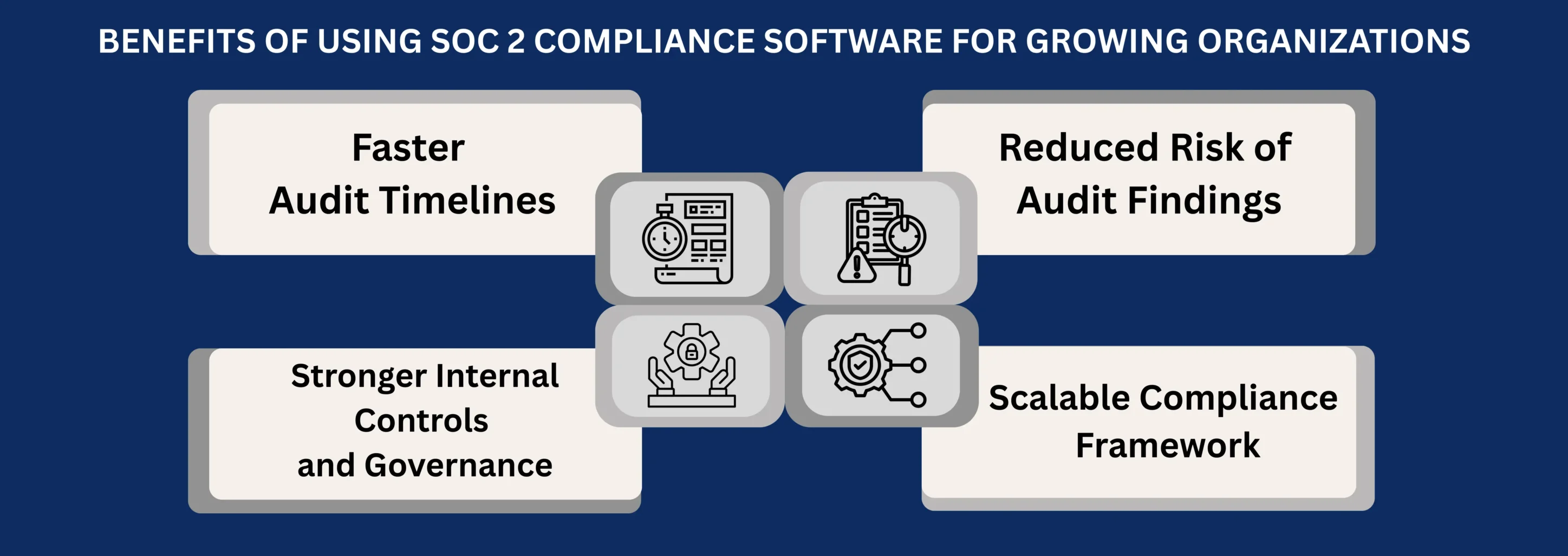
SOC 2 Certification in France delivers documented, independently verified benefits that extend across commercial, operational, and regulatory dimensions. Organizations that have completed a SOC 2 examination possess a structured attestation artifact that addresses multiple stakeholder requirements simultaneously. This reduces the need for repeated, bespoke security assessments for each individual customer relationship — creating meaningful efficiency across sales, compliance, and risk management functions.
SOC 2 Certification in France directly accelerates enterprise sales cycles. When a prospective customer’s security team requests assurance over a vendor’s control environment, an organization holding a current SOC 2 Type 2 attestation report can respond immediately with a formally issued document prepared by a Licensed CPA Firm. This eliminates the delay associated with custom security questionnaire completion, on-site vendor assessments, and informal evidence gathering.
For French SaaS providers targeting US enterprise customers, SOC 2 certification is frequently a mandatory threshold requirement that must be satisfied before contract execution. Similarly, fintech firms in France use the SOC 2 attestation to qualify for partnerships with regulated financial institutions that impose third-party risk management standards requiring independent assurance.
Beyond initial procurement, SOC 2 attestation reduces the recurring compliance burden associated with annual vendor reassessments. Customer organizations that conduct periodic vendor reviews can rely on updated SOC 2 reports — refreshed through annual examination cycles — rather than initiating new custom assessments each year. This creates a durable, scalable assurance mechanism for the service organization.
For France-based organizations serving clients across the EU, the UK, and North America simultaneously, a single SOC 2 attestation report satisfies assurance requirements across multiple markets. This provides multi-jurisdictional commercial value from a single examination engagement — a significant advantage for growing organizations managing complex buyer relationships.
The SOC 2 audit process requires organizations to document, formalize, and test their control environments in ways that produce lasting operational improvements. The process of preparing for a SOC 2 examination — defining control objectives, documenting procedures, and accumulating evidence — establishes control infrastructure that directly benefits internal risk management.
Organizations that have completed multiple annual SOC 2 examination cycles develop mature control monitoring processes, consistent evidence collection procedures, and well-defined management responsibilities. These capabilities reduce the risk of control failures and the costs associated with security incidents. The attestation process creates accountability and documentation discipline that extends well beyond the examination period itself.
- ✓Independently verified assurance documentation accepted by enterprise, financial sector, and institutional buyers
- ✓Accelerated vendor qualification and procurement processes with customers in France and internationally
- ✓Structured evidence of control effectiveness available for regulatory inquiries and due diligence reviews
- ✓Annual SOC 2 examination cycle establishes continuous control monitoring discipline
- ✓SOC 2 attestation report satisfies assurance requirements across multiple markets from a single engagement
- ✓Documented control environment supports internal risk management and board-level oversight
- ✓Differentiated market positioning relative to competitors relying on self-assessed security questionnaires
- ✓Commercial and Procurement Benefits
- ✓Operational and Risk Management Benefits
Requirements for SOC 2 Certification in France
SOC 2 Certification in France requires organizations to satisfy a defined set of examination prerequisites and maintain a control environment that the Licensed CPA Firm can evaluate against the selected Trust Services Criteria. Requirements are organizational, technical, and documentation-based. For a Type 2 engagement, these requirements must be sustained consistently throughout the entire observation period.
Management must prepare a formal system description that accurately describes the services provided, the infrastructure and software components involved, the people and processes responsible for control operation, and the control objectives applicable to each selected Trust Services Criterion. The system description is a management-prepared document included in the SOC 2 attestation report, and its accuracy is subject to examination.
Management must also provide a written assertion confirming that the system description is fairly presented and that controls were suitably designed — and, for Type 2, operating effectively — throughout the observation period. Organizational requirements include defined roles and responsibilities for control ownership, documented policies and procedures, and evidence retention practices that ensure audit artifacts remain available for examination.
For SOC 2 compliance engagements in France, organizations must ensure that their system descriptions accurately reflect any France-specific infrastructure considerations. These include data residency configurations, French or EU-based cloud infrastructure, and any country-specific operational procedures relevant to the in-scope service.
Where organizations use subservice organizations — third-party vendors whose services form part of the system — the system description must identify these relationships and address how controls at the subservice organization level are considered within the overall control environment. The inclusion or exclusion method selected for subservice organizations affects the scope of the examination and the nature of evidence the Licensed CPA Firm requires.
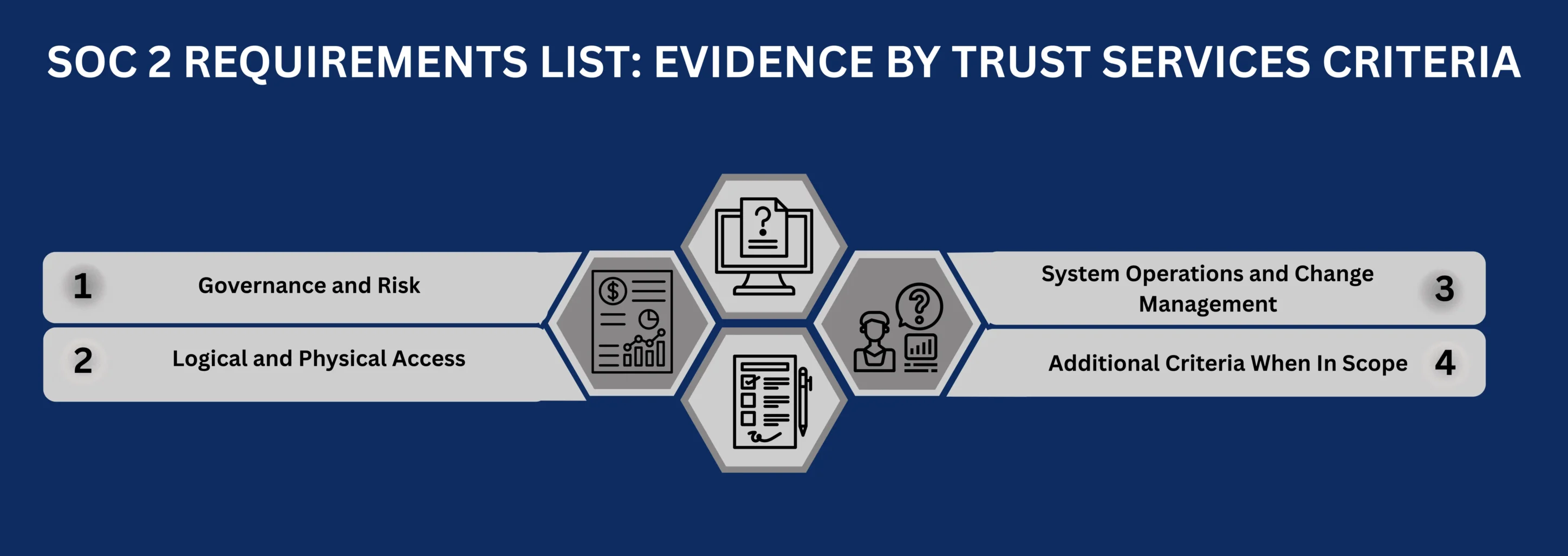
The Security criterion — mandatory in every SOC 2 examination — requires controls addressing logical and physical access, system operations, change management, risk management, and monitoring. These controls must be documented and must have operated consistently throughout the observation period, with evidence available for each control assertion.
For the Availability criterion, organizations must demonstrate controls over capacity management, backup and recovery, incident response, and environmental protections. Processing Integrity requires controls ensuring completeness, accuracy, and timeliness of processing — particularly relevant for fintech, payments, and data analytics organizations. Confidentiality and Privacy criteria require controls addressing data classification, encryption, retention, disposal, and — for Privacy — alignment with applicable privacy policies and notice obligations.
| Trust Services Criterion | Mandatory / Optional | Primary Control Domains |
|---|---|---|
| Security (Common Criteria) | Mandatory | Access control, change management, risk assessment, monitoring, incident response |
| Availability | Optional | Capacity management, backup and recovery, environmental controls, SLA monitoring |
| Processing Integrity | Optional | Completeness, accuracy, and timeliness of processing; error detection and correction |
| Confidentiality | Optional | Data classification, encryption, retention, disposal, access restriction |
| Privacy | Optional | Notice, consent, data subject rights, collection limitation, privacy policy controls |
- ✓Documentation and Organizational Requirements
- ✓Technical Control Requirements by Trust Services Criterion
How to Obtain SOC 2 Certification in France: Step-by-Step Process
Obtaining SOC 2 Certification in France involves a defined sequence of organizational actions and examination activities. The process begins before the observation period starts and concludes with the issuance of the SOC 2 attestation report. Each step involves specific management responsibilities and produces outputs that the Licensed CPA Firm relies on during the examination.
The first step in obtaining SOC 2 Certification in France is determining the scope of the examination — specifically, which services, systems, and Trust Services Criteria will be included. Management then prepares the system description, documenting the in-scope environment in sufficient detail to allow the Licensed CPA Firm and report users to understand the system and its controls.
Policies and procedures supporting each in-scope control must be documented and approved before the observation period begins. Control ownership must be assigned to specific individuals or teams within the organization. For organizations undergoing a SOC 2 examination for the first time, this documentation phase typically requires two to four months of sustained management effort to complete thoroughly.
Evidence collection infrastructure must also be established before the observation period begins. For a Type 2 engagement, the Licensed CPA Firm will request evidence of control operation at multiple points throughout the observation period — not only at the end. Organizations must therefore implement repeatable, documented procedures for generating and retaining evidence artifacts.
These artifacts include access review records, security monitoring logs, change management documentation, training completion records, risk assessment outputs, and vendor assessment reports. Organizations using cloud infrastructure in France or the EU must ensure that logging and monitoring configurations are active, and that evidence retention periods cover the full observation period plus any additional time required for audit proceedings.
Once the observation period concludes, the Licensed CPA Firm executes its planned control testing procedures. Management must respond promptly to evidence requests and provide access to systems, personnel, and documentation as required by the audit program. The firm may request walkthroughs of specific processes, interviews with control owners, and direct inspection of system configurations.
Following evidence review and testing, the firm identifies any control exceptions and presents preliminary findings to management. Management provides responses and, where applicable, additional supporting evidence. The firm then finalizes its opinion and drafts the SOC 2 attestation report. The completed report is issued and signed by the Licensed CPA Firm, providing management with a formal, distributable assurance document ready for sharing with authorized user entities.
- Define examination scope: select in-scope services, systems, and Trust Services Criteria
- Prepare management’s system description accurately reflecting the in-scope environment
- Document and approve policies and procedures for each in-scope control
- Assign control ownership and establish evidence retention procedures
- Engage the Licensed CPA Firm and confirm the observation period start date
- Execute and retain evidence of control operation throughout the observation period
- Respond to auditor evidence requests and facilitate control testing procedures
- Review preliminary findings and provide management responses to identified exceptions
- Receive and distribute the completed SOC 2 attestation report to authorized user entities
- ✓Preparation Phase: System Description and Control Documentation
- ✓Examination and Report Issuance Phase
SOC 2 Compliance France: Regulatory Context and Alignment
SOC 2 compliance in France encompasses both the internal control requirements of the AICPA Trust Services Criteria and the broader regulatory environment in which French service organizations operate. Understanding how SOC 2 attestation relates to — and differs from — French and European regulatory obligations is essential for organizations seeking to use the SOC 2 examination effectively within their compliance programs.
GDPR, CNIL, and French Data Protection Considerations
GDPR Article 32 requires data controllers and processors to implement appropriate technical and organisational measures to ensure a level of security appropriate to the risk. The specific controls examined under the SOC 2 Security and Privacy Trust Services Criteria — including encryption, access control, incident response, and data processing controls — address domains directly relevant to those GDPR requirements.
A SOC 2 Type 2 attestation report provides documented, auditor-tested evidence of these measures that data controllers can reference in their records of processing activities and present to CNIL in the event of an inquiry. However, the SOC 2 examination does not evaluate legal bases for processing, data subject rights fulfillment mechanisms, or other GDPR obligations outside the Trust Services Criteria scope. Organizations must maintain separate compliance programs for GDPR obligations not addressed by the SOC 2 framework.
The French Data Protection Act (Loi Informatique et Libertés), which implements and supplements GDPR in France, imposes requirements administered by the CNIL. French organizations subject to CNIL oversight — including technology companies processing French citizen data — can reference SOC 2 attestation reports as evidence of their technical security measures when responding to CNIL requests or demonstrating accountability under GDPR’s principle of accountability (Article 5(2)).
The SOC 2 audit process in France produces a structured, independently verified record that supplements internal compliance documentation. It provides an objective third-party perspective on the organization’s control environment — distinct from management self-assessments or internal audit reports — that carries meaningful weight in regulatory and procurement contexts alike.
NIS2, DORA, and Sectoral Regulatory Alignment
The NIS2 Directive, transposed into French law, imposes cybersecurity risk management obligations on essential and important entities across critical sectors including energy, transport, banking, financial market infrastructure, health, and digital infrastructure. NIS2 requires these entities to implement technical and organisational measures proportionate to their risk exposure, maintain incident response capabilities, and assess the security of their supply chains.
French organizations in NIS2 scope that use third-party ICT service providers can reference those providers’ SOC 2 attestation reports as part of their supply chain security assessment procedures. The SOC 2 examination’s structured evaluation of security controls provides a documented basis for the supply chain risk assessments that NIS2 compliance programs require.
SOC 2 Certification in France: Industry-Specific Applications
SOC 2 Certification in France applies across a broad range of industries and organizational types. The specific Trust Services Criteria selected, the controls examined, and the assurance value delivered vary based on the nature of the service provided and the requirements of the user entities served. The following describes how SOC 2 attestation applies within France’s primary technology and business sectors.
Technology, SaaS, AI, and Cloud Providers
SaaS providers and cloud platform operators headquartered in France — particularly those concentrated in Paris and the broader Île-de-France region — represent the most frequent seekers of SOC 2 Certification in France. These organizations process customer data on behalf of enterprise clients and face contractual assurance requirements that specify SOC 2 Type 2 reports as a vendor qualification standard.
AI companies and machine learning platform operators face additional scrutiny from customers concerned about data handling in training and inference pipelines. The SOC 2 Confidentiality and Privacy criteria provide structured evaluation of the controls governing these data flows. Cloud infrastructure providers operating data centers in France face customer demand for Availability criterion attestation — particularly from clients with data residency requirements that necessitate France-based processing.
French cybersecurity firms that provide managed security services, security operations center (SOC) capabilities, or threat intelligence platforms face a particular dynamic: their customers require assurance that the security firm’s own control environment is sound. SOC 2 certification obtained by France-based cybersecurity providers demonstrates that the organization applying security controls on behalf of its customers also maintains independently verified controls over its own systems.
Telecommunications providers and e-commerce platforms in France similarly use SOC 2 attestation to satisfy enterprise customer requirements for vendor assurance documentation — covering the systems that process customer communications data and transaction records.
Financial Services, Healthcare, and Life Sciences
SOC 2 certification applications within France’s financial services sector span fintech platforms, payment processors, banking technology providers, and insurtech firms. These organizations serve regulated financial institutions that apply DORA-compliant third-party risk management programs and require SOC 2 attestation as part of their ICT vendor oversight processes.
For payment platforms and banking-as-a-service providers, the Processing Integrity criterion is particularly relevant, as it addresses the completeness, accuracy, and timeliness of financial transaction processing — the core service commitment these organizations make to their clients. The SOC 2 examination provides independently tested evidence of these commitments that financial institution compliance teams can incorporate into their third-party risk registers.
Healthcare technology organizations, pharmaceutical companies, and life sciences firms operating in France face strict data protection requirements under GDPR, the French Public Health Code, and sector-specific CNIL guidance on health data. Technology vendors serving these organizations — including electronic health record providers, clinical data management platforms, and healthcare analytics services — frequently receive requirements for SOC 2 attestation from hospital systems, pharmaceutical companies, and health insurance organizations.
The Privacy criterion under the Trust Services Criteria provides a structured framework for evaluating controls over health-related personal data. This complements — without substituting for — the specific French and EU health data protection requirements applicable to the organization’s services.
SOC 2 Certification Cost in France: Scope and Engagement Factors
The investment associated with SOC 2 Certification in France is determined by examination scope, organizational complexity, and the type of report being sought. Understanding the factors that influence examination scope is essential for organizations planning their SOC 2 audit program and budgeting appropriately for the engagement.
Factors That Determine Examination Scope and Effort
The primary factors that determine the scope and effort of a SOC 2 examination include: the number of Trust Services Criteria selected; the complexity of the in-scope system, including the number of infrastructure components, applications, and integrations; the number of subservice organizations in scope; the volume of in-scope personnel and control owners; and, for Type 2 engagements, the length of the observation period.
Organizations with complex, multi-environment cloud architectures — common among large SaaS providers and data center operators in France — typically involve more extensive control testing than organizations with simpler, single-environment systems. Each additional Trust Services Criterion adds control domains and evidence requirements that expand the audit program proportionally.
Type 2 engagements require substantially more examination effort than Type 1 reports because they involve testing control operation across the full observation period rather than a single-date assessment. Organizations undergoing their first SOC 2 examination typically require more engagement time than those with established control environments and prior examination history, since first-time engagements involve more extensive system description review and baseline establishment.
Organizations that have undergone prior SOC 2 audits — and maintained well-documented evidence trails with consistent control operation — benefit from more efficient examination cycles in subsequent years. The Licensed CPA Firm can build on prior-period knowledge of the control environment while performing current-period testing, reducing overall examination effort over time.
Annual Examination Cycles and Report Validity
SOC 2 attestation reports do not carry an indefinite validity period. A SOC 2 Type 2 report covers a specific observation period — typically twelve months — and becomes progressively less current as time passes following the report issuance date. Most enterprise procurement standards and financial institution vendor programs require SOC 2 reports issued within the past twelve months.
Organizations must therefore complete annual SOC 2 examination cycles to maintain a current attestation. Annual cycling ensures that control environments are tested continuously, that new controls introduced during the year are included in the examination, and that the organization’s assurance documentation remains aligned with its evolving technology and service environment. The annual examination cycle is the standard operating model for maintaining SOC 2 attestation in France and internationally.
FAQ
▶
Q: What is SOC 2 Certification in France?
▶
What is SOC 2 Certification in France and who issues it?
▶
How long does a SOC 2 audit take for a French organization?
▶
What is the difference between SOC 2 certified and SOC 2 compliant?
▶
Which Trust Services Criteria should a French organization include?
▶
Does SOC 2 attestation establish GDPR compliance?
▶
What is the observation period for a SOC 2 Type 2 audit in France?
▶
Should a French organization pursue SOC 2 or ISO 27001 first?
SOC 1 VS SOC 2: WHICH REPORT YOUR CUSTOMERS ACTUALLY ASK FOR
If you sell SaaS or provide outsourced services, you have likely been asked for a SOC report. However, the follow-up question is rarely easy to answer…

AICPA Issues New Guidance for Peer Reviewers Evaluating SOC 2 Engagements
AICPA SOC 2 guidance has been issued to help peer reviewers identify quality risks associated with SOC 2 engagements as the use of compliance automati…
SOC 2 Certified: What Does It Mean for Your Business
For companies that handle sensitive data or run cloud-based services, the question “Can you provide your SOC 2 report?” carries enormous weight. Yet, …
Get In Touch
have a question? let us get back to you.