
SOC 2 Certification in Minneapolis
CertPro CPA LLC – Licensed CPA Firm conducts independent SOC 2 certification audits for organizations operating across Minneapolis. SOC 2 certification evaluates the design and operating effectiveness of an organization’s controls against SOC 2 requirements and regulatory standards.
OUR CLIENTS










SOC 2 Certification for Minneapolis-Based Financial and Technology Organizations
SOC 2 Certification in Minneapolis is conducted by a Licensed CPA Firm as an independent third-party examination under AICPA attestation standards (AT-C Section 205). The examination evaluates whether an organization’s controls meet the Trust Services Criteria across security, availability, processing integrity, confidentiality, and privacy. The resulting SOC 2 attestation report reflects the auditor’s independent findings based on evidence collected during the examination period — not an advisory engagement or consultant-prepared assessment. This distinction is critical for Minneapolis organizations presenting audit results to enterprise buyers and regulated counterparties.
Minneapolis as a Technology and Financial Services Hub
Minneapolis and the broader Twin Cities metro — encompassing Saint Paul, Bloomington, Edina, and surrounding business corridors — host a significant concentration of financial institutions, SaaS providers, healthcare technology companies, fintech firms, insurance organizations, retail and e-commerce enterprises, manufacturing and industrial technology companies, cloud service providers, cybersecurity firms, AI companies, and logistics businesses.
The North Loop technology corridor has emerged as a notable cluster for enterprise software companies and digital services organizations. Health technology firms connected to Minnesota’s medical and life sciences ecosystem operate alongside major financial institutions headquartered in the region, creating a dense landscape of organizations that routinely process, store, and transmit sensitive customer, financial, healthcare, and proprietary data.
These organizations regularly encounter enterprise procurement requirements and vendor security review processes that specify SOC 2 attestation as a condition of engagement. As a result, SOC 2 Certification in Minneapolis has become a practical operational requirement — not a discretionary credential — for many technology and financial services providers across the Twin Cities.
Licensed CPA Firm and Independent Certification Body Positioning
SOC 2 examinations are performed exclusively by Licensed CPA Firms under AICPA attestation standards. This legal and professional requirement distinguishes a SOC 2 attestation from internal self-assessments, vendor-completed security questionnaires, or consultant-prepared compliance reports.
The Licensed CPA Firm conducting the SOC 2 audit operates as an independent third party — not as an advisor, implementer, or consultant. The attestation reflects the auditor’s professional opinion on whether described controls were suitably designed and, for Type 2 reports, operating effectively over a defined observation period.
For Minneapolis-based organizations presenting SOC 2 reports to enterprise clients, regulated counterparties, or institutional buyers, the independence of the Licensed CPA Firm is central to the report’s evidentiary value. SOC 2 compliance that Minneapolis organizations demonstrate is externally verified through this structured audit methodology — not through internal declarations or self-certification processes.
Minnesota Regulatory and Privacy Context
Organizations in Minneapolis and across Minnesota operate within a regulatory environment that includes federal frameworks such as HIPAA, GLBA, and FedRAMP, as well as Minnesota-specific data protection considerations including the Minnesota Consumer Data Privacy Act.
SOC 2 attestation does not automatically establish compliance with these statutes. However, the Trust Services Criteria evaluation documents control structures relevant to data security, confidentiality, and privacy that inform a broader regulatory posture. For health technology companies connected to Minnesota’s medical ecosystem, HIPAA’s security and privacy rule requirements intersect with SOC 2’s Privacy and Confidentiality criteria. For financial institutions and fintech organizations, GLBA’s Safeguards Rule requirements align closely with the Security Trust Services Criterion.
Minneapolis organizations should treat SOC 2 attestation as one component of a broader information security and regulatory compliance program — not as a substitute for statute-specific compliance determinations.

What Is SOC 2 Certification?
SOC 2 Certification refers to the formal attestation resulting from a SOC 2 examination conducted by a Licensed CPA Firm under the AICPA’s attestation standards. The examination evaluates whether a service organization’s controls are designed and operating in accordance with one or more of the five Trust Services Criteria: Security, Availability, Processing Integrity, Confidentiality, and Privacy.
The Security criterion — also referred to as the Common Criteria — is mandatory for all SOC 2 examinations. Organizations select additional criteria based on the nature of their services, contractual commitments to customers, and the categories of data processed or stored within the system under examination. Understanding what SOC 2 Certification requires is the first step for any Minneapolis-based organization preparing to engage a Licensed CPA Firm for an independent audit.
SOC 2 Type 1 and Type 2 Reports Defined
A SOC 2 Type 1 report evaluates whether the described controls are suitably designed to meet the applicable Trust Services Criteria as of a specific point in time. The examination assesses control design without evaluating operating effectiveness over a period.
A SOC 2 Type 2 report evaluates both the suitability of control design and the operating effectiveness of those controls over a defined observation period — typically six to twelve months. Type 2 reports carry greater evidentiary weight in enterprise procurement processes because they demonstrate that controls functioned consistently over time, not merely that they existed on a single audit date.
SOC 2 audit engagements in Minneapolis most commonly pursue Type 2 reports, reflecting enterprise customer and institutional buyer expectations that prioritize demonstrated operating effectiveness over point-in-time design assessments alone.
Trust Services Criteria: The Five Categories
The AICPA Trust Services Criteria provide the evaluative framework for all SOC 2 examinations. Each of the five categories addresses a distinct dimension of service organization control:
Security addresses the protection of system resources against unauthorized access, including logical and physical access controls, encryption, intrusion detection, and incident response. Availability addresses whether the system is available for operation as committed or agreed. Processing Integrity evaluates whether system processing is complete, valid, accurate, timely, and authorized. Confidentiality addresses whether information designated as confidential is protected as committed. Privacy evaluates whether personal information is collected, used, retained, disclosed, and disposed of in accordance with the organization’s privacy commitments and the AICPA’s Generally Accepted Privacy Principles.
Each criterion is supported by specific control points that the Licensed CPA Firm evaluates through evidence review, inquiry, observation, and testing during the SOC 2 examination.
SOC 2 Versus Other Security Certifications
SOC 2 differs from other security certifications in several material respects. Unlike ISO 27001, which establishes a prescriptive information security management system standard, SOC 2 evaluates specific controls based on Trust Services Criteria, service commitments, and contractual requirements relevant to the service organization’s system. SOC 2 is U.S.-centric and governed by the AICPA, whereas ISO 27001 carries global recognition under the ISO/IEC framework.
Unlike PCI DSS — which applies specifically to payment card data environments — SOC 2 applies broadly to service organizations handling any category of sensitive customer data. SOC 2 compliance demonstrated by Minneapolis organizations is particularly valued in North American enterprise procurement contexts, where AICPA-governed attestation reports serve as a recognized evidentiary standard in vendor due diligence and third-party risk management programs.
SOC 2 Certification Audit Process for Organizations in Minneapolis
The SOC 2 audit process follows a defined sequence of stages established under AICPA attestation standards. Each stage produces specific outputs that feed into subsequent phases of the examination. For Minneapolis-based organizations, understanding each stage of the SOC 2 examination enables management to fulfill their responsibilities accurately and ensures the evidence collection process proceeds without material gaps.
The process applies consistently whether the engagement is a Type 1 or Type 2 examination. The principal difference between the two is the observation period and operating effectiveness testing scope required in Type 2 engagements. Organizations pursuing SOC 2 Certification in Minneapolis for the first time should plan accordingly for the full audit timeline.
| Audit Stage | Key Activities | Output |
|---|---|---|
| Scope Definition | Identify systems, processes, data categories, and applicable Trust Services Criteria | Defined examination boundary and criteria selection |
| Documentation Review | Review system description, control inventories, policies, and management assertions | Confirmed system description accuracy and control documentation completeness |
| Stage 1 Audit (Type 1 Element) | Evaluate suitability of control design against Trust Services Criteria as of a point in time | Control design assessment and Type 1 report (if applicable) |
| Stage 2 Audit — Operating Effectiveness Testing | Test controls through inquiry, observation, inspection, and re-performance over the observation period | Evidence of control operating effectiveness across the defined period |
| Nonconformity Review and Reporting | Identify exceptions, evaluate materiality, obtain management responses | Draft SOC 2 attestation report with auditor opinion and findings |
| Attestation Report Issuance | Licensed CPA Firm issues final SOC 2 report with independent auditor’s opinion | Completed SOC 2 Type 1 or Type 2 attestation report |
The first stage of a SOC 2 examination requires the organization to define the scope of the system under review. Scope definition encompasses the identification of the infrastructure, software, people, procedures, and data that collectively constitute the service organization’s system.
Management prepares a written system description detailing the boundaries of the system, the nature of the services provided, and the controls in place to meet the applicable Trust Services Criteria. The Licensed CPA Firm reviews the system description for completeness, accuracy, and alignment with the selected criteria. Scope decisions made during this stage affect the breadth of evidence collection and control testing throughout the entire SOC 2 examination.
Minneapolis-based SaaS providers and cloud service organizations frequently scope their SOC 2 audits to production infrastructure, application controls, and data handling procedures directly relevant to their customer commitments.
During the Stage 2 phase of a SOC 2 Type 2 engagement, the Licensed CPA Firm collects evidence through four primary procedures: inquiry, observation, inspection of documentation, and re-performance of control procedures.
Inquiry involves structured interviews with personnel responsible for executing control activities. Observation involves the auditor directly reviewing control execution. Inspection of documentation involves reviewing logs, configuration records, access reviews, change management records, incident reports, backup verification records, and other artifacts that demonstrate control operation. Re-performance involves the auditor independently executing a control procedure to confirm it produces the expected result.
The combination of these procedures provides the evidentiary basis for the auditor’s opinion on operating effectiveness. For Minneapolis organizations undergoing a SOC 2 audit, maintaining organized, timestamped evidence artifacts aligned to each control in the examination scope significantly streamlines the evidence collection process.
A SOC 2 Type 2 examination covers a defined observation period during which controls are evaluated for operating effectiveness. The observation period typically spans six to twelve months, with twelve-month periods most commonly required by enterprise customers and institutional buyers seeking a comprehensive operating history.
At the conclusion of the examination, the Licensed CPA Firm issues the SOC 2 attestation report containing the system description, management’s assertion, the auditor’s opinion, and a description of tests and results. SOC 2 reports do not carry ongoing certification status — each report covers a specific period and reflects the organization’s control environment during that time.
Organizations seeking to maintain current SOC 2 compliance that Minneapolis enterprise buyers expect must conduct annual examinations, each producing a successive Type 2 report covering the next observation period. SOC 2 Certification in Minneapolis is therefore a recurring attestation cycle, not a one-time credential.
- ✓Scope Definition and System Description
- ✓Evidence Collection and Control Testing Methodology
- ✓Observation Period, Report Issuance, and Recertification
Why Organizations in Minneapolis Pursue SOC 2 Certification
SOC 2 Certification in Minneapolis is pursued across a broad range of industry sectors and organizational types, reflecting both the diversity of the Twin Cities business ecosystem and the expanding scope of enterprise vendor security requirements. Organizations seek SOC 2 attestation primarily in response to specific demand signals from customers, institutional counterparties, and regulated industry procurement processes.
The drivers differ by sector, but the underlying rationale is consistent: enterprise buyers require documented, independently audited evidence of control effectiveness before extending trust to service providers handling sensitive data or critical system functions. For many Minneapolis organizations, completing a SOC 2 audit is no longer optional — it is a direct prerequisite for growth in regulated or enterprise markets.
Enterprise Vendor Security Reviews and Procurement Requirements
Minneapolis SaaS providers, cloud platform vendors, and data analytics firms regularly encounter enterprise procurement processes that require SOC 2 Type 2 attestation as a condition of vendor approval. Large financial institutions headquartered in the Twin Cities — including major banks, insurance carriers, and investment management firms — maintain formal third-party risk management programs that assess vendor security posture through documentation review and SOC 2 report evaluation.
A Minneapolis-based SaaS company seeking to sell software to a regional bank, for example, would likely encounter a vendor security questionnaire mandating submission of a current SOC 2 Type 2 report as part of the due diligence process. Without a current SOC 2 attestation, the vendor approval process stalls — creating a direct commercial barrier.
SOC 2 Certification that Minneapolis financial services organizations require from their technology vendors has therefore become a practical prerequisite for technology companies operating in regulated market segments across the Twin Cities.
Healthcare Technology and Life Sciences Sector Demand
Minnesota’s medical and life sciences ecosystem generates significant demand for SOC 2 attestation among health technology companies, electronic health record software providers, population health management platforms, and clinical data analytics organizations. These companies frequently process protected health information and are subject to HIPAA’s Security and Privacy Rules.
However, healthcare system procurement offices and hospital network technology committees increasingly require SOC 2 Type 2 reports as supplementary evidence of control maturity — beyond HIPAA attestations and Business Associate Agreements. Health technology organizations in the Minneapolis metro that serve national hospital networks, regional health systems, or insurance carriers find that SOC 2 attestation is a distinct and separately evaluated evidentiary requirement.
The SOC 2 examination provides structured, auditor-verified evidence of security, availability, and confidentiality controls that HIPAA compliance documentation alone does not supply — making SOC 2 Certification in Minneapolis a meaningful differentiator for health technology vendors.
Fintech, Retail, and International SaaS Expansion Drivers
Minneapolis fintech companies, payment technology providers, and retail technology vendors face SOC 2 demand from multiple directions simultaneously. Payment network operators and card brand compliance programs create upstream pressure on fintech vendors that process transaction data or provide payment infrastructure. Retail and e-commerce enterprises headquartered in the Twin Cities that use cloud-based order management, inventory, or customer data platforms also evaluate their vendors’ SOC 2 compliance as a standard practice.
Minneapolis-based SaaS companies pursuing expansion into enterprise markets in New York, Chicago, San Francisco, or internationally encounter SOC 2 attestation requirements as a standard feature of enterprise procurement in those markets. SOC 2 compliance demonstrated through Type 2 reports is recognized across North American enterprise procurement contexts as the primary evidentiary standard for cloud and software service provider security assurance — enabling market access that organizations without current attestation cannot readily achieve.
SOC 2 Certification Requirements and Control Environment
SOC 2 Certification requirements are defined by the AICPA Trust Services Criteria and the attestation standards governing the examination. Organizations seeking SOC 2 attestation must establish and maintain a control environment that addresses each of the Common Criteria and any additional selected Trust Services Criteria.
Unlike prescriptive compliance frameworks that mandate specific technical configurations, the Trust Services Criteria are principle-based. Organizations demonstrate how their specific controls achieve the stated criteria rather than implementing a uniform control set. The SOC 2 examination evaluates the design and operating effectiveness of controls the organization has described and asserted in its system description — making accurate documentation a foundational requirement for any Minneapolis organization preparing for a SOC 2 audit.
The Common Criteria within the Security Trust Services Criterion address nine control areas that form the foundation of every SOC 2 examination. These areas include the control environment, communication and information, risk assessment, monitoring of controls, logical and physical access controls, system operations, change management, and risk mitigation.
Each control area contains specific criteria points against which the Licensed CPA Firm evaluates the organization’s control activities during the SOC 2 audit. For example, the logical access criteria require controls that restrict system access to authorized individuals, authenticate users before granting access, and remove access when no longer required. Control activities evidencing these requirements include access provisioning records, periodic access reviews, authentication configuration documentation, and termination access revocation logs.
Minneapolis organizations undergoing a SOC 2 examination must produce organized evidence for each applicable criterion point within the defined examination scope.
SOC 2 examination documentation requirements fall into several distinct categories. Policy documentation establishes the organization’s stated commitments and control objectives, covering areas such as information security policy, access control policy, incident response policy, change management policy, and vendor management policy.
Process and procedure documentation describes how control activities are executed, by whom, and at what frequency. Evidence artifacts demonstrate that described controls operated during the observation period — these include system-generated logs, approval records, configuration screenshots, meeting minutes, review checklists, and audit trail exports.
Management assertions constitute a formal written statement by organizational leadership attesting to the accuracy of the system description and the design and operating effectiveness of described controls. The Licensed CPA Firm evaluates all of these documentation categories during the SOC 2 examination and forms an independent opinion based on the totality of evidence collected.
Many Minneapolis-based service organizations rely on subservice organizations — third-party vendors that perform functions relevant to the system under examination. Common subservice organizations include cloud infrastructure providers (such as AWS, Azure, or Google Cloud), data center colocation facilities, identity and access management platforms, and third-party monitoring services.
The SOC 2 examination must address how subservice organization controls factor into the overall control environment. The carve-out method excludes subservice organization controls from scope while describing their relevance; the inclusive method incorporates them directly. Additionally, the system description must identify Complementary User Entity Controls — controls that customers of the service organization are expected to implement to achieve the full Trust Services Criteria objectives.
For Minneapolis SaaS providers with complex multi-tenant architectures, accurately characterizing subservice organization relationships and user entity control expectations is a material component of the SOC 2 examination scope.
- ✓Common Criteria and Mandatory Security Controls
- ✓Documentation Requirements for SOC 2 Examination
- ✓Subservice Organizations and Complementary User Entity Controls
Benefits of SOC 2 Certification for Minneapolis-Based Organizations
SOC 2 Certification in Minneapolis provides organizations with independently verified evidence of control effectiveness, structured audit oversight, and recognized attestation status in enterprise procurement contexts. The benefits are both operational and commercial — the SOC 2 examination produces a formal record of auditor findings that serves evidentiary purposes across a wide range of business scenarios.
The following benefits apply broadly to Minneapolis-based organizations across technology, financial services, healthcare technology, insurance, retail, logistics, and cloud services sectors. Each benefit reflects the practical value that SOC 2 compliance delivers when enterprise clients, regulated counterparties, or institutional buyers evaluate vendor security documentation.
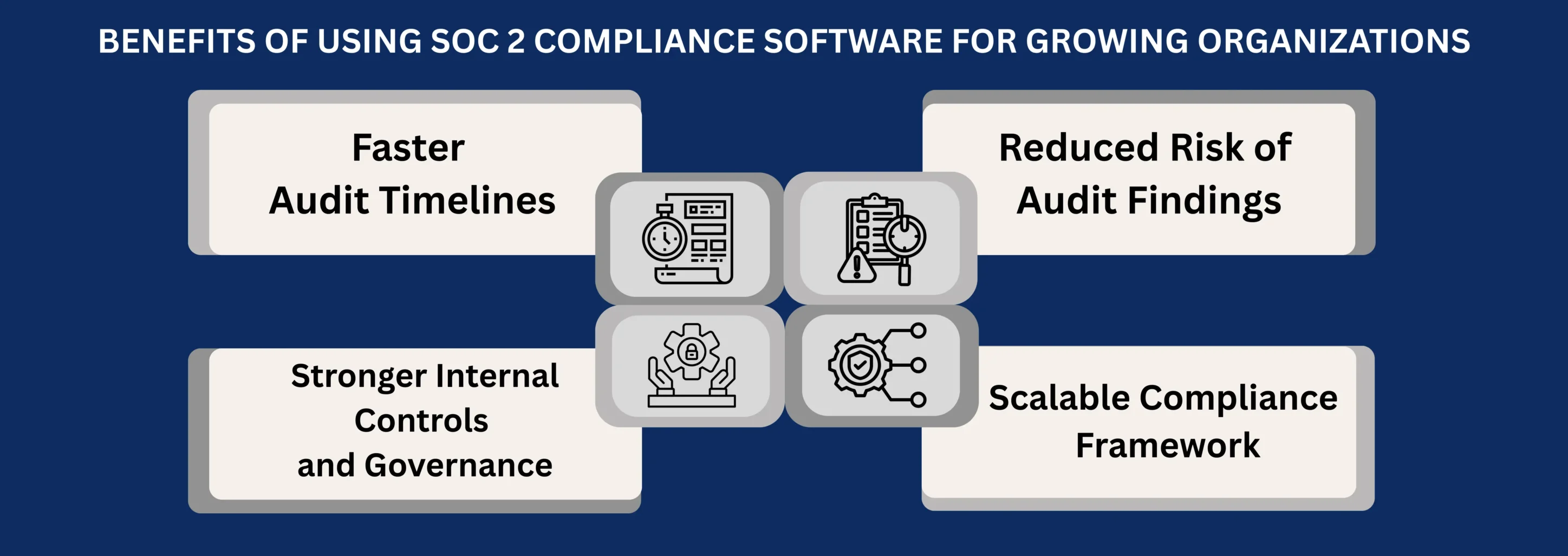
- ✓Independent verification of control design and operating effectiveness through a Licensed CPA Firm examination
- ✓Structured, AICPA-governed audit methodology that produces a SOC 2 attestation report with recognized evidentiary weight in enterprise procurement
- ✓Demonstrated SOC 2 compliance that Minneapolis enterprise buyers, regulated counterparties, and institutional clients require for vendor approval
- ✓Documented evidence of security, availability, confidentiality, processing integrity, and privacy controls relevant to customer and regulatory expectations
- ✓Annual SOC 2 examination cycle that supports ongoing control monitoring and organizational accountability
- ✓SOC 2 attestation report that accelerates vendor security review processes by providing standardized, auditor-verified control documentation
- ✓Support for international SaaS expansion into markets where SOC 2 attestation is a recognized security assurance standard
For Minneapolis organizations that serve as vendors to financial institutions, healthcare systems, insurance carriers, or other regulated entities, SOC 2 attestation directly supports the third-party risk management evaluation process conducted by those customers. Enterprise buyers operating formal vendor risk programs assess suppliers using a structured framework that evaluates security documentation, certifications, and audit history.
A current SOC 2 Type 2 report from a Licensed CPA Firm provides a standardized, independently audited artifact that satisfies the security documentation requirement within these evaluation frameworks. Without current SOC 2 attestation, technology vendors must respond to extensive security questionnaires individually for each prospective customer — a resource-intensive process that scales poorly across a growing client base.
SOC 2 Certification maintained by Minneapolis technology providers reduces friction in security review cycles and enables faster progression through enterprise vendor approval processes.
The SOC 2 examination cycle imposes structured accountability on the organization’s internal control environment. Because Type 2 reports evaluate operating effectiveness over an observation period, organizations must maintain controls consistently throughout the year — not merely prepare documentation at audit time.
This structured requirement supports ongoing control monitoring practices, including periodic access reviews, change management oversight, vulnerability management cadences, and incident response documentation. The annual nature of the SOC 2 examination creates a recurring accountability cycle that aligns internal security governance with external attestation expectations.
For Minneapolis-based cloud service providers and SaaS companies undergoing rapid growth, the SOC 2 audit cycle also provides a structured mechanism for evaluating whether existing controls remain appropriately designed as the system scales, new services are introduced, or the organization enters new market segments requiring additional Trust Services Criteria coverage.
- ✓Third-Party Risk Management and Vendor Due Diligence
- ✓Internal Control Accountability and Ongoing Monitoring
Industry Sectors in Minneapolis Seeking SOC 2 Attestation
SOC 2 attestation pursued by Minneapolis organizations spans a wide range of sectors. The Twin Cities metro’s economic diversity — anchored by financial services, healthcare, retail, technology, logistics, and manufacturing — generates SOC 2 demand from organizations with varied service profiles and data sensitivity levels.
The common thread across all sectors is the management of sensitive data on behalf of customers, the operation of technology systems with availability commitments, or the provision of services to regulated industries that impose security documentation requirements on their vendors. The table below summarizes key SOC 2 demand drivers and Trust Services Criteria selections by industry sector in the Minneapolis market.
| Industry Sector | SOC 2 Demand Driver | Commonly Selected Trust Services Criteria |
|---|---|---|
| Financial Services and Fintech | GLBA Safeguards Rule alignment, institutional vendor risk programs | Security, Confidentiality, Availability |
| Healthcare Technology | HIPAA-adjacent vendor due diligence, hospital network procurement requirements | Security, Availability, Confidentiality, Privacy |
| SaaS and Cloud Providers | Enterprise customer procurement requirements, international market expansion | Security, Availability, Processing Integrity |
| Insurance Organizations | Regulatory examination expectations, reinsurance counterparty requirements | Security, Confidentiality |
| Retail and E-Commerce Technology | PCI DSS alignment, customer data handling and privacy attestation | Security, Availability, Confidentiality |
Financial Services, Insurance, and Fintech Organizations
Minneapolis is home to several of the United States’ largest financial institutions, insurance carriers, and payment processing organizations. These entities — and their technology vendor ecosystems — represent a significant concentration of SOC 2 demand in the region.
Fintech companies operating in the Twin Cities, including payment technology providers, lending platforms, wealth management software vendors, and treasury management systems, regularly serve regulated financial institutions that require SOC 2 Type 2 attestation as a vendor security control requirement. Insurance technology organizations and claims processing platforms similarly encounter carrier procurement requirements that specify current SOC 2 reports.
SOC 2 Certification maintained by Minneapolis financial services technology providers enables access to institutional contracts with major regional banks, credit unions, investment managers, and insurance companies — contracts that would otherwise be inaccessible without current, independently audited SOC 2 attestation documentation.
AI Companies, Cybersecurity Firms, and Logistics Technology Providers
Emerging AI companies and machine learning platform providers based in Minneapolis face SOC 2 attestation requirements when their systems process customer data as part of model training, inference services, or analytics outputs. Enterprise customers evaluating AI platforms for sensitive use cases — including financial modeling, clinical decision support, fraud detection, or supply chain optimization — routinely require SOC 2 Type 2 attestation as evidence that data governance, access controls, and confidentiality measures are audited and independently verified.
Cybersecurity companies providing managed detection and response, security information and event management, or vulnerability management services to enterprise clients also encounter SOC 2 requirements from the organizations they protect. Logistics technology providers managing transportation data, carrier networks, or supply chain visibility platforms for retail and manufacturing customers in the Minneapolis metro increasingly face SOC 2 requirements from enterprise shippers and retailers with formal vendor security programs.
Certification Scope and Independent Decision Framework
The SOC 2 examination scope defines the boundaries within which the Licensed CPA Firm conducts its evaluation. Scope encompasses the specific system components, processes, and controls subject to the auditor’s assessment, the Trust Services Criteria applied, and the observation period for Type 2 engagements.
The independent certification decision — specifically, the auditor’s opinion expressed in the SOC 2 attestation report — is made based exclusively on evidence collected during the examination. The opinion is not influenced by management preferences or commercial considerations. It reflects the Licensed CPA Firm’s professional judgment formed through the application of AICPA attestation standards to the evidence obtained during the SOC 2 audit.
Nonconformity Classification and Auditor Opinion Types
When the Licensed CPA Firm identifies exceptions or control deficiencies during the SOC 2 examination, these are documented as deviations from the described control environment. The auditor evaluates the nature, frequency, and pervasiveness of identified exceptions when forming the attestation opinion.
SOC 2 attestation opinions can be unqualified (clean opinion), qualified (opinion with specific exceptions noted), adverse (controls do not meet criteria), or a disclaimer of opinion (insufficient evidence). An unqualified opinion indicates that described controls were suitably designed and, for Type 2 reports, operating effectively throughout the observation period without material exceptions. Qualified or adverse opinions include specific descriptions of the control deficiencies that led to the modified conclusion.
Management responses to identified exceptions are typically included in the SOC 2 attestation report alongside the auditor’s findings, providing context for report readers evaluating the organization’s control environment during the examination period.
Report Validity, Distribution, and Confidentiality
SOC 2 attestation reports do not carry a formal expiration date in the sense of revocation. However, the AICPA and enterprise procurement standards generally treat SOC 2 Type 2 reports as current if issued within the preceding twelve months and covering a recent observation period. Reports older than twelve months are considered stale by most enterprise vendor risk programs and may not satisfy vendor security documentation requirements.
SOC 2 reports are not public documents. They are confidential attestation reports intended for restricted distribution to specified parties — typically the service organization’s management, its customers, and regulators with jurisdiction over the service organization. Prospective customers may request access to a current SOC 2 report under a nondisclosure agreement as part of vendor evaluation.
Minneapolis organizations maintaining current annual SOC 2 compliance through successive Type 2 examinations can provide prospective and existing customers with access to current reports within this framework.
Management Responsibilities in the SOC 2 Examination
The SOC 2 examination places specific responsibilities on the service organization’s management. These responsibilities are distinct from the auditor’s independent evaluation function and are required for the examination to proceed under AICPA attestation standards.
Management of Minneapolis-based organizations undergoing a SOC 2 audit must actively fulfill their obligations throughout the examination period to support an accurate and complete attestation. The SOC 2 examination is not a passive process in which the auditor independently discovers and documents all relevant information. It is a structured engagement in which management provides assertions, documentation, and access to personnel and systems — all of which directly inform the auditor’s findings.
Management Assertion and System Description Accuracy
Management is responsible for preparing an accurate and complete system description that reflects the service organization’s system as it operated during the examination period. The system description must identify the principal service commitments and system requirements relevant to each Trust Services Criterion, describe the components of the system and their roles, and identify the controls management has implemented to meet the applicable criteria.
Management must also prepare and sign a written assertion — formally attesting to the fairness of the system description and the design and, for Type 2 examinations, operating effectiveness of controls. This assertion is included in the SOC 2 attestation report alongside the Licensed CPA Firm’s independent opinion.
If the system description does not fairly represent the actual system, the auditor will identify the discrepancy during evidence collection, which may affect the attestation opinion issued for that SOC 2 examination period.
Evidence Facilitation and Personnel Cooperation
During the SOC 2 examination, management is responsible for providing the Licensed CPA Firm with access to relevant personnel, systems, and documentation required to perform the audit procedures. This includes making control owners available for inquiry, providing access to system logs and configuration records, supplying policy and procedure documentation, and facilitating the auditor’s observation of control activities where required.
Management is also responsible for informing the auditor of any changes to the control environment that occurred during the observation period — including significant infrastructure changes, personnel transitions in control-owning roles, security incidents, or modifications to control activities.
Timely and complete disclosure of control environment changes enables the auditor to accurately assess operating effectiveness across the full observation period and avoids material misrepresentation in the final SOC 2 attestation report.
FAQ
▶
What is SOC 2 Certification and who needs it in Minneapolis?
▶
What is the difference between a SOC 2 Type 1 and Type 2 report?
▶
How long does the SOC 2 audit process take for a Minneapolis organization?
▶
Which Trust Services Criteria should a Minneapolis organization select?
▶
Does SOC 2 attestation establish compliance with the Minnesota Consumer Data Privacy Act?
▶
How does a SOC 2 examination differ from a SOC 2 compliance self-assessment?
▶
What is the observation period in a SOC 2 Type 2 examination?
▶
How often must a Minneapolis organization renew its SOC 2 attestation?
SOC 1 VS SOC 2: WHICH REPORT YOUR CUSTOMERS ACTUALLY ASK FOR
If you sell SaaS or provide outsourced services, you have likely been asked for a SOC report. However, the follow-up question is rarely easy to answer…

AICPA Issues New Guidance for Peer Reviewers Evaluating SOC 2 Engagements
AICPA SOC 2 guidance has been issued to help peer reviewers identify quality risks associated with SOC 2 engagements as the use of compliance automati…
SOC 2 Certified: What Does It Mean for Your Business
For companies that handle sensitive data or run cloud-based services, the question “Can you provide your SOC 2 report?” carries enormous weight. Yet, …
Get In Touch
have a question? let us get back to you.