
SOC 2 Certification in New Jersey
SOC 2 examination requirements center on demonstrating that controls exist, are suitably designed, and — for Type 2 examinations — have operated effectively throughout the observation period. The Licensed CPA Firm evaluates controls based on documented evidence rather than representations alone.Understanding these evidence requirements is essential for any New Jersey organization preparing its control environment for a SOC 2 audit. The quality and completeness of evidence directly affects the auditor’s ability to form and support an attestation opinion.
OUR CLIENTS










What SOC 2 Certification Means for New Jersey Organizations
SOC 2 Certification in New Jersey is a formal, independent attestation issued exclusively by a Licensed CPA Firm following an examination conducted under AICPA AT-C Section 205 attestation standards and evaluated against the Trust Services Criteria (TSC). The certification confirms that a service organization’s internal controls over security, availability, processing integrity, confidentiality, or privacy have been independently examined and found to be operationally effective — not merely documented or self-declared.
For organizations operating across Newark, Jersey City, Princeton, Hoboken, and throughout the broader New Jersey business ecosystem, this attestation signals to enterprise clients, regulators, and procurement teams that security controls function as designed and have been independently verified by a qualified third party.
The distinction between SOC 2 compliance and SOC 2 Certification is fundamental. SOC 2 compliance refers to an organization’s internal effort to align controls with the Trust Services Criteria. This may involve internal assessments, self-attestations, or policy documentation — but without external verification. SOC 2 Certification, by contrast, requires an independent SOC 2 examination conducted by a Licensed CPA Firm, producing a formal attestation report that can be presented to customers, partners, and regulators as objective evidence of control effectiveness.
This independent examination is what transforms internal compliance efforts into a credible, externally recognized attestation that enterprise buyers and regulators trust.
New Jersey’s position as a major hub for financial services, fintech, pharmaceuticals, life sciences, healthcare, biotechnology, telecommunications, and SaaS creates a concentrated demand environment for SOC 2 attestation. Organizations in these sectors routinely process sensitive financial data, protected health information (PHI), customer data, intellectual property, and research data on behalf of enterprise clients.
Those enterprise clients — particularly financial institutions, healthcare systems, and large technology companies — increasingly require SOC 2 reports as a prerequisite for vendor onboarding, contract renewals, and third-party risk management programs. A SOC 2 audit conducted by an independent Licensed CPA Firm produces the attestation report that satisfies these requirements.
The AICPA’s Trust Services Criteria provide the evaluative framework for every SOC 2 examination. The Security criterion — also known as the Common Criteria — is mandatory in all SOC 2 engagements. It addresses the protection of information and systems from unauthorized access, disclosure, and damage.
The remaining four criteria — Availability, Processing Integrity, Confidentiality, and Privacy — are selected based on the nature of the services an organization provides and the commitments made to its customers. A Licensed CPA Firm evaluates controls against only those criteria relevant to the defined scope of the examination. This ensures that the resulting SOC 2 attestation accurately reflects the organization’s control environment as it applies to its specific service commitments and customer contractual obligations.
For New Jersey organizations operating in regulated industries, SOC 2 Certification in New Jersey aligns with broader U.S. cybersecurity and privacy expectations, vendor assurance requirements, cloud security frameworks, and applicable New Jersey state privacy considerations. Enterprise procurement teams, federal contractors, and regulated-industry customers treat a current SOC 2 attestation report as a primary assurance mechanism in vendor due diligence.
Organizations that hold a current SOC 2 report issued by a Licensed CPA Firm are positioned to respond to security questionnaires, vendor risk assessments, and contractual security requirements with documented, independently verified evidence — rather than self-certification or informal representations.

What Is SOC 2 Certification?
SOC 2 Certification is a third-party attestation framework developed by the American Institute of Certified Public Accountants (AICPA) specifically for service organizations that store, process, or transmit customer data. The framework operates under AICPA AT-C Section 205 and evaluates a service organization’s controls against the Trust Services Criteria.
Unlike regulatory certifications mandated by law, SOC 2 is a voluntary framework that has become a market-driven standard. Enterprise customers — particularly in financial services, healthcare, and technology — routinely require a SOC 2 attestation report as a condition of vendor engagement. The resulting report is issued by a Licensed CPA Firm and represents an independent professional opinion on the design and operating effectiveness of controls within the defined scope.
SOC 2 Type 1 vs. SOC 2 Type 2 Reports
SOC 2 examinations produce one of two report types, each serving a distinct purpose. A SOC 2 Type 1 report evaluates the design and suitability of controls as of a specific point in time. The Licensed CPA Firm examines whether the controls described in management’s description are suitably designed to meet the applicable Trust Services Criteria at the report date.
A Type 1 report does not assess whether those controls operated effectively over time — it provides a snapshot of control design at a defined moment. Organizations that have recently implemented a control environment, or are pursuing SOC 2 Certification for the first time, may begin with a Type 1 examination to establish an initial attestation baseline.
A SOC 2 Type 2 report extends the examination beyond design to include operating effectiveness over a defined observation period — typically a minimum of six months and commonly twelve months. The Licensed CPA Firm tests whether controls not only were suitably designed but also functioned consistently and effectively throughout the observation period.
Enterprise customers in financial services, healthcare, and regulated technology sectors typically require a SOC 2 Type 2 report rather than a Type 1. The Type 2 report provides evidence of sustained control performance rather than a single-point assessment. The SOC 2 Type 2 audit is the more rigorous and widely recognized form of SOC 2 attestation in vendor due diligence contexts across New Jersey and nationally.
| Report Type | Evaluation Focus | Time Scope | Primary Use Case |
|---|---|---|---|
| SOC 2 Type 1 | Control design and suitability | Point in time | Initial attestation, establishing baseline |
| SOC 2 Type 2 | Control design and operating effectiveness | Minimum 6-month observation period | Enterprise vendor due diligence, regulated-industry procurement |
The Five Trust Services Criteria Explained
The Trust Services Criteria (TSC) are the evaluative standards against which a Licensed CPA Firm assesses a service organization’s controls during a SOC 2 examination. The Security criterion — universally referred to as the Common Criteria — is mandatory in every SOC 2 engagement. It covers the protection of information and systems against unauthorized access, unauthorized disclosure, and damage to systems.
The Common Criteria encompasses logical and physical access controls, system monitoring, change management, risk mitigation, incident response, and vendor management, among other control domains. Because Security forms the foundation of every SOC 2 attestation, organizations must demonstrate robust controls across these areas regardless of which additional criteria are included in the examination scope.
The four additional Trust Services Criteria are selected based on service commitments and the nature of data processed. Availability addresses whether systems are available for operation and use as agreed upon in service commitments. Processing Integrity evaluates whether system processing is complete, valid, accurate, timely, and authorized. Confidentiality examines whether information designated as confidential is protected as committed. Privacy addresses the collection, use, retention, disclosure, and disposal of personal information in accordance with the organization’s privacy notice and applicable AICPA privacy criteria.
New Jersey organizations in healthcare, pharmaceutical research, financial services, and SaaS frequently include Confidentiality and Availability in their SOC 2 examination scope. Those handling personal data often include the Privacy criterion as well, particularly when serving enterprise clients with GDPR or CCPA obligations.
SOC 2 Certification Audit Process in New Jersey
The SOC 2 audit process in New Jersey follows a structured, multi-stage methodology governed by AICPA attestation standards. Each stage serves a defined purpose in the overall examination and produces documented outputs that feed into the Licensed CPA Firm’s final attestation opinion. The process begins with scope definition and proceeds through evidence collection, control testing, and issuance of the final SOC 2 attestation report.
Understanding each stage helps organizations anticipate what the examination entails and what evidence the auditor will require — enabling more efficient preparation and a smoother audit timeline.
The SOC 2 examination begins with a precise definition of the system scope — the specific services, infrastructure, software, people, procedures, and data that fall within the boundaries of the attestation. The Licensed CPA Firm reviews the service organization’s system description, service commitments, and the applicable Trust Services Criteria to determine the appropriate audit program. This stage establishes the boundaries of the examination, identifies which controls are relevant, and determines the evidence types required.
For New Jersey organizations providing cloud-based services, SaaS platforms, or data processing services, scope definition typically encompasses the technical infrastructure, data flows, third-party service providers, and relevant organizational controls that directly affect the delivery of in-scope services.
During the audit program determination phase, the Licensed CPA Firm establishes the specific control areas to be tested, the evidence sampling approach, and the testing procedures appropriate for the engagement. This includes identifying any subservice organizations — third-party vendors whose services are relevant to the in-scope system — and determining whether those subservice organizations are included in or carved out of the examination scope.
For New Jersey financial technology organizations and healthcare data processors, subservice organization considerations frequently involve cloud infrastructure providers, identity management platforms, and data center operators whose controls may affect the service organization’s ability to meet its Trust Services Criteria commitments.
The Stage 1 audit focuses on reviewing the organization’s system description and supporting documentation to assess whether the control environment is sufficiently defined and documented to proceed to substantive control testing. The Licensed CPA Firm evaluates whether management’s description of the system accurately represents the services provided, the components of the system, and the controls relevant to the applicable Trust Services Criteria.
Documentation reviewed at this stage typically includes the system description, control documentation, policies, procedures, organizational charts, and evidence of the control environment’s existence. For SOC 2 Type 1 engagements, the examination substantially concludes at this stage with an assessment of design suitability.
The Stage 2 audit constitutes the substantive phase of a SOC 2 Type 2 examination, during which the Licensed CPA Firm tests the operating effectiveness of controls over the defined observation period. Testing procedures include inquiry, observation, inspection of evidence, and re-performance of control activities. The auditor selects samples of control executions — access reviews, change management records, incident logs, backup verification records, encryption key management logs, and security monitoring evidence — and evaluates whether each control operated as described and as required by the applicable Trust Services Criteria.
The observation period for a SOC 2 Type 2 audit in New Jersey typically spans a minimum of six months and most commonly covers a twelve-month period aligned with the organization’s fiscal or operational year.
Evidence collection during the Stage 2 audit is systematic and traceable. The Licensed CPA Firm documents each test performed, the evidence inspected, the sampling methodology applied, and the conclusion reached for each control tested. Where a control is found to have not operated effectively during the observation period — referred to as a deviation or exception — the auditor documents the nature and extent of the deviation and assesses its impact on the overall attestation opinion.
Nonconformities identified during the SOC 2 audit are reported in the attestation report with factual descriptions. This allows the report reader to assess the materiality of any control deviations in the context of their own risk tolerance and vendor due diligence requirements.
| Audit Stage | Key Activities | Output |
|---|---|---|
| Scope Definition | System description review, TSC selection, audit program design | Defined examination boundary and audit plan |
| Stage 1 Audit | Documentation review, control environment assessment, design suitability evaluation | Design assessment findings, readiness for Stage 2 |
| Stage 2 Audit | Control testing, evidence sampling, operating effectiveness evaluation | Test results, deviation identification |
| Nonconformity Review | Assessment of deviations, impact evaluation, management response | Documented findings and management responses |
| Attestation Report Issuance | Certification committee review, opinion formulation, report finalization | Signed SOC 2 attestation report |
Following the completion of control testing and the resolution of any identified deviations, the Licensed CPA Firm finalizes the SOC 2 attestation report. The report includes management’s description of the system, management’s assertion regarding the effectiveness of controls, and the auditor’s independent opinion. The attestation opinion expresses whether, in the Licensed CPA Firm’s professional judgment, controls were suitably designed and — for Type 2 reports — operated effectively throughout the observation period.
The completed SOC 2 attestation report is issued to the service organization and made available to customers, prospects, and regulators under a non-disclosure agreement or customer access arrangement. SOC 2 reports do not carry an indefinite validity period. Organizations typically undergo annual SOC 2 audits to maintain a current attestation, as enterprise customers and regulated-industry procurement teams require reports covering recent observation periods.
- ✓Scope Definition and Audit Program Determination
- ✓Stage 1 Audit: Documentation and Control Environment Review
- ✓Stage 2 Audit: Control Testing and Evidence Collection
- ✓Attestation Report Issuance and Recertification
SOC 2 Certification Requirements and Evidence Standards
SOC 2 examination requirements center on demonstrating that controls exist, are suitably designed, and — for Type 2 examinations — have operated effectively throughout the observation period. The Licensed CPA Firm evaluates controls based on documented evidence rather than representations alone.
Understanding these evidence requirements is essential for any New Jersey organization preparing its control environment for a SOC 2 audit. The quality and completeness of evidence directly affects the auditor’s ability to form and support an attestation opinion.
The control environment documentation reviewed during a SOC 2 examination encompasses the policies, procedures, system configurations, and organizational structures that define how controls operate. Core documentation includes information security policies, access control policies and procedures, change management procedures, incident response plans, business continuity and disaster recovery plans, vendor management policies, and risk assessment documentation.
Each policy must be formally approved, version-controlled, and demonstrably communicated to relevant personnel. For New Jersey organizations in financial services and healthcare, policies must also reflect the organization’s obligations under applicable data protection requirements and customer contractual commitments. This ensures alignment between the control environment and the service commitments evaluated under the applicable Trust Services Criteria.
Beyond written policies, the Licensed CPA Firm requires operational evidence demonstrating that controls are executed as documented. This includes system-generated logs, configuration screenshots, access review records, change tickets, training completion records, background check documentation, penetration testing reports, and vulnerability scan results.
Evidence must be contemporaneous — created at the time the control was executed — rather than retroactively produced. Organizations that fail to maintain systematic, time-stamped evidence of control execution throughout the observation period create gaps in the evidentiary record that the auditor cannot supplement through management representations alone. Consistent, automated evidence collection across the observation period is a practical necessity for organizations seeking a clean SOC 2 Type 2 attestation.
Under AICPA attestation standards, management of the service organization bears specific responsibilities in a SOC 2 examination. Management is responsible for the preparation of the system description, the design and implementation of controls, the fair presentation of the description, and the assertion that controls were suitably designed and — for Type 2 reports — operated effectively throughout the observation period.
Management’s assertion is included as a formal component of the SOC 2 attestation report, distinct from the auditor’s independent opinion. This distinction is fundamental: the Licensed CPA Firm provides an independent professional opinion on management’s assertions, not a validation of management’s own claims. The auditor’s role is examination and attestation; management’s role is design, implementation, and assertion.
Management is also responsible for providing the Licensed CPA Firm with timely access to personnel, systems, and documentation required to conduct the examination. This includes facilitating interviews with control owners, providing access to system logs and configuration data, making third-party vendor documentation available, and responding promptly to evidence requests.
During the SOC 2 audit, management’s cooperation and the organization’s evidence management practices directly affect the efficiency and completeness of the examination. Delays in evidence provision or incomplete documentation can extend the audit timeline and may result in the auditor being unable to form a complete opinion on specific control areas — affecting the scope and content of the final attestation report.
SOC 2 attestation is not a permanent certification — it reflects the state of controls over a specific, time-bounded period. Enterprise customers and regulated-industry procurement programs require current SOC 2 reports, typically issued within the preceding twelve months. Organizations that hold a SOC 2 Type 2 report covering a prior observation period are expected to undergo annual recertification audits to maintain the currency of their attestation.
Between audit cycles, ongoing control monitoring is necessary to sustain the control environment’s effectiveness. This includes continuous log review, periodic access reviews, change management oversight, and vulnerability management. Maintaining these activities ensures that controls continue to operate as documented when the next SOC 2 examination commences.
- ✓Control Environment Documentation Requirements
- ✓Management’s Responsibilities in a SOC 2 Examination
- ✓Ongoing Control Monitoring and Annual Recertification
Industries in New Jersey Seeking SOC 2 Certification
New Jersey’s diverse and concentrated business ecosystem generates significant demand for SOC 2 Certification in New Jersey across multiple industry sectors. The state’s position as a national center for financial services, pharmaceutical research, healthcare, and technology creates conditions where SOC 2 attestation is a routine requirement in vendor procurement, enterprise sales, and regulatory alignment processes.
Organizations across the following sectors pursue SOC 2 Certification in New Jersey to satisfy customer contractual requirements, respond to enterprise security questionnaires, and demonstrate the operational effectiveness of their information security controls to institutional stakeholders.
Financial Services, Fintech, and Banking Organizations
New Jersey is home to a substantial concentration of financial services organizations, including regional banks, investment managers, insurance carriers, and fintech platforms operating from Jersey City, Newark, and Princeton. These organizations frequently process sensitive financial data, customer account information, and transaction records on behalf of institutional and retail clients.
SOC 2 compliance in New Jersey is a standard expectation in financial sector vendor due diligence. Banks, broker-dealers, and asset managers routinely require SOC 2 attestation reports from technology vendors, data processors, and cloud service providers before engaging or renewing contracts. SOC 2 Certification for New Jersey companies in the fintech sector provides the independently verified assurance that financial institution procurement teams require when evaluating third-party technology providers handling customer financial data.
New Jersey fintech organizations also use SOC 2 attestation reports to support regulatory examinations and audits conducted by state and federal financial regulators. While SOC 2 is not a regulatory mandate in financial services, examiners from the Office of the Comptroller of the Currency (OCC), the Federal Reserve, and the New Jersey Department of Banking and Insurance treat current SOC 2 attestation reports as meaningful evidence of a technology vendor’s control environment during third-party risk management reviews.
A SOC 2 Type 2 audit covering systems that process financial data provides regulators and institutional clients with a structured, independently audited view of the service organization’s security and availability controls.
Healthcare, Pharmaceutical, Life Sciences, and Biotechnology Organizations
New Jersey’s role as a global center for pharmaceutical research, life sciences, and healthcare creates specific demand for SOC 2 attestation among organizations that manage protected health information (PHI), clinical research data, intellectual property, and proprietary scientific data. Healthcare technology vendors, electronic health record (EHR) platform providers, clinical data management organizations, and biotechnology data processors operating in New Jersey are regularly required to produce SOC 2 reports by hospital systems, pharmaceutical manufacturers, and research institutions as part of vendor qualification processes.
While HIPAA governs PHI directly, SOC 2 attestation serves as a complementary assurance mechanism that addresses the broader information security control environment beyond PHI-specific requirements.
Pharmaceutical and biotechnology organizations in New Jersey that engage cloud-based research data platforms, contract research organizations (CROs), and laboratory information management system (LIMS) vendors increasingly require SOC 2 attestation as a baseline security assurance standard. The Confidentiality criterion of the Trust Services Criteria is particularly relevant in these contexts, as it directly addresses the protection of proprietary research data and commercially sensitive scientific information representing significant intellectual property value.
Organizations that process research data for major pharmaceutical companies headquartered in New Jersey — including those in the Princeton corridor and the Route 1 technology corridor — are expected to maintain current SOC 2 Certification as a condition of ongoing engagement.
SaaS, Cloud, Cybersecurity, and Telecommunications Providers
New Jersey’s technology sector includes a significant number of SaaS providers, cloud service organizations, cybersecurity firms, and telecommunications carriers that process customer data at scale. These organizations operate in a vendor ecosystem where SOC 2 attestation has become a de facto requirement for enterprise customer acquisition. Large enterprise buyers — particularly in regulated industries — evaluate technology vendors based on the existence and currency of a SOC 2 report before finalizing procurement decisions.
For SaaS and cloud providers based in Newark, Hoboken, and the broader New Jersey technology corridor, a current SOC 2 Type 2 attestation report issued by a Licensed CPA Firm differentiates the organization in competitive enterprise sales processes. It also satisfies security questionnaire requirements that would otherwise demand lengthy manual responses, reducing the sales cycle burden significantly.
- ✓Financial services and fintech platforms processing customer financial data and transaction records
- ✓SaaS and cloud service providers serving regulated-industry enterprise clients
- ✓Healthcare technology vendors managing PHI and clinical data under HIPAA-adjacent obligations
- ✓Pharmaceutical and life sciences data processors handling proprietary research and clinical trial data
- ✓Biotechnology organizations managing intellectual property and commercially sensitive scientific information
- ✓Telecommunications carriers and managed service providers handling sensitive customer communications data
- ✓Cybersecurity organizations providing managed detection, response, and security operations services
- ✓Logistics and professional services organizations processing sensitive business and financial information
Benefits of SOC 2 Certification for New Jersey-Based Organizations
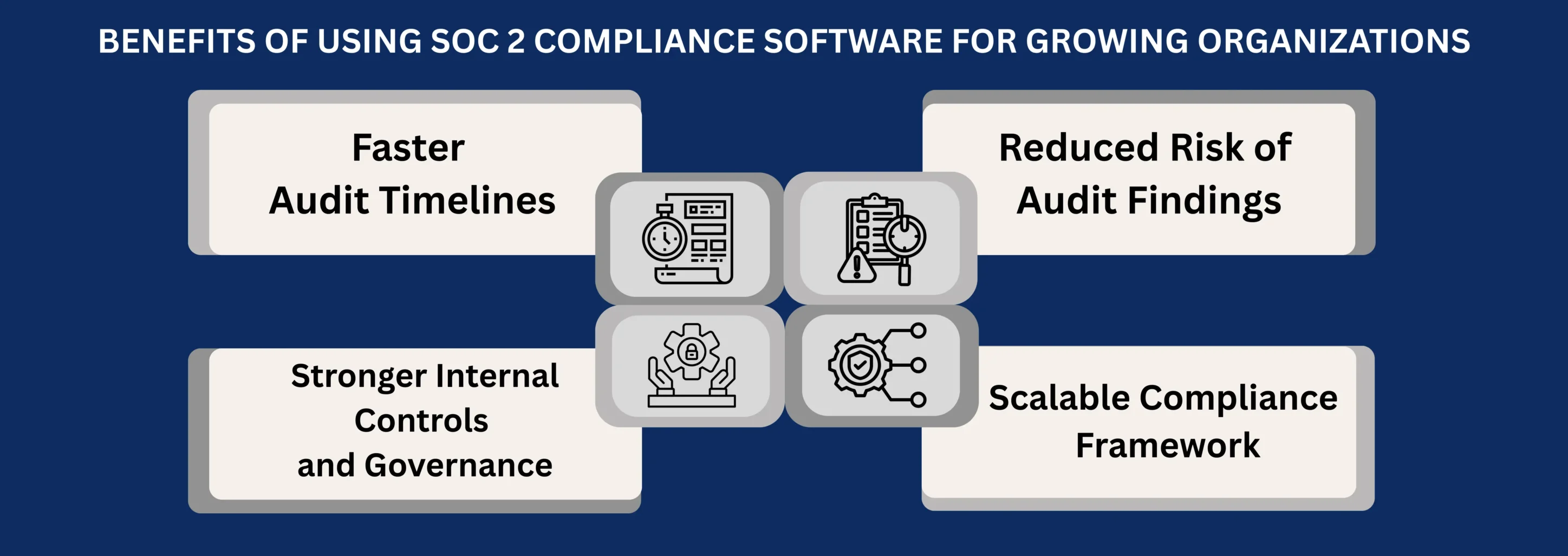
SOC 2 Certification in New Jersey delivers measurable, independently verified assurance that an organization’s security controls meet the standards evaluated under the AICPA Trust Services Criteria. The benefits of SOC 2 attestation extend beyond the report document itself — they encompass market access, procurement efficiency, risk management credibility, and demonstrated control maturity.
For New Jersey organizations competing for enterprise contracts in financial services, healthcare, and technology, a current SOC 2 attestation report issued by a Licensed CPA Firm represents a verifiable credential that addresses information security assurance requirements across the full vendor lifecycle.
A current SOC 2 Type 2 report is recognized across enterprise procurement programs as evidence that an independent Licensed CPA Firm has examined and attested to the effectiveness of a service organization’s controls. In New Jersey’s financial services ecosystem, enterprise vendor onboarding processes at major banks, insurance carriers, and investment management firms routinely request SOC 2 reports as a primary component of third-party risk assessments.
Rather than completing individual security questionnaires for each customer — a process that can consume significant organizational resources — organizations with current SOC 2 attestation reports can reference the report in response to the majority of standard vendor security questionnaire requirements. This reduces the time and operational burden associated with customer security due diligence cycles.
SOC 2 attestation in New Jersey also accelerates contract execution timelines with enterprise customers. Procurement teams that receive a current, clean SOC 2 Type 2 report from a Licensed CPA Firm can complete their third-party risk assessment with substantially reduced manual effort compared to evaluating organizations that cannot produce independent attestation.
In competitive enterprise sales cycles, the availability of a current SOC 2 report can determine whether an organization clears the security review phase and advances to contract negotiation. Organizations that lack current SOC 2 attestation may be excluded from enterprise procurement lists or required to complete extensive manual security reviews — delaying contract execution by weeks or months.
The primary assurance value of SOC 2 Certification lies in the independence of the examination. A self-assessment or internally produced compliance report cannot provide the same level of assurance as a formal SOC 2 audit conducted by a Licensed CPA Firm under AICPA attestation standards. The auditor’s independent opinion — grounded in evidence-based control testing rather than management representations — provides customers, regulators, and business partners with a credible, objectively derived assessment of whether security controls are operating as intended.
This independence is what distinguishes SOC 2 attestation from internal control reviews, vendor questionnaires, and self-certification programs. It is also what makes the SOC 2 examination the standard of choice for enterprise vendor assurance programs across New Jersey and nationally.
- ✓Independent, Licensed CPA Firm attestation recognized by enterprise procurement and regulated-industry customers
- ✓Demonstrates control effectiveness through evidence-based testing, not self-declaration
- ✓Supports third-party risk management programs at financial institutions, health systems, and regulated entities
- ✓Reduces the volume and duration of manual security questionnaire responses in enterprise sales cycles
- ✓Provides a structured, annually renewable attestation that maintains currency of assurance
- ✓Aligns with U.S. cybersecurity and privacy expectations for cloud, SaaS, and data processing vendors
- ✓Supports international expansion by satisfying security assurance requirements in global enterprise procurement
- ✓Enterprise Procurement and Vendor Due Diligence Recognition
- ✓Independent Verification of Control Effectiveness
SOC 2 Certification vs. SOC 2 Compliance: Key Distinctions
The terms SOC 2 compliance and SOC 2 Certification are frequently conflated, but they represent meaningfully different states of assurance. Understanding the distinction is important for New Jersey organizations evaluating what level of assurance their enterprise customers and regulators actually require — and what an independent third-party examination produces versus what internal compliance efforts demonstrate.
What SOC 2 Compliance Represents
SOC 2 compliance refers to an organization’s internal effort to design, implement, and maintain controls that align with the Trust Services Criteria. An organization that has documented its security policies, implemented access controls, established incident response procedures, and conducted internal reviews of its control environment has taken meaningful steps toward SOC 2 compliance — but it has not obtained SOC 2 Certification.
Compliance in this sense is an internal state: the organization believes its controls meet the applicable criteria, but no independent Licensed CPA Firm has examined and attested to that belief. Self-assessed compliance cannot be presented to enterprise customers or regulators as equivalent to an independently issued SOC 2 attestation report.
What SOC 2 Certification Produces
SOC 2 Certification — specifically, the issuance of a SOC 2 attestation report by a Licensed CPA Firm — transforms internal compliance efforts into a publicly shareable, independently verified credential. The SOC 2 examination conducted by the Licensed CPA Firm subjects the organization’s controls to professional scrutiny: the auditor independently tests controls, evaluates evidence, identifies deviations, and forms a professional opinion expressed in the attestation report.
The resulting report is a formal professional document governed by AICPA standards, carrying the authority of an independent CPA firm’s examination opinion. Enterprise customers who receive this report understand that it represents an independent assessment — not an internal representation — and that distinction is what makes SOC 2 attestation valuable in vendor risk management contexts across New Jersey and beyond.
| Dimension | SOC 2 Compliance | SOC 2 Certification (Attestation) |
|---|---|---|
| Assessment type | Internal self-assessment | Independent examination by Licensed CPA Firm |
| Verification | Self-declared | Independently tested and attested |
| Output | Internal controls documentation | Formal SOC 2 attestation report |
| Customer value | Limited — not independently verified | High — recognized by enterprise procurement |
| Governing standard | None (internal) | AICPA AT-C Section 205 |
SOC 2 Audit Methodology: Control Environment, Risk Assessment, and Evidence Collection
The SOC 2 audit methodology employed by a Licensed CPA Firm is structured around four interconnected elements: the control environment, risk assessment, control activities, and evidence collection. These elements align with the COSO framework, which underpins the AICPA’s Trust Services Criteria and provides the conceptual structure for evaluating service organization controls.
Understanding how these elements interact in a SOC 2 examination helps organizations structure their control environments effectively — and clarifies what the Licensed CPA Firm assesses at each stage of the engagement.
Control Environment and Risk Assessment Evaluation
The control environment encompasses the organizational structures, governance mechanisms, and cultural factors that establish the foundation for effective controls. During the SOC 2 audit, the Licensed CPA Firm assesses the control environment through review of the organizational chart, board-level oversight mechanisms, management’s commitment to information security, and the assignment of authority and responsibility for control execution.
A strong control environment — characterized by defined accountability, documented oversight, and demonstrated management commitment — supports the effectiveness of individual controls. It is evaluated as a component of the Common Criteria under the Trust Services Criteria framework. Weaknesses in the control environment, such as unclear role assignments or absent oversight mechanisms, can affect the auditor’s assessment of individual controls that depend on the broader organizational context.
Risk assessment, as evaluated during the SOC 2 examination, examines whether the organization has a defined process for identifying, analyzing, and responding to risks that could affect its ability to meet its service commitments and Trust Services Criteria obligations. The Licensed CPA Firm reviews risk assessment documentation, risk treatment decisions, and evidence that identified risks have been addressed through specific control activities.
For New Jersey technology organizations operating in highly dynamic threat environments — including SaaS providers handling financial data or healthcare information — the risk assessment process must be demonstrably current. It should reflect recently identified threats and vulnerabilities, rather than a static assessment conducted at a single point in time without subsequent review or update.
Control Activities and Evidence Collection During the SOC 2 Examination
Control activities are the specific actions — automated or manual — that the organization executes to address identified risks and fulfill its Trust Services Criteria commitments. During the SOC 2 audit, the Licensed CPA Firm tests control activities using a combination of inquiry, observation, inspection of documentation, and re-performance. Testing procedures are designed to produce sufficient, appropriate evidence to support the auditor’s opinion on control design suitability and, for Type 2 examinations, operating effectiveness.
Examples of control activities tested in a typical SOC 2 examination include: logical access provisioning and de-provisioning workflows, multi-factor authentication enforcement, encryption configuration validation, security monitoring and alerting review, backup and restoration testing records, and change management authorization and approval documentation.
Evidence collection during the SOC 2 audit is systematic and documented. The Licensed CPA Firm maintains a workpaper record of every test performed, including the evidence examined, the sampling criteria applied, and the conclusion reached. For SOC 2 audit engagements in New Jersey, evidence commonly includes system-generated access logs, configuration management database exports, ticketing system records for change management, SIEM alert reports, vendor management records, and employee background check documentation.
The completeness and quality of this evidence — and the organization’s ability to produce it promptly during the examination — directly influences the auditor’s ability to form a complete, well-supported attestation opinion within the planned examination timeline.
Why SOC 2 Attestation Matters for New Jersey’s Business Ecosystem
New Jersey’s business ecosystem presents a specific and concentrated set of conditions that make SOC 2 attestation particularly relevant. The state’s geographic proximity to New York City’s financial markets, its role as a pharmaceutical and life sciences hub, and its growing technology sector create an environment where enterprise procurement processes, regulated-industry vendor requirements, and international client expectations converge.
SOC 2 Certification in New Jersey is not merely a competitive differentiator for organizations operating in this ecosystem — in many enterprise and regulated-industry contexts, it is a baseline requirement for vendor qualification and contract execution.
Vendor Risk Management in New Jersey’s Regulated Sectors
Third-party risk management (TPRM) programs at New Jersey’s financial institutions, healthcare systems, and pharmaceutical companies create sustained demand for SOC 2 audit engagements in New Jersey among technology vendors and data service providers. Banks regulated by the Federal Reserve and state-chartered institutions regulated by the New Jersey Department of Banking and Insurance are required to maintain formal third-party risk management programs that include periodic assessment of vendor security controls.
SOC 2 Type 2 reports issued by a Licensed CPA Firm are a recognized input to these assessments. They provide the independently tested control evidence that TPRM teams require to complete their risk assessments without relying solely on vendor-supplied questionnaire responses. For a New Jersey SaaS vendor providing services to multiple regulated financial institutions, a single current SOC 2 Type 2 attestation report can satisfy the security assurance requirements of dozens of institutional clients simultaneously.
In New Jersey’s healthcare and pharmaceutical sectors, SOC 2 attestation serves a complementary role alongside HIPAA compliance documentation and FDA data integrity requirements. A clinical data management organization operating in the Princeton pharmaceutical corridor, for example, may be required to produce both HIPAA Business Associate Agreement documentation and a current SOC 2 Type 2 report covering the Confidentiality and Availability criteria when qualifying as a data processing vendor for a major pharmaceutical client.
The SOC 2 report addresses the broader information security control environment, while HIPAA documentation addresses PHI-specific obligations. Together, they satisfy the multi-framework assurance requirements common in pharmaceutical vendor qualification processes.
International Expansion and Cross-Border Assurance Requirements
New Jersey technology and financial services organizations pursuing international growth encounter security assurance requirements from European, Asian, and other global enterprise clients that align closely with the evidence-based framework that SOC 2 attestation provides. European enterprise buyers familiar with ISO 27001 certification and GDPR data processing requirements recognize SOC 2 attestation reports as equivalent evidence of a mature information security control environment, even though SOC 2 is not a globally mandated standard.
For New Jersey SaaS providers and fintech organizations expanding into European financial markets, a current SOC 2 Type 2 report — particularly one that includes the Privacy criterion aligned with GDPR data handling commitments — provides a recognized, independently verified assurance credential. This cross-border recognition extends the value of SOC 2 Certification in New Jersey beyond domestic enterprise sales into global market expansion scenarios.
FAQ
▶
What is SOC 2 Certification and who issues it?
▶
Who needs SOC 2 Certification in New Jersey?
▶
What is the difference between SOC 2 Type 1 and Type 2?
▶
How long does a SOC 2 audit take?
▶
How long is a SOC 2 attestation report valid?
▶
What are the Trust Services Criteria in a SOC 2 examination?
▶
What evidence is required for a SOC 2 audit in New Jersey?
▶
Is SOC 2 Certification the same as SOC 2 compliance?
SOC 1 VS SOC 2: WHICH REPORT YOUR CUSTOMERS ACTUALLY ASK FOR
If you sell SaaS or provide outsourced services, you have likely been asked for a SOC report. However, the follow-up question is rarely easy to answer…

AICPA Issues New Guidance for Peer Reviewers Evaluating SOC 2 Engagements
AICPA SOC 2 guidance has been issued to help peer reviewers identify quality risks associated with SOC 2 engagements as the use of compliance automati…
SOC 2 Certified: What Does It Mean for Your Business
For companies that handle sensitive data or run cloud-based services, the question “Can you provide your SOC 2 report?” carries enormous weight. Yet, …
Get In Touch
have a question? let us get back to you.